

About 78% of organizations used AI in 2024, and businesses used it at a rate of 68.0%, according to the U.S. Census Bureau's reporting on technology impact. For Atlanta companies, that matters less as a software headline and more as an infrastructure problem. Once AI moves from a pilot into daily operations, somebody has to buy, secure, redeploy, retire, and document the hardware behind it.
That's the part many teams underestimate. How AI is impacting Atlanta businesses today isn't only about copilots, analytics, or automation. It's also about faster laptop replacement, server upgrades, storage retirement, GPU demand, and a bigger pile of end-of-life assets holding sensitive data. In a market with deep finance, healthcare, logistics, and professional services activity, that hardware churn creates real exposure if ITAD planning lags behind AI adoption.
How AI Is Reshaping Atlanta's Business Infrastructure
AI spending is rising fast enough that hardware planning can no longer sit behind software planning. IDC expects worldwide spending on AI-centric systems to keep climbing through 2028, and Atlanta companies are feeling the local version of that pressure in procurement queues, storage growth, and shorter replacement windows for end-user and data center equipment.

Why the hardware issue arrives early
The first operational effect of AI adoption is usually not a model. It is a capacity problem.
A team adds copilots, document processing, local inference tools, or heavier analytics workloads. Older laptops struggle with memory and battery life. Shared storage fills faster. Edge devices and servers that were acceptable for conventional workloads start to miss performance targets. Then the retired equipment starts to pile up, often before anyone has updated chain-of-custody procedures or media destruction requirements.
That sequence matters in Atlanta because so many companies here operate in data-sensitive sectors. A law firm replacing attorney laptops, a healthcare group retiring imaging workstations, or a logistics company swapping out warehouse systems all face the same practical question: what happens to the outgoing assets that still hold client, patient, operational, or financial data?
The answer cannot be “deal with it later.”
Some organizations are also connecting AI projects to more structured data environments. For healthcare and research teams evaluating standardized data frameworks, the OMOP Vocabulary MCP Server is a useful example of the kind of operational tooling that increases the need for disciplined retirement and migration controls.
Atlanta firms building inside startup and innovation ecosystems run into the same issue at a different speed. Companies working near hubs like Atlanta Tech Village often add devices quickly, repurpose equipment informally, and postpone documentation until growth forces a cleanup. That is manageable right up to the point an audit, funding review, office move, or security incident exposes gaps in asset records.
What works and what fails
On the ground, the pattern is consistent:
- What works: approving AI purchases with a retirement path for the equipment they will replace
- What works: classifying outgoing assets by reuse, resale, destruction, and compliance handling
- What works: requiring data sanitization records before equipment leaves a site
- What fails: treating AI adoption as a licensing decision instead of an infrastructure change
- What fails: letting obsolete laptops, SSDs, and servers sit in storage rooms without inventory control
- What fails: assuming internal redeployment removes the need for wipe verification and disposition records
AI adoption changes the useful life of physical assets. Companies that plan for that early spend less time chasing old devices, reduce avoidable security risk, and keep refresh budgets tied to real business value instead of cleanup work.
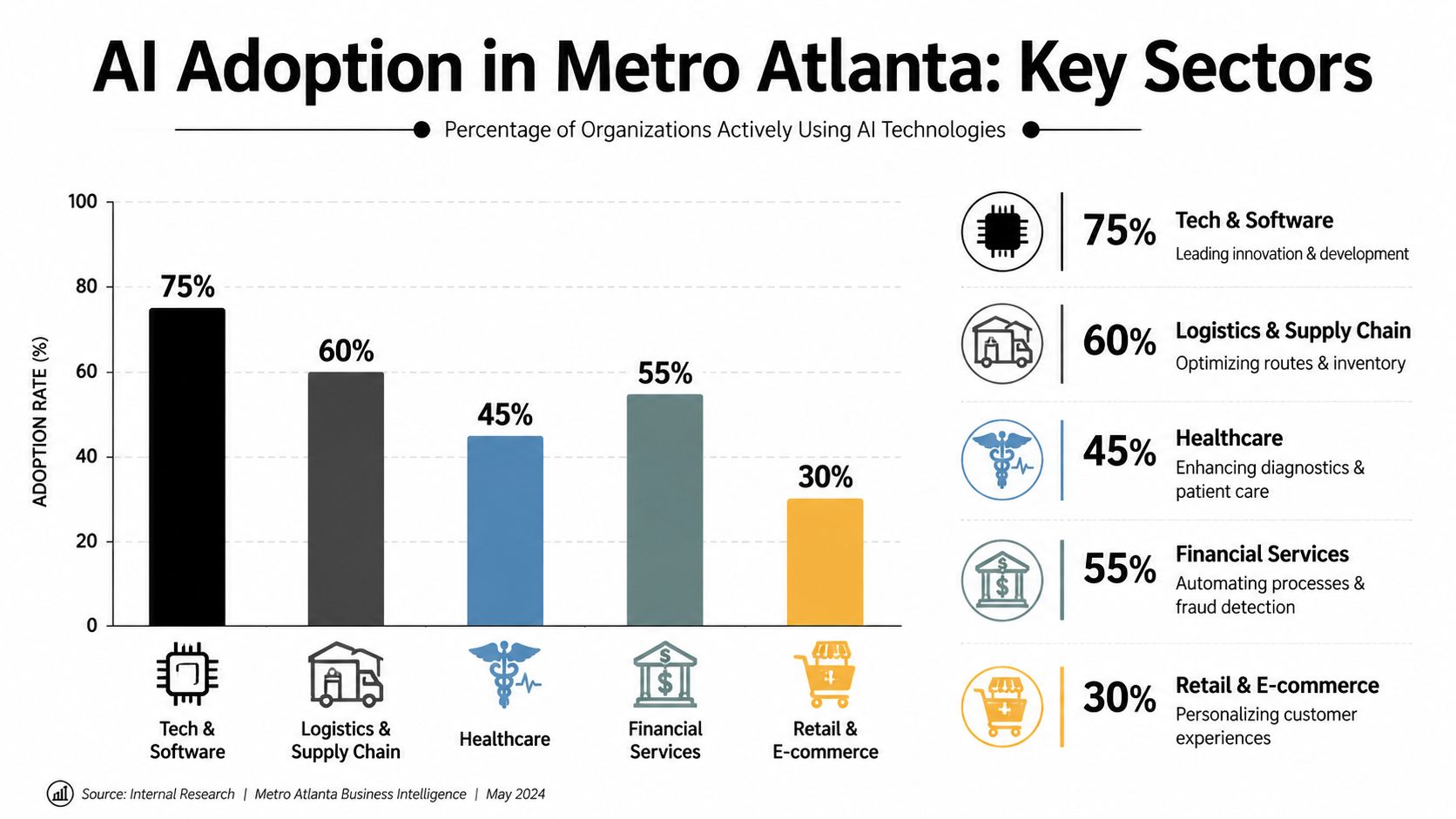
Sector-Specific AI Adoption Across Metro Atlanta
Atlanta's AI story isn't uniform. Different sectors are adopting it for different reasons, and those reasons shape the hardware they retire.
Finance and professional services
Work-related generative AI adoption is highest in financial services (63%) and professional services (62%), according to the Federal Reserve's monitoring of AI adoption in the U.S. economy. Those are two of metro Atlanta's most important business pillars.
For banks, insurers, advisory firms, legal operations, and accounting groups, AI often lands first in document review, underwriting support, forecasting, research, and customer service triage. That usually increases demand for secure endpoints, faster replacement cycles for user devices, and tighter controls around retired laptops and storage media.
Healthcare and regulated environments
Healthcare organizations approach AI with a different mix of caution and urgency. The challenge isn't only performance. It's data handling. Systems used for diagnostics support, patient administration, records processing, and analytics can leave protected information across workstations, drives, backup devices, and test equipment.
That's why disposal standards matter as much as deployment standards. For organizations that need a healthcare-specific disposal approach, HIPAA-compliant electronics recycling in Georgia is directly relevant to the end-of-life side of AI modernization.
In regulated sectors, the retired asset is often riskier than the active one because teams stop looking at it.
Logistics, operations, and the Georgia tech base
Atlanta's logistics and supply chain footprint creates another pattern. AI gets used to improve routing, scheduling, forecasting, warehouse visibility, and exception handling. That pushes upgrades beyond office IT into scanners, edge devices, industrial PCs, mobile equipment, and back-end servers.
Georgia's broader business environment supports that shift. Industry reporting says the state is home to more than 14,000 technology companies, employs over 280,000 tech professionals, and generates more than $50 billion in annual economic impact. The same reporting says 58% of small businesses now use generative AI, and 82% of AI-using small businesses increased their workforce over the past year, based on national business data summarized in Franklin Fitch's review of Georgia as an AI talent and innovation hub.
That growth has a physical byproduct. More adoption means more devices entering service and more devices leaving it. IT, facilities, procurement, and compliance teams all end up involved.
The Hidden Risks of AI-Driven Hardware Upgrades
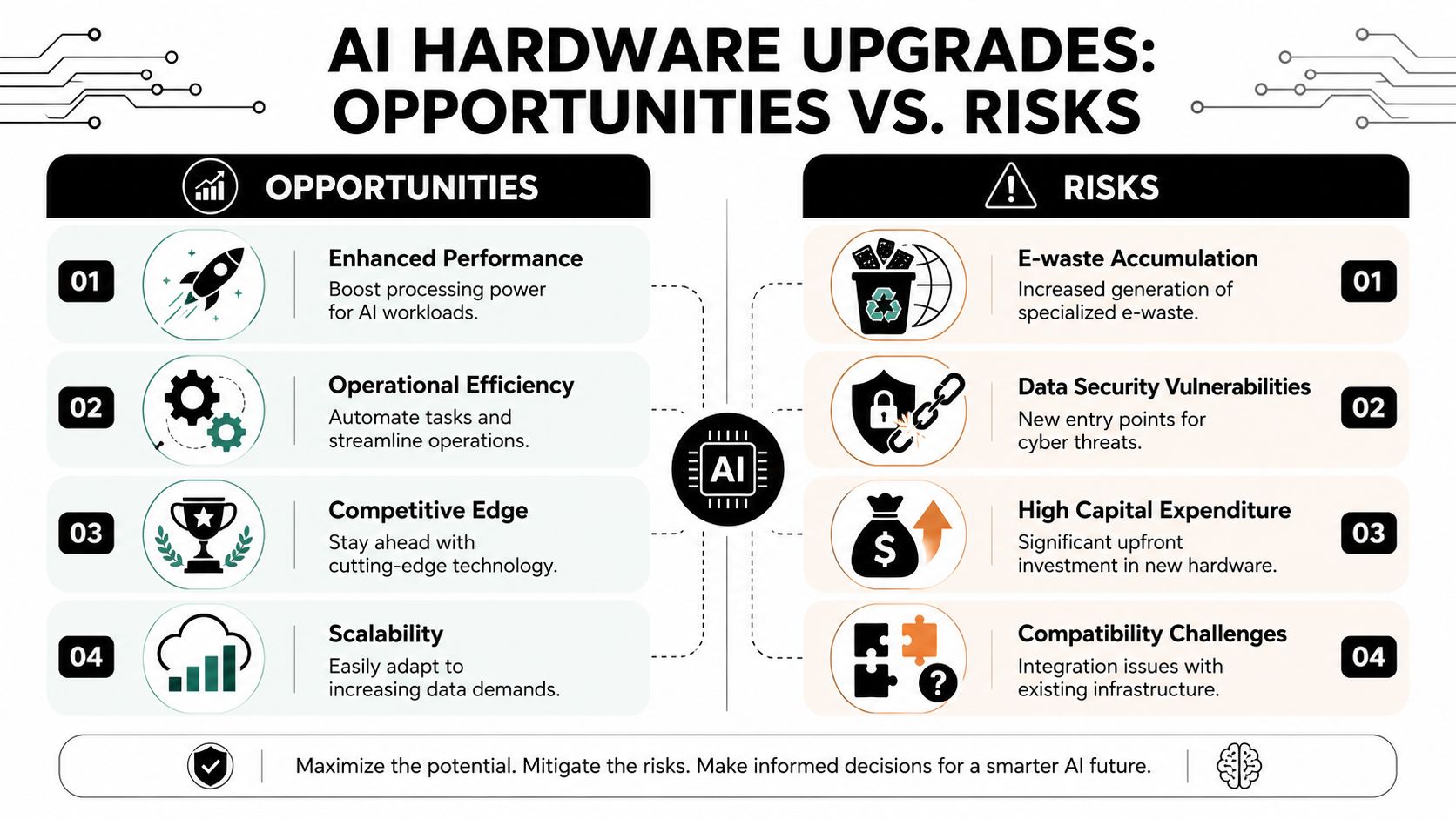
AI spending is rising fast. In Atlanta, that shows up physically as more laptops, servers, storage arrays, edge devices, and office equipment leaving service earlier than many IT teams planned for.
Faster refresh means more exposure
AI projects often force hardware decisions sooner than a normal depreciation schedule would. A company adds GPU-capable workstations, higher-density servers, more storage, or newer endpoints that can support local AI features. The old equipment still works, but it no longer fits the performance, compatibility, or security requirements of the new environment.
That is where disposal risk starts.
In practice, the problem is rarely the new purchase. The problem is the pile of retired gear that appears during a rushed rollout. Devices get pulled from service, stacked in a server room, moved to a branch office, or handed to operations without a documented disposition path. Once that happens, three risks show up quickly:
- Residual data: SSDs, hard drives, copiers, firewalls, and even some network gear can retain customer records, credentials, logs, scans, and internal documents
- Broken chain of custody: assets move between IT, facilities, vendors, and storage areas without asset-level tracking
- Poor downstream handling: equipment is resold, recycled, or scrapped without proof of sanitization, destruction, or compliant processing
I see this most often after infrastructure upgrades that were approved for speed. The AI initiative gets executive attention. The decommissioning work gets treated like cleanup.
Where companies get caught
The failure point is usually process design. Teams know old hardware has to be handled securely, but they do not always decide in advance which assets should be wiped, which should be shredded, and which still have resale value after testing.
That decision has real trade-offs. Physical destruction reduces reuse value but lowers risk for high-sensitivity media. Certified data erasure preserves remarketing value, but only if the asset is tested, tracked, and sanitized under a documented process.
A practical breakdown looks like this:
| Asset type | Common issue | Better response |
|---|---|---|
| Laptops | Held for possible reuse with no status tracking | Record serials, test condition, wipe to standard, then redeploy or resell |
| Servers | Removed during upgrades with drives still inside | Separate media from chassis, document custody, then sanitize or destroy based on data sensitivity |
| Network gear | Treated as low-risk infrastructure | Review configs, stored credentials, logs, and onboard flash before release |
| Office devices | Left out of IT disposal planning | Include printers, copiers, and scanners in the same asset disposition workflow |
One missed category can create the whole problem. I have seen copier hard drives and firewall appliances create more exposure than the laptops a company was worried about.
Teams tightening this process should start with documented secure data destruction practices that help prevent company data breaches. The goal is simple: every retired asset gets a defined path, a custody record, and a final disposition outcome that security, compliance, and finance can all verify.
AI rollouts create visible progress. Retired hardware creates quiet liability.
Unlocking Opportunities in the AI Refresh Cycle
Retired AI-era hardware isn't always waste. In many environments, it's a recoverable asset if the company handles it early enough and with the right separation of duties.
Value recovery starts with triage
The first mistake is lumping everything together. A mixed pallet of laptops, servers, drives, docks, monitors, and lab or network equipment is hard to value and harder to process cleanly. A better approach is triage at pickup or before pickup.
Separate assets into practical groups:
- Remarketable equipment that still has business value after testing and sanitization
- Parts recovery candidates where components may have reuse value even if the full system doesn't
- Destruction-only media where data risk outweighs resale value
- Commodity recycling for broken, obsolete, or low-value equipment
That structure helps procurement and finance understand where value can be recovered and where destruction is the right answer.
Compliance can support efficiency
A well-run ITAD process doesn't only reduce risk. It also speeds projects. When decommissioning is documented, facilities can clear space faster, IT can close tickets faster, and auditors have a paper trail instead of a verbal explanation.
The strongest programs usually include:
- Asset-level tracking: serials, counts, device categories, and pickup records
- Clear media handling rules: wipe for reuse, shred for high-risk data
- Certificates and reporting: documents that support internal controls and external review
- Logistics planning: scheduled pickups that align with office consolidations, refreshes, and data center work
There's also an ESG angle. AI projects can increase power use and shorten useful life for some devices. Responsible reuse and recycling help prevent modernization from becoming a disposal problem.
One practical vendor model
Some Atlanta companies use providers that combine pickup logistics, secure data destruction, certificates of destruction and recycling, and IT buyback under one workflow. Beyond Surplus is one example of that operating model for businesses retiring IT equipment in Georgia and across the contiguous United States. The important point isn't the brand. It's the integration. When transport, custody, destruction, and reporting sit in one documented chain, fewer things slip through.
An IT Leader's Action Plan for AI-Ready ITAD
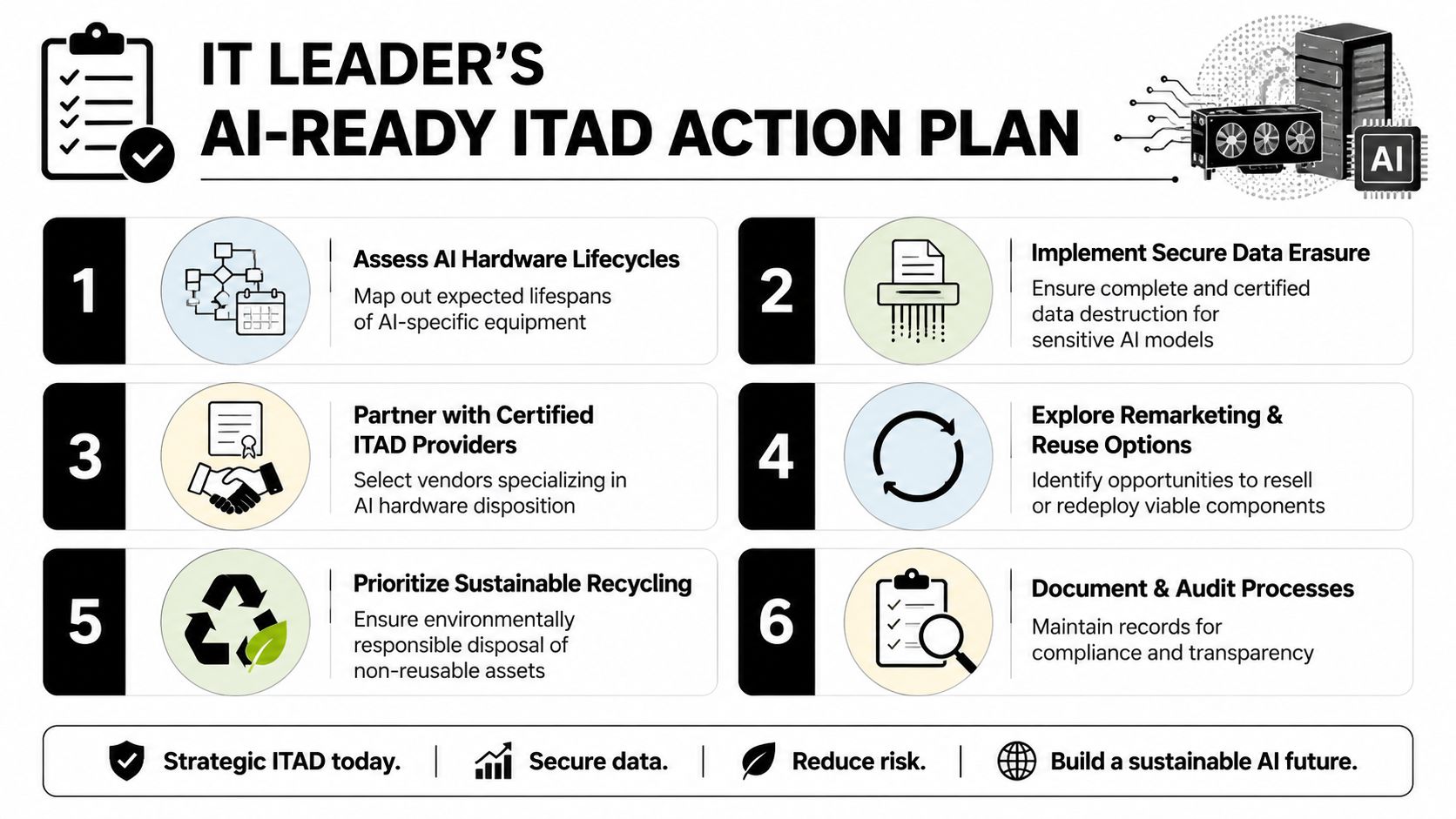
AI refresh cycles punish loose process. The safest response is a repeatable disposal framework that starts before hardware leaves production.
Build the program before the next refresh
Use this checklist to tighten control.
Map the assets affected by AI projects
Don't limit the list to servers. Include laptops, workstations, local storage, mobile devices, networking gear, copiers, and any specialized systems touched by model training, analytics, or workflow automation.Classify data risk before disposition
Some devices can be wiped and reused. Others should never leave custody intact. Finance, healthcare, legal, and government environments usually need stricter destruction choices for media-bearing assets.Choose the right destruction method
Physical shredding makes sense when confidentiality matters more than recovery value. Certified wiping fits equipment that may be redeployed or sold after sanitization. The decision should be written into policy, not made ad hoc.
Operational advice: If your team can't explain why an asset was wiped instead of shredded, the policy isn't mature enough.
Vet the vendor and the paperwork
The disposal vendor becomes part of your risk profile. Treat selection that way.
A solid review should include:
- Certification checks: ask what standards and downstream controls the provider follows
- Logistics detail: who transports the assets, when custody transfers, and how exceptions are logged
- Documentation samples: review certificates, inventory reports, and audit support before the first pickup
- Facility visibility: understand where equipment goes after collection and how media is handled there
A practical starting point is a structured vendor due diligence checklist for ITAD and recycling partners.
Audit remote offices and edge locations
The biggest blind spots usually sit outside the main office. Branch locations, home-office returns, warehouse tech rooms, and temporary project sites often accumulate devices with no disciplined retirement path.
Create a routine for:
- Quarterly collection sweeps of remote and satellite equipment
- Move-add-change coordination with facilities and operations teams
- Return workflows for terminated employees and hardware replacements
Tie ITAD to procurement and security
The handoff between purchasing, IT, and security is where many programs break. Procurement buys replacement hardware. IT deploys it. Security writes policy. Then old assets remain in limbo because no one owns the final step.
Assign ownership for end-of-life actions, escalation, and documentation retention. If that ownership isn't explicit, retired hardware turns into unmanaged inventory.
Partnering for Secure and Sustainable Growth in Atlanta
Atlanta companies are adopting AI in ways that are already changing day-to-day operations, especially in finance, healthcare, logistics, and professional services. The less visible change is physical. More AI deployment means more hardware entering service, more equipment leaving service, and more pressure on teams to handle that turnover securely.
That's where many organizations still have a gap. They've built an AI roadmap, but not a retirement roadmap. The result is familiar: assets waiting in closets, drives sitting in decommissioned servers, unclear chain of custody, and documentation that arrives late or not at all.
What a mature response looks like
A sound response is straightforward, even if the execution takes discipline:
- Plan disposition during procurement
- Inventory before pickup
- Match destruction method to data risk
- Require documented chain of custody
- Recover value where it makes sense
- Recycle nonrecoverable equipment responsibly
Atlanta also has a local wrinkle that national AI coverage often misses. AI can concentrate teams in offices and hubs even as it consolidates other operations. That tension affects relocations, equipment moves, office closures, and refresh timing. Companies need ITAD partners that can support both centralized projects and dispersed asset recovery. For businesses balancing security and sustainability goals, sustainable IT disposal in Georgia with an ESG-minded ITAD approach is part of that equation.
The companies that handle AI well won't just choose the right tools. They'll also control the full hardware lifecycle behind those tools.
If your organization is upgrading systems, retiring laptops, decommissioning servers, or clearing AI-era hardware from offices and data environments, contact Beyond Surplus for certified electronics recycling and secure IT asset disposal.


