

Old laptops are stacked in a storage room. Retired switches are sitting on a shelf because no one wants to unplug the wrong thing. A batch of desktops from the last refresh still has hard drives in them, and procurement wants the space back. That's a common position for growing companies in Chamblee.
The mistake is treating that pile as a cleanup project. It's a risk management issue with compliance, data security, and financial consequences attached. The global e-waste stream reached 62 million metric tons in 2022, and the United Nations projects it could rise to 82 million metric tons by 2030 according to Beyond Surplus reporting on IT asset disposal trends. For a business, the critical issue isn't just getting equipment off-site. It's proving what happened after pickup.
Most companies already understand they need a certificate. Far fewer know how to verify whether their ITAD partner controls downstream handling. That gap is where liability lingers. This guide focuses on the practical checks that protect a Chamblee business after devices leave the office.
Navigating IT Asset Disposal in Chamblee
A workable ITAD program starts with one decision. Stop thinking in terms of junk removal and start thinking in terms of asset disposition.
That shift matters because old IT equipment carries three different outcomes. Some devices should be remarketed. Some should be wiped and reused internally. Others should be destroyed and recycled because the data risk is too high or the hardware no longer has value.
What businesses usually get wrong
Many teams delay disposal until a move, audit, merger, or storage crunch forces action. By then, inventory is often incomplete. Missing serial numbers, unlabeled drives, and mixed pallets of reusable and nonfunctional equipment create avoidable problems.
A stronger process looks like this:
- Inventory first: Identify what you have before pickup is scheduled.
- Separate by disposition path: Reuse, resale, destruction, and recycling should not be treated as the same stream.
- Match handling to risk: A finance workstation and a lobby monitor don't need the same controls.
- Require documentation: If an item leaves your site, there should be a record tied to that specific asset.
Why local businesses need a formal process
Chamblee companies sit inside a larger Atlanta market with constant equipment turnover across offices, clinics, warehouses, schools, and distributed workforces. That means refresh cycles happen faster than many disposal processes can keep up.
Practical rule: If your team can't tell you which retired assets are still on-site, which have been picked up, and which have documented final disposition, your ITAD process isn't finished.
A formal program also reduces friction between departments. IT wants secure handling. Facilities wants space cleared. Finance wants value recovery where possible. Compliance wants records that hold up under scrutiny. A structured workflow serves all four.
For organizations comparing service options across the metro area, this broader Georgia ITAD guide for enterprises is a useful starting point for understanding service scope and documentation expectations.
Meeting IT Disposal Compliance Requirements
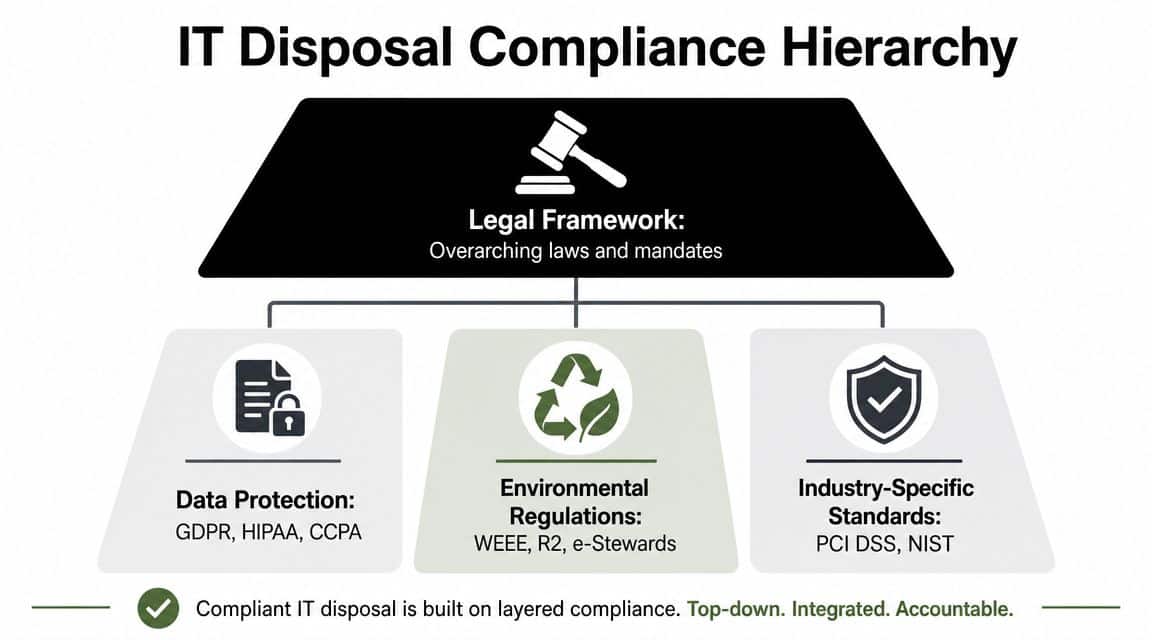
Compliance in IT disposal is less about memorizing acronyms and more about proving reasonable handling. If a retired device contains personal data, customer records, employee information, or regulated business data, disposal has to be controlled and documented.
The federal baseline is clear. The U.S. Federal Trade Commission finalized the Disposal Rule in June 2005, requiring businesses to take reasonable measures to protect consumer information when disposing of records, as noted in Securis on ITAD compliance requirements. In practical terms, that means your disposal process must include secure sanitization and documented transfer of custody.
What compliance means on the ground
For most Chamblee businesses, compliance isn't satisfied by a truck showing up and hauling equipment away. It means you can answer basic audit questions:
- What left the site
- Who handled it
- How data was sanitized or destroyed
- What proof exists for final disposition
If you operate in healthcare, finance, education, or government, that standard gets stricter in practice because the devices themselves often contain regulated data, cached credentials, archived files, or backup material.
The difference between paperwork and defensibility
A certificate alone doesn't protect you if the underlying process is weak. A defensible program ties records to actual assets and actual handling steps.
Look for these elements:
- Asset-level documentation: Serial numbers should connect to the disposition record.
- Sanitization records: The method used should be clear and appropriate to the media type.
- Transfer records: Pickup, transport, and facility intake should be documented.
- Final reporting: You should receive records that support both compliance review and internal retention.
A disposal document is only useful if it can survive follow-up questions months later.
If a provider can't explain how they maintain records between pickup and processing, the compliance story is incomplete. That's why many organizations also screen for certifications and formal process controls before they sign an agreement. This R2 certified ITAD overview for Georgia businesses helps frame what to examine before onboarding a vendor.
Choosing a Secure Data Destruction Method
Not every retired device should be handled the same way. The right destruction method depends on the media type, the sensitivity of the data, whether you want value recovery, and what level of destruction evidence your organization requires.
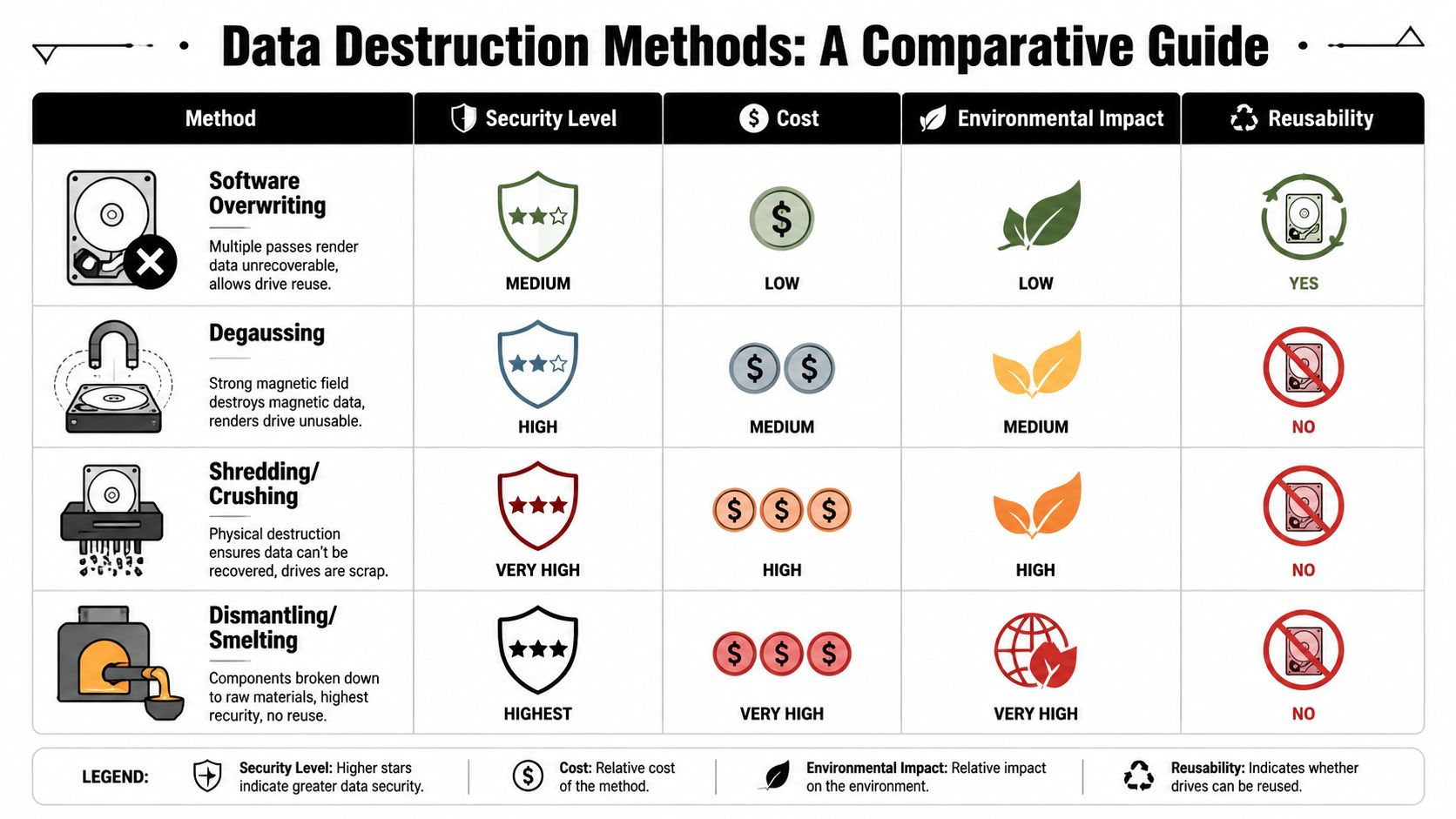
Industry guidance is straightforward on the trade-off. For reusable drives, data wiping can preserve asset value, while physical shredding is favored for irreversible destruction. The same guidance notes that degaussing works for magnetic media but does not work on modern SSDs, as explained by NCS Global's ITAD provider guidance.
Comparing the main options
| Method | Best use | Strength | Limitation |
|---|---|---|---|
| Data wiping | Reusable laptops, desktops, servers | Preserves resale or reuse value | Requires the device to be functional enough for sanitization |
| Degaussing | Magnetic hard drives and certain legacy media | Effective for magnetic media | Not suitable for SSDs |
| Physical shredding | High-risk drives and devices needing irreversible destruction | Clear destruction outcome | Eliminates reuse value |
How to make the choice
The wrong approach is picking one method for every asset. The better approach is to assign methods by risk and business objective.
Use wiping when the drive is reusable and your team wants value recovery. Use shredding when legal, contractual, or internal policy requires irreversible destruction evidence. Use degaussing only when the media type supports it.
A few practical checks help:
- Confirm media type: SSDs, magnetic hard drives, and backup media don't respond the same way.
- Decide if resale matters: If value recovery is important, wiping should be considered first where appropriate.
- Match evidence to policy: Some organizations need witnessed destruction or stronger proof for internal governance.
- Choose on-site or off-site intentionally: On-site destruction gives direct visibility. Off-site processing can work well if chain-of-custody controls are tight.
For businesses updating internal handling policies, this hard drive erasure resource is useful for aligning technical sanitization decisions with disposition goals.
Establishing an Unbroken Chain of Custody
If data destruction is the security control, chain of custody is the proof that the control was applied without gaps. Many IT disposal programs, however, fall short in this area. They focus on the end document and ignore the process that makes that document credible.
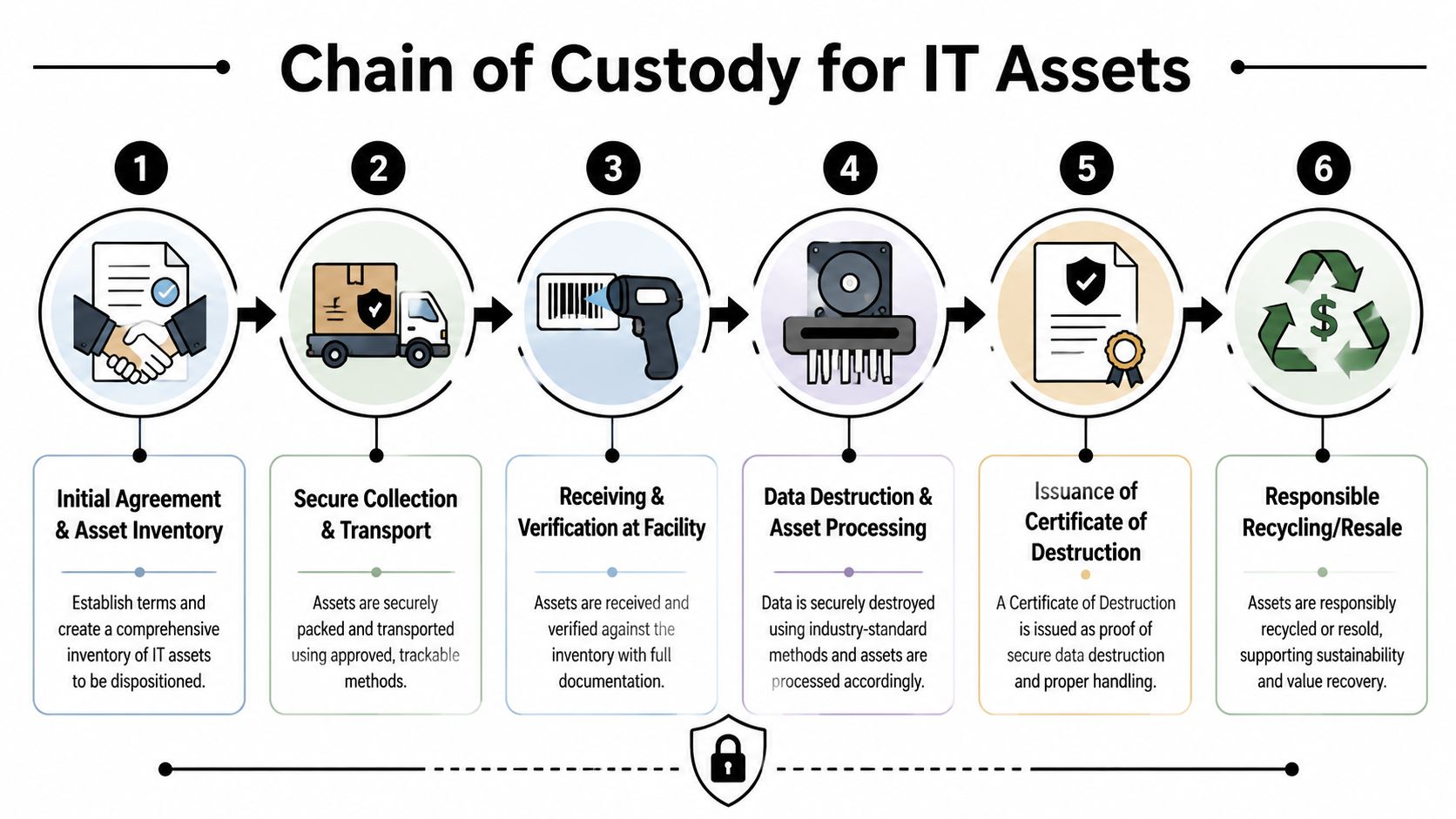
Independent guidance on vendor selection says a reliable provider should support NIST SP 800-88 sanitization workflows and maintain serialized chain-of-custody controls, including precise asset tagging, timestamped transport logs, and formal certificates, according to Astralis Tech's ITAD vendor criteria.
What the process should include
A clean chain of custody usually contains several linked records rather than one final certificate.
Inventory and tagging
Each asset should be identified before it leaves your site. Serial numbers matter.Pickup documentation
The handoff should be recorded, including date, time, and what was collected.Transport logging
Movement between your site and the processing location should be traceable.Facility intake verification
Items received should be checked against the pickup inventory.Processing records
Sanitization, shredding, testing, refurbishment, or recycling decisions should be documented.Final certificates and reports
The closing paperwork should match the original inventory.
What breaks the chain
Weak providers often create risk in ordinary ways:
- Mixed loads without asset detail
- Generic certificates with no serial references
- Unclear handoff to downstream processors
- No timestamped transport or intake records
If a provider can't map an asset from your office to its final outcome, liability hasn't really transferred.
For regulated businesses, that audit trail also supports incident response. If a question comes up later, you need more than a promise. You need records that show who handled the asset, when they handled it, and what happened to it.
Unlocking Value with IT Asset Buyback Programs
Not every retired asset belongs in the shred bin. Some still have market value, and a good ITAD program separates those assets before destruction decisions erase that value.
Many companies overspend by disposing of entire batches as scrap because sorting takes time, or by defaulting to blanket destruction when a portion of the equipment could have been remarketed after proper sanitization.
What tends to hold value
In commercial environments, value recovery usually comes from equipment that is still functional, supportable, and marketable. That often includes:
- Business laptops: Especially units with usable specifications and intact components
- Servers: Enterprise hardware can retain value when demand exists in secondary markets
- Network gear: Certain switches, firewalls, and access equipment remain resalable
- Bulk endpoint fleets: Standardized models are easier to test, grade, and process
Condition matters. So does age, configuration, and whether chargers, rails, caddies, or other accessories are included.
When buyback works and when it doesn't
Buyback programs work best when an organization prepares assets before pickup. Missing parts, unknown passwords, damaged housings, and unverified inventory all slow down appraisal and reduce resale options.
A practical workflow looks like this:
- keep like assets grouped together
- provide model and serial information early
- flag damaged units separately
- decide in advance which assets must be destroyed regardless of value
Some providers offer both secure disposition and asset recovery in one workflow. Beyond Surplus asset recovery services in Georgia are one example of a program that pairs resale evaluation with data destruction and recycling services for business equipment.
The best value recovery programs don't chase every dollar. They separate what can be remarketed efficiently and move the rest into compliant recycling without delay.
Companies get the best results when finance, IT, and compliance agree on the decision rules before pickup day. Otherwise, reusable assets get destroyed by default, and low-value scrap gets held too long in the hope of resale.
Selecting the Right Chamblee ITAD Provider
Most vendor comparisons stop too early. They ask whether the provider wipes drives, issues certificates, and offers pickup. Those are basic requirements. The harder question is whether the vendor can prove what happens after assets leave your dock.
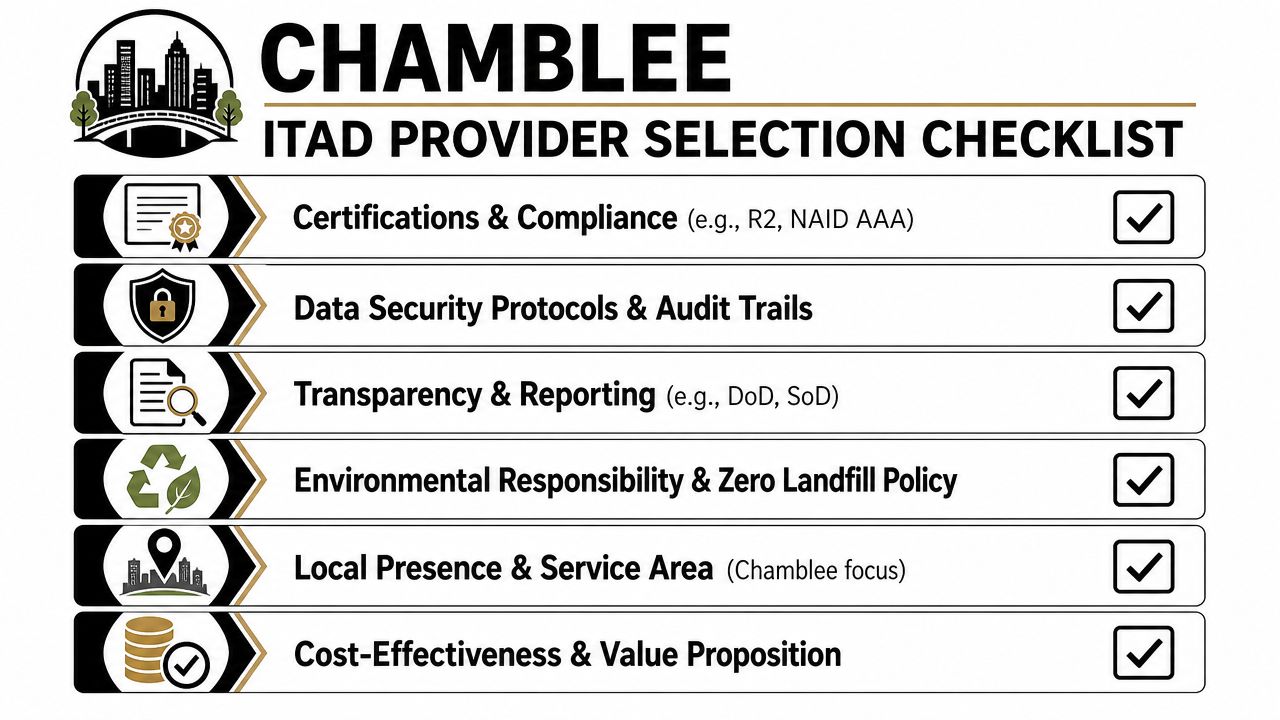
That's the part many businesses miss, and it matters because downstream handling is where environmental, security, and documentation risk can reappear. Guidance on the IT asset management disposal process points out that businesses should ask for serial-level records, confirmation of downstream partners, and proof of environmentally responsible recycling beyond a generic certificate, as explained by Green Retech Recycling's ITAD process guidance.
The questions that reveal real controls
Ask direct questions. If the answers are vague, move on.
What serial-level records will we receive?
You want documentation tied to individual assets, not just pallet counts.How do you decide refurbishment versus destruction?
The provider should explain the triage process, not just say they “handle everything.”Who are your downstream vendors?
If material leaves the primary processor, you should know where it goes.How do you audit downstream partners?
A serious provider should have a defined verification process.What proof exists beyond a generic recycling certificate?
Ask for examples of reporting packages, destruction records, and disposition detail.
A practical shortlist
When evaluating Chamblee ITAD providers, the shortlist should include:
- Documented compliance controls
- Media-appropriate destruction methods
- Serialized tracking
- Clear downstream transparency
- Reporting that legal and audit teams can use
- A service model that fits local pickup and enterprise logistics
Some vendors sound strong until you ask what happens after the first handoff. That's where the real screening starts.
Don't ask only whether they provide a certificate. Ask what records make that certificate believable.
A provider that can't answer those questions is asking you to accept risk on trust. That's not a professional ITAD standard.
Partner with Beyond Surplus for Certified ITAD
A sound disposal program for a Chamblee business should do four things well. It should protect data, document custody, recover value where appropriate, and show responsible final processing. If one of those pieces is missing, the program is weaker than it looks.
That's why vendor selection should be disciplined. You need a partner that can support secure sanitization, destruction when required, serialized reporting, and practical logistics for pickups, refresh projects, and decommissioning work. You also need records your compliance team can retain without having to reconstruct the story later.
For businesses evaluating service options in Georgia, Beyond Surplus ITAD services include data destruction, IT equipment disposition, electronics recycling, and asset recovery workflows designed for commercial clients. The important point isn't branding. It's whether the process gives your organization credible proof of handling from pickup through final outcome.
That's the standard to hold any Chamblee ITAD provider against.
When you review proposals, keep the focus tight. Ask how assets are inventoried. Ask how chain of custody is documented. Ask which data destruction method is used for each media type. Ask what happens downstream. Ask what records you'll still have access to if someone asks questions later.
If a provider can answer all of that clearly, you're looking at a real ITAD partner. If they can't, you're looking at a hauling service with nicer paperwork.
Contact Beyond Surplus for certified electronics recycling and secure IT asset disposal for your business in Chamblee and across Georgia.


