

Old equipment tends to steadily pile up. A few retired laptops from the last refresh. Storage arrays pulled from production but still sitting in a cage. Network gear waiting on approval for disposal. In many Georgia enterprises, that backlog becomes two problems at once: data risk and stranded value.
That's why Georgia ITAD services for enterprises have moved out of the facilities bucket and into IT, security, procurement, and audit. A retired server isn't just scrap. It may still hold regulated data, require documented disposition, and carry resale value if it's handled correctly. The mistake is treating all end-of-life hardware the same.
Your Enterprise ITAD Challenge in Georgia
Georgia enterprises often reach the same point. The asset list is incomplete, departments have stored hardware in different rooms, and nobody wants to authorize a pickup until they know exactly what happens to the data and what the final bill will look like.
That hesitation is reasonable. Georgia's enterprise environment includes large organizations and data-heavy sectors, so modern ITAD programs are built around secure data destruction, documented chain of custody, and value recovery for retired servers, laptops, storage, and network gear, as outlined in Georgia ITAD solutions that reduce risk and recover asset value.
Why ad hoc disposal fails
Basic recycling works for low-risk materials. It does not work for enterprise IT.
A recycler may remove equipment. An ITAD provider is supposed to control the disposition process so you can answer hard questions later:
- Where was each device collected and who signed for it
- What happened to the data-bearing media
- Which assets were reused, resold, or destroyed
- What documentation ties each serial number to an outcome
If those answers aren't easy to produce, the process isn't defensible.
Practical rule: If your retired assets leave the building without a serial-based record and a defined data destruction path, you still own the risk.
What Georgia buyers usually need
Most enterprise buyers in Georgia aren't looking for a truck and a pickup window. They need a process that fits internal controls.
That usually means:
- Inventory discipline: assets grouped by type, location, and data sensitivity
- Security controls: wiping, shredding, or both based on the media involved
- Financial review: identifying what should be remarketed instead of destroyed
- Audit support: certificates and reporting that legal, procurement, and compliance teams can use
A formal ITAD program solves a business problem. It reduces exposure, clears space, and turns end-of-life hardware into a controlled workflow instead of a lingering liability.
What is Enterprise ITAD and Why It Matters
Enterprise ITAD is the managed retirement of IT assets through data sanitization, tracking, remarketing, recycling, and reporting. It is not the same as basic e-waste pickup.
The practical difference is control. A recycler focuses on material handling. An enterprise ITAD workflow focuses on data security, chain of custody, and value recovery before anything is dismantled.
The category has become too important to treat casually. One market estimate projects the global IT asset disposition market at USD 27.8 billion by 2035, showing that ITAD is now a mainstream enterprise function rather than a niche disposal service, according to this ITAD market projection. If you want a plain-language definition, what IT asset disposition means for organizations is a useful starting point.
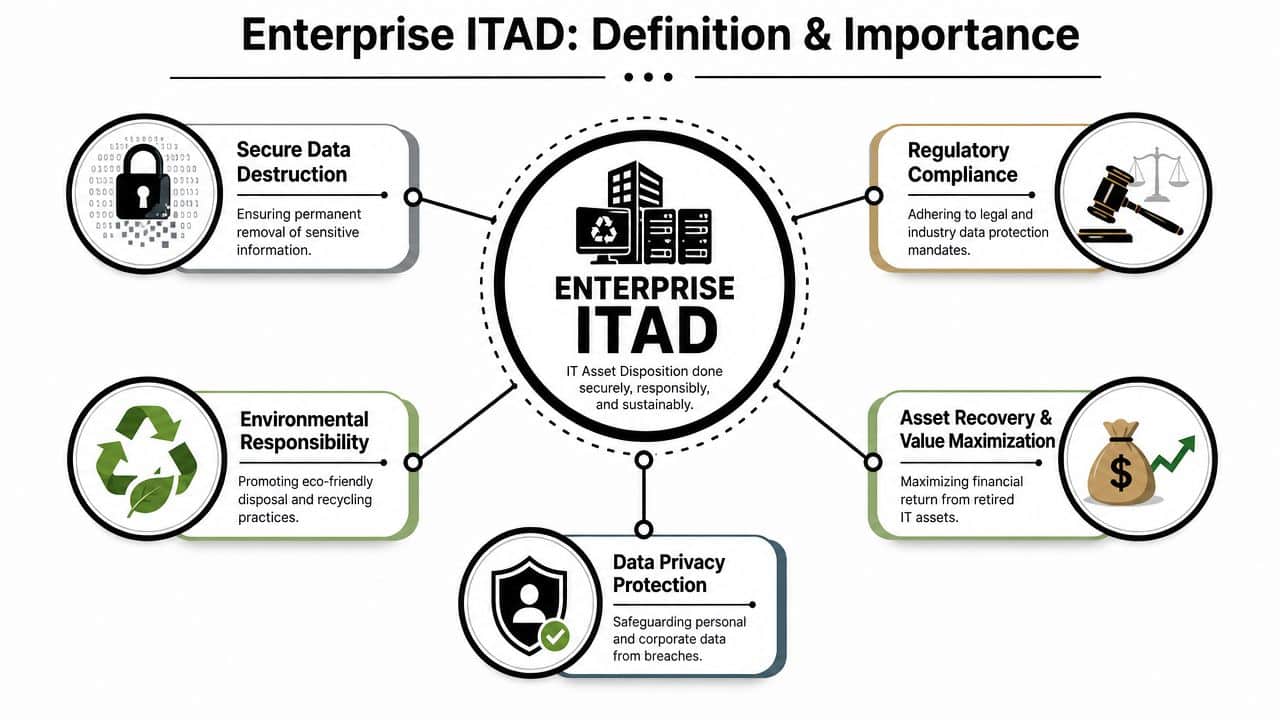
The four functions that matter
Secure data handling
Every device with storage has to move through a defined sanitization path. That includes laptops, servers, arrays, desktops, and removable media. “We reset it” is not an enterprise standard.
Asset accountability
Each unit should be tracked from collection through final outcome. In practice, that means serial capture, intake records, and matched reporting.
Value recovery
Not every retired asset belongs in a shredder. Working enterprise equipment may still have secondary market value. Good ITAD separates reusable assets from dead scrap early so finance can compare recovery against disposition cost.
Responsible downstream processing
When equipment has no reuse path, materials still need to move through proper recycling channels. That's often the first environmental aspect that comes to mind, but in enterprise settings it comes after data control and documentation.
Think of ITAD like an audit trail
A useful comparison is bookkeeping versus an audited financial statement. Basic recycling removes items. ITAD creates a record you can defend.
A mature ITAD program doesn't just answer “Was this picked up?” It answers “What happened to this exact asset, and can we prove it?”
That standard matters because retired equipment still touches legal, security, finance, and ESG concerns long after it stops being productive in the data center or office.
Navigating Georgia ITAD Compliance and Legal Risks
Improper disposal creates a familiar internal failure. IT assumes facilities handled it. Facilities assumes the recycler handled it. Audit arrives later and asks for proof.
For regulated enterprises, that gap is where problems start. Healthcare organizations have patient data concerns. Financial firms have customer information exposure. Government contractors often face stricter documentation expectations than the average office environment. Even when a specific law doesn't prescribe one disposal method, the business still has to show that sensitive data was handled responsibly.
Where risk becomes real
The legal issue usually isn't “you recycled hardware.” It's that data remained recoverable, records were incomplete, or custody was poorly documented.
That's why compliance-minded buyers should evaluate vendors around:
- Documented removal procedures
- Traceable data destruction outcomes
- Reporting that can support audits or incident response
- Clear responsibility transfer once assets leave the site
A provider that only talks about green recycling is missing the point for enterprise accounts.
What procurement should insist on
The strongest way to reduce exposure is to define requirements before pickup. That means stating whether assets are eligible for remarketing, which media must be destroyed, and what records must be returned after processing. Guidance on compliant IT disposal in Georgia is useful because it frames disposition as a documentation issue as much as a recycling issue.
Use questions that force operational answers:
- Can you tie each serial number to a wipe or destruction result?
- How is custody documented during pickup and transport?
- Which assets are routed for resale, and who approves that path?
- What certificates and reports are produced at closeout?
The cheapest pickup can become the most expensive outcome if legal, security, and finance have to reconstruct the chain after the fact.
Good ITAD reduces that reconstruction work. Weak ITAD creates it.
Secure Data Destruction Methods Explained
Many enterprise programs break down due to a common error. Teams pick one destruction method and apply it to every device. That sounds simple, but it's often wrong.
The method has to match the media type and the business objective. If you want reuse, the device needs a verified erase path. If the media type makes verification unreliable, physical destruction becomes the safer choice.
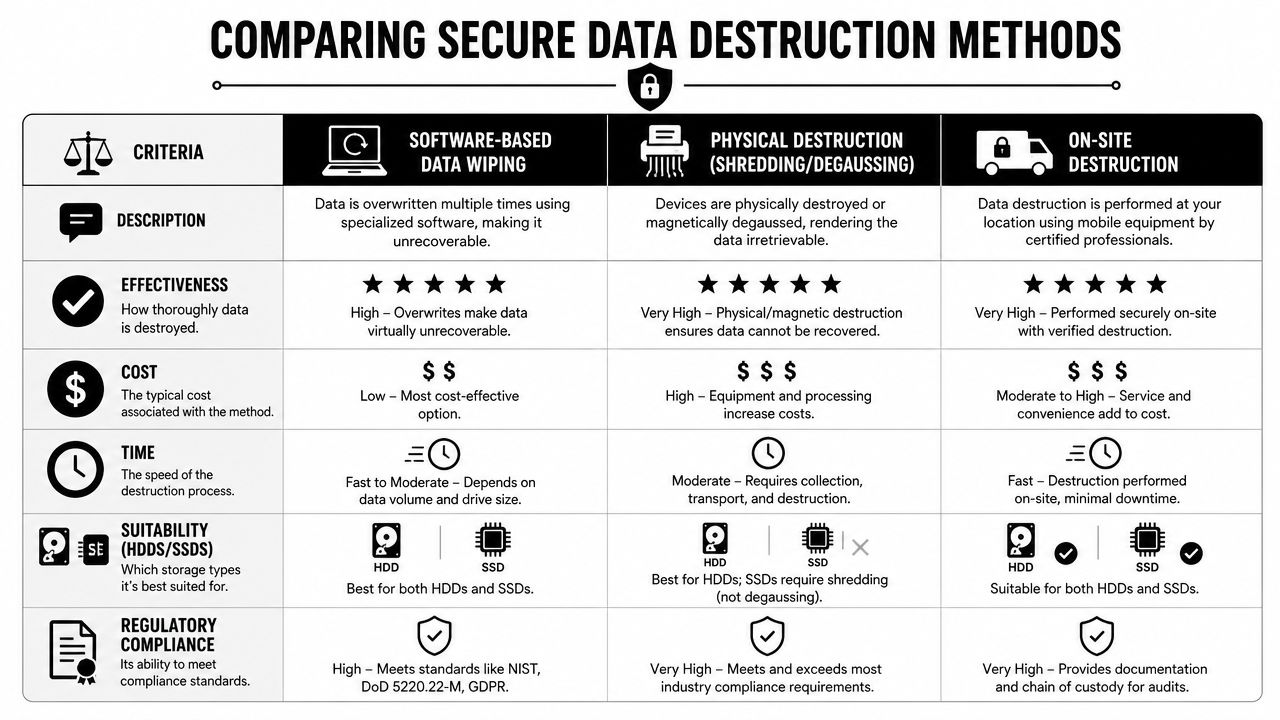
Software wiping
Software overwriting is appropriate for functioning HDDs intended for reuse. It supports remarketing because the drive stays intact, and the system can often return more value than a destroyed asset.
But this only works when the media cooperates and the process is verifiable. NIST SP 800-88 guidance matters here because it pushes teams toward method selection by media type, not by habit.
Degaussing
Degaussing is effective for magnetic media such as HDDs and tapes. It is not effective for SSDs or flash media.
That limitation matters more than many buyers realize. If your environment includes mixed fleets, a blanket degaussing policy leaves gaps.
Physical destruction
For SSDs, flash storage, or high-risk assets, physical destruction is the strongest fallback when cryptographic erasure can't be verified. NIST-aligned guidance treats physical destruction as the gold-standard fallback for media like SSDs, which is why enterprise ITAD programs need per-asset rules for different storage types, as discussed in this review of ITAD and cybersecurity controls.
A practical decision table
| Media or scenario | Best fit | Main trade-off |
|---|---|---|
| Working HDD for resale | Verified software wipe | Better recovery, slower than bulk destruction |
| Magnetic media with no reuse need | Degaussing or destruction | Fast security outcome, limited or no resale path |
| SSD or flash media | Physical destruction when erase can't be verified | Stronger assurance, eliminates reuse value |
| Highly sensitive assets | Physical destruction | Lowest residual data risk, highest impact on recovery |
Don't default to shredding everything. Don't default to wiping everything either. Match the method to the media and the risk.
That's the economic and security balance enterprise buyers need to get right.
The ITAD Service Workflow and Chain of Custody
A defensible ITAD project should feel predictable from the first inventory review to the final certificate package. If any step is vague, ask why.
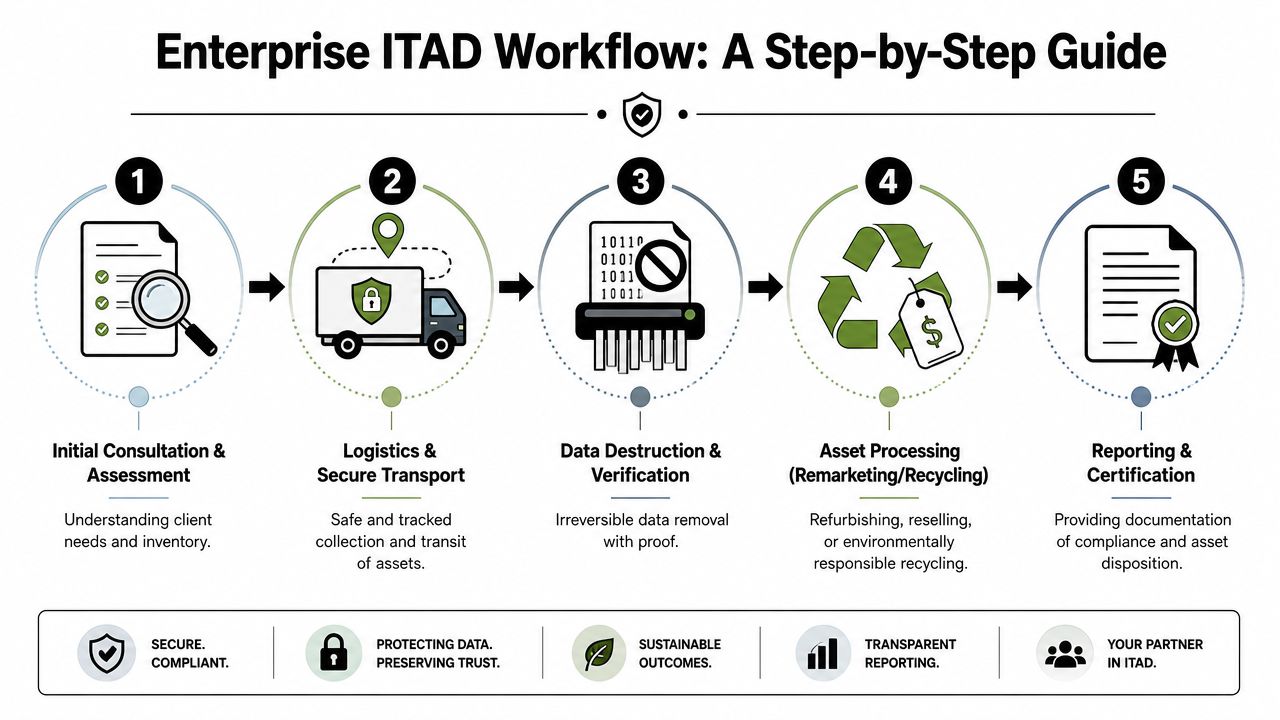
How the process should run
First comes scoping. The vendor needs to know asset types, volumes, location constraints, and whether the job includes office equipment, server racks, storage arrays, or multiple Georgia sites.
Then comes pickup and intake. This is the control point many teams overlook. For enterprise ITAD in Georgia, the critical issue is chain of custody from pickup through final disposition, and buyers should require serialized intake logs and certificates that tie each device to a specific wipe or destruction result, as explained in this overview of end-to-end ITAD controls.
What good chain of custody looks like
Look for an unbroken record with clear handoffs:
- Pickup authorization tied to a site, date, and responsible contact
- Serialized intake showing what was received
- Processing records documenting wipe, destruction, recycling, or resale routing
- Final reporting with certificates linked back to individual assets or defined asset groups
If a provider can't explain those handoffs plainly, the workflow probably depends too much on trust and not enough on records.
Why this matters after the truck leaves
Once equipment leaves your facility, your main risk isn't clutter. It's loss of control.
That's why mature ITAD programs build around documentation, not just transportation. Some Georgia providers, including Beyond Surplus, structure services around secure pickup, serialized tracking, data destruction, and certificates of destruction or recycling for business clients. That operating model matters because it gives IT, procurement, and audit teams the same paper trail.
ITAD Pricing Models and Maximizing Value Recovery
Most enterprise buyers get weak pricing information from the market. They're told the pickup is secure, certified, and compliant, but not how the economics work.
That's a problem, because pricing varies widely based on what you're sending and what you expect back.
What usually drives cost
A pricing review should separate service components instead of rolling everything into a vague disposal fee. According to this guide to ITAD service pricing, costs are driven by inventory volume, device type, condition, and logistics, while value recovery depends on whether assets can be resold. That's why the right comparison is true total cost of disposition versus recovery value, not just the cost of pickup.
In practice, common cost drivers include:
- Asset mix: laptops are different from rack servers, storage arrays, or network gear
- Condition: reusable devices support buyback, damaged units usually do not
- Logistics complexity: multiple locations, loading limitations, or tight windows add labor
- Destruction choice: wipe-and-remarket economics differ from shred-and-recycle economics
- Reporting depth: more detailed serial-level reporting usually requires more processing effort
Where enterprises lose money
The biggest financial mistake is destroying recoverable equipment by default. The second is trying to maximize resale on assets that should have been destroyed for security reasons.
You need a decision model, not a slogan.
Use this approach:
- Route reusable equipment to tested remarketing paths when the data can be sanitized appropriately.
- Destroy media that can't be defensibly erased or that falls under stricter internal policy.
- Separate high-value assets early so they aren't mixed into bulk scrap handling.
- Ask for net settlement logic so service charges and recovery are evaluated together.
A pickup quote tells you the expense. A real ITAD review tells you the net outcome.
The best enterprise discussions include both sides of the ledger. What will disposition cost, and what value can the organization recover without weakening security controls? When buyers ask both questions, pricing gets clearer fast.
Handling Specialized Logistics and Data Center Decommissions
A one-floor office refresh is manageable. A data center decommission is a project.
The difference is coordination. Large removals involve rack-level planning, shutdown sequencing, de-install labor, packing standards, freight handling, and clear separation of assets for resale, destruction, or scrap. That work has to happen without creating confusion about what was removed from production and what remains live.
What a controlled decommission requires
For enterprise teams, the process usually starts with a physical review and a disposition plan:
- Map the environment: identify servers, storage, networking, UPS-related components, and loose media
- Define removal windows: align with facilities, security, and operations teams
- Set packaging rules: palletizing, labeling, and segregation by asset category
- Assign disposition paths: resale candidates, destruction-required media, and recycling-only materials
Data center decommissioning process guidance is useful here because it highlights that de-installation and logistics are part of ITAD, not a separate afterthought.
Statewide Georgia coordination
Many Georgia enterprises don't have just one location. They may have an Atlanta headquarters, regional offices, remote clinics, warehouses, or branch operations that all hold retired equipment.
That's where statewide coordination matters. A single point of contact, standardized manifests, and consistent reporting prevent each site from improvising its own disposal process. For larger refreshes, that consistency often matters more than speed. It keeps inventory cleaner and makes final reconciliation much easier.
Your Georgia ITAD Vendor Selection Checklist and FAQs
Vendor selection usually fails when teams ask broad questions and accept broad answers. “Are you secure?” is too vague. “Show me how you document serialized custody through final disposition” is much better.
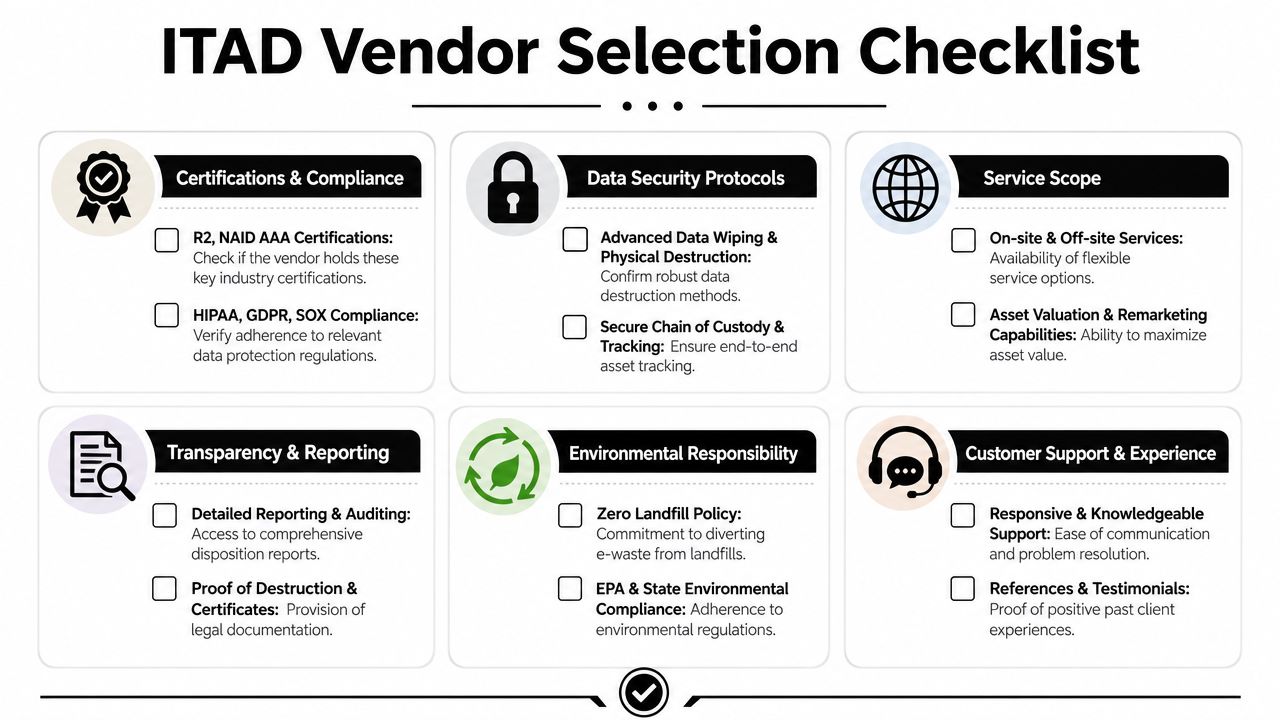
Checklist for enterprise buyers
Use this list when comparing Georgia ITAD vendors:
- Security controls: Ask how they handle HDDs, SSDs, tapes, and mixed media.
- Chain of custody: Require serialized intake, transfer records, and closeout documentation.
- Value recovery capability: Confirm whether they support testing, triage, and resale.
- Project range: Verify they can handle office pickups, multisite collections, and data center work.
- Reporting quality: Review sample certificates and final asset reports before signing.
- Downstream transparency: Ask what happens after initial processing and how outcomes are documented.
- Operational fit: Confirm scheduling, loading, packing, and site-access requirements.
Common questions from Georgia enterprises
Can we witness destruction
Many enterprise buyers ask for this on high-risk jobs. It's a reasonable request when internal policy requires direct oversight or when legal wants a tighter control narrative.
What's the difference between an ITAD vendor and a recycler
An ITAD vendor manages the full asset retirement process, including data destruction, tracking, value recovery, and reporting. A recycler may only handle material processing.
Should we wipe or shred
Use wiping when the asset is suitable for reuse and the erase result can be verified. Use destruction when the media type, security level, or policy makes reuse a poor choice.
What about moves, consolidations, and office closures
ITAD often overlaps with relocation work. When that happens, operations teams may also benefit from practical move-planning advice such as these Posch & Silva business moving tips, especially when retired equipment, active infrastructure, and facilities timing all collide in one project.
A strong Georgia ITAD vendor should be able to answer these questions without hand-waving. Clear process, clear records, clear economics.
Contact Beyond Surplus for certified electronics recycling, secure IT asset disposition, data destruction, and value recovery support for enterprise operations across Georgia.


