

For businesses, computer component recycling is more than a simple process of breaking down old hardware for scrap metal. It is a strategically managed protocol for dismantling obsolete IT equipment to recover valuable materials and, more importantly, to permanently destroy sensitive data. This isn’t just about environmental responsibility; it’s a critical business function that protects your organization from data breaches, ensures regulatory compliance, and can even recover value from retired assets. This guide is designed for business owners, IT managers, and procurement professionals seeking secure and efficient IT asset disposal (ITAD) solutions.
Why Computer Component Recycling Is a Business Necessity
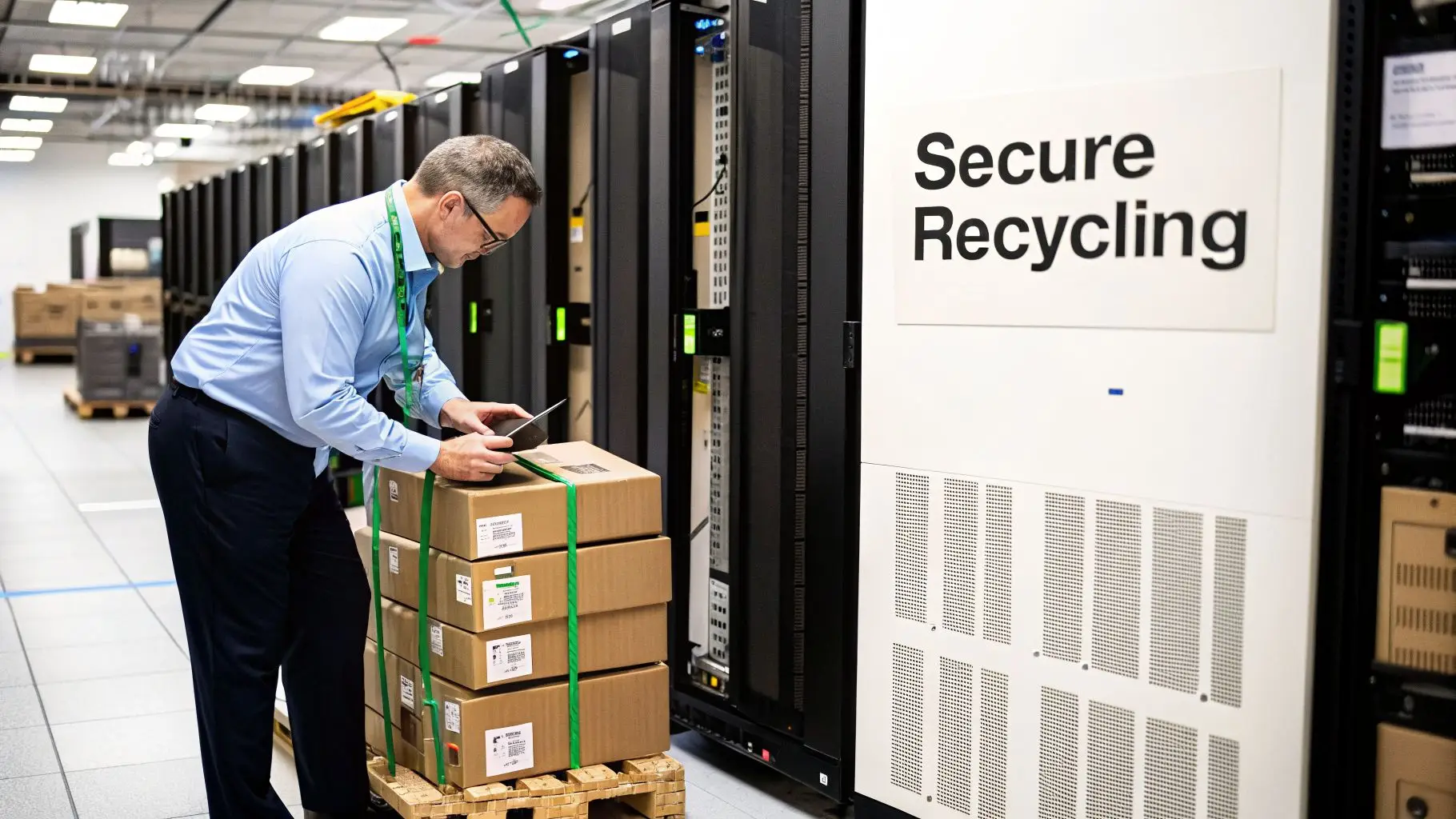
In any modern enterprise, technology evolves rapidly. The servers, laptops, and networking gear that were once state-of-the-art can become obsolete in just a few years. This creates a steady stream of retired IT equipment that requires proper management. Simply stockpiling these assets in a storage closet is not a solution—it’s a significant liability posing security, compliance, and financial risks.
That stockpile of end-of-life technology is a triple threat. Every device could be a data breach waiting to happen, a compliance violation under regulations like the FTC Disposal Rule, and a source of unrecovered capital. For any enterprise that prioritizes data security and operational efficiency, improper disposal of this equipment is completely out of the question.
The Strategic Shift To IT Asset Disposition for Businesses
This is where a formal IT Asset Disposition (ITAD) strategy becomes essential. ITAD is a significant upgrade from basic recycling, which typically focuses only on material recovery. Instead, ITAD provides a complete, structured framework for managing the entire end-of-life process, with data security and value recovery as the top priorities for your enterprise.
A professional ITAD program directly addresses the primary challenges of outdated technology. It operates by:
- Securing Data: Utilizing certified data destruction methods to completely eradicate all sensitive corporate information from hard drives, SSDs, and other storage media.
- Ensuring Compliance: Creating a documented, auditable chain of custody that proves your company has met all legal and regulatory requirements for data privacy and environmental disposal.
- Recovering Value: Identifying components and whole units that retain market value, converting old equipment into a return on your original technology investment.
For IT managers and procurement professionals, a certified ITAD process transforms a complex disposal challenge into a secure, compliant, and often profitable component of corporate operations. It converts a cost center into a tangible business opportunity.
The Role Of A Certified Commercial Recycling Partner
Partnering with a certified electronics recycling expert like Beyond Surplus is the most effective way to manage this process. A qualified partner handles every aspect—from secure logistics and nationwide pickup to certified data sanitization and detailed reporting. This partnership ensures your company’s assets are handled responsibly and securely from the moment they leave your facility. The environmental impact of electronic waste is a major global issue, and certified recyclers are essential in mitigating it for the commercial sector.
By outsourcing your computer component recycling to a specialist, you also transfer the logistical burdens and compliance risks. This frees up your internal IT team to focus on strategic initiatives that drive your business forward. It’s a strategic decision that protects your brand, secures your data, and supports your bottom line.
Understanding The E-Waste Challenge in Your Business
Every business today operates on technology. However, this dependency creates an often-overlooked byproduct: a constant, growing stream of business-generated electronic waste, or e-waste. This isn’t just about a few old keyboards in a supply closet—it’s a significant volume of servers, laptops, and networking gear that reaches its end-of-life every single year.
This accumulation of outdated equipment is more than a storage problem. It poses a direct threat to your company’s security and financial health. Every forgotten hard drive is a potential data breach, and every pallet of retired IT assets represents lost revenue that could have been recovered.
The Staggering Scale Of The Global E-Waste Problem
To fully grasp the challenge, it’s necessary to examine the global data, as it directly influences how your own business should manage its IT lifecycle. The volume of e-waste generated worldwide is accelerating at an unsustainable rate.
In 2022, the world produced a staggering 62 million tonnes of electronic waste—an 82% increase from 2010. This growth is not slowing; projections indicate it will climb another 32% to 82 million tonnes by 2030. This explosion is completely overwhelming recycling capacities. In fact, documented e-waste recycling rates are projected to decline to just 20% by 2030.
A significant portion of this trend is small IT equipment—the servers, laptops, and networking devices your business depends on. These devices accounted for 4.6 million tonnes in 2022 but had a dismal 22% collection and recycling rate, squandering billions in recoverable materials.
Why This Global Issue Is Your Local Business Problem
These massive global figures are not merely an abstract environmental concern. They translate into specific, high-stakes risks for your business, directly impacting your operations.
- Immense Security Vulnerabilities: Every corporate device, from data center servers to company-issued smartphones, contains sensitive data. Without certified data destruction, that information becomes a prime target for cybercriminals.
- Significant Financial Leakage: End-of-life electronics are not worthless. They are filled with valuable materials like gold, copper, and aluminum, and many components can be remarketed. Failing to recover this value is equivalent to discarding cash.
- Escalating Legal and Compliance Risks: Regulations surrounding data privacy and environmental disposal are becoming increasingly stringent. A single misstep can result in substantial fines, legal challenges, and severe damage to your brand’s reputation.
The sheer volume and complexity of modern e-waste make a casual or ad-hoc disposal approach indefensible for any business. Proactive, professional computer component recycling is no longer optional—it’s a core component of responsible IT governance and corporate strategy.
Ignoring this reality is no longer a viable business option. As technology refresh cycles shorten, the wave of outdated equipment will only grow larger. A strategic approach is the only way to navigate these challenges securely and sustainably. For a deeper analysis, see our article on the impact of e-waste on health and the environment.
Partnering with a certified expert like Beyond Surplus transforms this operational burden into a managed, secure, and value-driven process for your enterprise.
Turning Depreciated IT Assets Into Revenue
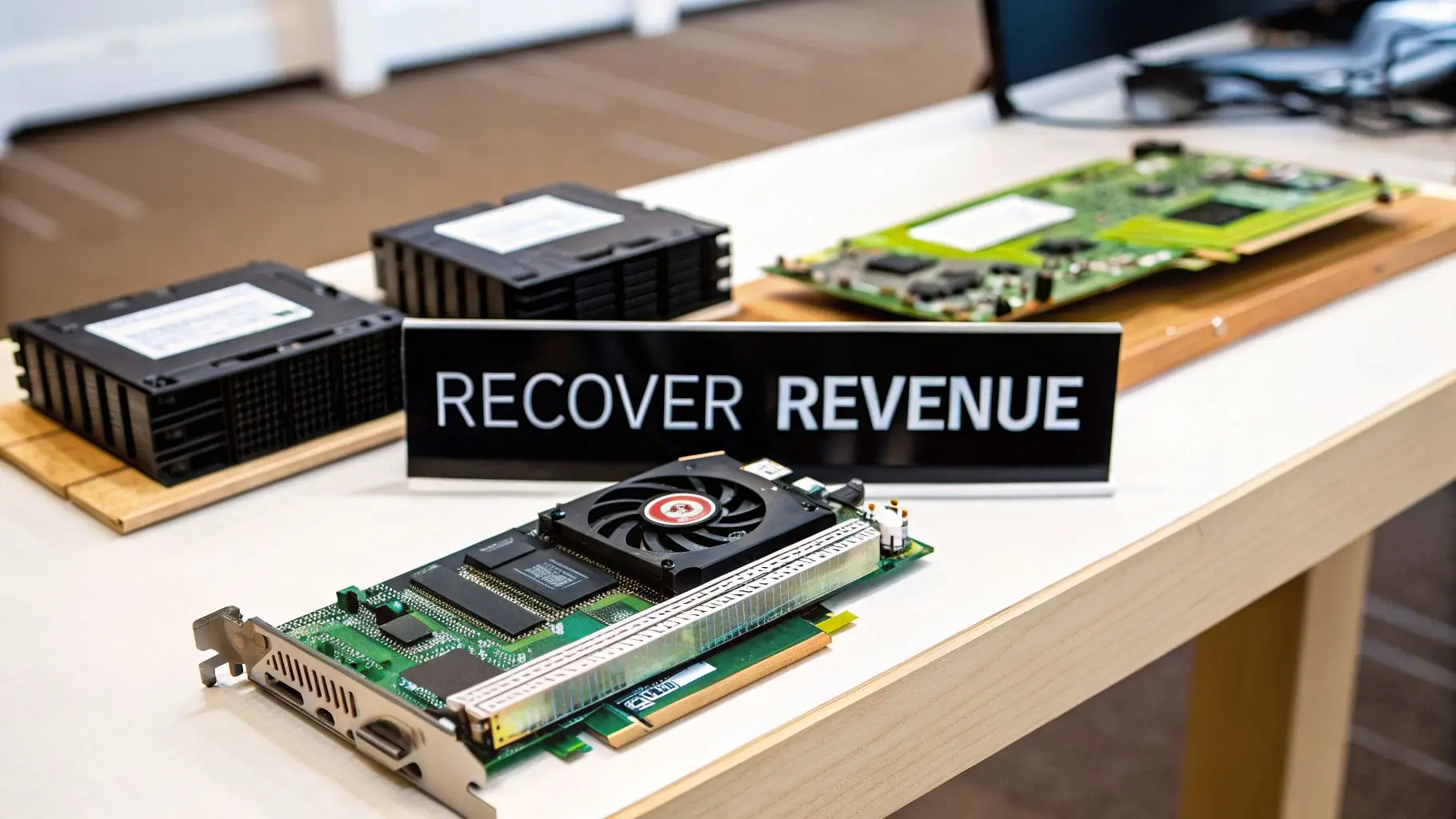
For many business leaders, “recycling” suggests a necessary expense—a line item for the responsible disposal of old equipment. It’s time to shift that perspective. Strategic IT Asset Disposition (ITAD) is not a cost center; it’s a potential revenue stream that can transform retired hardware from a liability into a financial asset.
This is a tangible opportunity driven by a robust secondary market and advanced material recovery processes. The global computer recycling market is expanding rapidly, projected to reach a $50 billion valuation by 2025 and continue growing at a 12% annual rate through 2033. Shorter enterprise tech refresh cycles and stricter disposal regulations are creating a massive volume of equipment that certified recyclers can process for significant value.
By managing your retired hardware strategically, you can unlock that value. This approach aligns perfectly with broader IT cost reduction strategies that benefit your entire business.
Identifying High-Value Components for Businesses
Not all computer parts hold equal resale value. While entire systems can sometimes be remarketed, it’s often the individual components that command the highest prices. A certified ITAD partner like Beyond Surplus has the expertise and diagnostic tools to test these parts and maximize your financial return.
Key components that retain significant value include:
- CPUs (Central Processing Units): High-performance processors from brands like Intel and AMD are consistently in demand for system builds and upgrades.
- RAM (Random Access Memory): High-capacity memory modules, particularly server-grade ECC RAM, are highly sought after in the secondary market.
- GPUs (Graphics Processing Units): Enterprise-level and high-end graphics cards are valuable for applications ranging from AI and machine learning to professional design.
- Enterprise Storage: Solid-State Drives (SSDs) and large-capacity Hard Disk Drives (HDDs) from retired servers can be securely wiped and resold.
Before these components can be resold, they must be professionally evaluated. Below is a breakdown of common parts and how they generate value for your business.
Recyclable Computer Components And Recoverable Materials
| Component | Key Recoverable Materials | Primary Value Proposition |
|---|---|---|
| CPU/Processor | Gold, Silver, Copper, Palladium | Resale (High) / Material |
| RAM/Memory Modules | Gold, Silver, Copper | Resale (High) / Material |
| GPU/Graphics Cards | Gold, Copper, Aluminum | Resale (High) / Material |
| Motherboards | Gold, Silver, Copper, Palladium, Aluminum | Material Recovery |
| Hard Disk Drives (HDD) | Aluminum, Platinum, Neodymium | Resale (Medium) / Material |
| Solid State Drives (SSD) | Gold, Copper | Resale (High) / Material |
| Power Supply Units | Copper, Aluminum, Steel | Material Recovery |
This table illustrates that value is derived from two primary avenues: reselling functional components or recovering the raw materials they contain. An expert recycling partner determines the optimal path for each item to maximize financial returns.
The Power of Precious Metal Recovery
Beyond reselling functional parts, significant value is locked within components that are no longer operational. Circuit boards, processors, and connectors contain small but valuable quantities of precious metals that can be extracted through specialized refining processes.
View your old servers and desktops not as scrap, but as urban mines. Each device contains trace amounts of gold, silver, platinum, palladium, and copper. When collected and processed correctly, this translates into a direct financial return for your company.
This material recovery is a fundamental aspect of the computer component recycling process. An R2v3 certified recycler ensures these materials are extracted in an environmentally safe manner, preventing hazardous waste from entering landfills while generating revenue from otherwise valueless electronics.
From Cost Center to Revenue Generator for Your Business
This financial upside is the core of commercial ITAD buyback programs. A professional partner will assess your retired assets, test them for functionality, and determine their fair market value. This systematic approach can convert a storage closet full of depreciated hardware into a positive entry on your balance sheet.
For CFOs and IT managers, the return on investment is clear. A professionally managed disposal program not only mitigates security and compliance risks but also delivers a tangible, measurable financial return. By partnering with an expert, you gain access to a global marketplace for both refurbished components and recovered materials.
To understand how your specific assets could generate revenue, learn more about our professional asset recovery services.
Your Guide To Ironclad Data Destruction Methods
For any business, data protection is an absolute imperative during the disposal of retired IT assets. A single data breach can result in catastrophic financial losses, severe regulatory penalties, and irreparable damage to your company’s reputation. That is why ironclad data destruction is the cornerstone of any responsible computer component recycling program.
When a server, laptop, or storage drive leaves your facility, you must have absolute certainty that the data it contains is permanently destroyed. Simply deleting files or reformatting a drive is insufficient. With readily available tools, sensitive “deleted” information can be easily recovered, leaving your business completely exposed.
Choosing The Right Destruction Method for Your Enterprise
To guarantee total data security, certified ITAD providers like Beyond Surplus rely on three primary methods. Each offers a different level of security and is suited for specific business needs. The principal options are data wiping, degaussing, and physical destruction.
-
Data Wiping (Sanitization): This is a software-based method where every sector of a hard drive or SSD is overwritten with random binary data. This process, analogous to digital shredding, renders the original data irrecoverable. Wiping to the NIST 800-88 standard is the industry benchmark, ensuring data cannot be recovered using any current technology.
-
Degaussing: This hardware-based process utilizes a powerful magnetic field to instantly erase data from magnetic media like traditional hard disk drives (HDDs) and backup tapes. It completely disrupts the magnetic platters, rendering the drive inoperable and the data permanently destroyed. It is an excellent choice for media that cannot be effectively wiped.
-
Physical Destruction (Shredding): This is the most direct, brute-force method of data destruction. Hard drives, SSDs, and other media are fed into industrial shredders that grind them into small, mangled fragments of metal and plastic. At this point, data recovery is physically impossible. This method is often mandated for the disposal of top-secret or highly sensitive information.
The appropriate method depends on your company’s internal security policies and whether the drives have resale value. Data wiping allows the hardware to be reused, maximizing value recovery. Degaussing and shredding, conversely, are terminal solutions that prioritize total destruction above all else. To understand the specifics, you can learn more about how Beyond Surplus implements the NIST SP 800-88 guidelines for data sanitization.
The Importance Of A Verifiable Chain Of Custody
Secure data destruction is more than the final wipe or shred; it is a complete, documented process that tracks your assets from the moment they leave your control, ensuring full accountability.
A robust chain of custody includes these key steps:
- Secure Logistics: Utilizing sealed, GPS-tracked vehicles and trained, background-checked personnel for asset transportation.
- Asset Tagging and Auditing: Scanning and logging the serial number of every data-bearing device at pickup and upon arrival at our secure facility.
- Controlled Access: Processing all assets in a secure, camera-monitored facility with tightly restricted access.
- Final Certification: Issuing a detailed Certificate of Data Destruction upon completion of the process.
This transparent, step-by-step protocol provides you with proof of compliance and mitigates your risk.
The Certificate Of Data Destruction: Your Legal Safeguard
After your data-bearing assets have been securely processed, your ITAD partner must provide a Certificate of Data Destruction. This is not a simple receipt; it is a critical legal document that serves as your official proof of compliance.
A Certificate of Data Destruction formally transfers the liability for the data from your company to your recycling partner. It is your undeniable proof for auditors and regulators that you have complied with standards like HIPAA, SOX, and the FTC Disposal Rule.
A proper certificate will meticulously list the serial numbers of every device destroyed, the method used, and the exact date of destruction. Without this document, your business has no verifiable means to prove it acted responsibly, leaving you vulnerable in the event of an audit or security incident. Partnering with a certified vendor who provides this is a non-negotiable element of any secure ITAD strategy.
The Modern Recycling Journey: From Pickup To Payout
Ever wonder what actually happens to your company’s end-of-life IT equipment after it leaves your facility? It’s not a simple trip to a local scrap yard. The professional process is a meticulously controlled journey, combining stringent security with advanced technology to protect your data, ensure compliance, and maximize your financial return.
Let’s trace the path of a pallet of retired corporate servers from the moment of pickup to illustrate how a modern IT Asset Disposition (ITAD) process functions for businesses.
The journey begins with secure logistics. A professional ITAD partner like Beyond Surplus schedules a pickup with vetted, background-checked personnel. They inventory every asset on-site, capturing serial numbers before a single item is loaded. The equipment is then transported in a sealed, GPS-tracked vehicle, establishing an unbroken chain of custody so you have full visibility at all times.
Arrival And Secure Triage At The Processing Facility
Once the vehicle arrives at a certified R2v3 processing facility, the pallet is moved into a secure area with controlled access and continuous video surveillance. The first step is check-in. Our team cross-references the on-site inventory list with the received assets to confirm every device has arrived safely. This is a critical step to maintain the integrity of the chain of custody.
After verification, the strategic triage begins. Experienced technicians evaluate each server, laptop, and component to determine its optimal disposition path. This is not a one-size-fits-all process; it’s a strategic decision based on the equipment’s age, condition, and current market value. Functional equipment may be designated for testing and resale, while older or non-functional hardware is slated for secure data destruction and material recycling.
Advanced Sorting And Material Recovery Technology
This is where the innovation of modern computer component recycling becomes evident. The industry is advancing rapidly, with new technologies transforming the process. By 2025, innovations like AI-powered sorting are achieving 99.9% accuracy in material differentiation, and plasma arc systems promise 99% extraction of precious metals. This is not surprising, considering the computer recycling market is projected to become a $50 billion industry. The goal is to recover all value, from achieving 95% reclamation rates for lithium-ion batteries to extracting steel, copper, and aluminum from server chassis. You can read more about these industry trends over at JoinTerra.org.
Before any material recovery, however, every device containing a storage drive undergoes a mandatory data destruction process.
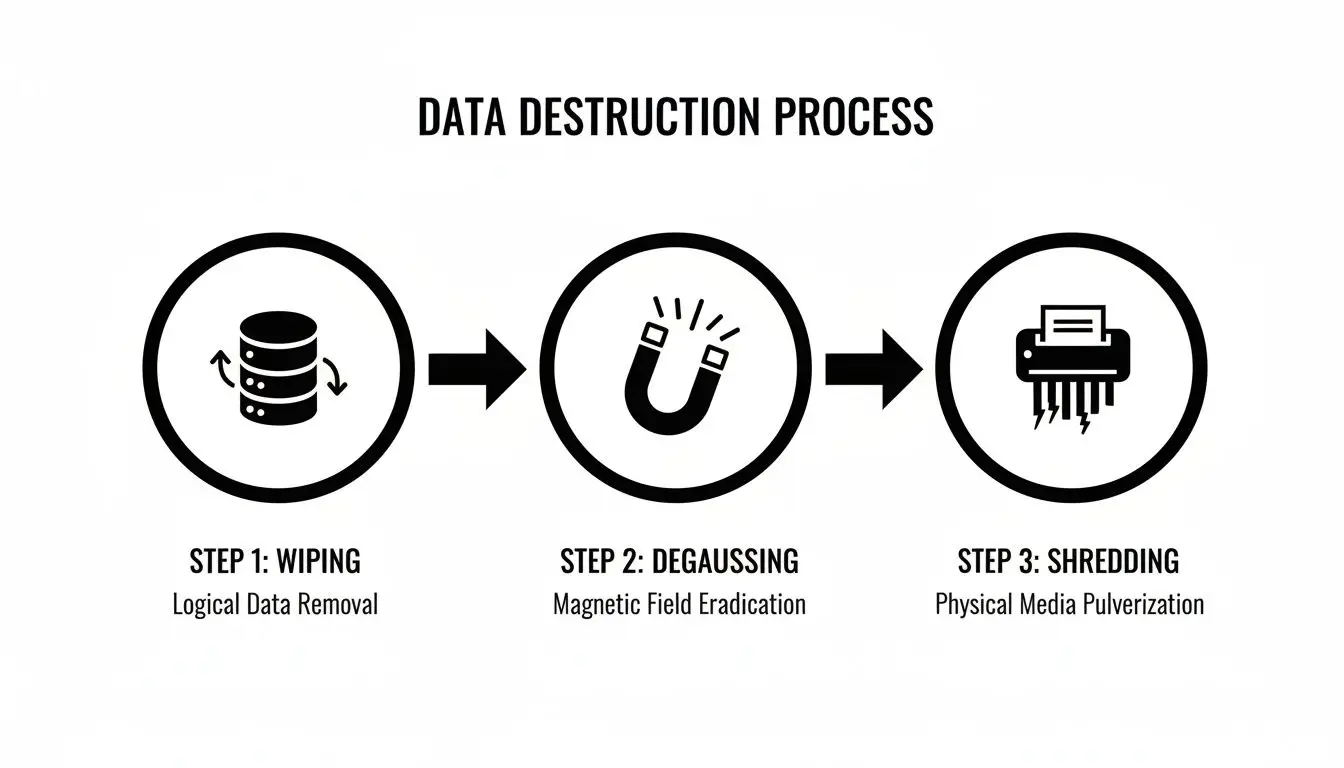
This step ensures that whether an asset is destined for resale or the recycling line, your sensitive corporate information is permanently destroyed—no exceptions.
Final Payout And Certification
After all data has been completely destroyed, the paths diverge. Assets identified for resale are thoroughly tested, refurbished, and sold through established B2B remarketing channels. All other materials proceed to the de-manufacturing line for commodity recovery.
Here, skilled technicians or advanced robotics disassemble the equipment.
- Industrial Shredders: Hard drives, SSDs, and other storage media are physically shredded into minute, unrecognizable fragments, making data recovery impossible.
- Automated Sorting: AI vision systems scan and separate different types of plastics, metals, and circuit boards with exceptional speed and accuracy.
- Eco-Friendly Hydrometallurgy: In place of traditional smelting, this cleaner process utilizes water-based solutions to safely extract precious metals like gold, platinum, and copper from circuit boards.
The level of detail and security in this process is what separates a certified ITAD expert from a simple junk hauler. It transforms a potential risk and logistical burden into a secure, documented, and financially advantageous operation that protects both the environment and your bottom line.
The final step is reconciliation. The value recovered from remarketed assets and refined commodities is tallied, and a detailed report is generated for your records. Your business receives payment for the recovered value, along with an official Certificate of Recycling and Data Destruction. This final documentation closes the loop, providing the auditable proof required to demonstrate secure and responsible asset management.
How To Choose A Certified ITAD Partner
Selecting the right ITAD partner is one of the most critical decisions an IT manager or procurement professional will make. This is not merely about offloading old equipment; it’s about protecting your company’s sensitive data, maintaining legal compliance, and safeguarding your brand’s reputation.
A poor choice can quickly lead to data breaches, substantial fines, or environmental penalties. In contrast, the right partner acts as a trusted extension of your IT and security teams, managing the entire process seamlessly. To make an informed decision, you must look beyond pricing and scrutinize a provider’s certifications, security protocols, and logistical capabilities. This due diligence is essential to ensure your retired assets are managed correctly from start to finish.
Vet Certifications And Compliance Standards
The absolute first step is to verify certifications. Independent, third-party certifications are the clearest evidence that a vendor adheres to strict industry standards for environmental practices, data security, and occupational health and safety.
Insist on these key credentials for your business partner:
- R2v3 (Responsible Recycling): This is the gold standard for the electronics recycling industry. An R2v3 certified company has demonstrated it follows best practices for data sanitization, equipment testing, and downstream material management. It is your best defense against e-waste being illegally dumped or exported.
- e-Stewards: Another highly respected certification, e-Stewards places a strong emphasis on preventing hazardous e-waste from being shipped to developing nations. It demands rigorous environmental and social accountability from certified recyclers.
- NAID AAA: This certification is exclusively focused on data destruction. A NAID AAA certified vendor is subject to surprise, unannounced audits of their hiring practices, training protocols, and security procedures to ensure your data is verifiably and securely destroyed.
Without these certifications, you are essentially relying on a vendor’s word, with no independent guarantee that they are handling your corporate assets responsibly.
Prioritize Ironclad Data Security And Reporting
Data security is entirely non-negotiable for any business. Any potential partner must be able to clearly articulate—and prove—their data destruction methods. Your responsibility is to scrutinize their processes and the documentation they provide.
A vendor’s promise to “wipe the drives” is insufficient. You need auditable proof. The Certificate of Data Destruction is the most critical document you will receive, as it formally transfers liability and serves as your legal proof of compliance.
You must ask specific, direct questions about their security measures:
- Destruction Methods: Do they offer data wiping compliant with NIST 800-88 standards, degaussing, and options for on-site or off-site physical shredding?
- Chain of Custody: Can they provide a detailed, serialized report that tracks every single asset from your facility to its final disposition?
- Facility Security: Is their facility genuinely secure? Verify controlled access, background-checked employees, and 24/7 video surveillance.
This level of scrutiny is vital for protecting your organization. For a detailed guide on what to ask, use our comprehensive vendor due diligence checklist to ensure you cover all critical points.
Evaluate Logistical Capabilities And Financial Returns
Finally, a premier ITAD partner must possess the logistical capabilities to meet your specific business needs. This may include nationwide pickup services for companies with multiple locations, extensive experience with complex projects like data center decommissioning, and the ability to manage diverse asset types.
A full-service provider like Beyond Surplus manages the entire end-to-end process. We coordinate secure transport and work to maximize the financial return on your assets through our established B2B buyback programs. This integration of security, compliance, and value recovery transforms a complex disposal problem into a secure, streamlined, and financially beneficial process for your enterprise.
Frequently Asked Questions About Corporate Computer Recycling
Navigating the disposal of your company’s end-of-life IT equipment can seem complex. To provide clarity, we have compiled answers to some of the most common questions we receive from businesses regarding professional computer component recycling and ITAD services.
What Is The Difference Between Recycling And IT Asset Disposition (ITAD)?
These terms are often used interchangeably, but they describe different service levels. Basic electronics recycling is the final-stage process where old equipment is de-manufactured to recover raw materials like metals and plastics in an environmentally responsible manner.
IT Asset Disposition (ITAD), however, is a comprehensive strategy for managing the entire end-of-life of an IT asset. The primary objectives of ITAD are to ensure data security and maximize financial value recovery for your business.
A robust ITAD strategy always includes:
- Secure Logistics: Coordinated and tracked pickup of your assets to ensure a complete chain of custody.
- Certified Data Destruction: Eradicating all data according to standards like NIST 800-88 or by physically shredding storage media.
- Value Recovery: Testing, refurbishing, and reselling functional equipment to generate revenue for your business.
- Responsible Recycling: Compliant and environmentally sound recycling for all equipment that cannot be reused.
- Auditable Reporting: Providing a full chain-of-custody report and a final Certificate of Data Destruction and Recycling.
While recycling is a crucial component, ITAD is the holistic, security-first approach that manages the entire process from start to finish for commercial clients.
Our Company Is Not In Georgia Can We Still Use Your Services?
Yes, absolutely. While our primary processing facilities are located in the metro Atlanta area, Beyond Surplus provides full-service, nationwide pickup services for our commercial, government, and enterprise clients across the contiguous United States.
We manage the entire logistical process. Our team will coordinate a secure pickup from your business locations—regardless of where they are—and transport all assets to our certified processing center. You will receive the same high standards of security, compliance, and detailed reporting as our local clients.
How Do We Prove To Auditors That Our Data Was Destroyed Securely?
This is the most critical question in the ITAD process, and its answer is vital for corporate governance. A simple verbal assurance that data was destroyed is insufficient; you need official, verifiable documentation for your records and for any potential audits.
Upon the completion of any data destruction service—whether through software-based wiping, degaussing, or physical shredding—a certified provider issues a formal Certificate of Data Destruction. This is your definitive legal document and auditable proof of compliance.
This certificate formally documents the services performed, includes a serialized inventory of the hard drives or other media that were destroyed, and confirms compliance with regulations such as HIPAA, GLBA, and the FTC Disposal Rule. Most importantly, it transfers liability for that data from your company to the service provider, protecting your organization from future risk.
Contact Beyond Surplus for certified electronics recycling and secure IT asset disposal. Discover our nationwide computer component recycling and ITAD services today.


