
Properly managing data center equipment recycling in Georgia is a critical business function for IT managers and procurement professionals, not just a standard e-waste issue. It demands unparalleled security, strict compliance, and logistical precision. For businesses in the Atlanta tech hub and across the state, executing this process correctly is non-negotiable for protecting sensitive corporate data, adhering to environmental regulations, and maximizing financial returns from retired IT assets.
Why Specialized Data Center Recycling Matters In Georgia
For commercial enterprises in Georgia, decommissioning a data center is far more than simply hauling out old hardware. It’s a significant operational undertaking fraught with risk. The sheer volume and complexity of the equipment—from servers and storage arrays to networking gear and UPS systems—require a dedicated IT Asset Disposition (ITAD) strategy tailored for business needs.
A single misstep can result in a catastrophic data breach, substantial regulatory penalties, or significant financial loss. This challenge is magnified by rapid digital infrastructure growth. As of March 2024, the U.S. was home to over 5,300 data centers, with Atlanta serving as a primary hub. This expansion contributes to a global e-waste problem; in 2022, the world generated 61.9 million metric tonnes of electronic waste, with only 22.3% documented as properly recycled. This global issue has direct local consequences, compelling Georgia businesses to implement responsible and secure disposal practices.
The Unique Demands of Data Center Assets
Data center equipment presents unique challenges that generic, consumer-focused recyclers are not equipped to handle. These enterprise-grade assets are often bulky, heavy, and integrated into complex infrastructure, requiring specialized teams for professional de-installation and secure transport. While a general understanding of the e-waste recycling industry is useful, the demands of data center decommissioning are in a class of their own.
A qualified ITAD partner provides the necessary solutions to navigate these commercial complexities effectively.
Key Challenges in Georgia Data Center Decommissioning
| Challenge | Business Impact | Required Solution |
|---|---|---|
| Data Security & Privacy | High risk of data breaches, reputational damage, and non-compliance fines. | Certified, audited data destruction (on-site or off-site shredding/wiping) with verifiable reporting. |
| Logistical Complexity | Operational disruption, downtime, and potential equipment damage during removal. | Professional project management, experienced de-installation crews, and secure, insured transportation. |
| Environmental Compliance | Fines for improper disposal of hazardous materials (lead, mercury) under federal and state law. | R2v3 or e-Stewards certified recycling processes that ensure responsible materials handling. |
| Value Recovery | Loss of potential revenue from valuable, reusable IT assets. | Expert asset evaluation, refurbishment, and established resale channels to maximize ROI. |
Ultimately, these challenges underscore the necessity of a specialized, business-focused approach. Key considerations for any Georgia enterprise include:
Data Security: Every server, hard drive, and storage device represents a significant liability. Absolute, certified data destruction—whether through on-site shredding or secure wiping—is essential to prevent breaches and comply with regulations like the FTC Disposal Rule.
Environmental Compliance: Data center hardware contains hazardous materials like lead, mercury, and cadmium. Proper disposal is a legal requirement under federal laws like the Resource Conservation and Recovery Act (RCRA) and various Georgia state regulations.
Value Recovery: Decommissioning should not be viewed solely as a cost. Much of your retired equipment, particularly newer-generation servers and networking gear, retains significant market value. A skilled ITAD partner can test, refurbish, and remarket these assets, converting a potential expense into a revenue stream.
Partnering with a certified expert in data center equipment recycling in Georgia is the only way for businesses to manage these complexities safely and efficiently. To learn more about local commercial solutions, explore our certified Georgia electronics recycling services.
Building Your Decommissioning Blueprint
A successful data center equipment recycling project in Georgia begins not with removing a server, but with a detailed, strategic plan. This decommissioning blueprint serves as a guide that transforms a potentially chaotic process into a controlled and predictable operation. This framework aligns all stakeholders, from the on-site IT team to the finance department, from the very beginning.
The initial step is a comprehensive asset audit. This is not a simple server count; it is a granular inventory detailing the make, model, serial number, internal asset tag, and precise location of every piece of equipment. This detailed list forms the foundation for all subsequent decisions, from data destruction methods to logistical planning.
Categorizing Assets for Maximum Return
With a complete audit, the next phase is to categorize your equipment. Not all retired IT assets share the same destination. A strategic approach involves segregating them into distinct streams to maximize both security and potential financial returns.
Your inventory will typically fall into three main categories:
- Assets for Remarketing: This includes newer-generation equipment—servers, networking gear, and storage arrays—that holds significant value on the secondary market. These are prime candidates for refurbishment and resale.
- Assets for Recycling: This category comprises older or non-functional equipment with no viable resale value. This hardware must be processed by a certified recycler to responsibly recover raw materials like steel, aluminum, and precious metals.
- Assets Requiring Secure Destruction: This is a non-negotiable category. It includes every data-bearing device—from hard drives and SSDs to backup tapes—that must undergo certified data erasure or physical destruction to eliminate the risk of a data breach.
This infographic illustrates the lifecycle of data center e-waste in Georgia, from growth and disposal challenges to the ultimate solution in recycling.
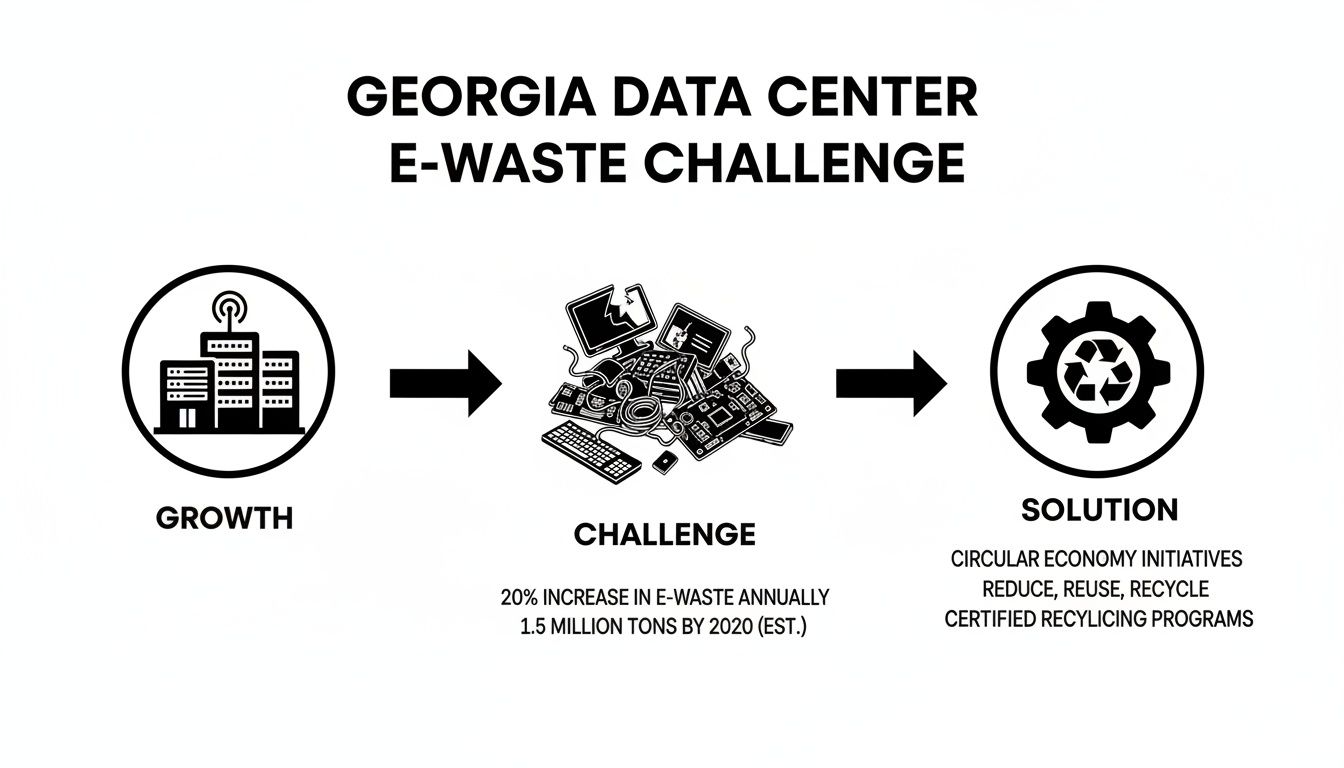
The graphic highlights how the state's expanding digital infrastructure creates a substantial e-waste challenge, making a planned, professional recycling strategy essential for sustainable business operations.
Establishing Timelines and Aligning Stakeholders
Developing a realistic project timeline is crucial to minimize disruption to your daily operations. This requires close collaboration with your facilities team to schedule power-downs, de-cabling, and the physical removal of heavy racks and equipment.
It is also advisable to engage the finance department early in the process. They will want to understand the potential revenue generation through IT asset buyback programs.
A critical component of a seamless project is establishing an unbroken chain of custody from the moment an asset is disconnected. This documented trail, managed by your ITAD partner, tracks every piece of equipment from your facility to its final disposition, providing an auditable record for compliance and security.
Engaging a certified ITAD partner from the outset provides invaluable expertise. They can assist with the initial audit, offer realistic insights on asset valuation, and develop a logistics plan tailored to your facility's specific layout and security protocols.
To better understand the entire process, learn more about our professional data center decommissioning services and how we create these custom blueprints for Georgia businesses. Early collaboration prevents costly errors and ensures flawless project execution.
Mastering Data Destruction And Security Compliance
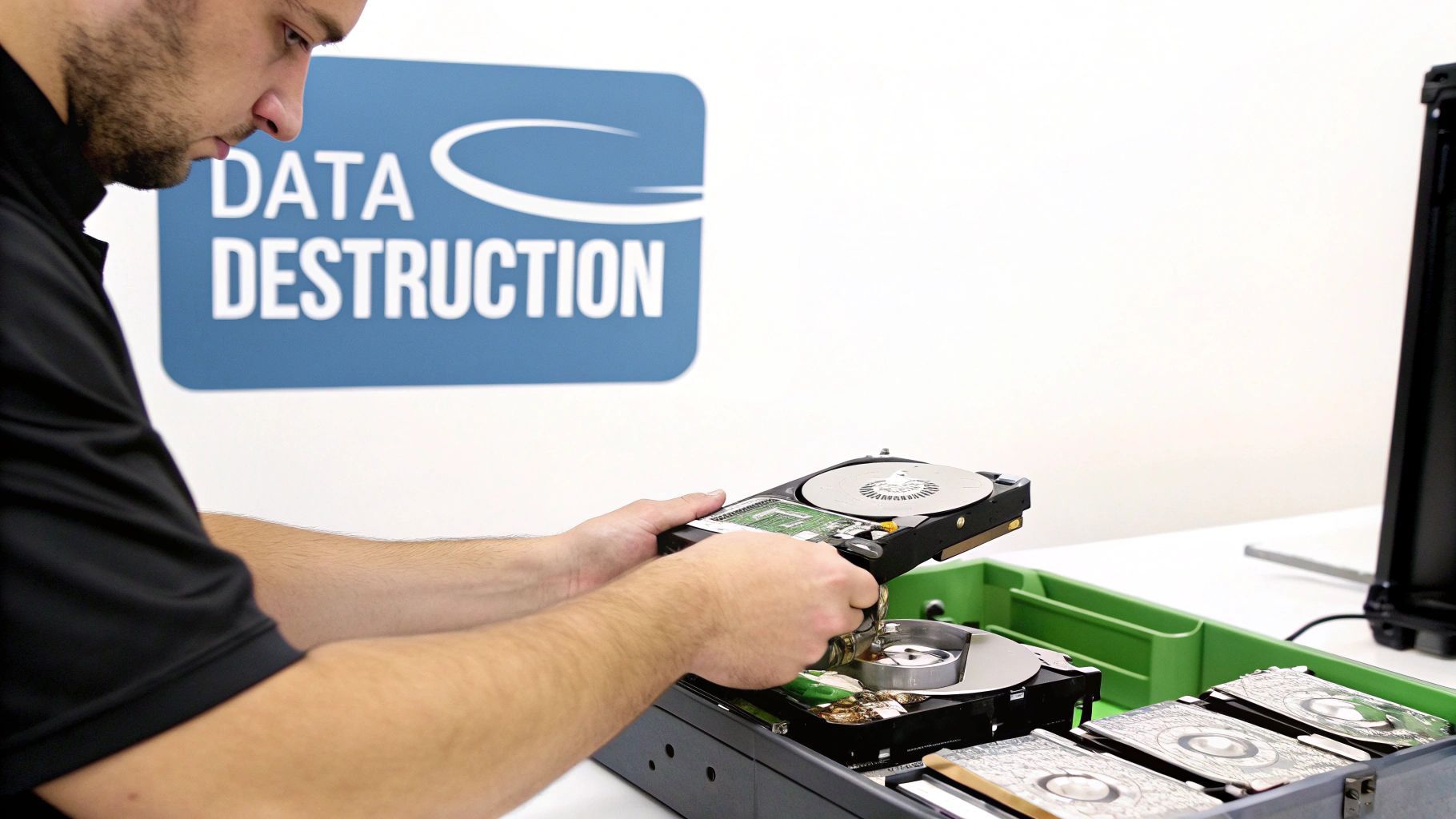
Data security is the absolute, non-negotiable core of any data center equipment recycling Georgia project. A single compromised hard drive can lead to millions in fines and cause irreparable reputational damage.
Protecting your organization's sensitive information is a legal and ethical mandate. For every data-bearing device leaving your facility—from enterprise SSDs to legacy HDDs—a clear, documented, and defensible destruction plan is required. This involves selecting the appropriate method and understanding the complex compliance landscape.
Choosing The Right Data Destruction Method
Not all data destruction methods are created equal. The optimal approach depends on the asset's age, potential resale value, and the sensitivity of the data it contains. Making the right choice is crucial for balancing ironclad security with potential value recovery.
The primary methods used in the ITAD industry are:
- Certified Data Wiping: This software-based process overwrites existing data with random characters, rendering the original information unrecoverable. It is the ideal choice for newer, high-value assets like servers or storage arrays intended for remarketing, as it preserves the hardware's functionality and value while ensuring complete data sanitization.
- Degaussing: This technique uses a powerful magnetic field to instantly scramble the magnetic domains on hard disk drives and tapes where data is stored. Degaussing renders the drives useless, making it a highly secure option for older media destined for recycling.
- Physical Shredding: This is the ultimate solution for data destruction. Hard drives are fed into an industrial shredder that reduces them to small, unrecognizable metal fragments. For assets containing highly sensitive PII, financial records, or proprietary data, on-site shredding is the gold standard, providing firsthand verification of destruction.
Linking Destruction To Regulatory Compliance
Proper data destruction is your primary defense against non-compliance with regulations such as the FTC Disposal Rule, HIPAA, and Sarbanes-Oxley. These laws mandate that businesses take reasonable measures to protect consumer and proprietary information during disposal. Failure to comply can result in severe penalties.
Proof of compliance comes from the documentation provided by your ITAD partner.
The Role Of Certificates And Audit Trails
Upon completion of processing, you must receive a Certificate of Data Destruction. This is not merely a receipt; it is a legally binding document that serves as your official record of compliant data destruction. A proper certificate details the method used and lists the serial numbers of every drive that was sanitized or shredded.
This certificate is your proof of due diligence. It creates a bulletproof, auditable trail that formally transfers liability from your organization to your certified recycling partner. In the event of an audit or legal inquiry, this documentation serves as evidence that you took every necessary step to safeguard sensitive data, protecting your Georgia business from the devastating consequences of a breach.
Executing Flawless Logistics And On-Site Services
Once the decommissioning plan is finalized, the operational phase begins. Moving bulky, sensitive, and heavy hardware out of a secure, operational data center presents a significant logistical challenge. Success hinges on precise coordination, professional de-installation, and maintaining an unbroken chain of custody from your server racks to the processing facility.
This is where an ITAD partner with an experienced, in-house logistics team demonstrates its value. The physical removal process requires more than just manpower; it demands experts who can navigate tight corridors, coordinate with building management for loading dock access, and execute the entire project with zero disruption to your ongoing operations. This includes carefully de-installing, palletizing, and shrink-wrapping everything from server racks to enterprise storage arrays for secure transit.
The Advantage of In-House Logistics
Working with a partner that operates its own logistics fleet provides a significant security advantage. When the same company manages both data destruction and transportation, you benefit from a completely closed-loop chain of custody. This eliminates risky third-party handoffs where assets could be misplaced or compromised, ensuring total accountability from start to finish.
This integrated approach is essential for businesses in highly regulated sectors like finance and healthcare. To understand how this works at a national scale, see how we maintain security across state lines with our nationwide reverse logistics services.
On-Site Services for Ultimate Peace of Mind
For maximum security, certain services should be performed at your Georgia facility before any equipment leaves the premises.
- On-Site Hard Drive Shredding: This is the gold standard. A mobile shredding truck comes to your location, allowing you to witness the physical destruction of every hard drive and SSD.
- Asset Tagging and Inventory Verification: Before removal, each asset is scanned and verified against the initial project manifest. This ensures a complete and accurate audit trail.
- Professional De-Cabling and De-Installation: Skilled technicians are needed to safely disconnect and remove equipment from racks, preventing damage to both retired assets and remaining infrastructure.
To execute this flawlessly, it is vital to understand the transport chain of responsibility. This framework is key to ensuring every stage of the transport process is compliant, safe, and accountable.
The demand for these specialized commercial services is growing. The global IT equipment recycling market is projected to reach USD 25 billion in 2025, growing at a 12% CAGR. This growth is driven by shorter IT refresh cycles and the increasing volume of e-waste from digital transformation. With over 5,381 data centers in the U.S. as of March 2024, the pressure on hubs like Atlanta is immense, making professional logistics a non-negotiable component of any decommissioning project.
Unlocking Hidden Value From Your Retired IT Assets
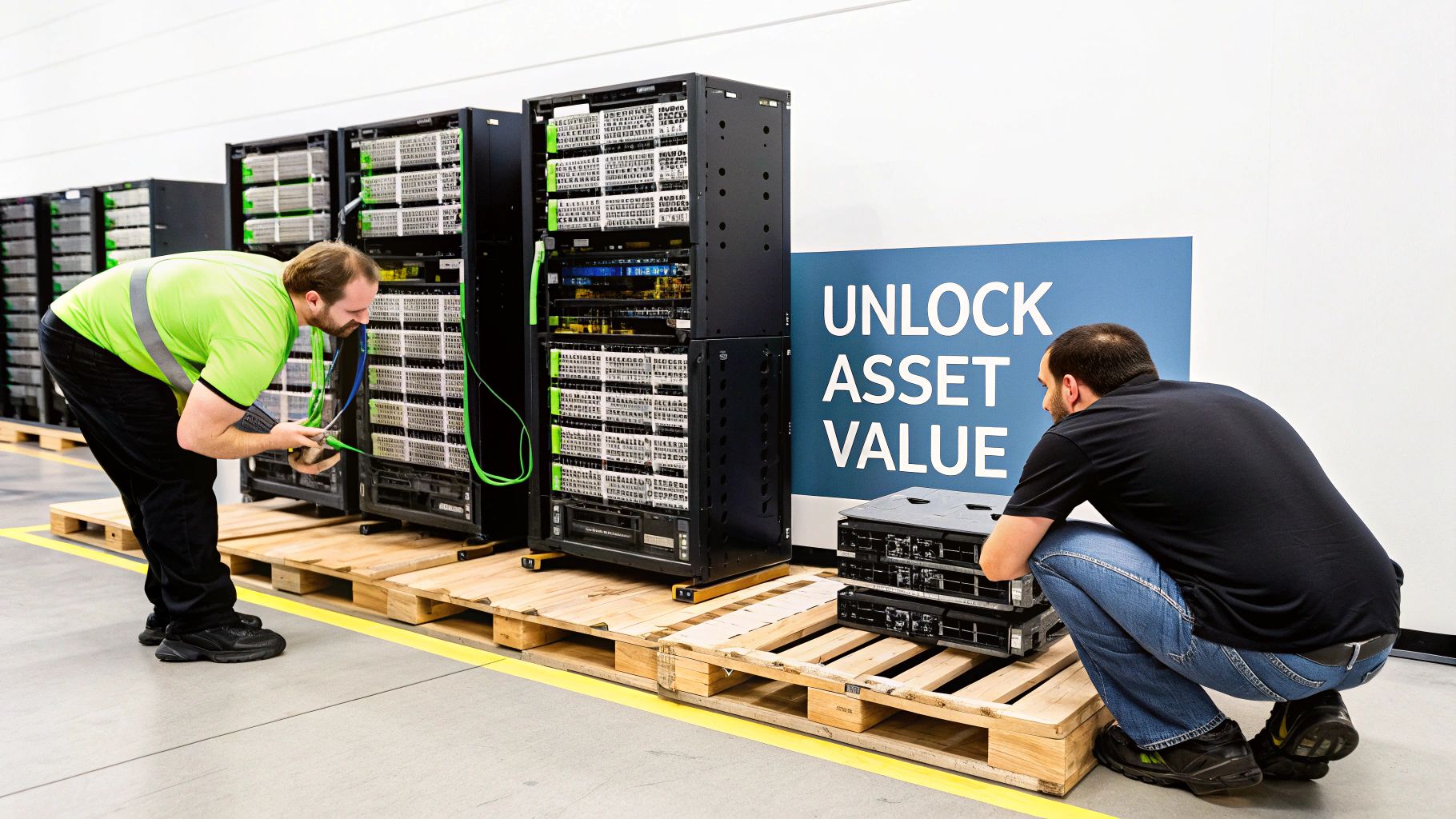
A data center decommissioning project should not be merely an expense for your business. For Georgia enterprises, it presents a significant opportunity to generate revenue and offset the costs of the next IT refresh. By approaching IT Asset Disposition (ITAD) strategically, the focus shifts from simple disposal to intelligent value recovery.
The financial benefit comes from a robust IT buyback process. Your retired assets—particularly recent-generation servers, networking switches, and enterprise storage arrays—still hold considerable value in the secondary market. A qualified partner will meticulously test and refurbish this equipment, converting depreciated hardware back into working capital for your organization.
Identifying Remarketable Assets
A successful buyback program depends on accurately identifying which assets are suitable for remarketing versus materials recovery. The criteria are straightforward, focusing on age, condition, and current market demand.
Equipment with strong resale potential typically includes:
- Enterprise Servers: Models less than five years old are consistently in high demand.
- Networking Gear: High-speed switches, routers, and firewalls from leading manufacturers often retain their value well.
- Storage Systems: SAN and NAS arrays with functional controllers and drives can yield significant returns.
- Components: Individual components such as CPUs, RAM, and GPUs can also be harvested and sold.
Conversely, older, proprietary, or damaged equipment is directed to a responsible recycling stream. Here, the objective is to recover valuable raw materials like aluminum, copper, and precious metals, ensuring nothing ends up in a landfill.
Connecting Value Recovery to Corporate Sustainability
Choosing value recovery over disposal is not just a smart financial decision—it is a powerful demonstration of your company's commitment to sustainability. By extending the life of functional IT equipment, you actively participate in the circular economy, reducing the demand for new manufacturing and conserving natural resources.
This approach directly supports corporate environmental, social, and governance (ESG) goals. Every server you remarket is one less that needs to be produced. Every pound of material recycled reduces your company's environmental footprint, providing tangible metrics for your sustainability reports.
This is more relevant than ever. The IT equipment disposal market in North America, including the Atlanta region, is projected to reach $1,257.6 million in 2025. This growth is fueled by the sheer volume of e-waste from cloud adoption and data center expansion.
With 5,381 data centers in the U.S. alone contributing to the 61.9 million tonnes of global e-waste generated in 2022, maximizing reuse is critical. Working with a certified partner ensures every asset is handled ethically, whether resold or recycled.
For a deeper dive into maximizing returns, explore our specialized IT asset recovery services in Georgia. This transforms your end-of-life IT challenge into a clear financial and environmental victory.
Answering Your Georgia Data Center Recycling Questions
When undertaking a major project like decommissioning a data center, questions inevitably arise. We understand that Georgia business operators and IT managers need clear, straightforward answers to proceed with confidence. Here are some of the most common inquiries we receive regarding security, logistics, and value recovery.
What Happens to My Data-Bearing Devices?
This is the most critical question. The only acceptable answer is total, verifiable data destruction.
Every data-bearing device we process, from server hard drives to SSDs, undergoes a certified destruction process compliant with NIST 800-88 standards. We offer several methods tailored to your specific business needs:
- Certified Multi-Pass Wiping: This is the optimal solution for newer assets intended for remarketing. It completely erases all data beyond recovery while preserving the hardware's value.
- Degaussing: For older magnetic media like HDDs and tapes, we use a powerful magnetic pulse to instantly obliterate all data, rendering the device unusable.
- On-Site Physical Shredding: For maximum assurance, we can bring a mobile industrial shredder to your facility anywhere in Georgia. You can witness firsthand as every drive is reduced to small, shredded metal fragments.
Regardless of the method chosen, the process concludes with a serialized Certificate of Data Destruction. This document provides a complete audit trail and formally transfers liability from your organization to ours.
Can You Handle the Logistics of Removing Equipment from a Secure Facility?
Yes. Managing the complex logistics of a data center cleanout is a core part of our service. Our professional team handles the entire physical removal process, ensuring a smooth operation with minimal disruption to your business.
We manage everything: professional de-installation of servers from racks, careful packing and palletizing of all assets, and secure transport using our own company-owned trucks and trained, vetted personnel. We collaborate closely with your facility managers to adhere to all security protocols and work within your schedule.
Is It Possible to Recover Any Value From Our Old Equipment?
Absolutely. A strategic ITAD program should not only be a cost center—it should contribute back to your budget. Our IT asset value recovery program is designed to maximize the return on your retired equipment.
We conduct a thorough evaluation of every piece of hardware to determine its potential in the secondary market. High-demand assets like servers, networking gear, and storage arrays are professionally tested, refurbished, and sold through our established global network. You receive a transparent, detailed report breaking down the value recovered, turning old hardware into a positive entry on your balance sheet.
When your business requires a professional partner who can handle every detail with expertise, contact Beyond Surplus. We deliver certified data center equipment recycling in Georgia, with an unwavering focus on security, compliance, and maximizing your financial return. Learn more at https://www.beyondsurplus.com.