

A lot of Stockbridge companies have the same problem right now. Old laptops from the last refresh cycle are stacked in a storage room, a few retired servers are still sitting in a rack, and someone keeps asking whether the equipment can be donated, recycled, sold, or shredded.
That situation looks routine. It isn't.
Every retired device holds two business questions at once. First, how do you make sure no data leaves with the asset? Second, how do you move the equipment out without creating an audit problem, an environmental issue, or a missed recovery opportunity? Stockbridge ITAD services for safe IT equipment disposal exist to solve exactly that problem for business and enterprise environments.
Your Guide to IT Asset Disposition in Stockbridge
For a business in Stockbridge, IT asset disposition is the controlled retirement of business technology. It covers desktops, laptops, servers, storage arrays, networking gear, phones, and specialized electronics that have reached end of life, end of lease, or end of use inside your organization.
The key point is simple. This isn't junk removal.
A proper ITAD program treats retired equipment as a risk-bearing asset until final disposition is complete and documented. That means the process has to cover data handling, pickup logistics, inventory accuracy, downstream recycling, and resale decisions. If any one of those breaks, your company keeps the exposure.
What usually creates the disposal backlog
Most companies don't fall behind because they ignore security. They fall behind because the project sits between teams.
- IT owns the devices but may not control loading docks, storage rooms, or surplus procedures.
- Facilities can move equipment but usually shouldn't decide how data-bearing assets are handled.
- Procurement and finance track value but may not see the serial-level disposition record they need later.
- Compliance teams need evidence long after the gear is gone.
That is why old equipment tends to collect in waves after office moves, data center cleanouts, hardware refreshes, or mergers.
Practical rule: If a device has storage media or ever connected to business systems, treat it as an ITAD item until you have a final disposition record.
For Stockbridge organizations, the strongest approach is to decide the disposition path before pickup. Some assets should be wiped and remarketed. Others should be physically destroyed. Others belong in a recycling stream only after data handling and documentation are complete. The businesses that manage this well don't improvise at the loading dock. They build a repeatable retirement process and hold vendors to it.
What ITAD Really Means for Your Business
ITAD is often confused with basic electronics recycling. That definition is too narrow for any company with customer data, regulated records, remote users, or depreciated equipment that may still have resale value.
ITAD is asset retirement planning for business technology. It combines security, reporting, logistics, reuse, recycling, and audit support into one controlled workflow. That distinction matters because a recycler may remove equipment, but an ITAD process has to answer what happened to each asset, what happened to the data, and what proof your business keeps.

The market itself reflects that shift. The global IT asset disposition market was valued at USD 17.5 billion in 2025 and is projected to reach USD 40.1 billion by 2035, while the U.S. market was estimated at USD 7.03 billion in 2025 and is forecast to reach USD 18.45 billion by 2035 at a 10.1% CAGR. That growth shows secure disposal, data destruction, and value recovery are becoming mainstream enterprise infrastructure services, not side tasks handled ad hoc (ITAD market analysis from Global Market Insights).
The five parts that matter most
A business-grade ITAD program usually stands or falls on these points:
- Data handling first: Storage media has to be identified before anything leaves the site.
- Asset-level tracking: Serial numbers, quantities, and classes of equipment need to reconcile.
- Controlled transport: Pickup and transfer can't be casual if you want defensible custody.
- Disposition by condition: Working assets and failed media shouldn't go down the same path.
- Final reporting: Certificates, inventories, and disposition details must match what was removed.
A useful primer on that broader lifecycle is Beyond Surplus's overview of what IT asset disposition is.
What ITAD is not
It isn't a truck showing up, loading mixed electronics, and handing you a generic receipt.
It also isn't automatically shredding every device. That may feel safe, but it's often a blunt policy that destroys recoverable value and ignores the difference between a healthy laptop drive, an encrypted SSD, and a failed storage device from a regulated environment.
The right question isn't “How fast can this leave?” It's “Can we prove what happened to every asset and every data-bearing device?”
That standard changes how businesses in Stockbridge should buy disposal services. You aren't purchasing haul-away capacity. You're purchasing risk control.
The High Cost of Improper Equipment Disposal
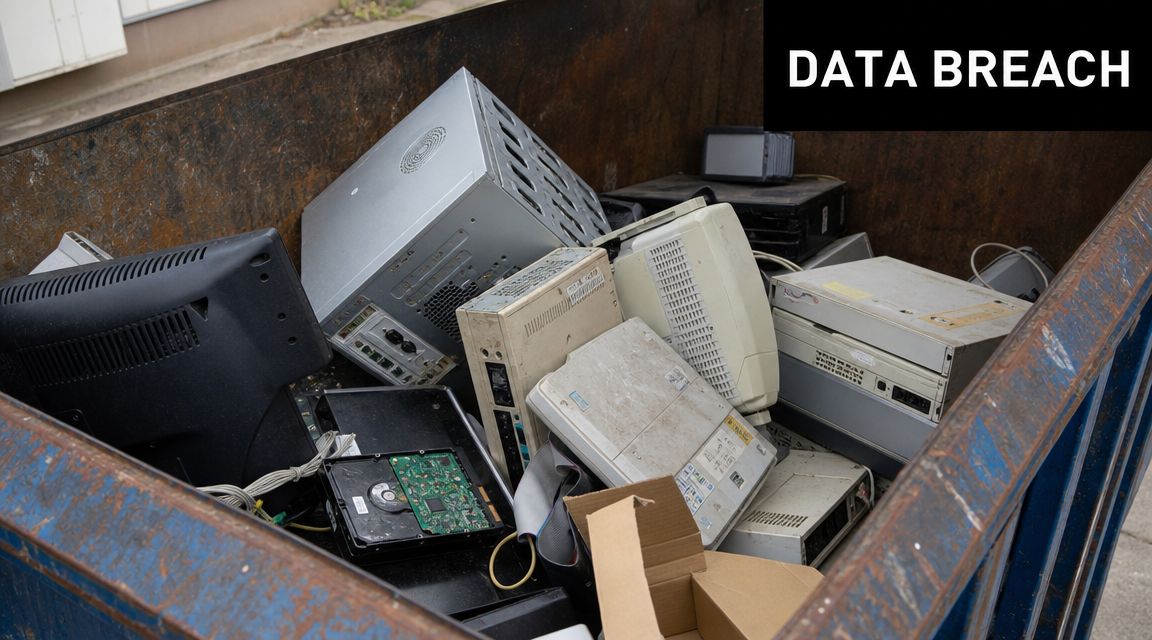
Improper disposal usually starts with convenience. A branch office clears a closet, a project team uses a general recycler, or someone assumes a device was already wiped because the user account was deleted.
Those shortcuts create the exact conditions that lead to exposure. Business devices don't just contain files. They can hold cached credentials, locally stored reports, emails, database extracts, browser data, archived backups, and configuration details that still matter long after a system is retired.
Where companies get into trouble
The most common failure isn't malicious behavior. It's loss of control.
A monitor with no storage is usually straightforward. A retired server with mixed drives is not. A pallet of office desktops is manageable. Remote laptops from hybrid staff are harder because they may never return to a central facility in a clean, documented way.
Modern ITAD programs have to handle mixed media and distributed infrastructure, including SSDs, tapes, and remote or hybrid assets, because those media types and deployment models change the right disposition path. Current service guidance also treats options like SSD shredding and remote hard-drive erasure as standard capabilities rather than edge cases (Park Place Technologies on modern ITAD service options).
That matters in practical terms because old assumptions fail on newer infrastructure. A team that thinks only in terms of desktop hard drives will miss what to do with branch devices, flash storage, backup media, and decommissioned cloud-connected endpoints. For Georgia organizations weighing that risk, this overview of why ITAD services matter for Georgia companies in 2026 is a useful checkpoint.
What improper disposal actually costs
Not every cost hits the balance sheet right away.
- Reputational damage: Clients and partners may remember the incident long after the hardware is gone.
- Operational disruption: Legal, compliance, and IT teams get pulled into reconstruction work.
- Audit weakness: If records are incomplete, your company has to explain the gaps.
- Lost recovery value: Equipment that could have been remarketed gets mishandled or scrapped.
The disposal decision also affects environmental exposure. Dumping electronics or sending them into an unclear downstream channel creates unnecessary risk for a business that should be able to prove responsible handling from pickup through final outcome.
In practice, the cheapest-looking option often becomes the most expensive one because it produces the weakest evidence.
Secure Data Destruction Methods Explained
Data destruction is the part executives ask about first, and for good reason. If the data isn't rendered inaccessible in a defensible way, the rest of the disposal process doesn't matter much.
There are two core paths. One is data erasure, sometimes called sanitization or wiping. The other is physical destruction. Each has a valid place in a mature ITAD program. Problems happen when companies treat one method as a universal answer.

When sanitization makes sense
A technically sound process should align with NIST SP 800-88, which defines three sanitization outcomes: Clear, Purge, and Destroy. That framework lets organizations match the method to the media type and residual risk instead of defaulting to shredding everything. In practice, wipeable and reuse-eligible equipment can be sanitized and remarketed, while failed, encrypted, or highly sensitive media can be physically destroyed. The operational result is lower disposal cost per asset, better residual value recovery, and cleaner compliance documentation when the chain of custody and certificate package are retained (NIST-aligned ITAD process explanation).
For many laptops, desktops, and servers that are still functioning, sanitization is the smarter path because it preserves reuse.
When destruction is the better call
Physical destruction is usually the right decision when media is damaged, inaccessible, policy-restricted, or tied to data categories your organization doesn't want remarketed under any condition.
A good decision model looks like this:
| Asset condition | Preferred method |
|---|---|
| Functioning drive with reuse potential | Data erasure |
| Failed or unreadable media | Physical destruction |
| Highly sensitive media under strict policy | Physical destruction |
| Equipment targeted for resale | Data erasure with verification |
A lot of businesses also need to choose between on-site and off-site handling.
- On-site destruction: Best when witness requirements or internal policy demand immediate visibility.
- Off-site processing: Often more efficient for larger volumes when custody, manifests, and reporting are strong.
- Hybrid approach: Common in mixed environments where some media is shredded and some is wiped for recovery.
For a more detailed look at the standard itself, this NIST SP 800-88 resource gives the business context behind the sanitization categories.
If a vendor can't explain why an asset is being wiped instead of shredded, or shredded instead of wiped, the process probably isn't mature enough for enterprise use.
Ensuring Compliance and Verifiable Chain of Custody
The most defensible ITAD programs are built on documentation, not assumptions. If an auditor, regulator, client, or internal reviewer asks what happened to a specific device, your team should be able to answer without piecing together emails from three departments.
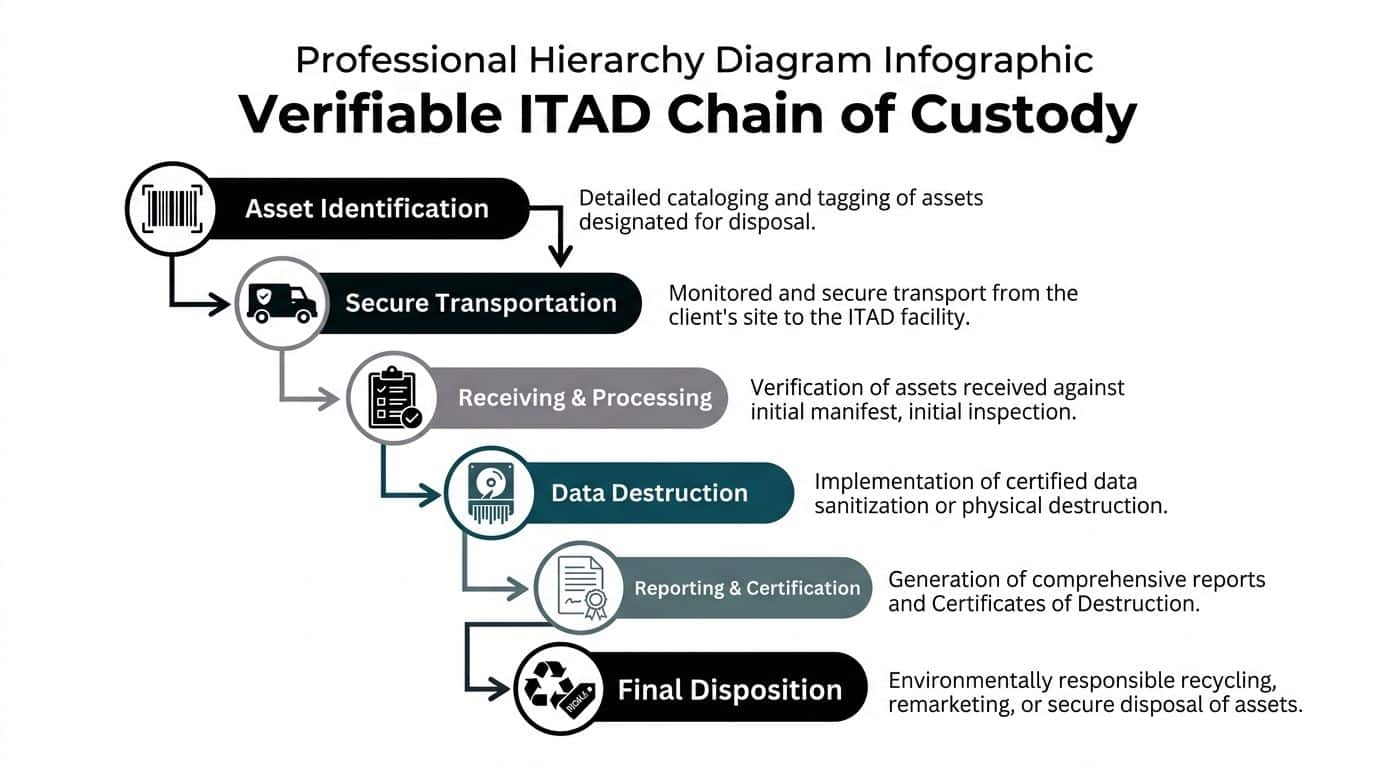
That answer comes from chain of custody.
What the paper trail should include
In enterprise and data-center environments, the strongest disposal programs combine serialized inventory control, chain-of-custody documentation, and NIST 800-88-compliant destruction. The practical benchmark is whether every drive can be tied to a final disposition record, because that documentation is what transfers liability and supports defensible compliance outcomes for regulated sectors such as healthcare, finance, and government (Human-I-T on data center ITAD controls).
That standard should show up in your records from the start.
- Pickup manifest: What was removed, from where, and under whose authorization.
- Serialized tracking: Device-level identifiers where available, especially for data-bearing assets.
- Transport record: Evidence that assets moved through controlled custody.
- Destruction or wipe report: Confirmation of the method used for each relevant item.
- Final certificates: Formal records that support audit and liability transfer.
How to evaluate the vendor side
A surprising number of disposal arrangements sound compliant until you ask for examples of the actual reporting package.
Ask direct questions:
- Will every data-bearing asset appear on a final report?
- Do the serial records match the pickup inventory?
- Are data destruction results tied to specific devices?
- Will the certificate package support audit review later?
Those questions matter more than broad promises. This vendor due diligence checklist is a practical way to pressure-test whether a provider's controls are documented or just described.
Audit mindset: Receipts show removal. Chain-of-custody records show control. Certificates show final disposition. You need all three.
For Stockbridge businesses, IT equipment disposal either narrows or widens risk. Once equipment leaves the site, your protection depends on whether the paperwork is precise enough to stand on its own months or years later.
ITAD Logistics and Value Recovery for Stockbridge Businesses
For most companies, the hardest part isn't deciding that the old equipment has to go. It's coordinating the actual removal without disrupting operations, losing track of inventory, or sending potentially valuable devices down a scrap path too early.
A typical Stockbridge project starts with a site conversation about what equipment is in scope and whether any of it needs special handling. That can be as small as retired employee laptops in an office closet or as large as a phased data center de-installation with servers, switches, UPS units, and storage shelves.
What a well-run pickup looks like
The efficient model is straightforward. Assets are identified, staged, packed appropriately, and removed under a documented manifest. Once they reach the processing point, the equipment is sorted by disposition path.
That sorting step is where companies often recover value they would have lost with a simpler recycler.
- Remarketable equipment: Newer laptops, servers, and networking gear may be tested and prepared for resale.
- Parts-bearing systems: Some units have limited whole-unit value but still support component recovery.
- Non-reusable assets: Equipment with no resale path still moves into responsible recycling after data handling is complete.
One available local option is Beyond Surplus's Georgia IT asset recovery service, which combines pickup logistics, data destruction pathways, and asset recovery for business equipment.
Where value recovery helps most
Value recovery isn't guaranteed, and smart clients don't assume every retired asset has a resale market. Age, condition, specifications, cosmetic wear, and current demand all affect whether remarketing makes sense.
Still, disciplined ITAD distinctly outperforms blanket destruction policies.
Consider two disposal approaches. In the first, a company shreds all storage and scraps every chassis without testing. In the second, the company separates failed or high-risk media for destruction and allows reuse-eligible systems to be sanitized, graded, and sold through proper channels. The second approach usually gives the finance team a cleaner answer because it treats residual value as part of the project rather than an afterthought.
Old equipment isn't automatically worthless. It's only worthless after you've confirmed there's no compliant reuse path.
For Stockbridge businesses with multiple locations, hybrid staff, or recurring refresh cycles, the biggest advantage is consistency. Once the workflow is set, teams stop reinventing disposal every quarter. Equipment moves out faster, records improve, and the organization gets a repeatable process instead of another backlog.
Common Questions About Stockbridge ITAD Services
What factors determine the cost of ITAD services
Pricing usually depends on the equipment mix, the quantity, how pickup is staged, and the required data destruction method. On-site shredding, off-site processing, remote asset coordination, and specialized packing can all change the service scope. If some assets still have resale value, that recovery may offset part of the project.
What equipment is too old to have value
Age alone doesn't decide it. Marketability depends on configuration, condition, brand, and whether the equipment still fits current business demand. Some older devices have no resale path and should go straight to recycling after data handling. Others still have component or secondary-market value.
Can specialized business equipment be handled
Yes, many business ITAD projects include more than standard computers. Medical devices, lab electronics, networking hardware, storage equipment, and other specialized systems can require different handling, especially if they contain drives, embedded storage, or regulated components.
How long does the process take
That depends on project size and complexity. A small office pickup can move quickly. Multi-site collections, remote user recovery, or data center work takes more planning because inventory matching and custody controls matter more than speed.
How should a business prepare for pickup
Start with a basic asset list if you have one. Separate equipment that contains storage from peripherals that don't. Identify anything that may need witness destruction, and flag assets that were used in healthcare, finance, government, or other tightly regulated environments.
How do you start
Contact the provider, review the inventory and requirements, confirm the pickup model, and ask what reporting package you'll receive at the end.
If your team in Stockbridge needs a documented way to retire laptops, servers, storage, network gear, or specialized electronics, contact Beyond Surplus. Ask for a business ITAD workflow that covers pickup, chain of custody, data destruction, recycling, and value recovery with records your compliance team can effectively use.


