

A lot of Duluth IT managers are dealing with the same scene right now. Retired laptops are stacked in a storage room, a few old servers are still sitting on a rack because nobody wants to touch them, and a pile of monitors, switches, and dead SSDs keeps growing while the next refresh cycle is already underway.
That backlog looks like an operations problem, but it’s really a security and compliance problem. Every stored device is an asset you still have to account for. If it contains regulated data, credentials, client records, or internal IP, “we took it out of service” is not the same as “the risk is gone.”
That’s why businesses searching for Duluth ITAD Providers: Secure IT Disposal Options need to think beyond basic recycling. IT asset disposition, or ITAD, is the controlled retirement of business technology through documented pickup, data destruction, downstream processing, and final reporting. If your company is also relocating or exiting space, IT retirement often overlaps with furniture removal, cabling, and facility turnover, which is why teams handling broader transitions may also be planning an office shutdown at the same time.
A solid local program starts with a clear disposal workflow, not a truck and a promise. That includes asset listing, packaging, custody control, destruction decisions, and a final record you can hand to legal, compliance, procurement, or an auditor. Businesses that need regional service can also review Duluth computer electronics recycling options as part of a wider ITAD process.
Introduction The Challenge of Retiring Business IT Assets in Duluth
Old business equipment creates hidden exposure because retired gear often stays in limbo. Devices get pulled from desks and racks faster than they get documented, sanitized, and removed. In practice, that gap is where mistakes happen.
What usually goes wrong
The weak points are rarely dramatic. A team member sets aside drives for “later.” Pickup happens before the asset list is reconciled. Someone assumes formatting a laptop is enough. Finance wants resale value, security wants shredding, and nobody has a rule for deciding between them.
Secure disposal fails when companies treat it like junk removal instead of controlled risk transfer.
The right framing is simple. You are closing out a chain of responsibility for each asset.
What a Duluth IT manager should expect
A workable ITAD process for a Duluth business should answer these questions before pickup day:
- What are we disposing of: You need a current inventory, even if it’s a spreadsheet cleaned up from multiple systems.
- Which items contain data: Servers, laptops, desktops, mobile devices, storage arrays, backup media, and loose drives all need separate handling rules.
- What happens to each class of asset: Some devices should be wiped and remarketed. Others should be destroyed immediately.
- What proof do we receive: Reporting matters as much as the physical work.
If a provider can’t explain those points clearly, they are not helping you reduce risk. They are just moving it somewhere else.
Understanding Your ITAD Compliance Obligations
Compliance starts before any pallet leaves your building. The disposal process has to stand up to internal review, insurer questions, customer scrutiny, and potentially litigation if something goes wrong.

The baseline rules that matter
A foundational benchmark for secure IT disposal is the regulatory and standards framework itself. The U.S. FTC Disposal Rule has applied since 2005 and requires covered organizations to take “reasonable measures” to dispose of consumer information properly, while NIST SP 800-88 remains the most widely cited technical guide for media sanitization in ITAD programs, as outlined in this secure ITAD framework overview.
That has direct consequences for procurement and operations. A defensible workflow should include inventory tracking, chain-of-custody records, certified data wiping or physical destruction, and proof of disposal. Those controls are what allow a company to show that the right asset was processed the right way.
Why this matters beyond the IT team
A disposal failure doesn’t stay in the server room. It can become a legal dispute, a customer notification issue, an insurance problem, or a board-level incident. For legal teams evaluating downstream exposure, it helps to understand how firms approach navigating data breach lawsuits after a security event.
Here’s the practical point. If your company cannot produce an intake list, a custody trail, and final destruction evidence, you may have trouble proving that the risk was closed.
Practical rule: If a provider’s paperwork would not help your compliance lead answer an auditor’s question, it is not enough paperwork.
Duluth organizations that need internal buy-in often have success when they present ITAD as a compliance control instead of a recycling expense. For a broader operating checklist, this secure IT disposal guide is useful for mapping disposal tasks to governance requirements.
Liability doesn’t disappear on its own
Retiring equipment is not the same as transferring liability. Liability transfer becomes much easier to demonstrate when the provider gives you verifiable records tied to the specific devices collected. That’s why vague “all materials recycled” receipts are weak. Auditable device-level reporting is stronger.
Core Services from Duluth ITAD Providers
A Duluth IT manager closing a satellite office usually has two pressures at once. Legal and security teams want proof that retired devices were handled correctly, and finance wants to know whether any value can be recovered from the equipment. A capable ITAD provider should address both without forcing you to choose one at the expense of the other.
The service mix should match the risk profile of the assets. A healthcare practice retiring encrypted laptops can often preserve resale value if the provider can verify sanitization and maintain asset-level tracking. A manufacturer pulling failed drives from network closets may decide that on-site destruction is the better control because the residual value is low and the exposure from a custody gap is much higher.
The service categories that matter
Most Duluth ITAD projects fall into five operational categories:
- Secure logistics and pickup: Scheduled collection, packing, labeling, chain-of-custody intake, and transportation controls.
- Data destruction: Software sanitization, degaussing for compatible media, or physical destruction based on the device and policy requirements.
- Value recovery: Functional testing, repair screening, refurbishment, resale, and settlement reporting for devices that still have market value.
- Recycling: Downstream processing for equipment that cannot be reused economically or should not return to the secondary market.
- Project support: De-installation, rack and cable removal, palletization, site cleanup, and serialized reconciliation for larger refreshes or closures.
A good provider should be able to explain where each service starts, where it ends, and what documentation you will receive. Analysts at Gartner describe IT asset disposition as a set of services that commonly includes logistics, data sanitization, remarketing, recycling, and reporting in this IT asset disposition market overview.
Comparison of Core ITAD Service Options
| Service | Security Level | Value Recovery | Best For |
|---|---|---|---|
| Secure pickup with manifesting | Moderate to high, depending on custody controls | Limited by itself | Offices that need documented removal before processing |
| Off-site certified data wiping | High when verification and reporting are strong | Strongest option for reusable hardware | Laptop and desktop fleets with resale potential |
| On-site physical destruction | Very high for media that must not leave intact | Low | Sensitive drives, regulated environments, urgent risk reduction |
| Off-site shred after intake | High if custody is documented and serials are matched | Low | Mixed loads with failed or non-remarketable media |
| Asset remarketing and recycling | Varies by sanitization path | High for eligible gear | Refresh projects seeking cost offset and sustainability reporting |
The main trade-off is straightforward. The more resale value you want to preserve, the more disciplined the provider must be at intake, testing, sanitization, and exception reporting.
That matters because some retired devices still contain recoverable data if controls fail. Companies that have seen drives resurface through secondary channels already understand why improper handling creates demand for data recovery services in the first place.
Some vendors mainly haul equipment away and pass it downstream. Others provide decommissioning labor, serialized inventories, repair triage, and final reconciliation tied to each asset tag. Businesses reviewing IT equipment disposal services should ask a direct question early: will you receive device-level reporting that lets you prove what happened to each asset, or only a general recycling receipt?
A Deeper Look at Data Destruction Methods
Data destruction is where many disposal projects either become defensible or fall apart. The method has to fit both the media type and the sensitivity of the data that lived on it.

Clear Purge and Destroy
NIST 800-88 recognizes three sanitization outcomes: Clear, Purge, and Destroy. The strongest technical control is choosing among them by data sensitivity, not by habit, as described in this evaluation of data-center sanitization practices.
- Clear: Typically software-based sanitization. Useful where policy allows reuse and the media supports verifiable erasure.
- Purge: A stronger sanitization path for certain media types, often used where a higher assurance level is required.
- Destroy: Physical destruction when reuse is not appropriate or the risk profile is too high.
Why deletion and formatting are not enough
Deleting files changes pointers. Formatting prepares a file system. Neither automatically means the data is irrecoverable. If you need a reminder of how recoverable storage can be under the right conditions, consumer-facing data recovery services make that point very clearly.
That is why a vendor’s method statement matters. Ask what tool or process they use, how they verify the result, and whether the final report ties the action back to the serial number or storage identifier.
High-assurance disposal needs proof that the correct storage device received the correct sanitization method at a specific time.
For teams that need a practical refresher before vendor conversations, this guide on how to erase a hard drive helps clarify what secure erasure involves and where it stops being enough.
How to Vet and Choose an ITAD Partner for Your Duluth Business
A Duluth IT manager usually finds out whether an ITAD vendor is competent after the first exception, not during the sales call. A pallet count is off. A drive is missing from the report. A certificate arrives with no serial-level detail. At that point, the issue is no longer recycling. It is audit exposure, contractual risk, and a disposal process you may have to defend to leadership, customers, or counsel.
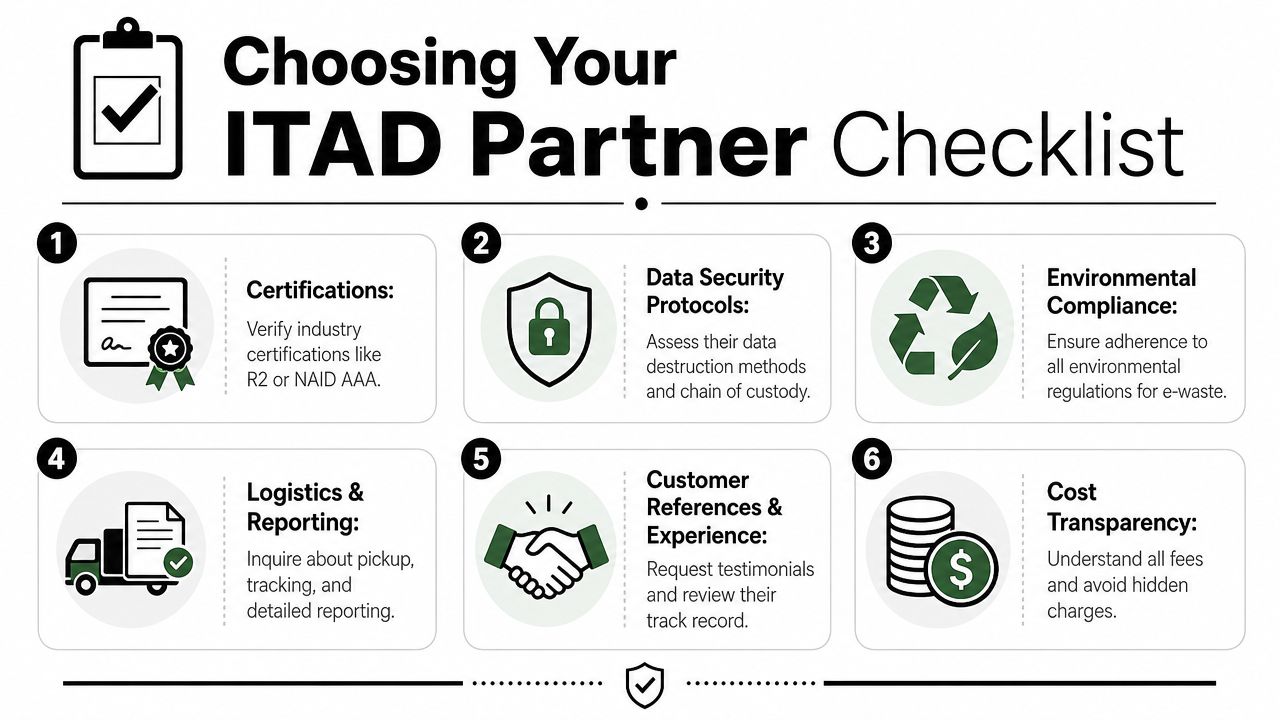
Choosing an ITAD company is closer to selecting a security and compliance vendor than hiring a hauler. The right provider can support your NIST-aligned media sanitization policy, preserve chain of custody, and document what happened to each asset class. The wrong one creates gaps your team has to explain later.
Baseline vendor requirements
Start with documented controls. Ask whether processing happens under recognized certification frameworks, whether destruction and resale decisions follow written policy, and whether reports tie actions back to specific assets or storage media. Certifications do not replace due diligence, but they do tell you the vendor has submitted its process to outside review.
For Duluth businesses, this matters most when local convenience conflicts with process discipline. A nearby pickup option may still be the wrong fit if the vendor cannot show intake controls, employee screening, downstream accountability, and exception handling. Proximity helps operations. It does not reduce liability on its own.
Ask these questions directly
- Who takes custody, and when: Get the exact handoff point from your staff to the vendor, including manifests, sealed containers if used, and what happens during transport.
- What level of reporting do you issue: Ask for sample reports. You want asset-level or media-level documentation where your policy requires it, not a generic weight ticket or pickup receipt.
- How do you decide between remarketing, sanitization, and destruction: A credible provider can explain the decision logic by device type, data sensitivity, and client instruction.
- How are exceptions handled: Ask what happens if a serial number is unreadable, a drive fails erasure, or equipment arrives damaged or incomplete.
- Can your process hold up under a larger project: Office closures, server room cleanouts, and mixed loads expose weak procedures quickly.
A strong proposal reads like an operating procedure. It covers packaging expectations, inventory reconciliation, transport controls, intake verification, sanitization or destruction workflow, and the records you receive at closeout. A weak proposal usually stays high-level and avoids the awkward details where risk sits.
For businesses with multiple offices or mixed asset streams, a nationwide provider can make policy enforcement easier because the reporting format and handling process stay consistent across sites. Beyond Surplus is one example of a provider serving commercial clients with ITAD, data destruction, logistics coordination, and final certification. If you need a practical scoring tool before you compare quotes, use this ITAD vendor due diligence checklist to test whether each proposal covers the controls your auditors and customers will care about.
If a provider cannot explain, in plain terms, how assets move from your custody to final disposition and how that path is documented, keep looking.
Logistics Costs and Final Certification
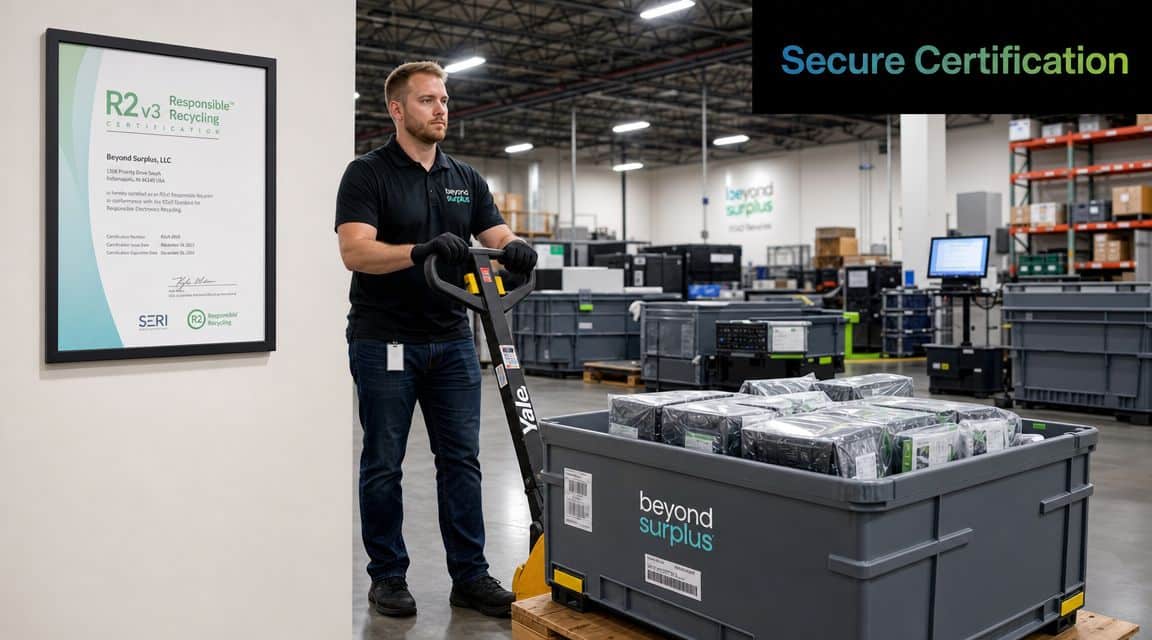
Once you approve a project, the practical work begins with scheduling, packaging rules, and pickup coordination. Some jobs are straightforward pallet pickups. Others involve de-installation, internal moves to a loading area, or separate handling for loose drives and backup media.
What you should expect operationally
Cost structures vary by project type. Providers may quote by device category, by load characteristics, or as a bundled project fee when labor and decommissioning are involved. What matters most is clarity on what is included: pickup, labor, wiping, shredding, reporting, and downstream recycling.
The document that closes the loop
The final certificate matters because it is the document your team files to show that assets were processed through a controlled end-of-life workflow. Depending on the project, that may include a Certificate of Destruction, a Certificate of Recycling, or both.
Keep those records with your disposal ticket, inventory reconciliation, and internal approval trail. If legal, compliance, or a customer asks later what happened to a retired device set, that documentation is your answer.
Frequently Asked Questions about IT Asset Disposition
Should we shred SSDs or try to recover value first
It depends on device type, age, and data sensitivity. Modern ITAD programs often recover more value when they segment assets instead of shredding everything by default, especially in SSD-heavy environments. At the same time, recoverability remains possible if devices are not properly processed, which is why guidance emphasizes NIST 800-88-compliant sanitization and certificate-backed proof in this ITAD and e-waste discussion.
What equipment do ITAD providers usually accept
Commercial providers typically handle laptops, desktops, servers, networking gear, mobile devices, storage hardware, peripherals, and mixed electronic loads from office or data-center environments. Acceptance depends on the provider’s downstream process and whether the load includes data-bearing devices, batteries, or equipment that needs de-installation.
How long does it take to get final documentation
That depends on project scope, intake complexity, and whether the devices are being wiped for remarketing or destroyed immediately. Straightforward destruction jobs usually move faster than projects that require testing, verification, and resale grading. Ask the provider to state the expected reporting timeline in writing before pickup.
Is local pickup enough to judge a provider
No. Pickup is the easy part. The key evaluation points are custody controls, destruction method, serialized reporting, and the quality of the final certificate package.
If your team in Duluth needs a documented path for retiring laptops, servers, storage, or mixed IT equipment, contact Beyond Surplus to discuss secure pickup, certified data destruction, asset recovery options, and the reporting required to close out risk properly.


