
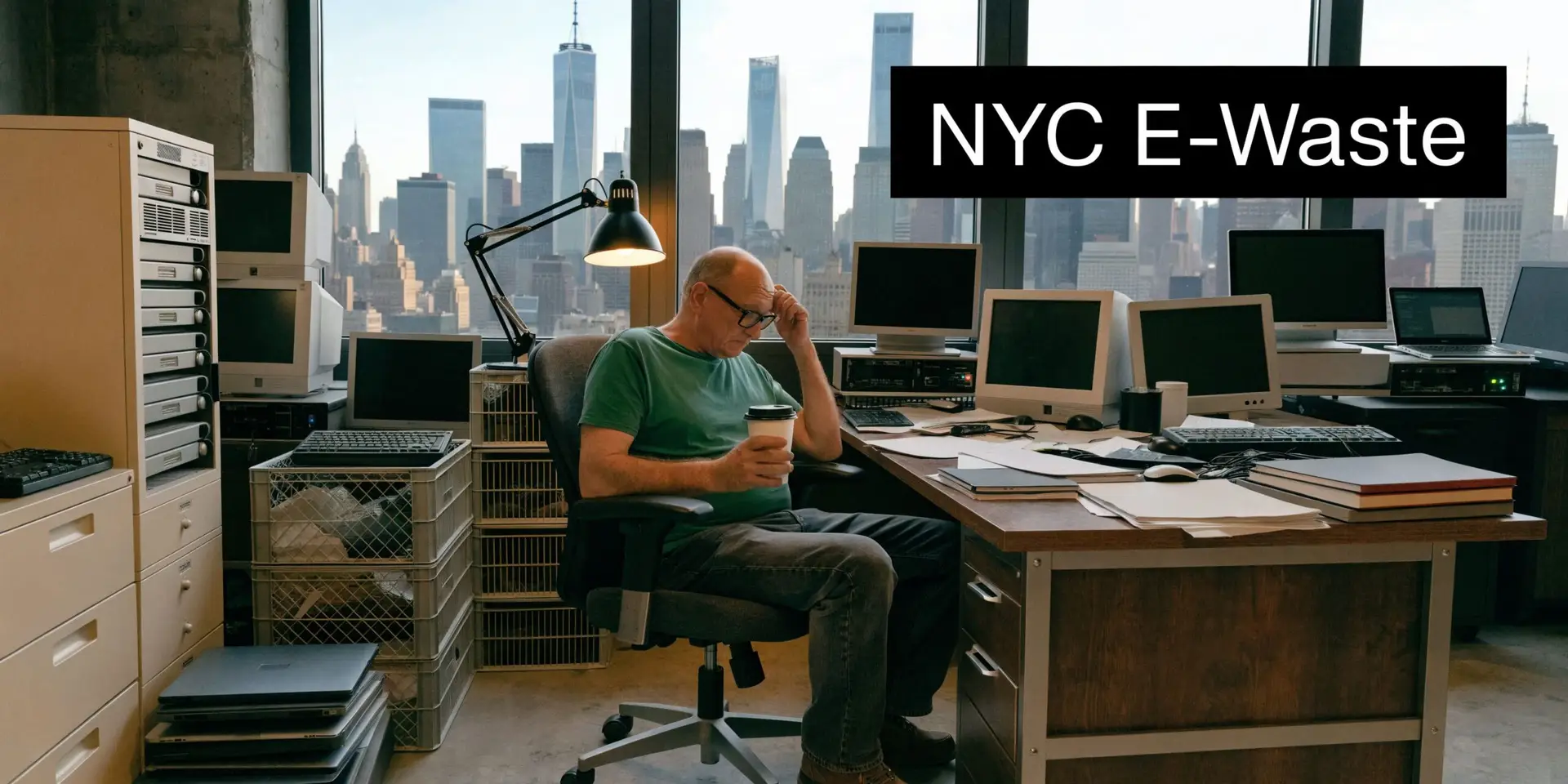
Old laptops in a locked closet. Retired switches in a server room corner. Pallets of monitors waiting for someone to “deal with them later.” That is how e waste nyc usually shows up for businesses. Not as a sustainability initiative, but as an operational problem with legal, security, and space consequences.
For an NYC business, the wrong disposal decision can create two failures at once. One is regulatory. The other is data exposure. The practical answer is not “find a drop-off site.” It is building a process that treats retired electronics as controlled assets until they are documented, sanitized, transported, and processed correctly.
Navigating Corporate E-Waste Disposal in New York City
The first mistake many teams make is assuming business electronics can follow the same path as household electronics. In New York City, that assumption breaks down fast. Public information often leans residential, while commercial IT managers have to solve for security, chain of custody, building access, scheduling, and documentation.
A typical business disposal project starts with a trigger event:
- Refresh cycle: desktops, laptops, and peripherals age out
- Office move: old hardware cannot move to the new floorplan
- Data center work: storage, servers, and network gear come offline
- Merger or cleanup: duplicate assets pile up without ownership
The right response is to classify the project before anything leaves the building.
What business teams need first
Start with an asset list, even if it is imperfect. Identify devices that store data, devices with resale potential, and devices that only need compliant recycling. This avoids the common failure of mixing everything together and losing both control and value.
Use a documented handoff process from the beginning. Facilities, IT, compliance, and procurement should know who approves pickup, who verifies serials, and who receives final reporting. That is the only way to keep e waste nyc manageable at business scale.
Treat retired electronics like controlled inventory, not like junk removal.
For companies that need a commercial starting point, NYC e-waste pickup options for organizations are more relevant than consumer guidance.
Understanding Your Legal Obligations for E-Waste in NYC
If your company operates in New York City, electronics cannot go in the trash. That is not a best practice. It is a legal boundary.
According to New York e-waste compliance guidance for business disposal, businesses in New York City have been prohibited from disposing of electronics in trash since 2015 under the New York State Electronic Equipment Recycling and Reuse Act, and violations can bring fines of up to $25,000 per day.
What that means in practice
For IT and facilities teams, compliance starts before pickup day. You need to identify what qualifies as covered electronic equipment, isolate it from general waste streams, and route it through a processor that can handle both environmental and data security requirements.
This compliance is important because business electronics are not just bulky. They often contain hazardous materials. Improper disposal increases environmental risk, and it puts the generator of the waste under scrutiny.
A useful operational lens is to treat e-waste as a specialized waste stream that intersects with IT governance. Teams that separate it early tend to avoid rushed, end-of-quarter disposal decisions that create audit problems later.
The legal risk is only part of the issue
The bigger problem is that bad disposal tends to come bundled with poor recordkeeping. If a company cannot show what left the site, when it left, and how data was handled, the issue is no longer limited to waste compliance.
That is why many compliance teams align e-waste handling with broader universal waste and EPA management considerations. The legal standard is only the floor. Internal controls should go further.
A business e-waste program fails the moment assets leave the building without documentation.
Municipal Programs vs Private ITAD Services
Municipal options have a place. They are just not designed for most enterprise disposal scenarios.
The key example is e-cycleNYC. The official DSNY e-cycleNYC program page shows that it targets residential buildings with 10+ units and uses scheduled pickups when sites accumulate 20 items or fill a bin. That model fits consumer density. It does not fit the high-security, high-volume requirements of corporate IT departments.
Side-by-side decision points
| Need | Municipal programs | Private ITAD |
|---|---|---|
| Volume handling | Limited for business-scale projects | Built for bulk loads and recurring pickups |
| Data destruction | Often not specified in detail | Typically central to the service scope |
| Chain of custody | Minimal or not business-focused | Expected for compliance-sensitive clients |
| Asset tracking | Basic collection model | Serialized reporting and audit support |
| Value recovery | Usually not the focus | Often includes remarketing workflows |
A city program can move material. A private ITAD provider manages a business process.
What works and what does not
What works:
- Single-site consumer volumes: public programs can be adequate
- Non-sensitive accessories: low-risk items may fit simpler channels
- Business projects with compliance demands: dedicated ITAD is the practical option
What does not work:
- Sending mixed lots of servers, laptops, and storage media into a generic collection stream
- Assuming a drop-off listing equals secure data destruction
- Treating a decommissioning project like office junk removal
Large organizations usually need pickup windows, dock coordination, serialized intake, and proof of disposition. Municipal services are not built around those requirements.
Secure Data Destruction a Critical Compliance Checkpoint
The most expensive mistake in e waste nyc is not recycling the wrong way. It is letting data leave your control.
Public resources in NYC often list drop-off locations but do not spell out certified data wiping or shredding options, which leaves a real gap for healthcare, finance, and government organizations that need proof of destruction for compliance, as shown on the NYC electronics disposal information page.

Wiping and shredding solve different problems
Data wiping is appropriate when the asset may be reused or resold. The goal is to sanitize media in a documented way while preserving hardware value.
Physical shredding is appropriate when policy, media condition, or risk profile does not allow reuse. This is common for failed drives, highly sensitive environments, or devices with uncertain custody history.
Neither option should be informal. The business requirement is evidence.
The document that matters
A certificate of data destruction is more than a receipt. It is the record your compliance team, legal team, and auditors may need later. If your vendor cannot produce clear destruction documentation, your company still owns the risk.
That why mature programs pair secure transport with certified data destruction services for business electronics. The destruction event has to be traceable to the assets you released.
If a hard drive leaves your building without a documented sanitization path, the project is unfinished.
Security teams that are tightening endpoint retirement policies should also review broader essential cybersecurity tips for businesses. End-of-life hardware is part of the attack surface, not a separate issue.
Planning for Large-Scale Business E-Waste Pickup
Bulk disposal projects fail when companies wait until the hallway is blocked. The logistics in NYC are too tight for improvisation. Elevators are shared, docks have time windows, buildings require COIs, and traffic punishes loose planning.
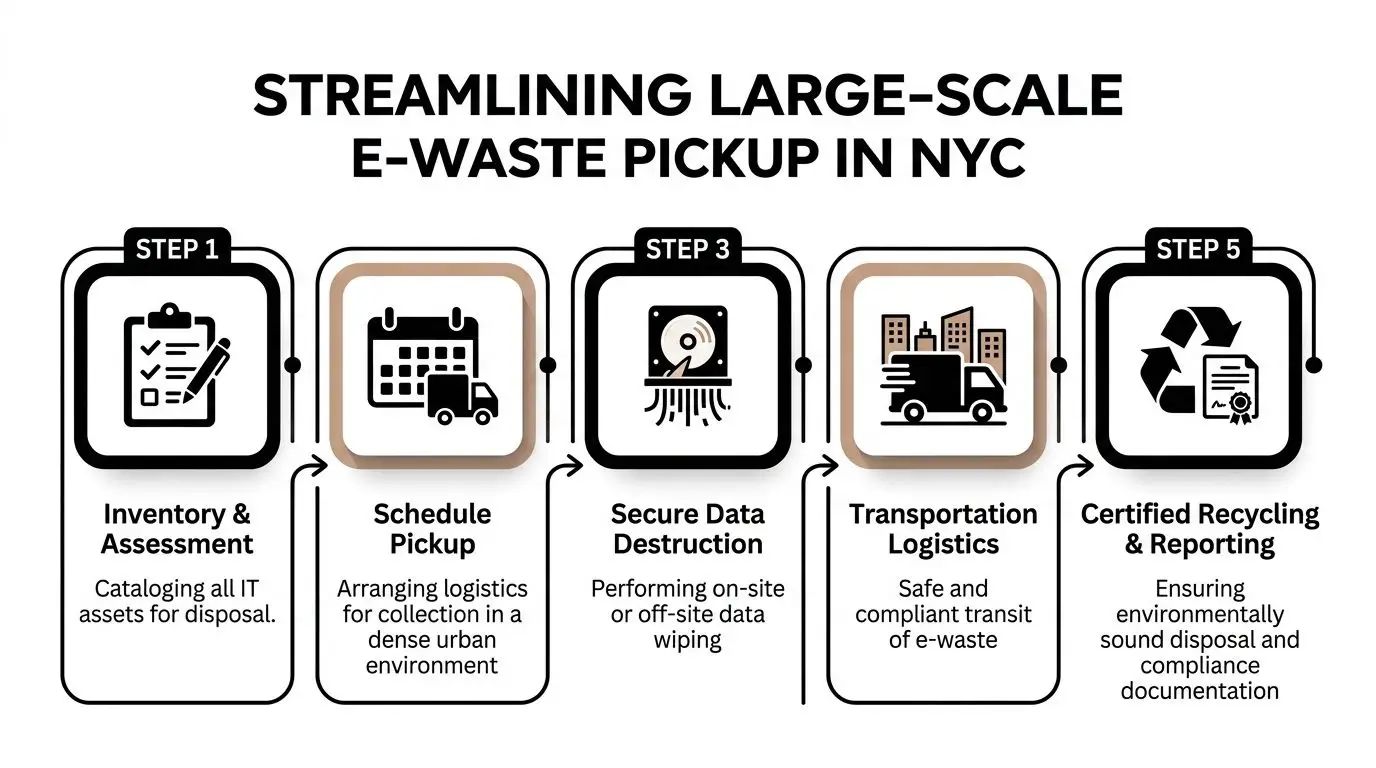
Larger New York businesses face documented “logistical challenges of storing and transporting” bulk e-waste, and free municipal services are not available to them, which is why they end up using private providers for scalable pickup and processing, as noted in this overview of New York e-waste regulations for organizations.
A workable pickup framework
Build the inventory
Count the asset types first. Then flag anything with storage media, anything leased, and anything that may still have remarketing value.
Separate by handling path
Servers and laptops should not be mixed blindly with cables, broken monitors, and scrap peripherals. Separation speeds intake and preserves options.
Prepare the site
Confirm loading dock access, freight elevator reservations, building paperwork, and after-hours restrictions. In NYC, this step often determines whether the pickup runs smoothly.
Package for control
Use pallets, gaylords, carts, or clearly staged equipment by category. Labeling matters. A clean staging area reduces counting errors and chain-of-custody disputes.
Define the paperwork
Decide who signs the release, who receives serial reports, and where certificates will be stored internally.
Common friction points
- Mixed ownership: equipment from multiple departments with no single approver
- Incomplete records: devices appear in storage but not on the asset register
- Access issues: trucks arrive before dock clearance
- Late security review: legal asks about destruction proof after pickup is complete
For teams comparing options, public electronics drop-off and collection references can help frame the market, but large NYC projects usually require direct pickup planning instead of drop-off logic.
Maximizing Value Recovery from Retired IT Assets
A lot of companies treat every retired device as disposal cost. That is an accounting habit, not a technical truth.
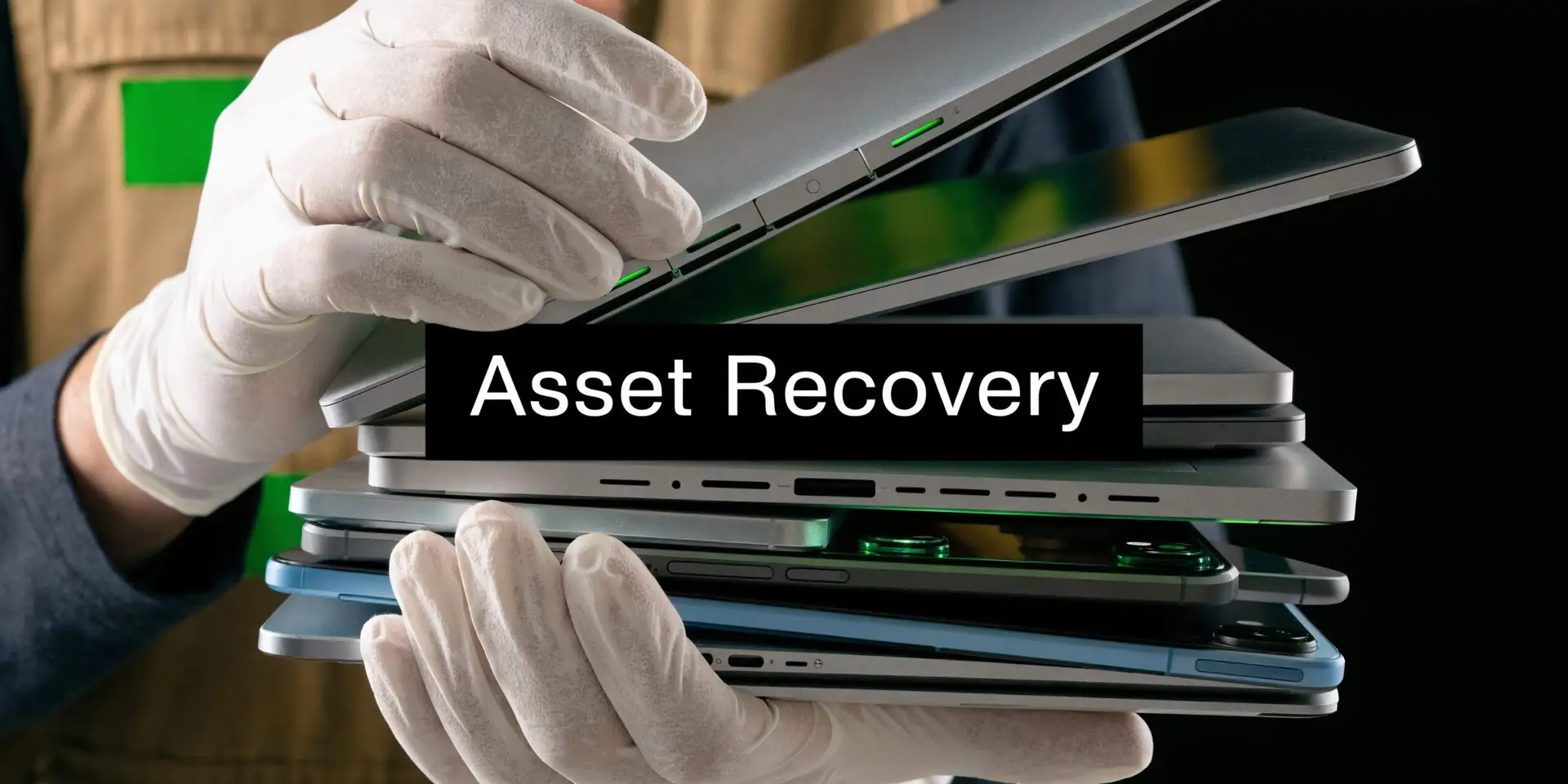
New York State’s e-waste programs processed over 101 million pounds in a single year, exceeding the statewide goal of 97 million pounds by more than 4 million pounds, according to the New York State e-waste annual report. In a stream that large, enterprise hardware with resale potential easily gets lost when organizations default to basic recycling.
Which assets usually hold value
Not every device should be marketed. But several categories often deserve a second look:
- Business laptops: especially standardized fleets with known specs
- Servers and networking gear: where secondary demand still exists
- Late-model peripherals: if they are clean, functional, and complete
- Spare inventory: unopened or lightly used hardware often performs best
The mistake is shredding or scrapping assets before anyone checks condition, age, and marketability.
Why process design affects recovery
Value recovery starts before the truck arrives. If equipment is stacked carelessly, stripped of components, or mixed with broken material, resale potential drops quickly. Good ITAD programs separate reusable assets early, test where appropriate, and route only nonrecoverable material to recycling.
That is one reason mature teams connect retirement planning to broader mastering IT asset lifecycle management. The best recovery results come from decisions made at deployment, refresh, and storage stages, not just at the end.
Companies evaluating outcomes should look at IT asset recovery service models as part of disposal planning, not as an afterthought. Done well, e waste nyc becomes a controlled mix of destruction, recycling, and remarketing.
The cheapest disposal path is often the one that destroys the most recoverable value.
How Beyond Surplus Solves E-Waste for NYC Businesses
NYC organizations need more than a recycler. They need a process owner.
That means one partner handling pickup coordination, secure transportation, data destruction, downstream recycling, reporting, and asset recovery without forcing your internal team to stitch together separate vendors. For a Manhattan office, Brooklyn school, Queens healthcare facility, or regional data center, that consolidation removes the usual gaps where mistakes happen.
Beyond Surplus supports business e-waste projects with nationwide pickup for organizations, secure data destruction, certificates of recycling and destruction, de-installation support, and value recovery workflows for resale-eligible equipment. That mix matters in New York City because compliance, logistics, and security all converge in the same project.
The practical advantage is not just convenience. It is consistency. One documented chain from pickup through final disposition is easier to manage than a patchwork of haulers, recyclers, and internal handoffs.
For IT managers and facilities teams, the standard should be simple. Your vendor should be able to answer four questions clearly:
- What happens to each asset category?
- How is data destroyed and documented?
- How is transport controlled?
- Which assets may return value instead of becoming pure scrap?
If those answers are vague, the risk stays with your company.
Frequently Asked Questions for NYC E-Waste Disposal
Below are the questions business teams ask most often when managing e waste nyc projects.
| Question | Answer |
|---|---|
| Can my company throw old computers in the trash if they no longer work? | No. Business electronics in NYC cannot be disposed of in the trash. Noncompliance can trigger serious penalties. |
| Can a business use e-cycleNYC? | That program is designed around residential building collection, not most corporate IT environments. Business teams with volume, security, or documentation needs usually require private ITAD service. |
| Do I need data destruction for every device? | You need a documented decision for every device that may store data. Some assets can be wiped for reuse. Others should be physically destroyed. |
| What paperwork should I expect? | At minimum, expect pickup documentation and final certificates tied to the service performed. Many organizations also require serialized reporting. |
| What about a data center shutdown or office consolidation? | Those projects need tighter planning because equipment volumes are higher, access windows are narrower, and chain-of-custody failures are more costly. |
| Can schools, healthcare groups, and finance firms follow the same process? | The basic disposal workflow is similar, but regulated sectors usually need stricter internal approvals and stronger proof of data destruction. |
| Is recycling always the best outcome? | No. Some assets should be remarketed after proper data sanitization. Others should go straight to destruction or material recovery. |
| Should we schedule recurring pickups? | If your organization retires equipment routinely, recurring service often reduces storage problems and keeps projects from becoming urgent cleanouts. |
Beyond Surplus helps organizations manage e waste nyc with secure pickups, certified data destruction, electronics recycling, IT asset recovery, and nationwide logistics for business clients. Contact Beyond Surplus to schedule compliant electronics recycling and secure IT asset disposal.