

For businesses in Georgia, arranging a professional e-waste pickup service is more than just clearing out old equipment—it’s a critical component of risk management and corporate responsibility. Improper disposal of IT assets exposes your company to significant data breach risks, severe regulatory penalties, and lasting reputational harm. A certified IT asset disposal (ITAD) strategy is not a luxury; it is an essential business practice for commercial and enterprise operations.
Why Georgia Businesses Require a Professional E-Waste Strategy
Managing retired IT equipment presents a substantial challenge for Georgia’s businesses, data centers, and healthcare facilities. Obsolete computers, servers, or specialized medical devices cannot be discarded in standard waste streams. The entire disposal process is fraught with risks that can result in severe financial and legal repercussions if not handled by certified professionals.
An unmanaged approach to electronic waste leaves a business vulnerable to two primary threats: data security breaches and environmental compliance violations. Every hard drive, server, and smartphone contains sensitive corporate, client, or patient information. Failure to properly destroy this data before disposal can lead to breaches that violate federal regulations like HIPAA or the FTC Disposal Rule, resulting in costly penalties.
The Compliance and Security Imperative
For IT managers and compliance officers, maintaining a secure chain of custody for retired assets is paramount. Without a documented, auditable process, it’s impossible to prove your organization has met its due diligence obligations. This is where a professional e-waste pickup service transforms a logistical challenge into a secure, streamlined operation.
It delivers:
- Certified Data Destruction: Guarantees that all sensitive information is permanently and irretrievably destroyed according to NIST standards.
- Documented Compliance: Provides official Certificates of Recycling and Data Destruction for your records, proving adherence to all regulations.
- Liability Transfer: Shifts the responsibility for proper disposal from your organization to a certified, insured ITAD vendor.
Navigating Georgia’s Regulatory Landscape
The national e-waste crisis presents a unique challenge in Georgia. The U.S. generates millions of tons of e-waste annually, yet recycling rates remain insufficient. Because Georgia is one of the states without mandatory e-waste recycling laws for businesses, the onus falls directly on companies to act responsibly without explicit state-level legislative guidance.
This lack of state mandates actually increases the risks for IT directors and facility managers, who must navigate complex federal data protection and disposal regulations independently.
Integrating IT asset disposition into broader operational planning is a smart business practice. For instance, when planning an office move, including e-waste management in your office relocation checklist ensures retired electronics are handled securely from the outset. A robust strategy is not just about disposal—it’s about safeguarding your business’s future. You can learn more about the environmental impact of electronic waste in our detailed guide.
Preparing Your IT Assets For Secure Pickup
A smooth and secure e-waste pickup in Georgia begins long before our truck arrives at your facility. The preparation phase is the most critical for any IT or facilities manager. It transforms a potentially chaotic cleanout into a seamless, auditable, and secure operation.
Proper preparation ensures your data remains secure, maximizes potential value recovery, and guarantees an efficient handover to our logistics team.
Inventory and Segregation: The Groundwork for a Smooth Pickup
First, create a detailed inventory of all assets slated for disposal. A simple spreadsheet is typically sufficient to establish a clear record of what is leaving your active environment. This step is vital for your internal accountability and for the chain-of-custody documentation we provide.
Next, physically sort the equipment. Grouping similar items—such as laptops, servers, and peripherals—streamlines the pickup process significantly and can dramatically reduce the time our team spends on-site.
This is also the ideal time to separate equipment that may have resale value from items destined solely for recycling. For example:
- High-Value Assets: Laptops less than five years old, enterprise-grade servers, and recent networking switches often retain significant value on the secondary market.
- Recycling-Only Assets: Older desktops, non-functional monitors, printers, and obsolete cables are typically processed for their raw commodity value.
The infographic below illustrates how improper e-waste handling creates unnecessary risks, and how a secure, certified process protects your business at every stage.
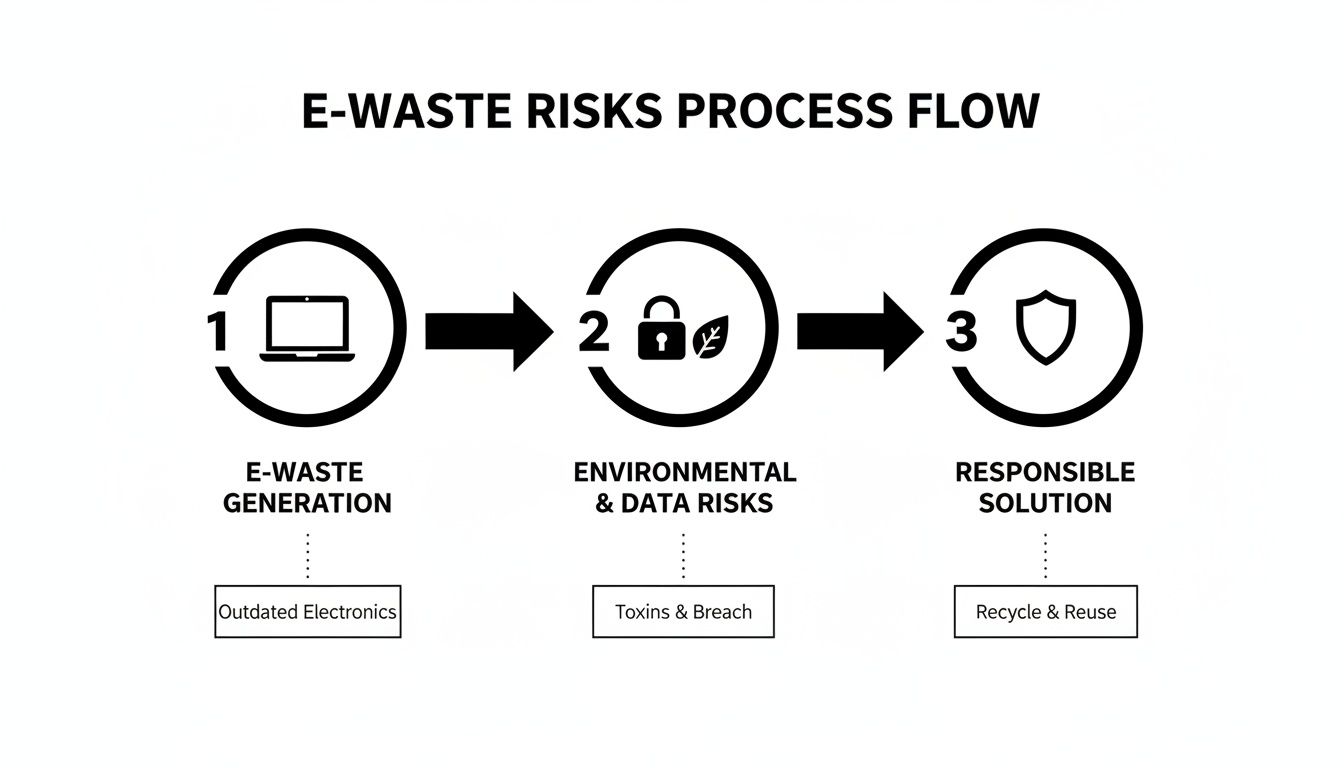
As you can see, managing retired electronics is not merely about hauling away old equipment. It is a deliberate process of mitigating both data security and environmental liabilities through a certified partner.
Data Destruction and Staging: The Final Steps Before We Arrive
While Beyond Surplus provides certified, documented data destruction for every drive we process, many organizations perform an initial data wipe in-house as a first line of defense. This is a best practice we highly recommend, particularly for businesses in highly regulated sectors like healthcare or finance. An internal standard operating procedure for wiping drives adds a powerful layer of security.
To ensure the pickup day is as efficient as possible, consolidate all prepared assets into a single, easily accessible location, such as a loading dock or a designated storage room. For a large data center decommission, this might involve palletizing server racks. For a hospital, it could mean loading medical devices onto rolling carts. The key is to have the equipment ready for a swift and secure handover.
To help you get organized, we have created a clear checklist.
E-Waste Preparation Checklist for Georgia Businesses
This table outlines the essential steps to prepare your IT assets for a secure and efficient pickup. Following this guide ensures no detail is overlooked.
| Preparation Step | Key Action Required | Why It Matters |
|---|---|---|
| Asset Inventory | Create a spreadsheet listing all items for pickup (e.g., model, serial number). | Essential for internal records, accountability, and chain-of-custody documentation. |
| Data Backup | Ensure all critical data is backed up from devices being retired. | Prevents accidental loss of important company information before assets are wiped. |
| Internal Data Wipe | Perform an initial data wipe on all drives, if company policy requires it. | Adds an extra layer of data security and compliance, acting as your first defense. |
| Segregate Assets | Group similar items together (laptops, servers, monitors, cables). | Speeds up the on-site pickup process and helps identify high-value equipment. |
| Consolidate & Stage | Move all prepared equipment to a single, accessible location like a loading dock. | Makes the physical handover quick, efficient, and secure for both your team and ours. |
| Labeling | Clearly label pallets or groups of equipment, especially those with resale value. | Ensures clear communication and accurate processing upon arrival at our facility. |
Systematically following these steps transforms the disposition process from a logistical burden into a well-managed project.
For a more detailed walkthrough, review our complete guide on how to prep electronics for recycling, which offers a deeper dive and a printable checklist. These proactive steps protect your organization and ensure you receive the most efficient and secure service from your ITAD program.
Understanding Data Destruction and Compliance
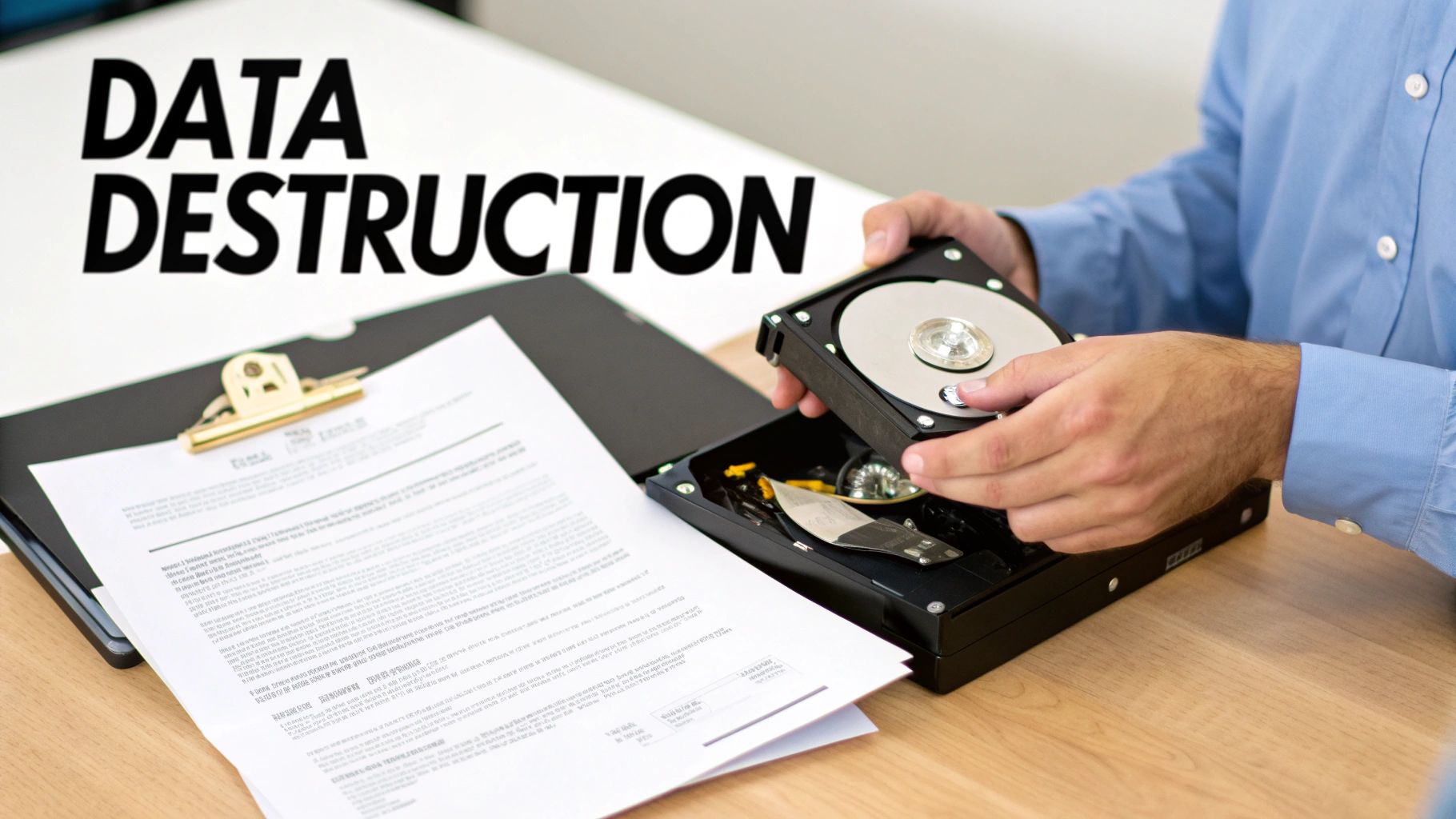
When any business in Georgia schedules an e-waste pickup, data security is the paramount concern. It is the legal and ethical foundation of IT asset disposal. Simply recycling hardware is insufficient; you have a corporate responsibility to guarantee that every bit of sensitive information on retired devices is permanently destroyed.
Failure in this area exposes your organization to immense risks, including brand-damaging data breaches and severe fines under regulations like HIPAA, SOX, and the FTC Disposal Rule.
Proper data destruction involves building an unbreakable chain of custody and a robust audit trail. This process protects your clients, your employees, and your company’s reputation. It is not an IT chore; it is a critical component of corporate governance.
On-Site Shredding vs. Certified Wiping
Businesses have two primary, highly secure methods for data destruction: physical shredding of drives or using certified software for data erasure. The correct choice depends on your internal security policies, compliance requirements, and whether the storage devices have potential resale value.
- On-Site Hard Drive Shredding: This is the most transparent and definitive method. A specialized shredding truck comes to your location, allowing you to witness your hard drives being physically destroyed. For healthcare systems or financial institutions that must meet the highest security standards, this is often the preferred option.
- Certified Data Wiping: This software-based approach overwrites all data on a hard drive multiple times, rendering it irrecoverable. It adheres to strict standards from the Department of Defense (DoD 5220.22-M) and the National Institute of Standards and Technology (NIST). The key advantage is that the drive remains intact, allowing it to be refurbished and resold to generate revenue that can offset your recycling costs.
For context, a major hospital system in Atlanta would likely require on-site shredding for any device that held patient data to ensure HIPAA compliance. Conversely, a tech company in Alpharetta retiring a rack of three-year-old servers might opt for certified wiping to recover value from the still-functional hardware.
The Role of Certification in Your Audit Trail
In compliance, documentation is your primary defense. A verbal assurance that data was destroyed is insufficient during an audit. This is why official certification is vital—it provides tangible proof that you have fulfilled your legal obligations.
Upon completion of any secure e-waste pickup, your company must receive a Certificate of Data Destruction. This legally binding document serves as your official record, detailing the methods used and the serial numbers of the sanitized devices. At this point, liability officially transfers from your company to your certified ITAD partner.
This certificate is the cornerstone of your compliance strategy. It provides your legal and compliance teams with the concrete evidence needed to demonstrate due diligence to auditors and regulators, closing the loop on an asset’s lifecycle.
For a deeper technical understanding, learn more about the industry gold standard in our article on NIST SP 800-88. It is the definitive framework for media sanitization and essential reading for any IT manager.
The Logistics of E-Waste Pickup in Georgia
The logistics of a commercial e-waste pickup involve more than simply showing up with a truck. Understanding the process demystifies the task, turning a complex project into a predictable, secure service. The journey from your initial call to the final compliance report is built on clear communication and meticulous coordination, designed to protect your assets and data from the moment they leave your control.
The process begins when you contact our team. To provide an accurate quote, our logistics specialists need a few key details about your project. This information allows us to tailor the pickup to your specific needs, whether you are a small business with a single pallet or a large enterprise managing a full data center decommission.
Information We Need for a Seamless Pickup
To ensure we arrive fully prepared and that the pickup proceeds without issue, we typically request the following:
- An equipment summary: A general list of what you have is sufficient for a quote (e.g., 50 laptops, 10 servers, 2 racks of networking gear).
- Location details: Is the equipment on the ground floor? Is there a loading dock? Understanding building access helps us deploy the right crew and equipment.
- Special handling needs: Are there unusually heavy items, such as a server rack that requires disassembly? Or sensitive medical equipment needing extra care?
- Data destruction requirements: Do you require on-site hard drive shredding for immediate verification, or is certified off-site wiping a better fit for your value recovery goals?
This information helps us determine the appropriate truck size, crew allocation, and timeline, resulting in a smooth and efficient collection day. For companies with regular IT refresh cycles, we can establish a recurring e-waste pickup in Georgia to maintain a clean and secure IT environment.
Behind the Scenes of a Coordinated Pickup
Once the details are finalized, our team coordinates the logistics. For larger projects, a dedicated project manager will work directly with your facilities or IT team to create a detailed action plan, including a clear chain-of-custody protocol from the start.
Every pickup is executed with security as the top priority. Our uniformed technicians arrive in branded vehicles, equipped to safely pack and transport your assets. Each item is inventoried and tracked, ensuring a transparent and defensible audit trail from your door to our secure facility.
The execution is precise. Equipment is carefully loaded onto pallets, shrink-wrapped for security, and transported in locked trucks. This professional approach not only protects your physical assets but also guarantees that your sensitive data is never exposed during transit, all with minimal disruption to your daily operations.
Ready to begin? You can schedule a pickup or register for drop-off through our online portal.
Turning Retired Tech into Revenue
Many businesses view their closet of old IT equipment as a sunk cost or a liability. However, what if those retired assets could generate revenue for your bottom line?
A strategic IT Asset Disposition (ITAD) program shifts the conversation from the cost of disposal to the opportunity for revenue recovery. For any CFO or IT manager focused on ROI, this is a significant advantage. This approach is about identifying and remarketing functional, in-demand technology in the robust secondary market.

Unlocking the Value in Your IT Closet
Not all retired technology is created equal. The key is identifying which assets hold the most resale potential. We have consistently found that certain categories deliver strong returns for our clients.
Assets with the highest potential for value recovery typically include:
- Recent-Model Laptops and Desktops: Corporate-grade equipment from brands like Dell, HP, and Lenovo is always in demand, especially if less than five years old.
- Enterprise Servers and Networking Gear: Data center equipment, including servers, switches, and routers from Cisco, Dell, and HPE, often retains significant value.
- Specialized and Lab Equipment: High-tech laboratory, medical, and manufacturing equipment can have a long and valuable second life.
Our evaluation process is transparent. We assess each asset based on its age, condition, configuration, and current market demand to provide a fair market value and a clear path to converting surplus tech into working capital. Beyond electronics, a comprehensive e-waste strategy can also explore turning plastic waste into profit through processes like industrial plastic recycling.
The Financial Case for Professional ITAD
The scale of untapped value in e-waste is staggering. In 2019, 53.6 million metric tons of e-waste contained an estimated $57 billion in raw materials, yet nearly 82.6% of that value was lost due to improper recycling.
For businesses in Georgia, this highlights a massive financial opportunity often overlooked.
When you partner with a certified ITAD provider, you are doing more than scheduling an e-waste pickup in Georgia; you are activating a new revenue stream. The funds recovered can directly offset—and often exceed—the costs of recycling and data destruction, frequently resulting in a net-positive financial outcome for your business.
This strategic approach transforms IT asset retirement from a mandatory expense into a smart financial decision. To learn more, explore our in-depth guide to IT asset recovery services.
Frequently Asked Questions for Businesses
Navigating professional e-waste management can raise questions, even with a well-defined plan. We regularly assist IT directors, facility managers, and business owners across Georgia who are managing this process. Here are answers to some of the most common inquiries.
Our goal is to make secure IT asset disposition accessible to any commercial organization.
Do You Handle Pickups for Small Businesses?
Yes. While we are fully equipped for large-scale data center decommissioning projects, we are equally dedicated to providing e-waste pickup solutions for small and medium-sized businesses across Georgia.
Our mission is to ensure every business has access to professional ITAD services. We serve law firms with a dozen laptops as readily as we do tech startups with pallets of servers. No business is too small to prioritize data security and environmental compliance, and we deliver the same certified level of service to all clients.
What Documentation Will We Receive?
This is a critical part of the process. After every pickup, we provide official documentation that creates a complete, defensible audit trail, officially transferring liability from you to us.
You will receive two key documents:
- A Certificate of Recycling: This confirms that all non-data-bearing equipment was processed in an environmentally responsible manner, compliant with all regulations.
- A Certificate of Data Destruction: This is your proof that every data-storing device was wiped or physically destroyed according to NIST 800-88 standards, ensuring compliance with rules like the FTC Disposal Rule.
Retaining this paperwork is essential for audits and regulatory inquiries.
How Is the Cost of a Pickup Determined?
The cost for a commercial e-waste pickup in Georgia depends on the type and volume of equipment, your location, and logistical factors (e.g., loading dock access). The specific services required, such as on-site hard drive shredding, also influence the price.
However, these costs can often be reduced or eliminated through our IT Asset Disposition (ITAD) and value recovery programs.
If your retired equipment has resale value—such as recent-model servers, laptops, or networking gear—you could receive a cash rebate or a no-cost pickup. We provide a custom assessment to determine the potential resale value of your assets.
This transforms a potential operational expense into a smart financial opportunity for your business.
Ready for a clear quote? Contact Beyond Surplus today for a detailed assessment of your company’s needs. Our team will develop a secure, compliant, and financially advantageous plan for your retired IT assets.


