Cut it up and throw it away is bad advice for an organization holding recalled children's products. That instruction may suit a parent with one toy and a recall notice that authorizes simple disposal, but it doesn't satisfy a retailer, school, childcare operator, distributor, or manufacturer that must account for every unit. Informal disposal can erase evidence, void a refund or repair remedy, and let usable products reenter donation or resale channels.
Controlled recalled children's product destruction is narrower and more demanding. It's authorized disposition, physical quarantine, reconciliation, witnessed destruction when required, safe handling of hazardous parts, and a record that identifies what was destroyed. A recycler receipt alone doesn't prove any of that. I would treat destruction as the last step in a documented chain, not as a shortcut for clearing storage space.
Table of Contents
- When Destruction Is the Right Remedy
- How to Vet the Destruction Vendor
- How to Quarantine and Destroy the Units
- Proof CPSC Will Accept
- Cost Logistics and Hazardous Parts
- Report What Is Still Outstanding
When Destruction Is the Right Remedy
Destruction isn't the default answer to a children's product recall. In the CPSC recalls data, disposal represented only 23 cases, or 1.1%, of listed remedies across five years, compared with 54.6% for refunds, 26.3% for repairs, and 16.9% for replacements. That distribution matters because cutting or crushing a unit before you know the authorized remedy can put your organization outside the recall plan.
Start with the recall notice, not with tools. Match the product name, model, lot, date code, and quantity exactly. Recalls often cover one production run while apparently identical units remain lawful inventory. Destroying unaffected stock wastes money, while missing one lot leaves the hazard in place.
Compare the Remedy Before You Act
| Remedy | Share of listed remedies | Use it when | What happens to the unit |
|---|---|---|---|
| Refund | 54.6% | The buyer is owed money and the item comes back | Quarantine returns; destroy only if they cannot safely reenter commerce |
| Repair | 26.3% | The defect can be fixed in home or at a facility | Destroy only units that fail repair or are missing parts |
| Replacement | 16.9% | A safer substitute is the offered remedy | Destroy the recalled unit after the replacement is issued |
| Disposal or destruction | 1.1% (23 cases) | Repair, relabel, or return to sale is unsafe | Make the product unusable under written instructions |
Contact the recalling firm before any unit is cut, crushed, dismantled, or hauled away. Ask four direct questions. Who is authorized to destroy it? Is destruction required or merely permitted? Must CPSC approve the method or observe the work? What certificate, affidavit, photographs, or serial records must you retain?
Those questions separate consumer self-disposal from institutional destruction. A parent may be told to cut a strap, remove a battery door, or photograph a disabled item to receive a refund. An organization holding cartons of the same product needs written disposition, segregated storage, controlled transport, and proof that no unit was diverted into salvage.
Cases Where Destruction Fits
Destruction fits when a product can't be safely repaired, relabeled, reworked, or returned to commerce. A crib with a dangerous structural design, broken components, or missing safety parts is a practical example. Repairing around a fundamental design defect can leave a usable looking product that still presents the original hazard.
It also fits when returned units can't be reliably inspected or when reusable components create a route back into service. Wheels, restraint systems, electronic modules, battery packs, and branded housings can all outlive the product if someone harvests them. The disposition instruction should say whether components must be destroyed with the unit or handled separately.
Practical rule: Written disposition from the recalling firm or CPSC outranks a local manager's wish to clear the storeroom.
Don't let urgency collapse the decision. A school that dumps recalled playground items in an open container may create retrieval, donation, and resale risk. A retailer that sends units to liquidation may breach recall restrictions even if staff removed them from the sales floor. Physical removal from your building isn't the same as removal from commerce.
Plan communications alongside operations. Staff need to know what to say to parents, customers, donors, and employees, and who approves external statements. The crisis readiness advice from Chicago Brandstarters is useful context for assigning decision makers and messages before questions arrive. Keep that communications plan tied to the recall file, but don't let public messaging run ahead of verified counts.
I would authorize destruction only after the remedy, quantity, method, witness requirement, and evidence package are settled in writing. Until then, the correct action is quarantine. That pause protects the refund, repair, or replacement path and prevents an irreversible step from becoming a compliance problem.
How to Vet the Destruction Vendor
Assume the vendor becomes part of your recall record. If its paperwork can't connect a specific recalled model and quantity to a specific destruction event, you're buying hauling and hope. Vet the company against pass or fail controls before discussing pickup dates or price.
Require a written scope naming the recall, model, lot, date code, and estimated quantity. The scope should prohibit resale, donation, employee removal, liquidation, and parts harvest. It should also prohibit commingling recalled goods with salvage, ordinary returns, or unrelated recyclable material.
Pass or Fail Vendor Checks
| Control | Accept | Reject |
|---|---|---|
| Chain of custody | Serialized intake through certified destruction | Bill of lading only |
| Method | De-manufacture, cut, crush, or shred until unusable | Resale, donation, or parts harvest |
| Battery and electronics stream | Licensed hazardous-material processor with documented route | Unknown export or landfill |
| Witness | Client or CPSC can observe on request | Witnessing refused |
| Certificate | Identifiers, quantity, method, date, facility, disposition | Generic recycling receipt |
| Liability | Accepted in writing for the destroyed load | Silent on liability |
Ask the vendor to describe the physical method product by product. A molded plastic ride on toy, a fabric carrier, a crib, and a battery powered learning toy don't become unusable through the same action. The credible answer names disassembly, cutting, crushing, shredding, or material specific processing and explains how operators prevent reconstruction.
Our own test is consistent with that standard. Equipment that fails reuse standards, is unrepairable, old, obsolete, or not contractually permitted to be remarketed is recycled and completely destroyed by de-manufacture and/or physical shredding. A vendor that offers buyback value for the recalled children's product itself should fail immediately, because the financial incentive points toward remarketing rather than verified destruction.
Follow the Hazardous Components
Batteries and electronics need a separate answer. Ask where lithium ion packs, circuit boards, motors, and chemical components go, which processor accepts them, and what document returns to you. "We recycle everything" isn't a route. Neither is an unnamed downstream buyer.
For electronic modules and data bearing components, look for controlled handling rather than casual dismantling. Our hard drives are shredded to NAID approved particle size, recorded under 24/7 video surveillance, and documented with a serialized certificate of destruction. Beyond Surplus also holds NAID AAA certified data destruction, covering hard drive shredding and product destruction with chain of custody for every Atlanta pickup.
Those controls don't replace children's product expertise, so keep asking product specific questions. Can the facility isolate swollen or damaged batteries? Will it reject loads that arrive mixed with unaffected inventory? Can it preserve a representative sample separately when the manufacturer requires failure analysis?
Control Witnessing and Subcontractors
Confirm that your representative can witness destruction and that a CPSC investigator can attend if the agency requires observation. A refusal to allow witnesses is a practical rejection point. You don't need to attend every routine load, but you do need the contractual right before a regulator asks.
Ask whether any subcontractor will transport, store, dismantle, shred, or recycle the material. Disclosure must happen before pickup, and the prime vendor must monitor the third party. The certificate should identify the actual facility and downstream disposition rather than hiding the work behind a broker's letterhead.
Use our vendor due diligence checklist to score candidates against the same written criteria. Weigh certificate content, witness access, hazardous battery handling, subcontractor disclosure, and written liability more heavily than a small price difference. Reject vague scopes, salvage language, parts recovery, and certificates that report only load weight.
The handoff isn't complete when the truck leaves. It's complete when the certificate identifies the product, quantity, method, date, facility, responsible people, and final material disposition, and those details reconcile with your intake log. Make the vendor accept that standard in writing before the first pallet moves.
How to Quarantine and Destroy the Units
Run quarantine like a controlled inventory event, not a cleanup. The CPSC recall effectiveness guidance supports identifying products by model, lot, date code, and quantity, segregating returns, maintaining a serialized intake log, and distinguishing units still in distribution from units already in consumers' hands. Mixing those populations distorts the true correction rate.
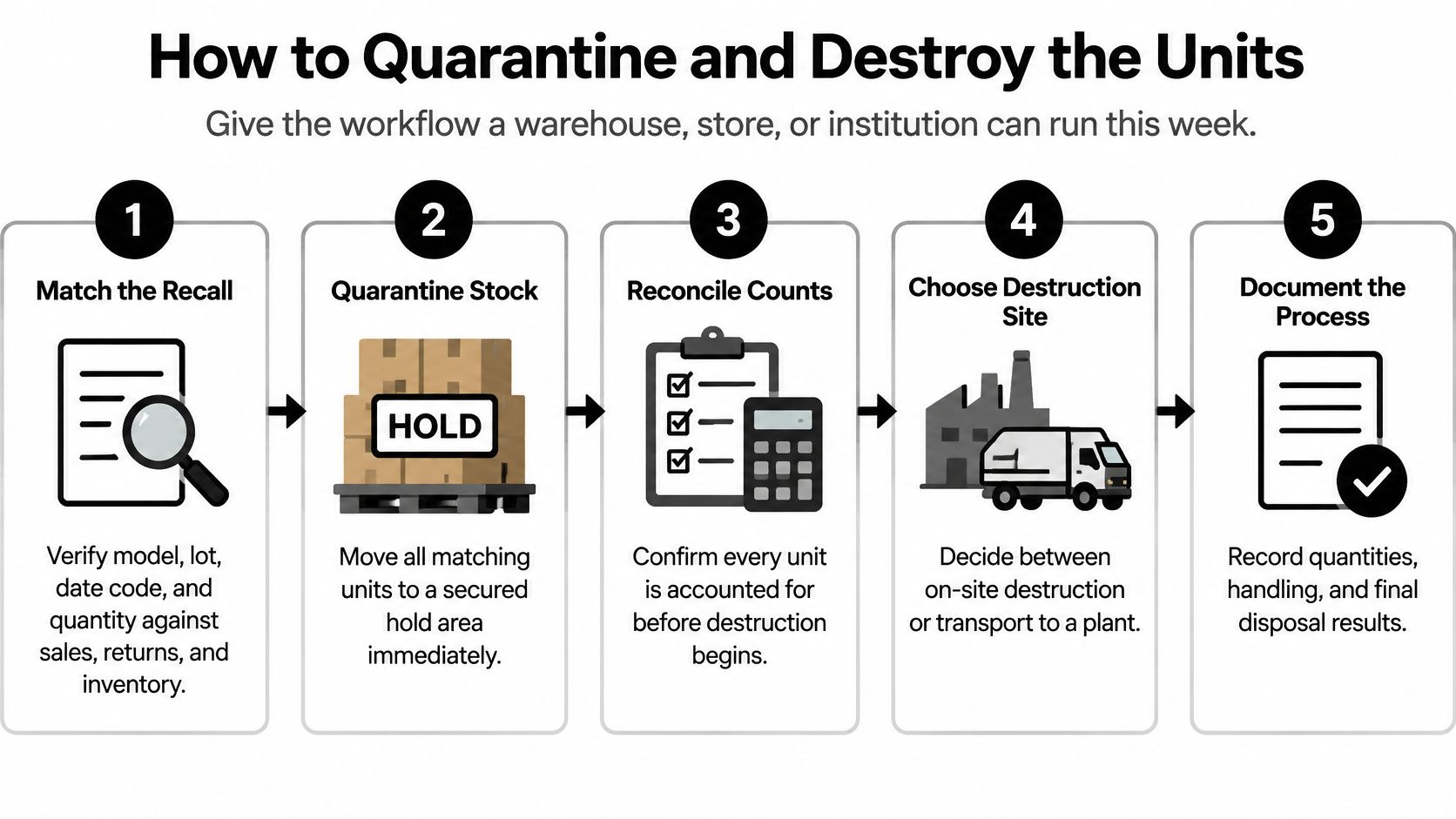
Ten Step Workflow
- Match every unit to the recall. Record model, lot, date code, serial number when present, location, and quantity. This prevents unaffected stock from being destroyed and affected stock from hiding under a similar SKU.
- Stop redistribution the same day. Block sales, transfers, marketplace listings, donations, employee purchases, and interstore movement. A product can't be quarantined if your system still allows someone to ship it.
- Move units into a locked hold area. Label containers with the recall identifier and keep them apart from unaffected inventory, customer returns, and salvage. Open floor stacks invite picking errors and unauthorized removal.
- Photograph labels and defects. Capture the model label, date code, packaging identifiers, and safety critical defect before packing. Later photographs of shredded material can't establish which product entered the process.
- Open a serialized intake log. Give each unit or sealed container a control number and record who handled it. A count without identifiers breaks down when partial returns arrive over several weeks.
- Reconcile the physical count. Compare units on hand with purchase, sales, distribution, return, repair, and prior disposal records. Investigate gaps before destruction because destroying the available units can conceal a counting error.
- Separate distribution units from consumer returns. Warehouse stock, store stock, goods in transit, and products already sold require different recovery actions. Reporting them as one pool makes performance look better or worse than it is.
- Obtain written disposition. The instruction should choose return, rework, component reclamation, repair, replacement, or destruction and identify any samples to preserve. Verbal approval from a sales representative isn't enough.
- Resolve hazardous and location specific requirements. Confirm handling for batteries, chemicals, and electronic modules before transport. If unsafe goods were intercepted at a port of entry, follow the agency direction for destruction there rather than moving them into ordinary distribution.
- Destroy and seal the batch record. Disassemble first when needed, then cut, crush, or shred until the product is unusable and not worth rebuilding. Complete the count, photographs, and operator record before the residue leaves.
Notify CPSC before destruction when the recall or regulated product instruction requires it, and leave room in the schedule for agency witnessing. Don't compress the job into a same day pickup if approval is still pending. The cost of secure storage for several days is usually smaller than the cost of repeating or defending an unauthorized destruction event.
Method matters more than machinery ownership. Cutting one strap may disable a carrier for consumer disposal, but bulk destruction needs a repeatable process that damages the safety critical structure across every unit. Facilities evaluating equipment capacity can shop shredders at Material Handling USA to understand the machinery category, but buying a shredder doesn't create chain of custody, witness control, or regulatory approval.
A shipment record proves movement. It does not prove destruction.
Keep representative samples only when the recalling firm or regulator directs you to preserve them for failure analysis. Tag those samples, store them outside the destruction batch, and record why they're excluded. Unexplained sample retention looks like a shortage during reconciliation.
Our warehouse guidance for recalled product disposal fits the same operational principle. Maintain control at intake, during storage, through transport, and at destruction. If any handoff can't identify the units and custodian, stop and repair the record before moving the load.
Don't rely on consumer self-disposal for hazardous or complex products merely because it's inexpensive. Batteries, electronics, chemical components, and products requiring tools or force may need controlled handling. Consumer instructions should be easy and safe, and disposal shouldn't strip the consumer of a promised refund or replacement.
Proof CPSC Will Accept
Treat the file as the product. Months later, nobody can inspect the destroyed units, so your certificate, photographs, intake log, and written authorization carry the burden. The CPSC regulated products handbook says staff may witness destruction in person or require an affidavit, including photographic proof of disposal, and companies should notify CPSC by email before destroying, disposing of, or recycling recalled products.
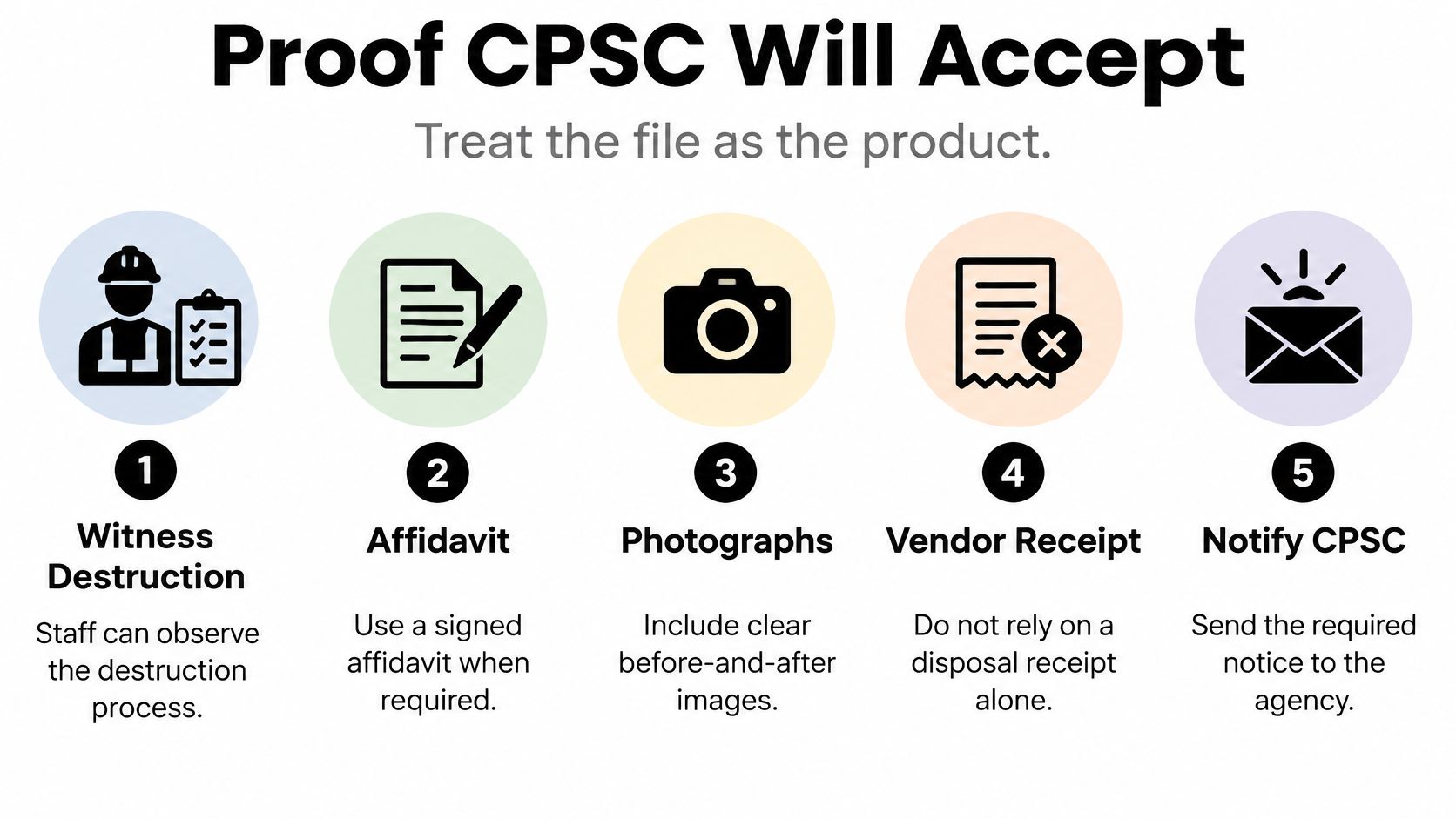
Copy These Certificate Fields
- Recall identity: Recall number, product name, recalling firm, and authorization date.
- Product identity: Model, lot, date code, SKU, and serial numbers when present.
- Quantity reconciliation: Units quarantined, units destroyed, samples retained, and units still awaiting disposition.
- Destruction event: Method, date, start and stop time, facility name, and facility address.
- People: Operator names, client witness, vendor representative, and CPSC investigator if present.
- Downstream result: Recycler or hazardous material processor and final material disposition.
- Attachments: Before and after photographs, written disposition instruction, container list, and intake log reference.
| Field | What to record | Weak substitute |
|---|---|---|
| Product identity | Recall number, model, lot, date code, serials | Product category only |
| Quantity | Units destroyed and units still quarantined | Weight of a mixed load |
| Method and time | Cut, crush, or shred, with date and times | Received by recycler |
| People | Operators, witnesses, CPSC investigator if present | Unsigned vendor invoice |
| Downstream | Recycler name and final material disposition | Unknown export or landfill |
Photographs need sequence and context. Take readable label images before destruction, a wide image showing the sealed batch, an image during cutting or shredding, and a final image showing the product rendered unusable. File names should carry the recall and batch number so the photo set doesn't become anonymous phone images.
Off site work needs extra discipline. Use written instructions, clearly marked containers, no commingling with salvage, and monitoring of the third party. Seal numbers belong in the transport record when you use sealed containers. If a seal changes, document who opened it, where, and why.
A generic certificate of recycling fails when it says only that a load arrived at a facility. It may not name the recalled model, quantity, method, or final disposition. Our certificate guidance for recall destruction reflects the stronger standard I would require. The document must let an auditor trace each batch from quarantine to unusable residue.
Don't count a consumer's refund photograph as your organization's destruction record. That image may support an individual remedy claim, but it doesn't establish your chain of custody for institutional inventory. Keep consumer remedy files and bulk destruction batches separate, then reconcile both to the affected population.
Retain the packet with the recall file for as long as your record policy, contracts, and any CPSC request require. Restrict editing after the batch closes and correct mistakes through dated amendments rather than replacing pages. Silent corrections destroy confidence in otherwise sound work.
Three documents close a batch. The serialized intake log establishes what you controlled, the destruction certificate or affidavit establishes what happened, and the photo set shows the condition before and after. If one leg is missing, the batch remains open even if the physical products are gone.
Cost Logistics and Hazardous Parts
Price destruction by operational drivers, not by a flat per unit promise. Quantity matters, but so do distance, on site versus plant destruction, sorting labor, witness time, photographic documentation, affidavit preparation, container requirements, and separate handling for hazardous components. A cheap quote often becomes expensive when the vendor excludes the very controls that make the work defensible.
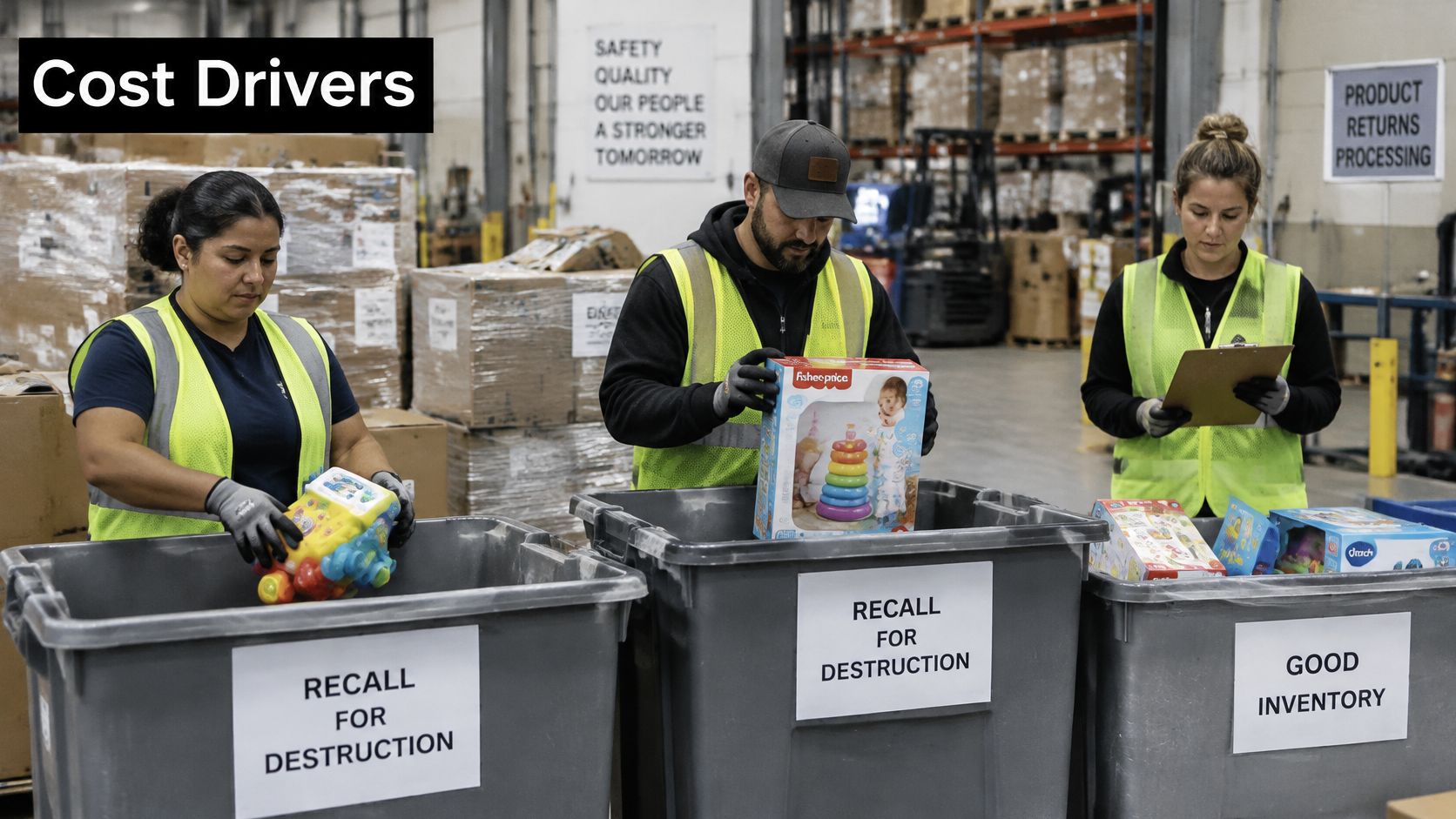
Physically disabling the product is only part of the risk decision. The CPSC product safety warning listing supports separate handling for defective lithium ion batteries because of fire risk, including confirming in advance that a household hazardous waste facility accepts them. For commercial quantities, apply the same pre acceptance discipline through a documented hazardous material route.
Where the Money Goes
Transport and access drive cost when units sit across stores, schools, warehouses, or return centers. Consolidation can reduce freight, but every transfer adds custody records and another opportunity for commingling. Don't consolidate into unlabeled gaylords merely to fill a truck.
Sorting and disassembly rise when products combine fabric, molded plastic, metal frames, motors, circuit boards, and batteries. Operators may need to remove a battery before shredding the housing or separate chemical components before crushing. Trying to force mixed products through one machine can create fire, contamination, or incomplete destruction.
Witnessing and documentation consume paid time. Serial capture, photographs, seal checks, affidavits, and reconciliation are labor, not paperwork decoration. Budget for them explicitly so the vendor doesn't dilute the record to meet an unrealistic unit price.
A cut stroller frame doesn't end the hazard if its battery pack enters ordinary trash or its intact restraint assembly reaches a secondary market. A destroyed electronic toy can still create risk if reusable modules are harvested. Price the downstream route for each component, not just the destruction of the outer product.
Move Units Without Losing Count
Use clearly marked, closed containers labeled by recall and batch. Record container counts and seal numbers at loading, then verify them at receipt before destruction. Contracted or in house transport can work if pickup is tracked and custody transfers are signed at each change.
Nothing should leave without the intake count. If a store adds late returns at the dock, create a new batch or amend the log before loading. Handwritten additions on a driver's copy invite disputes about whether destroyed quantity matches quarantined quantity.
Review applicable state and local hazardous waste and landfill rules before selecting the route. Our universal waste regulations guidance is a helpful starting point for the battery and electronics questions your environmental team should resolve. Don't assume a recycler's general acceptance policy covers damaged, defective, or recalled batteries.
Build capacity around how units will be found. Registration searches, retailer inventory sweeps, marketplace takedowns, direct notices, and return incentives produce uneven waves rather than one clean shipment. Plan repeat pickups and batch closures instead of waiting indefinitely for a perfect full load.
A notification is not a recovered unit, and a recovered unit is not yet a destroyed unit.
Track quarantined, returned, destroyed, repaired, refunded, replaced, and still outstanding quantities separately. That dashboard tells operations when to schedule another pickup and tells leadership whether money is solving recovery or merely processing the easiest inventory. I would review shortages by site weekly during an active recall because small unexplained gaps get harder to reconstruct with time.
Report What Is Still Outstanding
Destroying every unit in your warehouse settles only part of the recall. Destruction is the exception among CPSC remedies, and the units you never recovered may still sit in homes, childcare rooms, resale listings, thrift stores, and donation streams. A meaningful share of recalled children's products is never returned or destroyed at all, which is why your own unrecovered count matters more than any published average.
Report two balances to the recalling firm and, when required, to CPSC. The first is the closed batch balance: quantity destroyed, method, date, facility, certificate, affidavit, and photographs. The second is the outstanding balance: units sold, located, recovered, quarantined, awaiting disposition, and not yet found.
Use a Closed Loop Rate
Calculate documented destruction divided by affected units recovered or located. A recycler's receipt confirms that a pickup happened; it does not prove the product was made unusable. Anchor the rate to certificates and affidavits, and track overall correction separately so a strong warehouse destruction rate doesn't disguise weak consumer recovery.
Don't double count replacements as destroyed originals. Don't treat mailed notices, opened emails, website visits, or refund inquiries as recovered products. Each unit needs one current status, supported by a return record, repair record, refund record, destruction certificate, or documented location.
Escalate unresolved units by age, geography, retailer, sales channel, and institution type. A cluster at one childcare operator calls for direct site contact. Marketplace listings call for takedowns and seller notices. Older products may require thrift and donation partner checks because original purchasers no longer control them.
Effectiveness also changes with product price, useful life, affected unit volume, time in distribution, share already with consumers, remedy offered, and amount of direct notification. Record those variables in the outstanding report rather than blaming low returns on consumer apathy. A low cost, short life product sold years ago needs a different search plan from a registered crib sold recently through one retailer.
Schedule the next search before you close the current batch. Re-run registration files, store inventories, return center holds, repair queues, and donation partner records on a defined date. Assign an owner to each channel and require a negative report when a site finds no units, because silence can mean nobody looked.
For quarantined units still awaiting destruction, book a documented pickup rather than leaving them in indefinite storage. Our multi location recall collection services can support coordinated collection when units are spread across sites. Beyond Surplus provides product destruction with documented chain of custody and sustainable material recovery built in, and every load receives a Certificate of Recycling and Data Destruction, with all liability transferring to Beyond Surplus.
Close the report with one scheduling action, one owner, and one date. Contact Beyond Surplus for certified electronics recycling and secure IT asset disposal when recalled goods include electronic modules that must be destroyed under chain of custody. The recall stays operationally open until the outstanding balance is explained, even after the last pallet in storage has been shredded.
If you're holding recalled children's products with electronic modules, batteries, or other components that need verified destruction, we can coordinate documented pickup, chain of custody, physical destruction, and certification for the load. Visit Beyond Surplus to discuss the affected models, quantities, locations, and evidence your recall file requires.