

What does “recycling center closest to me” mean when a business needs to retire laptops, servers, drives, and network gear? In practice, it should mean “which provider can pick up assets securely, document every handoff, erase or destroy data properly, and stand behind the process when audit or legal questions come later.”
Distance matters for freight cost and scheduling. It is rarely the deciding factor. For business electronics, the harder problems are chain of custody, data-bearing media, site logistics, and whether the vendor can handle a single office cleanout as well as a multi-site refresh.
Atlanta makes that difference easy to see. The metro has public drop-off programs, nonprofit recycling sites, scrap processors, and specialized ITAD firms operating in the same geography. Those categories overlap on the word “recycling,” but they serve different business needs. A convenient local center may accept old electronics. That does not mean it offers serialized asset tracking, certificates of destruction, de-installation, packing, or outbound pickup for a corporate environment.
This comparison uses an operations-first lens. The goal is to help companies choose an Atlanta-area recycling partner based on security, compliance posture, service scope, and logistics, not just the shortest drive. For teams evaluating providers for electronics recycling in Atlanta, that is the difference between clearing space and closing out an IT asset disposition project cleanly.
1. Beyond Surplus

What does “closest” provide a business retiring servers, laptops, drives, and network gear? If the answer needs to include pickup, asset tracking, data destruction, and documentation that holds up under audit, Beyond Surplus fits the search better than a standard local drop-off option.
Beyond Surplus is based in Atlanta, but its service model is built for business collections across the contiguous U.S. That matters for companies with multiple offices, clinics, warehouses, or remote locations that need one process instead of a patchwork of local recyclers.
Why businesses choose it
The practical value is operational control. Beyond Surplus offers on-site and off-site hard drive shredding, certified data wiping, chain-of-custody records, de-installation, palletizing, hauling, product destruction, and IT buyback where equipment still has resale value. For teams comparing electronics recycling in Atlanta providers, that is a different service category from a public recycling center.
Compliance is usually the deciding factor because the FTC Disposal Rule requires secure disposal of consumer report information. For regulated or data-heavy environments, the key question is whether the vendor can document each handoff and show what happened to every data-bearing device. A recycler that accepts electronics does not solve that problem.
Practical rule: if a vendor cannot issue Certificates of Recycling and Data Destruction, do not send them data-bearing assets.
A second difference is project scale. Beyond Surplus is set up for office closures, refresh cycles, warehouse cleanouts, and recurring ITAD programs. That operating model also makes it a strong reference point for businesses reviewing recycling center options for secure, documented electronics disposition.
Trade-offs to know
Beyond Surplus is aimed at business programs, not household curbside convenience or quick public drop-offs. Pricing is quote-based, which can feel less simple at first, but that is standard in ITAD work because cost changes with asset mix, packing requirements, pickup access, serialized reporting, and whether on-site labor is needed.
That trade-off is usually worth it when the job includes sensitive data, multiple locations, or tight scheduling. In those cases, the harder part is not finding a recycler nearby. It is finding one that can handle logistics cleanly, protect chain of custody, and close the project with documentation your legal, compliance, and IT teams can use later.
2. Smyrna Recycling Center
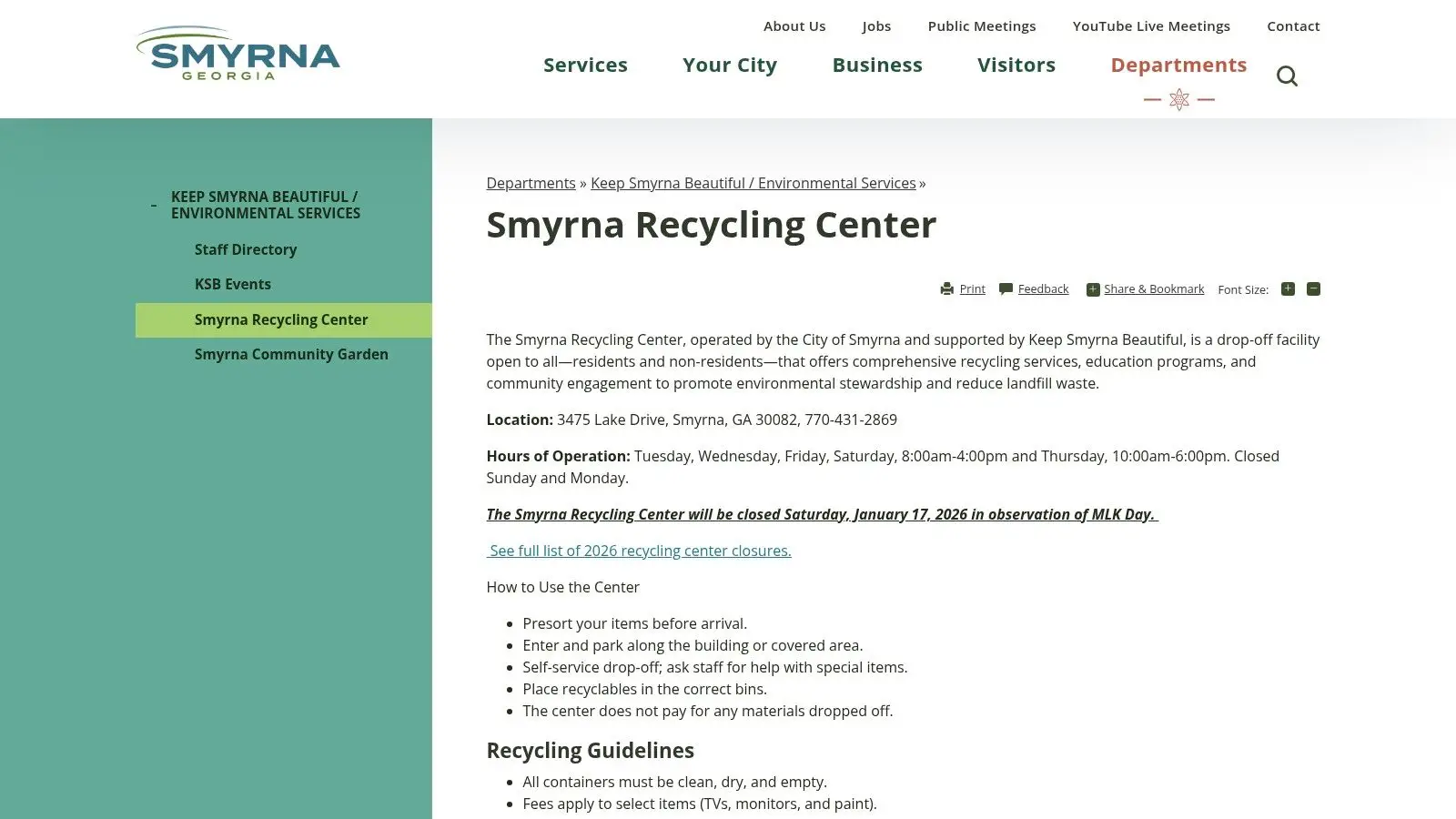
The Smyrna Recycling Center is useful as a baseline comparison because it represents what many searchers expect from a local recycling result. It is a city-run drop-off facility with clear public guidance and broad material acceptance.
For businesses, that reliability has some value. If a facilities team has a small volume of non-sensitive material from a cleanup, a municipal site can be convenient.
Where it works
Smyrna works best for simple local drop-offs where data security is not part of the job. City-run operations also tend to be straightforward about hours, accepted materials, and item restrictions. If your team is sorting mixed waste from a property cleanup, this kind of site can play a supporting role.
The bigger lesson is strategic. Companies often start with proximity and only later ask whether the center fits the assets. That is backward. A strong vendor review starts with security, documentation, and scale. This guide on recycling center options and what to look for frames that better than a map search does.
Where it falls short
Municipal centers are not designed as enterprise ITAD programs. There is no indication that a city drop-off provides certified data destruction, asset-level tracking, or formal liability-transfer paperwork for retired business devices. That makes it a poor fit for servers, laptops, desktops, or storage media that held company or customer information.
If your organization needs audit support, downstream visibility, or scheduled pickup, a municipal recycler is usually the wrong endpoint. It may be nearby. It is not built for the business risk involved.
3. Live Thrive CHaRM Atlanta and DeKalb

Live Thrive CHaRM is one of the better-known hard-to-recycle outlets in metro Atlanta. It solves a different problem from ITAD vendors. CHaRM is designed around managed drop-off and broad diversion for materials that standard curbside programs often do not take.
That is valuable. It is also why some businesses mistakenly treat it as a catch-all answer for retired electronics.
Best use case
If your organization has specialty waste from a small office cleanout and needs a community-focused outlet for certain materials, CHaRM can be a practical option. The appointment model also creates a predictable drop-off flow, which many teams prefer to waiting in line or guessing at site congestion.
The broader recycling ecosystem is fragmented. The Recycling Partnership’s National Recycling Database aggregates data from more than 9,000 community recycling programs across the U.S., which shows how localized acceptance rules can be, as noted on the National Recycling Database page. That fragmentation is why businesses should verify acceptance before moving any load.
Not built for enterprise custody
CHaRM is not structured like a full ITAD chain-of-custody provider. Businesses handling data-bearing equipment should also review a vendor’s exclusions and downstream rules before arrival. This overview of restricted or non-accepted recycling items is a good reminder that acceptance is only one part of compliant disposal.
If the site is optimized for appointments and mixed household-style hard-to-recycle streams, assume you still need a separate process for corporate drives, servers, and network gear.
For companies, the key limitation is not environmental intent. It is documentation depth.
4. Ecycle Atlanta

Ecycle Atlanta is one of the clearer answers to the business version of "recycling center closest to me." Proximity helps, but for companies, the key question is whether the vendor can destroy data on site, document the work, and keep the handoff simple enough for a facilities or IT team to execute without extra risk. Ecycle Atlanta earns attention because it offers on-site hard drive shredding and certificates of destruction.
Good fit for contained, local IT disposals
This provider makes the most sense for smaller business loads. A branch office with retired PCs, loose drives, or a few decommissioned laptops can use a drive-up drop-off process without building a larger pickup project around it. That keeps labor low and shortens the time equipment sits in a storage room waiting for a decision.
The security benefit is practical, not theoretical. If equipment still contains data, the disposal process has to cover media handling, destruction, and paperwork in one motion. Teams that need a quick refresher on why electronics recycling matters for secure business disposal should treat that review as part of vendor screening, not an afterthought.
Where the model starts to strain
Ecycle Atlanta appears strongest as a local, tactical option. The trade-off is scale.
A company planning a multi-floor refresh, a warehouse cleanout, or a multi-site retirement program usually needs more than drop-off convenience. It may need serialized asset tracking, pickup coordination, de-installation labor, packaging, and consistent reporting across locations. That is a different operating model from a site built primarily for local electronics recycling and hard drive destruction.
For Atlanta businesses, that distinction matters. A nearby recycler can solve a specific job well, especially when the priority is secure destruction for a limited number of assets. Larger ITAD programs usually require broader logistics and deeper chain-of-custody controls.
Ecycle Atlanta is a solid option for small secure disposals with immediate documentation. Businesses with pallets of equipment, recurring refresh cycles, or audit-heavy requirements should evaluate whether the vendor’s process can hold up once volume and complexity increase.
5. eWaste ePlanet
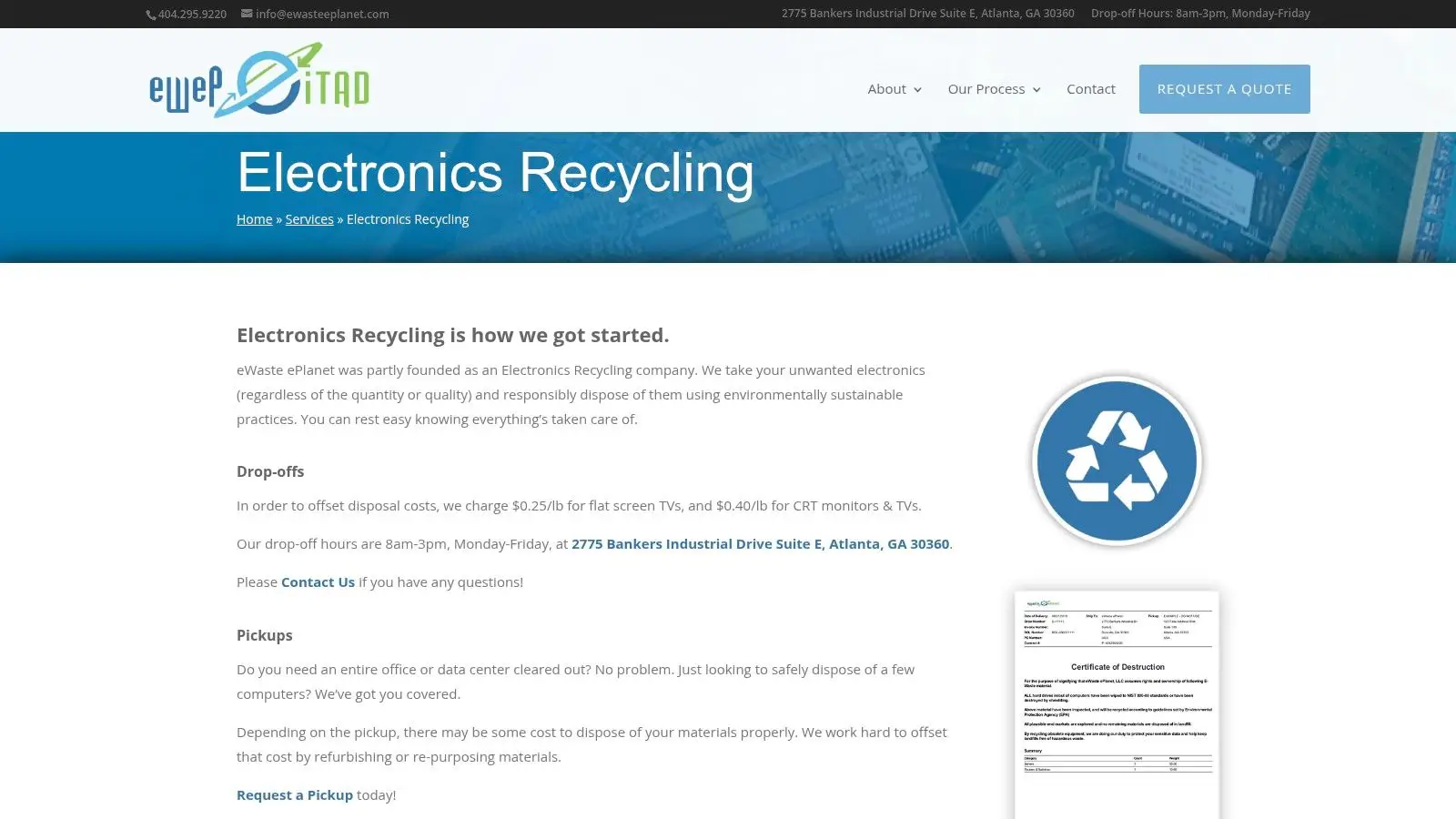
eWaste ePlanet sits in the middle ground between public drop-off convenience and documented business recycling. That middle ground works well for many organizations.
The biggest positive is paperwork. Certificates of Recycling and Data Destruction are included, which is the kind of documentation a facilities manager or IT lead can file and retrieve later.
What it does well
eWaste ePlanet appears well suited to office clear-outs and business loads that need a documented chain, but not necessarily a national service footprint. It also publishes pricing for some common fee-based items, which is useful for budgeting and internal approvals.
There is also a broader business case for using a specialist. The North America Waste Recycling Services Market is projected to reach USD 17.13 billion in 2025 and grow to USD 20.19 billion by 2030, according to Mordor Intelligence. That points to a mature service category, not a niche errand. Buyers should treat vendor selection accordingly.
For companies that still view electronics recycling as basic haul-away, this background on why electronics recycling matters helps reposition the decision as risk management and asset control.
Practical drawbacks
The visible limitation is flexibility. Weekday-only access can complicate scheduling for businesses trying to stage equipment outside production hours. The service scope also appears more regional than nationwide.
If your need is local, documented, and moderately sized, eWaste ePlanet is a credible option. If your need spans many sites, you may want a provider with broader pickup infrastructure.
6. Cornerstone Technologies
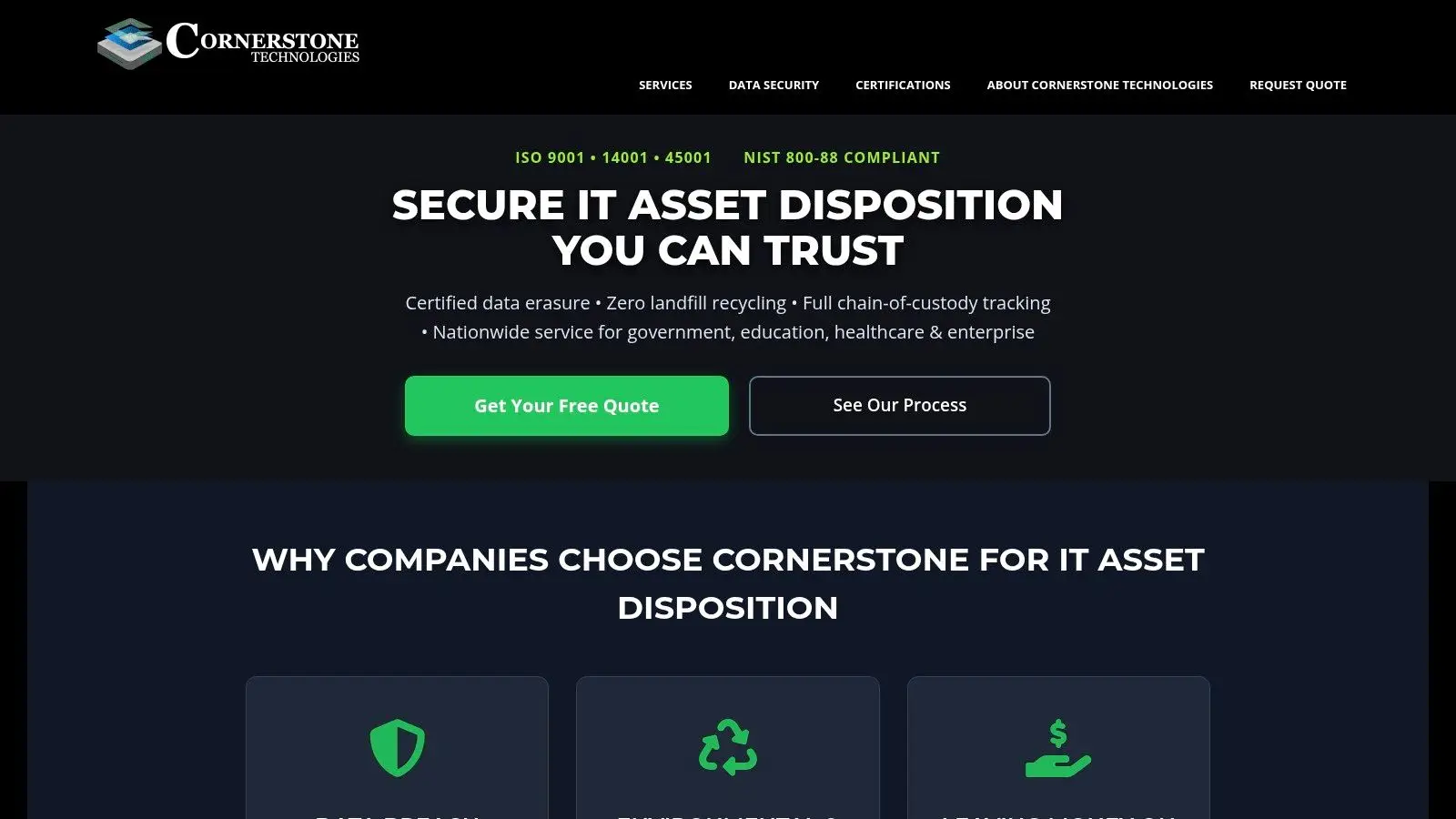
What matters more to your business. A short drive across Atlanta, or a vendor that can stand up to a security review?
Cornerstone Technologies is one of the few providers on this list that reads like an enterprise ITAD partner rather than a general recycling outlet. Along with Beyond Surplus, it fits organizations that need documented controls, formal intake procedures, and reporting that procurement, compliance, and legal teams can use.
Best fit for organizations with audit pressure
Cornerstone puts the right signals up front. It emphasizes NIST 800-88 data destruction practices, certificate-backed service, ISO-certified operations, and zero-landfill positioning. For healthcare systems, public agencies, school districts, and financial firms, those are the details that usually decide whether a vendor gets approved.
That matters because the recycling company becomes part of your risk chain the moment devices leave your site.
A local provider can still be the wrong provider if it cannot produce destruction records, asset logs, or process documentation during an audit. Businesses searching “recycling center closest to me” often start with distance. For IT assets, distance is secondary to custody, sanitization method, and proof.
Trade-offs to weigh
Cornerstone appears built for scheduled business pickups and managed projects, not casual public drop-off. That structure works well for office decommissions, refresh cycles, and regulated asset disposition programs where stakeholders want a quote, a scope, and a paper trail before anything moves.
It can feel heavier for a smaller company that just needs to clear out a handful of laptops this week. In those cases, the extra process may be more than the job requires.
If your team expects vendor questionnaires, certificates of destruction, and downstream accountability, Cornerstone deserves a serious look. If the only requirement is finding the nearest place to unload old electronics, this is probably more provider than you need.
7. Fulton Metals Recycling
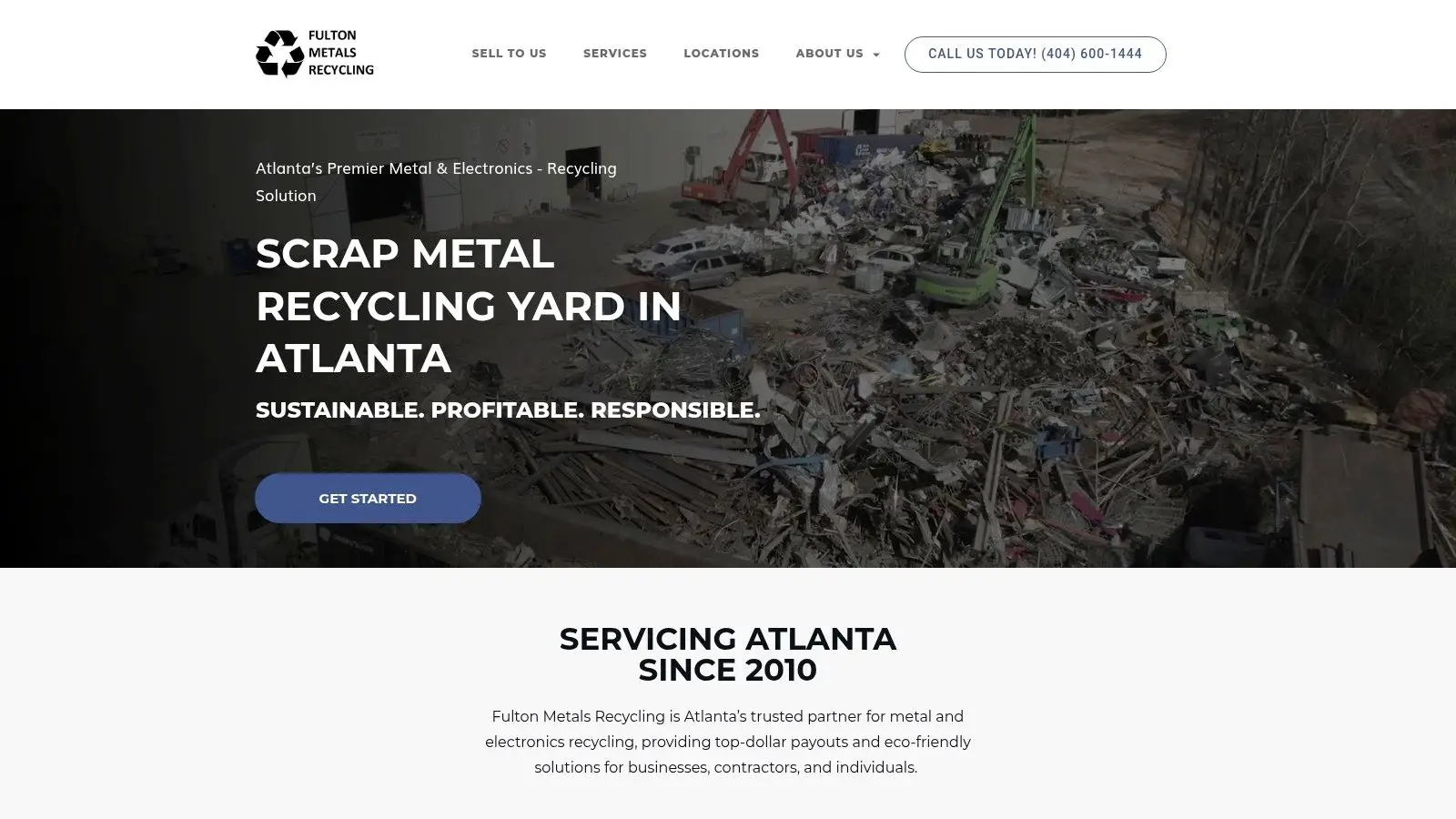
Fulton Metals Recycling wins on one criterion that drives many “recycling center closest to me” searches. Convenience. Multiple metro locations make it easy to get material off a truck and out of a facility.
For non-sensitive electronics mixed with scrap, that convenience may be enough.
Where scrap recyclers fit
A multi-location scrap operator can be useful during warehouse cleanouts, maintenance projects, and jobs where metals and non-data-bearing equipment move together. If the goal is general diversion and fast unloading, this type of operator can be efficient.
That model also reflects a broader reality in local search. Existing “closest recycling center” content focuses on municipal and general-purpose recycling rather than secure IT disposal, as discussed in this analysis of consumer-style locator gaps. Business users often land on the wrong kind of result because the search phrase itself is too generic.
Why businesses should be cautious
Scrap acceptance is not the same as ITAD. If the device held employee, patient, financial, or customer data, a scrap yard is usually the wrong channel unless it explicitly provides business-grade data destruction and documentation.
The trade-off is simple:
- Use scrap recyclers for non-sensitive material where convenience is the priority.
- Use ITAD providers for anything that requires wiping, shredding, serialization, or proof of destruction.
For any corporate device with storage, proximity should be the last filter, not the first.
7 Nearby Recycling Centers, Comparison
| Service | 🔄 Implementation complexity | ⚡ Resource requirements | 📊 Expected outcomes | 💡 Ideal use cases | ⭐ Key advantages |
|---|---|---|---|---|---|
| Beyond Surplus | Moderate–High: end-to-end pickups, on/off-site work | Fleet, technicians, scheduling; pallet/minimum options | Certified data destruction, chain-of-custody, value recovery | Enterprises, data centers, regulated sectors needing nationwide service | Certified security, nationwide logistics, ESG-aware processes |
| Smyrna Recycling Center (City of Smyrna) | Low: municipal drop-off, walk-in | Minimal: public drop-off, staffed facility | Basic recycling for non-data items; no destruction certificates | Residents and non-sensitive e-waste; supplemental mixed loads | Convenient local access, transparent city guidelines |
| Live Thrive CHaRM (Atlanta & DeKalb) | Low–Moderate: appointment-based drop-off | Appointment system, staffed nonprofit; limited bulk capacity | Accepts hard-to-recycle items; no enterprise-grade data services | Residents with hard-to-recycle materials; community education | Handles difficult streams; strong community mission |
| Ecycle Atlanta (College Park) | Low: drive-up, no appointment | On-site hard-drive shredding for small batches | Certified shredding with certificates for small volumes | Individuals and small businesses needing verified destruction | On-site shredding with certification; convenient free drop-off for many items |
| eWaste ePlanet (Doraville) | Moderate: regional ITAD and drop-off | Certificates included; published fees; office-clearout support | Documented data destruction with included certificates; transparent pricing | Regional businesses seeking compliant, budgeted disposal | Chain-of-custody certificates and clear pricing |
| Cornerstone Technologies (Norcross) | High: scheduled enterprise ITAD with audits | NIST/ISO-certified processes, consulting, enterprise reporting | Audited compliance, full chain-of-custody, zero-landfill options | Regulated industries (healthcare, government) and large enterprises | NIST 800-88 and ISO certifications; compliance-focused |
| Fulton Metals Recycling (multiple sites) | Low: walk-in scrap/recycling model | Multiple locations, scrap-handling equipment; general capacity | General e-waste recycling including TVs/monitors; no certificates | Non-sensitive electronics and mixed scrap metal recycling | Multiple convenient sites; accepts a wide range of electronics |
Partner with Beyond Surplus for Secure, Compliant ITAD
What does “recycling center closest to me” mean when the equipment holds company data, appears on asset ledgers, and may be subject to audit later?
For a business, this is a vendor selection decision with security, compliance, and logistics consequences. The right partner does more than accept old electronics. It controls chain of custody, documents what happened to each asset, and supports the project from pickup through final disposition.
Atlanta makes that distinction easy to see. Municipal programs help with general recycling. Nonprofits handle specialty items and community drop-off needs. Scrap-focused recyclers offer convenience for low-risk material. Business IT disposition is a different job. It requires data destruction options, serialized reporting, clear downstream handling, and the ability to scale from a few laptops to a multi-site refresh.
Beyond Surplus fits that business requirement because the service model is built around ITAD rather than public drop-off. Companies can schedule pickup, coordinate de-installation, choose on-site or off-site drive destruction, request data wiping, and receive the documentation procurement, IT, legal, and compliance teams usually ask for. That capability matters whether a company is retiring a small laptop pool, closing an office, or decommissioning a server room.
The trade-off is straightforward. The nearest recycler may save a short drive. It may also leave gaps in reporting, chain of custody, or downstream accountability. For low-value, non-sensitive items, that may be acceptable. For devices that stored client data, employee records, credentials, or regulated information, it usually is not.
Environmental outcomes matter too, but for businesses they should be tied to process, not just intent. A qualified ITAD partner should be able to explain how equipment is triaged for reuse, resale, parts recovery, or recycling, and what records the business will receive. That is the difference between clearing space and closing the loop responsibly.
If the shortlist includes Atlanta-area providers, use a simple filter. Can the vendor protect data, support compliance, and execute the job without creating extra work for your team? In many business scenarios, Beyond Surplus is the stronger fit because it addresses all three.


