

Retired PBX systems, switches, handsets, routers, gateways, and conferencing gear have a way of piling up in the least visible parts of the business. They sit in telecom closets, warehouse racks, and vacated branch offices while finance treats them as fully spent, operations treats them as clutter, and security hopes nobody forgot a drive, module, or stored configuration. That's usually the moment corporate IT starts looking for telecom asset recovery services USA providers instead of a simple recycler.
That distinction matters. Disposal removes equipment. Asset recovery manages risk and extracts remaining value. For an IT director, those are different mandates with different consequences. One protects the business from data exposure and audit trouble. The other decides whether retired telecom hardware leaves as cost, salvage, or documented return.

The urgency is growing. The global asset recovery services market was valued at USD 6.28 billion in 2024 and is projected to reach USD 12.01 billion by 2034, growing at a CAGR of 6.2%, with North America expected to dominate according to Zion Market Research on the asset recovery services market. That growth tracks what enterprise teams already know firsthand. Sustainability expectations are higher, data destruction scrutiny is tighter, and procurement groups are more willing to recover value from retired infrastructure instead of writing everything off.
Introduction The Strategic Value of Telecom Asset Recovery
A typical project starts with a room nobody wants to own. Facilities wants the space back. Network operations already cut over to newer hardware. Procurement wants closure. Legal wants documentation. Finance asks a fair question: is there any residual value here, or are we paying to make it disappear?
In practice, the answer depends on whether the equipment is handled as inventory or as junk. Current, intact, tested gear can move into resale. Units with limited market demand may still support parts harvesting. End of life hardware can still be processed through documented recycling. The mistake is mixing all three streams together before anyone has identified what's worth what.
What seasoned teams do differently
Experienced ITAD and telecom recovery teams treat retired communications hardware as a controlled disposition project, not a pickup request. They inventory first. They decide which assets are data-bearing. They separate reusable gear from damaged or obsolete units before transport if possible. They preserve serial-level visibility so accounting, compliance, and internal audit can all work from the same record set.
Practical rule: If a vendor talks about trucks before they talk about audit trail, they're solving the wrong problem.
Telecom asset recovery services USA providers create real business value by helping large organizations clear space, reduce disposal risk, and recover proceeds where market demand still exists. They also reduce the internal friction that happens when multiple departments need different outcomes from the same pile of retired equipment.
For enterprises with multi-site operations, that control is even more important. Equipment often leaves branch locations, clinics, call centers, and regional offices under inconsistent local practices. The more distributed your environment is, the more expensive unmanaged retirement becomes.
Understanding the Core Service Components
A proper recovery program follows a controlled chain from identification to final reporting. A properly structured telecom asset recovery program includes asset identification, data sanitization, testing and grading, secure transport, and final disposition reporting, creating value through resale or parts harvesting while maintaining a clean audit trail, as outlined by Beyond Surplus telecom asset recovery services.
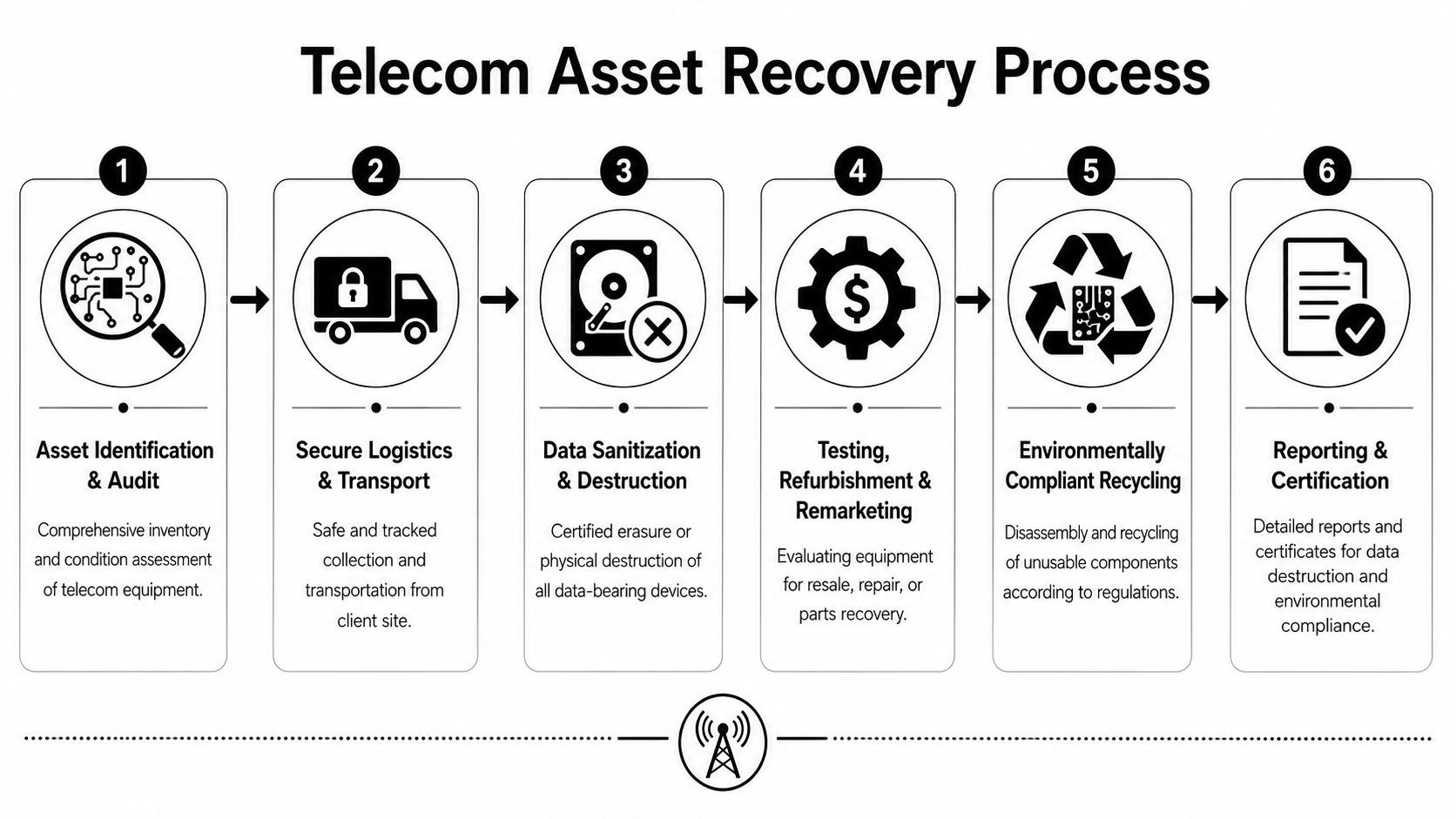
Asset identification and pre-removal audit
Everything starts with knowing exactly what you have. That sounds obvious, but telecom environments are messy. A single site may contain rack gear, desktop handsets, expansion modules, power supplies, cabling, media converters, call recording appliances, and spares that were never added to a current inventory.
The useful approach is to log by asset type and serial where practical, then separate:
- Resale candidates that appear complete and current enough for secondary market demand
- Parts units that may have value even if the full chassis won't move
- Recycling-only material that has no realistic reuse path
Without that first pass, organizations lose margin by scrapping equipment that still has recoverable value.
De-installation and secure logistics
Some projects involve palletized gear in a storage room. Others require actual de-installation from racks, wall mounts, branch closets, or office floor systems. That labor changes the project scope immediately.
The operational details matter:
- Site coordination: Access windows, escorts, freight elevator rules, and shutdown dependencies
- Packing method: Static-safe handling, palletization, labeling, and separation of sensitive devices
- Manifest control: Every handoff should match a documented pickup record
That same thinking applies outside telecom. Companies managing office closures often coordinate telecom retirement alongside furniture liquidation, and Cubicle By Design on office furniture liquidation is a useful example of how adjacent decommissioning work benefits from the same inventory-first discipline.
Data destruction decisions
Not every telecom asset stores data in the same way. That's why blanket assumptions fail. A desk phone may present little concern in one environment and become sensitive in another if it stores credentials, call history, or configuration details. PBX systems, voice platforms, gateways, and network modules can carry much higher risk.
A competent provider chooses sanitization based on device type, storage method, and client requirements. Some devices can be wiped logically. Others require media removal and physical destruction.
The safest workflow is the one that decides data handling before resale decisions are made, not after.
Testing, grading, and remarketing
Recovery either succeeds or fails at this critical stage. Equipment requires thorough inspections for completeness, condition, and function. Cosmetic grading directly influences marketability. Missing rails, faceplates, or power components can transition a unit from resale value into parts recovery.
What works:
- Model-specific triage so common equipment isn't overprocessed
- Functional screening before labor is spent on detailed refurbishment
- Demand-aware remarketing based on real buyer channels
What doesn't work is treating every retired unit as if it deserves bench time. Labor can erase recovery value fast.
Recycling and disposition reporting
The final stream handles what can't be resold or harvested. That process should still produce documentation. Finance needs closeout. Compliance needs records. Internal audit needs proof that assets left under controlled conditions and ended in an approved channel.
A pickup vendor can remove clutter. A recovery program closes the loop.
Navigating the Complex Web of US Regulations
The hardest part of telecom disposition in the United States isn't moving the hardware. It's dealing with a compliance framework that changes depending on what the equipment stored, where the company operates, and where the material ends up.

Federal rules are only the start
The penalty risk is real. Failure to comply with the FTC Disposal Rule can result in penalties of up to $43,792 per violation, and only 10 states have robust producer responsibility laws, which leaves national enterprises dealing with a fragmented patchwork, according to Timeline GTS on asset recovery compliance.
For healthcare, finance, and government environments, the challenge gets sharper. A telecom system isn't just a piece of old hardware. It may contain call records, user credentials, routing information, or protected operational data. If the wrong unit reaches a secondary market without proper sanitization and documentation, the liability sits upstream with the original owner unless transfer was handled correctly.
The state-by-state problem most vendors gloss over
This is the pain point many IT directors underestimate. A company headquartered in Georgia might assume local disposal practices are enough because Georgia doesn't carry the same producer-responsibility framework some other states do. But the moment that same company operates offices across multiple states, ships assets across state lines, or uses a downstream recycler in another jurisdiction, local assumptions stop helping.
That's why vendor selection has to include environmental handling depth, not just data destruction. Teams that need a baseline for these requirements should review Beyond Surplus guidance on universal waste and EPA considerations. It's a practical starting point for understanding why telecom hardware retirement often intersects with broader e-waste and hazardous material controls.
How regulated organizations should think about it
The safest way to manage telecom asset recovery services USA projects is to build the process around the most demanding likely requirement, not the easiest local one.
Use this lens:
- Federal exposure: Could this equipment trigger disposal-rule scrutiny if mishandled?
- Sector exposure: Did the hardware touch protected, regulated, or confidential information?
- Geographic exposure: Are pickup, transit, and downstream processing crossing state boundaries?
- Documentation exposure: Can you prove what happened to each asset stream if legal or audit asks later?
A multi-state company doesn't have a single disposal obligation. It has a chain of obligations that follows the asset from site to final disposition.
That's why nationwide capability matters. The vendor has to understand route-by-route and site-by-site differences without forcing your internal team to become a patchwork law specialist.
Valuation Models and Maximizing Financial Return
Telecom recovery only delivers financial value when the pricing model matches the equipment profile. That's where many projects go sideways. Clients focus on the headline promise of “buyback,” but the better question is how the provider intends to value aging telecom inventory under changing demand conditions.
The three common commercial models
A quick way to frame your options:
| Model | Best fit | Trade-off |
|---|---|---|
| Outright purchase | Teams that want fast closeout and budget certainty | Lower upside if resale performs well later |
| Revenue share | Clients with stronger resale candidates and patience for settlement | Slower return and more dependence on vendor transparency |
| Hybrid structure | Mixed loads with some known-value gear and some uncertain inventory | More negotiation up front, but better alignment |
Outright purchase works well when a company is exiting sites fast, consolidating locations, or doesn't want residual inventory hanging open on the books. Revenue share can outperform it when gear is current enough to attract buyer demand, but it requires trust in grading, channel strategy, and reporting.
What actually drives value
Three factors usually decide the financial outcome more than anything else:
- Market timing: A delayed project can turn usable inventory into stale inventory.
- Completeness: Missing accessories, modules, power supplies, and rails drag units out of resale lanes.
- Testing confidence: Buyers pay more when condition and function are verified.
The shift in telecom hardware markets makes this even more important. Surplus 5G equipment has faced 35% year over year value drops, while AI-driven valuation pilots have shown 28% higher recovery rates than manual assessment by using real-time global resale data, according to GDI Technology on asset recovery valuation.
That's an important signal. Static pricing sheets age badly in fast-moving categories. Manual valuation still has a place for unusual systems, but it often misses short-window demand changes.
Where modern valuation is heading
AI-assisted pricing is useful when a provider needs to compare current resale signals across broad inventories and shifting buyer demand. It won't fix bad inventory data or poor handling, but it can improve the speed and consistency of pricing decisions.
For teams evaluating buyback paths, Beyond Surplus telecom equipment buyback program shows the type of service structure to look for: clear recovery pathways for telecom hardware, not just generic recycling pickup.
Recovery value is rarely lost in one big mistake. It's usually lost through delay, weak inventory detail, and generic pricing.
Ensuring Security with an Ironclad Chain of Custody
A lot of vendors talk about secure handling. Fewer can show a chain of custody that would stand up under legal review. For telecom equipment, that difference matters because these devices often store more than people assume.

Telecom infrastructure often contains sensitive data that can't be wiped like standard IT equipment, and a certified chain of custody ending in a Certificate of Destruction is legally binding evidence that satisfies FTC Disposal Rule and HIPAA requirements while transferring data destruction liability from the client to the vendor, as explained by Zurich Tech Solutions on asset recovery security controls.
What a defensible chain looks like
The process should begin before equipment leaves your control. Assets need to be identified, counted, and matched to pickup records. Containers or pallets should be sealed or otherwise controlled. Handoffs need named accountability.
Then the security controls continue:
- In transit: Tracked movement, documented manifests, and limited custody changes
- At intake: Reconciliation against pickup records and exception logging
- During processing: Controlled access, defined sanitization path, and documented destruction or release to resale
- At closure: Formal certificates and final reporting tied back to the original load
A certificate alone isn't enough if the middle of the story is missing.
Why this matters beyond recycling
Many IT leaders now think about asset ownership and transfer in much broader terms, including digital proof and record integrity. If that topic is on your radar, real world asset tokenization USA is a useful adjacent read because it highlights how verifiable transfer records are becoming more important across physical asset classes.
For telecom retirement, the practical equivalent is straightforward. You need evidence that the right assets were collected, handled under control, sanitized correctly, and disposed or remarketed under the agreed path. If a vendor can't document those steps, they haven't really accepted liability.
Organizations that require formal proof should insist on certificate of destruction documentation as part of standard closeout, not as an optional add-on after the fact.
Security in ITAD isn't a single event. It's a documented sequence.
How to Select the Right Nationwide Recovery Partner
Most vendor evaluations fail because the questions are too shallow. “Do you recycle telecom equipment?” isn't a serious screening question. Almost anyone can answer yes. The useful questions test whether the provider can protect your organization when the project gets complicated.
Questions worth putting into an RFP
Use this shortlist when comparing telecom asset recovery services USA providers:
- Data handling: How do you decide between wiping, purging, and physical destruction for different telecom device types?
- Custody controls: What documentation is created at pickup, transit, intake, and final settlement?
- Testing method: How do you grade equipment for resale versus parts harvesting versus recycling?
- Downstream management: Who receives non-resold material, and how is that chain audited?
- Geographic reach: Can you coordinate pickups and consistent reporting across multiple states under one program?
- Insurance and liability: What coverage applies to data incidents, logistics loss, and environmental exposure?
- Reporting package: What will finance, compliance, and internal audit receive at the end?
If a vendor gives vague answers, assume the process is vague too.
What separates a recycler from a recovery partner
A recycler removes material. A recovery partner manages commercial, security, and reporting outcomes together. The difference shows up in details such as serialized intake, exception handling, resale grading, and closeout support for audit.
A good due-diligence process should also ask how the provider handles mixed loads. Many projects include some resale-worthy telecom gear, some dead stock, and some attached accessories or non-core electronics. The vendor should be able to explain how each category is identified and settled.
For teams building a formal procurement review, this vendor due diligence checklist from Beyond Surplus is a practical template for comparing providers on risk controls rather than just pickup price.
Warning signs to catch early
Here's what usually leads to trouble:
- No clear asset-level reporting
- No distinction between telecom data-bearing assets and ordinary e-waste
- No explanation of how resale values are determined
- No documented downstream accountability
- No nationwide logistics discipline for multi-site jobs
The wrong vendor often looks inexpensive at quote stage and expensive during audit, settlement, or incident response.
Example Project Workflow Timelines and Cost Drivers
Consider a national company closing or refreshing telecom rooms in three regional offices. One site has rack-mounted voice equipment, another has branch routers and switches, and the third has a mix of handsets, conferencing systems, and spare modules. The internal team wants one project number, one reporting package, and no surprises.
How the work usually unfolds
Week one is usually scoping. The provider reviews equipment lists, photos, site conditions, and any de-install requirements. If inventory is weak, expect extra time because unknown loads create both pricing and custody issues.
Scheduling comes next. Site access windows, building rules, loading dock coordination, and shutdown timing often matter more than the miles involved. Once the trucks and crew schedule are set, on-site work can move quickly if equipment is already segregated.
Then the physical project begins:
- Pickup and de-installation: Removal, packing, palletization, and manifest creation
- Transit and intake: Shipment to processing, reconciliation, and exception review
- Processing: Data destruction decisions, grading, resale triage, parts harvesting, or recycling
- Settlement and closeout: Final reporting, certificates, and financial reconciliation if value recovery is part of scope
What tends to drive cost
The biggest cost variables aren't mysterious. They're operational.
| Cost driver | Why it changes the budget |
|---|---|
| Equipment mix | Dense rack gear, handsets, and accessories process differently |
| On-site labor | De-installation and packing take more time than dock pickup |
| Site complexity | Restricted access and after-hours windows add coordination burden |
| Inventory quality | Poor lists create slower intake and more exception handling |
| Disposition mix | Heavy recycling loads behave differently than resale-heavy loads |
A realistic planning step is to prepare the internal team before the first truck arrives. Facilities, network operations, procurement, and security should agree on ownership, approvals, and signoff sequence. A project can stall even with a good vendor if the client side isn't aligned.
For organizations handling larger infrastructure exits, this server decommissioning checklist from Beyond Surplus is useful because the same planning discipline applies to telecom room retirements.
Conclusion Take Control of Your Retired Telecom Assets
Retired telecom hardware shouldn't sit in limbo. It creates security exposure, consumes space, complicates audits, and often hides recoverable value. A disciplined recovery program gives IT directors what they need: controlled removal, documented data destruction, compliant downstream handling, and a rational path to resale, parts recovery, or recycling.
The companies that handle this well don't treat telecom retirement as cleanup. They treat it as lifecycle management with financial and legal consequences. That's the right mindset for any enterprise operating across multiple sites or multiple states.
If your organization needs a documented, nationwide approach to retired telecom equipment, contact Beyond Surplus for certified electronics recycling and secure IT asset disposal.


