

Proper universal waste signage is the straightforward system of labels and placards used to identify containers holding common hazardous materials, like batteries and lamps, under simplified EPA rules. For a business, this isn't just about sticking a label on a box; it's a mandatory communication tool that prevents costly compliance fines and ensures all regulated assets, including IT equipment in many states, are sorted correctly for secure recycling or disposal.
Think of it as the first line of defense for any business managing e-waste and other regulated materials, and a critical component of your IT Asset Disposition (ITAD) strategy.
Why Universal Waste Signage Is Your First Line of Defense

Picture your company’s waste management program as a busy intersection. Without clear, correct traffic signals, you’re bound to have accidents. Universal waste signage provides that clarity, preventing compliance collisions, hazardous material pile-ups, and serious regulatory risk.
Proper signs guide your team to put the right items in the right places, from spent fluorescent bulbs to old laptop batteries. This simple act of clear labeling is what separates a well-run IT asset disposal (ITAD) program from one staring down the barrel of severe EPA penalties.
The Strategic Importance of Clear Labeling
For any IT, facility, or procurement manager, getting universal waste signage right is a non-negotiable part of the job. It’s the very first step in making sure countless assets have a smooth and compliant end-of-life process. When you get it right, you see several direct benefits:
- Prevents Regulatory Fines: Simply labeling a container "Universal Waste—Batteries" and adding the date you started filling it is your main proof of compliance. A missing or wrong label is one of the easiest and most common violations an inspector can cite.
- Avoids Hazardous Material Spills: Clear signs stop employees from accidentally mixing incompatible materials or mishandling sensitive items. This is crucial for things like lithium-ion batteries, where proper management is key to mitigating fire risk.
- Streamlines Disposal and Recycling: When your universal waste is clearly marked, it makes the pickup and processing workflow much simpler for certified partners like Beyond Surplus. This leads to faster logistics and accurate documentation, like Certificates of Recycling.
- Protects Your Bottom Line: If mismanaged, your universal waste can be reclassified as fully hazardous waste, which comes with exponentially higher disposal costs. Proactive signage is what keeps these materials under the more flexible and cost-effective universal waste rules.
In short, your signage program is a direct reflection of your company's commitment to environmental responsibility and managing risk. It’s the most visible—and critical—piece in showing you have control over your waste streams.
Ultimately, investing a little time in a solid universal waste signage system pays huge dividends. It minimizes your company's liability, protects your team, and reinforces your brand's reputation as a responsible corporate citizen.
If you’re looking to get a deeper understanding of these regulations, you can learn more about the specifics in our comprehensive guide to universal waste. It’s the perfect starting point for building an ITAD program that is both compliant and efficient.
Cracking the Code on Federal Universal Waste Signage
Diving into federal regulations can feel like a headache waiting to happen, but when it comes to universal waste, the EPA’s rules are surprisingly straightforward. These guidelines, laid out in 40 CFR Part 273, were created to be much simpler than the ones for full-blown hazardous waste. They give you a clear path for managing common items like batteries, lamps, and certain pesticides without drowning you in paperwork.
The whole system is designed for efficiency, but it all comes down to one simple action: proper labeling from the very first day. Think of the federal rules as a universal language for waste handlers. A correctly marked container instantly tells anyone—your employees, a certified recycler, or an EPA inspector—exactly what’s inside and how old it is.
The Two Must-Have Labeling Rules
On a federal level, the EPA requires just two key pieces of information on any container or single item you’re managing as universal waste. These aren't suggestions; they're the absolute foundation of staying compliant.
The Identification Phrase: You have to clearly state what kind of waste is inside. The good news is the EPA gives you a few options, so you can pick what works best for your team.
- "Universal Waste—[Type of Waste]" (e.g., "Universal Waste—Batteries")
- "Waste [Type of Waste]" (e.g., "Waste Lamps")
- "Used [Type of Waste]" (e.g., "Used Pesticides")
The Accumulation Start Date: This is the date the very first piece of waste went into the container. This date is critical because it officially starts a one-year countdown.
That one-year rule is the heart of the Universal Waste Program. It gives you a full 365 days to gather waste before it absolutely has to be sent out for proper recycling or disposal. The accumulation start date on your label is your proof that you’re playing by the rules. A missing date is one of the first things an inspector will look for, and it's an easy violation to avoid.
Small vs. Large Quantity Handlers
The federal rules also draw a line between businesses based on how much waste they handle. Your status as either a small or large quantity handler affects your recordkeeping duties, but the basic labeling rules we just covered are the same for everyone.
Small Quantity Handler of Universal Waste (SQHUW): You fit into this category if you have less than 5,000 kilograms (that’s about 11,000 pounds) of total universal waste on-site at any given time. SQHUWs have it easier, with a focus on correct labeling and making sure the waste goes to a compliant facility.
Large Quantity Handler of Universal Waste (LQHUW): If your site accumulates 5,000 kg or more of universal waste, you’re an LQHUW. On top of the standard labeling, you also have to keep records of every universal waste shipment for at least three years.
The EPA's Universal Waste Program, governed by 40 CFR Part 273, simplifies handling for items like batteries and mercury-containing lamps, which is essential for IT managers disposing of e-waste components. The rules mandate that generators label containers immediately with phrases like "Universal Waste—[type]" and the accumulation start date, as this marks the beginning of the one-year compliance period. While small quantity handlers (under 5,000 kg) have fewer obligations than large ones, all must adhere to these fundamental labeling and time-tracking requirements. For a detailed breakdown of these federal mandates, you can explore the EPA's official guidance on their website.
Knowing whether you're a small or large quantity handler is key for your paperwork, but for the day-to-day work on the ground, the signage rules are the same no matter your size.
Every business has to make sure its containers are clearly marked with the right phrase and the date the clock started ticking. Getting this basic practice right is your best defense against common fines and the easiest way to keep your waste program in good standing. As you get your system set up, you can dig deeper into how these rules apply in our article on universal waste requirements.
Navigating State-Specific Signage Requirements
While federal regulations set a good baseline for universal waste management, they’re really just the starting point. Think of the federal rules as the national speed limit—each state can then set its own, often stricter, speed zones. For any business operating across the country, understanding these state-level differences in universal waste signage isn't just good practice. It's essential for staying compliant.
It’s a common mistake to assume that what works in one state will fly in another. That assumption can lead to easy-to-spot violations and some hefty fines. States have the power to add their own waste streams to the universal waste list and enforce more detailed labeling rules, creating a tricky patchwork for any multi-state company to navigate.
At a minimum, a federally compliant label needs to cover a few key things.
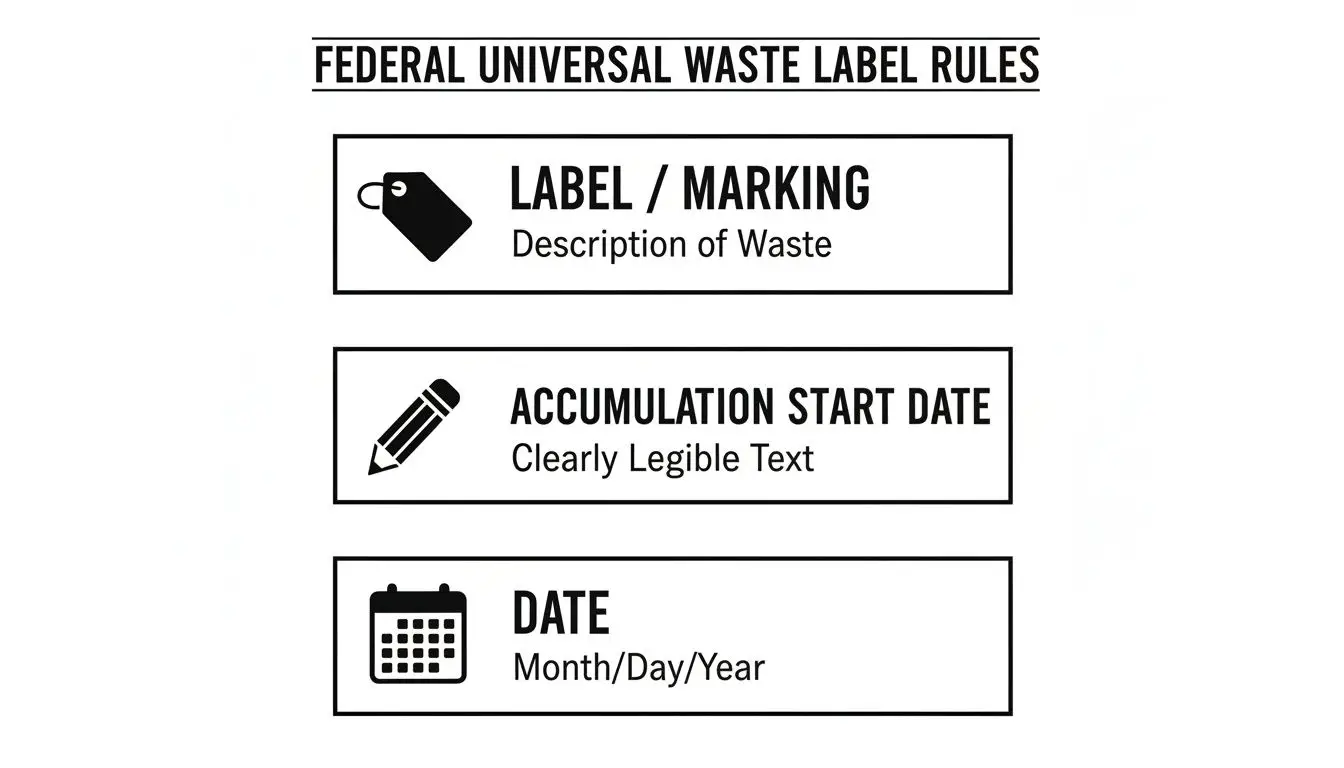
This breaks down the federal mandate into three simple parts: your label must clearly identify the type of waste and track how long you've had it. But remember, these are just the basics, and your state’s environmental agency will likely have more to say.
Key State Differences to Watch For
The main way states differ from federal rules is by expanding the definition of what counts as universal waste. This is especially true for electronic waste, which the EPA doesn’t currently classify as universal waste at the federal level.
However, many states have stepped in to regulate e-waste much more strictly under their own universal waste programs. This is where compliance can get tricky for IT and facility managers.
A perfect example is California. The state’s Department of Toxic Substances Control (DTSC) considers pretty much all electronic devices to be universal waste under Title 22 of the California Code of Regulations. This means containers holding anything from old laptops and servers to monitors and keyboards must be managed with proper universal waste signage.
Other states have their own specific rules, too:
- Maine: Regulates Cathode Ray Tubes (CRTs) from old monitors and TVs under its universal waste program.
- Michigan: Classifies a wide range of electronic devices as universal waste, forcing businesses to follow state-specific labeling and handling rules.
- New Hampshire: Also includes CRTs under its state universal waste rules, highlighting the regional differences you need to be aware of.
The most important takeaway for any business is this: the rules you follow are dictated by where the waste is generated. If your Sacramento office produces e-waste, you must meet California's strict signage standards, even if your headquarters is in a state with looser rules.
Federal vs. Key State Universal Waste Regulations
To make sense of this complex landscape, it helps to see the differences side-by-side. This table shows how a state like California builds on the federal foundation, making it clear why a one-size-fits-all approach to universal waste signage is a risky move.
| Regulation Aspect | Federal EPA Standard (40 CFR 273) | California Example (Title 22) | Other State Examples |
|---|---|---|---|
| Applicable Waste | Batteries, certain pesticides, mercury-containing equipment, and lamps. | Includes all federal types plus all electronic devices, CRTs, and non-empty aerosol cans. | Maine & NH: Include CRTs. Michigan: Includes most electronic waste. |
| Required Label Text | "Universal Waste—[Type]", "Waste [Type]", or "Used [Type]". | Must use "Universal Waste—[Type of Waste]" and include a description of the contents. | Varies, but typically aligns with either federal or California-style specific wording. |
| Dating Requirement | Accumulation start date is mandatory. | Accumulation start date is mandatory on each container or individual item. | Nearly all states with programs mandate the accumulation start date. |
| Container Condition | Must be structurally sound and closed to prevent leakage. | Explicitly requires containers to be in good condition, closed, and not leaking. Stricter enforcement. | Similar requirements, with emphasis on preventing hazardous material release. |
As you can see, state rules don’t replace federal ones—they add to them. For companies with a national footprint, the safest and most effective strategy is to create a signage policy that meets the strictest requirements of all the states you operate in.
To learn more about how these different rules intersect, check out our complete guide on navigating universal waste regulations for a more detailed overview.
The True Cost of Getting Signage Wrong
So, what really happens if a universal waste label is wrong or missing? It’s easy to dismiss it as a small clerical error, but that simple mistake can hit your budget, operations, and even your company’s reputation. The financial penalties for non-compliance are serious, and what starts as a simple oversight can quickly become a very expensive problem.
These fines aren't just empty threats. An inspector walks through your facility, finds a single drum of old fluorescent lamps with a smudged or missing accumulation date, and writes a citation. If that same issue is found on other containers or at different sites, those costs multiply, turning a completely preventable error into a major financial headache.
The Ripple Effect of One Bad Label
A simple labeling mistake doesn't just lead to a one-time fine. It kicks off a damaging ripple effect that sends risk and cost through your entire waste management process. It’s a small crack that can lead to a much bigger break.
Here’s how quickly a single labeling failure can spiral out of control:
- Risk of Reclassification: This is where it gets really expensive. If regulators see that you're not managing items correctly under the Universal Waste Rule—like missing labels or storing them for more than a year—they can strip the universal waste status. Suddenly, those items are reclassified as fully regulated hazardous waste.
- Skyrocketing Disposal Costs: Once reclassified, that same container of batteries or lamps now falls under the much stricter and pricier Resource Conservation and Recovery Act (RCRA) rules. Your disposal costs can jump by 5 to 10 times or even more.
- Deeper Regulatory Scrutiny: A violation for something as basic as signage is a huge red flag for inspectors. They’ll likely assume that if you’re missing the easy stuff, bigger compliance problems are probably hiding somewhere else. This often triggers a much more thorough facility audit.
What should have been a straightforward pickup for your IT or facilities team now becomes a complex mess involving hazardous waste manifests, specialized transportation, and a much heavier administrative workload.
Contamination: The Hidden Cost of Confusion
Beyond the fines, incorrect signage creates another costly problem: waste stream contamination. When employees don't have clear signs telling them what goes where, they’re forced to guess. That’s how batteries end up in the e-waste bin and old lamps get tossed in with regular trash, contaminating your recyclables and driving up disposal fees.
Clear signage isn't just about avoiding fines; it's a powerful tool for cutting down on contamination. Research from institutions like Western Washington University (WWU) has shown that by rolling out standardized universal signage, organizations can cut contamination in some streams by half and dramatically increase the amount of correctly sorted recyclables. Their success shows just how much of an impact a clear label can make. You can see how they built their program by reviewing their full signage initiative findings.
This proves that clear, consistent signage is one of the best cost-control tools you have. Reducing contamination doesn't just lower your disposal fees—it can also increase the value your business receives for clean streams of materials like electronic scrap.
Ultimately, putting a solid universal waste signage program in place isn't just another operational expense. It's an investment in protecting your business from fines, preventing costly operational headaches, and showing that your company is committed to doing things the right way. That simple label is one of your best defenses for both your budget and your brand.
Building Your Signage Program Step by Step
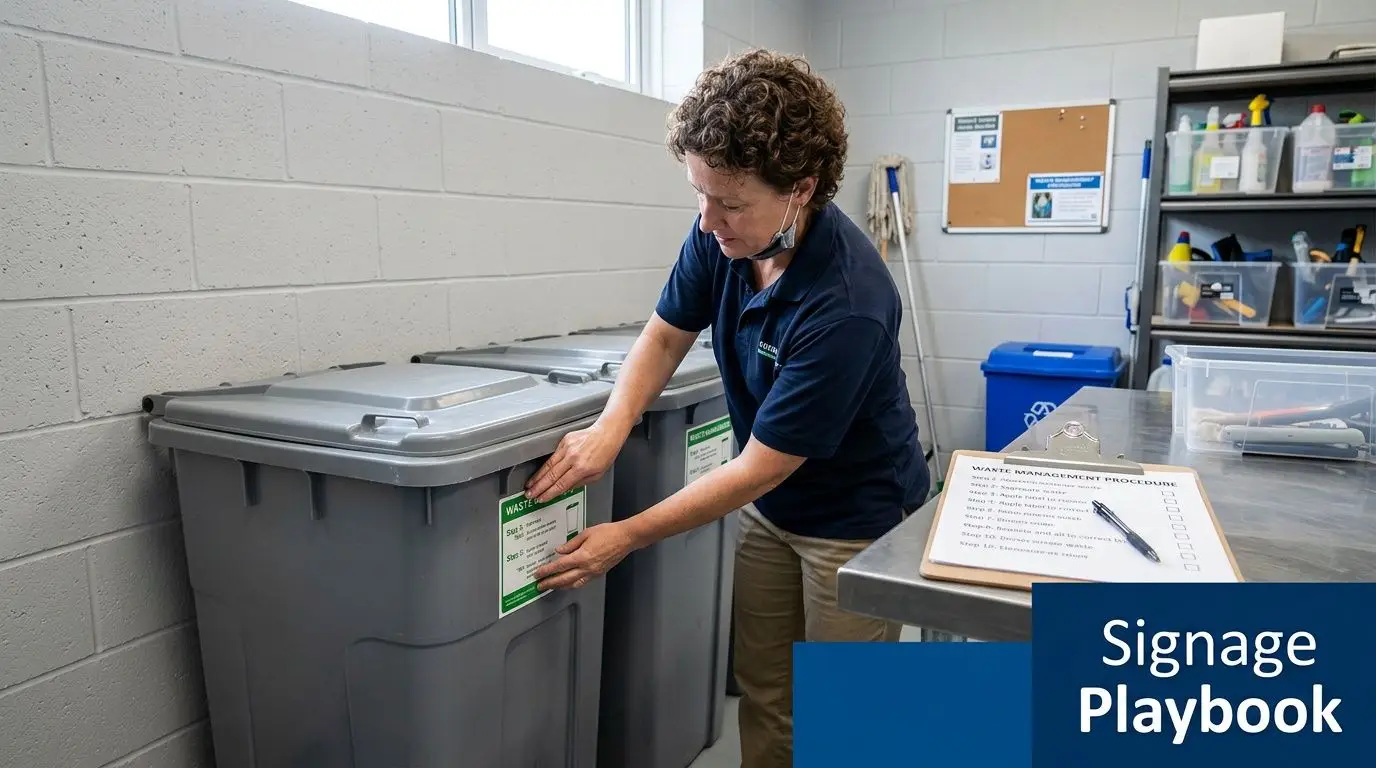
Knowing the rules is one thing, but putting them into practice is what keeps you compliant. A solid universal waste signage program is about more than just a few labels; it's a complete system built on consistency, clarity, and communication. This guide will walk you through setting up a foolproof program that will hold up under any inspector's watch.
The goal here is to create a system so intuitive that every employee—from IT to maintenance—can follow it without a second thought. This means designing the right labels, putting them in the right places, training your team, and keeping records that are simple but effective.
Designing Effective Labels and Templates
Consistency is the secret to a great signage program. When every label follows the same format, it creates a visual language your team can recognize and act on instantly. The first step is to create a standard template for all your universal waste labels.
You don't have to buy pre-printed labels, but any design you create yourself must have the non-negotiable elements required by the EPA and your state. At a bare minimum, your templates need to include:
- A Clear Title: Make sure it says "Universal Waste," "Waste [Type]," or "Used [Type]" in big, bold letters.
- Specific Waste Type: You'll need a blank space or checkboxes to identify the exact material (e.g., Batteries, Lamps, Electronic Devices).
- Accumulation Start Date: This is the most important field on the label. It absolutely must be filled out the moment the first item goes into the container.
Using a digital template is a smart move. It guarantees every label is identical, whether it's printed in your Atlanta headquarters or a satellite office. This kind of standardization shows you've got a well-managed, professional program. For ideas, you can check out some design options and download free samples from our resource page on universal waste labels.
Placement and Visibility Best Practices
A perfectly designed label is completely useless if nobody can see it. Where you put the sign is just as critical as what's written on it. Your signage has to be clearly visible from any direction someone might approach the container or storage area.
Just follow these simple placement rules:
- Affix Immediately: The label goes on the container before or at the same time the first piece of waste is added. Don't put it off until the bin is full.
- Front and Center: Stick the label on the front of the drum, box, or pallet—never on the lid, where it can be covered up or removed.
- Durable and Legible: Use weather-resistant labels and a permanent marker. To an inspector, a smudged or unreadable date is the same as no date at all.
- Area Signage: For designated Central Accumulation Areas (CAAs), use larger signs to clearly mark the entire zone in addition to labeling individual containers.
An effective signage program acts as a silent supervisor, constantly guiding employees toward correct disposal actions. The visibility and clarity of your labels directly correlate with your program's success and your ability to prevent costly sorting errors.
Employee Training and Recordkeeping
Your signage system is only as good as the people who use it. Training is what breathes life into your program and makes it work. Every employee who generates or handles universal waste needs to understand what the labels mean and what they're supposed to do.
Keep the training focused on two key actions: putting the right waste in the right container and understanding why the accumulation start date is so important. This doesn't need to be a long, drawn-out meeting; a simple one-page guide or a quick team huddle often works best.
Finally, back up your physical signs with simple records. A basic logbook or spreadsheet that tracks each container's start date and its final shipment date gives you undeniable proof that you're following the one-year accumulation rule. When a certified e-waste partner like Beyond Surplus schedules a pickup, you can simply close out the entry for that container, creating a clean and complete chain-of-custody record.
How a Certified Partner Simplifies E-Waste Compliance
Let's be honest, managing universal waste signage, keeping up with state-specific rules, and tracking accumulation dates can feel like a full-time job. The constant worry of non-compliance, on top of the paperwork, puts a real strain on IT and facility managers. This is exactly where bringing in a certified IT Asset Disposition (ITAD) expert like Beyond Surplus can make all the difference.
When you outsource your electronics recycling, you're not just clearing out old equipment. You're handing off the most complex parts of your compliance program to a partner who lives and breathes this stuff. Instead of you juggling all those regulations, you get an expert to manage the process from start to finish.
Easing Your Team's Burden and Reducing Risk
Think of a certified partner as an extension of your team—one that specializes in compliance. We take on the tricky logistics so your staff can get back to their real jobs. Partnering with us brings a few immediate wins:
- Hassle-Free Pickups: We handle the secure collection and transport of your e-waste with our nationwide pickup services, no matter where your offices are.
- Guaranteed Compliance: We make sure every single step, from pickup to final recycling, meets all federal, state, and local rules. This includes the very specific universal waste regulations for electronics you find in states like California.
- No More Accumulation Worries: With regular, scheduled pickups, your business will never get close to that one-year accumulation deadline. This takes a major compliance headache related to universal waste signage and storage right off your plate.
It’s really about offloading your regulatory risk. We take on the full responsibility for proper handling and processing, giving you complete peace of mind.
Solid Documentation for Total Accountability
Proving you did everything by the book is one of the most important parts of compliance. A certified partner provides the official paperwork you need to show complete accountability and transfer that liability away from your organization.
When you work with Beyond Surplus, you receive detailed reports that serve as your official record of responsible disposal. This isn't just a receipt; it's your proof of compliance for any potential audit.
This documentation includes two key items:
- Certificates of Recycling: This document confirms that your assets were processed in an environmentally sound way, following our strict zero-landfill policy.
- Certificates of Data Destruction: For any devices that held sensitive data, this certificate proves that all information was securely and permanently destroyed, keeping you in line with privacy laws like the FTC Disposal Rule.
These documents officially close the loop on your IT asset's lifecycle. They create a clear, auditable paper trail from your facility all the way to final disposition. By understanding the importance of electronics recycling certification, you can see how a qualified partner truly protects your business. With Beyond Surplus, you're not just getting rid of old gear; you're putting a secure, responsible, and fully documented compliance strategy into action.
Frequently Asked Questions About Universal Waste Signage
Even with a solid plan, a few common questions about universal waste signage always seem to pop up. Getting the right answers is key to running a compliant program and making sure your team isn't left guessing.
We’re here to clear up that confusion with practical answers to the questions we hear most often. This will give you the confidence to manage your universal waste correctly.
When Exactly Do I Need to Label My Universal Waste Container?
You need to label the container the very same day you put the first piece of universal waste inside. That’s when the EPA’s clock on the "accumulation start date" officially starts ticking.
Waiting even a single day to add the label can get you flagged for a violation during an inspection. The best approach? Pre-label your empty containers before they’re even used. This simple step completely removes the risk of forgetting and keeps you compliant from day one.
Can I Create My Own Universal Waste Signs?
Yes, you can absolutely make and print your own signs. The EPA doesn’t require you to buy pre-made labels. What matters is that all the required information is on there, accurate, and easy to read.
Your custom signs must have two key things:
- A specific phrase: You can use "Universal Waste—[Type of Waste]," "Waste [Type of Waste]," or "Used [Type of Waste]."
- The accumulation start date: This is the date the very first item went into the container.
Many companies find it helpful to create their own digital templates. It’s a great way to keep all your labels consistent and professional-looking across different sites.
What Happens If I Miss the One-Year Accumulation Deadline?
Going past the one-year storage limit for universal waste is a big deal. If an inspector finds waste that has been sitting for more than 365 days, it can be reclassified under the much tougher—and more expensive—Resource Conservation and Recovery Act (RCRA) rules for fully hazardous waste.
This isn't a slap on the wrist. Reclassification often leads to hefty fines, more intense regulatory oversight, and a sharp spike in your disposal costs. Your dated sign is your number one piece of proof that you’re playing by the rules.
Does Universal Waste Signage Apply to Electronics Like Laptops?
This is a common source of confusion, so it’s a critical one to get right. Federally, e-waste isn't considered universal waste. But—and this is a big but—many states have created their own rules that do.
States like California, Michigan, and Hawaii classify electronic waste as a state-specific type of universal waste. If you’re doing business in one of these states, you must use universal waste signage on containers holding laptops, servers, monitors, and other electronics. It’s always your responsibility to know and follow the rules in the state where you’re generating the waste.
Navigating these complex regulations is simpler with an expert partner. Beyond Surplus provides certified electronics recycling and secure IT asset disposal nationwide, ensuring your e-waste is managed in full compliance with all federal and state rules. Contact us today to schedule a pickup and simplify your compliance strategy. https://www.beyondsurplus.com


