

When your business has a stockpile of old hardware, the first question for any IT or facility manager is, "What do we do with all these old computer components?" The answer isn't to start hauling things away—it's to start with a smart assessment. This is your most critical step, turning what looks like a chaotic pile of e-waste into an organized inventory ready for a compliant and profitable disposal process.
The First Step with Old Computer Components
Staring down a room full of retired IT assets can feel overwhelming. It's tempting to make quick decisions just to clear the space, but that's a mistake. The best approach for your business is a systematic triage, sorting every single item into clear categories based on its future potential.
This method transforms a messy cleanup job into a strategic business move. It ensures you don't accidentally discard valuable assets while also making sure any device with data on it gets the security treatment it needs.
Think of it less like an operational cleanup and more like a profit-and-loss strategy for your retired technology. By sorting components, you can quickly identify items with high resale value, like CPUs and enterprise-grade RAM. At the same time, you can isolate security risks—like hard drives and SSDs—that require certified, secure data destruction. Everything else, from obsolete motherboards to broken keyboards, can be flagged for certified electronics recycling.
A Framework for Assessment
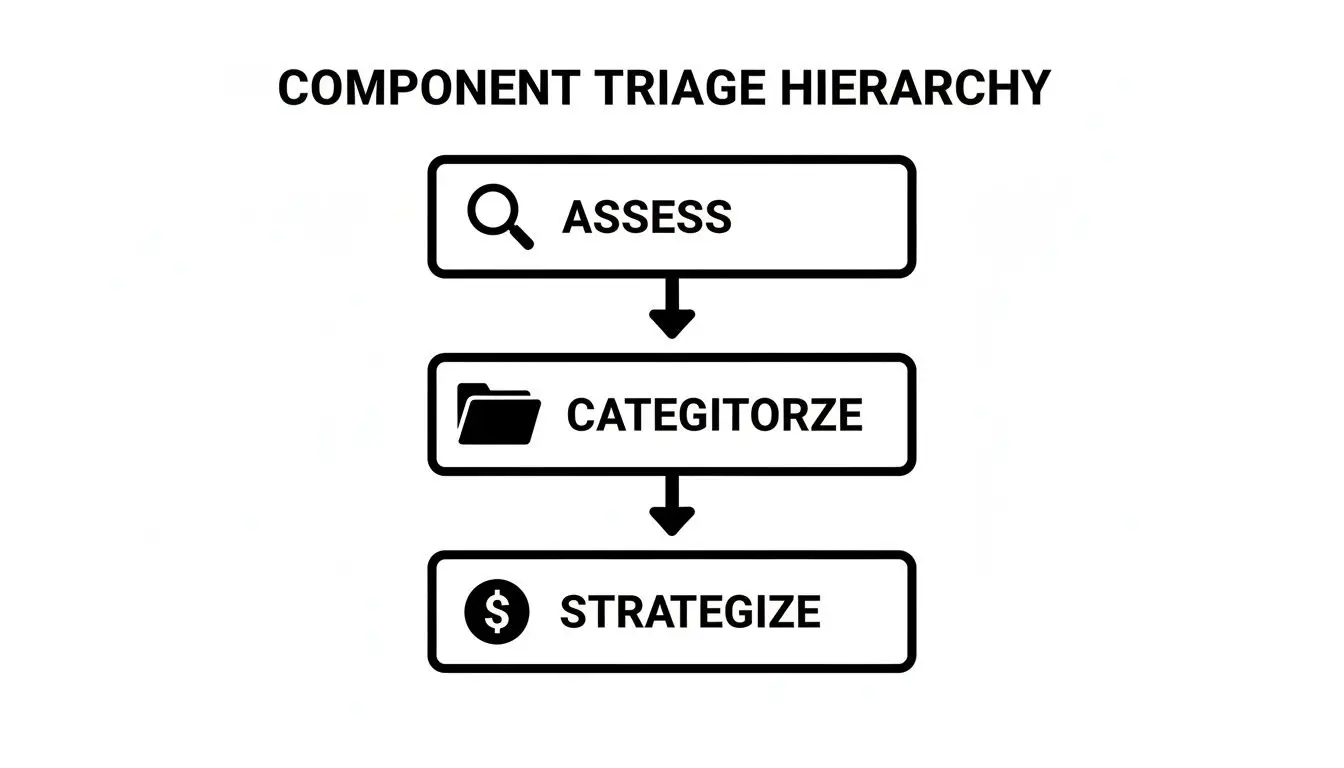
To make this manageable for your team, use a simple three-part framework: Assess, Categorize, and Strategize. This approach helps you quickly sort through hardware and decide on a clear next step for each piece, which helps avoid compliance headaches and gets you the best possible financial return.
- Assess: Examine each component's condition and model. Does it have current market value? Is it a recent-generation CPU or an old, forgotten power supply?
- Categorize: Group your items based on your assessment. You should have distinct groups for resale, secure data destruction, and certified recycling.
- Strategize: Now, execute a plan for each category. This means contacting an ITAD partner for a buyback offer, scheduling certified data destruction for data-bearing assets, and arranging a pickup for the remaining e-waste.
This simple but effective triage process is the foundation for managing old computer components correctly and securely.
Initial Triage for Old Computer Components
Use this framework to sort components by action, value, and risk, transforming retired IT assets into a clear action plan.
| Component Type | Primary Action | Potential Value | Security Risk |
|---|---|---|---|
| CPUs (Processors) | Resale/Reuse | High | Low |
| RAM (Memory) | Resale/Reuse | High | Low |
| Hard Drives (HDD/SSD) | Secure Destruction | Low (Scrap) | CRITICAL |
| Graphics Cards (GPU) | Resale/Reuse | Varies | Low |
| Motherboards | Recycle | Low | Low |
| Power Supplies | Recycle | Low | Low |
| Network Cards | Resale/Recycle | Low to Moderate | Low |
| Laptops/Desktops | Assess for Reuse/Resale | Varies | CRITICAL |
By following this hierarchy—Assess, Categorize, then Strategize—you can systematically convert a hardware surplus into an actionable plan. This initial sorting is what allows for a smooth and secure transition from your facility to the next stage, whether that's resale, refurbishment, or recycling. This is the crucial first step in getting your assets ready for transport and final disposition.
To learn more about preparing your assets, review our guide on how to prepare your computers for recycling.
How to Guarantee Your Data Is Secure
Before any old computer components leave your facility, ensuring the data on them is unrecoverable isn't just a best practice—it's a critical business requirement. A single data breach from one mishandled hard drive can lead to massive fines, litigation, and irreparable brand damage. It's no longer a question of if you should secure your data, but how you can be absolutely certain it’s unrecoverable.
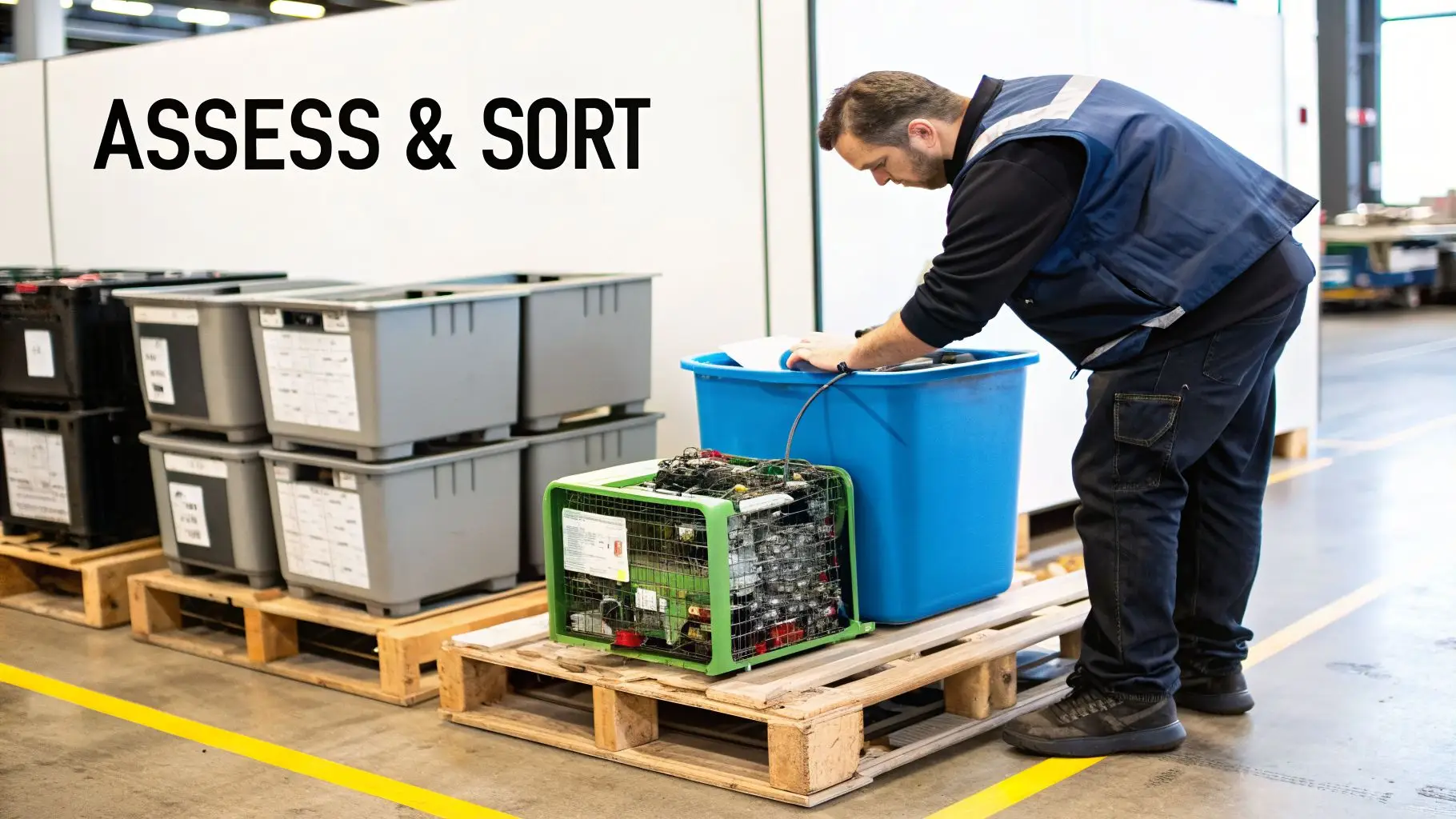
Simple file deletion or formatting provides a false sense of security. These basic functions often leave the underlying data intact and easily recoverable with off-the-shelf software tools. For true, enterprise-level security, you must select a method that aligns with your industry's regulations and your company's risk tolerance.
Data Sanitization Methods
There are three primary methods to guarantee data destruction: software-based wiping, degaussing, and physical shredding. Each serves a specific purpose, and the right choice depends on whether the storage media will be reused or destroyed.
- Data Wiping (Sanitization): This software approach overwrites the entire surface of a hard drive or SSD with random data, often in multiple passes. This is the ideal choice for components destined for resale, as it preserves the drive's functionality while rendering the original data unrecoverable.
- Degaussing: This process uses a powerful magnetic field to instantly scramble the magnetic platters on hard drives and tapes where data is stored. It is highly effective but renders the drive permanently unusable. Degaussing is a fast, secure option for media destined for recycling, not resale.
- Physical Shredding: For the highest level of security, nothing surpasses physical destruction. This method feeds hard drives, SSDs, and other media into an industrial shredder, grinding them into tiny, unrecoverable metal fragments.
Compliance and Proof of Destruction
If your business operates in a regulated industry like healthcare (HIPAA), finance (GLBA), or handles consumer data (FTC Disposal Rule), you are legally required to have proof of data destruction. Assuming your vendor performed correctly will not protect you from liability.
A "Certificate of Data Destruction" is the official document that legally transfers liability from your business to your ITAD partner. It’s your auditable proof that every data-bearing device was properly sanitized or destroyed according to federal and industry standards.
This certificate is your shield against audits or legal challenges. It must list the specific serial numbers of the disposed assets, the destruction method used (wiping, degaussing, or shredding), and the completion date. Without it, your company remains liable for that data, even years after the hardware has been disposed of.
Working with a certified partner is the only way to ensure you meet compliance obligations. For a deeper understanding of government standards, learn about our adherence to the NIST SP 800-88 guidelines for media sanitization. A certified vendor like Beyond Surplus ensures every step is documented, secure, and fully compliant, providing total peace of mind when disposing of old computer components with sensitive information.
Turning Old Components into a Revenue Stream
That storage room full of old computer components isn’t just occupying space—it’s a hidden financial asset. Knowing what to do with old computer gear means you can unlock its remaining value, turning what appears to be a disposal cost into revenue for your business. It's not about avoiding a fee; it's about actively generating income from retired hardware.
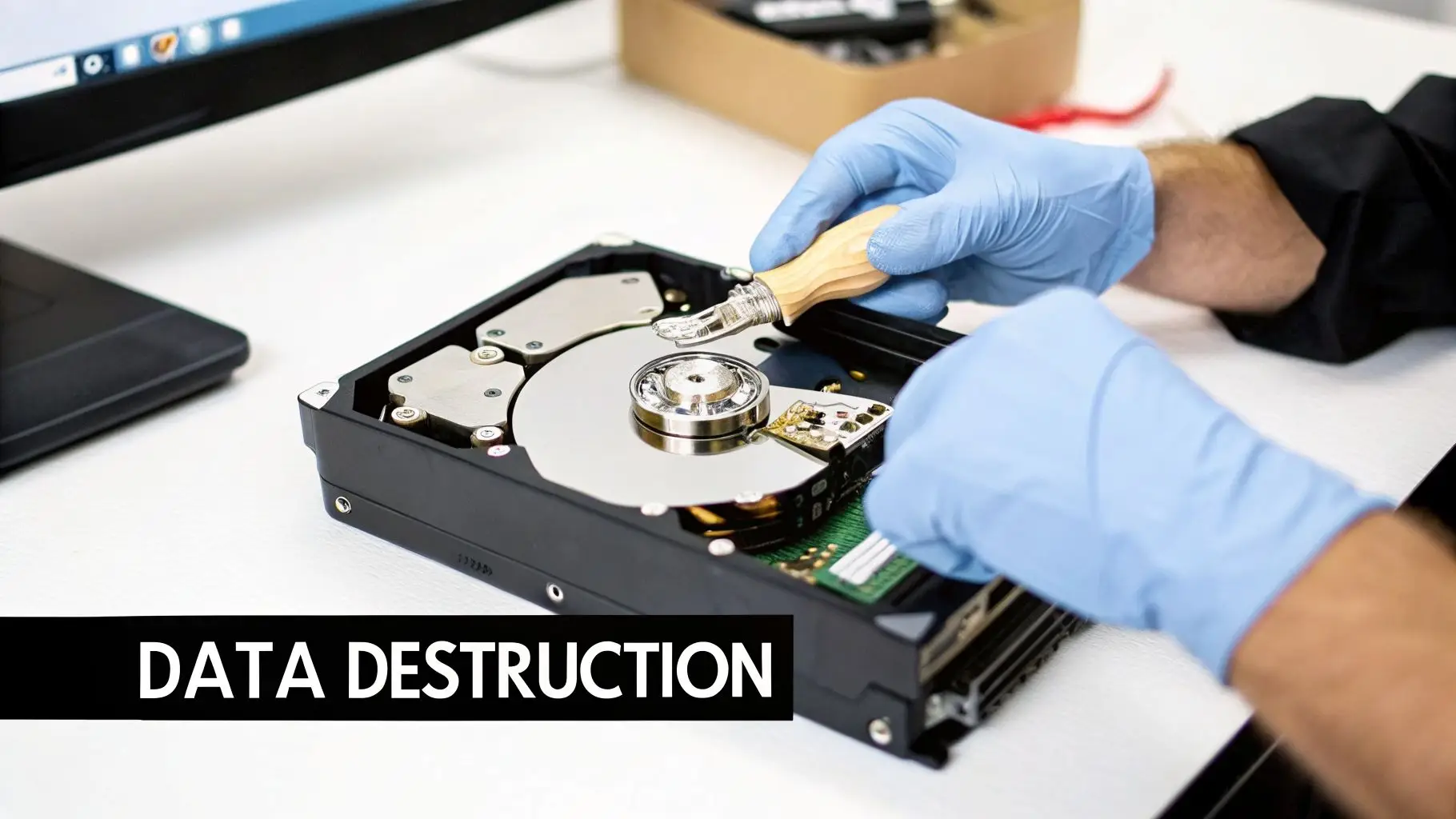
You have two primary paths to convert these assets into revenue: selling individual parts in-house or partnering with an IT Asset Disposition (ITAD) company for a comprehensive buyback program. Each route achieves the same goal—maximizing your financial return—but through very different operational approaches.
In-House Resale of High-Demand Items
Some components retain their value remarkably well on the secondary market long after the original system is decommissioned. If your IT department has the time and expertise, they can identify and sell these items directly.
The parts that are consistently in high demand include:
- Enterprise CPUs: Processors from servers and high-end workstations are always sought for upgrades and repairs.
- Enterprise GPUs: Professional graphics cards from data centers and workstations command a strong resale market.
- High-Capacity RAM: DDR4 and DDR5 memory modules, particularly larger capacities, are consistently valuable.
- Enterprise SSDs: High-endurance solid-state drives can be resold for a significant price once securely wiped.
Selling direct may yield the highest price per item, but it means your team must manage the entire process—testing, listing, sales, and shipping. This diverts significant time and resources from core business functions.
The ITAD Buyback Program Advantage
For most businesses, partnering with a full-service ITAD vendor like Beyond Surplus is a more strategic and efficient move. A buyback program removes the entire project from your team's responsibility. We manage all logistics, testing, valuation, and resale for every piece of equipment that retains value.
The process is simple and designed to minimize your team's workload. We evaluate your entire inventory of old computer parts, identify everything with resale potential, and provide a fair market offer. A complex, months-long project becomes one simple, streamlined transaction.
The primary advantage of an ITAD buyback program is its efficiency. Instead of your IT department spending weeks selling parts one by one, a professional partner liquidates all your valuable assets at once. You receive a prompt, consolidated payment, and your personnel regain their time.
This is more than a convenience; it's a strategic financial decision. The market for used and refurbished electronics is substantial and continues to grow, as confirmed by a report on the Global Computer Recycling Market on marketresearch.com. An expert ITAD partner has established sales channels to secure the best possible price for your hardware.
By utilizing a buyback program, you’re not just ensuring data security and compliant disposal. You are transforming a logistical headache into a reliable revenue stream for your bottom line. To get a better idea of the potential return for your specific hardware, explore our guide on IT equipment resale services.
Choosing a Certified E-Waste Recycling Partner
When old computer components have no resale value or contain proprietary designs that cannot be resold, certified e-waste recycling isn't just an option—it's a non-negotiable part of corporate responsibility. The decision to recycle is simple. Choosing the right partner, however, is where true risk management begins. A poor choice can expose your company to hefty fines, data breach liabilities, and brand-damaging headlines.
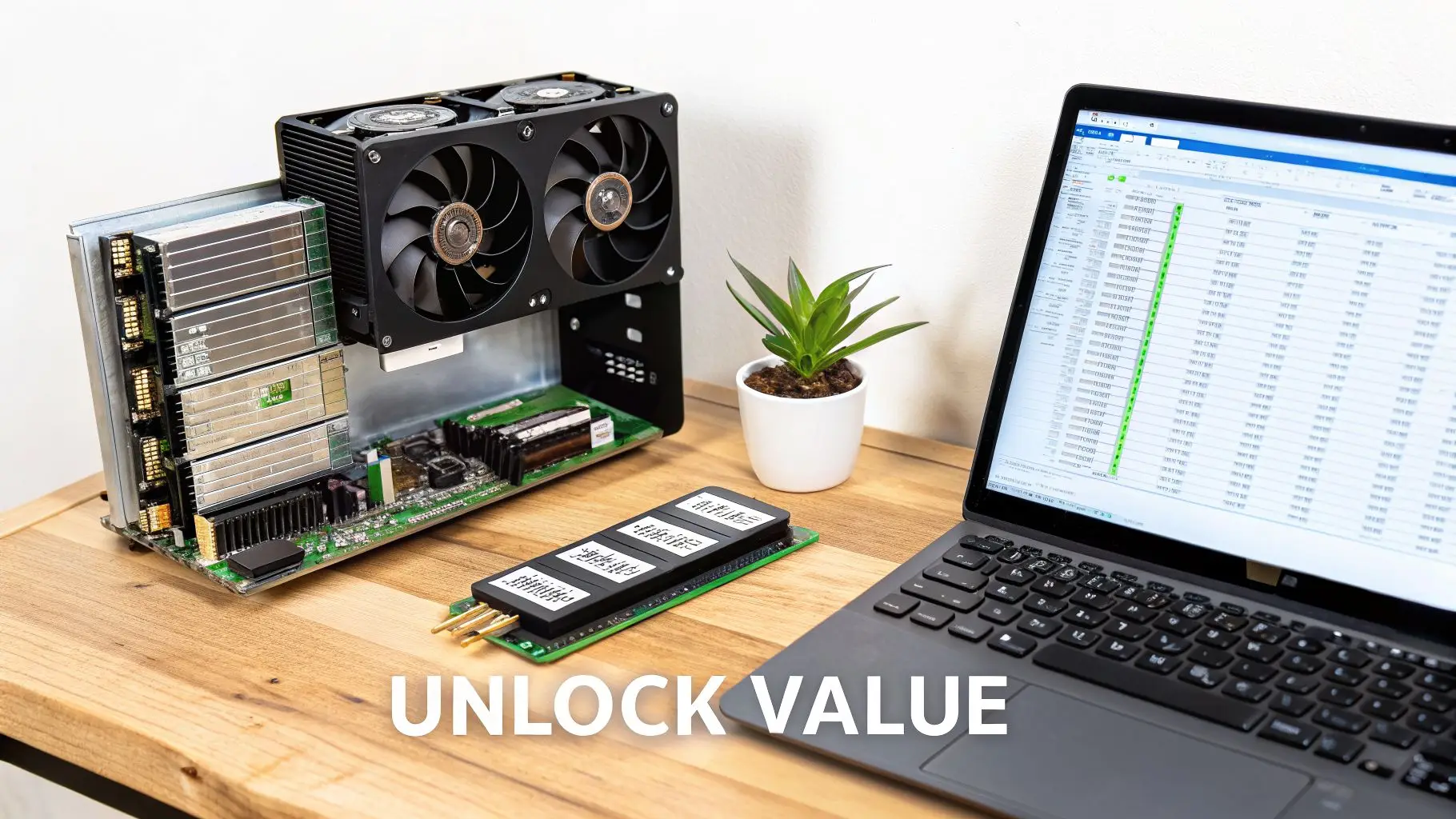
Simply handing your assets over to any company with "recycling" in its name is a significant gamble. It is equivalent to giving a box of your most sensitive financial records to an unknown third party and hoping for the best. Without a certified process, you have no real guarantee of where your equipment ends up or how its data is managed.
Understanding E-Waste Certifications
The most reliable way to vet a recycling partner is to examine their certifications. Standards like R2 (Responsible Recycling) and e-Stewards are the gold standard in the ITAD industry. These are not merely badges; they prove that a facility meets strict, third-party audited standards for security, environmental safety, and operational transparency.
These certifications provide concrete guarantees that:
- Data is secure: All data-bearing devices are handled and sanitized according to strict protocols like NIST 800-88.
- Operations are environmentally safe: Hazardous materials in electronics, like lead and mercury, are managed responsibly.
- Assets are not illegally exported: Your equipment will not be dumped in developing countries—a practice that creates environmental disasters and significant legal risk for your company.
A certified partner doesn’t just promise to do the right thing; they are contractually and legally obligated to prove it. For a deeper dive into what these credentials entail, you can review our guide that explains what R2 Certification means for your business.
Chain of Custody: The Ultimate Liability Shield
The most critical service a certified e-waste recycler provides is a documented chain of custody. This is an unbroken, auditable paper trail that tracks your assets from the moment they leave your facility to their final destruction. It includes detailed logs, serialized tracking, and, most importantly, Certificates of Recycling and Data Destruction.
This documented chain of custody is your organization's primary defense against liability. It legally transfers the responsibility for the assets and their data from your company to your ITAD partner, giving you verifiable proof of compliance for any future audits.
This is what separates professional ITAD services from scrap haulers. A scrap company might remove your equipment, but they offer zero transparency or legal protection. When you work with a certified partner like Beyond Surplus, you gain a partner in risk management.
The Growing E-Waste Challenge
The need for certified partners is becoming more critical as the volume of electronic waste skyrockets. The world generated a staggering 62 million tonnes of e-waste in 2022, a figure projected to reach 82 million tonnes by 2030. Despite this surge, only 22.3% of that waste was formally collected and recycled, highlighting a massive gap that creates both environmental and regulatory risks for unprepared businesses.
This growing problem underscores the importance of choosing a partner who can navigate complex regulations and provide a transparent, compliant solution for your old computer components. A certified recycler ensures your business is part of the solution, not the problem, safeguarding your reputation and your bottom line.
Managing Logistics and Meeting Compliance Rules
Disposing of old computer parts involves more than just deciding whether to sell or recycle them. For any IT or facilities manager, it's a complex intersection of logistics and rigid compliance rules. Mismanagement at this stage can lead to data breaches, substantial fines, and operational disruption. A simple equipment refresh can quickly become a significant liability.
To navigate this successfully, you need a firm grasp of your options. This could range from palletizing gear for a scheduled pickup to arranging on-site data destruction for maximum security. It also means translating dense legal regulations into simple, actionable steps that keep your organization secure.
Understanding Key Compliance Mandates
Several federal and state laws dictate how businesses must handle old electronics, particularly those containing sensitive data. Ignoring these rules leads to serious financial penalties and reputational damage. The purpose of these laws is to protect consumer and corporate data from unauthorized access during the disposal process.
Two of the most significant regulations for U.S. businesses are:
- The FTC Disposal Rule: This rule requires businesses to take "reasonable measures" to protect consumer information on any assets they dispose of. Discarding a hard drive in a dumpster is a clear violation.
- HIPAA (Health Insurance Portability and Accountability Act): For any organization in the healthcare sector, HIPAA imposes extremely strict controls on protected health information (PHI). Any device that ever stored PHI must be completely sanitized or physically destroyed according to specific standards before it leaves your premises.
Failure to comply is not just a procedural error; it’s a major financial risk. Fines for a single data breach can easily reach into the millions.
The Importance of Chain of Custody
When it comes to proving compliance, your most powerful tool is a clear chain of custody. This is the documented, unbroken paper trail that tracks your old computer components from the second they leave your control to their final disposition—whether that’s resale, reuse, or certified destruction.
A chain of custody is your best defense in an audit. It serves as irrefutable proof that your organization followed a secure, compliant, and documented process for every single asset, effectively transferring liability to your certified ITAD partner.
A robust chain of custody report will always include:
- Serialized Asset List: Every component, from a CPU to a hard drive, is logged with its unique serial number.
- Secure Transit Records: Documentation confirming who handled the assets, when they were picked up, and how they were transported.
- Final Disposition Certificates: Official Certificates of Data Destruction and Recycling that confirm exactly what happened to each serialized asset.
This level of detail is what separates a professional ITAD service from a standard scrap hauler. It is the legal and procedural shield your business requires. For companies needing to arrange secure transport, utilizing a dedicated IT equipment pickup service ensures that chain of custody begins the moment equipment leaves your office.
Navigating the Logistics of Disposal
Once you have a handle on compliance, you must manage the physical movement of the equipment. A full-service ITAD partner simplifies this by managing everything from transport to final documentation. This is incredibly valuable as the market grows and compliance demands get stricter. The global e-waste recycling market is expected to hit USD 80,432.8 million in 2025, with North America accounting for about 37% of that. This growth is driven by regulations like the Resource Conservation and Recovery Act (RCRA) and the simple fact that more businesses require certified partners. You can get a deeper look at the expanding market in the full e-waste recycling market report.
A professional partner handles all logistical challenges, including:
- On-Site Services: Packing, palletizing, and shrink-wrapping equipment at your location to ensure it is secure for transport.
- Secure Transportation: Using dedicated, GPS-tracked vehicles to move assets from your facility to a secure processing center.
- Detailed Reporting: Providing the final documentation and certificates you need to close the loop and satisfy compliance requirements.
By outsourcing these complex logistical and compliance tasks, your IT and facilities teams can remain focused on their core responsibilities, knowing your old computer components are being handled securely and responsibly.
Why an ITAD Partner Makes Sense for Your Old Components
Attempting to manage the end-of-life for a large volume of computer components in-house is a high-risk, resource-intensive undertaking. Juggling the assessment, data security, value recovery, and compliance for hundreds or thousands of individual parts can quickly overwhelm even the most capable IT and facilities teams.
This is precisely where engaging a professional IT Asset Disposition (ITAD) firm like Beyond Surplus provides a strategic advantage. Instead of a complex, risky project that drains your resources, your old computer components become a predictable, managed service—an opportunity for value recovery and guaranteed compliance.
What a Typical Engagement Looks Like
A professional ITAD partnership transforms a chaotic disposal project into an orderly, fully documented process. It follows a clear path designed from the ground up to maximize security, value, and efficiency for your business.
It all starts with a consultation where we work with your team to understand the scale of your project. We assess your entire inventory of old computer components and provide a complete valuation, flagging assets with resale potential and those destined for secure recycling. This transparent approach gives you a clear financial picture from the outset.
From there, we handle all the logistics:
- Secure On-Site Packing: Our teams can come to your location to securely pack and palletize all your equipment, ensuring a safe and organized transition.
- GPS-Tracked Transportation: We use a dedicated, secure fleet to move your assets to our certified processing facility, maintaining a strict chain of custody from your door to ours.
- Certified Processing: Once assets arrive, all data-bearing devices undergo certified data destruction following NIST 800-88 standards. Other components are tested, sorted for remarketing, or responsibly recycled.
Delivering Peace of Mind and Real Value
The final step is delivering complete, auditable documentation. This includes Certificates of Data Destruction and Recycling, which legally transfer liability away from your organization and serve as your proof of compliance for any future audits. You receive detailed reports that close the loop on every single asset.
When you engage a certified ITAD partner, all stakeholders benefit. Your C-suite receives brand protection and risk mitigation, your IT manager gets documented compliance and peace of mind, and your facilities manager gets a streamlined, efficient process.
Ultimately, partnering with a firm like Beyond Surplus changes how you approach managing old computer components. It replaces internal headaches and compliance risks with a secure, profitable, and fully managed process that protects your brand, recovers maximum value, and guarantees total regulatory compliance.
Common Questions About Component Disposal
When it's time to retire old computer hardware, many of the same questions arise for businesses, regardless of their size or industry. Here are the straightforward answers you need to make smart, secure, and compliant decisions.
Can Our Company Just Throw Away Old Components?
No. First, it’s illegal in most areas. Electronics are classified as universal waste and are banned from landfills because they contain hazardous materials like lead and mercury.
More importantly, discarding old hardware—especially data-storing devices like hard drives—is a direct invitation for a data breach. Doing so places your company in violation of data security laws like the FTC Disposal Rule. Using a certified e-waste recycler is a legal and security imperative.
What Is the Difference Between Recycling and ITAD?
While often used interchangeably, e-waste recycling and ITAD are different services. Recycling is a destructive process focused on breaking down electronics into their raw commodity materials—metals, plastics, and glass—for reuse in new products.
IT Asset Disposition (ITAD) is a comprehensive end-of-life strategy. An ITAD partner like Beyond Surplus prioritizes secure data destruction and value recovery first, remarketing valuable assets to maximize your financial return before responsibly recycling the remainder. ITAD is a full-service solution, whereas recycling is just one component of it.
How Do We Know Our Data Is Actually Destroyed?
You get proof. The only way to be certain is by working with a certified ITAD provider who issues a Certificate of Data Destruction. This is your legally binding, auditable record confirming that all your data-bearing media was wiped or destroyed according to federal standards like NIST 800-88.
A Certificate of Data Destruction is your official liability shield. It formally transfers responsibility for the data from your company to the vendor, giving you documented proof and peace of mind for any future audits or legal questions.
Is It Worth Selling Old Components?
Absolutely. It is almost always worth evaluating the resale value of your old components. Items like enterprise-grade CPUs, recent RAM modules, and high-capacity SSDs can hold significant value on the secondary market. A professional ITAD partner can assess your inventory and provide a fair market valuation.
This allows you to recover funds to offset recycling costs or even generate a net profit from your retired assets. Simply recycling everything without an assessment is leaving money on the table.
For a complete, secure, and profitable solution to managing your end-of-life IT assets, contact Beyond Surplus. We provide certified electronics recycling and secure IT asset disposal services nationwide. Visit us at https://www.beyondsurplus.com to schedule a pickup.


