

A spring afternoon in 1966 changed Atlanta's self-image. The Braves took the field for their first regular-season game in the city, and the Falcons arrived that same year, giving Atlanta two major league markers of ambition almost at once.
That twin landing mattered because it told the rest of the country that Atlanta didn't want to remain a regional stop. It wanted to be on the national sports map, then on the global one.
The 1966 Spark That Ignited a Sports Town
In Atlanta, the story starts with a gamble that looked bold even by the standards of a fast-growing Southern city. Atlanta's transformation into a major sports city began in 1966 when two landmark franchises arrived: the Atlanta Falcons joined the NFL, and the Atlanta Braves played their first regular-season game on April 12, 1966, becoming the city's first major sports franchise (Sports Business Journal on Atlanta's turning point).
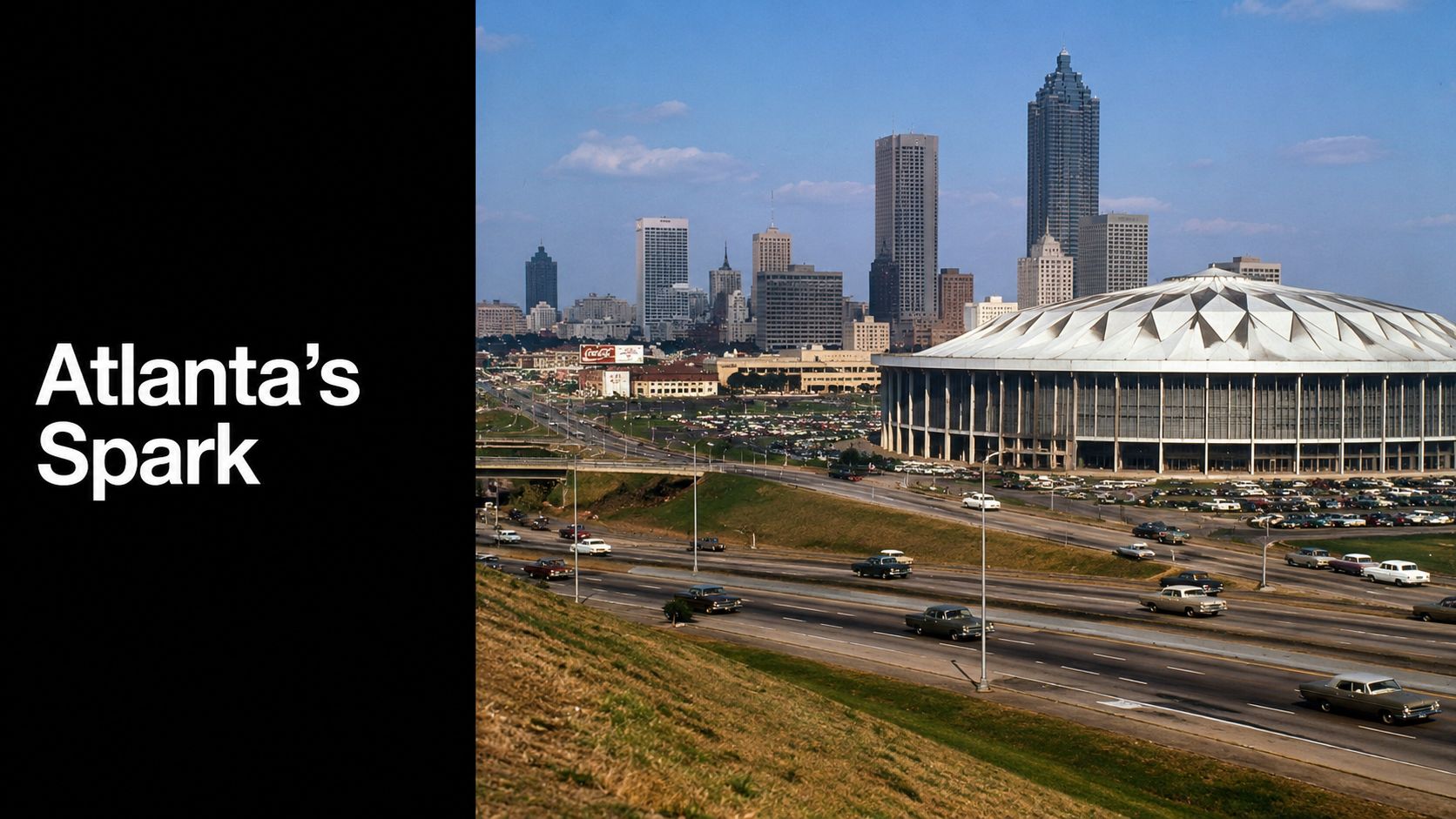
Two arrivals, one civic statement
The Braves gave Atlanta something it had never had before. A major professional franchise calling the city home. The Falcons, meanwhile, told football fans and television executives that Atlanta intended to compete in America's biggest sports conversation, not just observe it from the edge.
That mattered in the South, where college allegiances often ran deeper than pro loyalties. Atlanta's leaders weren't only adding teams. They were trying to reshape how the city was seen by investors, broadcasters, airlines, and the wider public.
Atlanta didn't become a sports city because one team won quickly. It became one because local leaders and fans agreed that major league status was part of the city's future.
The culture had to catch up to the ambition
Expansion on paper is one thing. Sustained support is another. Atlanta still had to prove that it could fill seats, build traditions, and make transplants and longtime residents feel that these teams belonged to them.
That process took time. It involved local media, downtown business interests, and a public that was still deciding what a major league Atlanta should look and sound like. Even today, traces of that early identity-building remain visible in how the city talks about itself, from baseball nostalgia to football spectacle.
A useful local example sits outside the standings. The city's sports identity became part of its civic storytelling, the same way neighborhoods and landmarks became symbols of modern Atlanta. That's part of why even adjacent local narratives, such as the Atlanta Braves connection in local business storytelling, still resonate.
Why 1966 still holds up
Three points explain why that year keeps returning in any honest account of how Atlanta became a major sports city:
- First proof of concept: The city showed it could attract top-tier leagues, not just talk about doing it.
- Regional breakthrough: Atlanta gave professional baseball a durable foothold in the South.
- Civic momentum: Once the city entered the major league system, future expansions and bids became easier to imagine.
The teams didn't solve everything. They did something more important. They made Atlanta think bigger.
How the 1996 Olympics Became a Permanent Catalyst
Three decades later, Atlanta's biggest sports event still isn't remembered only for medals. Its real legacy sits in concrete, transit patterns, and the logic of downtown land use.
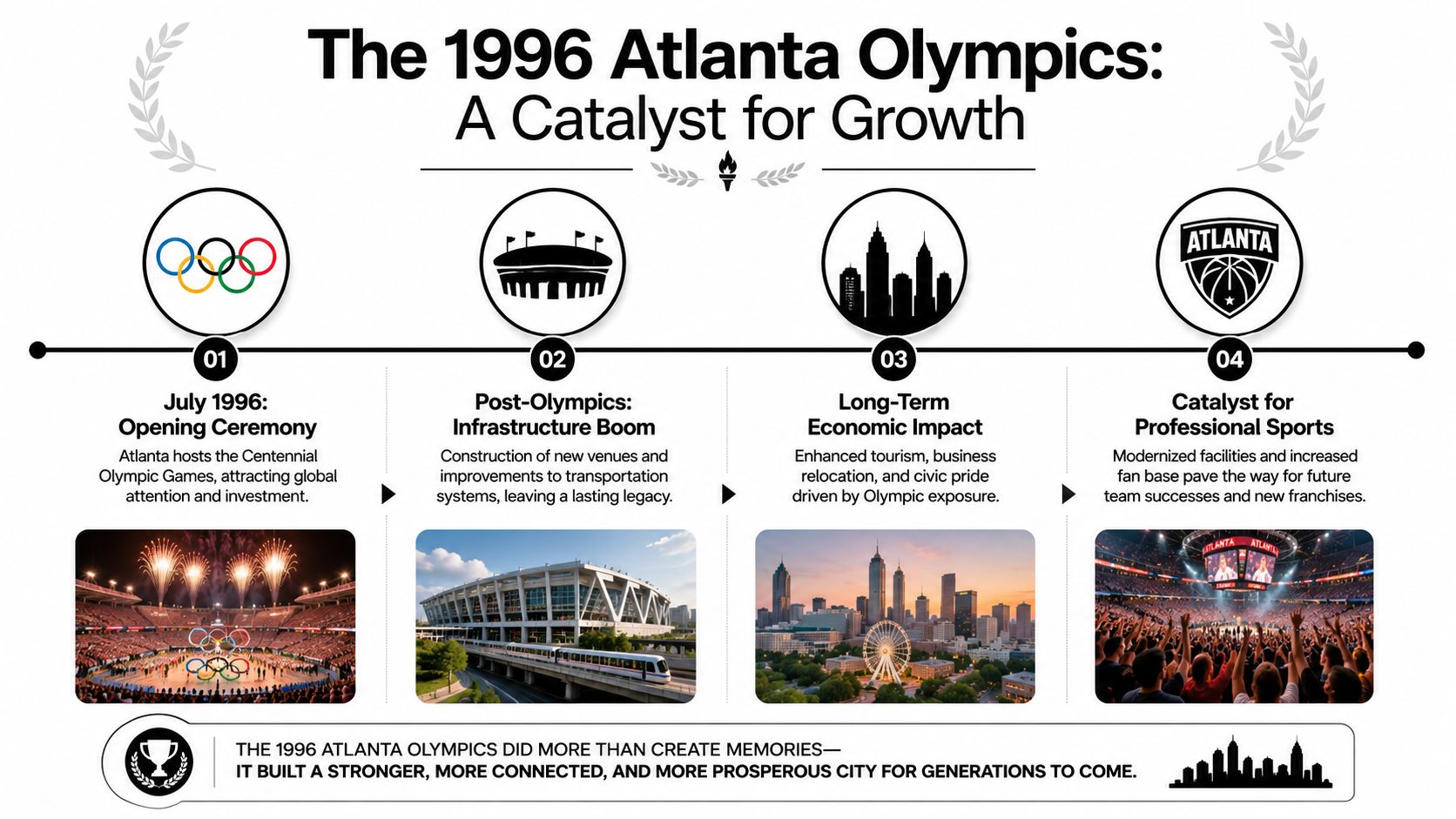
The Games changed the map, not just the calendar
The strongest case for the 1996 Olympics is physical. Atlanta's transformation was catalyzed by the strategic repurposing of $500 million in Olympic-era venue infrastructure, establishing a replication template for hosting major events. That legacy is visible in the city's later $300–$400 million infrastructure investment for the 2026 FIFA World Cup, which builds on the same downtown event geography around Centennial Olympic Park (Atlanta Magazine on the Olympic legacy).
The key word is repurposing. Atlanta didn't just host the Olympics and move on. It used the event to build a system. Venues, roads, public spaces, and visitor corridors became reusable assets for later bids.
That's why the Olympics still sit at the center of the city's sports story. They gave Atlanta an operating model for recurring relevance.
Centennial Olympic Park became the hinge
Centennial Olympic Park helped reorganize downtown around the visitor experience. Event districts work best when hotels, public gathering space, convention capacity, and stadium access reinforce each other. Atlanta gradually learned how to turn that proximity into a habit.
That same logic also changed how the city marketed itself. Atlanta wasn't selling one team or one season. It was selling readiness.
For readers interested in how global spectacles often leave lessons beyond the scoreboard, Vanta Sports has a thoughtful piece on life lessons from global sporting events. The framing fits Atlanta well because the city's biggest win may have been institutional memory.
The Olympic lesson was urban, not sentimental
The Olympics also changed how Atlanta thought about legacy projects:
- Build for reuse: Temporary attention matters less than long-term utility.
- Concentrate assets: Parks, arenas, transit, and hospitality work better as a connected district.
- Think globally, plan locally: A city hosts the world best when daily infrastructure already works.
Practical rule: Mega-events only matter after the closing ceremony if a city can reuse what it built.
The park and surrounding districts became part of Atlanta's modern identity in ways that go beyond sport. Even local place-based narratives, such as Atlanta BeltLine perspectives on urban change, reflect the same civic instinct. Build visible public assets, then let them anchor the next phase of growth.
The Public-Private Playbook for Building Stadiums
Atlanta's next leap wasn't emotional. It was financial. The city figured out a model for building expensive venues without asking residents to absorb the entire risk.
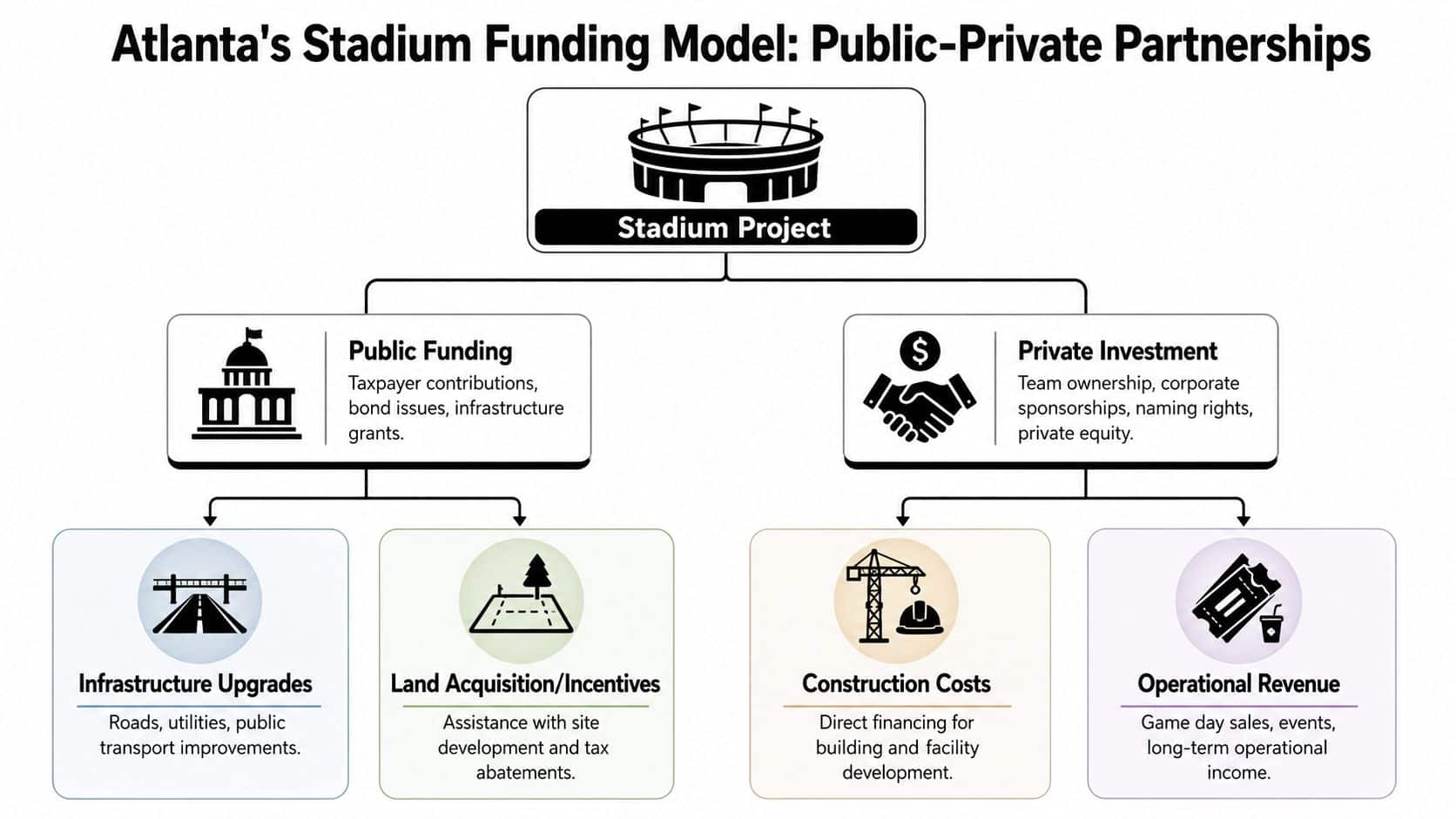
How the structure worked
Atlanta's sports economics model caps public contributions for stadium construction at $200 million, sourced from hotel-motel taxes paid largely by visitors. In the case of the $1.2 billion Mercedes-Benz Stadium, 80% of the capital risk was borne by private bondholders and the Falcons' ownership group, not municipal taxpayers (City of Atlanta on the stadium financing structure).
That's the part casual fans often miss. The argument extended beyond whether stadiums are good or bad. It was about who pays, who benefits, and who carries the downside if projections disappoint.
Why officials liked it and critics still questioned it
City leaders liked the hotel-motel tax component because it shifted much of the burden toward visitors. Team ownership liked it because public participation, even when limited, helped make large projects workable. Bondholders accepted risk in exchange for the possibility of return.
Critics still had room to object. They could argue that public resources, land-use choices, and political attention were still being steered toward sports infrastructure rather than other needs. That tension never disappears in a growing city.
For readers who want background on one financing concept often discussed in urban development, Unitism® offers a useful guide for municipal TIF policies. Atlanta's approach wasn't identical to every tax-increment case, but the broader debate over how cities structure development incentives is familiar.
The stadium model became part of the brand
Atlanta's stadium strategy did more than deliver a building. It signaled competence to leagues, event organizers, and sponsors. It said the city could close large deals, manage political complexity, and produce venues with year-round appeal.
That's one reason Mercedes-Benz Stadium quickly became more than a football home. It was a platform for Atlanta's larger claim that it could host almost anything.
A local cultural shorthand for that claim still runs through the Falcons' place in the city's identity, including in adjacent commentary like Atlanta Falcons business and civic branding.
Winning Without Trophies The Atlanta United Effect
Atlanta has spent long stretches without the kind of championship haul that usually defines a classic sports capital. Yet the city kept climbing. That contradiction points to the most interesting part of the story.
The city learned to monetize attention
A lot of places tie sports prestige to titles. Atlanta increasingly tied it to turnout, programming, and venue utility. That's where Atlanta United matters, even beyond the club itself. The team arrived and exposed an appetite for live sports culture that many outsiders had underestimated.
The broader business case became hard to ignore. Atlanta's sports venues, such as Mercedes-Benz Stadium, generated $1.2B in annual economic impact by 2023, with 78% of that revenue coming from non-game-day events like concerts and conventions (Sportsepreneur on Atlanta's venue model).
That number sharpens the argument. Atlanta's sports rise can't be explained only by wins and losses. It rests on a model in which buildings stay busy even when teams don't win titles.
Fan culture mattered, but so did calendar management
Atlanta United helped prove that the city could create an atmosphere, not just host an event. Packed crowds, scarves, chants, and a visible sense of belonging changed the national conversation. The city no longer looked like a market that merely tolerated pro sports. It looked engaged.
But culture alone doesn't produce a durable sports economy. Operators still need concerts, neutral-site games, conventions, sponsor events, and premium hospitality uses. In Atlanta, the fan experience and the event business reinforced each other.
A city becomes a sports capital when its venues stay relevant in February, June, and on weekdays too.
That's the contrarian truth. Atlanta didn't wait for a dynasty. It built a machine that could earn through use.
The Economic Engine and Its Social Costs
Sports development creates winners. It also creates arguments. Atlanta is no exception.
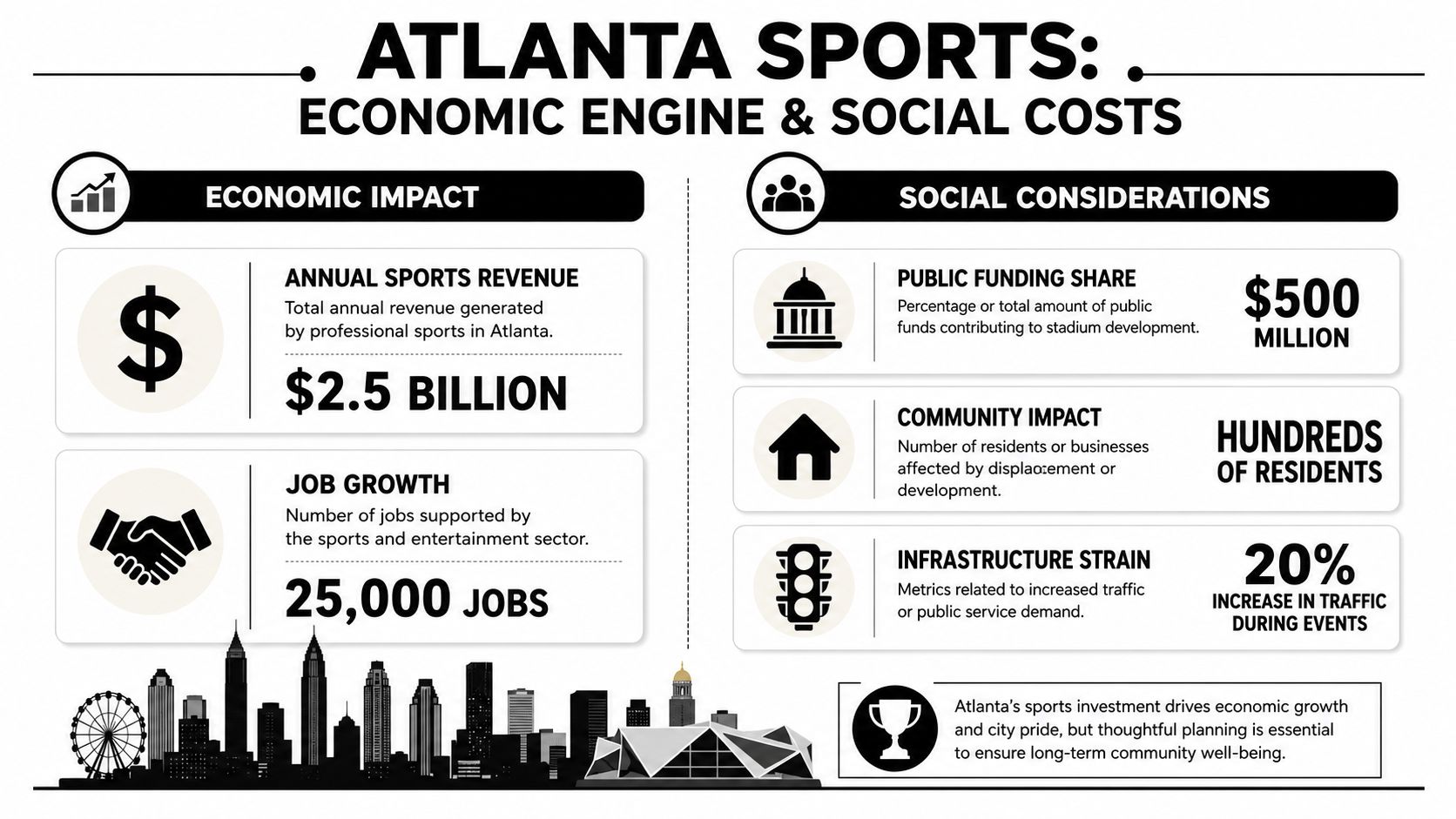
The upside is visible
Supporters of Atlanta's sports-centered growth point to the obvious results. The city has become a regular host for major events, and that reputation spills into tourism, conventions, hotel demand, and corporate visibility. A sports weekend can benefit restaurants, parking operators, bars, event staff, and nearby districts well beyond the stadium gates.
There's also a branding dividend. Sports put Atlanta on national and international television in a way few urban marketing campaigns can match. For civic leaders, that kind of visibility helps reinforce the city's claim to be a business and travel hub, not just a state capital.
One reason the business side of fandom matters is that sports increasingly operate as a retail, apparel, and lifestyle ecosystem. For a lighter but useful angle on that commercial layer, Mystershirt has a piece on the football shirt business and fan demand. The principle applies in Atlanta too. Teams sell identity as much as tickets.
The costs are harder to celebrate
Critics ask a different set of questions. Who gets displaced when land values rise around stadium districts. Which neighborhoods absorb the downside of redevelopment pressure. Whether promises about shared prosperity reach residents living closest to the cranes.
These questions don't erase the gains. They complicate them. Atlanta's sports success sits inside a larger urban story about growth, inequality, and the uneven geography of investment.
- For business boosters: Sports districts can attract spending and sustain all-season activity.
- For neighborhood advocates: Large projects can strain affordability and reshape communities without equal local benefit.
- For public officials: The challenge is keeping event-driven development from becoming a substitute for broader civic obligations.
Cities don't argue over sports development because it's trivial. They argue because it changes land, money, and power.
Atlanta's wider growth debate often circles this same issue, including in reflections on how Atlanta's economy is driving growth across Georgia. The benefits are real. So are the trade-offs.
The Next Frontier The World Cup and Beyond
The next major test is already on the calendar. The 2026 FIFA World Cup is a future event, and for Atlanta it represents both an opportunity and an audit of everything the city has built since the Olympics.
A familiar kind of challenge
Atlanta has hosted big games before. The World Cup is different because it puts the city back into a global rotation with unusual intensity. Transit, crowd management, public space, hospitality capacity, and international presentation all matter at once.
The city's advantage is that it isn't improvising. It has decades of experience in stitching together sports venues, convention infrastructure, hotels, and downtown movement patterns. That continuity is one reason Atlanta remains competitive for mega-events.
What comes after that
The larger question is whether Atlanta can keep extending its sports identity without becoming predictable. A future NHL conversation always hovers at the edge of local debate. So does the challenge of staying distinctive as more cities build entertainment districts and multipurpose venues.
Atlanta's strongest card is still flexibility. It has shown that a city can use sports as a gateway to tourism, concerts, conventions, and civic branding rather than treating games as isolated products. That's likely to matter long after the World Cup leaves town.
The city's tourism growth story is part of the same pattern, reflected in local analysis about why Atlanta is one of America's fastest-growing tourist destinations. Sports don't explain everything. In Atlanta, they've become one of the clearest ways to understand everything else.
Key Takeaways from Atlanta's Playbook
Atlanta's rise wasn't neat, and it wasn't driven by one championship run. It came from layering decisions over time until the city could host, finance, market, and reuse sports infrastructure better than many rivals.
A few lessons stand out:
- Start with legitimacy: The arrivals of the Braves and Falcons gave Atlanta major league standing before it had a fully mature pro sports culture.
- Build legacy into the blueprint: The Olympic model worked because the city reused infrastructure instead of treating it as disposable spectacle.
- Structure the money carefully: Atlanta's stadium financing approach reduced direct taxpayer exposure and made ambitious projects politically possible.
- Monetize the building, not just the team: The city's strongest innovation was turning venues into year-round revenue engines.
- Accept the trade-offs: Sports can accelerate growth, but they can also sharpen fights over land, access, and who shares the rewards.
That's the clearest answer to how Atlanta became a major sports city. It didn't merely accumulate teams. It learned how to convert sports into urban strategy.
Contact Beyond Surplus for certified electronics recycling, secure IT asset disposal, data destruction, IT asset recovery, data center decommissioning, product destruction, and commercial e-waste pickup for businesses nationwide.


