

If you're landing in Atlanta for the first time, the fastest way to get it wrong is to treat the city like one neat downtown. It isn't. Atlanta Travel Guide for First-Time Visitors works best when you plan by corridor, pick one neighborhood pair per day, and stop trying to cross the whole city just because a map makes it look manageable.
Atlanta's modern visitor story still starts with the 1996 Summer Olympics, which left Centennial Olympic Park as the downtown anchor and helped shape the city's core sightseeing pattern (first-timers guide to Atlanta). That legacy still matters because the Georgia Aquarium, World of Coca-Cola, National Center for Civil and Human Rights, and College Football Hall of Fame sit close enough together to make downtown the cleanest first stop for newcomers. If you've got a short trip, the right move is simple, cluster hard, move less, and save your energy for actual experiences.
Why Atlanta Rewards a Corridor-First Plan
Atlanta works best when you think in lines, not dots. The city's strongest first-time pattern runs from the airport to Downtown, then up to Midtown, then east toward Old Fourth Ward and Inman Park through the BeltLine. That's the practical truth behind nearly every good first visit.
The Atlanta BeltLine is a 22-mile corridor built from former railroad tracks, and it's become one of the easiest ways to experience the city on foot or by bike (travel guide to Atlanta, Georgia). Use that mindset early, because Atlanta's attraction map is spread across neighborhoods, and the BeltLine gives you a way to connect food, parks, and culture without turning every move into a car trip. MARTA buses or trains, walking the BeltLine, and carpooling when possible are the sane choices in a city where road traffic can eat your day.
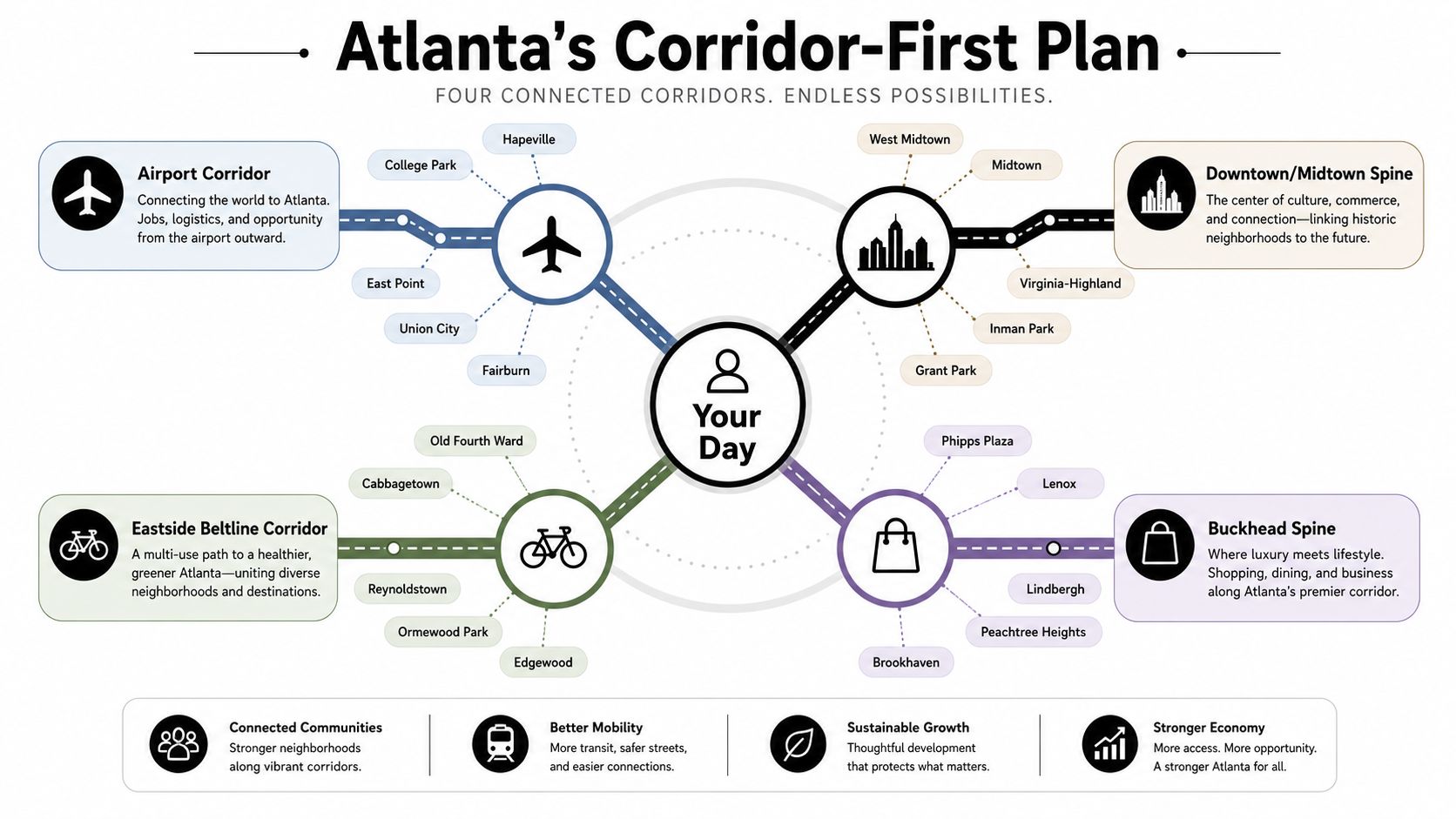
Here's the part most first-timers need to hear: a three-day stay is the practical minimum if you want downtown, Sweet Auburn, and the Midtown/BeltLine corridor without turning the trip into a transit exercise (Atlanta 1–3 Days Itinerary).
Practical rule: pick your neighborhoods before you pick your attractions. In Atlanta, geography saves more time than enthusiasm ever will.
If you're comparing your route options, start with this useful BeltLine overview from Beyond Surplus's Atlanta BeltLine guide, then build the rest of your plan around the corridor that matches how much walking you want to do.
The Downtown Anchor Cluster Around Centennial Olympic Park
Downtown is where you get the highest sightseeing density with the least friction. The whole cluster around Centennial Olympic Park is built for first-time visitors who want the big-name Atlanta hits without spending the day in rideshares. The logic is plain, start with the heavy hitters, walk between them, and let the district do the work.
What to hit first
The Georgia Aquarium and World of Coca-Cola should be at the top of your list because they're the most reliable downtown anchors for first-timers. Add the National Center for Civil and Human Rights and College Football Hall of Fame if you want a fuller downtown day, then finish with SkyView Atlanta once the light changes and the city looks different after dark. The walking distances are short enough that you're not burning energy on transfers, and that's the whole point.
A smart sequence is simple. Start at the Aquarium when it opens, move to World of Coca-Cola while your energy is still good, pair the National Center for Civil and Human Rights with it, and save SkyView for evening views. That order keeps your day organized by foot traffic instead of random ticket times.
Go downtown with your biggest tickets pre-booked. Atlanta rewards people who arrive ready, not people who plan at the sidewalk.
You should also treat this district as your most predictable MARTA day. Hotels connected to the rail system make downtown easy, and the area around Centennial Olympic Park is one of the few places where a first-time visitor can do a lot without overthinking transport. If you want a neighborhood-to-neighborhood history layer, the Atlanta sports city story gives useful context for why this core feels so central to the city's identity.
How to walk it
Keep the walking radius tight. Downtown works because the sidewalks are straightforward and the attraction cluster is compact, so don't break the rhythm by leaving for lunch miles away. Eat nearby, stay inside the core, and let the district save you time.
Midtown, Buckhead, Old Fourth Ward, and East Atlanta Compared
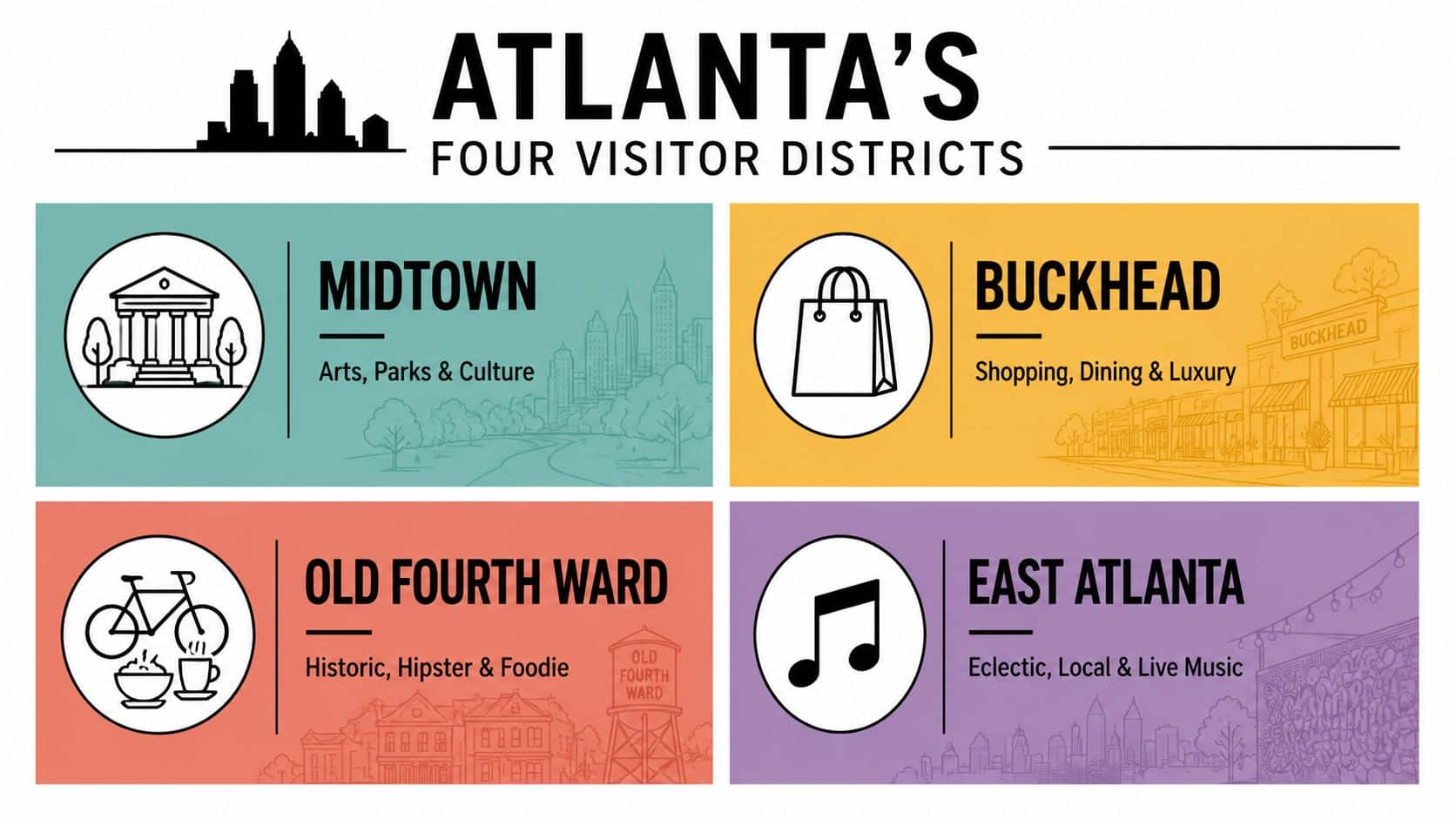
Atlanta's personality splits cleanly once you move beyond downtown. Midtown, Buckhead, Old Fourth Ward, and East Atlanta aren't interchangeable, and first-time visitors make mistakes when they try to treat them that way. Choose the neighborhood that matches the trip you want, not the one that looks best on a list.
Midtown for culture and parks
Midtown is the city's arts-and-park district. The High Museum, Fox Theatre, Piedmont Park, and Atlanta Botanical Garden sit close enough together to make this the best choice for travelers who want museums, green space, and a calmer daytime pace. If you want one neighborhood where you can move through a full day without shifting gears every hour, this is it.
Buckhead for upscale retail and dining
Buckhead is about shopping, polished restaurants, and a more upscale feel. Lenox Square and the Buckhead Village District define the visitor experience here, so it suits people who want retail first and nightlife second. It is not the best place for a low-effort walkable sightseeing day, but it is the right place if your trip leans toward dining and browsing.
Old Fourth Ward for BeltLine energy
Old Fourth Ward gives you the most obviously walkable, younger, food-forward energy in the city. Ponce City Market and the Eastside BeltLine are the core draws, and Atlanta starts feeling more like a neighborhood city than a convention city here. It's a strong fit for travelers who want a late afternoon and evening that builds naturally from one stop to the next.
East Atlanta for music and local character
East Atlanta is the choice for live music, independent bars, and a more offbeat local vibe. It's not the district you use for efficient sightseeing, and that's fine. Go here when your goal is atmosphere, not checklists.
If you want a straightforward comparison between two of the most common choices, the Buckhead vs. Midtown breakdown is useful, but the short answer is this, Midtown is easier for first-timers, Buckhead is more retail-driven, and Old Fourth Ward is better for a walkable night out.
Getting Around Atlanta Without Losing Half Your Day
Atlanta punishes vague transit planning. The best default is to match the mode to the corridor, then stop improvising. MARTA is the first choice for the airport, Downtown, and Midtown spine, the streetcar is useful for short downtown hops, the BeltLine works when you're staying inside a neighborhood, and rideshares fill the gaps when the city stops being walkable.
Use the right mode in the right place
MARTA rail and bus are the top options for first-time visitors because they connect Hartsfield-Jackson Atlanta International Airport directly to Downtown and Midtown (first-time in Atlanta). That means your best itinerary usually runs along that airport-downtown-Midtown corridor, not across the entire metro area. If you stay outside that spine, expect to lean on rideshares or a car.
Atlanta Streetcar is best for short downtown movement, especially if you're trying to connect points near the core without walking everything. The BeltLine is the right tool for places like Ponce City Market, Piedmont Park, and nearby neighborhoods, because it lets you move on foot or by bike while staying in one connected zone. Outer neighborhoods and late nights are where rideshare becomes the sane option.
| Mode | Best use |
|---|---|
| MARTA Rail | Airport, Downtown, Midtown |
| Streetcar | Short-hop downtown movement |
| BeltLine walking or biking | Old Fourth Ward, Inman Park, Ponce City Market |
| Rideshare or taxi | Outer neighborhoods and late-night returns |
If you're worried about driving, know this too. Georgia's driving rules don't make barefoot driving a problem by default, and this Georgia bare-feet driving summary is a helpful practical reference if you're deciding whether to rent a car at all. Most first-time visitors don't need one inside the core.
For airport logistics, the Atlanta airport guide is worth skimming before you land. It won't change the city, but it will change how smoothly your first hour goes.
Useful habit: if the trip is mostly downtown and Midtown, skip the car and let MARTA do the heavy lifting.
One, Two, and Three-Day Itineraries That Actually Work
The cleanest Atlanta trip is built in layers. One day gets you the downtown core, two days add Midtown and the BeltLine, and three days finally give you enough room for Sweet Auburn or a more personal neighborhood choice. Anything less than that starts feeling rushed fast.
Sample Three-Day Atlanta Itinerary
| Day | Morning | Afternoon | Evening | MARTA Anchor |
|---|---|---|---|---|
| 1 | Georgia Aquarium | World of Coca-Cola and Centennial Olympic Park | SkyView Atlanta or nearby dinner | Peachtree Center or Five Points |
| 2 | Piedmont Park and Atlanta Botanical Garden | High Museum | Ponce City Market and Old Fourth Ward dinner | Arts Center |
| 3 | Martin Luther King, Jr. National Historical Park and Sweet Auburn | Buckhead shopping, East Atlanta, or a day trip | Flexible neighborhood dinner | King Memorial or Five Points |
A one-day version should stay downtown. Do the Aquarium, World of Coca-Cola, and Centennial Olympic Park, then stop before you start adding cross-city errands. If the weather turns ugly, stay inside the museum-heavy parts of the downtown cluster and keep your day simple.
A two-day version works best when Day 2 shifts to Midtown. Start at Piedmont Park or the Atlanta Botanical Garden, move to the High Museum, then head south toward Ponce City Market for dinner. That sequence keeps you mostly inside connected areas, which is exactly how Atlanta should be handled.
A three-day trip finally gives you room for Martin Luther King, Jr. National Historical Park and Sweet Auburn in the morning, then lets the afternoon flex toward Buckhead, East Atlanta, or even a slower neighborhood walk. If your plans change, use the weekend things-to-do guide as a backup for ideas without rebuilding the whole itinerary.
Where to Stay by Purpose and Budget
Where you sleep shapes the whole trip more than people expect. The smartest choice is to stay near a MARTA station, because that removes the need for a rental car and keeps the airport-downtown-Midtown corridor easy to use. Pick the corridor first, then worry about price.
Best areas by travel style
Business and convention travelers should stay near Downtown or Midtown MARTA stations. That gives you airport access, quick movement, and fewer wasted minutes in traffic. It's the best fit if your schedule is structured and your meetings matter more than nightlife.
Families do well near Centennial Olympic Park or Midtown because you stay close to the Aquarium, Piedmont Park, and other major anchors. That cuts down on transit stress and keeps naps, meals, and sightseeing simpler.
Nightlife-focused travelers should look at Old Fourth Ward or the BeltLine Eastside Trail. Those areas make evening plans easier because you're already close to the restaurants and bars people want to visit.
Budget travelers often get better value around Midtown and Buckhead MARTA stations or in downtown hotels that discount on weekends. You may pay more or less depending on timing, but the biggest savings come from not paying for a car and parking every day.
Staying near a station is the highest-leverage lodging move in Atlanta. Everything else gets easier after that decision.
The trade-off is simple. Downtown and Midtown give you the easiest visitor logic, while Buckhead gives you a more polished, retail-heavy stay. If you want the least friction, choose accessibility first and luxury second.
Safety, Accessibility, Seasonality, and Budget Basics
Atlanta is not a place to overcomplicate, but it is a place to stay aware. The tourist core is well-patrolled, and most first-time concerns come from driving and traffic, not walking around the main visitor zones. Stick to normal big-city habits, keep your phone tucked away when you're moving, and don't wander into an area just because it looks close on a map.
What to expect and what to pack
Accessibility is better than many first-timers expect. MARTA is ADA-accessible, the Georgia Aquarium and Atlanta Botanical Garden have strong accessibility programs, and many Midtown sidewalks are smooth enough for easy movement. If mobility matters to you, this is one of the strongest reasons to keep your trip centered on the core.
Seasonality is straightforward. Spring and fall are the best times to visit, summer is hot and humid, and winter is usually mild but can still get disrupted by the occasional ice event. Pack for walking, not for being stylish. Good shoes matter more than a second outfit.
For budget planning, a mid-range traveler should expect to spend on hotels, meals, and transit without assuming Atlanta is cheap just because some attractions are clustered. MARTA fares are part of the equation, and tipping norms are standard for U.S. travel. If you want a luggage check before flying, the Pet Magasin carry-on guide is a useful reference for bag-size sanity, especially if you're trying to keep your trip compact.
If you're replacing a device while you're in town, use a secure electronics drop-off option rather than stuffing old gear into a hotel drawer. That's a small but real travel task, and Atlanta has a local facility option for it.
Packing rule: shoes, charger, and a little flexibility beat overpacking every time.
The One Decision That Shapes the Whole Trip
The trip gets easier or harder based on one choice, which two neighborhoods you pair on your first full day. The best answer is Downtown plus Midtown, linked by a single MARTA rail ride. Pre-book the Aquarium and World of Coca-Cola, stay near a station, plan one major cluster per day, and keep one evening open for the BeltLine or a neighborhood walk.
FAQ. Best time to visit, spring or fall. Is a car necessary, no, not for the core. What about a rainy day, stay in the downtown cluster or switch to museums and indoor attractions. If you follow the corridor rule, Atlanta feels compact instead of scattered.
If your Atlanta trip also involves retiring old laptops, hard drives, phones, or other business electronics, Beyond Surplus handles secure electronics recycling and IT asset disposal with certified data destruction and pickup options for organizations. Visit Beyond Surplus to plan a secure, compliant disposal process that fits your schedule and keeps sensitive equipment out of the wrong hands.


