

Choosing the right hospital in Atlanta can feel overwhelming when you need care now, not later. The Best Hospitals and Healthcare Systems in Atlanta are not interchangeable, because some are built for advanced cancer care, some for trauma, some for maternity, and some for rehab that changes long-term outcomes. The right choice depends on the condition, the location, and how quickly a patient can access the right team. It also matters for the organizations behind the scenes, because hospitals at this scale run complex fleets of imaging systems, laptops, servers, and medical devices that eventually need secure disposal and documented chain of custody.
Table of Contents
- 1. Emory Healthcare
- 1. Emory Healthcare
- 2. Piedmont Healthcare (Piedmont Atlanta Hospital)
- 3. Northside Hospital Atlanta (Northside Hospital system)
- 4. Grady Health System (Grady Memorial Hospital)
- 6. Children's Healthcare of Atlanta
- 6. Children's Healthcare of Atlanta
- 7. Shepherd Center
- Top 7 Atlanta Hospitals Comparison
- Operational Excellence The Backbone of Top Healthcare
1. Emory Healthcare
Emory Healthcare is the clearest benchmark for academic medicine in Atlanta. U.S. News & World Report named Emory University Hospital the No. 1 hospital in Georgia and metro Atlanta in its regional rankings, and Emory's follow-up ranking update showed that position holding across more than one reporting cycle. That consistency matters because U.S. News weighs reputation, patient safety, and outcome measures such as death rates, so repeat placement points to system-wide quality, not a one-year spike. Emory Healthcare's 2024 ranking announcement and the 2025 ranking update show how durable that position is.
Clinical depth and system scale
Emory is the right choice when a patient needs advanced specialty care, especially in Neurology & Neurosurgery, Geriatrics, and Urology, where Emory University Hospital earned national recognition. Atlanta's broader reputation also shows up across specialty lists, which is exactly what you want when the case is complex and the care team needs deep subspecialty support. For a practical view of how the system fits into daily life in the city, see a guide to living in Atlanta.
The system's scale also matters outside the exam room. Emory runs a large academic network that depends on coordinated staffing, imaging, IT, and device management across multiple sites, which makes it a meaningful partner for vendors that support hospitals with secure technology handling and medical equipment disposition. Patients benefit from the clinical depth. B2B partners should see the operational complexity immediately.
Why Emory matters to patients and B2B partners
For patients, Emory is the hospital system to prioritize when the condition is serious, the specialty needs are narrow, and continuity across providers matters. The academic model gives patients access to specialist teams, teaching resources, and referral pathways that smaller systems usually cannot match. That is the main reason Emory stays near the top of any serious Atlanta hospital list.
For B2B partners, Emory represents a different kind of opportunity and responsibility. Large health systems need strict controls for retired laptops, servers, imaging equipment, and clinical devices, because every asset leaves a paper trail and often contains sensitive data. Partners that work in secure IT and medical equipment disposition need to be prepared for high process standards, documented pickup, and clear chain of custody.
1. Emory Healthcare
Emory Healthcare is the clearest benchmark for academic medicine in Atlanta. U.S. News & World Report named Emory University Hospital the No. 1 hospital in Georgia and metro Atlanta for the 13th consecutive year in the 2024-25 regional rankings, and a later 2025-26 report again placed Emory at No. 1 in Georgia and metro Atlanta for the 14th year in a row. That consistency matters because U.S. News weighs reputation, patient safety, and outcome measures such as death rates, so repeat placement points to system-wide quality, not a one-year spike. Emory Healthcare's 2024 ranking announcement and the 2025 ranking update show how durable that position is.
Clinical depth and system scale
Emory is the right choice when a patient needs advanced specialty care, especially in Neurology & Neurosurgery, Geriatrics, and Urology, where Emory University Hospital earned national rankings. Atlanta's broader reputation also shows up across specialty lists, which is exactly what you want from a major academic health system. For patients, that means access to complex diagnostics and referral pathways. For B2B partners, it means a large operational footprint with centralized systems, standardized processes, and serious equipment lifecycle demands.
Practical rule: If the diagnosis is complex, rare, or likely to require multiple specialists, Emory should be near the top of the list.
Emory also stands out in Georgia for its research-driven oncology infrastructure. Winship Cancer Institute gives the system depth in cancer care that smaller regional hospitals can't match. Its scale makes it one of the strongest choices for businesses that serve healthcare clients, because the same complexity that helps patients also drives demand for secure IT asset disposition, medical device retirement, and documented recycling. For teams evaluating HIPAA-compliant electronics recycling in Georgia, Emory's model is the kind of environment that demands strict chain-of-custody controls and reliable asset handling.
Why Emory matters to patients and B2B partners
Emory Saint Joseph's Hospital ranked No. 2 in Georgia and metro Atlanta in the 2024-25 cycle and again in the 2025-26 cycle. Emory Johns Creek Hospital and Emory University Hospital Midtown also ranked high across the metro, reinforcing that this is a system, not just a flagship campus. That matters for referrals, transfers, and continuity of care. It also matters operationally, because large systems usually retire equipment across multiple locations at different speeds.
For organizations evaluating healthcare partners, Emory's breadth signals mature procurement, IT governance, and compliance expectations. If you support hospitals like this, you need vendors who can handle hard drive shredding, data wiping, and medical equipment disposition without creating audit risk. Emory's size makes that need obvious.
Website: Emory Healthcare
2. Piedmont Healthcare (Piedmont Atlanta Hospital)
Piedmont belongs in any serious Atlanta hospital comparison because it combines scale, specialty depth, and a broad metro network. Piedmont Atlanta Hospital is the flagship, and local U.S. News-based reporting places Piedmont's flagship and other Atlanta hospitals among the region's strongest performers. The system matters for patients who need cardiac, vascular, transplant, and critical care services in a large not-for-profit setting. Georgia hospital rankings coverage places Piedmont in the city's top tier.
Flagship cardiac and surgical capability
Piedmont Atlanta's main advantage is its cardiovascular and surgical depth. The Marcus Tower expansion strengthened advanced heart, vascular, and critical care capacity, which is what a flagship hospital should do. That kind of investment supports complex procedures and better referral continuity across the system.
The hospital also fits patients who want a large physician network with coordinated follow-up. That matters after discharge, because complex care often depends on clear communication between inpatient teams, specialists, and outpatient physicians. For employers and insurers, that continuity can reduce fragmentation and avoid unnecessary delays.
In Atlanta, scale is an operational asset. It affects ICU capacity and how quickly a system can standardize technology across campuses.
Where Piedmont is strongest
Piedmont is the practical choice for patients needing a high-performing heart and surgical hospital with broad physician access. It also matters for business partners because large systems like Piedmont tend to centralize procurement, imaging, and data workflows, which creates steady demand for structured IT asset disposition and secure device retirement. The tradeoff is straightforward. Some of the most complex services are concentrated at the flagship, so suburban patients may need to travel.
For companies evaluating the city's healthcare footprint, this scale also shapes real estate, staffing, and disposal planning. An Atlanta cost of living guide helps explain why hospitals, vendors, and support providers must plan for higher operating costs and tighter logistics across the metro.
Piedmont's role in Atlanta is clear. It is a major regional provider with a strong reputation in advanced medicine, and it belongs in the top tier of the city's healthcare systems.
Website: Piedmont Healthcare
3. Northside Hospital Atlanta (Northside Hospital system)
A family facing a high-risk pregnancy needs a hospital built for maternity, neonatal care, and high-volume women's health services. Northside is the clear choice in that situation. Local coverage tied to U.S. News placed Northside Hospital Atlanta in the metro's top group, and the system's reputation rests on volume, specialization, and disciplined operations. That is why it matters to families, referring physicians, and the broader care network. Metro Atlanta ranking coverage also places Northside in the city's strongest cluster.
Maternity leadership and network reach
Northside Hospital Atlanta is known nationally for women's and infant care. It holds Level IV maternal verification, which signals readiness for the most complex obstetric cases. Patients should treat that as the baseline standard when pregnancy care may require high-risk management or specialized neonatal support.
Its strength comes from repetition and experience. High maternity volumes support mature care pathways, more developed neonatal workflows, and stronger coordination with imaging, surgery, and oncology across the broader system. Families benefit from that consistency. Healthcare vendors and service partners see the same pattern in their own work, with recurring demand for reliable logistics, equipment management, and compliance-ready operations.
What patients should expect
Northside is especially strong for:
- Complex obstetric care, because Level IV verification signals the highest level of maternal readiness.
- Neonatal services, which are central to a high-volume maternity center.
- Metro access, since the system supports follow-up and ancillary care across Atlanta.
The tradeoff is straightforward. High volumes can mean busier units and less privacy at peak times. Adult trauma care is not the hospital's main focus, so patients with major trauma needs are usually better served elsewhere. That clarity is useful. It lets Northside do what it does best, focused women's and infant care at scale.
For families trying to plan around treatment costs and logistics, Atlanta healthcare trends affecting families and Atlanta cost of living considerations put the hospital's role in a practical context.
Website: Northside Hospital Atlanta
4. Grady Health System (Grady Memorial Hospital)
Grady is Atlanta's most important safety-net and trauma hospital. It is the region's premier adult Level I trauma center, and that status tells you everything about its role in the city. The hospital handles time-critical emergencies, manages complex trauma, and serves as the frontline for patients who need immediate intervention. U.S. News' underserved-community category also recognized Grady's work in equity-oriented care, underscoring its civic importance. Georgia public coverage highlights that distinction.
Atlanta's trauma backbone
Grady's core value is speed. The ACS-verified adult Level I trauma center gives it the highest adult trauma capability in metro Atlanta, and the Marcus Stroke & Neuroscience Center plus the burn center extend that role into specialty emergency care. Patients who arrive at Grady are often in the middle of the worst day of their lives. The hospital is built for that reality.
This is also a system with broad reach. Its central campus and additional locations support emergency and urgent care needs across the community. That matters in a metro area where access is uneven and some communities still lack enough medical facilities for emergencies and routine care.
Practical rule: If the case is time-sensitive trauma, stroke, or burn care, Grady is one of the first names that should come up.
Access, equity, and emergency care
Grady's reputation is tied to more than clinical intensity. A 2024 study reported that Emory University Hospital Midtown and Grady Memorial Hospital ranked among the nation's 10 most racially inclusive hospitals, while the Atlanta metro area was also identified as one of the most racially segregated hospital markets in the country. That contrast matters. It shows why the best hospital for a chart ranking is not always the best hospital for access, geography, or neighborhood fit. That study's local coverage makes the point clearly.
For partners serving healthcare clients, Grady also represents a large public infrastructure environment where secure equipment retirement, device tracking, and compliant recycling are essential. That scale creates serious operational demands, and vendors need to meet them without friction.
Website: Grady Health System
6. Children's Healthcare of Atlanta
Children's Healthcare of Atlanta is the region's dedicated pediatric system, and any serious Atlanta hospital guide needs to treat it as a separate category. Families do not choose Children's for general adult care. They choose it because the system is built around children, from emergency response to highly specialized inpatient treatment, and that focus shows up in both clinical workflow and facility design. Its Arthur M. Blank Hospital gives the system a modern flagship for complex pediatric care, and the scale of that campus changed how the region handles child health needs. Children's Healthcare of Atlanta
Pediatric specialty care at scale
Children's is the clear recommendation for families who need care in pediatric oncology, cardiology, surgery, and emergency medicine. The Aflac Cancer & Blood Disorders Center remains one of its standout specialty programs, and the system's round-the-clock pediatric emergency coverage gives families more than one entry point when a child needs urgent care. Its academic partnership with Emory adds depth for subspecialty care and research access.
The new flagship also changes the operational side of pediatric care in Atlanta. It gives the system more room for critical care, more current infrastructure, and a better platform for coordinating complex treatment across departments. Parents feel that in the care experience. Hospital operators and vendors feel it in the systems behind the scenes, where secure technology handling, device tracking, and careful equipment disposition are part of everyday work. That is why broader hospital planning discussions, including Atlanta healthcare trends affecting families, matter here too.
Website: Children's Healthcare of Atlanta
6. Children's Healthcare of Atlanta
Children's Healthcare of Atlanta is the region's dedicated pediatric system, and no Atlanta hospital list is complete without it. The system opened the Arthur M. Blank Hospital in September 2024, a 19-story, 2-million-square-foot flagship with 446 beds. That expansion consolidated pediatric inpatient, emergency, and specialty services at a scale that reshaped the city's pediatric care environment. Children's Healthcare of Atlanta anchors that system.
Pediatric specialty care at scale
Children's is the best choice for families who need care in pediatric oncology, cardiology, surgery, and emergency medicine. The Aflac Cancer & Blood Disorders Center is a major specialty strength, and the system's 24/7 pediatric emergency coverage gives families multiple access points when timing matters. The academic partnership with Emory also adds depth for subspecialties and trials.
The new flagship changes the practical experience of pediatric care in Atlanta. It gives the system more room for critical care, more modern infrastructure, and a stronger platform for complex coordination across departments. That matters to parents, of course, but it also matters to hospital operators who need secure technology management and equipment retirement across a large, specialized campus.
Why the new flagship changed the market
Children's now has one of the most modern pediatric footprints in the region. That improves the patient experience, but it also raises the operational bar. Every new tower or major expansion brings a wave of device deployment, IT refreshes, and regulated disposal needs.
Hospitals this specialized don't just need clinical expertise. They need logistics partners who can move equipment, document disposition, and keep data secure while facilities upgrade.
The downside is simple. Children's is pediatric-only, so it does not serve adults. During heavy respiratory seasons, demand can also strain scheduling and availability. Even so, its place in Atlanta is clear. It is the city's most important pediatric healthcare system.
Website: Children's Healthcare of Atlanta
7. Shepherd Center
Shepherd Center is Atlanta's standout rehabilitation hospital. It focuses on complex recovery after spinal cord injury, traumatic brain injury, stroke, multiple sclerosis, and other neurological conditions. U.S. News placed Shepherd among the nation's top rehabilitation hospitals, with a national ranking of No. 13 for 2025-2026 in the available reporting. That recognition fits its role as a specialty center rather than a general hospital. Atlanta hospital ranking coverage also shows Shepherd's national visibility.

Specialized rehabilitation for complex recovery
Shepherd is the right recommendation when acute treatment is over and recovery begins. Its inpatient and day rehabilitation programs support patients with severe neurologic conditions, and the outpatient clinics, assistive technology, and community re-entry services make the system unusually thorough. That combination matters for long recoveries that depend on consistent interdisciplinary care.
Shepherd's Buckhead campus is built around specialized equipment and teams that know how to manage complex rehab cases. Families usually notice the difference quickly. The hospital is organized around function, mobility, and long-term independence, not just acute stabilization.
When Shepherd is the right fit
Shepherd is not a general hospital, and that is exactly why it works. Patients who need trauma surgery or emergency medicine should go elsewhere first. Patients who need focused rehabilitation after a major neurologic event should look here.
The system also serves as a useful example for B2B readers. Specialized hospitals tend to run highly specific equipment fleets, assistive technologies, and clinical information systems. That creates a strong need for secure disposal and documentation when devices are retired or replaced. Shepherd's focus makes its operational environment tightly controlled, which is exactly where certified ITAD partners add value.
Website: Shepherd Center
Top 7 Atlanta Hospitals Comparison
| Hospital | 🔄 Access & Complexity | ⚡ Capacity / Throughput | ⭐ Clinical Strength | 📊 Expected Outcomes & Impact | 💡 Ideal Use Cases |
|---|---|---|---|---|---|
| Emory Healthcare | Academic quaternary referrals; may have longer waits and trainee involvement | Extensive network (11 hospitals, 580+ sites), strong capacity but specialty centers can be slower for non‑urgent care | Deep subspecialty depth; NCI‑designated Winship; transplant, advanced cardiac & neuro | Research‑driven care with access to clinical trials and high specialty outcomes | Complex oncology, transplants, advanced cardiac/neurosurgical care; patients seeking trial access |
| Piedmont Healthcare (Piedmont Atlanta) | System referrals with some services concentrated at flagship; ER wait variability | Large flagship (643 beds) with Marcus Tower, high surgical and critical‑care capacity | Strong cardiac, vascular and surgical programs; mature transplant services | High surgical volume and system continuity support reliable perioperative outcomes | Advanced heart/vascular surgery, complex surgical programs; continuity across metro referrals |
| Northside Hospital Atlanta | High‑volume, standardized maternity workflows; adult trauma not a primary focus | Extremely high maternity throughput and many metro access points | National leader in OB/GYN & neonatal care; Level IV maternal verification | Excellent maternal and neonatal outcomes driven by volume and specialized verification | High‑risk pregnancies, complex neonatal care, large‑volume obstetrics |
| Grady Health System (Grady Memorial) | Safety‑net emergency workflows; very high ER demand can delay non‑critical care | Rapid time‑critical response as ACS‑verified Level I trauma with broad emergency capacity | Premier adult Level I trauma center with stroke and burn specialty centers | Critical for lifesaving trauma/stroke/burn outcomes and care for underserved populations | Time‑sensitive trauma, stroke, burns and major emergency services |
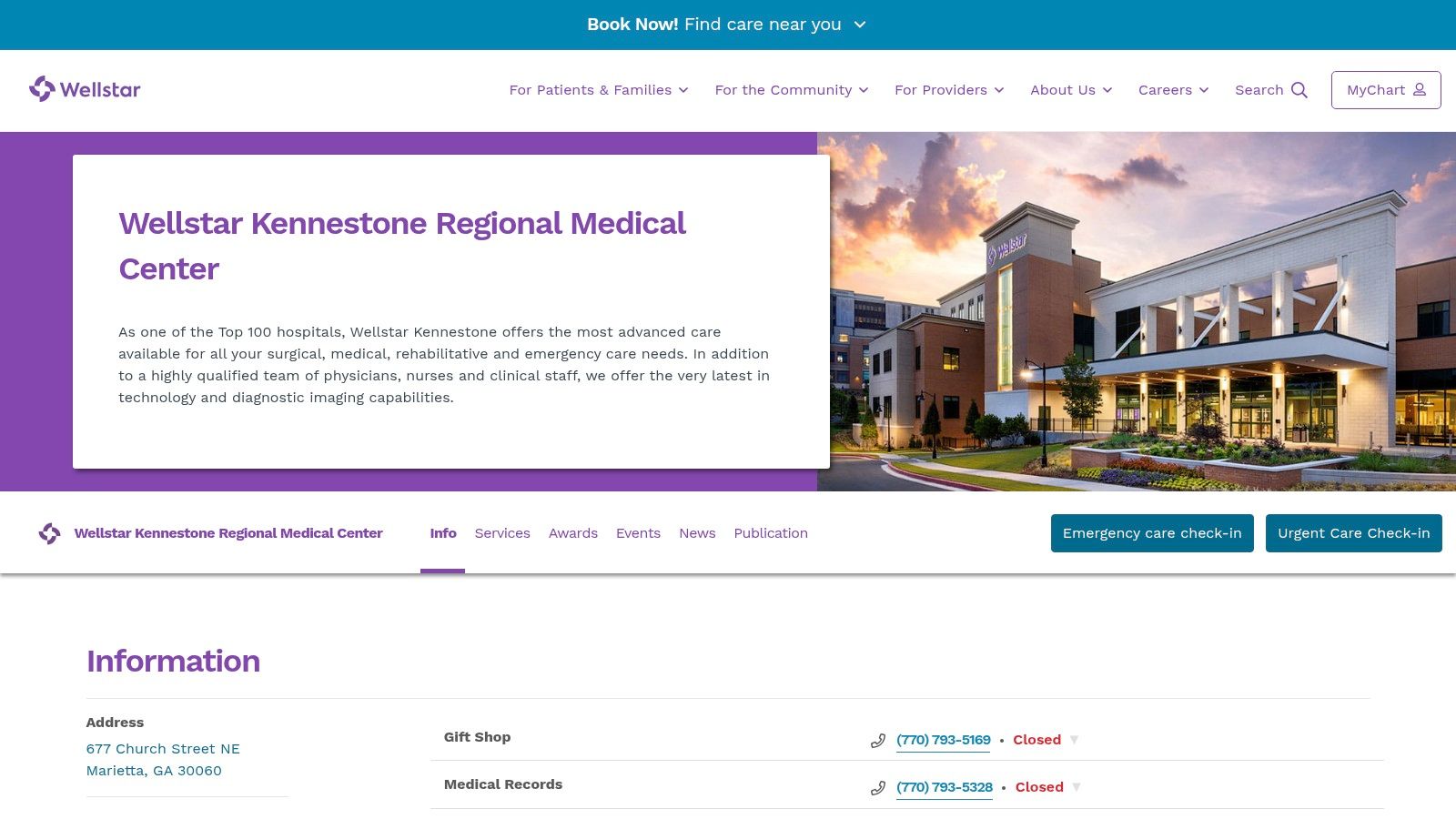
| Wellstar Kennestone Regional Medical Center | Tertiary referral patterns; suburban location may require travel for some patients | ACS Level I trauma, modern ORs and ICUs, strong regional trauma/cardiac throughput | Destination heart/vascular and neurosurgical programs; strong trauma capability | High regional trauma and cardiovascular survival capability; referral hub for northwest metro | North‑west Atlanta trauma, complex cardiovascular and neurosurgical cases |
| Children's Healthcare of Atlanta | Pediatric‑only access; consolidated flagship streamlines inpatient/ED/specialty flow | New 446‑bed Arthur M. Blank flagship, high pediatric capacity and ED throughput | State‑of‑the‑art pediatric subspecialties; strong oncology, cardiology, surgical programs | Improved pediatric outcomes, expanded critical care and trial access; seasonal demand spikes possible | Complex pediatric oncology, cardiology, intensive pediatric and emergency care |
| Shepherd Center | Specialty rehab referrals commonly follow acute stabilization and require authorization | Focused inpatient/day rehab capacity with efficient interdisciplinary programs | Nationally ranked neurorehabilitation expertise for SCI, TBI, stroke, MS | Strong functional recovery and community re‑entry outcomes for complex neuro cases | Long‑term multidisciplinary rehabilitation for spinal cord, brain injury, stroke and MS |
Operational Excellence The Backbone of Top Healthcare
While clinical excellence defines these top Atlanta hospitals, their success is built on a foundation of operational integrity. Managing vast amounts of patient data and advanced medical technology requires a rigorous approach to asset lifecycle management, including the secure, compliant disposal of IT and medical equipment. For healthcare administrators in Atlanta, partnering with a certified ITAD provider is essential for mitigating risk, supporting HIPAA compliance, and upholding environmental responsibility. structured outpatient behavioral health referrals often depend on the same kind of coordinated infrastructure, because referrals, records, and device workflows all have to stay aligned.
Atlanta's leading hospitals also show why scale matters in B2B healthcare operations. Large systems have more locations, more devices, and more end-of-life assets moving through the pipeline at once. That makes secure hard drive shredding, certified data wiping, medical device disposal, and documented recycling a real administrative need, not an optional service. The hospitals in this guide are successful partly because they treat healthcare as an operational discipline as well as a clinical one.
Beyond Surplus fits that environment. It supports organizations that need electronics recycling, IT asset disposition, and medical equipment disposal with documented chain of custody and secure data destruction. For hospital administrators, procurement teams, and IT leaders, that kind of partner helps reduce risk while keeping equipment retirement organized and compliant.
Contact Beyond Surplus for certified electronics recycling and secure IT asset disposal. If your organization supports Atlanta healthcare, retire servers, workstations, imaging hardware, and medical devices through a process built for compliance and accountability. Visit Beyond Surplus to schedule a pickup and keep your equipment disposal program secure.


