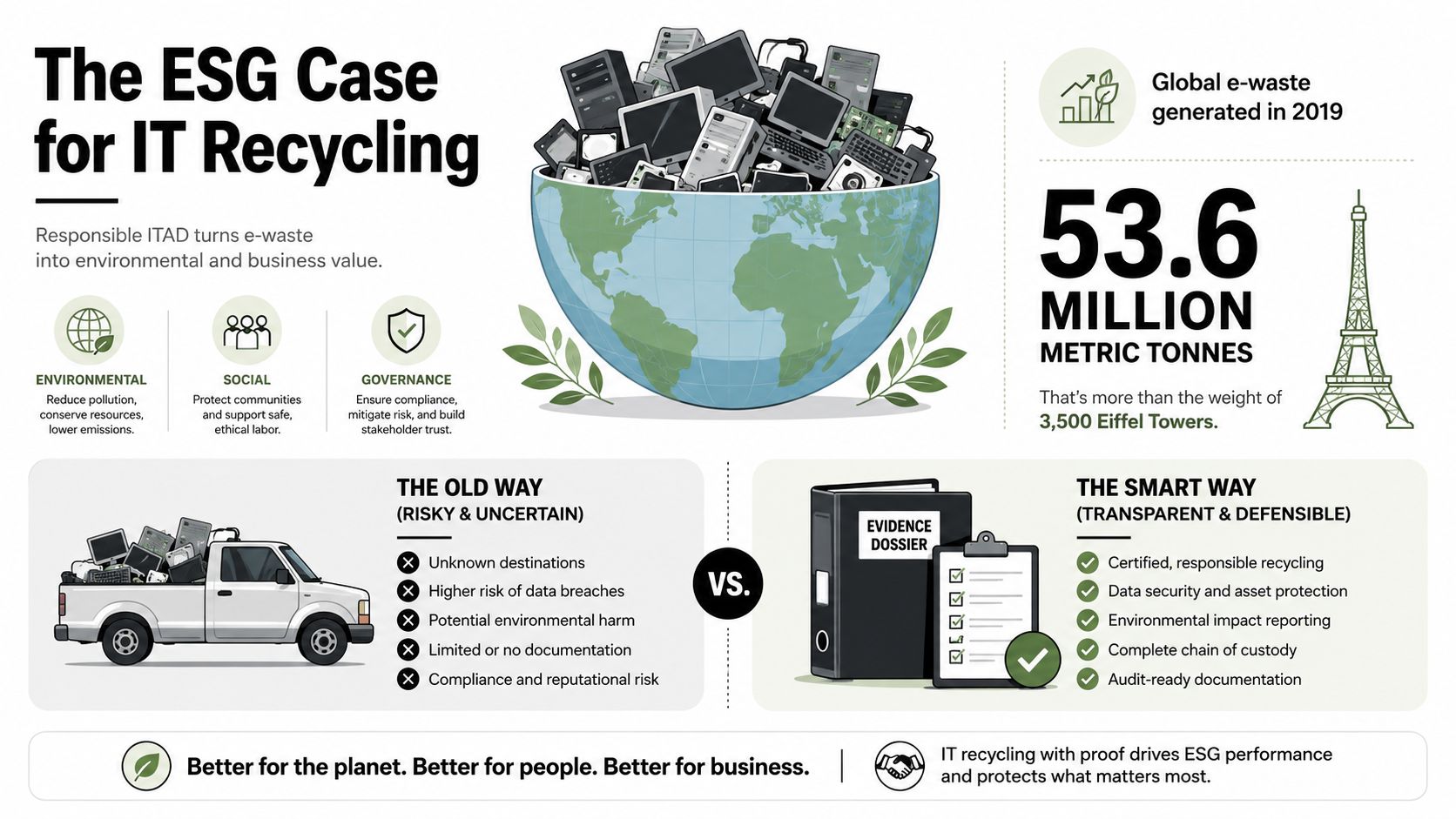
Global e-waste reached 62 million tonnes in 2022, but only 22.3% was formally collected and recycled in an environmentally sound manner, according to the Global E-waste Monitor 2024. That gap changes the business question. IT recycling isn't mainly a hauling task. It's an evidence problem, a data-security problem, and a circularity decision that affects how credibly your organization reports environmental, social, and governance performance.
A truck receipt rarely proves enough. IT leaders, sustainability teams, procurement managers, and auditors need asset-level records, verified data destruction, downstream traceability, and a defensible explanation of why each device was reused, repaired, remarketed, harvested for parts, or recycled. The strongest answer to how businesses can improve ESG through IT recycling is therefore simple: extend useful life where security and performance allow, then document every end-of-life decision.
Table of Contents
- The ESG Case for IT Recycling
- Running a Secure ITAD Process
- Choosing and Auditing an ITAD Vendor
- Measuring Carbon and Waste Outcomes
- Recovering Value Through IT Buyback
- Meeting Compliance and Reporting Requirements
- KPIs and a 90-Day Rollout Plan
The ESG Case for IT Recycling
The global waste stream is growing faster than responsible recovery. The same monitor projects 82 million tonnes of annual e-waste by 2030, while documented recycling is advancing far more slowly than generation, according to the Global E-waste Monitor 2024. For a business, that isn't an abstract environmental statistic. It signals that retired laptops, servers, mobile devices, networking equipment, and data-center hardware need a controlled disposition process rather than an informal handoff.
The evidence file matters because ESG reporting depends on what the organization can demonstrate. A weight-only invoice may show that material left a facility, but it usually doesn't show which assets were processed, whether storage media was sanitized, or where recovered materials went. A stronger file connects serial-numbered assets to intake manifests, disposition decisions, certificates, weights, and downstream attestations.
Practical rule: If your recycler can't explain what happened to each data-bearing asset, the program isn't audit-ready.
Design the program before choosing the vendor
Start by defining the asset scope. Include corporate laptops, desktops, servers, mobile devices, printers, storage arrays, networking gear, laboratory equipment, medical equipment, and hardware removed during data-center decommissioning. Product destruction may require a different workflow from ordinary reuse, especially when a company must prevent branded, defective, recalled, or sensitive products from reaching secondary markets.
Assign ownership across functions rather than leaving the program solely with IT. IT should control inventory and security requirements. Sustainability should define ESG metrics and reporting needs. Procurement should manage commercial terms, insurance, certifications, and audit rights. Legal and compliance teams should approve data handling, export controls, and downstream requirements.
Classify assets before collection:
- Redeployment candidates: Working laptops, phones, desktops, or network devices that can return to service after approved sanitization and testing.
- Refurbishment candidates: Equipment requiring repair, component replacement, cosmetic grading, or configuration before resale.
- Parts-harvesting units: Damaged equipment whose usable components can support repair or refurbishment.
- End-of-life material: Assets with no responsible reuse pathway that require certified recycling and documented material recovery.
Your program charter should specify chain-of-custody controls, data classification rules, accepted sanitization methods, approval authority, and reporting deliverables before the first pickup. Require serial-level records, reuse and resale outcomes, verified destruction or erasure, emissions methodology, weights, destinations, and final disposition status.
A useful external perspective is the Nexus IT Group sustainability resource, which provides context for connecting technology operations with broader environmental objectives. For a regional example of sustainable technology practices, review ESG trends in Atlanta and sustainable IT practices.
Choose circularity over tonnage
Weight is useful for waste reporting, but it can misrepresent circularity. A heavy server sent directly to shredding may increase diversion totals while destroying more remaining utility than a lighter laptop that returns to service. A 2025 EU-oriented study on e-waste targets argues that weight-based collection targets don't capture the full potential for reuse and circularity.
That distinction should shape board reporting. Show the reuse, repair, and remarketing split alongside recycled weight. The best ESG outcome is often to delay recycling by extending useful life, then send equipment to verified recovery only when reuse no longer makes sense.
Running a Secure ITAD Process
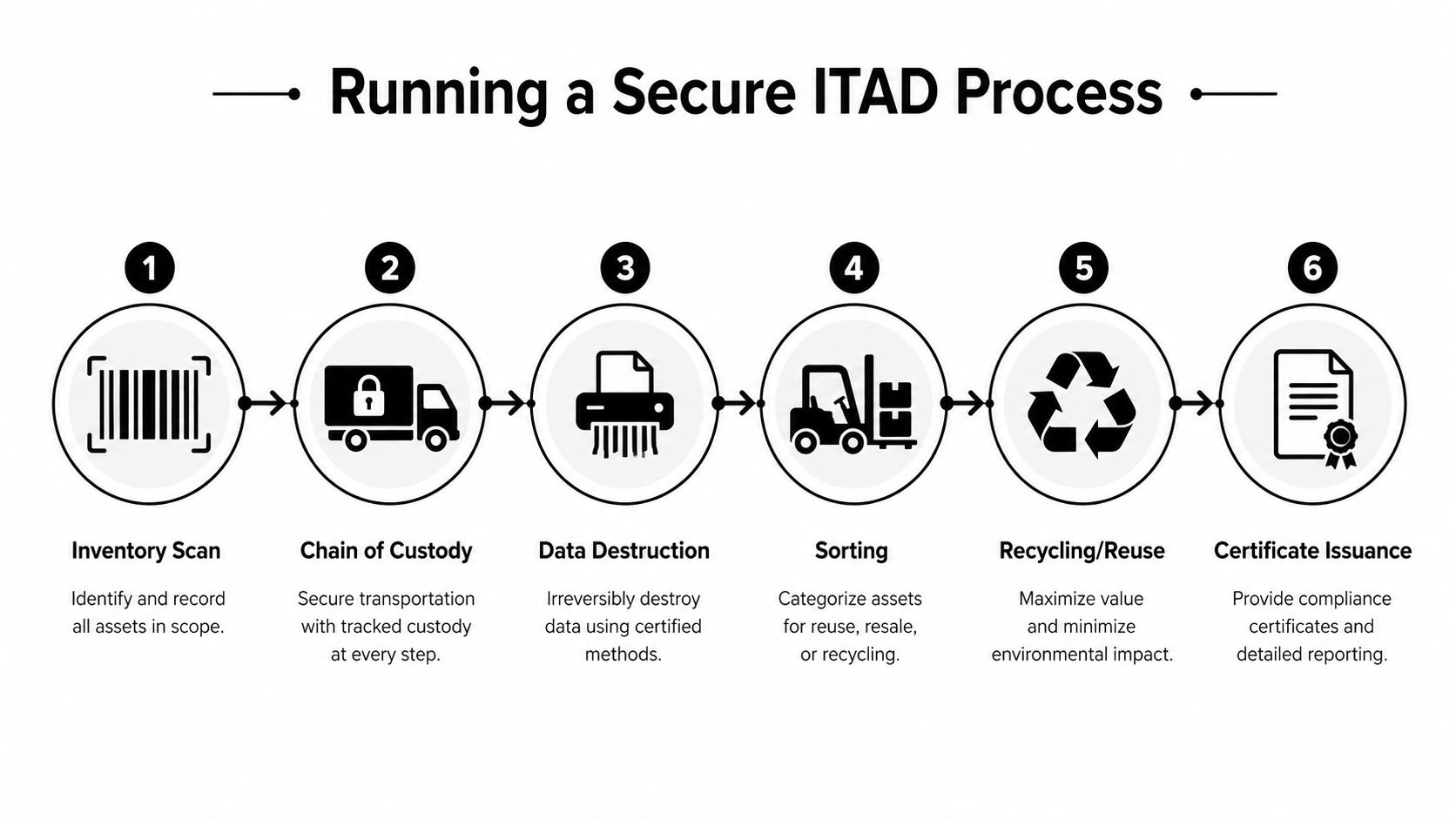
A secure IT asset disposition process should produce evidence at every handoff. The workflow begins before transportation and ends only when the final disposition record ties back to the original asset.
Build the evidence chain
Induct and identify. Scan barcodes, record serial numbers, capture make and model, and reconcile the shipment against the approved manifest. Record missing, damaged, or unexpected assets instead of aggregating them.
Assign data controls. Treat every storage-bearing device as sensitive until its classification and sanitization status are confirmed. Devices approved for reuse can undergo a documented NIST 800-88 Clear or Purge process. Failed drives or media requiring physical destruction should follow an approved destruction method.
Secure transport. Document custody when assets leave the client site, arrive at a staging facility, move between processing areas, and transfer to downstream partners. The IT asset disposition process guide provides useful context for structuring these controls.
Sort by outcome. Separate redeployment, refurbishment, parts recovery, resale, and materials recycling. Don't combine all equipment into a single “recycled” category if working assets could have been recovered.
Issue certificates. Produce sanitization logs, destruction certificates, recycling certificates, weight records, and final disposition reports. Each document should reference the relevant serial number or a controlled lot identifier that can be reconciled to individual assets.
Aggregation is a frequent weak point. A vendor may collect serialized equipment, move it to a third-party warehouse, and later issue only a batch-level summary. That gap leaves procurement and auditors unable to confirm whether the reported outcome belongs to the original shipment.
A pickup receipt proves movement. A complete chain of custody proves accountability.
Choosing and Auditing an ITAD Vendor
Procurement teams should evaluate ITAD providers on three separate layers: operational competence, independent oversight, and reporting quality. Certifications matter, but a logo on a proposal doesn't replace contract language that gives the buyer visibility into processing and downstream decisions.
R2v3 and e-Stewards can support responsible electronics processing and downstream controls. RIOS and ISO 14001 address management systems and environmental performance. NAID is associated with secure information destruction. These credentials answer different questions, so don't treat them as interchangeable proof of complete ESG performance.
Compare the evidence, not just the certificates
| Certification | Audit Frequency | Downstream Traceability | Data Destruction Standards | ESG Reporting Depth |
|---|---|---|---|---|
| NAID | Review the provider's current audit schedule and scope | Confirm whether downstream material and resale channels are covered | Verify approved erasure and physical destruction methods | Often strongest for destruction evidence, but buyers should confirm environmental reporting |
| R2v3 | Confirm certification scope, audit status, and facility coverage | Require documented downstream vendor controls and material pathways | Confirm sanitization procedures and asset-specific certificates | Can support reuse, recycling, and material reporting when the provider supplies detailed records |
| e-Stewards | Confirm certification scope and current audit documentation | Ask how ethical downstream traceability is demonstrated | Review data destruction controls and certificate format | Can support broad environmental and social accountability, subject to delivered report detail |
| RIOS | Confirm management-system audit scope and facility coverage | Request evidence showing how downstream partners are controlled | Verify that data destruction is separately documented | Useful for management-system assurance, but reporting depth depends on the contract and provider |
Put audit rights directly into the MSA. Require access to relevant facilities and records, notice of downstream changes, incident notification, insurance documentation, and the right to review certificates and material-flow evidence. Decide whether audits may be third-party, remote, or unannounced.
Red flags include broker-only sales, undisclosed downstream processors, weight-only invoices, vague destruction language, and certificates that don't identify the assets processed. Ask every bidder:
- Chain of custody: Where are custody checkpoints recorded, and who signs each transfer?
- Data security: Which devices receive Clear, Purge, degaussing, or physical destruction?
- Downstream control: Who receives assets or materials after the primary facility?
- Reporting: Will the provider deliver serial-level records, weights, destinations, and disposition categories?
- Liability: What insurance applies to data loss, environmental incidents, transportation, and downstream failure?
- Certificates: What exact documents arrive per shipment, lot, or asset?
Use the vendor due diligence checklist to turn those questions into a consistent procurement scorecard.
Measuring Carbon and Waste Outcomes
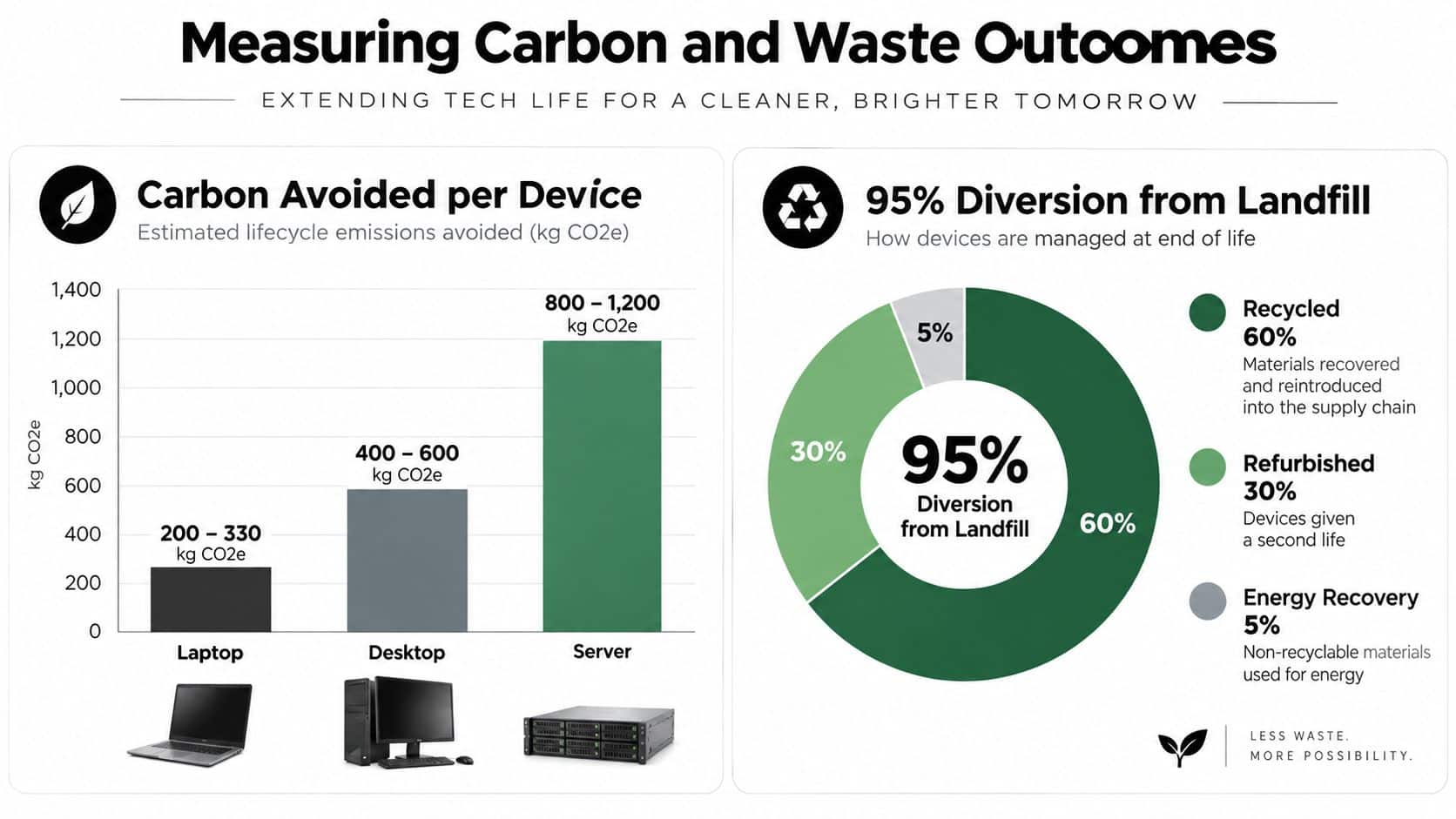
Carbon reporting fails when teams confuse a disposal event with an avoided footprint. Recycling matters, but extending equipment life usually addresses more of the manufacturing burden than sending a working device directly to material recovery.
Fraunhofer UMSICHT reported in 2025 that reuse can reduce greenhouse-gas emissions by 18% to 37%, depending on device type, compared with a conventional single lifecycle, as summarized by UNITAR's coverage of the research. The study estimated savings of 34.7 kg of GHG for smartphones, 59.4 kg for tablets, 107 kg for laptops, and 163 kg for desktop PCs. Those figures make a reuse-first disposition policy more credible than a program optimized only for tonnage.
Use transparent calculations
A practical internal model can be expressed as:
Assets processed × reuse or refurbishment outcome × applicable emissions factor = estimated avoided emissions
That formula isn't a license to select a favorable factor. Document the device type, baseline lifecycle, geographic assumptions, treatment of replacement parts, transport boundary, and whether the result represents avoided production or an operational emissions reduction.
A data-center LCA found that operation produced about 0.710 kg CO2e per 1 kWh of IT power consumed, with 67.3% of total emissions attributed to operation rather than disposal, according to the data-center circular-economy analysis. The implication is important: recycling alone captures only part of the opportunity. Asset extension, power efficiency, redeployment, and right-sizing belong in the same lifecycle conversation.
For waste reporting, separate reuse, refurbishment, parts recovery, materials recycling, and residual disposal. Report weights with the measurement boundary and downstream destination. The carbon and electronics recycling guidance can help teams frame those outcomes without presenting diversion as equivalent to circularity.
Recovering Value Through IT Buyback
Resale is an ESG outcome only when the buyer can prove what was sold, to whom, and under which controls. Treat buyback as a managed disposition channel, not an informal revenue opportunity.
Begin with pre-screening. Capture make, model, age, configuration, condition, and demand before promising recovery value. Functional testing and cosmetic grading can then assign an A, B, or C condition, while a separate security review determines whether the device is eligible for reuse, requires destruction, or falls under a restricted classification.
Data-bearing equipment must be sanitized or destroyed before external handoff. The chain of custody should continue through the remarketing transaction, not stop when a reseller collects the equipment. Contracts should prohibit sensitive devices from going to uncertified buyers and should require appropriate downstream controls, such as R2v3 or e-Stewards-aligned remarketing pathways.
Put value recovery in the contract
Buyback proceeds can offset program costs, but the commercial model needs clarity. Specify whether the provider shares revenue, deducts processing fees, or pays a fixed value after testing. Require the provider to identify the resale channel, retain serial-level evidence, and reconcile the payout to documented devices rather than total weight.
A workable MSA clause can state: “Provider will calculate client remittance from serialized assets documented as sanitized, tested, and resold. No payment will be based solely on aggregate tonnage. Provider will provide the disposition record, resale category, downstream channel, and applicable deductions for each remittance period.”
For accounting, finance teams should establish a supportable fair-value process and document the treatment of recovered proceeds. Don't call every resale a sustainability win. If security controls, buyer qualification, or downstream evidence are missing, the revenue may conceal an ESG liability.
The business laptop buyback program guide offers a practical reference for structuring pre-screening, testing, and value recovery without weakening the audit trail.
Meeting Compliance and Reporting Requirements
Compliance teams should separate two questions. How was the data removed? That question belongs to media sanitization controls such as NIST 800-88. How was the hardware handled afterward? That question concerns environmental processing, downstream controls, transportation, reuse, recycling, and material recovery.
The FTC Disposal Rule, HIPAA, GLBA, FACTA, state e-waste requirements, and SEC climate disclosure obligations can create different documentation expectations. Sector rules add further complexity. Healthcare organizations need disciplined handling of protected health information. Financial institutions need controls for customer information. Schools and government contractors may face contractual security requirements, procurement clauses, and restrictions on where used equipment can travel.
Match the record to the obligation
| Regulation | Scope | Evidence File |
|---|---|---|
| FTC Disposal Rule | Consumer-report information during disposal | Serialized manifest, chain-of-custody log, data destruction or erasure certificate, vendor contract |
| HIPAA | Protected health information on electronic media | Media sanitization record, destruction certificate, workforce and vendor controls |
| GLBA | Customer information held by financial institutions | Asset inventory, approved sanitization method, certificate, vendor oversight records |
| FACTA | Consumer information and disposal procedures | Disposal policy, vendor diligence file, destruction evidence |
| State e-waste laws | Covered electronics handling and recycling | Weight records, recycling certificate, processor information, destination documentation |
| SEC climate disclosure rules | Reportable climate-related information and supporting controls | Methodology, assumptions, emissions calculations, assurance-ready source records |
Breach-notification duties depend on the data, jurisdiction, and facts of the incident. Export controls can also apply when used equipment crosses borders, even when the original intention was reuse. Ask legal and compliance teams to define restricted asset categories before a vendor markets equipment internationally.
A complete audit pack should contain the approved policy, asset scope, serialized manifest, custody transfers, sanitization logs, destruction certificates, recycling certificates, weight tickets, downstream attestations, incident records, and emissions methodology. Store it where sustainability, IT security, procurement, and internal audit can retrieve the same controlled version.
That shared evidence can support GRI, CSRD, Scope 3, and other sustainability reporting without asking each department to rebuild the story from separate spreadsheets.
KPIs and a 90-Day Rollout Plan
A dashboard should show whether the program preserves value, controls risk, and produces defensible environmental evidence. Don't lead with the number of pallets collected. Lead with what happened to the assets inside them.
Track these KPIs using fixed definitions:
- Asset recovery rate: Assets with a documented final outcome divided by assets inducted.
- Reuse and refurbishment split: Units returned to service or refurbished, reported separately from material recycling.
- Certificate completeness: Disposition records containing required serial, method, destination, and certificate fields divided by total records.
- Verified emissions avoided: Calculated using the approved lifecycle boundary and device-specific factor.
- Scope 3 data coverage: Retired assets with sufficient records for the organization's chosen Scope 3 methodology.
- Residual value recovered: Documented proceeds linked to serialized resale or buyback outcomes.
- Hazardous material diversion: Regulated material directed to approved processing, supported by weight and destination evidence.
Sequence the first 90 days
Days 1 to 30, scope and inventory. Name the executive sponsor, define asset categories, reconcile the asset register with physical holdings, classify data sensitivity, and approve the disposition hierarchy. The acceptance test is a signed program charter and an inventory file with accountable ownership.
Days 31 to 60, vendor and pilot. Issue an RFP, score certification scope and downstream controls, negotiate audit rights, test certificate formats, and process a representative pilot shipment. The acceptance test is a reconciled manifest with verified sanitization, disposition, and reporting outputs.
Days 61 to 90, rollout and reporting. Train site teams, publish packing and custody procedures, establish escalation routes, launch scheduled collections, and produce the first management report. The acceptance test is a complete evidence pack that sustainability, security, procurement, and internal audit can review.
The data-center IT asset recycling measurement guidance reinforces the need for ICT-specific data rather than generic assumptions. That principle should govern the dashboard: report what the program measured, preserve the assumptions, and never turn an estimate into a verified fact.
Beyond Surplus provides commercial electronics recycling, secure data wiping and hard-drive shredding, IT asset disposition, product destruction, data-center de-installation, logistics coordination, and buyback services with documented chain-of-custody records. Visit Beyond Surplus to build an evidence-ready IT recycling program that supports reuse, compliance, value recovery, and credible ESG reporting.