A sustainable IT asset program starts long before a device reaches a recycling dock. It begins with procurement standards, accurate inventory, refresh planning, redeployment, secure data destruction, controlled transportation, documented compliance, and measurement. For business owners, IT managers, facilities leaders, and procurement teams, the best approach balances environmental responsibility with data security, regulatory evidence, operational control, and recovered value.
The need is larger than many organizations expect. The Global E-waste Monitor 2024 reports that the world generated 62 million tonnes of e-waste in 2022, equal to about 7.8 kilograms per person, while only 22.3% was formally collected and recycled in an environmentally sound manner. Annual e-waste is rising by about 2.6 million tonnes per year, with a projected 82 million tonnes by 2030, so lifecycle extension, reuse, and certified recycling belong at the center of enterprise ITAM.
The ten practices below organize sustainability as an integrated ITAM-to-ITAD operating model. They cover asset recovery, data destruction, inventory, vendor governance, compliance, environmental metrics, data center decommissioning, specialized equipment, refresh planning, and secure logistics. Beyond Surplus is one example of an ITAD partner that combines electronics recycling, secure data destruction, buyback, de-installation, and nationwide business logistics.
Table of Contents
- 1. Circular Economy IT Asset Recovery and Refurbishment Programs
- 2. Comprehensive Data Destruction and Chain-of-Custody Documentation
- 3. Strategic IT Asset Inventory Management and Lifecycle Tracking
- 4. Vendor Consolidation and Single-Source ITAD Provider Partnerships
- 5. Regulatory Compliance Frameworks and Audit Documentation Practices
- 6. Environmental Stewardship and Sustainable Disposition Metrics
- 7. Data Center Decommissioning and Large-Scale Equipment Logistics
- 8. Medical and Laboratory Equipment Specialized Disposition Programs
- 9. Proactive Refresh Cycle Planning and Technology Obsolescence Management
- 10. Secure Transportation and Facility Security Controls Throughout Asset Lifecycle
- 10-Point Comparison: Sustainable IT Asset Management Best Practices
- Turn ITAD Into a Measurable Sustainability Program
1. Circular Economy IT Asset Recovery and Refurbishment Programs
The most sustainable disposition decision is often not recycling. It's keeping a usable asset in service through redeployment, refurbishment, resale, or component recovery. That requires an organization to evaluate condition and remaining utility before sending equipment into material processing.
A practical workflow starts with an IT audit that identifies functional equipment, repair needs, ownership, warranty status, configuration, and likely secondary-market demand. Asset tags and condition grades should be applied before equipment leaves the operating environment. A laptop with cosmetic wear and a healthy drive may have a different recovery path from a damaged unit, even if both reached retirement at the same time.
Programs work better when procurement, finance, IT, and the ITAD partner share the same disposition rules. Dell's Global Trade-In Program, HP's Device as a Service model, Lenovo's commercial buyback programs, Apple's GiveBack program, and Microsoft's lifecycle-extension initiatives illustrate the range of manufacturer and partner models available to organizations.

Make recovery a controlled decision
Track whether each asset is redeployed, refurbished, resold, harvested for parts, or recycled. Record the financial result and the reason for the selected route.
- Audit early: Review replacement candidates well before planned retirement so refurbishment remains commercially viable.
- Use multiple channels: Certified refurbishers and resellers can create more options for specialized equipment.
- Document transactions: Keep valuation, transfer, resale, donation, and recycling records with the asset history.
- Set a hierarchy: Prioritize redeployment and refurbishment when security, performance, and condition support them.
For organizations building a regional program, circular economy electronics services can support recovery, refurbishment, resale, and responsible recycling decisions.
2. Comprehensive Data Destruction and Chain-of-Custody Documentation
Sustainability never overrides information security. A device can only enter reuse or resale after the organization has verified that stored data is inaccessible through an approved sanitization process.
Data destruction should match the media, sensitivity, and intended disposition. Certified software erasure can preserve a reusable drive when the process is appropriate and verifiable. Physical destruction, including shredding or crushing, may be the better choice for failed media, highly sensitive information, or equipment that won't return to service. Degaussing can apply to compatible magnetic media, but it also affects future usability.
The control is the evidence. A defensible workflow records the asset identifier, serial number, collection point, custody transfers, sanitization method, operator, verification result, and final disposition. Certificates should connect directly to the ITAM record rather than sit in an unindexed vendor portal.
Practical rule: If a certificate can't be matched to a specific asset and custody history, it isn't complete compliance evidence.
Healthcare, financial, government, retail, and education environments often need procedures aligned with their own regulatory and contractual obligations. Review the required method with security and compliance teams before equipment is released.
A documented chain of custody for IT asset disposal helps organizations maintain traceability from pickup through destruction, reuse, or recycling. The process should also define who can authorize release, who verifies completion, and how exceptions are escalated.
3. Strategic IT Asset Inventory Management and Lifecycle Tracking
Inventory accuracy determines whether every other sustainability practice works. If the organization can't identify where an asset is, who controls it, what data it holds, or when it should retire, it can't reliably choose reuse, secure destruction, or recycling.
An enterprise ITAM platform, CMDB, DCIM system, or specialized discovery tool should capture serial number, model, location, assigned user or department, purchase information, warranty status, condition, support status, and disposition state. Integrating ITAM with procurement, finance, service management, and facilities systems reduces duplicate records and exposes gaps between the ledger and the physical environment.
ServiceNow Asset Management, IBM TADDM, Jira Service Management, Lansweeper, and Flexera platforms can support different parts of this operating model. The technology matters less than ownership. Each department needs an asset steward responsible for updates, reconciliation, and exception handling.
Turn inventory into decisions
A useful inventory doesn't merely count devices. It helps managers identify underused equipment, redundant infrastructure, upcoming support risks, and assets that can be redeployed instead of replaced.
- Reconcile regularly: Compare physical records with system records and investigate missing or unexpected assets.
- Capture disposition data: Record the selected route, destruction evidence, recovery result, and downstream processor.
- Use alerts: Flag equipment approaching refresh, warranty expiration, vendor support termination, or planned facility closure.
- Validate before pickup: Review the final manifest with the ITAD provider to prevent unidentified equipment from entering the shipment.
The IT asset lifecycle management process should connect inventory control with procurement, maintenance, refresh, offboarding, and disposition.
4. Vendor Consolidation and Single-Source ITAD Provider Partnerships
Multiple disposal contractors can create fragmented custody, inconsistent documentation, and unclear accountability. A consolidated ITAD relationship can simplify operations when one provider coordinates pickup, data destruction, recycling, refurbishment, buyback, reporting, and logistics under defined service levels.
That doesn't mean every organization should select a provider based only on service breadth. Review certifications, downstream controls, geographic coverage, insurance, staffing, transportation capacity, processing locations, and experience with the organization's asset types. A provider that handles office endpoints may not have the equipment, labor, or project controls required for a data center de-installation.
The contract should define acceptance criteria and measurable deliverables. Include manifest accuracy, pickup scheduling, custody records, destruction certificates, recycling certificates, recovery reporting, incident escalation, liability transfer, and reporting timelines. Procurement should involve information security, legal, environmental compliance, finance, and facilities before award.
Govern the relationship after signing
Quarterly business reviews should examine service-level performance, exception rates, recovery outcomes, cycle time, documentation quality, and downstream changes. A single provider still needs oversight. Consolidation improves control only when the customer maintains clear audit rights and escalation paths.
Use a vendor due diligence checklist to compare providers consistently. Ask for references from organizations with similar security, regulatory, geographic, and equipment requirements. The strongest partnership creates one accountable operating model without turning the vendor into an unexamined black box.
5. Regulatory Compliance Frameworks and Audit Documentation Practices
Compliance begins by identifying which rules apply to the assets, data, industry, locations, and disposition routes. A healthcare provider may need controls for protected health information and biomedical equipment. A financial institution may have contractual and security requirements for payment systems and customer records. A public company may need stronger audit-trail coordination between IT, finance, and legal teams.
The policy should define approved sanitization methods, authorization levels, chain-of-custody requirements, vendor qualifications, environmental handling, exception management, and evidence retention. It should also explain what happens when a device is missing, damaged, unverified, or discovered outside the approved inventory.
Indiana provides a useful example of why jurisdictional review matters. The Indiana e-waste regulations state that businesses and other organizations are generally not regulated under most federal and state hazardous-waste requirements if they generate less than 220 pounds of hazardous waste per month, including computers and other electronics. The same guidance says e-waste sent for reuse or recycling instead of disposal is excluded from regulation as solid and hazardous waste. Organizations still need to confirm how those rules apply to their operations and materials.
Build an evidence file
Maintain current vendor certifications, insurance documents, audit reports, manifests, certificates, approvals, training records, and incident records. Retention periods should be determined with legal and compliance teams, not copied from a generic template.
Auditors should be able to trace a sample asset from procurement or assignment through collection, sanitization, final disposition, and reporting. That traceability turns a sustainability policy into a defensible control.
6. Environmental Stewardship and Sustainable Disposition Metrics
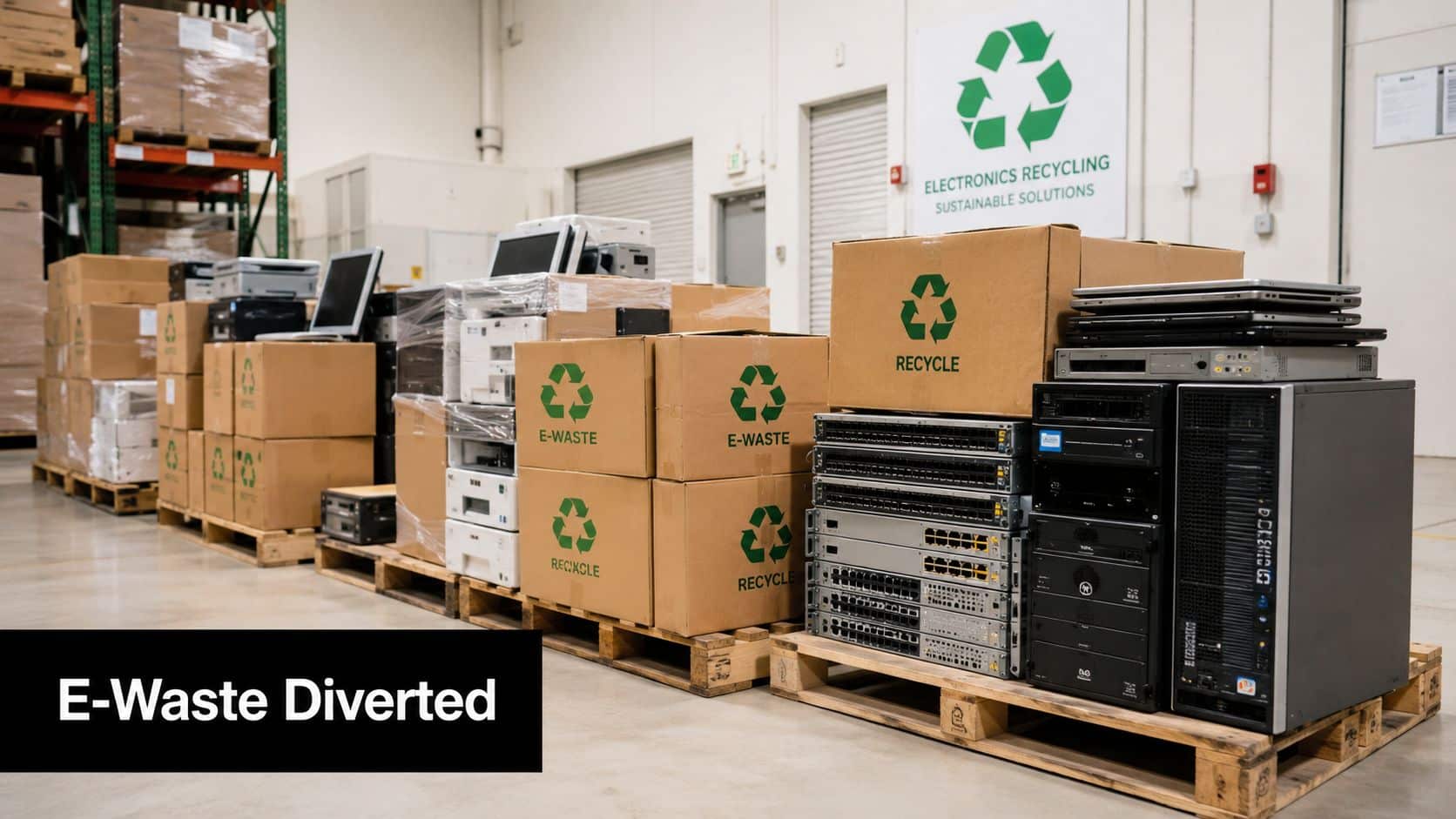
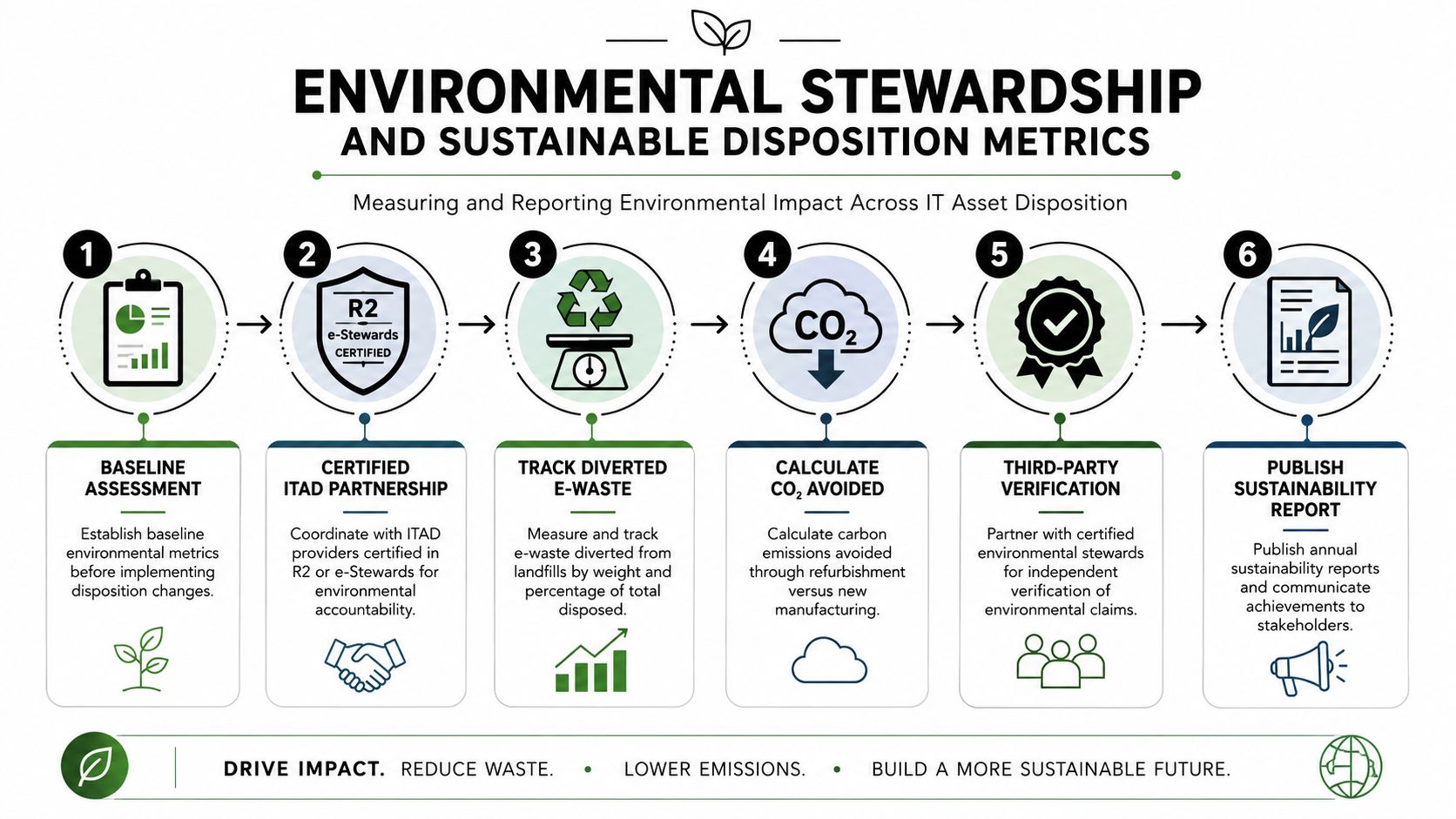
Environmental claims need an operating measurement system. Start with a baseline that describes what the organization currently sends for reuse, refurbishment, material recovery, recycling, or disposal. Then define metrics that managers can calculate consistently from manifests and vendor reports.
Useful measures include reuse volume, refurbishment volume, recovery value, e-waste weight, material categories, downstream destinations, certificate completion, and exceptions. Where reliable methodology exists, environmental reporting can also address avoided manufacturing impacts, recovered hazardous materials, energy, water, or emissions. Avoid unsupported estimates. A smaller set of auditable metrics is more useful than an impressive report built on assumptions.
The global context reinforces the need for disciplined measurement. The Global E-waste Monitor 2024 data records 62 billion kilograms of e-waste generated globally in 2022, with only 22.3% formally collected and recycled in an environmentally sound manner. This statistic appears once here because environmental reporting should focus attention on traceable collection and responsible processing, not just on removing equipment from a facility.
Connect metrics to governance
Review results at a defined cadence and assign owners for corrective action. Procurement can use recovery data to influence device standards. IT can use reuse data to improve redeployment. Sustainability teams can use documented downstream reporting in ESG disclosures and environmental audits.
For adjacent sustainability context, teams may also review eco-friendly additive manufacturing, while keeping ITAD metrics specific to actual asset flows.
7. Data Center Decommissioning and Large-Scale Equipment Logistics
A data center closure is a program, not a truck appointment. Servers, storage arrays, networking hardware, racks, power distribution equipment, cooling infrastructure, cabling, batteries, and supporting materials require coordinated planning across IT operations, security, facilities, finance, and the ITAD provider.
Begin with a room-level inventory and a removal sequence. Application and infrastructure teams must confirm migration, shutdown, retention, and access requirements before technicians disconnect equipment. The project plan should identify dependencies, work windows, safety controls, loading routes, staging areas, environmental risks, and approval gates.
Decommissioning principle: No equipment should leave the facility until the responsible team has confirmed data status and the manifest matches the physical asset.
Large projects benefit from weekly status reviews, issue logs, photographs, serial-level manifests, and documented handoffs. Equipment with resale or redeployment potential should be separated from damaged infrastructure and material-only loads. Batteries, refrigerants, lamps, and other regulated components need a documented handling path.
Protect uptime and recovery value
A specialized provider can coordinate de-installation, packing, transportation, data destruction, recycling, refurbishment, and reporting. The data center logistics service should be evaluated for labor capacity, equipment handling, secure transportation, insurance, and experience with complex site conditions.
A clear closeout package should include removed-asset reconciliation, destruction evidence, recycling certificates, recovery results, damage reports, and unresolved exceptions. That package supports both operational closure and financial accountability.
8. Medical and Laboratory Equipment Specialized Disposition Programs
Medical and laboratory equipment requires more than standard electronics recycling. Imaging systems, diagnostic instruments, surgical equipment, monitors, analyzers, spectrophotometers, chromatography systems, and related accessories may contain sensitive information, hazardous residues, regulated materials, or components requiring specialized handling.
The disposition plan should begin with an equipment register and a technical review. Document maintenance history, operating condition, decontamination status, embedded storage, chemicals, radioactive sources, mercury, and other known hazards. Facility safety officers, biomedical engineering teams, laboratory managers, and compliance personnel should approve the release path.
Reusable equipment may have value in secondary healthcare, education, or research markets, but resale isn't automatic. Decontamination must be verified, data-bearing components must be sanitized, and transportation must reflect the equipment's size and hazard profile. Equipment that can't be reused should move through qualified recycling or destruction channels with supporting records.
Require evidence before removal
Ask the ITAD provider for written procedures covering decontamination, data destruction, hazardous-material identification, packaging, transportation, downstream processing, and certificates. Healthcare customers should coordinate privacy requirements with their compliance teams. Research organizations should also account for proprietary methods, patient-linked records, and laboratory safety obligations.
For facilities planning, planning lab casework for cities provides related context on laboratory environments. It isn't a substitute for a specialized disposition plan, but it highlights why laboratory projects require coordination between equipment, space, safety, and facilities stakeholders.
9. Proactive Refresh Cycle Planning and Technology Obsolescence Management
Refresh planning determines whether an organization captures residual value or creates an emergency disposal problem. Waiting until equipment fails, loses support, or becomes a security liability leaves fewer reuse options and compresses procurement and logistics decisions.
A refresh policy should combine business performance, failure history, security patch availability, vendor support dates, warranty status, depreciation, and budget timing. The policy shouldn't rely on a fixed replacement age for every asset class. A mobile endpoint, a server, a network switch, and specialized laboratory equipment have different operational and security profiles.
The 2025 ITAD benchmarking report from Cascade Assets covered 56 organizations across 14 industries and more than 808,000 employees. It found that laptop refresh cycles shortened from 4.3 to 4.0 years, while NIST 800-88 sanitization adoption rose to 52% from 34% in the prior year. Those findings support a practical conclusion: faster refresh activity makes secure reuse, resale, and lifecycle-extension planning more important, not less.
Link procurement to disposition
ITAM alerts should identify assets approaching planned retirement, vendor end of support, or security risk. Procurement can then coordinate replacement delivery with collection and redeployment. Finance should receive recovery forecasts early enough to reflect likely proceeds without treating uncertain value as guaranteed revenue.
Use refresh waves to consolidate pickups, reduce disruption, and improve manifest quality. A planned disposition also gives the ITAD partner time to determine whether secure erasure, physical destruction, refurbishment, or material recovery is appropriate.
10. Secure Transportation and Facility Security Controls Throughout Asset Lifecycle
An asset can be secure inside the office and exposed during loading, staging, transport, or processing. Physical security therefore belongs in the ITAM control environment, not only in the information security policy.
Requirements should cover screened personnel, vetted carriers, restricted-access areas, sealed containers, loading procedures, photographs, custody signatures, vehicle security, incident response, and liability transfer. The appropriate control level depends on data sensitivity, asset value, location, and regulatory obligations. High-risk equipment may require additional escorting, dual custody, or on-site destruction.
Security language should appear in the RFP, statement of work, and service-level agreement. Ask the provider to explain how it controls subcontractors and what evidence it retains for each handoff. A provider's own fleet can simplify accountability, but transportation partners still need documented qualification and oversight.
- Control handoffs: Record who releases, receives, transports, and processes each asset group.
- Protect staging areas: Restrict access and keep collected equipment separated from ordinary waste streams.
- Investigate exceptions: Define response steps for missing assets, broken seals, damaged containers, or manifest discrepancies.
- Minimize exposure: Schedule pickups to reduce unsecured storage and unnecessary transfers.
The 2025 ITAD survey benchmarking found that security and environmental concerns remained the top disposition priorities across the survey's 11-year history, while sustainability importance rose from 19% in 2023 to 34% in 2024. The operational implication is clear. Secure logistics and environmental reporting should be managed as connected controls.
10-Point Comparison: Sustainable IT Asset Management Best Practices
| Approach | 🔄 Implementation Complexity | ⚡ Resource Requirements | 📊 Expected Outcomes | 💡 Ideal Use Cases | ⭐ Key Advantages |
|---|---|---|---|---|---|
| Circular Economy IT Asset Recovery and Refurbishment Programs | 🔄 Medium, refurbishment workflows, grading protocols, partner management | ⚡ Moderate, refurb facilities, certified refurbishers, audit tooling | 📊 Revenue recovery (20–60%), lifecycle extension, reduced e-waste | Organizations seeking cost recovery and sustainability during refresh cycles | ⭐ Revenue recovery; landfill diversion; stronger sustainability credentials |
| Comprehensive Data Destruction and Chain-of-Custody Documentation | 🔄 High, certified wiping/destruction and strict custody tracking | ⚡ High, certified tools, on-site/off-site destruction, audit trails | 📊 Eliminates breach risk; verifiable compliance evidence | Regulated sectors handling sensitive data (healthcare, finance, govt) | ⭐ Regulatory compliance; liability transfer; audit-ready certificates |
| Strategic IT Asset Inventory Management and Lifecycle Tracking | 🔄 High, integration, governance, ongoing data maintenance | ⚡ Moderate, ITAM/CMDB software, RFID/barcode tagging, staff training | 📊 Real-time visibility; reduced redundant purchases; 10–15% cost savings | Multi-site enterprises, regulated industries, large fleets | ⭐ Data-driven disposition decisions; redeployment; budget forecasting |
| Vendor Consolidation and Single-Source ITAD Provider Partnerships | 🔄 Medium, contract/SLA negotiation and vendor oversight | ⚡ Moderate, procurement effort, vendor validation, volume logistics | 📊 Lower admin costs; improved pricing; consistent compliance | Organizations with high transaction volume or distributed sites | ⭐ Simplified operations; unified SLAs and chain-of-custody; volume discounts |
| Regulatory Compliance Frameworks and Audit Documentation Practices | 🔄 High, mapping multi-jurisdiction regulations and policies | ⚡ Moderate–High, audits, legal support, training, retention systems | 📊 Reduced legal risk; audit readiness; documented due diligence | Highly regulated organizations and publicly traded companies | ⭐ Demonstrable compliance; legal protection; consistent governance |
| Environmental Stewardship and Sustainable Disposition Metrics | 🔄 Medium, requires measurement systems and third-party verification | ⚡ Moderate, certified ITADs, measurement tools, reporting resources | 📊 ESG improvements; tons e-waste diverted; CO2 avoided; reputational gains | Firms with ESG targets or public sustainability reporting obligations | ⭐ Measurable environmental impact; investor/client appeal; employee engagement |
| Data Center Decommissioning and Large-Scale Equipment Logistics | 🔄 Very High, complex project management, migration and remediation | ⚡ High, heavy logistics, specialized crews, environmental controls | 📊 Significant capital recovery ($M), reduced facility costs, minimized downtime (if planned) | Cloud migration, facility closure, large data center consolidations | ⭐ Bulk recovery efficiency; coordinated logistics; verified data destruction |
| Medical and Laboratory Equipment Specialized Disposition Programs | 🔄 Very High, decontamination, hazardous-material handling, export controls | ⚡ High, specialized vendors, compliance testing, longer timelines | 📊 Value recovery for usable equipment while ensuring safety and compliance | Hospitals, research labs, biotech firms with regulated assets | ⭐ Safe decontamination; HIPAA/state compliance; specialized refurbishment markets |
| Proactive Refresh Cycle Planning and Technology Obsolescence Management | 🔄 Medium, policy, forecasting, vendor support tracking | ⚡ Moderate, planning resources, ITAM integration, procurement alignment | 📊 Reduced emergency costs; higher recovery value; improved security | Organizations planning regular refreshes or large-scale upgrades | ⭐ Predictable budgets; maximized refurbishment value; fewer security gaps |
| Secure Transportation and Facility Security Controls Throughout Asset Lifecycle | 🔄 Medium, security procedures, vetted carriers, custody protocols | ⚡ Moderate–High, background checks, GPS tracking, secure storage, insurance | 📊 Lower theft/diversion risk; preserved asset value; auditable custody logs | High-value equipment transfers, regulated data pickups, remote sites | ⭐ Protects chain-of-custody; reduces loss/liability; strengthens audit evidence |
Turn ITAD Into a Measurable Sustainability Program
Sustainable IT asset management becomes practical when the organization treats every disposition decision as part of a governed lifecycle. Start with ownership. Assign responsibilities across IT, procurement, finance, facilities, security, legal, compliance, and sustainability. Establish a policy hierarchy that favors redeployment and refurbishment when the asset is suitable, requires verified data destruction before release, and directs unusable equipment to certified recycling or approved material recovery.
Inventory accuracy comes next. Reconcile physical assets with system records, capture storage and location details, and connect each asset to its owner and lifecycle state. Without this foundation, teams can't forecast refresh demand, locate data-bearing devices, validate vendor manifests, or calculate environmental outcomes with confidence.
Refresh planning should begin early enough to preserve options. Use support dates, security requirements, failure history, performance, budget cycles, and expected residual value. Coordinate procurement with collection, redeployment, and ITAD scheduling. A shorter refresh cycle can increase the volume of retired equipment, so organizations need stronger reuse, resale, and secure disposition workflows at the same time.
Define data controls before equipment moves. Specify approved wiping and destruction methods, verification requirements, custody documentation, certificate content, exception handling, and retention responsibilities. Then contract for secure logistics, qualified downstream processing, recovery reporting, and service-level performance. A provider should be able to explain how it handles office endpoints, servers, networking equipment, data center infrastructure, medical devices, laboratory equipment, and product destruction where applicable.
ISO/IEC TS 19770-13:2026 introduces explicit requirements for a strategic sustainable ITAM implementation plan, including sustainability goals, KPI development, control and monitoring processes, and stakeholder engagement, as described in the standard overview. Its emphasis on formal planning reinforces the need to move beyond broad sustainability statements.
Review a focused KPI set on a regular schedule:
- Reuse and recovery rate: Track redeployment, refurbishment, resale, component recovery, and recovered value.
- Disposition cycle time: Measure the period from approved retirement to documented final disposition.
- Data destruction evidence: Monitor certificate completion, verification, exceptions, and asset-record matching.
- E-waste diversion: Record weight, material categories, recycling routes, and any disposal exceptions.
- Environmental outcomes: Report only results supported by documented methodology and vendor evidence.
- Vendor performance: Review pickup timeliness, manifest accuracy, SLA adherence, incident handling, and downstream reporting.
Beyond Surplus offers business IT equipment disposal, electronics recycling, secure data destruction, buyback and value recovery, product destruction, data center de-installation, logistics coordination, certificates of recycling and data destruction, and nationwide pickup support for organizations. Contact Beyond Surplus for certified electronics recycling, secure IT asset disposal, data destruction, value recovery, data center de-installation, and nationwide business pickup support.
Contact Beyond Surplus to coordinate secure IT asset disposal, certified electronics recycling, data destruction, buyback, product destruction, data center de-installation, and business pickup logistics. Build a documented lifecycle program that protects sensitive information, supports compliance, and keeps viable equipment in productive use.