

The lease-end notices are already in your inbox. Refresh funding is approved, business owners want replacement devices deployed, and your team now has to retire 5,000 laptops, servers, and storage devices without exposing data, interrupting operations, or losing track of what happened to each serial number. The difficult part isn't moving equipment out of a building. It's proving that every asset was authorized, collected, sanitized or destroyed appropriately, transferred under control, and assigned a defensible final disposition.
The best practices for enterprise asset retirement begin before decommissioning. Procurement, IT, information security, legal, finance, facilities, sustainability, and business owners need one operating model, one inventory record, and clear approval gates. This guide lays out that model, including chain-of-custody telemetry, NIST-aligned sanitization, vendor controls, and the value-versus-risk decision that most retirement programs handle poorly.
Table of Contents
- Why Enterprise Asset Retirement Needs a Strategy in 2026
- The Scale of the Problem and the Compliance Gap
- Governance and Policy Foundations
- The Retirement Workflow from Decommission to Disposition
- Secure Data Destruction and NIST 800-88 Decisioning
- Comparing On-Site Versus Off-Site, Recycle Versus Resale
- Selecting and Vetting an ITAD Partner
- Value Recovery Timing, Compliance, and Your Retirement Checklist
Why Enterprise Asset Retirement Needs a Strategy in 2026
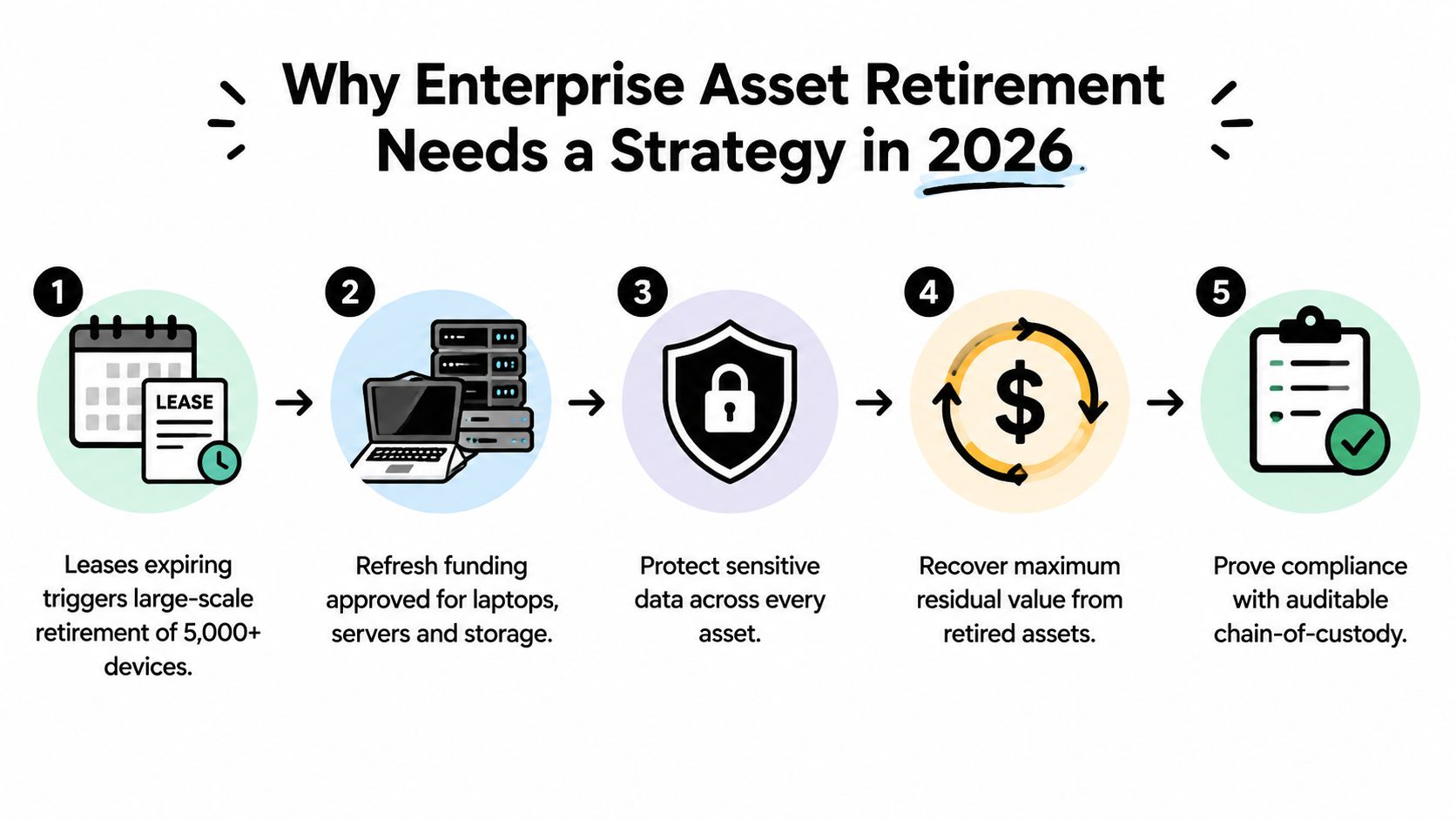
A large retirement run usually starts with a business event, not a recycling decision. Leases expire, hardware refreshes receive funding, software becomes unsupported, or a security exception makes continued use unacceptable. The CIO must decide what leaves service, when it leaves, where it goes, and who can authorize each step.
Treating retirement as an IT cleanup project creates predictable weaknesses. Teams miss devices in satellite offices, overlook storage media inside servers, rely on incomplete spreadsheets, and release equipment before ownership and data status are confirmed. A certificate issued later can't repair an inventory record that never matched the physical asset.
Set the retirement trigger early
Build retirement criteria into acquisition and lifecycle policy. Triggers may include:
- Refresh age: Move assets into review when they approach the organization's approved replacement point.
- Lease expiration: Start inventory validation before return deadlines create urgency.
- Security exceptions: Escalate devices that can't meet required encryption, patching, or configuration standards.
- Failure and support status: Route failed or unsupported hardware into a controlled disposition path.
- Business change: Include office closures, data center moves, mergers, and application migrations.
Approve the route by asset class, data classification, condition, residual value, and destination. A functioning encrypted laptop shouldn't automatically follow the same path as a failed SSD from a regulated environment.
Optimize net value, not the highest bid
The highest quoted resale price isn't necessarily the best financial outcome. Compare expected proceeds with handling, testing, data destruction, freight, storage, compliance exposure, and the cost of resolving exceptions. RFID or barcode scans, serialized manifests, and tamper-evident seals create the evidence needed to defend that decision.
Practical rule: Retirement is complete only when the inventory record, custody history, sanitization result, and final disposition agree.
A governed process turns asset retirement into a repeatable lifecycle control. It also lets production teams schedule decommissioning without forcing security and facilities staff to improvise under deadline pressure.
The Scale of the Problem and the Compliance Gap
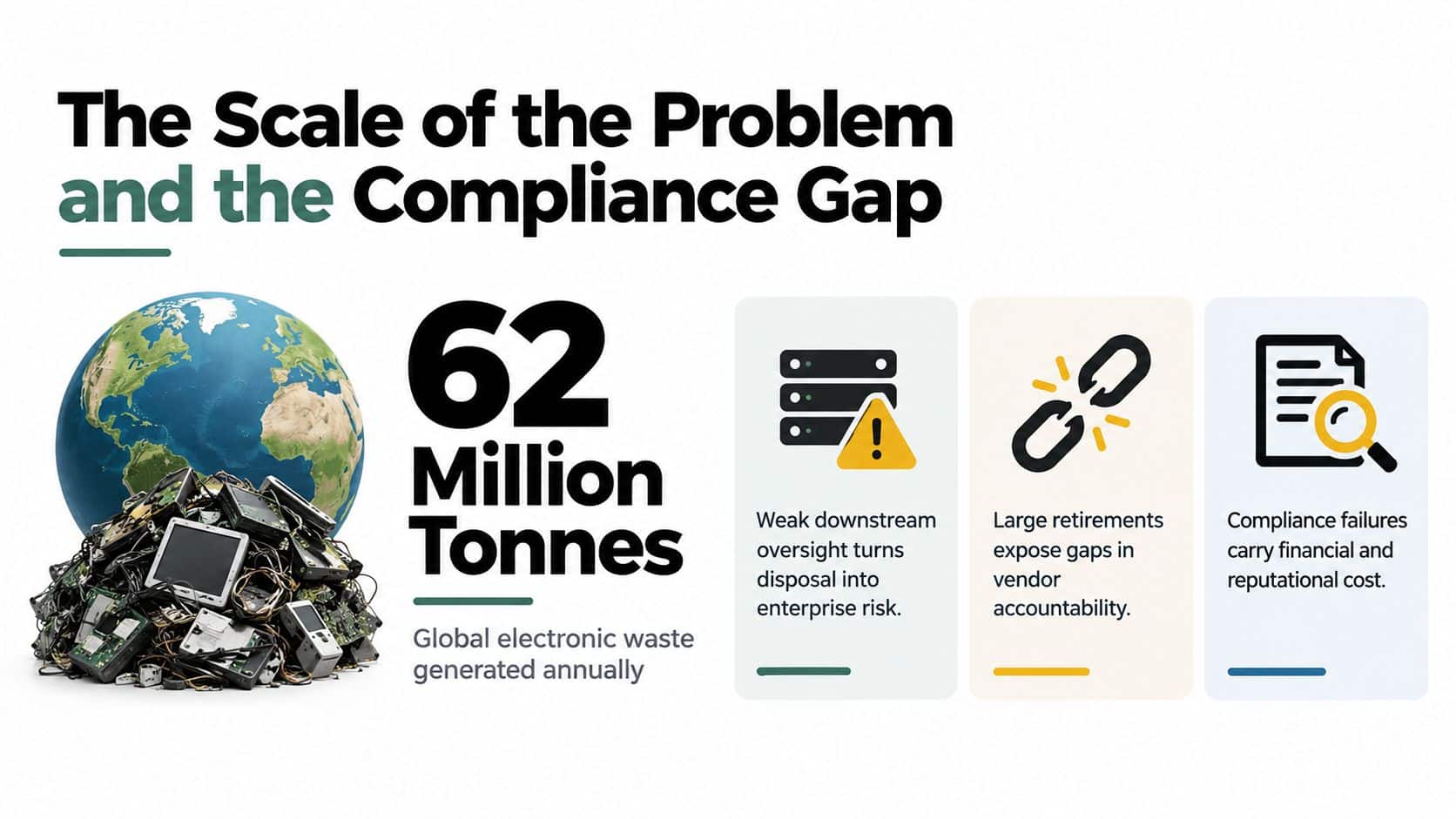
The global e-waste stream makes downstream oversight an enterprise control issue. The Global E-waste Monitor 2024 reports that the world generated a record 62 million tonnes of e-waste in 2022, equal to 7.8 kilograms per person, while only 22.3% was formally collected and recycled in an environmentally sound manner.
That gap matters to CIOs because retired equipment doesn't stop carrying risk when it leaves a loading dock. Every laptop, server, drive, network device, and specialized system needs a traceable route from organizational control to verified processing. The same monitor projects 82 million tonnes by 2030, a 33% increase from 2022, while annual generation is increasing by about 2.6 million tonnes and unrecycled materials represent roughly US$62 billion in lost value. Those projections make scalable retirement controls more important, not less.
Paperwork isn't the control
Industry commentary from Sage Environmental Consulting reports that 52% of enterprises said they complied with a relevant standard in 2026, up from 34% the previous year. The important lesson isn't the benchmark alone. It's that compliance depends on operating evidence, and many organizations still trust a certificate without proving the outcome for each serial number.
A certificate of destruction records a declared result. Stronger evidence connects that result to:
- Identity: Serial number, asset tag, model, and media type.
- Custody: Custodian, location, timestamp, condition, and next step.
- Movement: Container identifier, seal check, carrier scan, and receiving event.
- Processing: Sanitization logs, destruction method, technician, and processor record.
- Reconciliation: Authorized, collected, received, processed, and settled quantities.
The FTC Disposal Rule requires covered businesses that maintain or possess consumer reports for business purposes to use reasonable measures that prevent unauthorized access or use during disposal. The FTC's disposal guidance identifies measures such as destroying or erasing electronic files or media so information can't be read or reconstructed, and it permits contractors only when the business performs appropriate due diligence.
Review exceptions monthly. Investigate unmatched serials, failed sanitization, mis-sorted assets, unexplained weight differences, and resale-versus-recycle discrepancies as operational incidents. Annual certificate collection is too slow to detect a broken process.
Governance and Policy Foundations
Enterprise retirement needs named owners, not shared accountability. Create a cross-functional steering group before the next major refresh. IT should control inventory and technical decommissioning. Information security should define media and data classifications. Legal and privacy should identify applicable duties. Procurement should manage vendor terms, finance should approve valuation and settlement, sustainability should review environmental claims, and business owners should confirm scope and timing.
Build the policy around approval gates
Your policy should define eligible assets, prohibited equipment, data-bearing media, approved destinations, required records, and exception handling. It should require asset-level tagging before pickup, inventory approval before release, receiving reconciliation, and executive approval for exceptions.
Use gates that stop the workflow when evidence is missing:
- Scope gate: Confirm the asset list, owner, location, condition, and lease or title status.
- Security gate: Assign the data classification and sanitization route.
- Release gate: Verify scans, manifest, container seal, transporter, and authorized handoff.
- Disposition gate: Approve redeployment, resale, component harvest, recycling, or destruction.
- Closeout gate: Match final evidence to each serialized asset and approve settlement.
A practical policy also needs financial rules. Define valuation thresholds, payout schedules, title transfer, taxes, freight deductions, data-destruction fees, and treatment of assets with no resale value. Reconcile vendor settlements against serialized intake and final disposition, rather than accepting a bulk payment statement.
Make evidence searchable
Retain approvals, custody events, certificates, destruction logs, environmental records, exception decisions, and final reconciliation for the period required by legal, regulatory, contractual, and audit requirements. Require annual vendor review, documented subprocessors, site authorizations, insurance, incident notification, audit rights, and prompt reporting of unapproved diversion.
Your compliance documentation process should make it possible to answer one question quickly: what happened to this exact serial number? Include pre-approved pathways for remote sites, data centers, office closures, and emergency destruction so staff don't create unofficial workarounds.

The Retirement Workflow from Decommission to Disposition
The ITAD lifecycle commonly involves five to eight handoffs, including collection, staging, pickup transfer, transport, facility intake, processing, sanitization or destruction, and final documentation, as described in enterprise chain-of-custody guidance. Each handoff creates a chance for a missing scan, an incorrect condition code, or an unclear liability transfer.
Start with discovery. Validate the inventory against physical equipment, then de-provision users, remove devices from active services, segregate data-bearing media, and obtain business and security approval. Barcode every asset before release. Use RFID where volume or location makes manual scanning unreliable.

Control the physical transfer
At pickup, reconcile the manifest to the scans and record the custodian, time, location, container, condition, and next step. Apply tamper-evident seals and document the seal identifier. Transport records should connect the sealed container to the carrier and receiving event.
At facility intake, the ITAD provider should scan every serial number against the manifest and isolate exceptions immediately. A missing asset, duplicate record, or unexpected device shouldn't disappear into a batch workflow.
Processing then determines whether the asset is redeployed, resold, harvested for components, recycled, or destroyed. The route should reflect data risk, condition, ownership, market readiness, and environmental requirements. Organizations comparing reverse-logistics assumptions can consult these cost models for returns Australia for a useful framework around handling and recovery decisions.
The final downstream handoff requires the same discipline. Record the buyer, recycler, processor, or destruction facility, then retain the final reconciliation and supporting certificates. Beyond Surplus describes this kind of end-to-end ITAD solution as a connected process rather than a sequence of disconnected pickups.
A certificate is the endpoint of the record. It isn't a substitute for the record.
Secure Data Destruction and NIST 800-88 Decisioning
Data sanitization should follow a decision tree, not a universal “wipe” button. NIST-aligned sanitization guidance uses three outcomes: Clear, Purge, and Destroy. Choose among them according to the media type, data sensitivity, intended destination, and confidence in verification.
- Clear: Apply logical sanitization appropriate to the media and risk, then verify the result.
- Purge: Use a stronger technique, such as cryptographic erase or another approved purge method, when clear isn't sufficient.
- Destroy: Physically destroy the media when the risk or failed verification makes reuse indefensible.
A factory reset isn't enough for business data. The NIST 800-88 decision framework distinguishes overwrite-based Clear, stronger Purge methods such as degaussing or cryptographic erase, and physical Destroy. Treat NIST as the baseline, then apply stricter requirements for regulated or unusually sensitive data.
Match the method to the media
HDDs, SSDs, tape cartridges, self-encrypting drives, and mobile devices don't behave identically. SSD wear-leveling and over-provisioning can leave data outside ordinary overwrite paths, so the security team should approve the method rather than allowing technicians to select one by habit. If the tool reports an error or verification is uncertain, escalate to destruction.
| Media Type | Low Sensitivity | Moderate Sensitivity | High Sensitivity / Regulated |
|---|---|---|---|
| HDD | Clear with verification | Purge where risk or reuse requires it | Purge or Destroy, based on policy |
| SSD | Purge with supported verification | Purge | Destroy when verification or policy requires it |
| Tape | Clear when supported | Purge or Destroy | Destroy unless approved verification is available |
| Self-encrypting drive | Purge through approved cryptographic erase | Purge with key handling evidence | Destroy if key state or verification is uncertain |
| Mobile device | Clear with managed reset and verification | Purge through approved device controls | Destroy or use an approved high-assurance path |
For every device, retain the method, tool and version, operator ID, start and completion records, verification result, exception notes, and asset identifier. Beyond Surplus's NIST 800-88 standards overview provides additional context for aligning destruction decisions with enterprise controls.
Comparing On-Site Versus Off-Site, Recycle Versus Resale
On-site destruction reduces transport exposure and lets the organization witness or document the media event at the point of decommissioning. It can be the right choice for sensitive drives, remote facilities with strict access controls, or assets that can't be released before destruction. The trade-off is higher handling complexity, limited throughput, and less opportunity to recover value from usable equipment.
Off-site processing usually supports greater scale and more structured testing, grading, remarketing, and recycling. It also introduces a custody interval between pickup and facility intake. That interval is acceptable only when sealed containers, carrier records, serialized scans, and receiving reconciliation make the transfer visible.
The decision isn't “on-site or off-site” for the whole fleet. Split the program by asset class and risk.
| Decision | Best fit | Principal control |
|---|---|---|
| On-site destruction | High-risk media or assets that cannot leave the site | Witness, verify, and serialize the destruction event |
| Off-site processing | Volume equipment with recoverable value | Seal transport and reconcile every serial at intake |
| Resale | Functional, marketable equipment with verified sanitization | Document ownership transfer and buyer channel |
| Recycling | Failed, obsolete, contaminated, or uneconomic equipment | Verify downstream processor and environmental route |
The 52% enterprise compliance benchmark cited earlier is a warning against choosing a route from price alone. Recovery and control must work together. A resale proposal that depends on opaque brokers, batch certificates, or unverified downstream channels creates residual risk that can exceed the expected proceeds.
Use a written residual-risk acceptance for unusual routes. Document why an asset is held, sold, destroyed, or recycled, who approved the decision, and what evidence closes the record. The on-site versus off-site ITAD comparison can help stakeholders evaluate the operational trade-offs before the project begins.
Selecting and Vetting an ITAD Partner
An ITAD RFP is a risk contract. Price matters, but it should not outrank custody, sanitization verification, downstream accountability, and financial transparency.
Ask each bidder to demonstrate the workflow in real time. Request portal access, a sample serialized manifest, an exception report, a destruction record, a settlement statement, and an explanation of whether the provider owns its processing facility or uses brokers and subprocessors. A vendor that can't show how it connects a serial number to a final outcome hasn't demonstrated control.
Use an evidence-based scorecard
| Criterion | Weight | Must-Have Evidence |
|---|---|---|
| Chain of custody | High | Serialized scans, GPS or location records, sealed containers, transfer history |
| Certifications | High | Relevant R2v3, RIOS, e-Stewards, NAID AAA, or ISO 27001 evidence |
| Data destruction | High | Method selection, tool records, operator identity, verification, exceptions |
| Downstream accountability | High | Processor list, audit rights, direct-versus-broker disclosure, recall process |
| ESG reporting | Medium | Recycling route, environmental records, material reporting, subprocessor transparency |
| Financial stability | Medium | Insurance, settlement controls, references, continuity planning |
Don't accept “certified” as a complete answer. Ask which standard applies to which service, which location holds the certification, and how the provider handles assets that fail processing or arrive without a matching serial.
Reject these warning signs
- Vague destruction reports: Batch language without serial-level outcomes is insufficient.
- No audit rights: You can't outsource accountability and then surrender verification.
- Unclear downstream routing: Refusal to identify subprocessors creates diversion risk.
- Resale-heavy pricing: High projected recovery means little without channel controls.
- No recall procedure: The vendor needs a documented response for non-conforming assets.
Require incident notification, insurance, site authorizations, documented subprocessors, right-to-audit, ESG disclosures, and a process for recalling mis-sorted or non-conforming equipment. The ITAD vendor due diligence checklist gives procurement teams a practical structure for those questions.
Value Recovery Timing, Compliance, and Your Retirement Checklist
Value recovery starts with timing. Holding retired equipment may preserve optionality, but it also consumes storage space, labor, security oversight, and administrative capacity. Immediate recycling may reduce exposure, yet it can destroy resale or redeployment value. The correct decision depends on condition, age, storage type, demand, sanitization confidence, ownership status, and the cost of waiting.
Use a simple decision record for each asset class:
- Redeploy: Choose this when the device remains supportable, secure, and operationally useful.
- Resell: Choose this when testing, sanitization, title transfer, and market readiness are provable.
- Harvest: Choose this when components retain utility but the complete device doesn't.
- Recycle: Choose this when repair, storage, testing, or resale costs outweigh recoverable value.
- Destroy: Choose this when data risk or failed verification makes reuse unacceptable.
The FTC requires reasonable disposal measures for covered consumer-report information, including destruction or erasure that prevents reading or reconstruction. Your legal and privacy teams should also map state requirements, contracts, sector obligations, and geographic restrictions before equipment moves.
Final enterprise checklist
Before approving closeout, confirm:
- Governance: Named owners approved scope, timing, route, and exceptions.
- Inventory: Every in-scope device has a reliable serial or asset identifier.
- Custody: Each transfer includes custodian, location, timestamp, condition, and next step.
- Transport: Containers were sealed, scans were reconciled, and receiving was documented.
- Sanitization: Clear, Purge, or Destroy matched the media and data risk.
- Verification: Failed tools, uncertain results, and exceptions were escalated.
- Disposition: Resale, redeployment, harvesting, recycling, or destruction is supported by evidence.
- Closeout: Certificates tie to telemetry and serialized reconciliation, not just a batch.
- Review: Recovery, incidents, processing time, unreconciled units, failed destruction, and compliance exceptions feed the program review.
A strong retirement program doesn't chase paperwork after the fact. It captures evidence while people handle the assets, then uses that evidence to support security, compliance, sustainability, and value recovery decisions.
Beyond Surplus provides business IT asset disposition, secure data destruction, electronics recycling, buyback, product destruction, data center de-installation, logistics coordination, and compliance documentation for enterprise retirement programs. Visit Beyond Surplus to plan a serialized, risk-controlled disposition process for your organization's equipment.


