

A refresh is approved, the new equipment is arriving, and someone has just asked what will happen to the old fleet. In a 250-seat environment, the easy answer is often “recycle it.” That answer can be expensive. Used laptops, servers, storage systems, and network equipment may still have a resale route, but only if the business controls timing, records, data security, and disposition decisions from the start.
Recovering value from used business IT assets isn't a scrap-versus-resale decision. It's an operating process that determines how much of the original investment survives after logistics, compliance, testing, storage, and vendor costs. The practical objective is to move each asset into the highest-value compliant channel before its secondary-market demand disappears.
Table of Contents
- Why Used Business Hardware Still Has Real Money in It
- Building an Inventory Your Finance and Compliance Teams Will Trust
- Valuing Retired Assets by Class and Age
- Choosing Between Refurbish Resell Parts Harvest and Recycle
- Securing Data and Chain of Custody Before Anything Leaves the Building
- Proving the Program Pays for Itself With KPIs and ROI
- Running ITAD as a Repeatable Quarterly Program
Why Used Business Hardware Still Has Real Money in It
A fleet refresh can turn recoverable equipment into a cost centre before the new devices are fully deployed. A four-year-old laptop may be fully depreciated in the accounting system while still serving a secondary buyer. Book value records the ledger position. Market value reflects model generation, processor, memory, storage, cosmetic condition, battery health, warranty coverage, and current demand.
Timing determines how much of the original dollar survives. If the business identifies owned and leased equipment, stages devices promptly, and gives an ITAD partner accurate specifications, working units can be tested and remarketed. If the fleet remains in a locked room while teams resolve ownership or data-destruction questions, storage and handling costs rise as buyer demand shifts.
The available benchmark makes the timing problem clear. Enterprise servers remarketed within six months of retirement retain about 15–25% of original value after four years of service, compared with only 5–10% once they reach five or more years old, according to the 2026 ITAD value-recovery benchmark. It also reports that storage arrays retain roughly 30–40% at two years but only 3–8% at five or more years. Network switches fall from 25–35% at two years to 2–5% at five or more years.
Delay can cost more than age
Compliance work, secure transport, testing, packaging, storage, and incomplete records can consume the proceeds from an otherwise saleable device. A laptop sent to resale while buyers still want that configuration may offset disposition costs. Held until its model generation feels obsolete, the same laptop may produce only parts or material value.
Each stage affects the eventual recovery: identification protects eligibility, data sanitisation protects compliance, testing supports grading, and timely channel selection protects demand.
Operational rule: Treat refresh approval as the start of value recovery, not the date equipment reaches a warehouse.
A reuse-first program supports a broader circular economy and enterprise IT equipment approach, but circularity does not replace controls. Secure data destruction and documented custody must precede resale, while triage must begin before recoverable value drains away.
Building an Inventory Your Finance and Compliance Teams Will Trust
A defensible inventory is more than a list of serial numbers. It connects the physical device, the accounting record, the lease obligation, the person or department responsible for it, and the final disposition evidence.
Start with one controlled export from the asset-management or CMDB platform, then reconcile it against finance and HR records. At minimum, capture:
- Asset tag: The internal identifier used by IT and facilities.
- Make and model: The starting point for market valuation and buyer matching.
- CPU and RAM configuration: Specifications affect grading and resale eligibility.
- Serial number: The device-level key for custody and destruction records.
- Original purchase cost and accumulated depreciation: Finance needs the difference between book treatment and actual recovery proceeds.
- Warranty status: Remaining coverage can affect buyer confidence and lease-return decisions.
- Lease owner: Leased units may require a separate return process and cannot automatically enter resale.
- Last user: This supports retrieval, accountability, and investigation of missing equipment.
- Data destruction status: The inventory row should show whether the device is pending, sanitized, or destroyed.
Design the record for its next user
The resale partner needs accurate specifications and condition details. Compliance needs a traceable custody history. Finance needs proceeds matched to the asset population, while the IT manager needs to know which units remain in staging.
| Inventory Field | Primary User | Why It Matters |
|---|---|---|
| Asset tag | IT and audit | Links the physical device to internal records |
| Make, model, CPU, and RAM | Resale partner | Supports valuation, testing, and buyer listings |
| Serial number | Compliance | Ties custody and destruction evidence to one device |
| Purchase cost and depreciation | Finance | Separates book value from disposition proceeds |
| Lease owner | Procurement | Prevents unauthorized resale of leased equipment |
| Last user | IT and HR | Supports recovery and accountability |
| Sanitization status | Security and compliance | Shows whether the device can move to resale or recycling |
A spreadsheet can work for a small, stable batch, but it becomes fragile when multiple sites, leased assets, and destruction events are involved. Use a tagged export where possible, lock edit permissions, and reconcile exceptions before pickup. Missing serials, stale asset tags, and mixed purchased and leased units are warning signs.
The audit trail reporting process should receive the same identifiers used in the inventory. No asset should leave the building unless it appears in the controlled record with a disposition status and a clear data-destruction state.
Valuing Retired Assets by Class and Age
A server held in staging for several months can lose more resale value than a finance schedule suggests. Start valuation with current buyer demand, age, configuration, and expected processing costs. Depreciation records support accounting, but they do not show what a secondary buyer will pay or how much the business will retain after testing, transport, sanitization, and sale fees.
Asset classes age at different rates. Enterprise servers usually have their strongest resale window earlier in the lifecycle. Storage arrays and network switches can hold value while capacity, generation, licensing, and support remain useful. Business laptops often lose value faster, especially when battery health, accessories, or model generation limit deployment.
| Asset Class | 1–2 Years | 3–4 Years | 5+ Years |
|---|---|---|---|
| Enterprise servers | Strongest resale window | About 15–25% after four years when remarketed within six months | About 5–10% |
| Storage arrays | Roughly 30–40% at two years | Demand depends on capacity, generation, and supportability | Roughly 3–8% |
| Network switches | Roughly 25–35% at two years | Buyer demand depends on generation and support status | Roughly 2–5% |
| Business laptops | Usually suitable for refurbishment if specifications remain marketable | Value depends heavily on model generation and condition | Typically 0–2% |
| Desktops and all-in-ones | Evaluate configuration and physical condition | Often viable for lot resale when standardized | Frequently parts or recycling candidates |
| Monitors and peripherals | Evaluate model, ports, and condition | Batch economics matter more than individual value | Often low-value consolidation or recycling |
The benchmark cited above shows why timing should be measured in months, not years. A four-year-old server may still justify testing and remarketing if it can reach buyers within six months. Holding it through another refresh cycle can move the economics from resale to parts or recycling. For large laptop fleets, delayed collection can leave little recoverable value once devices reach the oldest age band.
A four-year-old device is not automatically a recycling candidate. A current business configuration with clean cosmetic grading, a healthy battery, complete accessories, and a clear ownership record may still attract a buyer. A newer unit with missing storage, screen damage, activation locks, or unclear ownership can fail the resale test and produce a lower net return.
Accounting treatment still matters for reporting and tax planning. Finance teams reviewing changes to asset write-offs should keep tax deductions separate from the operational question of what a secondary buyer will pay.
For data-center equipment, record firmware status, drive configuration, rails, optics, licenses, and support history where available. The data center equipment buyback guide can help structure valuation for rack retirements containing mixed generations or incomplete configuration records.
Choosing Between Refurbish Resell Parts Harvest and Recycle
The right exit path is the one that produces the strongest net recovery after processing, not the highest theoretical resale price. A working laptop with a clear ownership record may justify testing, cosmetic grading, secure wiping, and remarketing. A failed server with valuable memory, storage, or power components may earn more through controlled parts harvesting than through a risky whole-unit listing.
Use four practical routes:
- Refurbish and resell: Test, clean, repair, sanitize, grade, and remarket equipment with active demand. This route works best for business laptops, workstations, current-generation servers, and network hardware that buyers can deploy without extensive modification.
- Parts harvest: Remove components with identifiable secondary demand, such as SSDs, GPUs, high-wattage power supplies, enterprise hard drives, memory, screens, and server blades. Record each recovered component against the parent asset.
- Bulk resale: Consolidate mixed but usable equipment into a lot when individual listing and packing costs would consume the proceeds. Buyers need accurate counts, condition notes, and photographs.
- Component recycling: Send damaged, obsolete, data-restricted, or uneconomic equipment into controlled recycling. This isn't a failure. It is the correct endpoint when reuse would create more cost or risk than value.
A routing matrix keeps judgment consistent
| Tier | Asset Profile | Value Retention % | Best When |
|---|---|---|---|
| 1 | Working, supportable, marketable equipment | Not stated in verified data | Testing and secure remarketing can produce proceeds above processing cost |
| 2 | Non-resellable units with demanded components | Not stated in verified data | Parts have clear identification and a buyer channel |
| 3 | Mixed usable lots | Not stated in verified data | Volume reduces handling and shipping friction |
| 4 | Damaged, obsolete, or restricted equipment | Not stated in verified data | Certified recycling is safer and more economical than resale |
Don't assign a value percentage without a current appraisal. The verified market evidence supports the importance of reuse and timing, but it doesn't justify applying one fixed recovery rate to every device class.
A refurbish-or-recycle decision guide can help teams formalize the decision. The strongest programs also review demand before collection, because a technically functional device can still be commercially unattractive if buyers no longer support its generation.
Securing Data and Chain of Custody Before Anything Leaves the Building
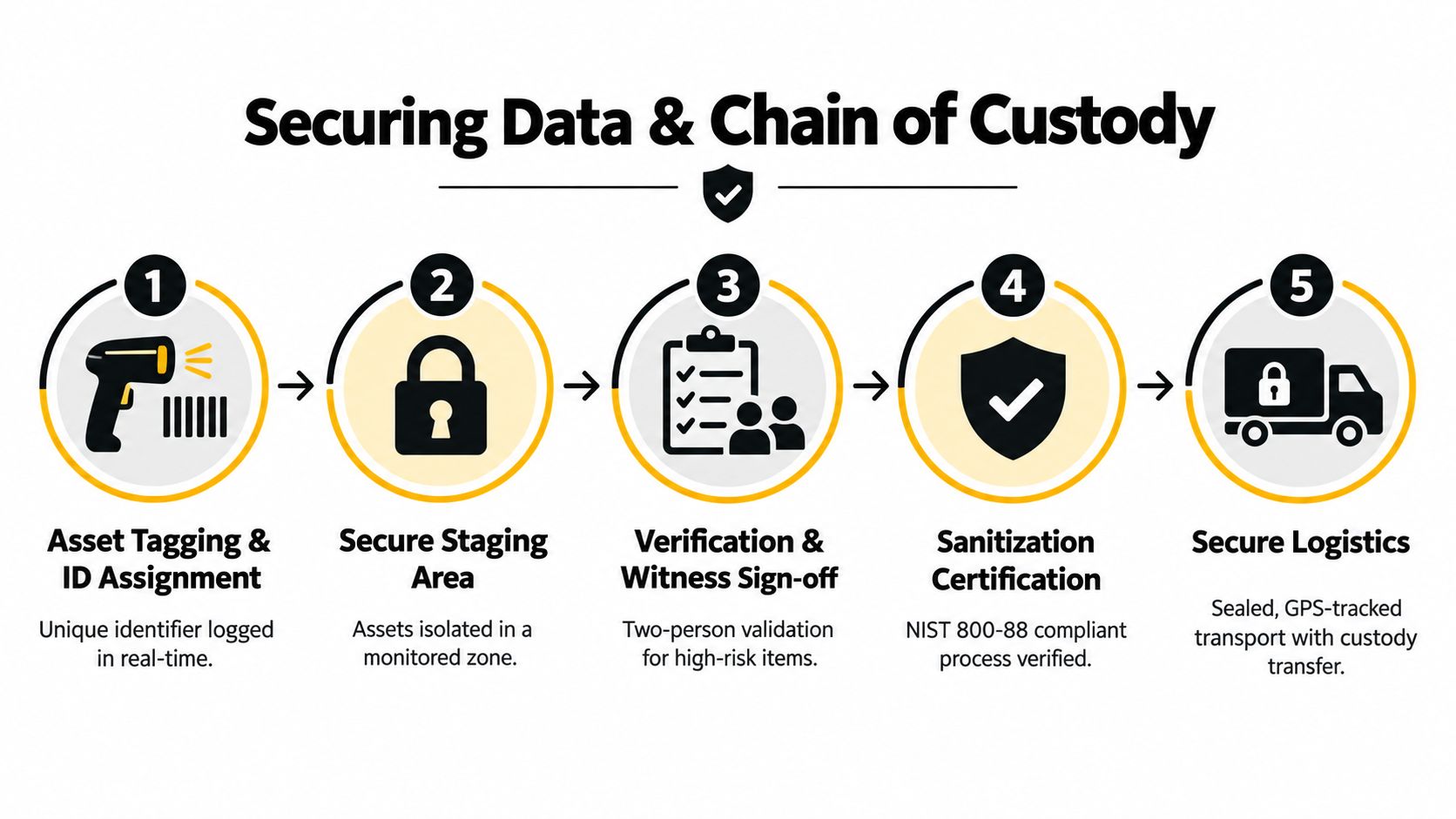
Data security protects the proceeds because buyers won't accept equipment with unresolved ownership or sanitization risk. Tag every device at retirement, isolate it in a monitored staging area, and record the identifier before anyone loads a pallet.
Use a device-appropriate sanitization method aligned with NIST 800-88 Purge or Destroy procedures. Encrypted drives may support cryptographic erasure when the control environment permits it, while failed or restricted drives may require physical destruction or degaussing. The FTC Disposal Rule requires businesses that maintain consumer information for a business purpose to take reasonable measures against unauthorized access or use during disposal, and it identifies erasing, shredding, destroying, pulverizing, or burning records as examples of reasonable disposal measures in its disposal rule materials.
Evidence must follow the asset
A certificate that can't be reconciled to an inventory row is weak evidence. Photograph serial numbers at physical destruction, preserve sanitization logs, and require the vendor to identify the asset tag, serial number, method, date, and disposition status in the final report.
Maintain a tamper-evident chain-of-custody record across every handoff:
- Staging: Record who placed the device in the secured area.
- Verification: Use a second-person check for high-risk assets and mismatched records.
- Loading: Capture pallet counts, seals, vehicle details, and the responsible handler.
- Transport: Require custody confirmation at the receiving facility.
- Processing: Match testing, sanitization, resale, parts, and recycling outcomes to the original identifier.
The chain-of-custody process for IT asset disposal should be agreed before pickup, not reconstructed after an audit request. Certificates of destruction and sanitization reports should arrive within the contractual turnaround period and remain serialized to the inventory. Without that evidence, the transaction is incomplete, regardless of the resale check.
Proving the Program Pays for Itself With KPIs and ROI
Finance usually doesn't need another sustainability slogan. It needs a transparent calculation showing whether recovered proceeds offset the cost of secure disposition.
Start with a blended cost model. Add logistics, packaging, sanitization, destruction, testing, vendor fees, storage, and internal program management. Subtract recovered revenue from resale, parts, bulk lots, and material recycling. The result is the net cost or net recovery for the retirement project.
Use a small KPI set that exposes leakage
- Average recovery per asset: Segment by laptops, servers, storage, switches, and recycling-only units.
- Original-cost recovery: Compare proceeds with the original purchase baseline, while keeping accounting depreciation separate.
- Days to settlement: Measure the time from decommission approval to vendor payment or credit.
- Certificate turnaround: Track how quickly destruction and sanitization evidence becomes available.
- Non-conforming destruction incidents: Record any mismatch, missing certificate, or failed process.
- Disposition cost per asset: Report the blended cost after recovered revenue is applied.
Recent industry guidance estimates that asset remarketing can offset about 40–60% of total disposition costs, while data destruction was the largest ITAD service segment in 2025 at about USD 5 billion, according to industry guidance on turning retired IT equipment into revenue. Those figures reinforce the operational point: security is a major cost and decision driver, but resale can materially change the total economics.
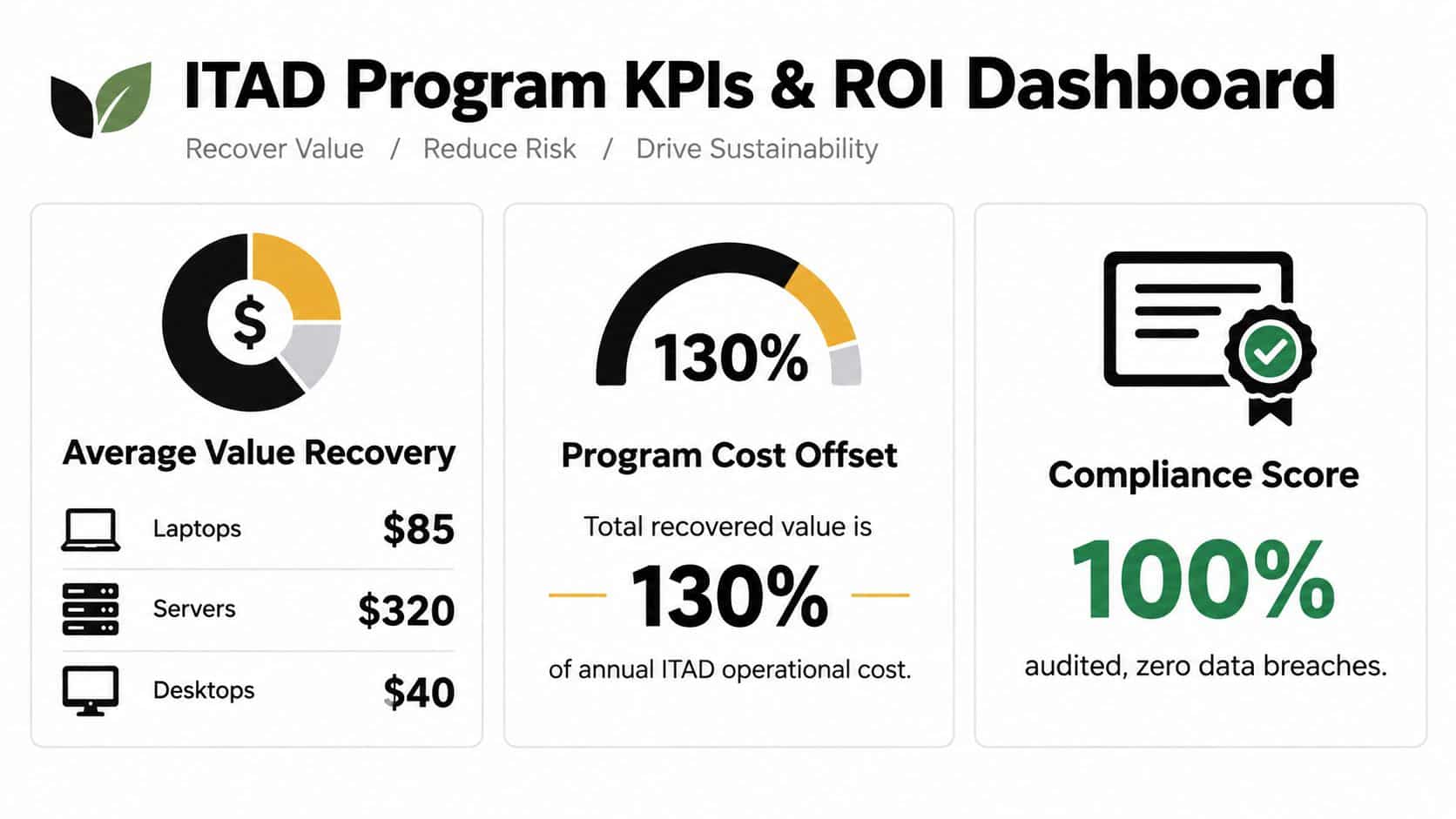
A useful scorecard doesn't hide recycling-only assets or failed pickups inside an average. Report results by asset class and route, then compare each quarter with the prior period. That view shows whether faster triage, better inventory quality, or stronger buyer channels are improving the program.
Running ITAD as a Repeatable Quarterly Program
Reactive scrappage usually begins with a storage room full of unlabeled equipment. A quarterly operating rhythm prevents that backlog by assigning owners and deadlines before assets become difficult to identify.
Days 1 through 15
The IT lead pulls the retirement population from finance, HR, procurement, lease, and CMDB systems. The team reconciles ownership, flags missing records, identifies data-bearing equipment, and schedules employee or department returns.
Days 16 through 30
IT and procurement assign each asset to a disposition lot. Working laptops, desktops, servers, storage, switches, monitors, medical equipment, laboratory equipment, and product-destruction requirements should be separated before pickup. The partner receives model, configuration, quantity, ownership, and security instructions early enough to prepare testing and downstream channels.
Days 31 through 60
The organization stages equipment, verifies tags, completes secure loading, and transfers custody under the agreed process. The ITAD provider performs data sanitization, destruction, testing, refurbishment, parts recovery, resale, or electronics recycling according to the approved route.
Days 61 through 90
Finance reconciles settlement statements against the inventory. Security files certificates, IT reviews exceptions, procurement checks lease obligations, and leadership receives a concise scorecard covering recovery, cost, compliance, and settlement timing.
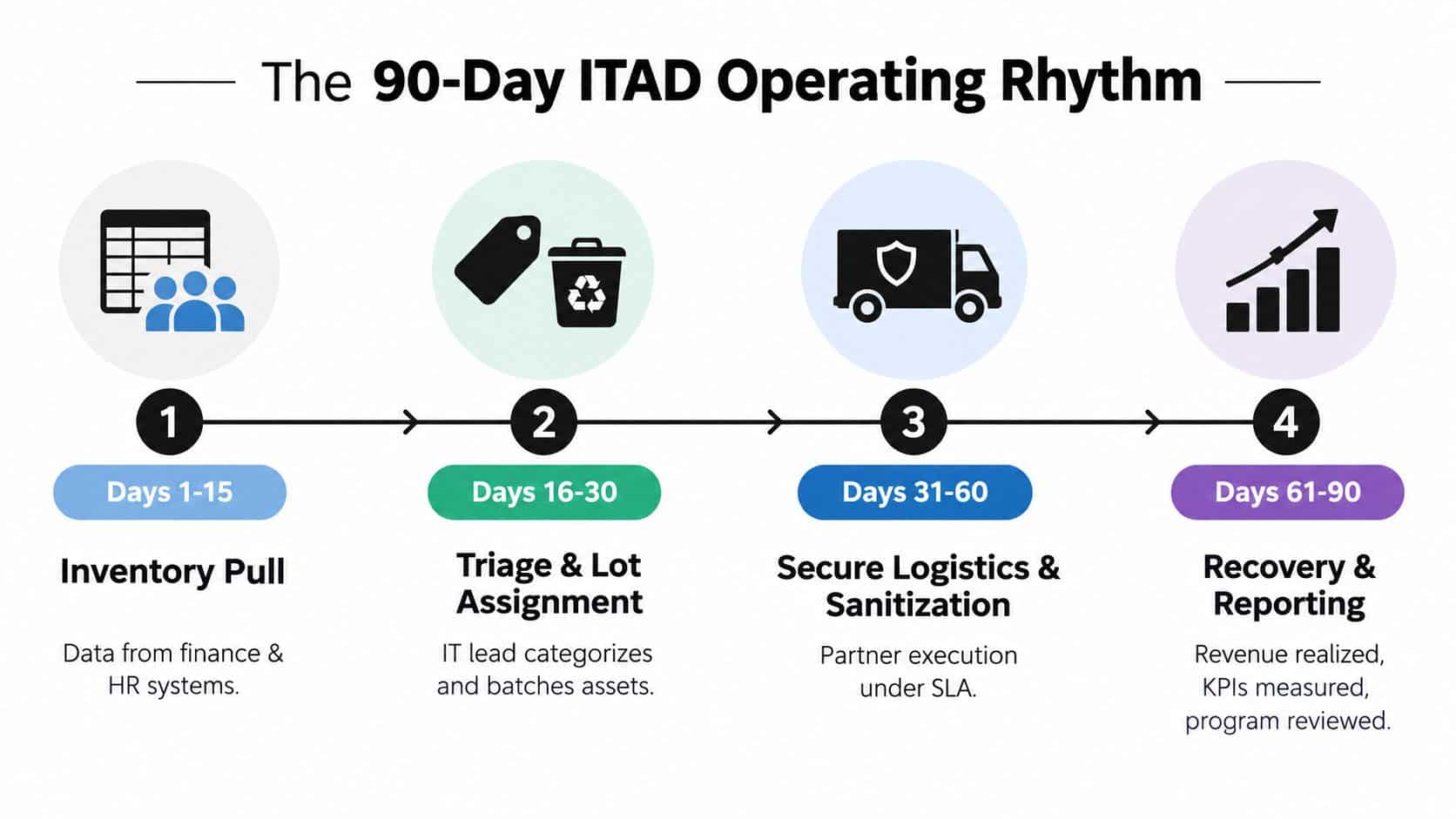
Tie the cadence to lease-return dates and fiscal close so credits and proceeds land in the correct accounting period. The program should also account for secure e-waste management, electronic waste pickup, computer recycling, data-center decommissioning, medical equipment disposal, laptop disposal, and laboratory equipment disposal when those streams appear in the same enterprise workflow.
Global e-waste reached 62 billion kilograms in 2022, or 7.8 kilograms per person, while only 22.3% was formally collected and recycled in an environmentally sound manner, according to the Global E-waste Monitor 2024. That scale makes documented sorting important, but the business case still starts with the same discipline: identify assets, secure data, move saleable equipment quickly, and prove the final outcome.
Choose a partner that can document the full chain from pickup signature to final disposition certificate. Beyond Surplus offers business IT equipment buyback, secure data destruction, electronics recycling, product destruction, and data-center de-installation services with logistics coordination for enterprise programs.
Contact Beyond Surplus to review your used business IT inventory, separate resale from recycling-only equipment, and build a secure disposition plan. Their team can coordinate data destruction, chain-of-custody reporting, electronics recycling, and value recovery for business equipment across the United States.


