
A regional bank is refreshing 2,000 laptops. In the same storage area, end-of-life desktops, damaged monitors, and aging server equipment are waiting for pickup. The IT team wants a fast exit, finance wants maximum recovery, compliance wants defensible data destruction, and sustainability leaders want proof that usable equipment wasn't sent directly into scrap.
That is the computer buyback vs recycling decision. It isn't a choice made one device at a time or reduced to cash versus environmental responsibility. It is a fleet-level routing decision. Working, marketable equipment should usually enter a buyback or remarketing stream. Obsolete, damaged, restricted, or low-value equipment should move through certified recycling, with secure data handling applied wherever required.
Table of Contents
- Why This Decision Matters for Your IT Refresh
- What Computer Buyback and Recycling Actually Mean
- Five Criteria That Drive the Choice
- Side-by-Side Comparison of Buyback vs Recycling
- Real Enterprise Scenarios and the Right Path
- A Practical Decision Framework for Mixed IT Fleets
- Choosing the Better Option for Your Organization
Why This Decision Matters for Your IT Refresh
A refresh project can look simple on a spreadsheet. One column lists assets being retired, another lists replacement equipment, and a shipping date sits at the bottom. In practice, the same fleet may include relatively recent laptops, failed peripherals, encrypted drives, obsolete desktops, and devices that held sensitive customer or employee information.
That mix creates competing priorities:
- IT needs control: Equipment must be collected, identified, wiped, and removed without disrupting deployment schedules.
- Finance needs recovery: Resalable computers can produce value that disappears if every asset is treated as scrap.
- Compliance needs evidence: Data destruction, custody transfers, and downstream processing must be documented.
- Sustainability teams need credible outcomes: Reuse, refurbishment, and material recovery should be reported accurately, not blended into one vague disposal claim.
The wrong route on a large refresh can create a material variance in recovery value, increase handling costs, or leave the organization unable to demonstrate what happened to sensitive assets. That is why the question should be answered before pallets are wrapped, not after a vendor has collected them.
Start with a fleet view
Begin by separating the inventory into practical groups. Record age, make, model, configuration, condition, operating status, storage media, and the type of information each device held. Then identify which assets have a realistic secondary-market path and which ones would require disproportionate testing, repair, or transport.
A documented office technology refresh planning guide can help teams coordinate replacement timing, staging, collection, and disposition instead of treating disposal as an isolated cleanup task.
Practical rule: Don't send a mixed fleet through one generic channel. Route assets according to value, condition, data exposure, and end-of-life obligations.
The global baseline reinforces the need for disciplined routing. The world generated 62 billion kilograms of e-waste in 2022, equal to 7.8 kilograms per person, while only 22.3% was formally collected and recycled in an environmentally sound manner, according to the Global E-waste Monitor 2024. A formal recycling route remains essential, but usable equipment can often create greater value by serving another user before it reaches that route.
What Computer Buyback and Recycling Actually Mean
Computer buyback is a value-recovery transaction. A provider evaluates working or refurbishable computers, assigns a value based on condition and secondary-market demand, and pays the organization per unit or lot. The provider may test, wipe, repair, refurbish, resell, or recycle the equipment after intake.
The payment isn't the only important output. A business buyback program should also produce an inventory record, a clear valuation method, data destruction evidence, and documentation showing how assets moved from pickup to final disposition. Without those controls, a high offer can hide avoidable data and liability risk.
Certified recycling is a materials-recovery and responsible-processing route. A recycler dismantles or processes equipment through controlled downstream channels, separates recoverable materials, and manages components that shouldn't enter ordinary waste streams. Recycling generally applies to broken, obsolete, incomplete, or economically unremarketable equipment.
The downstream process differs
Buyback starts with evaluation. The provider determines whether the asset can be resold, refurbished, upgraded, or recovered for parts. Data destruction still comes first, and the organization should know whether the provider uses verified software wiping, physical destruction, or a combination based on the storage media and security requirement.
Recycling starts with controlled processing. The provider still needs inventory controls and chain of custody, but the commercial objective is material recovery rather than resale. Drives may be wiped or destroyed before processing, and the organization should receive certificates that identify recycling and destruction outcomes.
The IT asset disposition overview provides useful context for programs that combine secure data handling, logistics, resale, refurbishment, and recycling.
Settlement and documentation matter
Buyback settlements may depend on final inspection, serial-number reconciliation, missing components, cosmetic condition, and marketability. Recycling settlements typically reflect commodity value, processing economics, and the equipment mix. Neither path should rely on a verbal promise.
Ask for:
- Asset-level reporting: Serial numbers, model details, quantities, and disposition status.
- Data evidence: Certificates of wiping or destruction, with the method identified.
- Custody records: Pickup, transport, receiving, processing, and downstream handoffs.
- Financial clarity: A written schedule for credits, payments, deductions, and rejected assets.
Five Criteria That Drive the Choice
A strong disposition decision uses five criteria together. Ranking a single factor above all others produces predictable mistakes. The highest offer may be unsuitable for sensitive equipment, while the most secure destruction process may destroy recoverable value unnecessarily.
Financial value recovery
Calculate expected resale proceeds after testing, repair, packaging, transportation, data destruction, and administrative costs. A working business laptop with a current configuration may justify detailed processing. A damaged desktop with missing components may not.
Secondary-market conditions matter. Refurbished laptop values rose 37.3% over the past year, while desktop values rose 14.8%, according to the Cascade 2025 ITAD Benchmarking Report. Those figures don't make every asset a buyback candidate, but they do make blanket recycling a poor default for a marketable fleet.
Data security practices
Data sensitivity determines the acceptable disposition process. Software wiping may suit an approved reuse path when the media and policy permit verified erasure. Physical destruction may be required when the drive is damaged, the information is highly sensitive, or the organization cannot permit resale.
Chain of custody connects the method to accountability. The provider should track the asset from collection through wiping, destruction, resale, or recycling, rather than treating a signed pickup receipt as the end of responsibility.
Regulatory compliance exposure
The applicable requirements depend on the organization, data type, contracts, and jurisdiction. Teams may need to account for the FTC Disposal Rule, HIPAA, GLBA, FACTA, PCI-DSS, and state data-protection laws. Compliance doesn't automatically prohibit resale, but it does require a defensible process and evidence.
A regulated healthcare provider may have a valid resale route for certain devices, while a particular drive containing protected health information may require a more restrictive treatment. Separate the data decision from the revenue decision.
Environmental impact
Reuse usually preserves more of the manufacturing investment than immediate materials recovery. Extending one computer and monitor from four years to six years can avoid about 190 kilograms of carbon dioxide equivalent, based on the University of Edinburgh computer carbon-footprint study.
Recycling still matters for equipment that cannot safely or economically serve another user. The best environmental outcome for a mixed fleet often comes from reuse where practical, followed by certified material recovery for everything else.
Logistics and operational overhead
Separate streams require planning. Someone must tag assets, stage pallets, protect screens, segregate batteries and peripherals, reconcile serial numbers, and coordinate pickup windows. A hybrid route can produce better outcomes, but only if the provider can manage sorting without creating delays or untracked exceptions.
Use the equipment condition assessment service as a model for the intake questions your team should answer before valuation and routing.
Side-by-Side Comparison of Buyback vs Recycling
For an enterprise fleet, buyback versus recycling is not a single-device verdict. It is a routing decision. Send newer, functional equipment with credible residual value to buyback. Send obsolete, damaged, low-value, or restricted equipment to certified recycling. The right policy splits the fleet instead of forcing every asset through one channel.
Buyback vs Recycling Across Five Criteria
| Criterion | Computer Buyback | Certified Recycling |
|---|---|---|
| Financial recovery | Usually produces stronger recovery for functional, current, refurbishable equipment. Returns fall when testing, repairs, transport, or data work consume the expected value. | Direct recovery is usually lower, but the route fits low-grade equipment and recoverable commodities. |
| Data security | Appropriate when the provider verifies wiping or destruction before resale and maintains custody records. | Stronger fit when drives require physical destruction or the equipment cannot be safely remarketed. |
| Regulatory compliance | Works when contracts, resale controls, data requirements, and documentation support the route. | Preferred for restricted, damaged, highly sensitive assets or equipment subject to strict destruction requirements. |
| Environmental impact | Usually the better route for equipment that can support productive reuse, because it delays replacement manufacturing. | Better for nonfunctional or obsolete equipment without a credible second life. |
| Logistics | Requires testing, grading, serial reconciliation, and settlement review. | Often simpler for uniform scrap streams, but certified transport and downstream records remain necessary. |
Buyback leads on residual value. Recycling leads on control and predictability for low-value assets. The decision changes when resale preparation costs exceed expected market return, or when data and contractual restrictions make remarketing inappropriate.
A market report cited by Cascade says roughly 20% of assets go to secondary markets and 40% go to certified recycling. Those figures support portfolio routing, not a universal rule. Enterprises should grade assets by age, condition, residual value, data sensitivity, and compliance exposure before assigning a channel.
Recycling also has material value. In 2022, e-waste contained 31 billion kilograms of valuable metals, with an estimated recoverable value of USD 91 billion, including about USD 19 billion in copper, USD 15 billion in gold, and USD 16 billion in iron, according to the ITU e-waste backgrounder. Those figures describe the global material pool, not a guaranteed payment for one enterprise load.
Use this refurbish-or-recycle decision guide to support the routing discussion. In practice, the strongest program combines buyback for assets with market demand and certified recycling for everything that fails value, condition, security, or compliance tests.
Real Enterprise Scenarios and the Right Path
Three situations usually expose the difference between a sound ITAD strategy and a blanket policy.
A recent laptop refresh
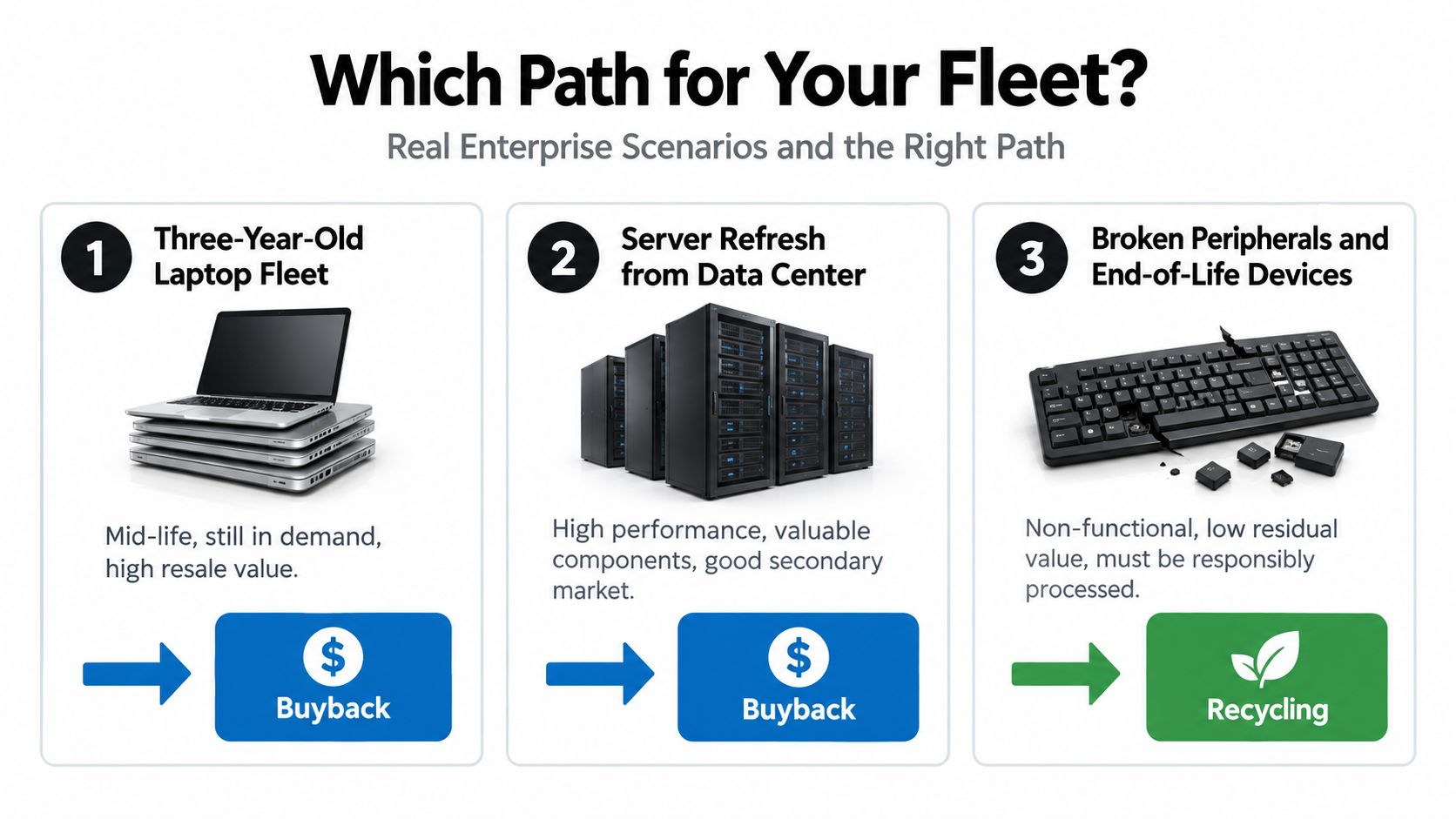
A company retires a three-year-old laptop fleet after a standard refresh cycle. Most systems power on, have intact displays, include modern processors, and remain useful to buyers in secondary markets. The organization has a documented wiping policy and can separate devices with restricted data from ordinary corporate endpoints.
Recommended path: buyback. The devices have a credible second life, and resale can recover value while preserving the environmental benefit of continued use. Assets that fail testing or carry special data restrictions should be diverted instead of forcing every unit through resale.
An aging data center
A data center decommissioning produces old servers, storage arrays, racks, cabling, and mixed peripherals. Some components may still have parts value, but demand is limited, configurations are incomplete, and the equipment requires substantial labor to test, dismantle, and transport.
Recommended path: certified recycling for most of the load. A targeted valuation can identify exceptional equipment, but the default should be controlled material recovery when resale preparation costs more than the likely return. Storage media still requires documented wiping or destruction before downstream processing.
A regulated healthcare or finance environment
A healthcare or financial organization retires equipment that held protected health information or non-public financial data. Some devices are functional and could attract a buyback offer, but the organization must prove how the media was handled and whether resale is permitted by policy, contract, and applicable regulation.
Recommended path: certified destruction plus recycling when the control requirement overrides resale. Revenue is not the deciding factor if the organization can't defend the chain of custody or destruction outcome. Where policy permits verified wiping and resale, those assets can be evaluated separately.
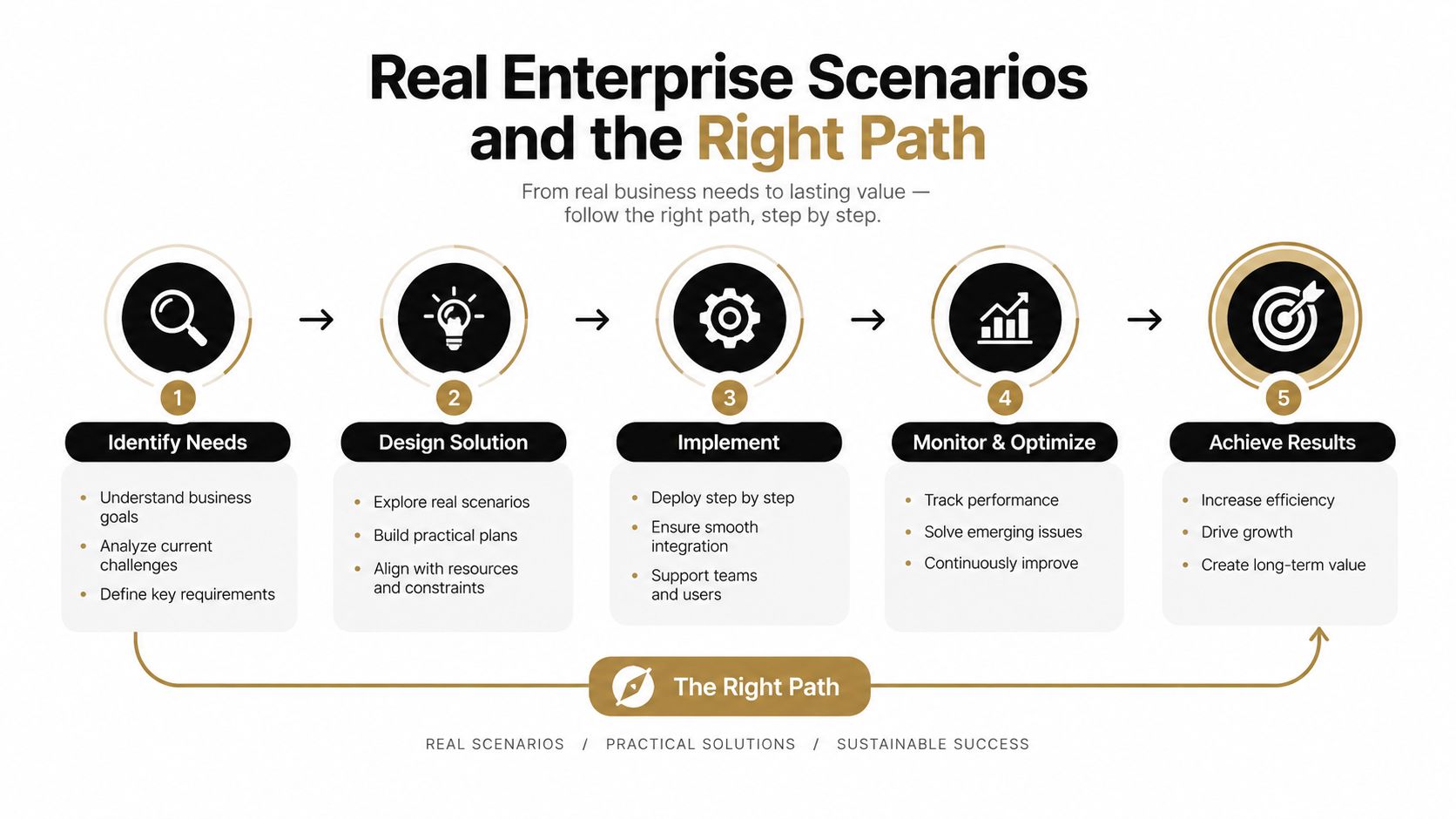
The practical answer is often mixed. A single pickup can contain a buyback stream, a destruction stream, and a recycling stream, provided the provider maintains clear segregation and reporting.
A Practical Decision Framework for Mixed IT Fleets
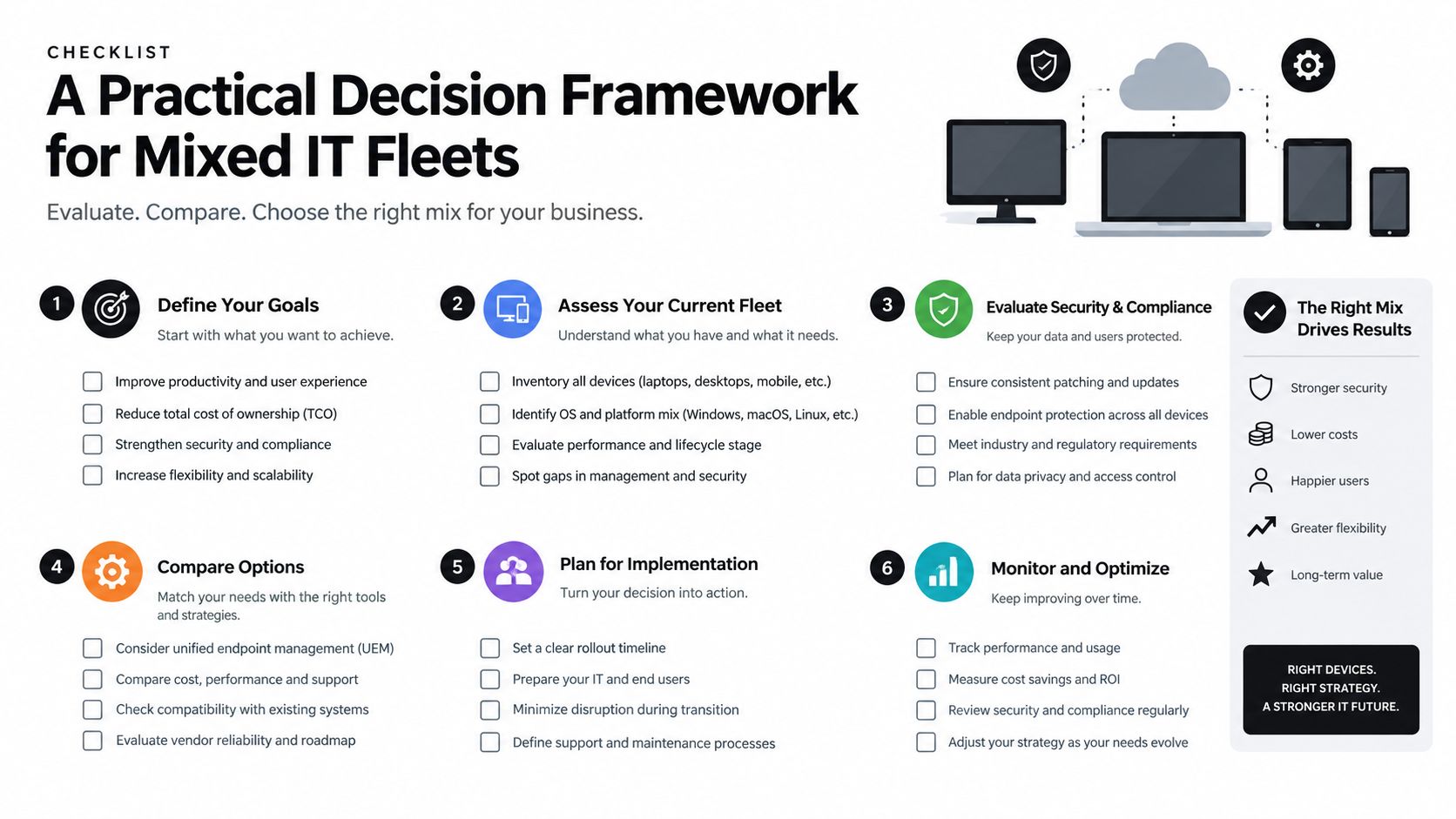
Apply this framework before equipment leaves the facility. It works for a few hundred devices, a distributed office refresh, or a complex data center project.
Step 1 Inventory every asset
Export the asset register and reconcile it against the physical fleet. Capture serial numbers, models, age, condition, storage media, location, and business owner. Don't accept a count that can't be matched to identifiable equipment.
Step 2 Assign a value and condition category
Use practical categories such as functional, refurbishable, parts-only, and nonfunctional. Estimate likely resale value, then subtract testing, repair, wiping, packaging, freight, storage, and settlement costs. The relevant figure is net recovery, not the provider's headline offer.
Step 3 Classify the data exposure
Mark devices that held customer records, payment information, health information, credentials, intellectual property, or regulated data. Define whether verified wiping is acceptable or whether physical destruction is required by policy or contract.
Step 4 Ask five screening questions
- Is the residual value worth the custody and processing effort?
- Does the data require certified destruction?
- Do regulations or contracts restrict resale?
- Is the device functional and realistically resellable?
- Can the team separate buyback and recycling streams without creating logistics risk?
If the answers support reuse, route the asset to buyback. If the equipment has no credible second life, or the control requirement demands destruction, route it to certified recycling.
Step 5 Document the routing decision
Keep the inventory, condition assessment, valuation, data classification, vendor scope, certificates, custody records, and final disposition report together. Auditors and sustainability teams need to see how the organization reached the outcome, not just the final weight or payment.
Step 6 Measure the whole project
Review recovered value, recycled material, destroyed media, exceptions, rejected assets, and unresolved serial numbers. The IT lifecycle management guide offers a useful way to connect refresh planning with end-of-life controls.
Choosing the Better Option for Your Organization
Choose computer buyback when the fleet is relatively recent, functional, in demand, and allowed to re-enter the market. It is particularly suitable when devices have residual value, the organization can approve verified data wiping, and the project needs a fast, organized recovery process.
Choose certified recycling when hardware is at end of life, damaged, incomplete, obsolete, or worth less than the cost of preparing it for resale. Recycling should also take priority when the data sensitivity, contract terms, or regulatory exposure make remarketing difficult to defend. HIPAA, PCI-DSS, GLBA, and similar obligations don't make every resale impossible, but they raise the standard for documentation and control.
For most enterprise refreshes, the right answer is a hybrid program. Put marketable laptops, desktops, servers, and components through evaluation and buyback. Send failed tests, low-grade peripherals, obsolete systems, and restricted assets to certified recycling or destruction. This approach avoids sacrificing value while keeping unsuitable equipment out of the secondary market.
Beyond Surplus provides commercial IT equipment buyback, secure data wiping, hard-drive shredding, electronics recycling, product destruction, data center de-installation, logistics coordination, and certificates supporting chain-of-custody and final processing. Its programs can combine value recovery with responsible recycling so one accountable provider manages the split.
The direct recommendation is simple: don't recycle a usable, marketable fleet by default, and don't force sensitive or worthless equipment into buyback. Classify the assets, verify the data controls, calculate net recovery, and route each group to the path it can support.
Beyond Surplus helps businesses evaluate mixed IT fleets, recover value from eligible equipment, securely destroy data, and process end-of-life electronics through documented recycling channels. Visit Beyond Surplus to plan a commercial pickup and build a buyback and recycling program around your organization's security, compliance, and recovery requirements.


