

You're probably dealing with some version of this already. A store manager has a bin of dead accessories behind customer service, your tech desk keeps getting asked to “just take” old laptops, and nobody can say with confidence where the data-bearing devices end up. That's not a recycling problem. It's an operations problem with compliance, labor, and brand risk attached.
Retail store electronics recycling solutions work when they're designed like a process, not a promotion. The wrong format creates a messy intake point, confused staff, and undocumented downstream handling. The right format matches the store footprint, the customer mix, and the share of devices that can hold data.
Table of Contents
- Why Retail Electronics Recycling Is Now a Core Operations Decision
- Comparing Drop-Off, Kiosk, Mail-Back, and Scheduled Pickup Formats
- Vendor Selection Criteria That Actually Predict Compliance
- Data Destruction and Device Triage Workflows
- Chain-of-Custody Documentation as a Risk and Revenue Tool
- Launching the Program In-Store Without Disrupting Operations
- Measuring ROI and Scaling the Program Across Locations
Why Retail Electronics Recycling Is Now a Core Operations Decision
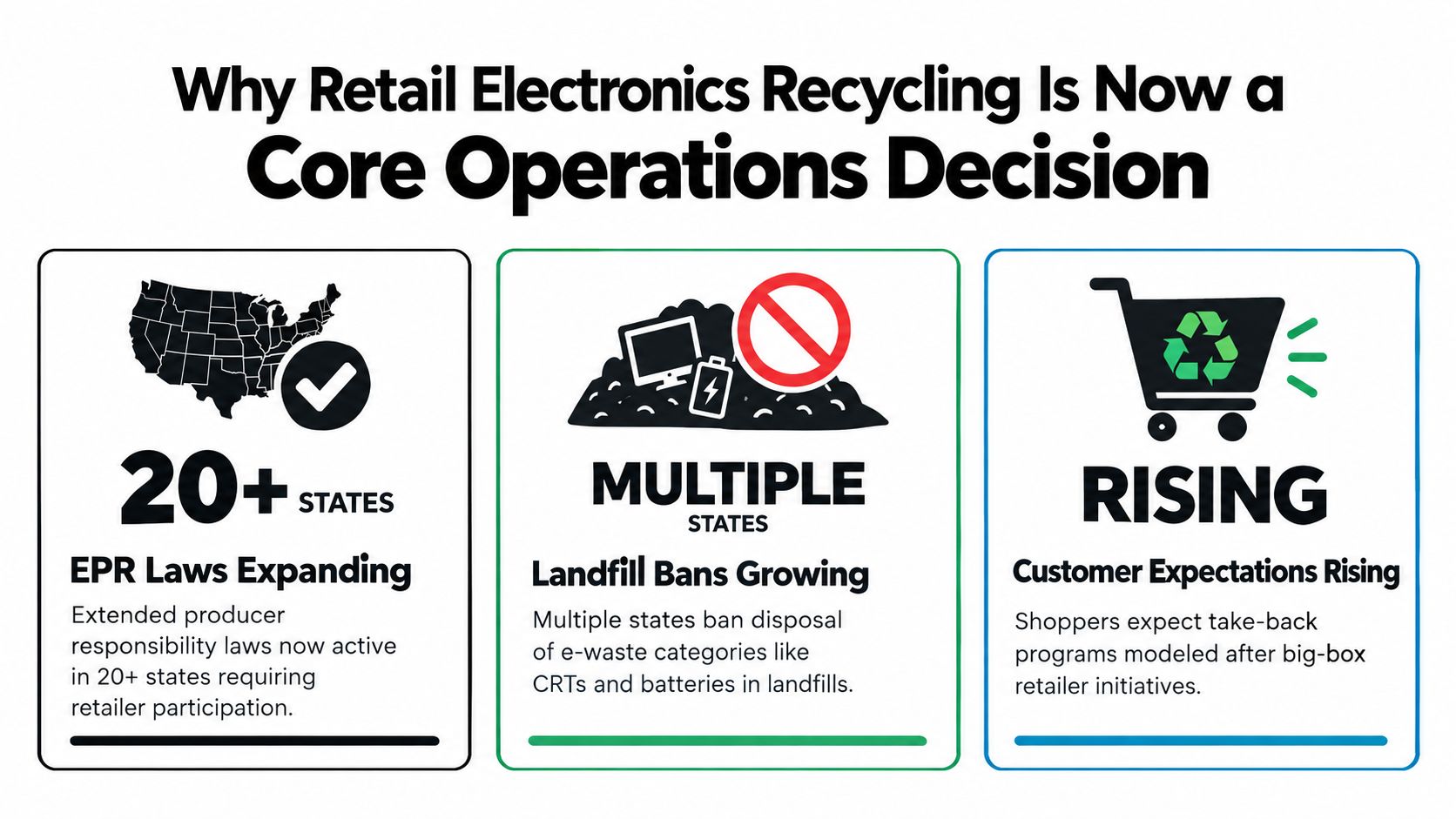
Electronics recycling has moved out of the CSR bucket. Retailers now have to treat it like returns, reverse logistics, and loss prevention. The global waste stream is too large to ignore. In 2022, the world generated 62 billion kg of e-waste, equal to 7.8 kg per person, and only 22.3% was formally collected and recycled in an environmentally sound manner according to The Global E-waste Monitor 2024.
That gap matters in retail because stores are convenient collection points. Customers bring in cables, routers, tablets, printers, phones, POS peripherals, and old laptops whether you planned for it or not. If your store accepts electronics without a documented intake and downstream process, you've created liability without building a program.
Three pressures that force the issue
The first is regulatory exposure. Rules vary by market, and that's exactly why loose programs fail. A separate global review notes that 81 countries, representing 42% of nations, had some form of e-waste policy, legislation, or regulation by 2022, while Europe posted the highest documented collection and recycling rate at 42.8% according to this Global E-waste Monitor summary. If you operate across states or regions, inconsistency becomes risk.
The second is brand trust. Customers assume a take-back program is secure, documented, and legitimate. If a device disappears into a broker network or a back room, the trust damage lands on the retailer, not the downstream processor.
The third is the data-device ratio. A store that mainly receives cables and peripherals can run a very different model than one taking in laptops, phones, tablets, and gaming hardware. Data-bearing traffic changes everything. Intake, storage, signage, training, and vendor requirements all get tighter.
Operational rule: Choose the collection format after you understand what's coming in, who's touching it, and how often data-bearing devices show up.
Retailers that want a serious ESG story should start with secure operational design, not campaign language. That's why I'd point teams to a practical view of how businesses can improve ESG through IT recycling before they launch anything customer-facing.
Comparing Drop-Off, Kiosk, Mail-Back, and Scheduled Pickup Formats
A customer walks up with a box of cables, two dead tablets, and an old laptop with family photos still on it. If your program treats all three items the same, you built a liability trap, not a recycling service.
Format choice decides who touches devices, where they sit, how contamination spreads, and whether you recover any value at all. Treat this as a store-operations decision tied to footprint, customer mix, and the share of data-bearing devices coming through the door.
Where each format fits
| Retail Electronics Recycling Format Comparison | Best For | Data-Device Handling | Footprint / Labor | Per-Unit Economics |
|---|---|---|---|---|
| Drop-off | High-volume accessories, cables, keyboards, mice, small non-data electronics | Weak unless staff screens intake | Small footprint, low labor | Works when contamination stays low |
| Kiosk | Flagship stores, mall locations, stores with heavy consumer tech traffic | Better control through locked intake and serialization | Medium footprint, moderate oversight | Better when fees or trade-in logic offset handling |
| Mail-back | Low-density markets, satellite coverage, distributed customers | Good if process separates data devices clearly | Minimal store labor | Usually tighter economics per unit |
| Scheduled pickup | Stores receiving business equipment, demos, IT returns, palletized loads | Strongest option for serialized business assets | Back-room space needed, low front-end labor | Best when volume is consolidated |
Drop-off is the simplest format and the easiest one to get wrong.
Use it for low-risk material only. Cords, chargers, headsets, mice, and similar accessories fit. The moment a store starts accepting phones, tablets, or laptops into an open bin, shrink risk and data risk go up fast. Front-end teams will not triage mixed electronics consistently during a rush. Build the program around that reality.
Kiosks work better in stores with steady consumer tech traffic and enough supervision to keep the unit clean, locked, and documented. They create a controlled intake point and reduce the casual handoff problem that breaks many drop-off programs. They also cost more, take floor space, and need oversight. That trade-off is worth it if the store already handles trade-ins, repairs, activations, or other device-heavy traffic.
Mail-back is a coverage tool, not a universal answer. It fits low-volume stores, rural markets, and chains that cannot spare selling space for collection. It also pushes effort onto the customer. Packaging mistakes, incomplete segregation, and shipping cost drag all cut into recovery. Use mail-back to extend reach, not as the backbone of a program built around frequent data-bearing intake.
Scheduled pickup is the right call for locations with commercial returns, surplus store equipment, demo units, or accumulated back-room electronics. It keeps higher-risk material out of public collection, supports cleaner sorting, and usually produces better downstream recovery because loads are consolidated before transport.
Match the format to the store, not the brand
One chain does not need one format. A mall flagship, a suburban big-box store, and a small-format urban location should not run the same collection model.
Use drop-off for accessory-heavy traffic. Use kiosks where customer device volume is high and floor supervision is realistic. Use mail-back to cover sparse markets and small footprints. Use scheduled pickup for business assets and any location with regular volumes of serialized equipment.
The deciding factor is usually the mix of data-bearing devices. As that share rises, self-service collection stops making sense. Controlled intake gets more expensive, but it is cheaper than a custody failure.
If you are screening local providers, start with electronics recycling service coverage for business pickups and secure handling, then verify that the vendor can support the collection format each store needs. A public drop-off network alone is not enough for a retail program with mixed device flows.
Vendor Selection Criteria That Actually Predict Compliance
A glossy sustainability deck tells you nothing about how a recycler operates after the truck leaves your lot. Compliance lives in the downstream details.
The market has a verification problem. Recent EU policy analysis found that only about 23% of WEEE treatment facilities in the EU operate in compliance with the relevant standards, and collection targets were missed by many Member States according to this EU policy evaluation. That's the point retailers miss. The hard part isn't finding someone willing to haul material away. It's proving the channel is standards-based all the way through.
What to require before you sign
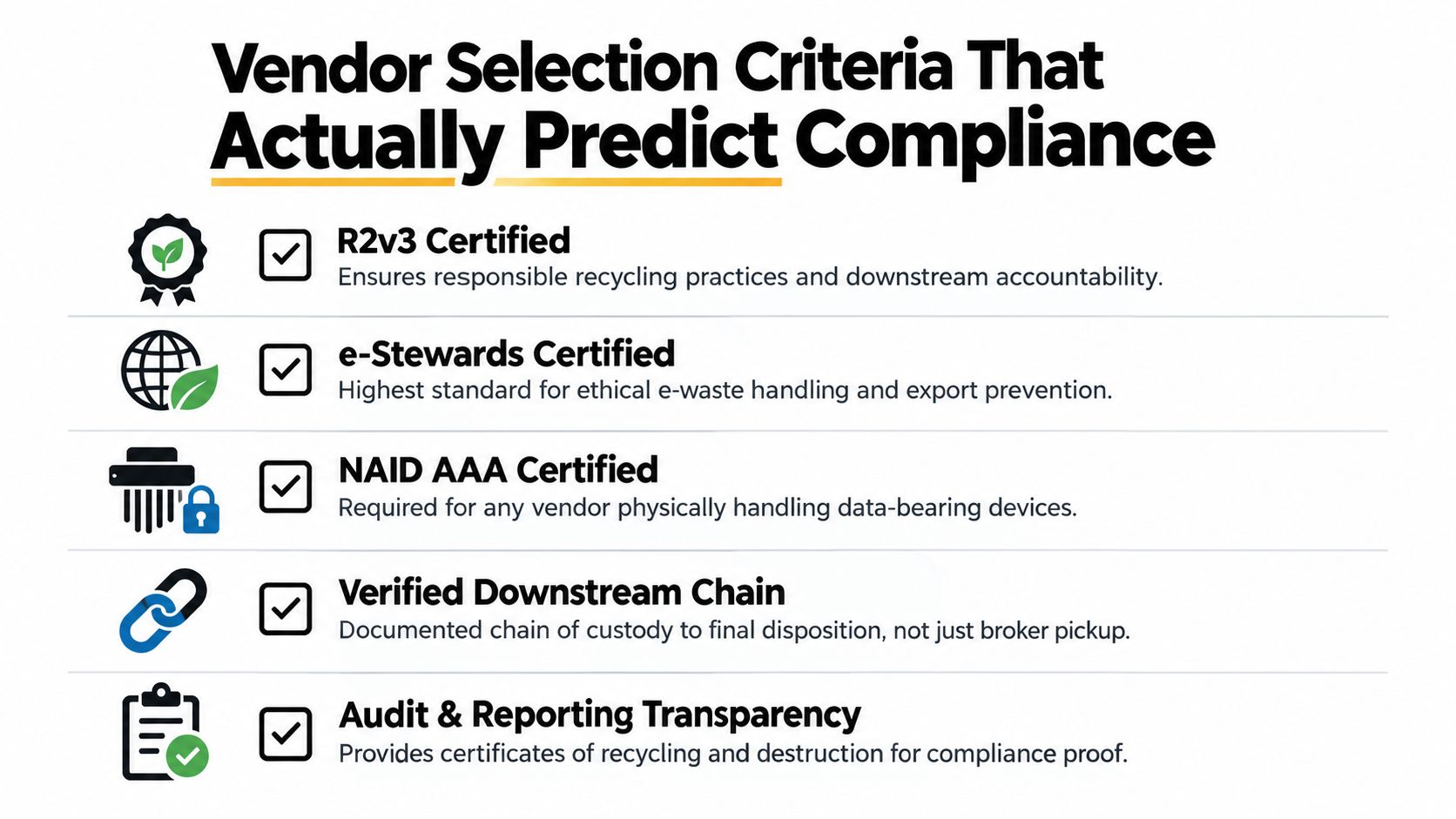
I'd treat R2v3, e-Stewards, and NAID AAA as baseline screens, not bragging rights. If a vendor physically handles data-bearing media, NAID AAA should be mandatory. If they process mixed electronics, R2v3 or e-Stewards should already be in place.
Then ask harder questions:
- Who owns the facility: If the vendor brokers loads to others, you need that disclosed in writing.
- What downstream list they use: You should know the processors, not just the pickup company.
- Which destruction standard they follow: For data-bearing assets, default to NIST 800-88 Purge or Destroy when the asset class or risk profile calls for it.
- What proof they issue: You want serialized certificates tied to asset tags, not a vague weight receipt.
- How they insure the work: Pollution liability and transport coverage matter because claims don't stop at your loading dock.
Broker signals to avoid
Flat per-pound pricing on everything is usually a warning sign. So is a vendor that gets fuzzy when you ask where material goes after initial sort. Another red flag is reluctance to provide sample reporting packets.
A real ITAD partner can show you the paperwork before the first pickup. A broker usually promises it later.
Retail teams that don't have a scorecard should build one before taking proposals. A practical starting point is a vendor due diligence checklist for ITAD and recycling partners.
Data Destruction and Device Triage Workflows
Retailers lose money and create risk at the same point in the process. Intake.
The basic mistake is treating all electronics the same. They're not. A cable, a monitor, a laptop, and a smartphone require different handling paths. The intake team needs one job above all others: separate data-bearing from non-data-bearing equipment immediately.
Start with a hard split
At intake, sort by device type, visible condition, age, and storage capability. Laptops, desktops, servers, phones, tablets, external drives, POS terminals, copiers, and networking gear all deserve a second look because they may contain storage media or retained credentials.
Then route by sanitization path under NIST SP 800-88:
- Clear for lower-risk reuse situations where logical sanitization is appropriate.
- Purge when stronger sanitization is required.
- Destroy when the device, media type, or risk profile makes reuse impractical or unacceptable.
Don't shred value by default
The World Health Organization notes that consumer electronics recycling is complex and often not profitable because collection, sorting, disassembly, and separation can cost more than recovered material value. It also notes that shredding may destroy personally identifiable information but can make high-value materials harder to recover, and cites a U.S. benchmark in which about 2.8 million tons of selected consumer electronics were disposed of in 2017 and only about 36% was recycled in this WHO e-waste fact sheet).
That trade-off is real in stores. If you shred every functional laptop on arrival, you wipe out resale and parts recovery that could help fund the program. If you fail to secure media, you create a bigger problem than scrap value can ever solve.
A practical workflow looks like this:
- Functional laptops and desktops: inspect, isolate media, sanitize to the required standard, then route for reuse if policy allows.
- Failed drives and high-risk media: destroy physically and document serials.
- Phones and tablets: verify lock status and storage handling before deciding on erase or destruction.
- Peripherals and accessories: push straight to commodity recovery if they contain no data.
One vendor option in this category is Beyond Surplus's NIST SP 800-88 data destruction process, which aligns wiping and destruction to documented standards for commercial equipment.
Chain-of-Custody Documentation as a Risk and Revenue Tool
Most retailers treat documentation like administrative overhead. That's backwards. Chain-of-custody records are what turn a pickup into a defensible business process.
According to All Green's retail electronics recycling overview, documented programs separate collection, transport, data sanitization, and downstream material recovery into auditable steps, often using store-level intake records, bills of lading, mass-balance allocation, and third-party audits. The biggest failure point is weak endpoint visibility. If downstream processors aren't audited, hazardous and valuable fractions can slip into uncontrolled streams.
The documents that matter
| Chain-of-Custody Documents by Use Case | What It Covers | When Required | Retention Period |
|---|---|---|---|
| Bill of lading | Transfer of material from store or DC to transporter or processor | Every shipment | Retain with shipment file |
| Serialized device log | Asset ID, serial number, model, origin location, disposition path | Data-bearing or remarketable assets | Retain long-term in compliance file |
| Certificate of recycling | Confirms material entered recycling stream | Non-resale electronics and commodity recovery loads | Retain with environmental records |
| Certificate of destruction | Confirms data media or device destruction | Data-bearing media and mandated destruction events | Retain with compliance and legal records |
| Weight ticket | Confirms processed or transported weight | Bulk loads and reconciliation | Retain with financial and audit support |
Why finance should care too
Refurbishment revenue depends on traceability. You can't confidently remarket a device if custody is broken, serials are missing, or sanitization proof is incomplete. Commodity recovery has the same problem. If the outbound weights and downstream reporting don't tie back to store intake, your recovery numbers are soft.
Keep the document stack simple, but make it complete. If legal, finance, or procurement asks for proof six years later, you should be able to pull one file and close the question.
I'd write the retention schedule into the master services agreement and store SOPs, then standardize the packet across every location. Teams that need a template should review chain-of-custody documentation requirements for IT asset disposition.
Launching the Program In-Store Without Disrupting Operations
A workable launch doesn't start with a press release. It starts with a pilot and a refusal policy.
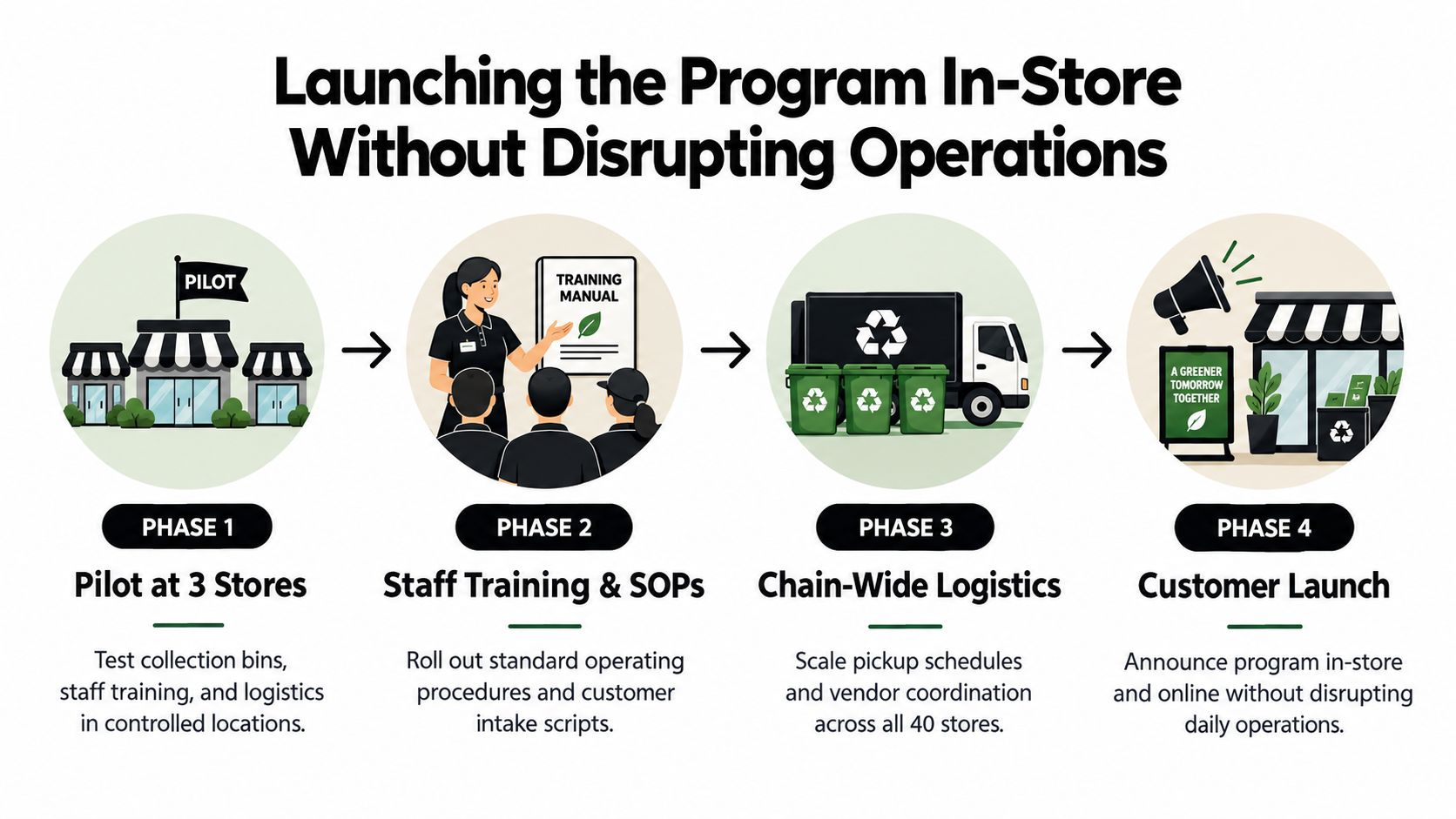
I'd roll this out in four phases across a regional chain. First, pilot in three stores with different traffic patterns. One high-volume suburban box, one urban small-footprint store, and one location with a service desk or stronger tech mix. You need operating contrast, not convenience.
What the pilot should prove
The pilot needs to answer practical questions:
- What comes in: Are you seeing mostly accessories, mostly screens, or a heavy share of laptops and phones?
- Who handles intake: Customer service, asset protection, receiving, or a tech counter?
- What gets refused: Damaged lithium batteries, swollen devices, leaking units, and anything outside program scope.
- How often pickups are needed: Too frequent wastes money. Too infrequent creates unsafe back-room buildup.
Second, train a store cohort. Not everybody needs deep technical knowledge. They do need scripts. Staff should know what the program accepts, what it refuses, how to respond to “will my data be erased,” and when to escalate to facilities, AP, or the corporate sustainability lead.
Keep customer communication tight
Point-of-intake signage should be short and operational. Accepted categories. Excluded items. Data disclaimer. Staff handoff instructions. That's it.
The website can carry the longer explanation about process, security, and scheduling. Receipts or confirmation slips should document only what the customer transferred, not broad promises about downstream outcomes unless your vendor can support them.
A weekly dashboard for store managers should stay lean:
- Collected volume
- Device mix
- Participation trend
- Contamination incidents
- Missed pickups or overflow events
Launch quietly, then optimize. A soft opening tells you more than a chain-wide campaign ever will.
At the thirty-day mark, review what the stores are experiencing. Adjust intake hours, signage language, and pickup frequency. Stores don't fail because the idea was bad. They fail because the operating model stayed frozen after the first week.
Measuring ROI and Scaling the Program Across Locations
If the only ROI model you have is scrap weight, your program will underperform. Retail store electronics recycling solutions create value in three places: resale recovery, commodity recovery, and avoided disposal cost.
The global material picture supports that approach. United Nations-based reporting says the 2022 e-waste stream contained about 31 billion kilograms of metals, 17 billion kilograms of plastics, and 14 billion kilograms of other materials, with embedded valuable metals worth about USD 91 billion overall and about USD 28 billion in recoverable secondary raw materials reclaimed according to this UN e-waste backgrounder. There is value in the stream. The issue is whether your program captures any of it.
Build the ROI model the right way
| Retail Electronics Recycling ROI Components by Value Stream | Typical Driver | Estimated Per-Device Impact | Notes |
|---|---|---|---|
| Resale recovery | Functional business-class laptops, tablets, phones, networking gear | Varies by model, age, condition, and custody quality | Highest upside, but only with proper triage and sanitization |
| Commodity recovery | Non-functional devices, mixed peripherals, cables, boards, metals | Lower and weight-driven | Best for material that has no realistic reuse path |
| Avoided disposal cost | Reduced trash hauling, landfill handling, special disposal events | Depends on local waste contracts and internal labor | Often overlooked, but meaningful at scale |
I'm not going to pretend every device has the same economics. It doesn't. A store with mostly dead accessories gets a different outcome than one consolidating lease returns, demo units, and back-room IT refreshes. The cleanest pilot is two to four matched stores with a ninety-day measurement window and fixed SOPs.
Scale only after the controls hold
Use the pilot to validate four things:
- Volume consistency by store type.
- Contamination rate by format.
- Resale yield on data-bearing assets that clear policy.
- Vendor SLA performance on pickups, reporting, and certificates.
The broader trend isn't slowing down. The latest global monitor projects annual e-waste generation will rise from 62 million tonnes in 2022 to 82 million tonnes by 2030, roughly 32% growth in eight years according to The Global E-waste Monitor 2024 summary. On the U.S. side, a major reference point remains the EPA estimate that 2.7 million tons of consumer electronics goods were generated in 2018, with 1.04 million tons collected for recycling, a 38.5% recovery rate, while the same global reporting notes annual e-waste generation is increasing by about 2.6 million tonnes per year and is projected to reach 82 million tonnes by 2030 in this Global E-waste Monitor PDF.
Retailers should take one concrete step in the next thirty days. Audit the devices already entering stores today, separate data-bearing from non-data-bearing material, and map the current custody path from handoff to final disposition. Until that's documented, you don't have a recycling program. You have informal accumulation.
Beyond Surplus provides business-focused electronics recycling, IT asset disposition, secure data destruction, product destruction, and nationwide pickup coordination for organizations that need documented end-of-life handling for technology assets. If your stores, service locations, or regional facilities need a controlled program for data-bearing devices and commercial e-waste, visit Beyond Surplus to evaluate a secure operating model.


