
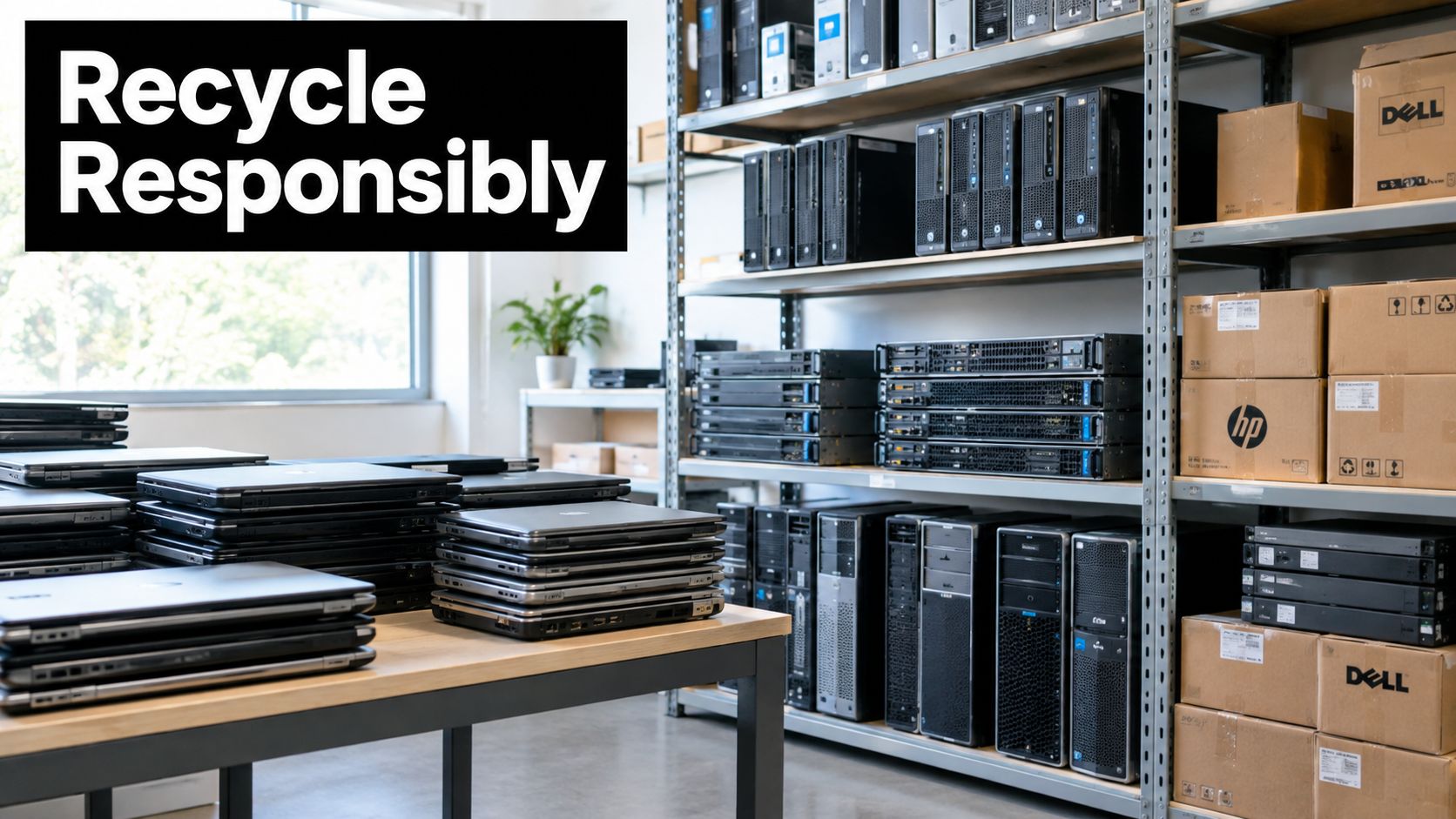
A storage room fills up faster than expected. One shelf holds retired laptops from the last refresh. Another has network switches, scanners, tablets, and a few servers nobody wants to power on again. Facilities wants the room cleared. IT wants the drives handled securely. Procurement wants asset records closed. Compliance wants proof.
That's the moment electronics recycling stops being a sustainability slogan and becomes an operational decision.
For business teams, the question isn't just where old equipment goes. It's who takes custody, how data is removed, what gets reused, what gets dismantled, and what documentation comes back to your file cabinet or audit folder. A pallet of devices can carry several kinds of risk at once: data exposure, environmental liability, missing chain-of-custody records, and lost recovery value if reusable equipment gets treated like scrap.
Many organizations first approach the topic through ESG goals, then realize the harder part is process discipline. A secure disposition program needs logistics, inventory control, documented handoffs, and clear decisions for data-bearing assets. That's why mature teams often treat end-of-life equipment the same way they treat any other controlled business asset.
A helpful starting point is understanding how recycling supports broader governance goals, including the practical ESG benefits outlined in this guide to improving ESG through IT recycling. But the business case usually gets approved when leaders see recycling as a risk-transfer workflow with measurable accountability at each step.
Table of Contents
- Introduction to Electronics Recycling for Modern Businesses
- What Electronics Recycling Really Means and How It Works
- Why Electronics Recycling Matters for Environment and Business
- Inside the End to End Electronics Recycling Workflow
- Business Versus Residential Electronics Recycling Options
- Compliance Certifications and How to Choose a Trusted Recycler
- Taking the Next Step Toward Secure and Sustainable Disposal
Introduction to Electronics Recycling for Modern Businesses
The equipment may be retired, but the responsibility isn't
A decommissioned laptop isn't harmless just because it no longer boots. A copier may still contain stored documents. A medical cart or lab workstation may no longer fit the current environment, yet it still needs controlled handling. Businesses often discover that “old tech” is really a mix of assets, data, and materials that require different end-of-life paths.
That's where confusion starts. Many people use disposal, recycling, liquidation, and destruction as if they mean the same thing. They don't.
Practical rule: If your company can't show who had the device, what happened to its data, and where it went next, the process isn't finished.
Why busy managers need a chain-of-custody mindset
Think of electronics recycling as the reverse of procurement. Instead of receiving, tagging, deploying, and supporting equipment, you're collecting, identifying, sanitizing, sorting, and documenting its exit. The same discipline matters on the way out as it did on the way in.
For IT and operations managers, that means asking practical questions early:
- What's in scope: Laptops, desktops, servers, mobile devices, switches, printers, medical equipment, or lab gear may each need different handling.
- Which assets hold data: Hard drives, SSDs, copiers, firewalls, and some specialty equipment may all store sensitive information.
- What outcome fits each item: Some equipment can be reused or remarketed. Other items should go straight to destruction or material recovery.
A calm, documented process reduces last-minute decisions. It also helps teams avoid the common mistake of sending everything into one stream when some assets still have reuse value and others need tighter controls.
What Electronics Recycling Really Means and How It Works
Electronics recycling is often described too narrowly, as if it means shredding devices and separating metal. In business settings, it's broader than that. It's the managed recovery of value, materials, and compliance records from retired technology.
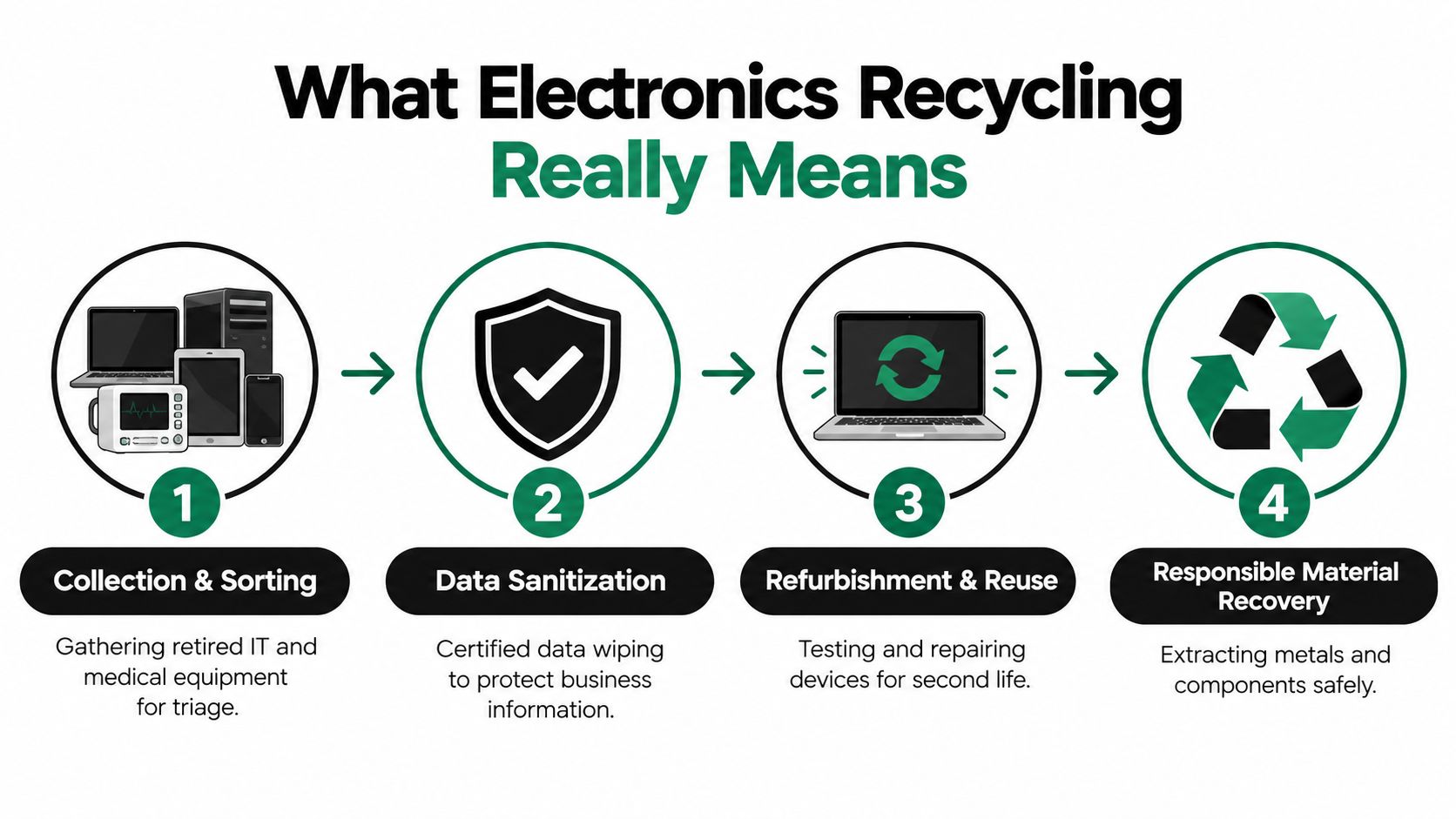
This visual sums up the workflow clearly.
Think of it as a reverse supply chain
When a company buys equipment, it moves from manufacturer to distributor to office or data center. At end of life, that flow reverses. Equipment leaves the user site, enters a controlled processing stream, gets triaged, and then follows one of several paths.
Some devices qualify for refurbishment and reuse. Others are dismantled for parts harvesting. Data-bearing media may be wiped, shredded, or both, depending on policy and risk tolerance. What can't be reused moves into downstream material recovery.
That's why a useful definition includes more than recycling. It includes:
- Collection and intake so assets are gathered without losing control.
- Data sanitization so storage media no longer presents a business risk.
- Testing and triage so reusable equipment isn't destroyed unnecessarily.
- Material recovery so commodities and components are processed responsibly.
For a deeper look at this broader lifecycle, IT asset disposition explained is the closest operational frame.
Why casual drop-off isn't enough for most organizations
A household drop-off model works for a single broken keyboard. It usually doesn't work for a business refresh involving racks, serialized assets, lease returns, or regulated data. Enterprise recycling needs records, not just bins.
A retired device can hold three kinds of value at once: resale value, material value, and evidentiary value. Good ITAD programs protect all three.
The “evidentiary value” is what many teams overlook. It's the proof that the device was handled properly. Without that proof, a company may still carry liability even after the equipment has physically left the building.
Why Electronics Recycling Matters for Environment and Business
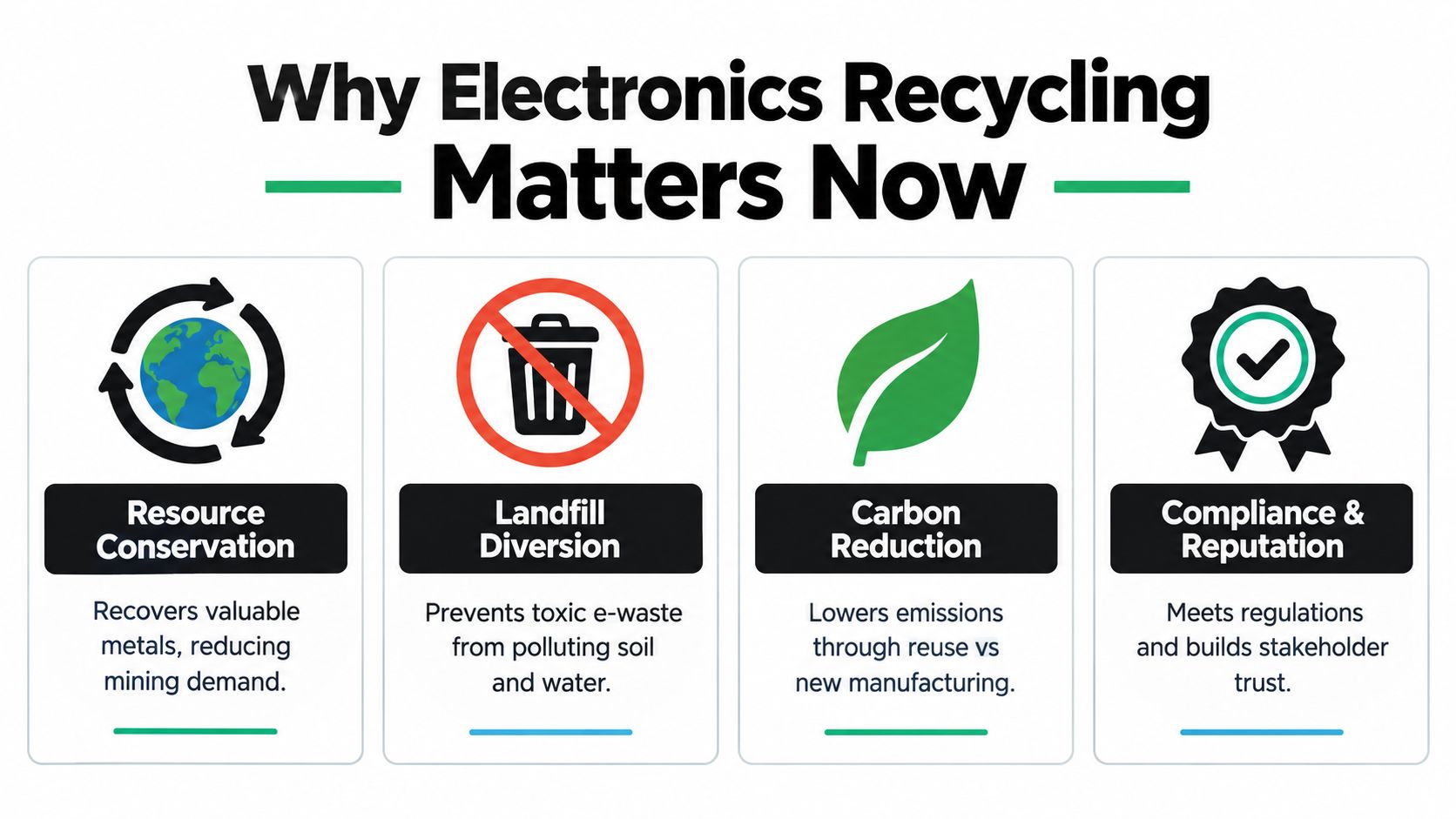
The environmental case is real, but the business case is just as strong. When managers understand both sides together, recycling decisions stop feeling optional.
The waste stream is growing faster than recovery
In 2022, the world generated a record 62 billion kg of e-waste, equal to 7.8 kg per person, but only 22.3% of that mass, or 13.8 billion kg, was documented as formally collected and recycled in an environmentally sound manner, according to the Global E-waste Monitor 2024.
That same source shows the scale of the gap over time. From 2010 to 2022, global e-waste generation rose from 34 billion kg to 62 billion kg, while documented formal recycling increased from 8 billion kg to 13.8 billion kg. Recycling improved, but not at the same pace as device disposal.
For businesses, that means informal or poorly documented channels still absorb too much material. If your organization cares about downstream accountability, collection alone isn't enough.
Recovery quality matters, not just pickup volume
A common misunderstanding is that once equipment gets collected, the environmental job is mostly done. It isn't. Recovery design matters.
Global e-waste in 2022 contained about 31 billion kg of metals, but only an estimated 19 billion kg were viably recovered and returned to circulation. Iron was the most successfully recovered metal, while precious metals were present in much smaller quantities, with only about 300 thousand kg of viable recovery. Rare earth element recycling remains around 1%, based on the Global E-waste Monitor full report.
That's why downstream sorting, disassembly, and processor choice matter. High-volume metals tend to recover more efficiently than low-concentration critical materials.
What this means for managers: Don't ask only, “Will you pick it up?” Ask, “How do you separate reuse, parts, and commodity streams, and what proof do you return?”
There's value tied up in retired equipment
Only 22.3% of global e-waste was documented as formally collected and recycled in 2022, leaving roughly USD 62 billion in recoverable natural resources unaccounted for. Europe reached 42.8%, showing that policy, collection infrastructure, and formal processing capacity strongly affect outcomes. Copper, gold, and iron together accounted for about USD 50 billion in embedded value in 2022, according to the JRC e-waste resource overview.
For an IT manager, that translates into a familiar lesson. The residual value of equipment doesn't disappear just because the refresh project is over. It gets captured, or it gets lost.
Inside the End to End Electronics Recycling Workflow
The safest programs treat disposition as a chain. Each link protects the next.
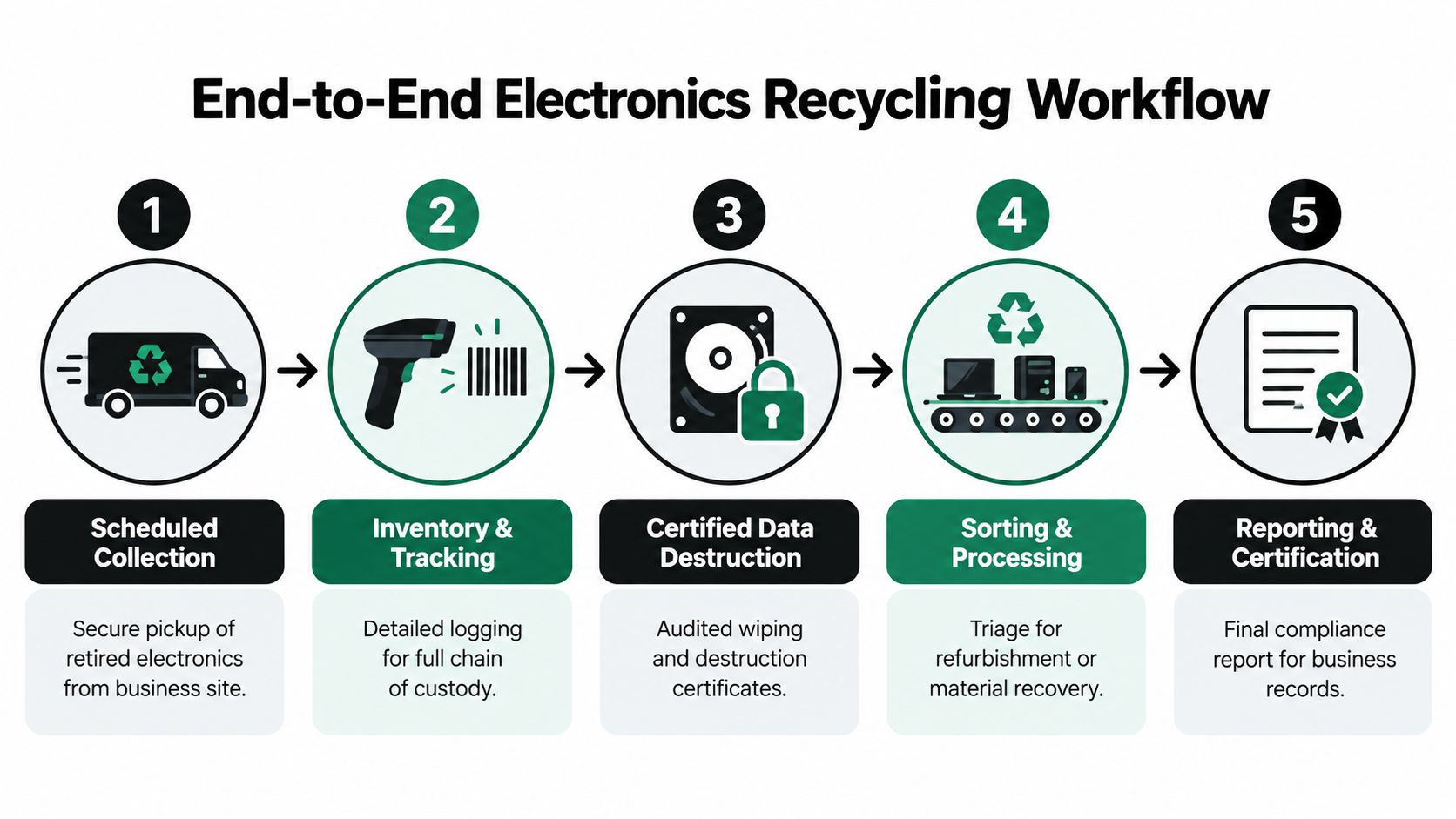
Start with pickup planning and containment
Secure handling begins before the truck arrives. Teams usually stage assets by location, business unit, or sensitivity level. Data center gear may need coordinated de-racking. Office equipment may need labels matched against asset records. Healthcare and lab devices may need separate handling instructions.
Packaging matters more than people think. If your team is boxing smaller electronics for transit, materials designed for static-sensitive hardware, such as Anti Static Bubble Wrap, can help reduce avoidable handling damage during internal staging and shipment prep.
At this stage, the best workflows answer three basic questions:
- What is being removed: Item type, count, serial number, or asset tag.
- Who released it: A site contact or department owner.
- Where it goes next: Pickup route, receiving facility, and custody handoff.
Inventory creates the audit trail
Once collected, assets should be logged in a way that supports both operations and compliance. Some organizations need only category-level tracking. Others need device-level reconciliation for lease returns, regulated environments, or internal controls.
Chain of custody becomes tangible. It's not an abstract compliance phrase. It's the written record that bridges your storeroom to the recycler's intake dock and then to final disposition.
One example of a provider built around this full process is Beyond Surplus end-to-end IT recycling services, which describes logistics coordination, data destruction, and final reporting in one workflow.
Data destruction is a decision, not a checkbox
Not every device needs the same treatment. A monitor doesn't need the same controls as a self-encrypting laptop. A failed SSD may require a different approach than a healthy hard drive. Some enterprises approve software-based sanitization for certain assets and physical destruction for others.
Recent reporting has noted that data erasure is becoming a bigger business decision as the discarded-device erasure market grows and cross-border shipment rules tightened in 2025 under Basel-related restrictions, as discussed in CNBC's coverage of the expanding data erasure market.
Sometimes the right question isn't “wipe or shred?” It's “which media types, risk classes, and destinations justify each method?”
Processing and reporting close the loop
After sanitization, equipment is sorted. Reusable devices may be tested and refurbished. Non-reusable assets move to dismantling and commodity recovery. The final step is paperwork. That often includes certificates of recycling, certificates of destruction, settlement reporting for recovered value, or itemized summaries by asset class.
When teams skip this last step, they lose the very record that proves the rest of the process happened.
Business Versus Residential Electronics Recycling Options
Business recycling and residential recycling serve different needs. The overlap is smaller than many people assume.
Business vs Residential Electronics Recycling at a Glance
| Service Feature | Business and Enterprise | Residential |
|---|---|---|
| Pickup logistics | Scheduled pickups, route planning, dock coordination, multi-site projects | Usually drop-off or simple mail-in options |
| Asset volume | Pallets, server racks, office refreshes, lab and medical equipment | Individual devices or small quantities |
| Data handling | Chain of custody, documented sanitization, destruction options | Often limited or self-managed |
| Documentation | Certificates, inventory records, audit support, settlement reporting | Usually basic receipt or no detailed reporting |
| Project scope | Data center decommissioning, office closures, lease returns, product destruction | Personal device recycling |
| Decision factors | Compliance, liability transfer, reuse recovery, internal approvals | Convenience and local access |
Why the difference matters
A consumer program is built for convenience. A business program is built for control.
That distinction affects everything from truck scheduling to how serial numbers are recorded. An enterprise may need after-hours pickup, loading dock coordination, badge access for technicians, and separate handling for drives, batteries, or network gear. A household drop-off program usually doesn't.
Residential recycling answers, “How do I get rid of this device?” Business recycling answers, “How do I retire this asset without creating a data, audit, or downstream problem?”
For procurement and facilities teams, that difference is useful. It prevents the common mistake of evaluating business ITAD vendors as if they were bulk haulers.
Compliance Certifications and How to Choose a Trusted Recycler
A recycler should be easy to understand before your assets leave the building. If their process sounds vague, your liability probably isn't shrinking.
Start with legal disposal obligations
The U.S. Federal Trade Commission says the Disposal Rule applies to large and small organizations that use consumer reports, including lenders, insurers, government agencies, mortgage brokers, and auto dealers. It requires disposal practices that are reasonable and appropriate to prevent unauthorized access or use of consumer report information, as outlined by the FTC's Disposal Rule guidance.
That wording matters. It doesn't tell you to merely “get rid of old devices.” It points to a defensible process.
Questions that reveal whether a recycler is trustworthy
Use a short screening checklist before scheduling any pickup:
- How is custody documented: Ask what records are created at pickup, intake, and final disposition.
- What happens to data-bearing media: Request clear explanations of wiping, shredding, and when each method is used.
- What certificates are issued: You want records that support internal controls and external audits.
- How are downstream vendors managed: If a provider sends material elsewhere, ask how that path is vetted and tracked.
- Can they separate reuse from scrap: This affects both value recovery and environmental outcomes.
A certification discussion often comes up here. If you want a concise explanation of one widely used framework, this overview of R2 certification is a practical starting point.
What “reasonable” looks like in practice
Reasonable disposal usually means matching the method to the asset and the risk. A failed hard drive from a regulated environment may justify physical destruction. Reusable laptops may be candidates for verified sanitization before remarketing. Mixed e-waste loads may need itemized exceptions for anything holding storage media.
The key is consistency. A trusted recycler should help you build repeatable rules so every office move, refresh, or decommissioning project doesn't become a custom compliance debate.
Taking the Next Step Toward Secure and Sustainable Disposal
Most organizations don't need a more complicated recycling program. They need a clearer one.
A simple decision framework
Start with the inventory. Separate assets by device type, data risk, and likely disposition path. Then decide which items are candidates for reuse, which require destruction, and which should move directly to material recovery.
From there, pressure-test the workflow:
- Map custody points: Know where responsibility changes hands.
- Define data rules: Set clear standards for wiping versus destruction.
- Require final records: Make certificates and reporting part of the scope, not an afterthought.
A planning document can help teams avoid missed details during a move, refresh, or decommissioning event. This business computer recycling checklist is useful for organizing internal handoffs before pickup is scheduled.
What a good outcome looks like
A good result isn't just “the room is empty.” It's when IT, operations, procurement, and compliance all get what they need. The equipment is gone. The data risk is addressed. The paperwork is complete. Reusable value is captured where appropriate. The remaining material moves through a documented downstream path.
The broader trend line adds urgency. The Global E-waste Monitor projects annual e-waste generation will reach 82 million tonnes by 2030, a 33% increase from 2022, with annual growth of about 2.6 million tonnes per year, according to the ITU media release on 2030 e-waste projections. That makes disciplined business disposal more important, not less.
Beyond Surplus provides business-focused electronics recycling, secure IT asset disposition, data destruction, logistics coordination, and reporting designed for commercial end-of-life workflows. If you're planning a refresh, decommissioning a data center, or clearing retired equipment from multiple sites, visit Beyond Surplus to review service options and schedule the next step.


