The world generated 62 million tonnes of electronic waste in 2022, but only 22.3% was documented as formally collected and recycled, according to the Global E-waste Monitor 2024. For a business searching for “computer recycling near me,” that gap changes the question. The issue isn't where retired laptops and servers go. It's whether the provider can protect data, document custody, recover usable value, and demonstrate responsible downstream processing.
Commercial computer recycling requires a controlled IT asset disposition workflow, not an informal drop-off. The right partner should be able to explain how equipment is inventoried, sanitized, transported, processed, and reconciled after receipt. That evidence matters to IT managers, procurement teams, facility leaders, and business owners responsible for technology that may contain confidential information.
Table of Contents
- The Global Impact of Local Electronics Recycling
- Preparing IT Assets for Professional Disposal
- Understanding Data Sanitization Standards
- Navigating FTC Disposal Rule Compliance
- Valuing Recovered Hardware and Resources
- Choosing Between Pickup and Drop-Off Logistics
- Partnering with Beyond Surplus for Secure Recycling
The Global Impact of Local Electronics Recycling
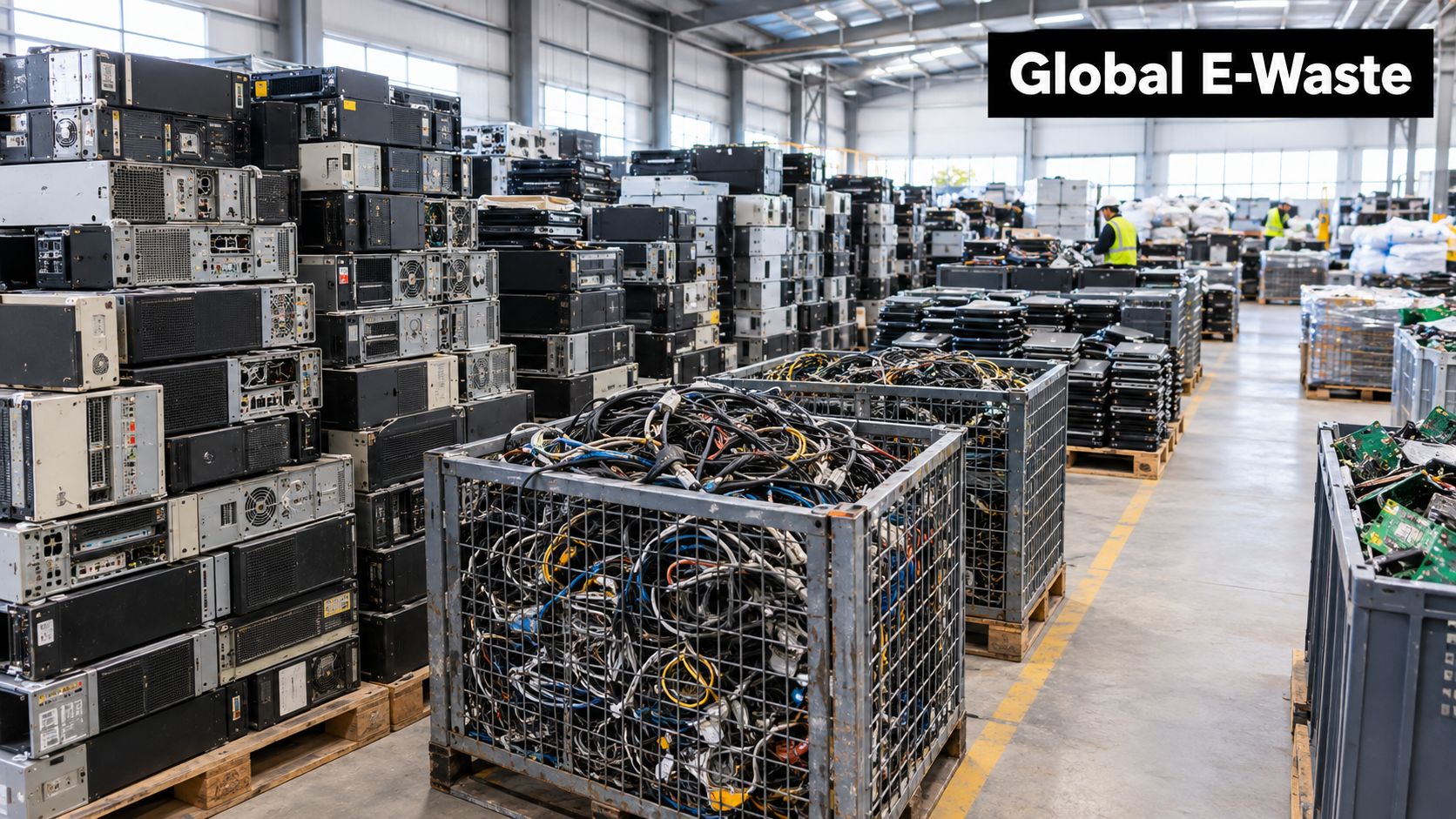
A warehouse of retired desktops, monitors, network equipment, and servers represents more than a facilities task. Global e-waste generation is projected to reach 82 million tonnes by 2030, showing that discarded electronics continue to outpace formal recycling capacity. The Global E-waste Monitor data provides the broader context, while the commercial response begins at the office, data center, clinic, school, or manufacturing site that releases the equipment.
Local service, broader responsibility
A responsible commercial recycler sorts equipment by its next controlled route: reuse, parts recovery, material processing, or destruction. That separation keeps usable hardware in service and prevents restricted materials from entering ordinary waste streams. The client does not need to manage downstream metallurgy, but it does need a vendor that can identify receiving facilities, document custody, and return processing records.
The World Health Organization's e-waste fact sheet) also identifies the Basel Convention as the international agreement governing transboundary movement and disposal of hazardous wastes, including e-waste. This requirement affects organizations that move retired equipment across borders or operate in multiple countries. A local pickup can therefore become part of an international compliance chain, with liability depending on documentation and certified downstream handling.
Practical rule: Treat every retired device as both a material resource and a potential information-bearing asset until its status has been verified.
Local search helps procurement teams identify nearby providers, but proximity does not establish capability. Compare service coverage, certifications, insurance, acceptance criteria, and reporting before approving a vendor. The concepts of relevance distance and prominence explained can clarify why a provider appears in local results, while commercial verification determines whether it can handle the actual disposition workflow.
What responsible processing looks like
A qualified partner should distinguish electronics recycling, IT equipment disposal, laptop disposal, data center decommissioning, and secure media destruction. Medical and laboratory equipment, networking hardware, storage arrays, and peripherals may require different preparation, transport controls, and downstream routes.
The environmental result depends on sorting and documented processing. The security result depends on custody, sanitization, and certificates that reconcile the shipment with the final disposition. A search for local computer recycling is useful only when it leads to a provider that can verify both outcomes.
Preparing IT Assets for Professional Disposal
The most reliable disposal programs begin before the recycler arrives. Internal staff need a controlled release process that connects the asset register to the shipment, the receiving report, and the final certificate. Without that continuity, even a reputable downstream facility may receive incomplete instructions or an inventory that can't be reconciled.

Build the release record
Use a sequential workflow rather than a general packing list:
Inventory every asset. Record manufacturer, model, serial number, location, condition, and assigned owner. The serial number is the bridge between the internal register and the recycler's receiving data.
Confirm authority to dispose. Check ownership, lease terms, return obligations, litigation holds, insurance requirements, and any internal retention decision. A device shouldn't leave the site just because it no longer supports a user's daily work.
Classify the media. Identify hard drives, SSDs, magnetic tape, optical media, mobile devices, and equipment with embedded storage. Media type determines which sanitization method can work.
Control the transfer. Use sealed containers or secured pallets, document release time, identify the carrier, and verify transport conditions. Damaged lithium batteries require separate handling and shouldn't be mixed casually with ordinary electronics.
Reconcile the outcome. Match the recycler's receiving report, sanitization or destruction result, recycling certificate, and downstream documentation to the original release inventory. Investigate exceptions instead of closing the work order with unexplained gaps.
The Beyond Surplus computer preparation guide can help teams organize equipment before pickup, but the governing principle is simple: the organization must know what left, why it left, and what happened afterward.
Avoid the failures that create liability
The most common process weaknesses are operational, not technical. Staff skip ownership checks, release devices before sanitization decisions are made, or fail to compare the final receiving data with the outbound list. Those shortcuts make it difficult to prove that every storage device was handled according to its data classification.
Keep sanitization records, destruction certificates, recycling certificates, and downstream reports with the asset record. If a recycler can't describe how exceptions are reported, how serial numbers are captured, or how damaged batteries are isolated, the service may be convenient without being commercially defensible.
Understanding Data Sanitization Standards
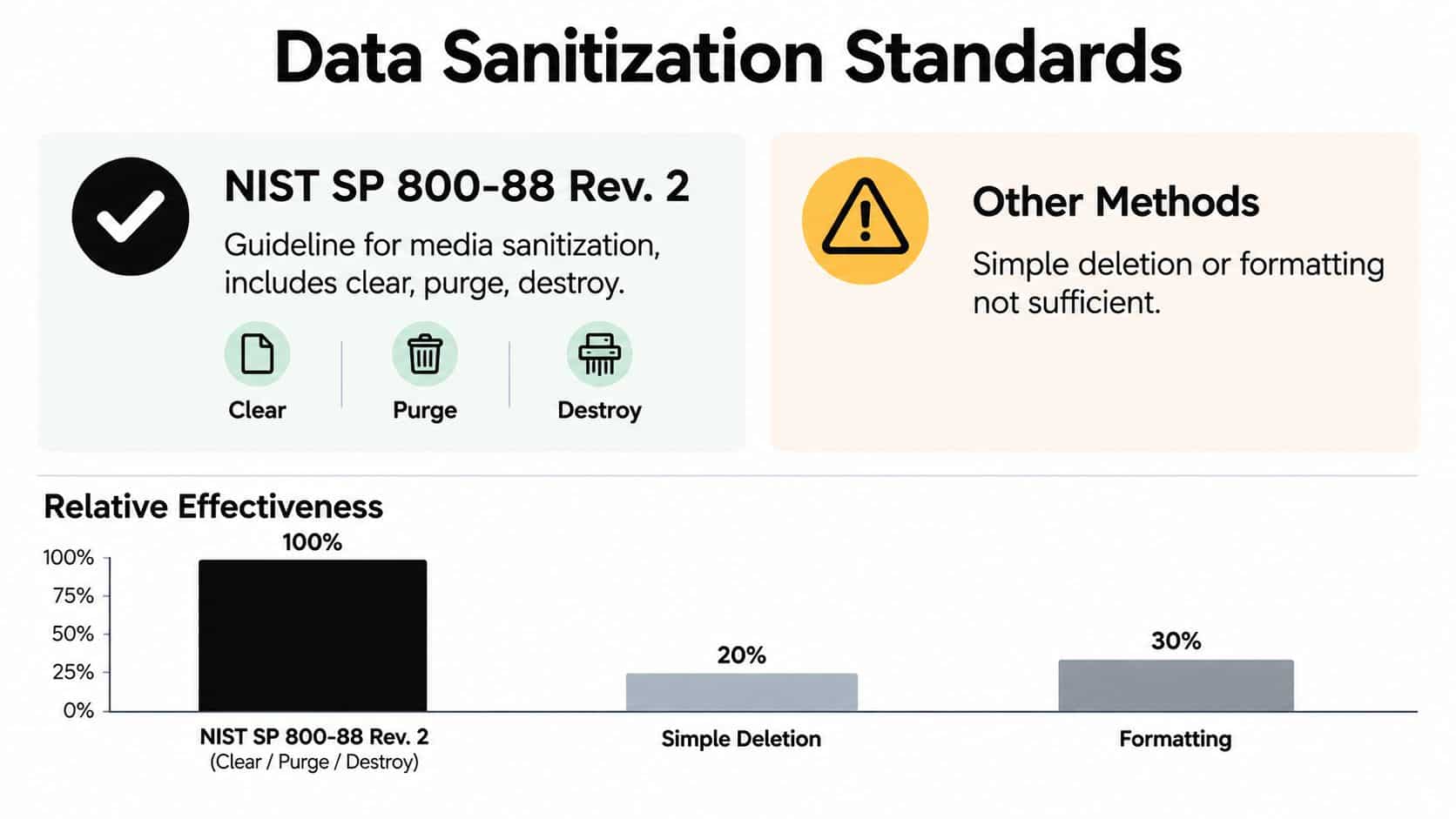
Data deletion is not the same as data sanitization. Removing a user profile, reinstalling an operating system, or formatting a drive may change what appears on screen without producing a verifiable outcome for the underlying media.
Match the method to the media
NIST SP 800-88 Rev. 2 defines three sanitization outcomes:
- Clear applies logical techniques intended to make data inaccessible through ordinary interfaces while preserving the media for an appropriate use.
- Purge uses stronger methods intended to make recovery infeasible with advanced techniques while potentially preserving the device.
- Destroy makes the media unusable, which is often the appropriate route when the device is damaged, the sensitivity is high, or reuse isn't acceptable.
The correct choice depends on the media type, data sensitivity, and reuse intent. Software wiping requires functional hardware and needs validation after the process. Degaussing applies to magnetic media, such as suitable hard drives or tape, but it doesn't sanitize SSDs because SSDs store data differently.
R2v3-certified facilities require documented, verifiable handling for hard drives, SSDs, magnetic tape, optical media, and mobile devices. Certification doesn't remove the need for buyer due diligence, but it gives procurement and compliance teams a meaningful framework for evaluating process controls.
Evidence matters as much as technique
Ask how the provider identifies each device, records the method used, validates the result, and issues documentation. A certificate that lacks an asset reference or sanitization detail may not support an audit as effectively as a record tied to a serial number and defined outcome.
Legal and regulated organizations also need a retention policy for the records themselves. A 2026 data retention guide for law firms offers useful context for thinking about how operational records should be organized and retained, although each organization must apply its own legal and regulatory requirements.
For a practical explanation of the standard, see Beyond Surplus's NIST 800-88 data destruction standards guide. The right question isn't whether a vendor says “we wipe drives.” Ask which outcome applies, why it fits the media, and what proof you'll receive.
Navigating FTC Disposal Rule Compliance
The Federal Trade Commission Disposal Rule is a federal requirement for businesses that handle consumer report information. It covers organizations in sectors such as banking, insurance, lending, government, automotive sales, and debt collection, among similar businesses. The rule requires reasonable measures to ensure information can't be read or reconstructed after disposal.
That obligation makes undocumented recycling a poor fit for regulated operations. A truck receipt may prove that equipment was collected, but it doesn't establish that data was sanitized or destroyed using a method appropriate for the device.
Turn policy into evidence
A defensible program should include:
- Written disposal procedures: Define who authorizes release, how devices are classified, and which outcomes are acceptable.
- Device-level records: Connect serial numbers or other identifiers to the selected sanitization or destruction method.
- Certificates: Retain wiping and destruction certificates that identify the completed work.
- Exception handling: Document damaged, missing, failed, or unrecognized assets rather than treating them as ordinary processing.
- Vendor oversight: Verify the recycler's certifications, facility controls, downstream practices, and reporting process.
The Beyond Surplus corporate electronics disposal guide provides additional business-focused context for building a controlled program.
Liability follows weak documentation
Certification doesn't magically erase every obligation, and no recycler can replace internal governance. It does, however, create evidence that the organization selected a defined process and transferred the equipment through a documented chain of custody. That distinction becomes important during an audit, an insurance review, an internal investigation, or a customer security inquiry.
Businesses should separate devices suitable for sanitization and reuse from media that should be physically destroyed. The decision should reflect the sensitivity of the data, the condition of the equipment, and the organization's risk tolerance, not merely the lowest processing cost.
Valuing Recovered Hardware and Resources
Retired equipment has two possible business outcomes. It can become an unmanaged disposal cost, or it can enter a controlled recovery program that separates residual hardware value from material value and destruction requirements.
The distinction starts with triage. Functional laptops, servers, memory, networking components, and peripherals may have reuse or resale potential after documented sanitization. Nonfunctional equipment may still contain recoverable metals and parts, but it shouldn't be marketed for reuse because a component appears intact.
Recovery has measurable material value
Industry figures cited by Beyond Surplus state that recycling one million laptops saves enough energy to power 3,600 homes annually, while recycling one million mobile phones can recover 16,000 kg of copper, 350 kg of silver, 34 kg of gold, and 15 kg of palladium. These figures appear in Beyond Surplus's overview of e-waste laws for businesses.
Those quantities illustrate why responsible electronics processing is more than landfill avoidance. Circuit boards and other components contain materials with real recovery value, while reusable equipment can support a buyback or remarketing channel when data handling and condition assessment are properly documented.
Evaluate the whole return
A sound commercial proposal should explain:
- Disposition route: Which items are reused, resold, harvested for parts, recycled, or destroyed.
- Data treatment: Whether each data-bearing device is cleared, purged, or destroyed.
- Financial treatment: How credits, buyback value, processing charges, and transportation are presented.
- Environmental records: Which recycling certificates and downstream reports you'll receive.
The financial return isn't the only measure. A lower resale figure may be acceptable if the provider offers stronger custody controls and clearer reporting. Conversely, a high recovery estimate means little if the vendor can't prove which assets generated that value.
For a deeper look at this balance, review Beyond Surplus's guide to recovering value from used business IT assets. Procurement teams should compare the complete disposition outcome, not just the pickup price.
Choosing Between Pickup and Drop-Off Logistics
Pickup and drop-off solve different operational problems. A commercial drop-off may work when a local business has a small, consolidated load, trained staff, suitable vehicles, and a clear receiving appointment. It becomes less attractive when equipment is distributed across floors, buildings, campuses, or multiple states.
Pickup fits controlled decommissioning
Scheduled business pickup is generally better suited to server rooms, office refreshes, data center decommissioning, and large peripheral collections. The provider can coordinate loading, secure transport, documentation, and receiving without requiring an IT manager to move heavy equipment through an informal route.
Pickup planning should address:
| Decision factor | Pickup consideration | Drop-off consideration |
|---|---|---|
| Asset volume | More suitable for consolidated fleets and large mixed loads | Practical for smaller, prepared quantities |
| Security | Supports documented handoffs and sealed transport controls | Requires the business to maintain custody until delivery |
| Equipment type | Better for servers, racks, monitors, and dense hardware | Easier for compact, boxed equipment |
| Staffing | Reduces internal loading and transport work | Requires staff, vehicle access, and handling time |
| Schedule | Can align with a refresh or facility shutdown | Depends on receiving hours and internal availability |
Choose based on risk, not convenience alone
A drop-off doesn't automatically create a security problem, and a pickup doesn't automatically solve one. The determining factor is whether the provider documents the handoff, identifies the assets, and gives the business a clear receiving and processing record.
For a multi-site organization, consistency matters. One documented workflow across offices is easier to govern than a collection of informal arrangements with different recyclers, certificates, and data-destruction methods. Ask for the logistics plan before the equipment is staged, especially when the load includes damaged batteries, storage arrays, or equipment removed from a secure environment.
Partnering with Beyond Surplus for Secure Recycling
Beyond Surplus is an Atlanta-based IT asset disposition and electronics recycling provider offering nationwide pickup for organizations. Its commercial services include secure data wiping, on-site or off-site hard drive shredding, IT equipment disposal, product destruction, data center de-installations, logistics coordination, and certificates of recycling and data destruction.
The provider serves business environments including healthcare, financial services, education, manufacturing, and government. Its stated process emphasizes chain-of-custody documentation, secure processing, value recovery, and environmentally responsible downstream handling.
Businesses evaluating a local provider can also use this service business local SEO guide from Digital Skyrocket to understand how local service visibility and service-area information influence discovery. For Georgia organizations, the Beyond Surplus Georgia service page provides location-specific information before arranging a commercial pickup.
Contact Beyond Surplus to arrange secure computer recycling, certified data destruction, IT equipment disposal, or nationwide business pickup. Share your asset types, locations, volume, and documentation requirements so the team can help define a controlled disposition workflow.