

Deleting a file isn't hard drive destruction. Formatting isn't hard drive destruction either. If a drive leaves your organization with readable or reconstructable information still on its storage medium, the disposal process has failed, regardless of how clean the operating system looks.
The better approach isn't to shred every drive on sight. Choose the least destructive method that satisfies the data risk, media type, reuse plan, and audit requirement. A functioning self-encrypting drive may be a strong candidate for a validated purge. A failed magnetic drive may require degaussing followed by physical deformation. An unsupported or damaged device may belong in a destruction workflow from the start.
That distinction saves money, preserves legitimate recovery value, and produces stronger evidence than a generic “destroyed” label.
Table of Contents
- Why Hard Drive Destruction Is Not Always the Safest Answer
- What Hard Drive Destruction Actually Means for a Business
- Physical Destruction Methods Compared Side by Side
- Compliance Rules That Drive Your Method Choice
- On-Site Versus Off-Site Hard Drive Destruction
- Chain of Custody and Certificates of Destruction
- How to Evaluate a Secure ITAD Provider
- Putting It All Together and Choosing Your Next Step
Why Hard Drive Destruction Is Not Always the Safest Answer
Shredding feels definitive because the device disappears into fragments. But physical destruction isn't automatically the most secure choice for every enterprise drive. NIST SP 800-88 Revision 2 separates Clear, Purge, and Destroy, and directs organizations to select a method based on storage technology, risk, and intended disposition, rather than assuming that maximum physical damage is always necessary. NIST SP 800-88 Revision 2 provides the current framework for making that decision.
A functioning, self-encrypting drive may support cryptographic erase or another validated purge process while remaining available for redeployment. Destroying that drive removes its storage function and any potential recovery value. That can be the right trade-off for highly sensitive or failed media, but it's wasteful when a documented purge meets the organization's recovery-resistance requirement.
Start with four questions:
- What data was stored? Consumer information, medical information, credentials, intellectual property, and ordinary operational files don't automatically create the same risk.
- What type of media is it? Magnetic HDDs, SSDs, NVMe devices, and other flash media require different treatment.
- Will the drive be reused? A drive headed for redeployment needs a different outcome from one headed for recycling.
- Can the process be proven? A method without asset identification, verification, and records creates an audit problem.
Practical rule: Don't buy a destruction service before you classify the drives. Buy a controlled disposition process that assigns the right method to each device.
Physical destruction becomes the right answer when a drive is failed, unsupported, inaccessible, unsuitable for reuse, or subject to a policy that requires permanent elimination of the storage function. For healthy equipment, start by reviewing the secure hard drive wiping process and then decide whether Clear, Purge, or Destroy fits the actual risk.
What Hard Drive Destruction Actually Means for a Business
For a business, hard drive destruction is an operational control, not merely a machine action. The organization must identify the device, restrict access, select an appropriate sanitization method, verify the result, and retain evidence that the data can't be read or reconstructed after disposal.
That differs from data wiping. Wiping uses software or logical commands on a functioning drive. It may support Clear or Purge, depending on the technology and validated process. IT recycling is broader still, covering collection, sorting, downstream processing, material recovery, and disposition of equipment after data controls are complete.
NIST describes three sanitization outcomes:
Clear
Clear uses logical techniques intended to protect against simple, non-invasive recovery attempts. Standard read and write commands or suitable factory-reset functions may fit this category when they are appropriate for the device and risk.
Clear isn't a universal answer. A reset that only removes user access, for example, isn't automatically proof that underlying data is unrecoverable.
Purge
Purge uses physical or logical methods intended to make recovery infeasible with state-of-the-art laboratory techniques. Cryptographic erase may fit a suitable self-encrypting drive. Degaussing may fit conventional magnetic media when the equipment and process are appropriate.
Purge can preserve a drive for reuse, which makes it valuable when the asset remains functional and the organization has a defensible redeployment or resale plan.
Destroy
Destroy permanently prevents the media from being reused for data storage. NIST identifies methods such as disintegration, incineration, pulverizing, shredding, and melting. Physical destruction is appropriate when reuse isn't reasonable or when the organization needs the storage medium eliminated.
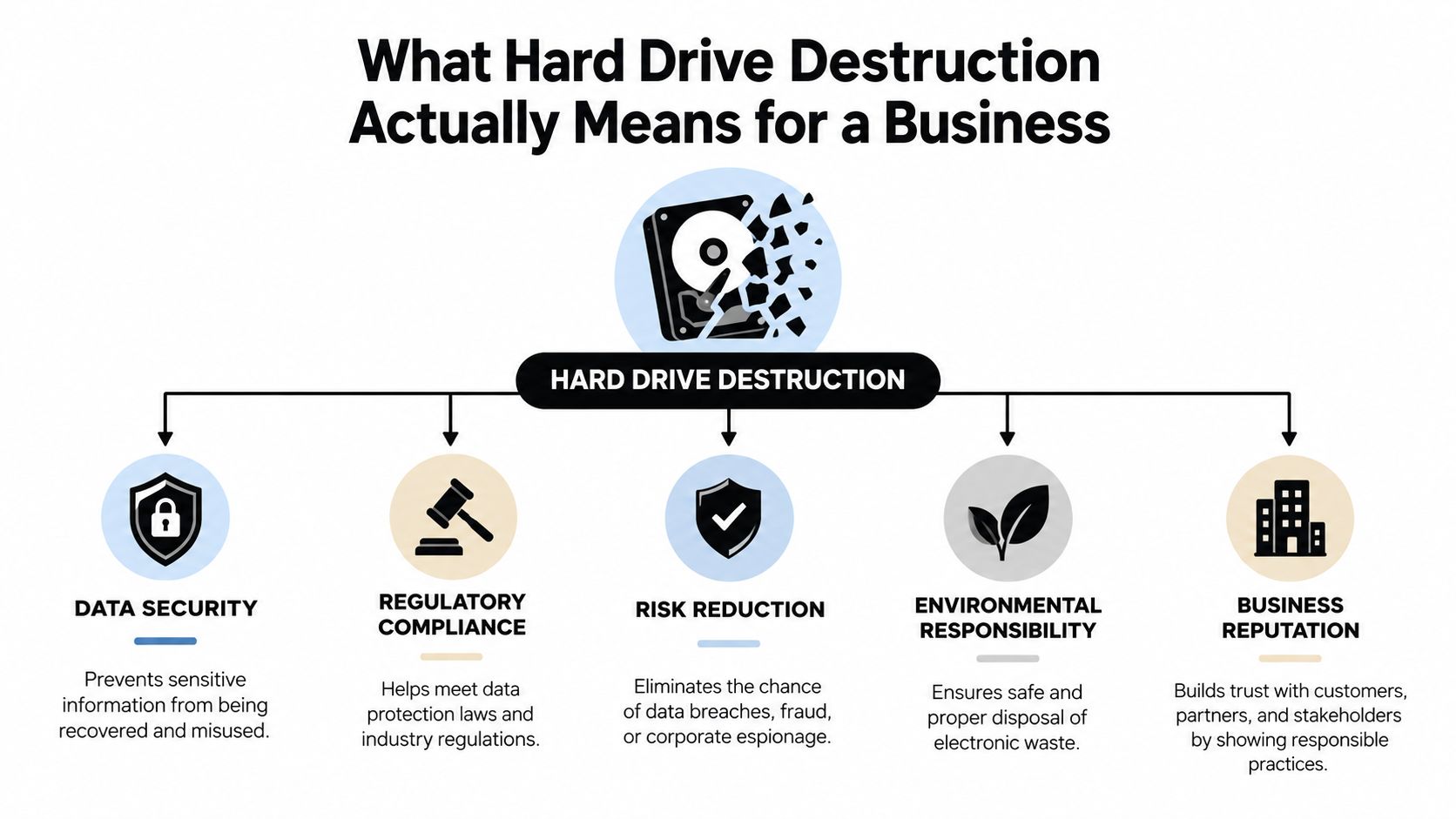
A mature ITAD program uses all three outcomes. It doesn't send every device to a shredder, and it doesn't trust software deletion on media that can't be accessed or verified.
Physical Destruction Methods Compared Side by Side
Physical methods aren't interchangeable. A buyer should ask what each process does to the data-bearing material, which devices it supports, how the output is verified, and whether the records match the required sanitization outcome.
Shredding cuts the enclosure, platters, boards, and other components into fragments. It can be suitable for permanent disposition across many device types, but the buyer must specify the output and verify that the process reaches the required media-destruction standard. A vendor's use of the phrase “hard-drive shredder” isn't proof of compliance.
Crushing or bending deforms the drive. For conventional magnetic HDDs, deformation alone isn't a complete sanitization method under the NSA guidance cited below. The guidance requires approved degaussing first, followed by deformation of every platter, or use of an approved disintegrator.
Degaussing applies a magnetic field to magnetic media. It isn't a solution for SSDs, NVMe devices, or other non-magnetic flash storage. It can also leave the buyer with a device that requires a separate physical process when the intended outcome is Destroy.
Disintegration reduces the HDD to debris. The NSA specification identifies an approved disintegrator with a nominal maximum edge size of 2 mm, while an approved deformer must bend, punch, or waffle every platter after degaussing. The specification also sets a maximum deformation cycle of 30 seconds. NSA hard disk drive sanitization guidance should be matched to the exact equipment and media type.
| Method | Typical Particle Size | Best For | Throughput | Regulatory Status |
|---|---|---|---|---|
| Shredding | Defined by the equipment and approved process | Permanent destruction of devices that won't be reused | Depends on equipment and workflow | Acceptable when the output prevents reconstruction and records support the method |
| Crushing or bending | Deformed media, not necessarily fragmented media | Limited-volume or controlled on-site work when the process is approved | Depends on equipment and handling | Must match the applicable sanitization requirement |
| Degaussing | No particle output | Magnetic HDDs and other suitable magnetic media | Depends on the approved device and workflow | Can support Purge for appropriate magnetic media |
| Disintegration | 2 mm nominal maximum edge size for the cited HDD specification | High-assurance HDD destruction | Depends on equipment and facility workflow | Supports the cited NSA process when approved equipment and sequence are used |
For mixed estates, combining methods is normal. The critical control is media identification before processing. For a practical explanation of magnetic erasure equipment, review what a degausser does before approving a method for an inventory that includes SSDs.
Compliance Rules That Drive Your Method Choice
Compliance doesn't demand the same machine for every drive. It demands a reasonable, appropriate process that prevents unauthorized access and produces evidence that the process worked.
The FTC Disposal Rule is the clearest verified foundation for businesses handling consumer-report information. It applies to organizations and individuals that maintain or possess consumer reports, or information derived from them, for business purposes. The rule treats disposal broadly. Discarding, abandoning, selling, donating, or transferring equipment or media containing consumer information can trigger secure-disposal obligations.
The FTC says reasonable safeguards may include destroying or erasing electronic files or media so information can't be read or reconstructed. For physical media, shredding, pulverizing, or another process is acceptable when reconstruction is impracticable. The organization may use a qualified contractor, but it still needs appropriate due diligence. FTC Disposal Rule text
A documented decision should connect the data, device, method, and evidence:
| Regulation | Trigger for Sanitization | Accepted Methods | Required Documentation |
|---|---|---|---|
| FTC Disposal Rule | Consumer-report information leaves organizational control | Erasure or physical destruction that prevents reading or reconstruction | Vendor due diligence, asset records, method details, and destruction evidence |
| Organization policy | Retired, failed, or redeployed media contains business data | Clear, Purge, or Destroy selected for the device and risk | Approval, device identity, verification, and disposition record |
| NIST-based program | The organization needs a repeatable sanitization decision | Clear, Purge, or Destroy under the applicable media process | Method, operator, equipment, verification, and chain-of-custody records |
| Contractual or customer requirement | A customer or agreement specifies a destruction outcome | The method required by the agreement, if reasonable and technically applicable | Contract mapping, certificates, reconciliation, and exception records |
A 2007 GAO review shows why documentation matters. At two of four Department of Veterans Affairs case-study locations, hard drives in the excess-property process contained personal information, including veterans' names and Social Security numbers. GAO also reported that its limited testing found no remaining data on drives identified as sanitized. GAO review of VA media sanitization
Don't accept a certificate that only says “destroyed.” Use NIST 800-88 data destruction standards to define the method, verification, and records your auditor will expect.
On-Site Versus Off-Site Hard Drive Destruction
The on-site versus off-site decision is a risk-window calculation, not a contest between two marketing packages. Ask how long the media remains under controlled custody between removal and destruction, who can access it during that period, and whether every handoff is recorded.
On-site destruction is compelling when transport creates the largest exposure. A data center decommission may involve racks being emptied while systems remain in a controlled facility. A healthcare refresh may require witnessed processing because the organization doesn't have an approved path for moving unprocessed media. In those cases, a mobile service at the loading dock can shorten the time between removal and destruction.
Off-site processing can be the stronger choice when the provider's fixed facility offers controlled intake, dedicated equipment, repeatable workflows, and serialized reporting. It also avoids bringing industrial machinery into a client environment. The transport plan must still include sealed containers, custody records, and a clear receiving event.
Compare the full operating cost, not just the quoted per-drive fee:
- Labor: Include removal, inventory capture, escorts, staging, and reconciliation.
- Security: Account for cages, seals, restricted access, and transport controls.
- Auditability: Confirm whether the provider can connect each device to an intake record and final certificate.
- Volume: Large, uniform inventories may favor a fixed facility, while a sensitive small batch may justify on-site service.
Use on-site versus off-site ITAD services to frame the decision around media count, sensitivity, available secure transport, and the evidence your compliance team needs.
Chain of Custody and Certificates of Destruction
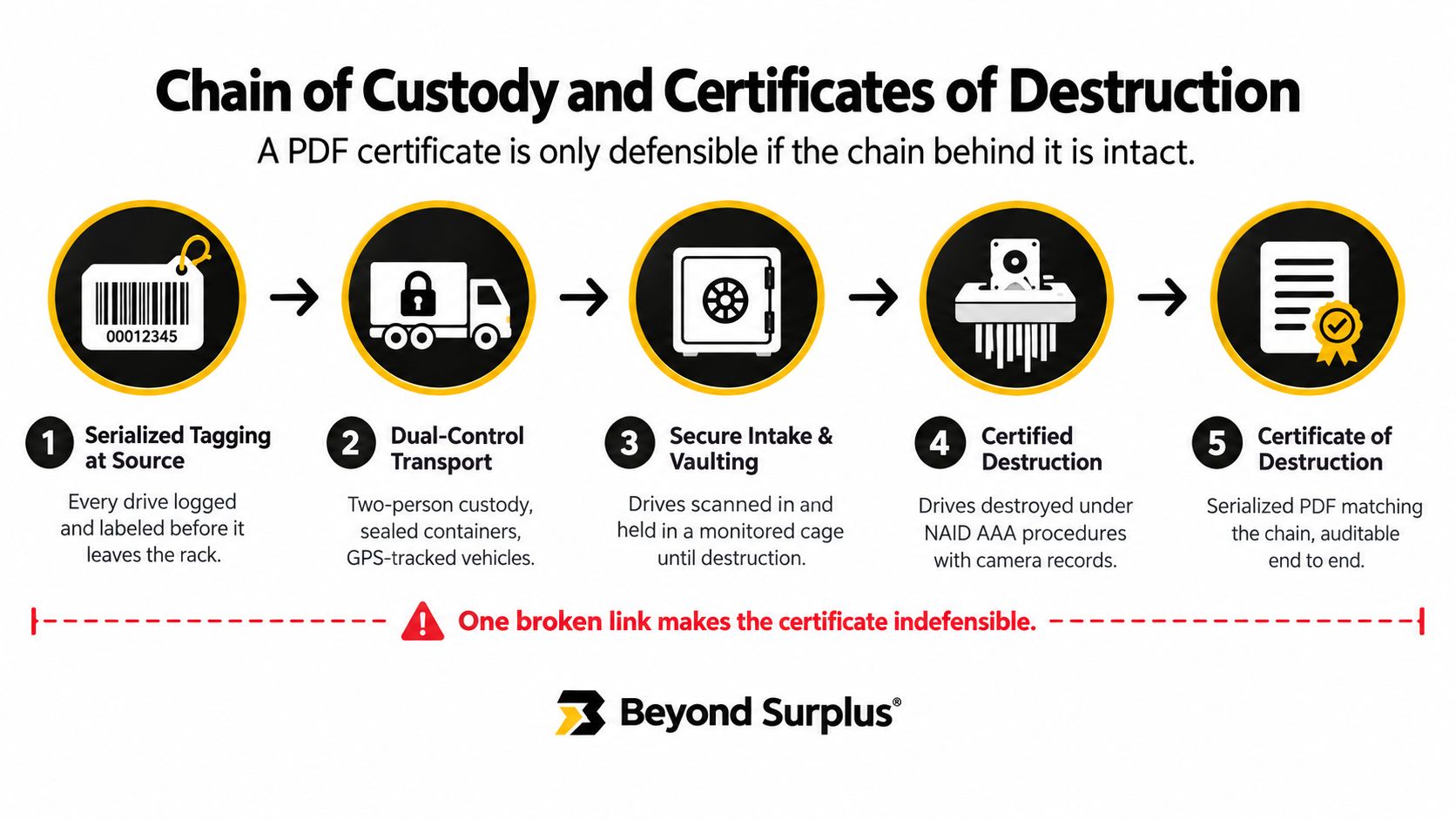
A certificate is not the control. It's the final document produced by the control. If the chain behind it is incomplete, a polished PDF won't prove which drive was destroyed, when it was processed, or whether the listed device matches the one removed from service.
A defensible chain begins at the source. Each drive should receive a serial-number or asset-tag record before leaving the rack, cage, workstation, or staging area. Sealed containers, named custodians, controlled handoffs, and time-stamped intake records close the gaps between collection and processing.
The destruction record should identify the device, method, date, operator, and verification outcome. For a physical process, the provider should be able to explain how the output meets the applicable requirement. For a purge process, the record should show the technology, approved procedure, and verification result.
What weak records look like
Common failures include certificates with mismatched serial numbers, bulk paperwork that cannot reconcile to the asset list, and destruction dates that don't align with pickup or facility intake records. These errors may not mean the data survived, but they make the organization prove a negative with incomplete evidence.
A stronger audit packet may include:
- Source inventory: Original serial number, asset tag, location, and custodian.
- Transport record: Container seal, handoff, carrier, and receiving details.
- Processing record: Sanitization level, method, equipment, operator, and date.
- Verification evidence: Test result, particle or deformation control, or process report.
- Disposition record: Certificate, recycling record, and downstream documentation where applicable.
Before selecting a provider, ask:
- Can you reconcile every certificate to our source inventory?
- Who controls the media during transport and intake?
- How do you verify destruction for each media type?
- What records support exceptions, failed drives, or unreadable serial numbers?
- How long will you retain the chain-of-custody and processing evidence?
Read what a certificate of data destruction should contain before accepting a one-page document as audit evidence.
How to Evaluate a Secure ITAD Provider
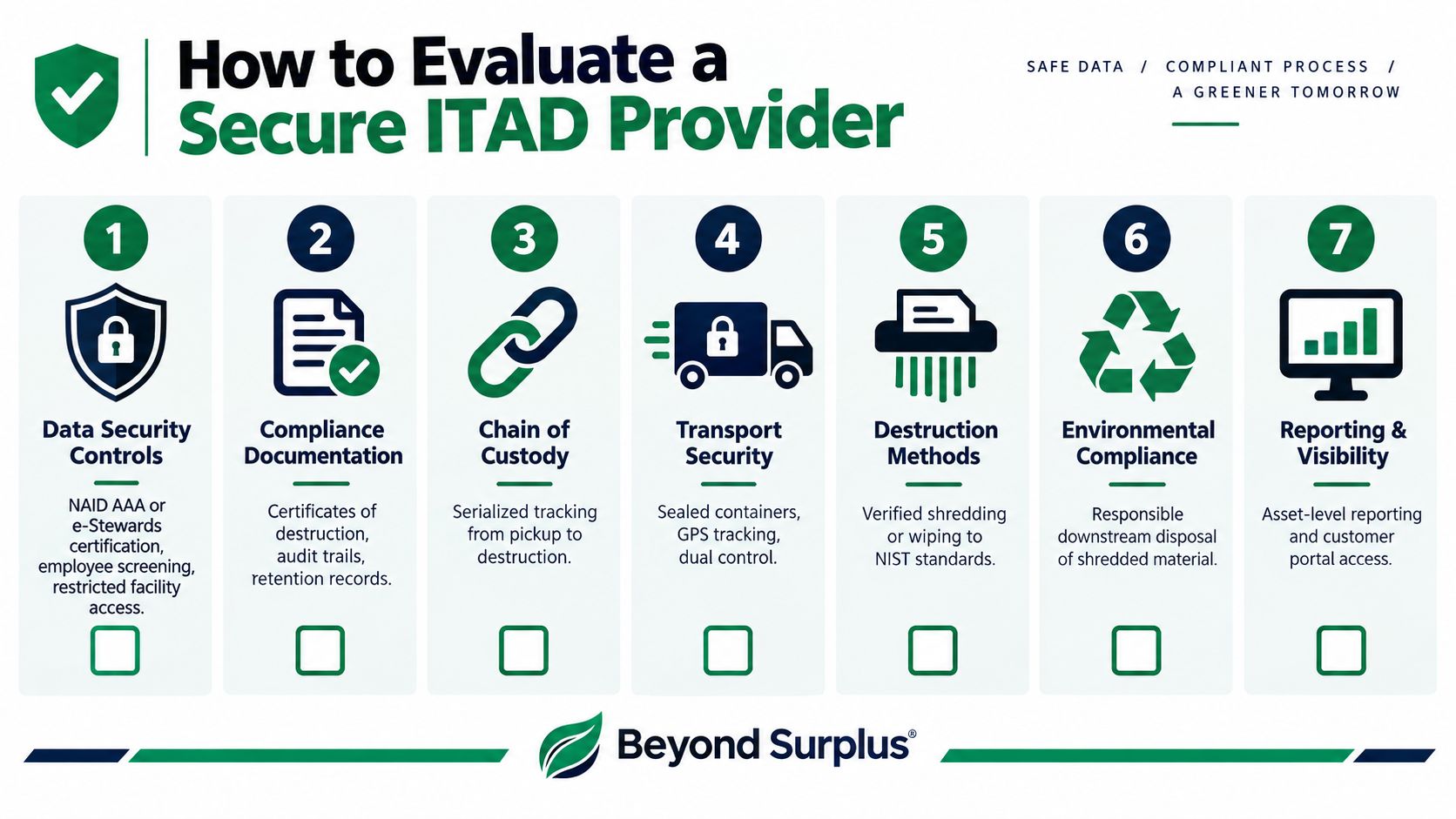
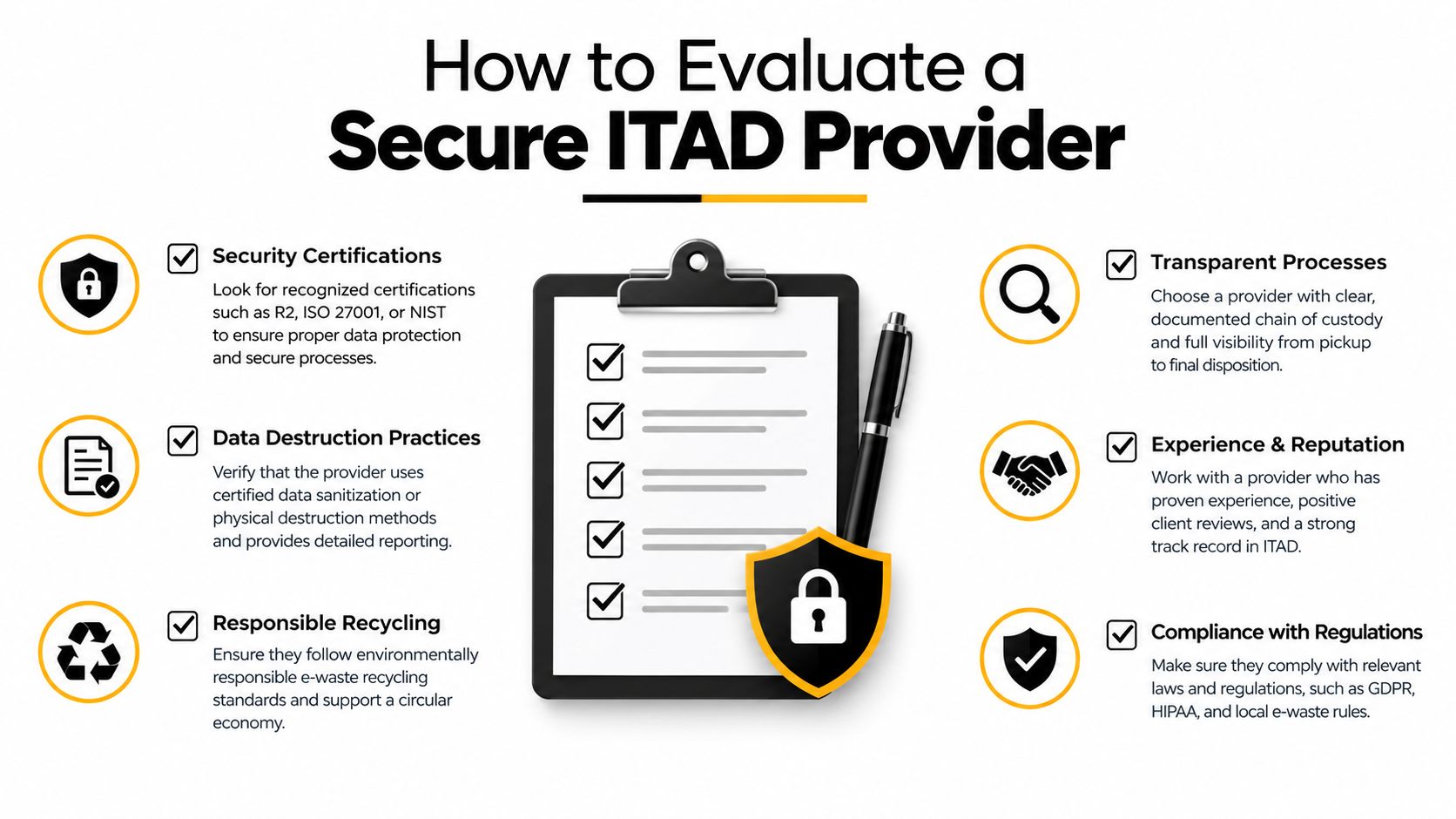
Procurement teams should score providers instead of choosing the lowest line-item quote. A secure ITAD partner handles data, equipment, transport, environmental processing, reporting, and contract risk as one workflow.
Security and documentation
Ask for evidence of restricted facility access, employee screening, documented procedures, and independent security controls. Request a sample certificate before signing. It should support serial-level reconciliation rather than merely state that a batch was processed.
The provider should explain how it handles unreadable labels, failed drives, mixed HDD and SSD inventories, and devices that arrive without a matching asset record. Those exceptions reveal more about operational maturity than a sales presentation.
Environmental and liability controls
Secure destruction doesn't end when a machine produces fragments. Ask how shredded material moves downstream, whether downstream vendors are audited, and how the provider prevents unauthorized resale or disposal. Confirm insurance coverage for errors, omissions, cyber exposure, and asset handling, with limits appropriate to your risk.
Reporting and logistics
A useful provider should capture serials, reconcile asset tags, and export records in a format your IT asset management system can use. Confirm whether the workflow supports on-site service, sealed transport containers, defined pickup windows, and nationwide logistics when your organization operates across locations.
Contract terms
Review per-drive pricing, minimum charges, cancellation terms, media-return procedures, and any automatic renewal language. Require a clear process for disputed counts and missing assets.
The cheapest quote usually becomes expensive when the certificate can't reconcile to the inventory or the method doesn't fit the media.
Give the heaviest weight to data security and documentation. Then evaluate environmental controls, insurance, reporting, logistics, and exit terms. A provider that won't show a sample audit packet or walk through its custody process hasn't earned access to your retired storage media.
Putting It All Together and Choosing Your Next Step
Use a simple decision sequence. Classify each device by data sensitivity and media technology. Decide whether the drive will be redeployed, remarketed, recycled, or permanently removed from service. Select Clear, Purge, or Destroy, then define the verification and records before the first drive leaves your facility.
A hybrid workflow is often the most rational enterprise outcome. Functioning drives may qualify for a validated purge when reuse is appropriate. Failed or unsupported media may require physical destruction. Magnetic drives may need the approved degaussing and deformation sequence described in the applicable guidance, while SSDs and other flash devices need a process designed for their storage technology.
Choose on-site destruction when reducing the custody window matters more than facility throughput. Choose off-site processing when a controlled facility, standardized intake, and serialized reporting provide the stronger overall control. In either case, approve the certificate template, serial-capture method, exception process, and reconciliation rules before scheduling pickup.
Beyond Surplus provides business hard drive shredding, data destruction documentation, on-site and off-site processing, and nationwide pickup coordination for organizations that need a defined disposition path. Its service mix can be matched to drive condition, media type, location, and compliance requirements.
Contact Beyond Surplus for a scoped hard drive destruction plan that covers on-site or off-site processing, serialized certificates, and controlled pickup logistics. Visit Beyond Surplus to discuss your drive inventory, locations, and documentation requirements.


