Only 22.3% of the 62 billion kilograms of e-waste generated globally in 2022 was documented as formally collected and recycled in an environmentally sound manner, according to the International Telecommunication Union. For a business handling recalled power banks, an undocumented disposal route isn't an acceptable shortcut. Stop use, identify the affected equipment, and establish an approved destination before anyone schedules a pickup.
Recalled charger and power bank disposal is a custody-control task, not just an electronics cleanout. Facility managers, IT teams, and procurement staff need a record that connects the product, its condition, the recall, and the receiving facility's acceptance.
Table of Contents
- Why Recalled Chargers and Power Banks Need a Separate Path
- How to Confirm a Charger or Power Bank Is Recalled
- How to Store and Handle Recalled Units Safely
- Choosing Between Recall Returns, Certified Recycling and Drop-Off
- Shipping Rules and Documents That Transfer Liability
- Confirm the Disposal Path Before You Schedule Pickup
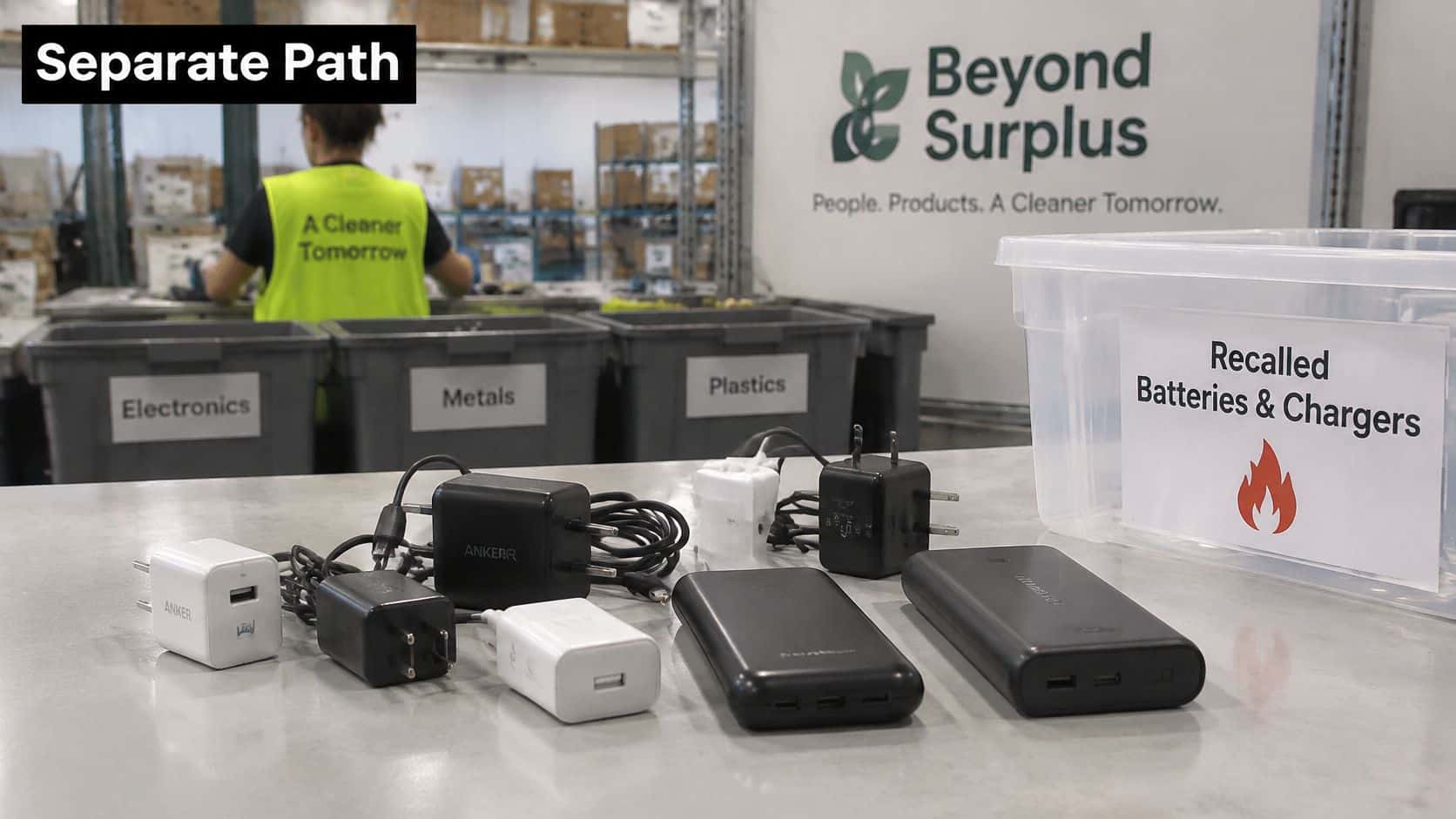
Why Recalled Chargers and Power Banks Need a Separate Path
A U.S. Environmental Protection Agency analysis identified 245 fires at 64 waste-management facilities caused by, or likely caused by, lithium-metal or lithium-ion batteries. The same analysis recorded two fires at one facility in 2013, compared with 65 fires across 16 facilities in 2020.
The operational exposure is straightforward. A battery-containing power bank can be crushed in a compactor, punctured during handling, or short-circuited against other discarded equipment. An office accessory becomes a warehouse, vehicle, or sorting-line hazard when employees place it in the wrong stream.
Define the equipment in scope
Apply a controlled process to employee-issued power banks, recalled charging accessories in warehouse stock, and portable batteries removed during equipment decommissioning. Include swollen, leaking, or damaged devices even when nobody has confirmed a recall.
Don't treat an intact, non-recalled wall charger without a battery as though it contains lithium cells. It can generally follow the standard commercial electronics-recycling route.
Use these intake categories:
- Intact chargers without batteries: Screen for recall status, then route through ordinary IT equipment disposal.
- Stable recalled power banks: Preserve identification and obtain specific receiving approval.
- Damaged battery-containing devices: Assign a battery-specialist assessment rather than routine collection.
Practical rule: Classify the device by battery content, recall status, and physical condition, not by the bin where an employee left it.
Review your facility's universal waste handling procedures with the environmental or compliance lead. A general waste label doesn't establish that a particular recalled device is suitable for that stream.
How to Confirm a Charger or Power Bank Is Recalled
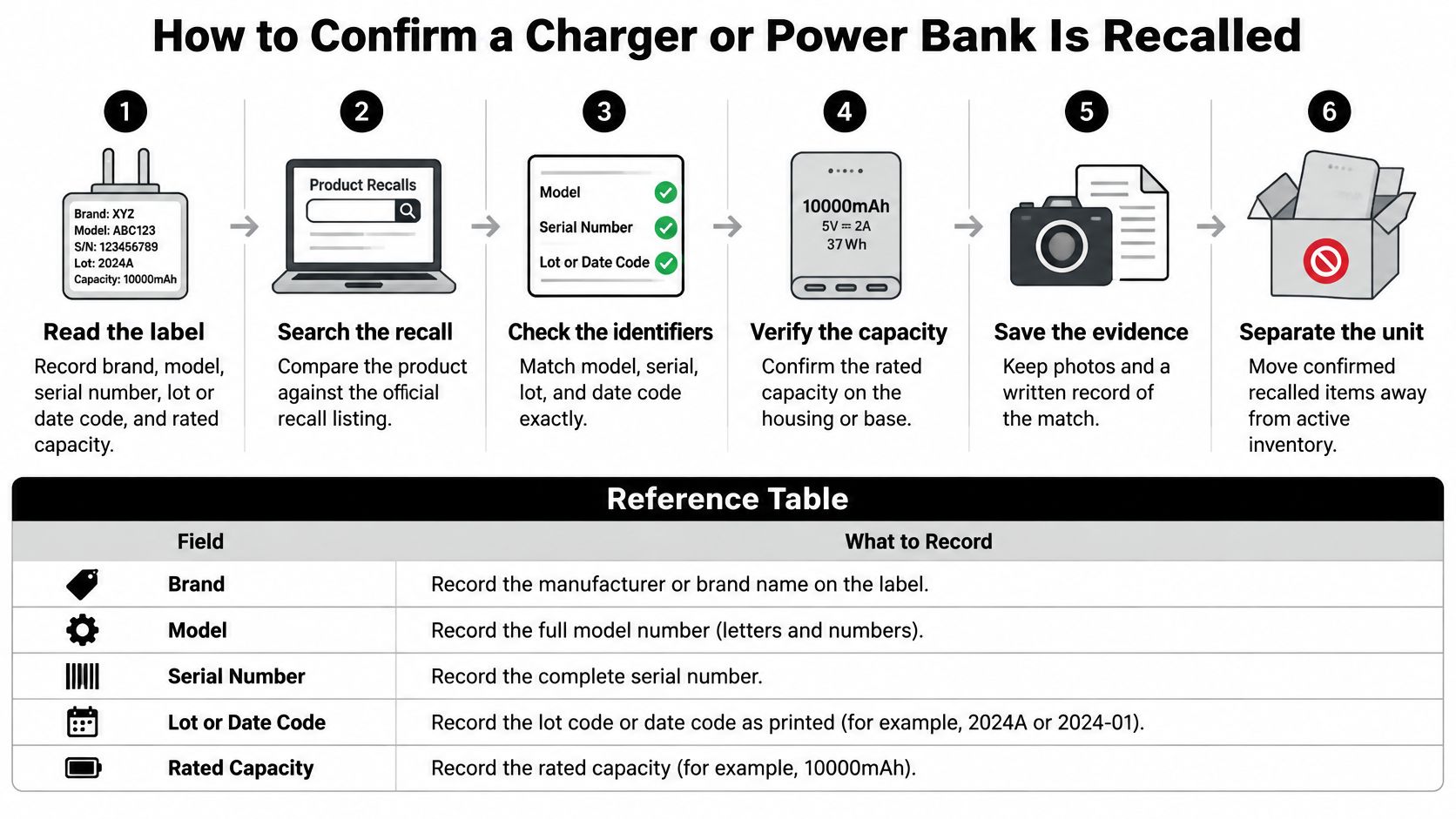
Match identifiers, not appearances. In 2025, the U.S. Consumer Product Safety Commission reported that a recalled Anker power bank was linked to 33 fire and explosion incidents. A matching model deserves immediate quarantine while staff complete verification.
Use a repeatable identification routine
- Read the unit label. Record the brand, model, serial number, lot or date code, and rated capacity from the housing or base. The physical unit is more reliable than an inventory description such as portable charger.
- Search the official recall listing. Search by brand and model rather than the marketing name alone. Similar-looking products can have different recall coverage.
- Compare the identifiers exactly. Check serial ranges, production lots, capacity, and any sales window named in the notice. Record the applicable window instead of assuming every product from the brand is affected.
- Save the evidence. Photograph the label and save the recall notice page with its access date. Attach both to the asset record so another reviewer can reproduce the decision.
- Assign a status. Mark the unit recalled, not recalled but damaged, or unknown. Physical damage needs a handling decision even when the recall search produces no match.
- Hold unresolved units. Apply recalled-unit handling controls until the manufacturer or regulator resolves uncertain coverage. Unknown isn't permission to return equipment to service.
Identifiers to record for each unit
| Identifier | Where to find it | Why it matters |
|---|---|---|
| Brand and model | Label on the housing or base | Matches the model named in the recall notice |
| Serial number | Label or sticker on the unit | Confirms whether the unit falls inside the recall range |
| Lot or date code | Printed on the label or retail box | Many recalls cover only specific production lots |
| Rated capacity (mAh or Wh) | Label or product sheet | Recall notices list power banks by capacity |
| Asset tag | Internal asset register | Links the unit to its custody and disposal record |
Retail boxes and receipts can help establish purchase history, but they may omit the identifier that decides coverage. Don't substitute a purchase order for a readable photograph of the unit.
The common error is matching by brand alone. Procurement should use model-level searches to locate affected purchases, while the physical inspection team confirms which individual units belong in the recall file.
How to Store and Handle Recalled Units Safely
Make the storage decision before collecting devices from desks or remote employees. Otherwise, staff tend to improvise a collection box in a mailroom, loading dock, or IT storeroom.
The CPSC's VC Group recall guidance warns against placing recalled power banks in trash, curbside recycling, or ordinary used-battery collection boxes. Your internal collection procedure must distinguish recalled devices from routine spent batteries.
Follow the controlled intake workflow
- Identify the product and recall reference. Assign a temporary tracking identifier if the device doesn't have an asset tag. Keep its label photograph accessible without repeatedly handling the unit.
- Stop use and disconnect power when safe. Don't recharge the device to check whether it works or to read a battery indicator. Tell the assigned employee that the unit can't be reissued.
- Inspect the exterior only. Look for swelling, punctures, deformation, leakage, unusual odor, hissing, or evidence of heat. Never open the enclosure or attempt to remove an embedded cell.
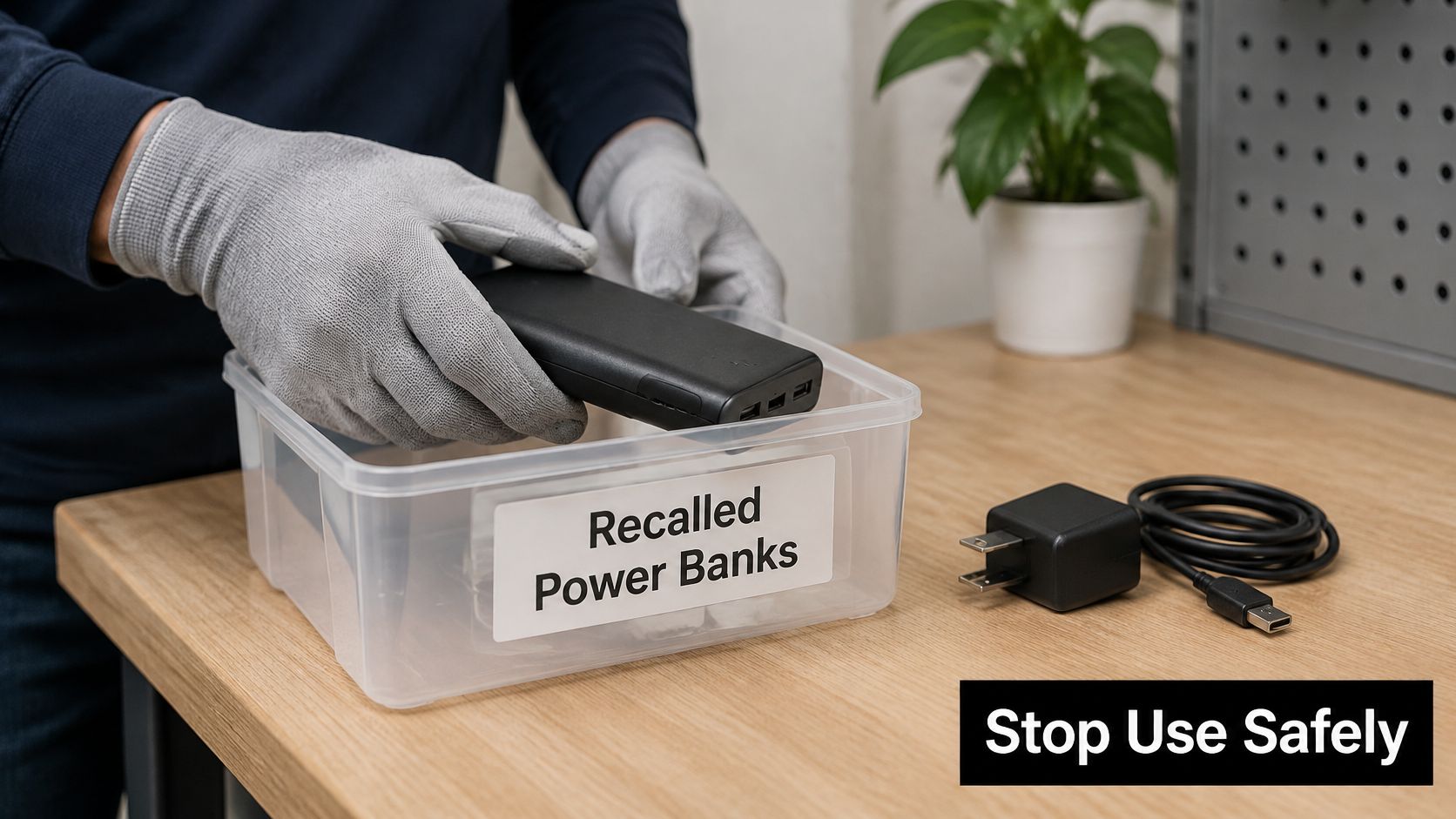
- Segregate the unit. Keep recalled lithium-ion equipment apart from ordinary e-waste, general trash, and standard battery boxes. Restrict access so cleaners and warehouse staff don't merge the collection with a routine pickup.
- Confirm an eligible destination. Ask the receiving recycler or hazardous-waste program whether it accepts business-generated recalled or defective lithium-ion devices. Describe the actual condition, not the product category.
- Record the handoff. Capture the date, quantity, recall identification, carrier, destination, and written acceptance. Name the employee responsible for checking that the receiving record matches the outgoing inventory.
Establish temporary storage and an emergency exception
For physically stable units, have the facility's safety lead designate a cool, dry, non-combustible area away from paper stock and flammable materials. Use individual segregation or non-conductive trays as approved for the condition, keep terminals clear of metal, and don't stack devices.
Keep collection points out of break rooms and server rooms. A tray or plastic bin is an organizational aid, not proof of fire containment or approved shipping packaging.
If a unit is hot, smoking, leaking, rapidly swelling, or otherwise unstable, don't package or transport it routinely. Clear the immediate area and contact emergency services or the local hazardous-materials authority.
Build the storage plan into your lithium battery recycling workflow before announcing an employee collection. Give reception, security, and loading-dock personnel the same escalation instructions.
The preventable failure is treating a recall as routine recycling and sending damaged cells toward compactors or sorting equipment. Keep quarantine status visible in the asset register until written acceptance exists, rather than closing the record when the device leaves a desk.
Choosing Between Recall Returns, Certified Recycling and Drop-Off
Choose the route by device condition, recall remedy, and the record your organization needs. Separate intact non-recalled chargers, physically stable recalled power banks, and damaged lithium-ion devices before requesting quotes. A contractor may coordinate several groups, but confirm it can handle each group's condition.
Check the CPSC recall listings for the product-specific remedy. A manufacturer may require proof of purchase for a refund without authorizing an ordinary return shipment. Confirm the accepted remedy and return process before handing over a unit.
Compare routes by documented outcome
Disposal routes compared for recalled units
| Route | Best for | Documentation you receive | Main limit |
|---|---|---|---|
| Manufacturer or retailer recall return | Units with proof of purchase or a business account | Refund or replacement record, when offered | Confirm that the recall program still accepts claims and authorizes return |
| Municipal hazardous-waste program | Small quantities of stable units, where business waste is eligible | Request a receipt and item description | Business-generated waste and recalled batteries may be excluded |
| Certified battery recycler | Business batches of stable or damaged lithium batteries | Request a certificate of recycling and applicable transport manifest | Packaging and transport must meet the recycler's specifications |
| Certified ITAD or e-waste provider | Mixed fleets of chargers, power banks, laptops, and IT equipment | Request a certificate of recycling and chain-of-custody record | Battery acceptance must be confirmed in writing before pickup |
Treat the documentation column as a procurement requirement, not a guaranteed deliverable. Request a sample record and confirm it identifies your shipment, the receiving facility, and the final processing outcome. Keep the acceptance and custody records together with the asset record so the handoff can be traced during an audit or insurance review.
For stable recalled units, follow the recipient's instructions to preserve product identity and prevent accidental activation. For damaged devices, use a trained hazardous-materials or battery-recycling provider rather than improvising a container. A battery bag alone does not establish carrier approval, recipient acceptance, or suitability for a damaged device, so treat it as only one part of the packaging decision. Staff considering one should review battery bag protection limits without treating a bag as authorization to ship or deliver a unit.
Choose the route that fits the condition
A small office batch of stable units may qualify for an authorized manufacturer return. A fleet of employee power banks alongside retired laptops may suit a coordinated ITAD pickup, if the provider confirms battery acceptance in writing. A local center may be convenient, but check its actual criteria first; consider the advantages of a local recycling center alongside its acceptance rules.
Set the benchmark at complete traceability, no commingling, and no undocumented handoffs. Record the selected route, written acceptance, requested documentation, and each transfer of custody. Removal from the facility is not proof of final processing.
If no facility accepts a unit:
- Keep custody assigned: Leave stable equipment under the safety lead's designated controls.
- Escalate in writing: Contact a certified battery recycler or hazardous-materials provider with photographs and condition details.
- Log refusals: Record the date, organization, contact name, and stated reason.
- Keep the route open: Do not move a refused item into general waste or an ordinary battery bin.
Shipping Rules and Documents That Transfer Liability
A pickup appointment isn't shipping authorization. Damaged or defective lithium batteries require a hazardous-materials transport assessment, and staff shouldn't tender them as ordinary parcels or add them to routine freight.
Use a trained shipping professional to determine the applicable requirements. The receiving facility's approval and the carrier's acceptance must cover the device's actual condition, not merely lithium batteries as a broad category.
Release equipment only against an approved packing plan
Give the packing team a written checklist:
- Use recipient instructions: Obtain the specified packaging and confirm that the carrier accepts the prepared shipment.
- Protect terminals: Apply non-conductive tape or individual protective bags where the approved instructions call for them and handling is safe.
- Separate devices: Prevent contact between units and with metal tools, loose cables, or other conductive objects.
- Identify damaged equipment: Use the specialist-approved separate packaging, markings, and labels rather than adding damaged devices to a mixed carton.
- Stop on changing condition: Don't pack hot or swollen units into bulk cartons. Refer them for specialist or emergency assessment as appropriate.
Don't improvise cushioning, sealing, or venting details. Packaging that suits an intact spent battery may be unsuitable for a defective device.
A loading-dock supervisor should have authority to reject a shipment that doesn't match the approved plan. Production schedules and lease-clearance deadlines aren't reasons to override the condition assessment.
Build the custody file before collection
Assemble the record while the equipment is still under your control:
- Recall evidence: Notice reference, model coverage, and any manufacturer instructions.
- Unit inventory: Asset identifiers, serial numbers, lot codes, quantities, and originating locations.
- Condition evidence: Dated photographs and inspection notes.
- Transport record: Carrier identity, booking reference, and applicable bill of lading or manifest.
- Custody events: Release and receipt timestamps, with named organizations.
- Final outcome: Receiving-facility acceptance and the agreed certificate of recycling or destruction.
Use a certificate of destruction for recalls when destruction is the agreed disposition. Confirm that the document identifies the relevant shipment and outcome rather than merely acknowledging that a truck collected material.
Liability distinction: A certificate records an outcome. It doesn't automatically erase the generator's legal responsibilities or replace appropriate shipping and vendor due diligence.
Custody records show who possessed the equipment and when. Together with contracts and acceptance documents, they help your insurer, auditor, or counsel assess responsibility if a claim arises.
For mixed IT collections, the pickup coordinator can arrange transportation and identify devices requiring a separate battery-specialist route. Keep shipping approval distinct from data-destruction approval, and retain the complete file for the period set by your legal, insurance, and audit teams.
Confirm the Disposal Path Before You Schedule Pickup
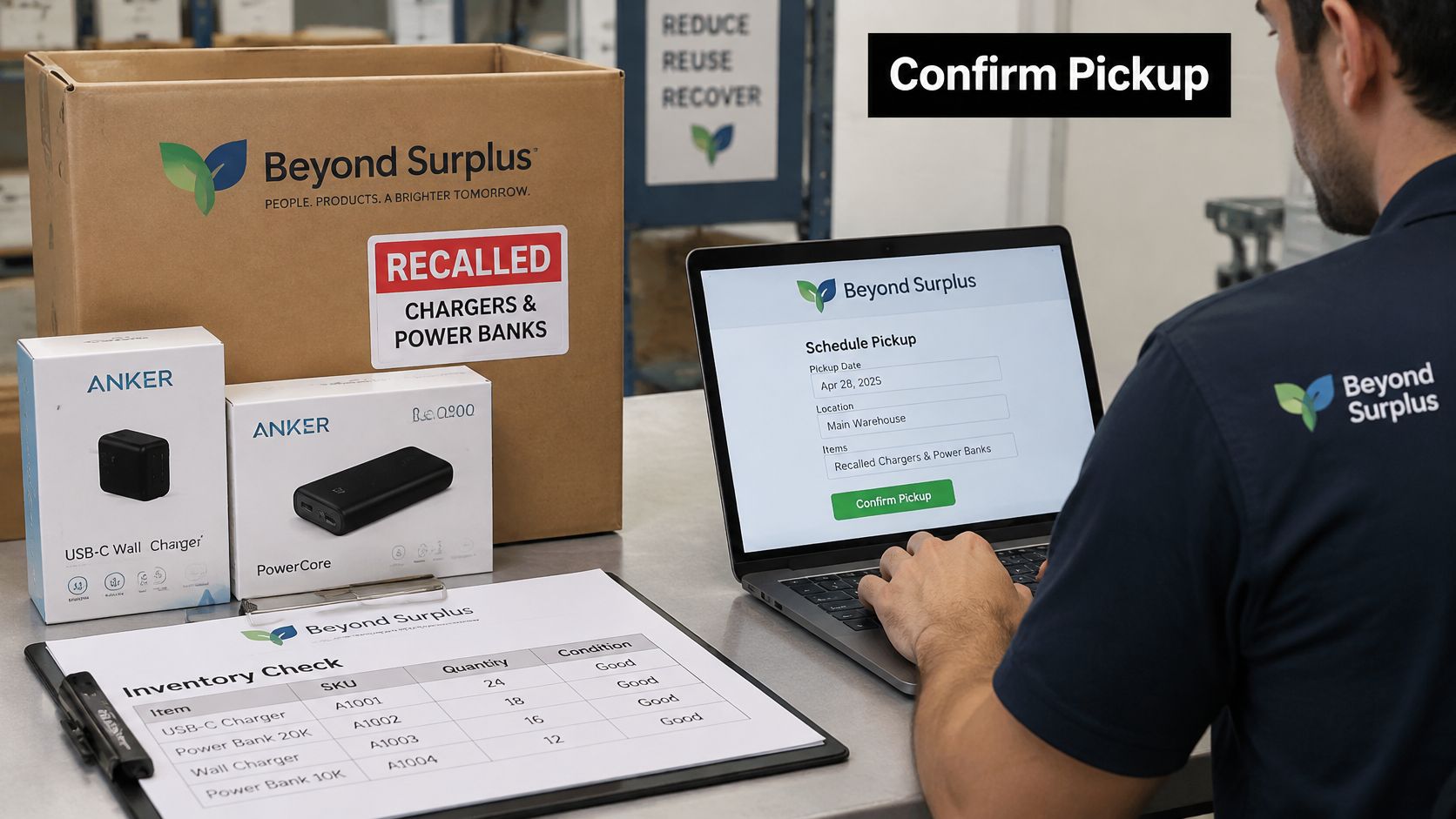
Approve the destination, condition-specific handling, and evidence requirements before approving the collection date. That sequence prevents the loading dock from becoming the place where staff discover that a contractor won't accept recalled batteries.
A commercial electronics recycling project may include computer recycling, laptop disposal, IT asset recovery, and secure data destruction. Battery-containing accessories need their own acceptance decision within that project, even when they appear on the same purchase order.
Assign ownership before vendors arrive
Give IT responsibility for identifiers and asset status. Have facilities manage the storage location and emergency arrangements, while procurement obtains written scope and commercial terms.
Assign a named coordinator to reconcile the final records. Without that owner, a pickup receipt can sit in procurement while IT closes assets and the compliance team still lacks receiving confirmation.
Build the vendor scope around product recall chain-of-custody services rather than a generic request for electronic waste pickup. Ask whether the provider will identify downstream recipients, report rejected units, and distinguish collection from completed processing.
For a remote-office collection, don't tell employees to mail power banks to headquarters. First establish an approved location-specific route and give staff instructions that match the device condition.
Keep the waiting period controlled
Use simple operational safeguards:
- Label quarantine shelves: Include the responsible employee and a clear restriction against reissue or routine disposal.
- Control vendor access: Don't let a driver remove recalled units without an inventory-linked transport record.
- Reduce unnecessary handoffs: Prefer a coordinator capable of managing mixed electronics, while retaining specialist handling where needed.
- Track exceptions: Record missing identifiers, unreadable labels, rejected devices, and changes in condition.
Avoid these common mistakes:
- Assuming kiosk eligibility: A general battery collection point isn't an approved destination for every recalled power bank.
- Accepting a verbal yes: Obtain written acceptance that describes recall status and physical condition.
- Skipping photographs: Preserve label and condition evidence before packaging obscures it.
- Closing at collection: Keep receipt and final processing as distinct milestones.
Complete the release and closure sequence
- Consolidate the inventory. Bring recalled, damaged, and intact equipment into a controlled register with identifiers, quantities, locations, and assigned custodians. Reconcile entries against what staff have physically located.
- Assign a route to each class. Distinguish standard electronics recycling from authorized recall returns and specialist battery handling. Mark unresolved items as exceptions rather than forcing them into a scheduled load.
- Obtain written receiving approval. Describe the devices and their condition, then obtain applicable packaging instructions. Ask the recipient to identify exclusions so the warehouse team knows what must stay behind.
- Book approved transport. Record the carrier and booking reference after acceptance is confirmed. Ensure that the pickup team receives the same inventory and condition information used for approval.
- Verify receipt and processing evidence. Compare the receiving acknowledgment with the released inventory. Collect the agreed certificate within the contractual window and investigate discrepancies before accepting the project as complete.
- Close and archive the records. Update each asset's final status and retain the linked recall, transport, acceptance, and processing documents. Keep unresolved quantities open with a named owner and next action.
The right finish isn't an empty shelf. It's a reconciled inventory and a defensible record of where each recalled unit went.
Beyond Surplus offers commercial electronics recycling, IT asset disposal, pickup coordination, and recycling documentation, with its fleet and transportation partners supporting organizational collections. Visit Beyond Surplus to discuss your recalled charger and power bank inventory, and ask the team to confirm battery acceptance and any specialist routing before scheduling pickup.