Up to 47% of devices destroyed for data-security reasons were still functional, according to a survey of 2,000 cybersecurity, IT, and sustainability leaders reported by Security Systems News. That finding doesn't mean recalled equipment belongs back on the market. It means business buyers should separate three decisions: what the recall requires, how to protect stored information, and whether any material or equipment value can legally be recovered.
Recalled electronics disposal services connect those decisions through controlled collection, safe handling, approved processing, and asset-level evidence. For an IT manager or procurement team, the deliverable isn't just an empty storage room. It's a defensible record of what happened to every affected device.
Table of Contents
- What Recalled Electronics Disposal Services Include
- Destroy, Recycle, or Reuse
- Legal and Safety Duties Before You Dispose
- Destruction and Data-Wiping Methods Compared
- Vendor Custody Requirements and Contract Terms
- How to Run a Recalled Electronics Disposal Workflow
- Frequent Questions and Confirming Your Next Step
What Recalled Electronics Disposal Services Include
A recalled electronics disposal service collects equipment that must leave use, keeps it segregated, sanitizes storage media, and routes it according to the remedy authorized for that product. Asset-level records connect each serial number to its outcome, whether that is a manufacturer return, an authorized repair, recycling, or destruction.
Ordinary IT asset disposition decisions often turn on age, condition, support status, and resale value. A recall changes the order of decisions: the authorized remedy determines what can happen before equipment value is considered. A working laptop may still present a safety risk, while a server with resale value may require component removal or manufacturer review first.
How each recall remedy changes the disposal provider's role
Refunds and repairs are more common recall remedies than disposal. Disposal is among the least common, so a provider's work depends on the remedy rather than a blanket instruction to destroy every affected unit.
| Recall remedy | Typical frequency | Typical role for a disposal provider |
|---|---|---|
| Refund | More common | The manufacturer usually leads; the provider handles leftover or unclaimed units under authorized instructions |
| Repair | More common | The manufacturer or service network corrects the defect; the provider may manage custody and document the unit's route |
| Replacement | Less common | Remove and record defective units, keeping them out of circulation |
| Disposal | Least common | Quarantine, sanitize, and arrange approved destruction or recycling, with a record of the final outcome |
These are broad patterns across recall remedies, not a forecast for a particular enterprise batch. They show why the provider must confirm the authorized route for each affected product. A disposal instruction for one model does not establish the correct handling for another.
Where ordinary ITAD stops being enough
For a recalled server backup battery, facilities staff may need to coordinate safe shutdown and removal with the infrastructure team. The recall administrator then determines whether the battery, its assembly, or the entire server must be returned.
A replaced laptop fleet creates a different custody gap. Procurement may receive replacement machines while defective originals remain in an IT cage, still holding corporate information and listed in the asset register. The provider's records should preserve that connection from collection through the authorized final outcome.
First decision: Confirm whether the manufacturer's remedy covers custody and final handling, or whether your organization must arrange an independent provider.
Do not authorize disposal until responsibility is clear. Premature destruction can disrupt a return or reimbursement process and may conflict with evidence-preservation requirements.
Destroy, Recycle, or Reuse
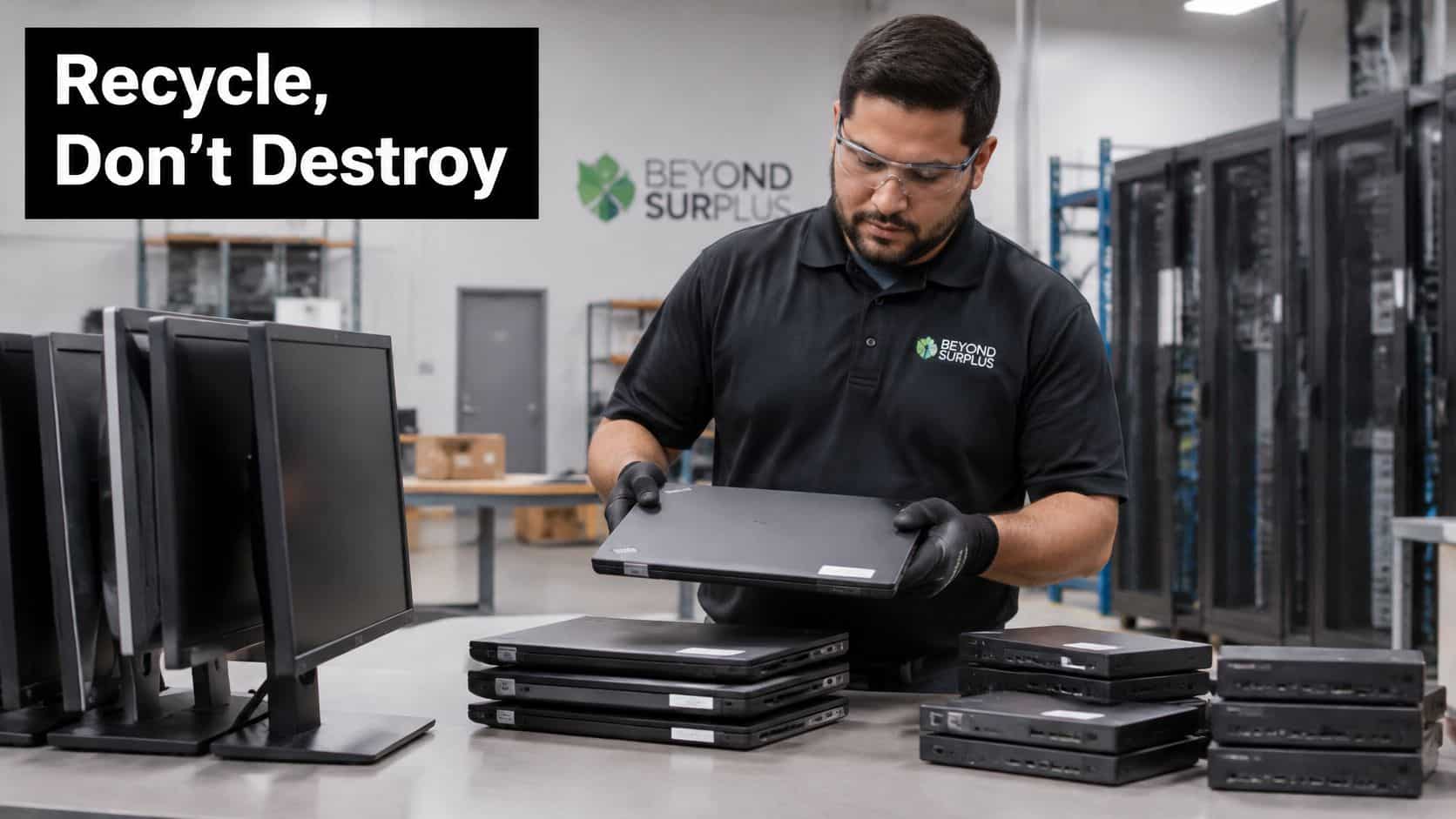
Treating every recalled device as a destruction job can eliminate recoverable value without improving the required safety outcome. The opposite shortcut, sending functional equipment straight to resale, can leave the original hazard unresolved.
The right approach is documented triage. Safety authorization comes first, information security follows, and value recovery comes last.
Questions that determine the outcome
- Does the recall permit reuse or resale? Obtain the applicable corrective-action instructions. If an authorized repair can resolve the defect, retain evidence that the particular unit received that correction before releasing it.
- Does the unit present a battery or fire hazard? Flag swelling, leakage, heat damage, or a recalled battery assembly before packaging. Hazardous units need a handling route selected for their actual condition.
- Does it contain sensitive information? Identify embedded drives, removable media, and storage soldered onto boards. Choose verified erasure or destruction independently of the product's outward condition.
- Is there recoverable value? Compare the expected return against testing, correction, sanitization, transport, and documentation costs. A buyback offer isn't useful if preparing the asset costs more than the credit.
Destroy when the approved remedy requires permanent loss of function or when an acceptable sanitization outcome can't be achieved. Recycle when authorized material recovery is appropriate, including recovery of metals such as copper, gold, and silver from suitable assemblies.
Reuse requires a different evidence package: permission for the disposition, proof of any corrective work, verified sanitization, and a documented transfer. A successful wipe doesn't correct a product defect, and a repaired product doesn't prove its storage is clean.
Beyond Surplus offers IT buyback for value recovery where resale is permitted. Its guide to choosing between refurbishment and recycling provides a useful starting point for evaluating equipment that survives the recall and security checks.
Keep the quote separated by outcome. Otherwise, a blended processing charge can hide whether the provider assumed resale income, destructive processing, or material-only recovery.
Legal and Safety Duties Before You Dispose
An EPA summary of the Global E-Waste Monitor estimated approximately 40 million metric tons of electronic waste worldwide in 2017, with less than 30% recycled, according to the EPA's electronic-waste management overview. Those historical figures establish the scale of the waste problem, not the current recycling rate or the legal duties for a particular shipment.
For a business, the practical obligation is to classify the equipment before selecting its destination. Recall instructions, information-security requirements, battery condition, and state waste rules can apply to the same asset.
Disposal duties by equipment situation
| Equipment situation | Rule or duty | Records to keep |
|---|---|---|
| Laptops, servers, or phones holding consumer report information | FTC Disposal Rule requires reasonable measures against unauthorized access during disposal | Erasure or destruction certificate and vendor due-diligence file |
| Lithium-ion batteries or damaged devices | Use appropriate hazardous handling; exclude them from general waste and ordinary battery collection | Written facility acceptance and applicable transport documentation |
| Any unit under a CPSC-directed recall | Follow the corrective-action plan and required segregation and disposition controls | Serial numbers, recall remedy, and any required witness record or affidavit |
| Equipment with Federal Tax Information | Disposal alone is unacceptable; apply the governing sanitization or destruction requirements | Verification and destruction records linked to the affected media |
| Multi-state equipment fleet | Check applicable state e-waste rules and landfill restrictions | State compliance matrix and applicable processor permits or licenses |
The table is a routing tool, not permission to apply one rule to every device. For example, the presence of ordinary business records doesn't automatically make a laptop subject to the consumer-report rule. Identify the information category rather than assuming every privacy obligation has the same disposal standard.
Assign duties before requesting bids
Give each equipment class an owner. IT identifies media and data sensitivity, environmental health and safety evaluates hazardous components, and procurement confirms the vendor's acceptance conditions and contractual responsibilities.
Use a universal-waste regulations overview as an orientation tool, then verify the requirements applicable to the material and its location. Don't assume that an acceptance policy at one facility covers shipments from every state.
For medical equipment disposal and laboratory equipment disposal, ask about contamination before discussing electronics processing. A recycler may need a decontamination declaration, supporting service records, or confirmation that restricted components have been removed before it accepts custody.
A data center decommissioning project should use a master manifest for the custody event, with asset-level schedules underneath it. Keep separate entries for exceptions such as missing drives, recalled batteries, and equipment held for investigation so those units don't disappear inside a bulk weight total.
Destruction and Data-Wiping Methods Compared
Clearing, purging, and destruction are distinct sanitization controls, not interchangeable labels. NIST's media sanitization guidance frames the objective as making data access infeasible for the relevant level of effort, so the choice must reflect media type, information sensitivity, and recovery risk.
Software clearing can support authorized reuse when the medium is healthy and policy permits it. Purging provides a stronger control against recovery, while physical destruction is appropriate when required by policy or when defective media can't be reliably sanitized and verified.
Destruction and wiping methods by use case and proof
| Method | Best for | Proof produced | Main limit |
|---|---|---|---|
| Certified software clearing | Reusable drives where clearing meets the data policy | Per-drive erasure and verification report | Unsuitable when failing media prevents reliable completion |
| Cryptographic erase | Properly encrypted drives and phones | Encryption validation and key-destruction record | Requires trustworthy encryption coverage and key management |
| Purging | Media requiring stronger resistance to recovery | Method-specific verification report | Requires compatible techniques and validation |
| On-site shredding | Sensitive media requiring witnessed destruction | Serial list, destruction certificate, and specified particle-size evidence | Requires suitable mobile equipment and site access |
| Off-site shredding at a certified facility | Bulk drives and larger batches | Certificate and custody record tied to serial numbers | Adds transport and interim-storage exposure |
| Whole-unit product destruction | Products that must not re-enter circulation | Photographs, video, affidavit, or witness evidence as required | Loses component value and adds processing work |
| Component reclamation | Manufacturer-approved dismantling | Component processing and destination log | Requires written authorization and control of restricted parts |
A certificate records a process; it doesn't automatically prove that the chosen process was adequate. Specify the method, verification criteria, and exception handling before work starts.
Where sanitization decisions fail
Cryptographic erase requires more than seeing an encryption setting enabled. Establish that sensitive data was encrypted throughout its relevant lifecycle, identify all applicable keys and copies, and record the supported erase operation. Factory encryption can support that assessment, but it isn't a substitute for checking the implementation.
NIST's updated SP 800-88 Rev. 2 announcement emphasizes an organizational sanitization program and points to standards such as IEEE 2883, NSA specifications, or approved organizational standards for applicable techniques.
For failing drives, specify destruction equipment and an acceptance standard for the resulting particles rather than buying an undefined shredding service. A working encrypted laptop may qualify for cryptographic erase, but only after its recall disposition and sanitization prerequisites are satisfied.
CTF Mobile Phones & Computer Repairs discusses the realistic chances of recovering lost data, useful context for understanding why apparent data loss isn't proof of sanitization. Commercial buyers should instead request method-specific evidence through data destruction services.
A sanitization method is only as defensible as its verification record and the way failed results are handled.
Vendor Custody Requirements and Contract Terms
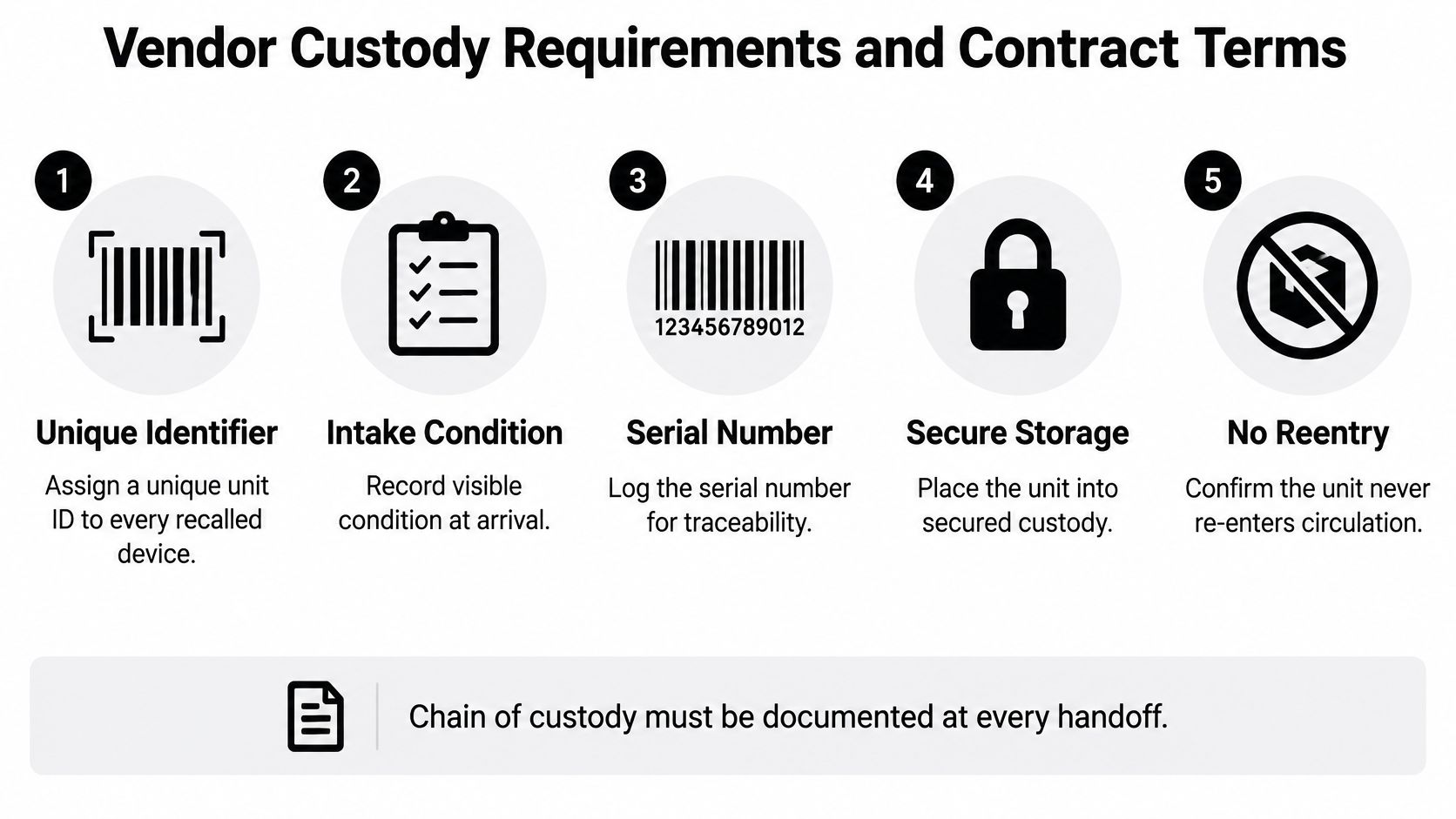
A custody chain should let your team reconstruct a device's movement without relying on someone's memory. Assign a unique identifier, record its serial number and intake condition, place it in marked quarantine, and log each transfer through its authorized final outcome.
The CPSC Regulated Products Handbook advises recalling firms to segregate recalled products and monitor third-party disposal providers. Before processing, determine whether the corrective-action plan calls for approval, witnessed destruction, an affidavit, photographs, or another evidence format.
Require evidence at every handoff
For transport, request access-controlled vehicles, signed manifests, named carriers, and handling instructions appropriate to the load. Require applicable carrier authorizations and disclosure of subcontractors before release, not after a problem occurs.
A vendor that supplies a destruction certificate but can't identify who transported the batch has left a custody gap. The certificate doesn't explain where the equipment was held, who could access it, or whether the certified batch matches the collected inventory.
Require completion records to include:
- Asset identity: Client asset IDs, manufacturer serial numbers, and a controlled exception process for unreadable labels.
- Processing details: Method, processing date, facility identity, and applicable authorization or licensing information.
- Record linkage: A reference connecting the certificate, pickup manifest, processing log, and original asset register.
- Exceptions: Missing units, failed erasures, rejected batteries, and items awaiting manufacturer instructions.
The FTC's Disposal Rule guidance covers businesses possessing consumer reports or derived information for business purposes, including disposal through sale, donation, or transfer of media. It also recommends contractor due diligence using audits, references, recognized certifications, and information-security policies.
Contract clauses to require and the red flags to reject
The deadlines below are example service levels to negotiate, not statutory deadlines or advertised vendor commitments.
| Clause | What to require | Red flag |
|---|---|---|
| Pickup service level | Proposed pickup within 5 business days of request, subject to agreed safe-shipping prerequisites | No stated window or availability-only commitment |
| Certificate turnaround | Proposed certificates within 10 business days after processing | Certificates only on request, without a deadline |
| Chain-of-custody records | Unit-level records from pickup to final outcome | Summary totals without serial-level detail |
| Subcontractors | Written disclosure of transporters and downstream processors | Refusal to identify the downstream facility |
| Audit rights | Facility access and certification review rights, including an annual review | Summary letter offered instead of meaningful audit rights |
| Insurance | Stated minimum transport and processing liability coverage | Missing or expired insurance evidence |
| Breach notification | Proposed notice within 24 hours of discovering a covered incident | No duty or an open-ended timeline |
| Liability and indemnity | Responsibility for loss, theft, and improper disposal, with negotiated limits | A cap disconnected from the fleet's exposure |
Check certification scope, facility address, expiry, and covered activities. R2 or e-Stewards credentials can inform supplier evaluation where applicable, but a logo alone doesn't establish that a particular site or subcontracted operation is covered.
For digitally signed evidence, CertSeal's explanation of how to verify credential revocation status offers useful background. Digital-signature validation is separate from confirming a recycling certification with its issuer.
Compare the complete project cost
Ask bidders to separate collection, battery packaging, quarantine, media processing, witnessed destruction, documentation, and downstream handling. Identify whether value-recovery credits are guaranteed or conditional, and who pays for rejected loads or failed erasures.
Before signing, ask:
- Certification scope: Which credentials cover the processing facility, and can we review the latest audit evidence?
- Handling responsibility: Who holds our equipment at each stage?
- Battery acceptance: Will you accept the recalled battery condition described in our inventory, and under what transport arrangements?
- Audit access: Can we inspect the facility and review subcontractor controls?
Request written details about the provider's own fleet and transport partners through product recall chain-of-custody services. Keep that response with the signed scope so logistics promises become reviewable commitments.
How to Run a Recalled Electronics Disposal Workflow
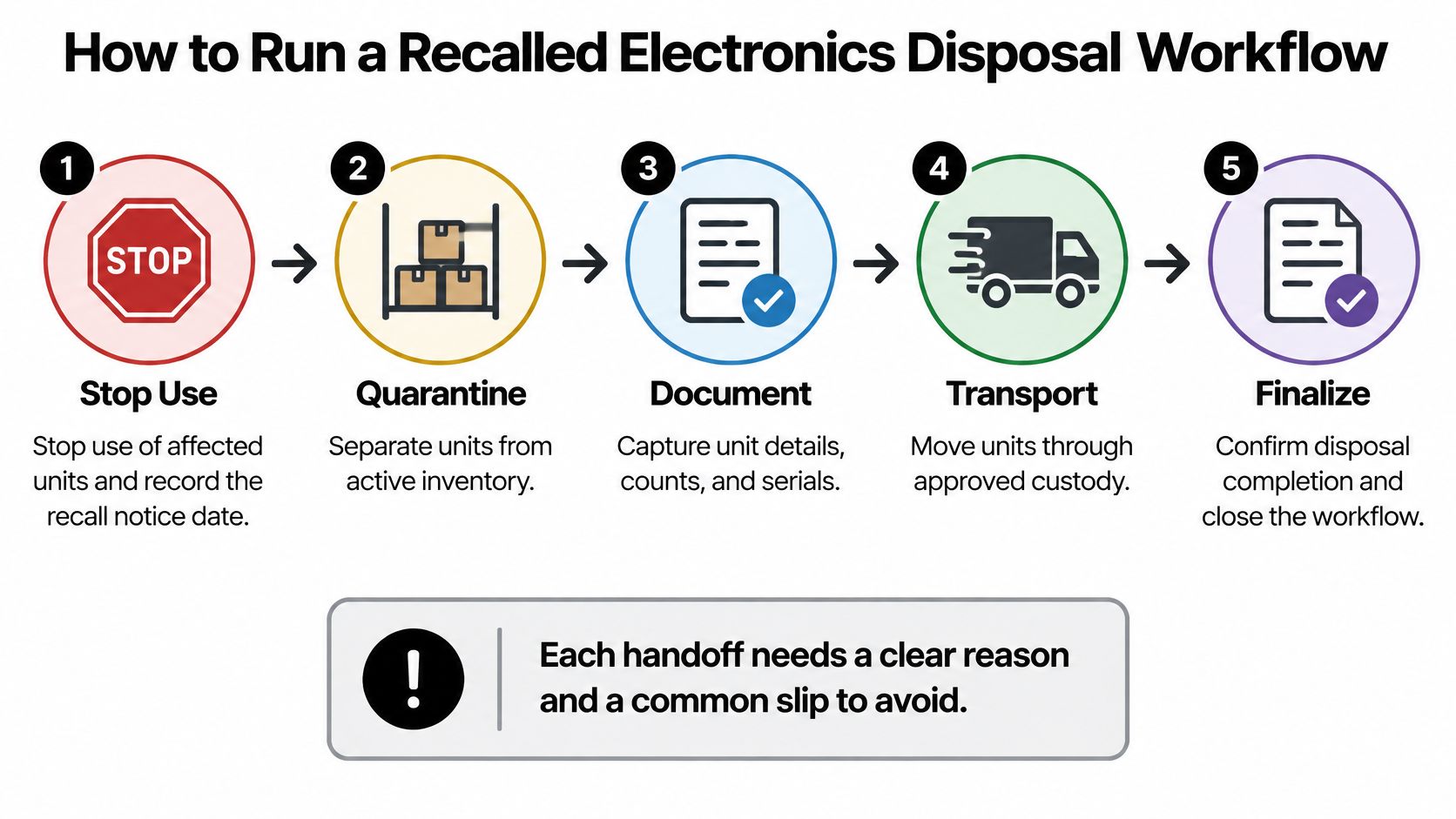
Use a single recall ticket to coordinate IT, facilities, procurement, and the receiving processor. The battery and charger recall notices collected by Justia illustrate why recalled lithium-ion equipment needs acceptance checks rather than routine battery collection.
Execute the handoffs in order
- Stop use and record the notice. Capture when the organization received the recall and assign an owner. Don't leave affected units operating while departments debate who pays.
- Match exact identifiers. Confirm model, serial range, and prescribed remedy with the manufacturer. A product-family name alone can include unaffected equipment.
- Quarantine safely. Separate affected assets from active stock and combustible materials according to the hazard instructions. Don't place a swollen battery beside running equipment or attempt unapproved dismantling.
- Inventory storage media. Inspect the asset configuration and record embedded and removable storage. Don't assume a chassis is empty because its primary drive bay is vacant.
- Obtain receiving acceptance. Describe recalled or damaged batteries accurately and get written acceptance and packaging instructions. Ordinary battery collection isn't a substitute.
- Release against a manifest. Arrange commercial electronics recycling pickup with signed, asset-level custody documentation. Don't release an unidentified pallet.
- Process and verify media. Apply the approved sanitization method and review failures. A tool's completion message shouldn't bypass verification.
- Complete the authorized disposition. Destroy, recycle, return, or release corrected equipment only through its approved route. Don't substitute reuse because a unit still works.
- Reconcile and close. Match certificates and exceptions against the original inventory. Keep unresolved assets open until their evidence arrives.
If a battery is heating, smoking, or otherwise unstable, stop routine handling and follow the site's emergency response procedure. A disposal booking isn't an emergency response plan.
Frequent Questions and Confirming Your Next Step
Can recalled equipment go to a standard recycler?
Only if the recall permits that route and the recycler accepts the specific equipment and condition in writing. General acceptance of laptops or batteries doesn't establish acceptance of recalled, damaged, or defective units.
Ask the recycler to confirm its processing method before shipment. A standard computer recycling agreement may not address manufacturer reporting, quarantine, or recall-specific evidence.
Does a certificate protect the business?
A certificate supports your evidence file, but it doesn't automatically transfer all liability or establish compliance. It should identify the assets, method, date, and facility, and connect to a complete custody record.
Check the certificate against the manifest before approving the invoice. Resolve missing serial numbers, unexplained substitutions, and outstanding exceptions rather than filing the document unread.
Must a working device be destroyed?
Not always. The permitted outcome depends on the recall remedy, the hazard, the data requirements, and any authorized corrective work.
A functional device isn't necessarily safe or eligible for resale. Reuse needs documented authorization and an acceptable sanitization result, not just a technician's confirmation that it boots.
This week's action: Inventory affected serial numbers, confirm the manufacturer's remedy, and request a written scope covering pickup, custody, processing, certificates, and insurance.
Give prospective vendors the same inventory and documentation requirements so their proposals are comparable. Select the route that produces the required outcome with clear evidence, rather than the lowest collection price alone.
Beyond Surplus offers commercial electronics recycling, secure IT asset disposal, data destruction, and logistics coordination for organizations managing recalled equipment. Visit Beyond Surplus to request a recall-specific proposal covering affected assets, approved processing, pickup arrangements, and the documentation your compliance team needs.