
For any business in California, managing retired technology is a critical operational function, impacting everything from data security and environmental compliance to your bottom line. The best California ITAD services go far beyond simple disposal; they provide a strategic, documented process for handling end-of-life IT equipment. Partnering with a certified IT Asset Disposition (ITAD) provider is the most effective way for commercial and enterprise organizations in California to mitigate risk, ensure compliance with state laws, and potentially recover value from obsolete assets.
Why Professional ITAD is a Strategic Necessity in California
In California's highly regulated business environment, the disposal of old computers, data center servers, or corporate laptops cannot be an afterthought. ITAD has evolved from a back-office task into a strategic imperative for any company focused on security and legal compliance. It represents a comprehensive lifecycle management plan for your retired technology, from secure on-site pickup to final, documented disposition.
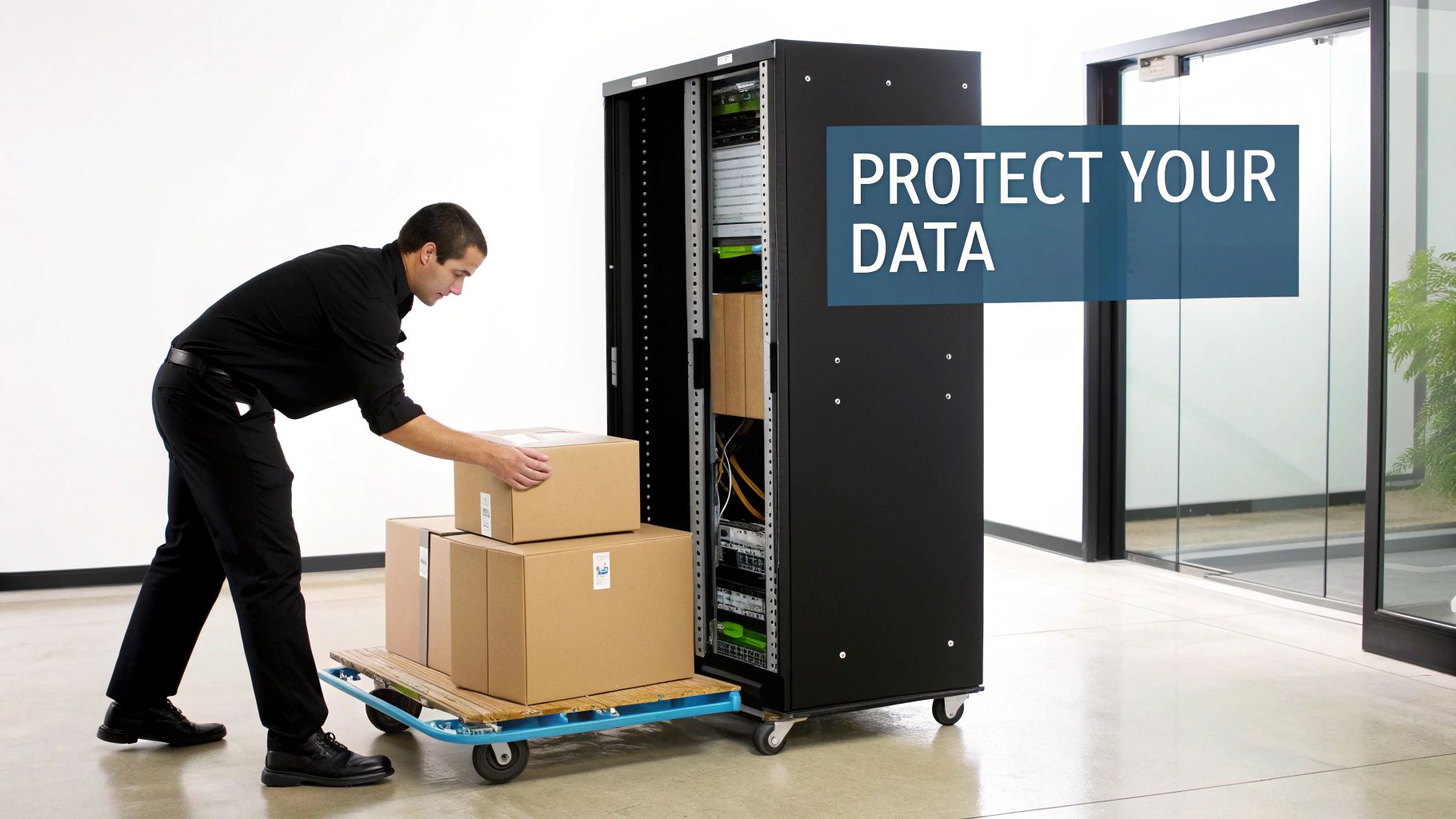
This process is your primary defense against the severe penalties associated with regulations like the California Consumer Privacy Act (CCPA). This legislation mandates the complete and verifiable destruction of all personal data on retired devices. A failure in this area can result in substantial fines and cause significant damage to your corporate reputation.
The Strategic Value of Professional ITAD
Viewing ITAD as mere "electronics recycling" overlooks its broader strategic value. A modern ITAD program is engineered to protect your organization and often creates new financial opportunities. The benefits are multifaceted, directly influencing your data security, regulatory standing, and revenue.
A professionally managed ITAD strategy delivers:
- Ironclad Data Security: The primary goal is ensuring all sensitive corporate and customer data is permanently destroyed, which is the most effective way to protect your company from data breaches with secure data destruction practices.
- Guaranteed Regulatory Compliance: A certified partner provides essential documentation, such as Certificates of Destruction and Recycling, to satisfy state and federal auditors.
- Financial Value Recovery: Experts identify equipment with residual value. These functional assets can be refurbished and resold, turning retired technology into a revenue source.
- Environmental Responsibility: You gain assurance that all materials are processed according to stringent environmental standards, helping your company achieve its sustainability objectives.
Furthermore, this aligns with California's business climate. The state promotes responsible growth through initiatives like the California Competes Tax Credit & Grant Program. By engaging a certified ITAD provider, you align your operations with the state's economic and environmental standards—an essential investment in your company's security and long-term viability.
Navigating California’s Strict Data And E-Waste Laws
Operating a business in California means adhering to some of the nation's most stringent regulations, transforming IT asset disposition from a logistical task into a critical compliance function. The state's legal framework establishes a high standard for both data privacy and environmental stewardship, making professional California ITAD services essential for risk management.
These regulations are mandates, not suggestions. Non-compliance can lead to significant financial penalties and legal repercussions. For any business handling customer or employee data, understanding these rules is the first step toward developing a defensible ITAD program.
The California Consumer Privacy Act (CCPA)
The California Consumer Privacy Act (CCPA), strengthened by the California Privacy Rights Act (CPRA), is a cornerstone of data privacy law. It grants consumers extensive control over their personal information, including the right to demand its deletion.
This directly impacts your ITAD process. When a device is decommissioned, simply deleting files is insufficient. The CCPA effectively requires the complete and permanent destruction of any personal information on those assets. A standard factory reset does not meet this legal standard.
This is precisely why certified data destruction is the foundation of any compliant ITAD service. The methods used must be verifiable and produce a clear audit trail, proving that sensitive data has been irretrievably destroyed. Our guide on NIST SP 800-88 compliance details the government standards for achieving this level of data sanitization.
California’s E-Waste Legislation
Beyond data privacy, California has long been a leader in managing electronic waste. The Electronic Waste Recycling Act of 2003 (SB 20) established a framework to prevent hazardous materials in electronics from contaminating landfills.
This law imposes strict disposal requirements on businesses for "covered electronic devices" (CEDs), a category encompassing nearly all computer and IT equipment.
Key requirements for businesses include:
- No Landfill Dumping: It is illegal to dispose of most electronics in standard commercial waste streams.
- Use Certified Recyclers: You must work with state-approved or certified e-waste recyclers equipped to properly manage materials like lead, mercury, and cadmium.
- Maintain Chain of Custody: You need clear documentation to prove your e-waste was managed responsibly from your facility to its final disposition.
In California, the combination of strict privacy and e-waste laws transforms ITAD from an optional best practice into a mandatory function for nearly every medium and large organization.
This dual regulatory focus means any ITAD partner you choose must be an expert in both data security and environmental compliance. They need the technical capability to destroy data to CCPA standards and the certifications to process the physical hardware in accordance with SB 20.
Federal Overlays and Industry-Specific Rules
Compliance extends beyond state regulations. Many California businesses must also adhere to strict federal laws, adding further complexity to ITAD.
- Healthcare (HIPAA): The Health Insurance Portability and Accountability Act requires robust security for protected health information (PHI). A data breach from an improperly disposed server can lead to multimillion-dollar fines.
- Finance (SOX/GLBA): The Sarbanes-Oxley Act and the Gramm-Leach-Bliley Act mandate that financial institutions protect sensitive financial data, with specific rules for data retention and destruction.
These federal laws reinforce the need for a meticulous, documented process. A certified ITAD provider ensures your data destruction methods meet these stringent requirements and provides the necessary documentation—like a Certificate of Data Destruction—to prove it. The North American ITAD market is projected to reach USD 6.59 billion by 2030, with analysts citing stricter regulations as a primary driver. Discover more insights about these market trends and their drivers to understand how they are shaping business needs.
The Anatomy Of A Secure ITAD Program
What does a truly secure ITAD program entail? It is a methodical, multi-stage process designed to eliminate risk and formally transfer liability from your organization. Understanding these steps is crucial for evaluating potential partners and ensuring your chosen California ITAD services provider meets the highest standards.
A professional program begins long before assets leave your facility, starting with a detailed plan for on-site inventory and asset tagging. Every server, laptop, and hard drive is recorded by its serial number, creating the foundational audit trail for the entire process. This step ensures full accountability from the outset.
Following inventory, secure logistics are implemented. This involves sealed, GPS-tracked vehicles and trained, background-checked personnel handling your assets. The objective is to maintain an unbroken, secure chain of custody, preventing loss or theft during transit.
The Core Of Security: Data Destruction Methods
Upon arrival at a secure facility, the most critical phase begins: data destruction. This is where your company's sensitive information is permanently and irrevocably eliminated. Simple "delete" functions or factory resets are non-compliant and leave data vulnerable. True security requires one of three industry-standard methods.
The flowchart below illustrates how California's key regulations—from data privacy to e-waste management—shape the compliance requirements for any ITAD program.

As shown, compliance is a sequential process of addressing data privacy under CCPA, managing disposal responsibly under SB 20, and adhering to federal standards like HIPAA where applicable.
Professional ITAD providers offer several certified data destruction methods, each suited for different needs.
Comparing Secure Data Destruction Methods
| Method | Process Description | Best For | Key Benefit |
|---|---|---|---|
| Data Wiping (NIST 800-88) | Software overwrites the entire drive with random data, making the original information unrecoverable. | Newer, functional drives that can be resold. | Allows for value recovery through remarketing. |
| Degaussing | A powerful magnetic field scrambles the magnetic domains on a hard drive, instantly destroying all data. | Older or non-functional magnetic media (HDDs). | Extremely fast and effective for bulk destruction. |
| Physical Shredding | An industrial shredder grinds drives into small, unrecognizable pieces, ensuring data can never be put back together. | SSDs, damaged drives, or for maximum security. | The ultimate "proof of destruction" for any drive type. |
An experienced ITAD partner will help you determine the most appropriate method for your specific equipment and security needs.
Finalizing The Process: Reporting And Certification
The final stage is documentation and reporting. A reputable vendor will provide a comprehensive report that concludes the entire process. This package should include a serialized inventory list matching the initial pickup, a Certificate of Data Destruction, and a Certificate of Recycling. You can learn more by exploring our detailed guide on what IT asset disposition is.
This documentation is your official record of compliance with all relevant state and federal laws, including CCPA and SB 20. It demonstrates that every asset was handled securely and all data was destroyed according to certified standards. The use of effective data security practices is central to a robust ITAD program. Demanding this level of transparency is non-negotiable and protects your company long after the equipment has been removed.
Turning Old Tech Into New Revenue And ESG Wins
A modern ITAD strategy extends beyond risk management to actively uncover hidden value. Many California businesses still perceive their retired technology as a disposal cost, an outdated view that overlooks significant opportunities to generate revenue and advance corporate sustainability goals. The key is to shift from viewing old hardware as a liability to recognizing it as a recoverable asset.
This transformation is driven by IT asset value recovery. It is the core of any advanced California ITAD services program, where functional equipment like servers, laptops, and networking gear is tested, data-wiped, and refurbished for resale on the secondary market.

From Cost Center To Revenue Stream
The financial return from value recovery can be substantial. A professional ITAD partner operates on a transparent revenue-sharing model, returning a significant portion of the proceeds from equipment sales to your organization.
This new revenue can be utilized in several ways:
- Offset Service Costs: The revenue generated from asset sales can often cover the entire cost of logistics, data destruction, and recycling.
- Generate Net Profit: For businesses with a large volume of recent, high-value equipment, the program can become a net positive for the IT budget.
- Fund Future Tech Refreshes: Recovered capital can be reinvested into acquiring new technology, making the next upgrade cycle more affordable.
Demand for quality refurbished IT equipment is robust. Across North America, remarketing and value recovery services are projected to grow at a 15.3% CAGR, significantly outpacing the broader ITAD market. This trend is driven by companies seeking to capitalize on the residual value of their assets rather than writing them off.
Connecting ITAD To Corporate ESG Initiatives
Beyond financial benefits, a strategic ITAD program is a powerful tool for advancing your company's Environmental, Social, and Governance (ESG) goals. ESG initiatives are increasingly important to investors, customers, and employees, particularly in a socially conscious market like California.
A value recovery-focused ITAD program directly supports the "E" in ESG by:
- Promoting the Circular Economy: Remarketing extends the useful life of electronic devices, conserving the energy and raw materials required to manufacture new equipment.
- Reducing E-Waste: By finding new users for functional hardware, you actively divert significant amounts of electronic material from the recycling stream.
- Providing Tangible Sustainability Metrics: Your ITAD partner can supply detailed reports quantifying the weight of equipment reused versus recycled—valuable data for corporate social responsibility (CSR) reporting.
By prioritizing reuse through a professional ITAD partner, you are not just recycling—you are actively participating in the circular economy. This demonstrates a tangible commitment to sustainability that resonates with stakeholders and strengthens your corporate reputation.
Ultimately, a modern approach to ITAD redefines the entire end-of-life process. By working with a provider specializing in maximizing asset value, you convert a compliance obligation into a strategic advantage—securing data, meeting California's stringent environmental regulations, and creating a new revenue stream, all while making a measurable impact on your ESG performance.
Learn more about our professional IT equipment buy-back services to see how we can turn your obsolete technology into a new opportunity.
How to Choose the Right ITAD Partner in California
Selecting a vendor for your California ITAD services is a critical business decision that directly impacts your data security, legal compliance, and environmental standing. The right partner acts as a safeguard against data breaches and regulatory fines, while the wrong one can expose your company to significant liabilities. This choice should not be based on price alone.
You must differentiate between a standard electronics recycler and a certified ITAD professional. A legitimate partner provides proof of security through industry certifications, transparent processes, and comprehensive documentation that formally transfers liability away from your business.
Non-Negotiable Industry Certifications
Your first step in vetting any potential ITAD provider is to verify their certifications. These are not merely logos; they represent third-party audited proof that a vendor adheres to strict standards for security and environmental responsibility.
Look for these two primary certifications:
- R2 (Responsible Recycling): This is the global standard for best practices in electronics recycling. An R2-certified vendor is regularly audited for data sanitization, worker safety, and downstream material tracking, guaranteeing that your e-waste will not end up in a landfill.
- e-Stewards: Another premier certification, e-Stewards is known for its rigorous requirements, including a complete ban on exporting hazardous e-waste. It represents the highest level of environmental and social accountability.
A vendor lacking at least one of these certifications presents a major red flag, as they cannot provide verified processes to protect your organization from long-term environmental liability.
Key Questions to Ask Potential Partners
After confirming certifications, delve deeper with specific questions to assess their capabilities beyond the sales pitch.
Use this checklist to guide your discussions:
- Data Destruction Protocols: How do you guarantee 100% data destruction? Do you offer data wiping to the NIST 800-88 standard, degaussing, and physical shredding? Can we witness the destruction of our most sensitive media?
- Chain of Custody and Reporting: What documentation will we receive? Request samples. A top-tier provider will supply a serialized inventory list, a Certificate of Recycling, and a legally binding Certificate of Destruction, which is crucial for liability transfer.
- Downstream Accountability: Where do our assets go after processing? A certified partner will be transparent about their downstream recycling network and provide documentation proving that all components are handled responsibly.
- Insurance and Liability: What types of insurance do you carry? Request a current certificate of insurance. Look for comprehensive general liability, cyber liability (for data breaches), and environmental pollution policies.
- Logistics and Scalability: Can you manage pickups from our multiple locations in California and nationwide? A provider with a robust logistics network is essential for businesses with a distributed footprint, ensuring consistent security and reporting.
A provider’s willingness to offer facility tours and give you detailed, straight answers says a lot. If a company gets cagey about their process or pushes back on a site visit, treat it with extreme caution.
Evaluating Logistics and Nationwide Reach
For companies with offices in Los Angeles, San Francisco, and other locations, logistics are paramount. A partner with a limited service area creates operational challenges. You need a vendor capable of coordinating secure pickups across the state—and potentially the country—using their own fleet or vetted transportation partners.
This creates a unified process. Instead of managing multiple local recyclers with varying standards, you get single-source security, a single point of contact, and centralized reporting. It simplifies compliance and provides a clean, auditable trail for every asset, regardless of its origin.
Choosing the right partner is about securing your data, reputation, and peace of mind.
Making Sense of the Booming ITAD Market
Let’s be clear: professional IT Asset Disposition isn’t some niche, back-office chore anymore. It’s a full-blown industry and a standard part of managing the lifecycle of your IT gear. The days of calling a guy for a one-off pickup are long gone. Today, a certified ITAD program is just good business for any compliant, forward-thinking company in California.
What’s driving this massive shift? It’s a perfect storm of powerful trends. Tech refresh cycles are getting shorter and shorter, meaning businesses are swapping out servers, laptops, and networking equipment faster than ever. At the same time, the sheer volume of data being created is exploding, which raises the security stakes for every single device you retire. Throw in the ever-increasing weight of government regulations, and you can see why specialized California ITAD services are so critical.
The Numbers Don't Lie
The data backs this up, showing a clear move toward formal, ongoing ITAD relationships. California, with its massive concentration of tech infrastructure and famously strict environmental laws, has quickly become one of the most mature ITAD markets in the country.
Looking at the broader picture, the U.S. ITAD market was valued at around USD 11.38 billion in 2023. It’s projected to hit USD 22.93 billion by 2032, growing at a steady clip of roughly 8.1% annually. For IT leaders, this means one thing: secure hardware disposal is now part of a huge, regulated ecosystem. In fact, large enterprises alone account for over 54% of global ITAD revenue. You can dig deeper into these market projections to see the forces shaping the industry.
This market growth points to a fundamental business reality: investing in a certified, long-term ITAD partnership is no longer optional. It's a strategic necessity for any scaling business that needs to keep risk in check.
This all reinforces why you need to think beyond simple recycling and build a durable relationship with a trusted ITAD partner. As your organization grows, so do your compliance headaches and security risks. A dedicated partner is built to scale right alongside you, delivering the consistent, auditable, and secure services you need to protect your business at every turn.
Your California ITAD Questions, Answered
When you're dealing with retiring company hardware, a lot of practical questions come up. Here are some straightforward answers to the questions we hear most often from businesses across California, designed to clear things up and show you what a top-notch ITAD partner should be doing.
Can You Handle Pickups From Multiple California Locations?
Yes, absolutely. One of the biggest advantages of working with a national ITAD provider is the ability to coordinate secure logistics across all your sites. We regularly manage pickups from main offices, data centers, and even remote employee locations throughout California and across the country.
This unified approach is a game-changer for companies with a footprint in cities like Los Angeles, San Francisco, and San Diego. It means you get one consistent process, one chain-of-custody, and one set of reports, all managed by a single partner. Every asset gets the same high level of data security and environmental compliance, no matter where it came from.
What Documentation Will I Receive After The Service?
Once the job is done, you'll get a full documentation package that serves as your proof of compliance and formally transfers liability away from you. This isn't just a simple receipt—it’s the official, auditable record proving every single asset was handled correctly under state and federal law.
Here’s what you should demand:
- A Certificate of Data Destruction: This is your proof that all sensitive data was destroyed for good. It lists the serial numbers of every hard drive and storage device we sanitized.
- A Certificate of Recycling: This confirms that any non-reusable materials were processed responsibly, following a zero-landfill policy and California’s tough e-waste regulations.
- A Serialized Inventory Report: This final report closes the loop. It provides a complete audit trail that matches the initial inventory we took at pickup with the final disposition of each asset.
Is It Possible To Recover Value From Our Old Equipment?
Definitely. This is where a strategic ITAD program really shines and sets itself apart from a basic recycling service. Any assets that still have market value—think recent-model servers, laptops, networking gear, and other enterprise hardware—are carefully tested, wiped clean to NIST 800-88 standards, and professionally refurbished for resale.
The goal is to shift your perspective on retired hardware from a disposal cost to a potential revenue source. A transparent value recovery program can significantly offset or even eliminate your service costs.
A reputable vendor will work on a clear revenue-sharing model, giving a significant portion of the sales proceeds right back to you. This transforms your old IT gear from a compliance headache into a real financial asset, helping you fund your next technology refresh.
Contact Beyond Surplus for certified electronics recycling and secure California ITAD services. Our professional asset disposition programs protect your business data, ensure full compliance, and maximize value recovery for your obsolete IT equipment. Visit us at https://www.beyondsurplus.com to schedule a consultation.


