

A Georgia IT manager finishes a carrier migration, signs off on the install, and then has to deal with the part nobody wants to own. Racks of retired switches, handsets, routers, firewalls, and storage media are sitting in a closet or MDF room waiting for a decision. If that decision is delayed, the gear ties up space, confuses inventory, and keeps risk alive longer than it should.
Old telecom hardware is rarely just old hardware. Some of it still has resale value. Some of it holds sensitive data. Some of it costs more to move and process than organizations often expect. The essential job is turning that mixed pile into a clean business outcome: documented removal, clear liability transfer, and the best available recovery on assets that still belong in the secondary market.
The Growing Challenge of Surplus Telecom Gear in Georgia
Georgia's telecom sector keeps pushing more infrastructure into the field, which means more hardware eventually comes back out. The Georgia Telecom MNO market was valued at USD 537.58 million in 2025 and is projected to reach USD 657.63 million by 2030, reflecting a 4.11% CAGR, according to Mordor Intelligence's Georgia telecom MNO market report. That matters to enterprise IT because more network growth usually means more refresh cycles, more decommissions, and more surplus gear to manage.

Why this becomes a recurring operations problem
Most teams first experience surplus telecom gear as a space issue. Then the second-order problems show up. Finance wants to know whether any value can be recovered. Security wants to know what data may still sit on drives, flash modules, or management appliances. Facilities wants the room back.
That mix is why "just recycle it" usually isn't enough. A practical disposition process separates resale-ready equipment from recycling-only material, documents what left the site, and closes the loop with certificates and reporting.
Practical rule: If you can't say what equipment you removed, where it went, and how data was destroyed, the project isn't finished.
Georgia organizations also have a local advantage. The state has an active business environment for used infrastructure and IT equipment, which can help when a company wants a structured resale path instead of a one-way disposal move. Teams that want a starting point for commercial resale options can review Georgia surplus electronics resale services.
The two goals that matter
A good telecom disposition project balances two outcomes:
- Recover value where it exists: Current-generation or still-supported gear may belong in a buyback channel.
- Reduce exposure where value doesn't exist: Data-bearing assets, damaged units, and obsolete hardware need secure processing and clean documentation.
- Keep the project moving: Fast pickup and disciplined inventory work prevent decommissioned hardware from lingering in production areas.
The mistake I see most often is treating all retired telecom gear the same. It isn't. One pallet may contain resaleable Cisco hardware, low-value handsets, and drives that require destruction. If you don't sort by risk and recoverability, you usually lose value on the good assets and under-manage the dangerous ones.
Identifying and Locating Potential Telecom Buyers
Not every buyer serves the same purpose. When people search for telecom buyers in Georgia, they often mean very different things: a buyer who can pay for late-model hardware, a vendor who can handle chain-of-custody, or someone who can remove old equipment without creating a compliance problem later.
Georgia has a real secondary market to work with. The state's telecom structure includes major carriers and 134 Telecommunications Resellers as of 2026, which supports multiple channels for used equipment sales, according to the Georgia communications market material.
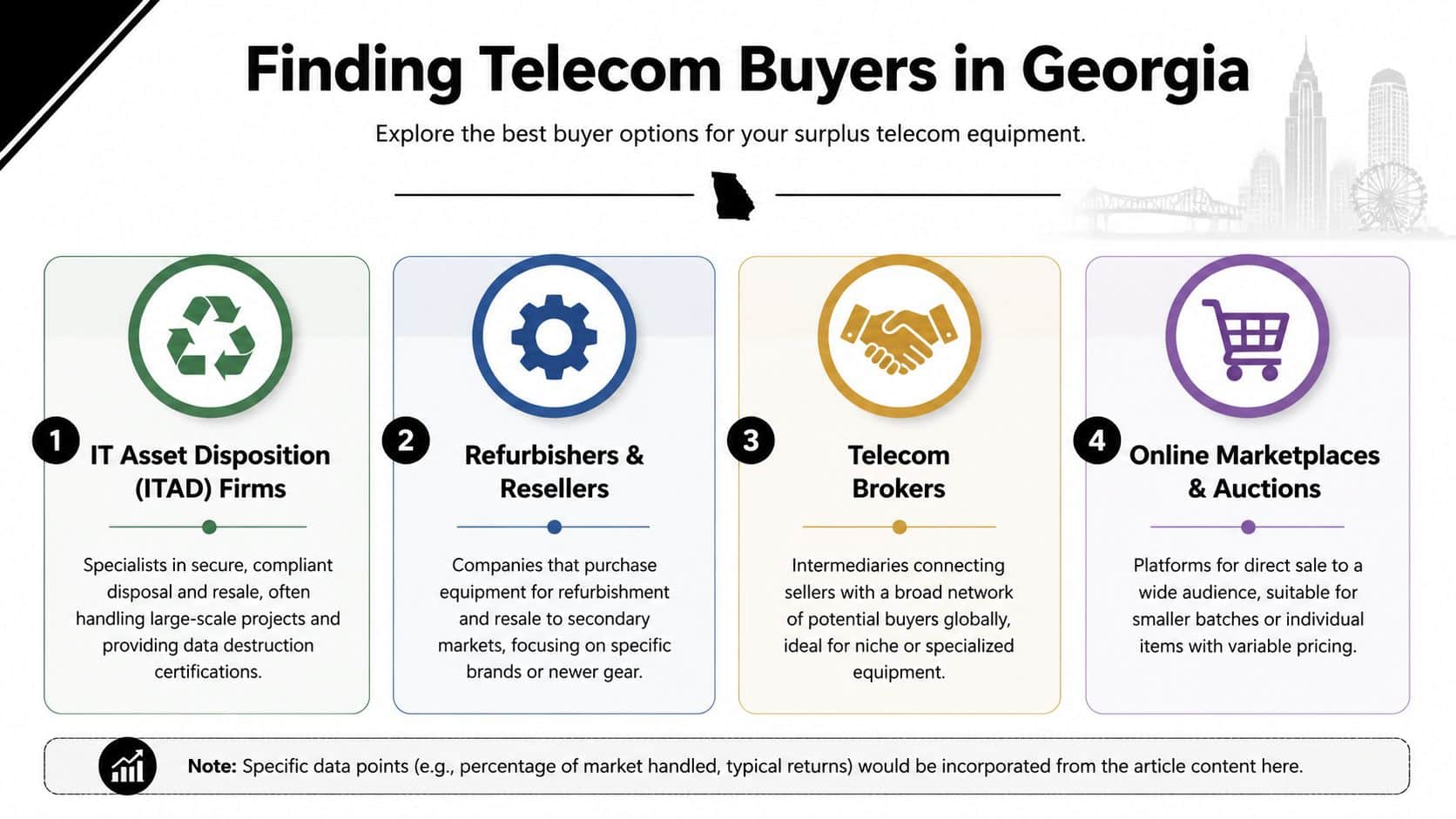
Four buyer types and when each fits
| Buyer type | Best fit | Main upside | Main trade-off |
|---|---|---|---|
| ITAD firms | Mixed lots, compliance-heavy projects, decommissions | One process for pickup, data destruction, reporting, resale, recycling | Payout isn't always the highest on a single premium unit |
| Refurbishers and resellers | Specific brands and cleaner, newer hardware | Strong interest in resale-ready gear | Often selective about what they'll take |
| Telecom brokers | Niche equipment and specialized channels | Access to broader buyer networks | More coordination, less direct control |
| Online marketplaces and auctions | Small lots, patient sellers, non-sensitive items | Direct listing control | More labor, more buyer screening, more data risk |
What works and what doesn't
An ITAD partner makes sense when your lot is messy. That's the normal condition in business environments. A school district, hospital, or multi-site company rarely has a perfect batch of identical resaleable units. It has mixed condition hardware, patchy records, and a hard deadline. In that case, one vendor handling removal, sorting, destruction, and downstream disposition is usually more practical than trying to maximize every single item.
A specialized reseller is a better fit when you already know the equipment is marketable. Think clean lots of routers, switches, IP phones, or firewalls with known models and intact accessories. Those buyers may be more aggressive on pricing, but they may also reject the low-value remainder.
A buyer who only wants your best units isn't solving your decommission. They're solving their inventory needs.
Online marketplaces can work for a few items, but they create hidden labor. Your staff has to photograph gear, verify specs, answer questions, pack shipments, handle disputes, and manage any mistakes in wiping or data removal. That's acceptable for some low-risk assets, but it's rarely efficient for enterprise telecom environments.
Scrap and commodity recycling has a place too. It just shouldn't be your first move for everything. If a lot contains obsolete handsets, damaged chassis, broken accessories, or unsupported equipment with no resale path, scrap processing may be the correct end state.
A useful mindset for mixed assets
Facilities teams already understand this logic with furniture. Some pieces deserve resale, others go straight to removal. The same valuation discipline applies here, and the decision framework behind how to price office furniture assets is useful because it forces you to separate resale candidates from clearance-only material.
For companies that want one commercial channel focused on telecom-specific recovery, telecom surplus buyers is one route to review. The key is matching the buyer type to the outcome you need, not the outcome you hope every pallet will deliver.
How to Accurately Value Your Telecom Equipment for Sale
Most companies misprice telecom hardware in one of two ways. They assume everything is worthless because it's used, or they anchor to the original purchase price and expect the secondary market to care. Neither approach helps.
Many Georgia organizations leave value on the table because they don't understand what the secondary market will still buy and what belongs in certified recycling, as noted by Beyond Surplus's telecom equipment buyback page. That's why valuation has to start with inventory discipline, not guesswork.

Start with a saleable inventory, not a room count
"One telecom room" isn't an inventory. A spreadsheet with actual device detail is.
Capture the basics first:
- Manufacturer and model: Cisco, Juniper, Polycom, Mitel, Panasonic, Shoretel, Toshiba, and similar lines should be listed precisely.
- Quantity and serial numbers: Serial-level detail helps with buyer review and internal signoff.
- Configuration details: Line cards, optics, memory, licensing status, power supplies, rack ears, and included modules all affect saleability.
- Condition notes: Working pull, untested, damaged, missing parts, heavily worn, or incomplete.
- Data-bearing status: Storage appliances, call recording systems, security appliances, and anything with internal media should be flagged.
This first pass usually changes the economics of the project. Teams discover that a few higher-interest units are buried inside a larger low-value lot.
What buyers usually care about
Value isn't just about age. Buyers look at whether they can resell the unit without creating more labor than margin.
The strongest candidates tend to share a few traits:
- Complete units: Chassis plus power supplies and standard accessories.
- Recognizable enterprise models: Especially equipment with ongoing field demand.
- Clean cosmetic condition: Battered hardware can still work, but appearance affects resale confidence.
- Predictable provenance: Equipment removed from a known business environment is easier to place than mixed unknown lots.
Value falls quickly when equipment is obsolete, physically damaged, incomplete, or tied to a shrinking user base. Legacy PBX hardware is a common example. Some components may still move, but entire systems often require selective resale rather than blanket assumptions.
A practical valuation workflow
Use a simple sequence:
- Build the inventory file.
- Separate likely resale from likely recycle.
- Request quotes from more than one commercial buyer.
- Compare bids based on net outcome, not just headline payout.
- Account for pickup, palletizing, wiping, reporting, and residual processing.
The best offer on paper can be the worst project in practice if the buyer leaves you with the hard drives, the scrap, or the freight problem.
A capable buyer should explain why certain assets have buyback value and why others don't. That explanation matters. It gives your finance team a record, helps procurement justify the disposition route, and prevents unrealistic expectations the next time a refresh project closes.
For organizations preparing a sell-side review, how to sell surplus telecom hardware is a useful operational reference. The most important habit is staying realistic. Don't ask, "What did we pay?" Ask, "What can a downstream buyer sell this for after testing, handling, and risk?"
Navigating Compliance and Secure Data Destruction
The hardest lesson in telecom disposition is that a device doesn't need to look like a server to create a data problem. Firewalls, call systems, unified communications appliances, edge devices, storage modules, and some network hardware can all hold sensitive information. Once that hardware leaves your control, documentation matters as much as the destruction method itself.
A major blind spot for telecom buyers in Georgia is the liability created by improper disposal under the FTC Disposal Rule, especially for healthcare and finance organizations that need certified destruction to transfer risk, as described in this Georgia telecom compliance gap summary.

What your team needs to verify before equipment leaves
You need answers to four questions:
- Which assets store data
- Which destruction method applies
- Who controls chain of custody
- What certificate closes the file
If any of those answers are vague, the project isn't ready.
Wiping, degaussing, and shredding
For reusable assets, wiping to NIST 800-88 standards is often the cleanest path because it supports resale while documenting sanitization. For damaged media or assets that shouldn't re-enter the market, degaussing or physical destruction may be the better fit. Physical shredding is often the most straightforward answer when legal, contractual, or internal policy requires irreversible destruction.
The right method depends on the device and your compliance environment. Healthcare, financial, education, and government organizations usually need a written standard tied to internal policy. Verbal assurance from a buyer isn't enough.
Compliance reality: "We removed the drive" is not the same as "We documented destruction and transferred liability."
Certificates are not paperwork for paperwork's sake
A Certificate of Data Destruction and Certificate of Recycling do real work for your organization. They create a record of disposition, show that the devices were processed through a defined method, and support your internal audit trail.
Commercial ITAD providers differ sharply from casual buyers in this regard. A pure reseller may offer payment for hardware, but if they can't document destruction, serial tracking, and downstream handling, they leave your risk team with open questions.
One option for Georgia businesses that need this documentation is data destruction services in Georgia, which covers wiping, shredding, and certificate-backed processing. Whether you use that route or another certified vendor, the requirement stays the same. Get the documentation before you consider the job complete.
What doesn't work
Three habits cause trouble:
- Holding decommissioned gear too long: Devices sit in unsecured rooms and drift off inventory.
- Mixing resale and destruction with no documented split: Nobody can prove what happened to which serial number.
- Letting the buyer define compliance after pickup: Standards should be agreed in writing before removal.
The financial side of a telecom sale matters. The legal side matters more when the hardware contains regulated data.
Vetting Buyers and Managing Logistics for a Smooth Transaction
A serious telecom disposition project should feel procedural. If the buyer's process sounds casual, expect casual results.
Professional ITAD vendors use a structured method that includes asset inventory audits, risk assessment for NIST 800-88 compliance, and transparent chain-of-custody tracking, according to BCG's discussion of telco decommission methodology. That's the standard to compare against when you're screening vendors.
Questions worth asking before you release anything
Don't keep the conversation high-level. Ask for operational detail.
- Certification scope: What certifications do you hold, and what locations or services do they cover?
- Chain of custody: How is equipment tagged, loaded, transported, received, and reconciled?
- Data handling: What sanitization or destruction standards are available for different asset types?
- Reporting: Will you provide serial-level reporting, exception handling, and final certificates?
- Downstream processing: What happens to resale units, scrap material, and nonconforming devices?
A buyer that answers quickly but vaguely usually creates work later. A buyer that can walk you through receiving, audit, and exception handling is usually safer to work with.
Logistics is where projects often wobble
The best quote can still fail in the field if pickup and packaging aren't planned. Multi-site telecom removals need dock coordination, site contacts, loading windows, and clear decisions on whether the vendor is palletizing on site or expecting your team to do it ahead of time.
Use a short planning checklist:
- Define the pickup scope by site, room, and asset category.
- Confirm packaging responsibility before the truck is scheduled.
- Separate data-bearing assets from general telecom hardware.
- Lock the paperwork so the statement of work matches the operational plan.
- Assign one internal owner for access, release approval, and discrepancy review.
Slow projects usually aren't caused by the market. They're caused by weak inventory files, unclear ownership, and pickup plans that were never fully defined.
Put the due diligence in writing
A practical review template saves time, especially when procurement, security, and operations all need to sign off. Teams that want a structured review process can adapt a vendor due diligence checklist to compare buyers on the same criteria.
The right buyer should make the process smaller for your team, not bigger. If your staff is still carrying most of the administrative load after the contract is signed, you haven't bought much risk reduction.
Maximizing Recovery and Minimizing Risk in Georgia
The best telecom disposition projects in Georgia do two things at once. They recover what can still be sold, and they close down security and compliance exposure without leaving loose ends.
That requires a sequence, not a scramble. Identify the buyer type that fits your lot. Build a real inventory. Separate resale candidates from destruction candidates. Vet the vendor's chain of custody and reporting. Then move the material under a service agreement that clearly assigns responsibility.
The business outcome to aim for
A resolved project should leave you with:
- Freed-up space in network rooms, storage areas, and decommission zones
- A documented asset trail that finance, procurement, and security can all use
- Value recovery on hardware that still belongs in the secondary market
- Certificates and records that support internal compliance requirements
In practice, that means treating end-of-life telecom equipment as an asset recovery and risk management workflow, not a junk removal task.
For organizations that want to combine removal, resale evaluation, and compliant processing under one commercial workflow, Georgia asset recovery services is one path to review. The key decision isn't whether to move the old gear. It's whether you'll do it in a way that preserves value and closes liability at the same time.
Frequently Asked Questions About Selling Telecom Gear
Is older PBX equipment worth selling
Sometimes, but not always. Older PBX systems usually need component-level evaluation. Power supplies, interface cards, handsets, and selected modules may still have resale demand even when the full system doesn't. If the lot is incomplete, damaged, or far outside current business use, recycling may be the cleaner path.
What if we only have a small quantity of equipment
You don't need a full data center decommission to justify a professional process. Smaller offices often bundle telecom gear with related IT assets so pickup, documentation, and downstream handling still make sense. The right approach depends on the mix, the presence of data-bearing devices, and whether the assets are concentrated at one site or spread across several locations.
Should we remove drives before requesting quotes
You can, but don't assume it always helps. Removing storage without documenting serial relationships can complicate inventory and reduce resale value on assets that would otherwise qualify for secure wiping and reuse. Many teams get better results by identifying data-bearing units in the inventory and agreeing on destruction standards before pickup.
How long does the process usually take
It depends on inventory quality, site access, and whether the project includes de-installation. A clean inventory and one decision-maker usually move much faster than a mixed lot with open compliance questions. The longest delays typically come from internal approvals, not from the physical movement of equipment.
How do we find companies that buy telecom equipment
Start with commercial buyers that understand enterprise hardware, not just general recyclers. Look for vendors that can explain resale criteria, data destruction methods, chain-of-custody controls, and what happens to non-resale material. A practical place to compare options is companies that buy telecom equipment.
What's the biggest mistake sellers make
They wait too long and treat everything the same. By the time the project gets attention, records are weaker, storage conditions are worse, and nobody is sure which devices still contain sensitive data. Early inventory work usually improves both recovery and control.
If you're dealing with surplus telecom hardware, don't leave the outcome to a reseller quote and a pickup date. Beyond Surplus helps Georgia organizations handle telecom equipment removal with asset recovery, secure data destruction, recycling, and documentation that closes the loop for IT, compliance, and operations.


