
A telecom refresh usually leaves the same scene behind. A cage full of routers, switches, optics, PBX gear, and transport hardware that no one wants to touch because the team is already busy with the new deployment.
That pile isn't just old equipment. It's a mix of recoverable value, security exposure, and compliance responsibility. If you treat it like cleanup, you usually get the worst outcome on all three fronts. Assets sit too long, buyer interest drops, and devices move without enough documentation.
The practical question isn't just how to sell surplus telecom hardware. It's how to sell it fast enough to protect value, while controlling data destruction, chain of custody, and final reporting.
From Storage Burden to Strategic Asset
Most IT teams inherit surplus telecom hardware at the worst possible moment. The migration is complete, the budget is closing, and the retired gear is sitting in a rack room or warehouse waiting for “later.” That delay is expensive because telecom hardware ages fast, and it's risky because network gear often retains sensitive configuration data long after shutdown.

This isn't a niche issue. The global telecom equipment market is projected to reach USD 603 billion by 2034, with rapid upgrade cycles tied to 5G and IoT, which means a steady stream of displaced equipment entering secondary channels, according to telecom equipment market projections from Global Market Insights.
What changes when you treat it as disposition
A disciplined sale starts with the same mindset used in procurement. You define ownership, timing, asset status, and required paperwork before anything leaves the building.
That means building disposition into your broader IT asset lifecycle management process, not waiting until storage fills up.
Practical rule: The resale project and the data security project are the same project.
What usually works and what doesn't
What works:
- Early triggers tied to site closures, carrier migrations, and refresh projects
- Named ownership between IT, facilities, procurement, and compliance
- A controlled outbound process with manifests, deadlines, and approved buyers
What doesn't:
- Ad hoc sales by whoever has time
- Loose storage with mixed revisions and missing accessories
- Separating security from resale as if one team can “wipe it later”
When teams handle value recovery and security together, decisions get cleaner. Equipment is assessed while it still has market relevance. Drives and data-bearing components are identified before shipment. Liability transfer is documented instead of assumed.
Building Your Value Recovery Inventory
Buyers don't pay top dollar for vague lists. They pay for certainty.
A spreadsheet that says “Cisco switches, qty 24” forces the buyer to assume missing parts, mixed revisions, unknown optics, cosmetic damage, and extra testing time. A buyer-ready manifest does the opposite. It reduces uncertainty, which improves pricing and speeds up the quote cycle.
What belongs in a buyer-ready manifest
A strong inventory should capture:
- Exact platform details including manufacturer, model, and revision
- Configuration data such as supervisors, line cards, power supplies, memory, rails, optics, and installed modules
- License status if transferability affects resale
- Physical condition including rack rash, broken tabs, missing faceplates, or bent ports
- Quantity by like item so buyers can quote lot value cleanly
- Photos of fronts, rears, labels, and internal card populations when relevant
A buyer-ready manifest can boost offers by 25-35%, and failing to separate revisions can cut perceived value by 20%, according to guidance on selling used telecom equipment for cash.
Good manifest versus bad manifest
Bad
- “Juniper routers, 8 units”
- “Cisco gear on two pallets”
- “Some optics included”
Good
- MX model family separated by revision
- Chassis listed with installed cards and power supplies
- Optics counted by type and packed with host hardware
- Serial numbers or asset tags tied to pallet location
- Photos matched to manifest lines
A manifest is a pricing tool, not an administrative afterthought.
How to prepare equipment for quoting
The best results usually come from staging assets in commercial lots before the first RFQ goes out.
- Group like with like. Keep identical chassis together. Don't mix old and newer revisions on the same line item.
- Bundle related parts. Rails, faceplates, transceivers, and power supplies should stay with the parent unit when they affect marketability.
- Label pallets clearly. If pallet labels match the manifest, receiving disputes drop.
- Photograph what the buyer needs to verify. Fronts, backs, labels, and internals where card population matters.
Even smaller organizations can borrow useful habits from warehouse discipline. This guide to optimizing small business inventory is focused on storage operations, but the same logic applies here. Clear categorization and traceable location data make liquidation faster and less error-prone.
The common inventory mistake
Teams often collapse multiple revisions into one line because it feels efficient. It isn't. The buyer then has to protect margin by assuming the lowest-value variant or planning to re-test everything. That's where low offers start.
If you want strong bids, make the lot easy to understand, easy to inspect, and easy to move.
Understanding the True Value of Your Telecom Hardware
The resale value of telecom hardware comes from relevance, not original purchase price. Buyers care about whether the platform still fits active deployments, whether the unit can be tested and remarketed quickly, and whether the configuration is complete enough to avoid parts chasing.

The main drivers of price
In practice, buyers look at five things first:
| Factor | Why it matters |
|---|---|
| Platform relevance | Active demand supports stronger bids |
| Condition | Clean, working units are easier to remarket |
| Configuration | Cards, optics, licenses, and memory change value materially |
| Lot size | Larger lots are easier to buy and resell |
| Documentation | Better manifests reduce buyer risk |
For a reliable benchmark across active resale channels, specialized enterprise telecom equipment resale services typically outperform generic disposal routes. They align valuation with actual secondary demand instead of scrap assumptions.
Timing is the hidden cost
Holding hardware in storage feels safe because nothing has happened yet. Financially, a lot is happening.
Surplus telecom gear can lose 50% of its resale value within 6 to 12 months after End of Life, according to used telecom equipment buyer guidance. After that window, gear that once had active remarketing value may be viewed as recycling inventory instead.
The worst time to start selling is after the business has emotionally decided the equipment is junk.
What valuation gets wrong when teams rely on marketplace searches
A quick search on eBay can mislead internal stakeholders for two reasons. First, listing prices aren't executed prices. Second, isolated unit pricing doesn't reflect the cost of testing, packaging, warranty expectations, and returns.
That's why professional valuation looks at channel fit, not just visible listings. A chassis with complete cards and current demand may belong in wholesale remarketing. An incomplete lot with uncertain condition may be better sold as-is. Completely obsolete gear may go straight to certified recycling.
The right question isn't “What did this cost us?” It's “What can this lot recover today if we move it in the right channel before demand fades?”
Ensuring Data Security Before a Sale
Used telecom hardware often contains more intelligence than people expect. Routers, firewalls, switches, PBX systems, and appliances may retain configs, cached credentials, call routing data, logs, VLAN details, and management settings. Turning the device off doesn't remove that risk.
The critical mistake is treating sanitization as a post-sale detail. It has to be a release requirement.
Why resale can increase liability if the process is weak
The compliance gap appears during the handoff. Many buyers know how to purchase and remarket equipment, but they don't operate with the documented controls expected in regulated environments.
That exposure is a real blind spot. Telecom resale compliance guidance notes that many resellers focus on value recovery but lack certified data-destruction infrastructure, which creates liability for the seller, especially in healthcare and finance.
What a defensible sanitization process looks like
For assets intended for resale, use documented wiping aligned with NIST SP 800-88 data sanitization practices. For failed drives or media at end of life, physical destruction is often the safer path because resale isn't worth the uncertainty.
A defensible process usually includes:
- Serialized intake records at pickup or decommissioning
- Clear identification of data-bearing components
- Approved wipe or destruction method based on asset condition and reuse plan
- Exception handling for failed media, locked devices, or undeclared storage
- Certificates and audit trail tied back to the original manifest
Selling first and asking about data later reverses the order that protects your organization.
A practical vetting lens for buyers
Before releasing hardware, ask direct operational questions:
- Who controls chain of custody from dock pickup to processing?
- Where does sanitization occur, and is it documented by serial number?
- How are exceptions handled when a device can't be wiped?
- What final certificates are issued, and do they match the manifest?
If your internal stakeholders need a broader primer on identifying security vulnerabilities and information risks, that framework is useful because the same principle applies here. Unknown data paths become business risk when ownership is unclear.
Security doesn't reduce resale value when it's built into the workflow. It protects the transaction from becoming a future incident.
Choosing the Right Channel to Sell Your Equipment
There isn't one universal sales channel for every telecom asset lot. The right route depends on your mix of priorities: speed, workload on your team, value recovery, and proof of compliance.
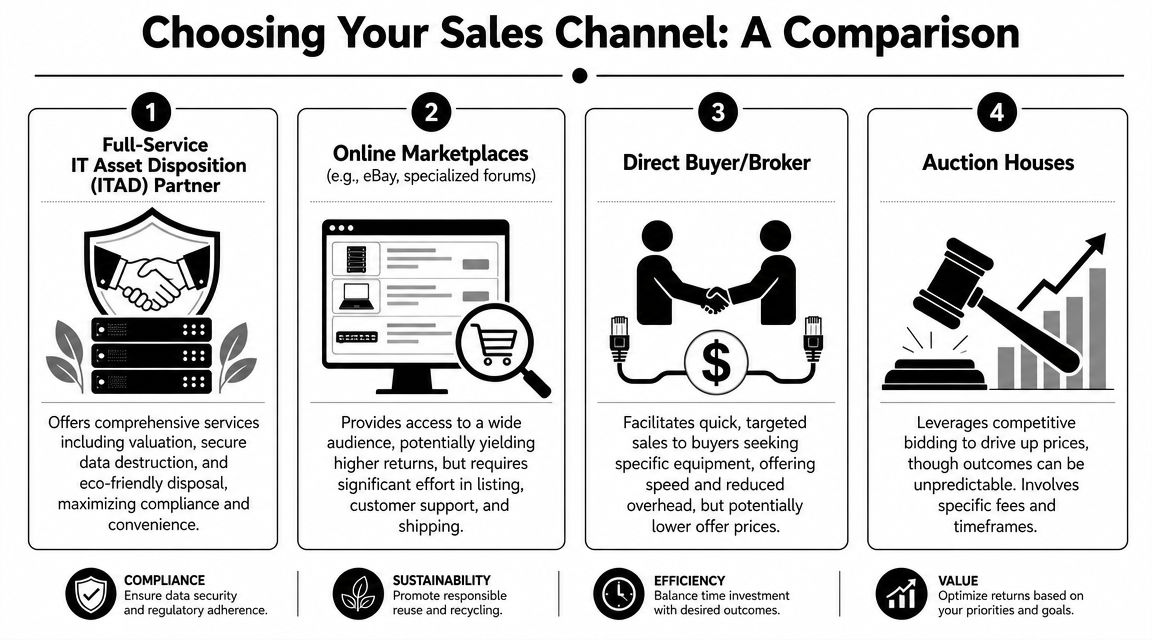
Four common channels and their trade-offs
| Channel | Best fit | Main trade-off |
|---|---|---|
| Full-service ITAD partner | Organizations that need security, logistics, and reporting | Revenue is tied to service scope and channel strategy |
| Online marketplaces | Teams with time to list, pack, support, and ship | High internal effort and weaker compliance controls |
| Direct buyer or broker | Fast movement for known-demand gear | Pricing can be narrower if the buyer is selective |
| Auction service | Broad liquidation where certainty matters less | Outcomes can be unpredictable |
Where informal selling breaks down
Marketplace selling looks attractive when someone spots a high listing price for a single unit. But enterprise telecom liquidation rarely behaves like a hobbyist sale. You still need testing, photos, packaging, freight coordination, support, and a plan for exceptions.
Structured ITAD workflows can achieve 20-40% higher resale yields than informal channels, and post-destruction testing plus wholesale remarketing can produce 2-3x the return of selling individual units on eBay, according to secondary market ITAD benchmarks.
That doesn't mean marketplaces never work. It means they work best when the lot is small, the equipment is easy to support, and your team can absorb the labor.
When each route makes sense
Choose an ITAD partner when the project includes data-bearing equipment, multiple sites, strict reporting, or mixed resale and recycling outcomes.
Choose a broker or direct buyer when you have concentrated demand in a known product family and want quick bids with less internal handling.
Use marketplaces only if your team is prepared to act like a seller, not just an owner of old equipment.
Use auctions when speed of liquidation matters more than precision.
One practical option in the ITAD category is selling used network switches and routers through a structured buyer workflow, where valuation, data handling, and logistics are managed as one process rather than split across vendors.
Channel choice should follow operational reality. If your team can't test, ship, support, and document the lot, the highest visible asking price isn't the highest return.
Managing Logistics and Finalizing the Transaction
The final phase is where good planning either holds together or falls apart. Once equipment starts moving, you need chain-of-custody discipline, clean title transfer, and final documents that stand up to audit.

What to lock down before pickup
Use a written release checklist. At minimum, confirm:
- Manifest-to-pallet match so shipped assets align with quoted assets
- Signed transfer records showing who released and who received the lot
- Data-bearing segregation for anything requiring separate handling
- Pickup scope including loading method, site access, and freight responsibility
For larger projects, dedicated telecom liquidation services can simplify fleet scheduling, palletization, dock coordination, and multi-site consolidation.
The documents that matter after the truck leaves
You want paperwork that closes the loop, not vague confirmation emails.
Ask for:
- Serialized reporting with final disposition by asset
- Certificate of Data Destruction where sanitization or shredding occurred
- Certificate of Recycling for non-remarketable material
- Settlement statement showing payment or credit outcome
What experienced teams watch closely
Most disputes happen when one of three things is missing: a complete manifest, a documented custody trail, or a shared understanding of condition at pickup.
If the handoff is well documented, title and liability transfer are easier to defend. If it's loose, every later question becomes expensive.
Frequently Asked Questions About Selling Telecom Hardware
Can I sell hardware with expired or non-transferable licenses
Yes, but don't assume the software adds value. Quote the physical hardware accurately and disclose license limitations up front. Hidden licensing problems slow deals and create post-sale disputes.
Is very old telecom hardware still worth selling
Sometimes, but not always through resale. Older gear may still have demand for spares, parts harvesting, or niche legacy environments. If there's no secondary market, certified recycling is the cleaner path.
Should I sell components separately or as full systems
It depends on what makes the lot easier to buy. Optics, rails, and cards often strengthen the value of a complete chassis sale. In other cases, high-demand components can be sold separately if the remaining hardware still has a viable outlet.
What's the difference between a recycler and a remarketer
A recycler focuses on material recovery and compliant end-of-life processing. A remarketer focuses on testing, refurbishment, and resale into secondary markets. Many organizations need both outcomes in the same project.
What if the buyer is overseas
Cross-border transactions can add customs complexity, export paperwork, and landed-cost uncertainty. If your lot may move internationally, this overview of managing international import duties is a useful reminder that logistics planning affects net recovery, not just transit.
What's the simplest way to avoid low offers
Send a clean manifest, disclose condition accurately, separate data-bearing assets, and choose a channel that matches your team's actual capacity. Most low offers start with missing information, not aggressive buyers.
If you need a documented process for telecom buyback, secure data destruction, logistics coordination, and final certificates, contact Beyond Surplus.