
Retired telecom gear stops being “old equipment” the moment a network refresh, lease exit, bankruptcy filing, or data center shutdown hits the calendar. It becomes a balance-sheet problem, a security problem, and a logistics problem at the same time. That's why telecom liquidation services matter.
The urgency is real. The global telecom equipment market saw a historic 11% revenue decline in 2024, the sharpest drop in over two decades, which pushed excess inventory into liquidation across categories like RAN and routers, according to Beyond Surplus on telecom equipment liquidation. For IT directors, facilities teams, and compliance officers, that kind of downturn changes the conversation. Surplus hardware isn't scrap by default. It's a mixed inventory of reusable assets, regulated data-bearing devices, batteries, cabling, and commodities that need different handling paths.
A disciplined liquidation program separates what can be resold, what should be refurbished, what belongs in parts harvesting, and what has to be recycled or destroyed. In regulated environments, that sorting decision carries legal consequences as much as financial ones.
The Growing Need for Telecom Liquidation Services
Telecom liquidation services have become more important because telecom infrastructure ages unevenly. A company may replace VoIP handsets on one floor, routers in a regional facility, structured cabling in a call center, and power backup units in a data room, all on different cycles. Then one merger, closure, or technology standard shift forces everything into one project.

Why surplus telecom equipment is different
Telecom assets create more operational friction than standard office IT. A retired laptop fleet is usually a straightforward ITAD event. A telecom site shutdown is not. It often includes rack-mounted switching gear, optics, patch panels, UPS systems, batteries, proprietary cards, copper and fiber runs, and paper records tied to carrier relationships or customer service operations.
That mix creates competing priorities:
- Security first: Routers, switches, and telecom servers may retain sensitive customer or operational data.
- Speed matters: Delays can collide with lease surrender dates, contractor schedules, or insolvency timelines.
- Residual value varies: A clean, marketable unit and a damaged unit from the same rack may follow completely different downstream paths.
- Documentation is mandatory: Audit trails have to survive legal review, not just internal asset tracking.
What effective teams do
Strong organizations don't wait until the loading dock is full. They plan asset disposition while systems are still live. They map inventory, identify resale candidates, isolate data-bearing devices, and assign secure handling requirements before removal starts.
Practical rule: Telecom liquidation works best when asset recovery planning starts before de-installation, not after equipment is piled in a staging room.
For companies trying to reduce exposure and recover value from retired network infrastructure, a structured telecom asset recovery program is usually more effective than treating the project as a last-minute cleanout. That's especially true in healthcare, finance, and dense data center environments, where mistakes travel quickly from operations into compliance.
Deconstructing the Core Components of Liquidation
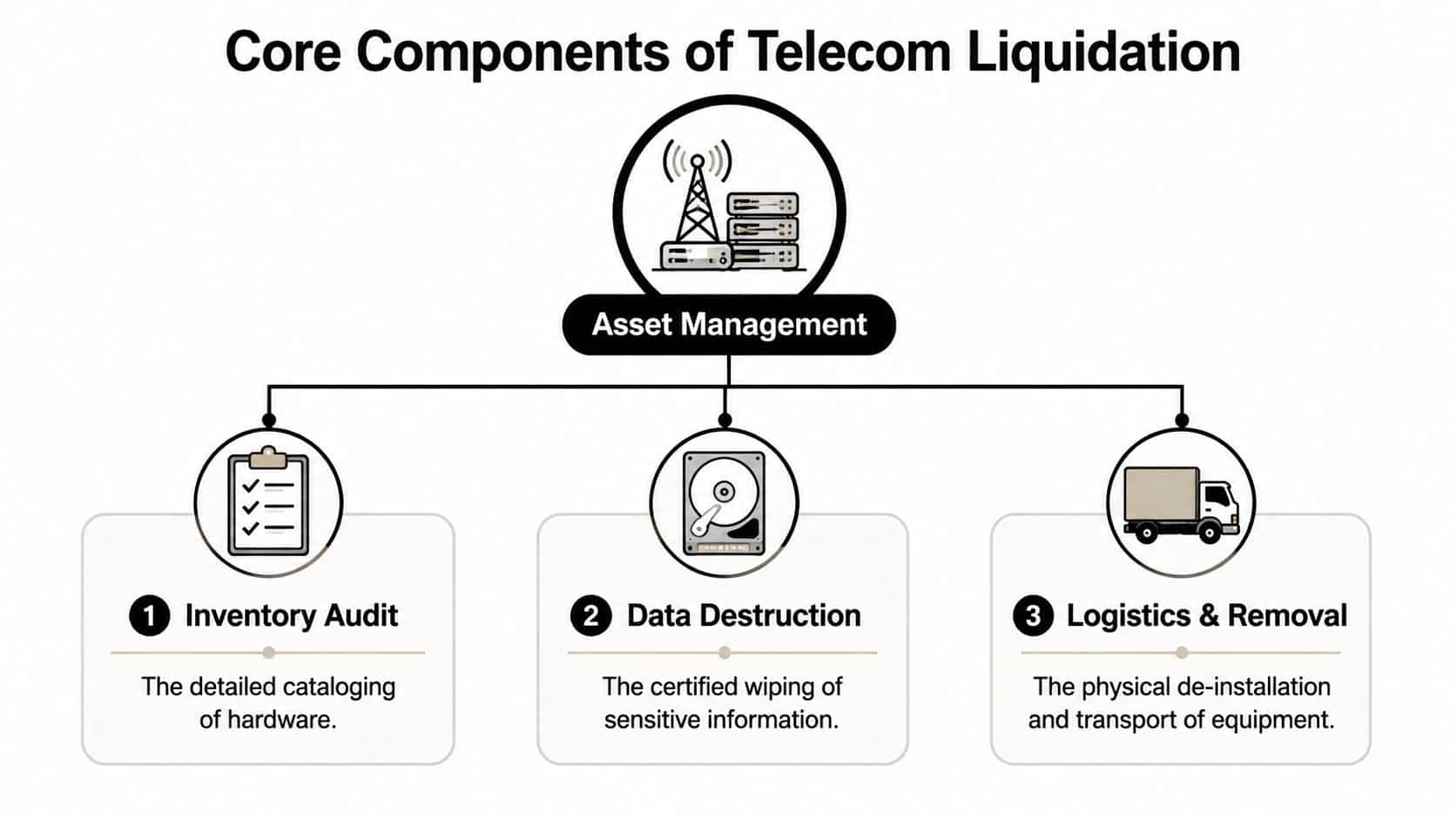
A good telecom liquidation partner functions a lot like a specialized general contractor for technology shutdowns. One team may be visible on site, but the project only works because several technical workstreams are coordinated in parallel. If one piece slips, the whole job slows down or creates risk.
The six workstreams that define real telecom liquidation
Professional telecom liquidation involves at least six concurrent technical workstreams: technology de-installation, structured cabling removal, confidential document destruction, battery backup decommissioning, furniture and fixture liquidation, and equipment removal logs with disposal certificates, as noted by MIWEC's call center liquidation overview.
Those workstreams sound simple until they overlap on an active site.
A rack can't be removed casually if patching documentation is incomplete. Batteries can't be moved carelessly if discharge and environmental handling are part of the scope. Documents can't be left in file cabinets if the site is tied to regulated customer records. Furniture can't block removal routes if crews need safe extraction paths for cabinets and UPS units.
Inventory is not just counting boxes
An inventory audit should answer three questions. What is it. What condition is it in. What's the right downstream channel.
That means cataloging make, model, quantity, configuration, and physical condition, then grouping assets into categories like resale, refurbishment, parts harvesting, recycling, or destruction. Teams managing broader infrastructure transitions often benefit from reviewing how core IT infrastructure components fit together, because telecom liquidation rarely happens in isolation from servers, storage, power, and network dependencies.
A weak inventory process leads to predictable mistakes:
| Problem | What goes wrong |
|---|---|
| Mixed staging | Resalable gear gets damaged or lost |
| Poor labeling | Chain-of-custody records become unreliable |
| No market separation | High-value units get sold as low-grade scrap |
| No site photos | Disputes become harder to resolve |
Data destruction and removal have to move together
The most common planning failure is treating data destruction as a later step. In telecom liquidation, it's usually part of the removal plan itself. If a switch, router, telecom server, or storage element holds sensitive information, the disposition path should already be defined before the tech unbolts it from the rack.
Liquidation succeeds when the inventory list, wipe plan, de-installation sequence, and transport manifest all match.
That's also why many enterprises use specialized bulk telecom equipment buyers only after they've confirmed which assets are marketable, which require processing, and which need destruction records. Buyers, recyclers, logistics crews, and compliance teams all touch the same project. The value comes from coordination, not from any single step by itself.
Navigating Complex Compliance and Chain of Custody
The fastest way to turn a liquidation into a liability event is to lose custody documentation. In telecom environments, data often sits in places non-technical stakeholders overlook. Routers, switches, telecom servers, voice systems, and storage-adjacent devices can all create exposure if they leave the site without a verified destruction or sanitization path.

Why chain of custody matters so much
During rushed bankruptcies in recent telecom Chapter 11 filings, up to 70% of firms fail to document chain-of-custody for data-bearing assets, exposing them to FTC Disposal Rule fines of up to $46,517 per violation, according to reporting on telecom Chapter 11 protection trends. That's the kind of risk that changes executive attention fast.
Chain of custody is not abstract compliance language. It's a defensible record showing who handled an asset, when it moved, how it was secured, and what happened to the data on it. In healthcare and finance, that record supports broader obligations tied to privacy and records protection. In government and education, it supports procurement accountability and public-sector audit readiness.
What good documentation looks like
A reliable custody trail usually includes:
- Asset identification: Tags, serial numbers, site references, and condition notes
- Handling records: Pickup logs, technician signoff, and transport documentation
- Processing proof: Sanitization records, shredding confirmation, or destruction details
- Final certificates: Formal documentation for recycling and data destruction
If a company has ever had to use a certified data recovery lab after failed media handling, it already understands a hard truth. Data-bearing equipment deserves specialized processes. Liquidation shouldn't be looser just because the hardware is leaving the building.
Liability transfer only happens with proof
A vendor saying “we wiped everything” isn't evidence. The client needs documentation that can stand up in an audit, legal review, or customer inquiry. That's where a formal certificate of destruction becomes practical, not ceremonial. It closes the loop between removal and proof.
Risk check: If your provider can't show exactly when custody began, who handled the asset, and how destruction was documented, liability likely hasn't moved off your organization.
In regulated sectors, that distinction matters more than any resale estimate. Security failures are harder to unwind than missed recovery value.
The Step-by-Step Telecom Liquidation Process
Most telecom liquidation projects succeed or fail before the first rack screw comes out. The process needs sequencing. Teams that improvise usually discover conflicts between facilities access, technical dependencies, transport timing, and downstream processing.

Step 1 through Step 3
Scope definition Start with the site list, equipment classes, access rules, shutdown windows, and documentation needs. Teams use this phase to identify what's still in use, what can be removed immediately, and what must wait for cutover.
Asset discovery and tagging
The project team verifies inventory on site. Photos, serials, rack locations, and condition notes matter because they support valuation, chain-of-custody records, and removal planning.De-installation planning
Removal crews need a sequence. Power-down procedures, battery handling, cable labeling, elevator access, pallet staging, and dock scheduling all belong here.
Why speed can't be improvised
In telecom bankruptcies, a two-month deposit requirement for network capacity can deplete all available cash, forcing liquidation timelines into days rather than weeks, according to Jones Walker's telecom bankruptcy analysis. Even outside bankruptcy, that same timing pressure shows up during lease exits, consolidations, and emergency site closures.
When the window compresses, teams don't have time to build processes from scratch. They need pre-staged labels, removal routes, approved transport methods, and clear downstream instructions before the first truck arrives.
The cleanest projects aren't always the slowest. They're the ones where every item already has a destination before removal begins.
Step 4 through Step 6
Secure transport
Once assets are off the floor, transport becomes part of the control environment. Loads need manifests, custody records, and routing discipline.Processing and settlement
At the receiving end, equipment is tested, sorted, wiped, dismantled, harvested for parts, recycled, or destroyed according to the agreed path. Value-bearing equipment is separated from commodity material quickly so it doesn't get blended into lower-value streams.Final reporting
The client should receive concise documentation: what was removed, what was wiped or destroyed, what was recycled, and what generated recovery value.
A linear process sounds basic, but that's the point. Telecom liquidation gets risky when everyone assumes someone else is managing the handoffs.
Maximizing Value Recovery and Understanding Costs
The biggest financial mistake in telecom liquidation is assuming all retired hardware is scrap. It isn't. Some assets have resale value. Some are worth more as parts. Some belong in certified recycling. The job is to route each category correctly before damage, delay, or poor handling destroys the return.

Where value actually comes from
According to Data Center Dynamics on the DZS liquidation process, firms entering Chapter 7 liquidation often recover only 10% to 20% of asset value, while strategic liquidation with data-wiped 5G and wireless assets can retain 40% to 60% of resale value. The same source notes a global e-waste recovery market worth over $62 billion annually.
That gap exists because “liquidation” can mean two very different things. One version is a distressed fire sale where everything gets pushed out quickly at low yield. The other is structured disposition, where marketable telecom hardware is tested, sanitized, and routed to buyers who still need it.
Common recovery channels
- Direct resale: Best for clean, functional, in-demand hardware
- Refurbishment: Useful when testing, cleaning, or minor fixes enable resale
- Parts harvesting: Optics, fans, modules, and power supplies often matter more than the full chassis
- Commodity recycling: Appropriate for low-demand or damaged material
- Destruction: Necessary when security, damage, or policy requirements remove resale as an option
Consumer refurbishing markets can help illustrate how secondary demand works. Even guides on the best refurbished iPhones show the same basic principle: condition, testing, and trust in the processing chain determine what buyers will pay. Telecom gear follows that logic, just with higher stakes and more technical screening.
How pricing usually works
Not every liquidation project fits the same commercial model. Providers may structure work as:
| Model | Best fit |
|---|---|
| Fee for service | Heavy labor, low resale inventory, strict compliance scope |
| Revenue share | Mixed-value inventory with a measurable resale channel |
| Outright purchase | Homogeneous, marketable equipment with clear demand |
For companies evaluating recovery options, a formal telecom equipment buyback program can make sense when the inventory includes reusable business telecom hardware rather than mostly end-of-life scrap. The key is transparency. If the vendor can't explain why assets fall into a given value tier, the client won't know whether the settlement is reasonable.
How to Select the Right Liquidation Partner
Vendor selection determines whether telecom liquidation reduces risk or creates more of it. A polished sales pitch doesn't tell you much. Process detail does.
Green flags worth looking for
Start with operational clarity. Ask how the provider handles data-bearing telecom equipment, batteries, structured cabling, and mixed-site inventories. A credible partner should be able to describe custody controls, de-installation methods, downstream channels, and reporting outputs without speaking in generic slogans.
Look for signs of discipline:
- Documented methods: Clear sanitization, destruction, and recycling procedures
- Audit-ready reporting: Asset logs, certificates, site summaries, and exception handling
- Real logistics capability: Ability to coordinate pickups, site access, and packaging requirements
- Sector familiarity: Experience with healthcare, finance, education, government, and data center environments
- Transparent settlement logic: A defensible explanation of resale, recycling, fees, and deductions
Red flags that usually lead to trouble
Some warning signs appear early.
- Vague answers about data destruction: If the vendor can't explain the process, assume the process is weak.
- No mention of chain of custody: That usually means paperwork is an afterthought.
- One-size-fits-all pricing: Telecom environments vary too much for blanket assumptions.
- No downstream visibility: If they won't explain where equipment goes, your risk doesn't disappear.
- Thin documentation: Certificates issued without supporting removal records are not enough.
Ask a simple question: “What would you hand me after the project if I were audited six months from now?” The quality of that answer tells you a lot.
A structured vendor due diligence checklist helps procurement and IT teams compare providers on evidence instead of impressions. That's especially useful when multiple stakeholders are involved and one group is focused on cost while another is focused on compliance.
The practical hiring test
The right provider makes the job feel more organized as the conversation progresses. The wrong provider makes it sound easier than it is.
That distinction matters because telecom liquidation isn't just truck rental plus recycling. It's custody management, de-installation planning, asset classification, value recovery, and liability control operating together.
Tailored Liquidation Strategies for Your Organization
A telecom liquidation plan should reflect the operating risk of the organization retiring the gear. A hospital, a trading firm, and a colocation facility may all remove switches, routers, and telecom servers, but the financial exposure and compliance burden are very different.
Data centers and high-density sites
In high-density environments, the liquidation strategy has to protect uptime, floor operations, and residual value at the same time. Rack order matters. Staging space matters. Loading sequences matter. If crews pull equipment in the wrong order or mix resale units with scrap too early, the project slows down and recoverable value drops.
Data center teams usually need disciplined de-installation, clear asset segregation, and documented handoff points from the white space to the dock. That is less about disposal and more about controlled extraction from an operating environment. The provider has to work around access windows, freight constraints, and equipment density without creating safety issues or interfering with adjacent infrastructure.
Healthcare and finance
Healthcare and financial institutions carry a different kind of exposure. Their primary risk is not just missed resale revenue. It is the combination of data security, audit scrutiny, and internal control failure if retired telecom assets leave the site without proper documentation.
That changes the liquidation model.
These organizations often need serialized tracking for data-bearing equipment, stricter custody records, and removal procedures that align with legal, compliance, and security requirements. Call center hardware, telecom servers, storage attached to communications systems, and backup devices all require close review before anything is released for remarketing or recycling. A faster pickup has little value if it creates gaps in the record six months later during an audit or incident review.
Education and government
Schools, universities, and public agencies usually face a coordination problem more than a pure de-installation problem. Telecom assets tend to be spread across campuses, offices, annex buildings, storage closets, and remote facilities. Equipment age and condition also vary widely, which affects both planning and recovery value.
A workable strategy for these organizations needs consistent inventory standards and site-by-site execution. Without that, one location gets full documentation while another gets a pallet pickup with limited records. Budget pressure makes value recovery important, but process consistency usually determines whether the program holds up under procurement and public accountability requirements.
Atlanta organizations and regional coordination
Organizations operating in and around Atlanta often benefit from a provider that can handle local facility logistics while supporting multi-site projects across a broader footprint. Access rules, building limitations, pickup timing, and regional coordination all affect labor hours and project timing.
Beyond Surplus is an Atlanta-based ITAD and electronics recycling company that handles secure data destruction, telecom equipment buyback, de-installation support, and nationwide pickups for organizations. For teams that need local execution with broader logistics coverage, that operating model can simplify scheduling and custody control.
The strongest telecom liquidation programs are organization-specific because the risk profile is organization-specific. A healthcare network may prioritize defensible destruction records. A data center may prioritize extraction speed and asset grading discipline. A financial firm may need both, with tighter audit documentation than either. The process should match the environment, not force the environment into a generic disposal workflow.
If your organization is retiring telecom infrastructure, consolidating sites, or managing a time-sensitive shutdown, contact Beyond Surplus for certified electronics recycling and secure IT asset disposal.