

Aging telecom gear rarely announces itself as a business problem. It just sits there. A room with legacy PBX hardware, unsupported switches, retired carrier equipment, abandoned patch fields, and copper that nobody wants to touch because every cable seems tied to something important.
Then the pressure starts coming from every direction at once. Facilities wants the space back. IT wants the risk out. Finance wants a clean answer on cost recovery. Compliance wants proof that no data-bearing asset left the building without a documented handoff. That's when telecom decommissioning services stop looking like a removal job and start looking like what they really are: a controlled retirement of infrastructure, with security, accounting, logistics, and liability all tied together.
A good project clears more than racks. It removes unsupported equipment, closes exposure around embedded data, separates reusable assets from scrap, and gives the business a paper trail that stands up to audit. It also helps leadership avoid the common mistake of treating telecom retirement as demolition first and documentation later.
Your Guide to Strategic Telecom Retirement
Most telecom retirement projects start with a familiar scene. A migration finishes, circuits move, voice platforms change, or a regional site closes. But the old equipment stays behind because nobody wants to own the final step.
That delay gets expensive fast. Legacy gear continues to consume power, take up white space, and create uncertainty about what is still live, what still stores data, and what can be sold, reused, or recycled. A rack that looks dead may still contain configuration data, customer records, call logs, or network credentials in embedded storage.

That's why experienced teams treat retirement as a planned business function. They inventory assets, sequence shutdowns, isolate data-bearing equipment, and decide early which assets belong in resale, recycling, or destruction streams. If your project includes carrier hardware, central office equipment, or surplus network gear, telecom liquidation services can fit into that process by helping recover value before materials get mixed into bulk scrap.
Practical rule: If equipment is leaving a telecom room, somebody should already know its asset ID, disposition path, and custody record.
The companies that manage this well don't wait until crews arrive with carts and cutters. They define scope first, preserve service continuity, and make documentation part of the job from day one.
What Is Telecom Decommissioning and Why Does It Matter Now
Telecom decommissioning is the controlled retirement of telecom and network infrastructure. It usually includes asset inventory, service validation, deinstallation, cable removal, secure handling of data-bearing devices, logistics, downstream disposition, and final reporting.
That scope matters because this work sits at the intersection of ITAD, facilities, compliance, and telecom operations. If one group treats it as disposal only, the project usually misses hidden dependencies. Those are the jobs that leave active services behind, remove the wrong gear, or lose custody visibility after equipment exits the building.
Why more organizations are doing it now
The pressure is not hypothetical. According to Telecoms.com coverage of sustainable decommissioning, 29% of decommissioning initiatives are driven by equipment reaching end of support from original manufacturers, and the same reporting highlighted BT Group's plan to reduce its exchanges from about 5,600 to 1,000 over 10 to 15 years. That tells you two things. Unsupported equipment forces action, and infrastructure consolidation is happening at very large scale.
A practical definition for business buyers looks like this:
- Operational retirement: Disconnecting and removing equipment without breaking active service.
- Security control: Identifying devices that may still hold customer, network, or configuration data.
- Asset disposition: Sorting gear into reuse, resale, recycling, or destruction channels.
- Evidence creation: Producing records that prove what left the site, when, how, and under whose custody.
For organizations closing offices, consolidating data centers, or absorbing acquisitions, telecom retirement often overlaps with broader facility work. If your project touches furniture, cabling, rooms, and infrastructure at once, this guide on managing office cleanouts for businesses is useful because it reflects the same sequencing problem: don't remove physical assets before you've confirmed what still supports operations.
What a business-focused scope includes
A proper statement of work usually covers more than hauling away hardware. It should address:
- Site survey and dependency review: Which racks, circuits, and cross-connects are retired.
- Asset tracking: Serial numbers, model IDs, quantities, and location mapping.
- Data-bearing device handling: Routers, switches, firewalls, PBX appliances, storage modules, and anything with embedded flash.
- Physical deinstallation: Rack removal, cable mining, battery handling, and structured teardown.
- Disposition controls: Testing, grading, recycling, and certified destruction.
- Final records: Audit-ready asset lists, custody logs, and certificates.
Many IT teams tie this work to broader IT asset disposition practices because the same end-of-life discipline applies. The difference is that telecom environments tend to have more service dependencies, more embedded storage than people expect, and more physical complexity in cabling and rack infrastructure.
Unsupported hardware often stays in place long after production traffic has moved elsewhere. That gap between “not needed” and “not removed” is where risk accumulates.
What doesn't work
Three patterns cause trouble repeatedly:
- Starting with demolition crews. If removal begins before asset triage and service validation, resale value drops and outage risk rises.
- Assuming network gear has no data risk. Many devices retain logs, configs, credentials, or subscriber information.
- Treating documentation as an afterthought. If you can't reconstruct custody later, you haven't really reduced liability.
The End-to-End Telecom Decommissioning Process
A disciplined decommissioning project follows a sequence. Skip steps and the project may still look finished, but the business will feel the gap later in lost asset value, service issues, or compliance questions.
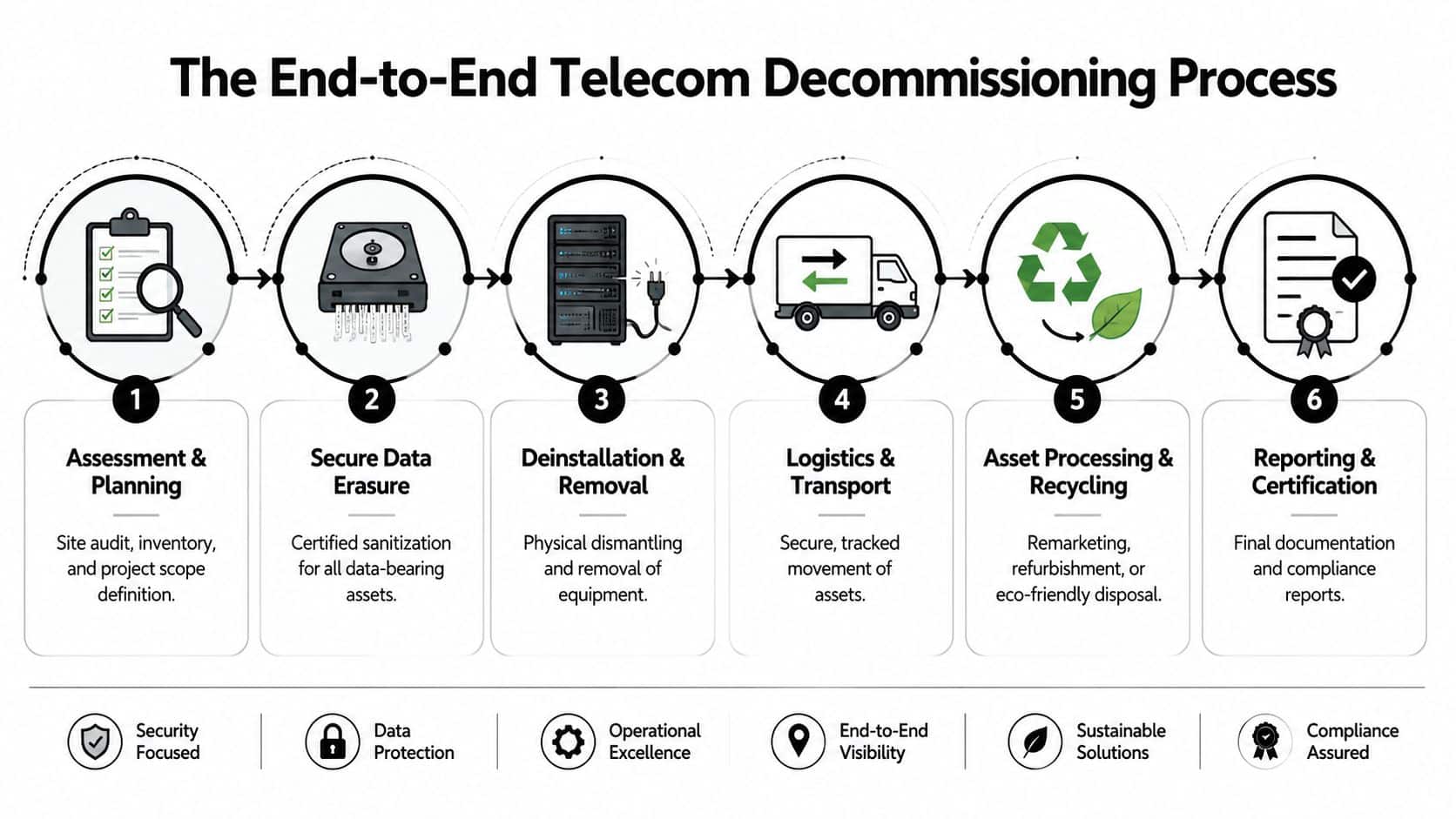
Assessment and scope control
The first step is a site survey that does more than count racks. Teams need to identify active versus retired equipment, access limitations, safety concerns, carrier handoff points, battery systems, and any shared infrastructure that could affect other tenants or business units.
This is also where project owners decide what success means. Is the goal to vacate a room, recover value, prepare for a lease exit, or support a network modernization program? Different goals change the work plan.
A strong assessment should answer:
- What is in scope
- What must stay live until cutover is complete
- Which assets may contain data
- What downstream disposition path applies to each category
- What evidence the client needs at closeout
Inventory and tagging
Inventory sounds routine, but good projects separate from messy ones at this stage. Every meaningful asset should be tagged to a location and disposition path before deinstallation starts.
That includes more than servers and switches. It can include PBX shelves, optics, cards, patch panels, UPS components, telecom batteries, structured cabling, antennas, and power distribution gear. Teams also need to identify owned gear versus leased or carrier-owned equipment so they don't remove something that must be returned under contract.
Remove ambiguity before you remove hardware.
Service disconnection and migration
Physical removal should follow service retirement, not lead it. That means coordinating with telecom operations, carriers, facilities, and business stakeholders to confirm what has already been migrated and what still has a business dependency.
In many environments, the riskiest equipment is the gear everyone assumes is dead. A legacy switch may still backhaul an alarm line. An old PBX shelf may still support a fax workflow in a regulated department. A copper bundle may still carry one circuit nobody documented correctly.
This stage usually requires:
- Cutover validation: Confirm replacement services are stable.
- Carrier coordination: Verify disconnects, returns, and demarc responsibilities.
- Maintenance windows: Schedule work when outage risk is acceptable.
- Rollback planning: Keep a recovery path for any service that proves harder to retire than expected.
Physical deinstallation and removal
Once the environment is cleared for retirement, crews can begin de-racking equipment, removing cabling, palletizing assets, and preparing transport. This part looks straightforward from the outside, but the details matter.
Cable mining is a good example. Pulling abandoned copper and fiber can recover space and improve airflow, but it has to be staged carefully. Mixed live and dead pathways, undocumented bundles, and poorly labeled panels can turn a cleanup job into an outage.
The best crews work in a controlled order:
- Isolate and label
- Power down and disconnect
- Remove devices from racks
- Segregate assets by disposition path
- Remove cabling only after validation
- Stage for secure loading
For larger facilities, many operators use a workflow similar to a formal data center decommissioning process because telecom rooms and network hubs create the same coordination issues around uptime, access, and chain of custody.
Data destruction and disposition triage
The project becomes financial at this stage, not just operational. A well-executed program can reduce total cost because reusable and recoverable assets are separated from true waste. PICS and related deinstallation guidance summarized here notes that surplus equipment can be reused, resold, or recycled to offset deinstallation cost, and that's the right way to think about the middle of the process.
Not every device belongs in the same stream. Some equipment still has remarketing value. Some has component or materials value only. Some should go directly to certified recycling or destruction because condition, age, support status, or data risk makes resale impractical.
A practical triage model looks like this:
| Asset category | Typical path | Main decision factor |
|---|---|---|
| Current or newer network hardware | Test and resale | Demand, condition, completeness |
| Legacy but usable equipment | Refurbishment or secondary market | Supportability and buyer interest |
| Mixed metals and obsolete gear | Recycling | Material recovery and compliance |
| Data-bearing devices with high risk | Sanitization or destruction | Liability and documentation needs |
Logistics, reporting, and closeout
The last stage proves whether the project was controlled or merely completed. Equipment moves through loading, transport, intake, processing, and final disposition. Each transfer should be documented.
Closeout records usually include asset manifests, pickup records, serial tracking where applicable, downstream disposition summaries, recycling certificates, and destruction documentation for data-bearing assets. Finance uses these records to reconcile value recovery. Compliance uses them to prove defensible handling. Facilities uses them to close the project and release the space.
What works is a process that preserves options early. What fails is bulking everything together and trying to sort it out after removal.
Navigating Compliance and Securing Chain of Custody
The biggest mistake in telecom decommissioning is assuming the hard part is getting the gear out of the room. It isn't. The hard part is proving, later, that every asset was handled correctly after it left.
According to guidance on nationwide telecom de-installation and decommissioning services, the highest-risk part of decommissioning is not the physical removal but the evidence trail after removal. That's exactly right. Telecom equipment often holds sensitive customer and network data, so documented chain of custody and certified data destruction are what transfer liability in practice.

Why telecom gear creates hidden compliance risk
People usually think about hard drives first. In telecom environments, the bigger issue is all the equipment that stores data without looking like traditional storage. Routers, switches, firewalls, call managers, unified communications appliances, wireless controllers, and specialty network devices may retain logs, credentials, configs, call detail records, or customer information.
For regulated organizations, that turns a disposal event into a documentation event. Healthcare teams care about protected information. Financial firms care about records retention and control evidence. Government agencies care about documented handling and approved destruction methods. In each case, “the vendor took it away” is not enough.
What chain of custody should show
A real chain of custody is an unbroken record. It should show where the asset started, who handled it, when custody changed, where it went next, and what happened to it in the end.
At minimum, the record should include:
- Asset identification: Model, serial where available, and site location
- Pickup details: Date, personnel, quantity, and packaging method
- Transfer events: Every custody handoff during transport and intake
- Processing outcome: Sanitized, destroyed, recycled, or remarketed
- Final evidence: Certificate set and supporting logs
If an auditor asks who had possession of a device at each stage, your records should answer that without guesswork.
The documentation buyers should demand
Many buyers ask for a certificate and stop there. That's too thin for complex multi-site work. The better question is whether the vendor can produce records that connect the pickup to the final disposition.
Ask for documentation such as:
- Serialized or itemized manifests where practical
- Pickup and transport logs
- Data destruction records
- A formal certificate of destruction for assets that require it
- Recycling documentation for non-resale material
- Exception reporting for missing labels, damaged assets, or unprocessable devices
What breaks compliance most often
The weak points usually aren't dramatic. They're ordinary process gaps.
A mixed pallet gets loaded without asset separation. A field technician removes equipment before the inventory is updated. A downstream processor receives devices that were never identified as data-bearing. A client gets a summary certificate, but no detailed trail tying that certificate back to the actual equipment removed from specific sites.
Those failures create two problems. First, they weaken the organization's ability to prove compliant disposal. Second, they make it harder to transfer liability to the service provider because the evidence is incomplete.
For telecom decommissioning services, security isn't just data wiping. It's traceability.
Factors Influencing Project Costs and Timelines
Buyers usually ask for a price too early. The fundamental question is what kind of project they're pricing. Telecom decommissioning costs and timelines depend on asset mix, site conditions, operational constraints, and how much value can be recovered before materials enter the recycling stream.
What pushes cost up
The biggest cost drivers are usually practical:
- Asset density: A sparse telecom closet and a fully built central room are very different jobs.
- Equipment type: Large chassis systems, batteries, overhead cabling, and legacy power gear take more labor.
- Site access: Freight elevators, bad loading conditions, restricted buildings, and after-hours work add complexity.
- Live environment rules: If crews are working beside active infrastructure, sequencing gets slower.
- Data handling requirements: On-site destruction or special segregation adds steps and documentation.
Timelines move for the same reasons. A straightforward site can be turned quickly. A multi-site project with service dependencies, landlord requirements, and return-to-carrier obligations takes more coordination.
Where the financial trade-offs sit
The economics are rarely simple. Light Reading's reporting on copper decommissions makes the point well: as companies such as TDS and Frontier begin copper decommissions, ROI depends on balancing savings from shutting legacy technology against the costs and operational risks of transition.
That same logic applies inside enterprise projects. Resale sounds attractive, but only certain hardware categories justify the time and testing. Recycling is faster and cleaner operationally, but it may leave money on the table if teams fail to separate reusable gear early. Accelerated shutdown can reduce ongoing expense, yet moving too fast can create outage or compliance risk.
A realistic budgeting discussion should compare three buckets:
| Cost or value area | What affects it most | Common mistake |
|---|---|---|
| Labor and logistics | Access, teardown complexity, site count | Underestimating cable and rack removal |
| Data and compliance handling | Asset identification and documentation depth | Assuming telecom gear has no storage risk |
| Value recovery | Condition, age, market demand, material content | Mixing resale candidates into scrap |
Field lesson: The earlier you classify assets, the better your budget accuracy gets.
If you're building an internal business case, a server decommissioning checklist can help frame the same budgeting variables because labor, data handling, and disposition planning follow similar patterns.
How to Choose Your Telecom Decommissioning Partner
Vendor selection should be boring in the best possible way. You want a partner with disciplined controls, documented processes, and no improvisation around data, transport, or downstream disposition.
One practical benchmark is whether the provider can explain its workflow in operational terms. Beyond Surplus, for example, describes telecom and IT asset retirement through pickup logistics, data destruction, chain-of-custody documentation, and final reporting. That's the right shape of conversation. Not promises about “easy recycling,” but process detail.
Vendor selection checklist
| Evaluation Criteria | What to Look For | Why It Matters |
|---|---|---|
| Certifications | Relevant industry certifications and documented downstream controls | Reduces security and environmental risk |
| Data handling | Clear procedures for sanitization, shredding, and data-bearing asset segregation | Prevents hidden liability from embedded storage |
| Chain of custody | Written custody workflow, pickup records, and traceable reporting | Supports audits and liability transfer |
| Logistics security | Vetted crews, secure transport, and controlled receiving processes | Protects assets in transit |
| Insurance coverage | Appropriate environmental and liability coverage | Limits exposure if something goes wrong |
| Asset recovery capability | Testing, grading, and resale channels where appropriate | Helps offset project cost |
| Multi-site execution | Experience coordinating complex regional or national pickups | Keeps large rollouts consistent |
| Reporting quality | Detailed closeout package, not just a generic certificate | Gives IT, finance, and compliance usable records |
Questions worth asking in the first call
Don't ask only “What do you charge?” Ask how they separate reusable equipment from scrap. Ask who identifies data-bearing devices. Ask what happens if serial data is missing on part of the lot. Ask whether they can support live-site restrictions and phased removals.
Also ask who owns the process after pickup. A surprising number of problems show up downstream, when a subcontractor, recycler, or remarketing channel takes over and visibility gets weaker.
The best partner is the one whose controls still make sense after the truck leaves your parking lot.
Partner with Beyond Surplus for Certified Decommissioning
Telecom retirement has become a standard operational issue, not an occasional cleanup project. TXO's 2025 whitepaper found that 83% of communication providers were already decommissioning network sections or planning to do so soon, and 7% believed decommissioning could reduce power consumption by more than 50% according to the TXO network decommissioning whitepaper. That's why buyers need a service model built around control, documentation, and value recovery.
For enterprise teams, the right partner should support site surveys, secure removal, asset triage, data destruction, logistics coordination, and final reporting without forcing the client to stitch together multiple vendors. It should also support finance with resale and recovery options where practical, while giving compliance teams the documentation needed to defend the project later.
The main point is simple. Telecom decommissioning services work best when they're run like a risk-managed asset retirement program. Not a cleanup crew. Not a scrap pickup. A controlled process with accountability at every handoff.
Frequently Asked Questions
Can an internal IT team handle telecom decommissioning on its own
Sometimes, but only for narrow and low-risk jobs. Internal teams usually know the environment well, which helps with service validation. Where they struggle is labor coordination, secure transport, downstream documentation, and disposition controls across multiple sites.
What happens to equipment with no resale value
It should be separated into certified recycling streams rather than mixed with reusable assets. That protects environmental compliance and preserves any recoverable material value without contaminating higher-value equipment lots.
How is data destroyed on routers, switches, and PBX equipment
The method depends on the device. Some equipment can be sanitized through supported data-clearing procedures. Other devices require removal and destruction of embedded storage or physical destruction of the unit when sanitization can't be verified.
When should a company start planning decommissioning
Earlier than most do. Planning should begin during migration design, not after cutover. Early planning helps teams identify data-bearing assets, preserve resale opportunities, and avoid removing infrastructure that still supports a forgotten service.
What should the final project file include
At minimum, keep manifests, pickup records, custody logs, destruction records where applicable, and recycling or disposition certificates. Finance may also want recovery summaries and exception notes for anything missing, damaged, or non-processable.
If you're planning a network shutdown, site exit, telecom room cleanup, or multi-site asset retirement, contact Beyond Surplus for certified electronics recycling and secure IT asset disposal.


