

A lot of Cisco gear sits in limbo longer than it should. An office phone system gets replaced, old ISR routers come out of branch locations, access switches get stacked in a storeroom, and nobody is fully sure what still has value, what still holds data, or what can be sold without creating a compliance problem later.
That's usually when companies start searching for used Cisco telecom equipment buyers. The first instinct is often price. Get a list, send it out, take the highest bid, move on. In practice, that shortcut causes most of the downstream pain. Deals get repriced after audit. Older equipment turns out to be outside the buyer's scope. Devices leave the building before anyone has documented serials, reset status, or custody.
Used Cisco hardware can still be a recoverable asset, but only if the sale is managed like an ITAD project instead of a quick liquidation. Cisco phones, switches, firewalls, UCS gear, and telecom platforms often carry a mix of financial value and operational risk. The value comes from secondary-market demand. The risk comes from configuration data, certificates, voicemail history, and incomplete documentation.
Introduction From Clutter to Capital
The most common starting point is a closet, cage, or staging room filled with decommissioned gear that no one wants to touch twice. It isn't active production equipment anymore, but it also isn't trash. That in-between state is where companies lose time and money.
I've seen the same pattern repeatedly. Procurement wants space back. Facilities wants pallets removed. IT wants assurance that nothing leaves without proper handling. Finance wants to know whether the hardware can offset part of the refresh. All of them are asking reasonable questions, and none of those questions get answered by a generic “we buy Cisco” page.
What matters is changing the frame. This is not just a disposal event. It's a value-recovery and liability-transfer event. If you approach it casually, you usually get the worst of both outcomes: a weak payout and avoidable risk.
Old Cisco telecom gear is rarely worthless on day one. It becomes worthless when the seller can't identify it, can't document it, or can't move it through a controlled process.
The practical path is straightforward. Build a clean inventory. Separate likely resale from likely recycle. Vet buyers on handling discipline, not just offer speed. Get logistics and payment terms in writing. Then close the loop with documented data destruction and liability transfer.
That's how clutter becomes capital instead of an audit issue waiting to happen.
Inventory and Preparation Your First Critical Step
Most bad quotes start with a bad asset list. If your inventory says “Cisco phones, routers, misc switches,” expect a vague offer, heavy regrading, or silence. Buyers price what they can identify, and serious asset-recovery firms often won't engage unless the lot is large enough. Some commercial buyers only consider lots with a minimum estimated value of $2,500, which makes aggregation and clear inventorying important from the start, as noted by Exit Technologies on selling Cisco equipment.
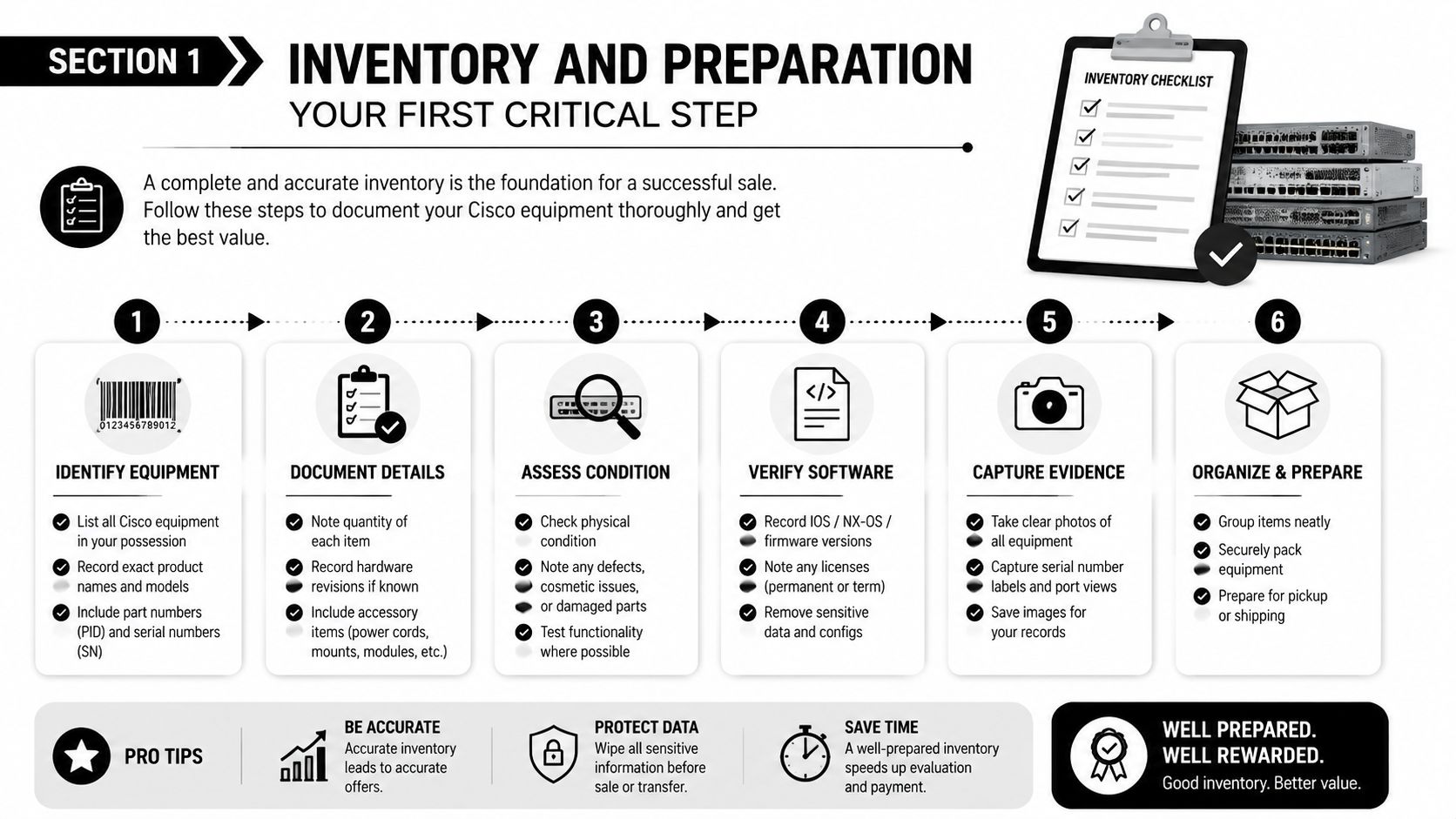
Build the list before you ask for money
Start with a spreadsheet or export from your asset system. Then verify it against what is physically on hand.
At minimum, capture:
- Model number: Exact Cisco part number, not just family name.
- Serial number: This matters for traceability and age checks.
- Quantity: Broken out by model, not lumped together.
- Condition: Clean pull, tested working, untested, damaged, or parts only.
- Completeness: Power supplies, rack ears, adapters, handsets, modules, licensing media if applicable.
- Location: Closet, rack row, branch site, warehouse, or third-party storage.
- Notes: Password-locked, missing faceplate, cracked screen, no power test, or surplus new-in-box.
That level of detail does two things. It improves quote accuracy, and it reduces the chance of a buyer saying the shipment didn't match the description after pickup.
Practical rule: The quality of your inventory list usually determines the quality of the offers you receive.
Document what a buyer will question later
Cosmetic condition matters, but so does completeness. A switch without power supplies, a phone lot missing handsets, or a firewall with no ears or rails may still move, but it won't be valued the same way as a complete, resale-ready unit.
Photos help when the lot is mixed or spread across sites. Use simple lot photos for context and close shots for visibly damaged units. You don't need studio images. You need enough evidence to stop disputes.
A short pre-sale checklist keeps the process tight:
- Segregate by product family so phones, switches, routers, firewalls, and UCS gear aren't mixed.
- Tag exceptions such as damaged, locked, or incomplete units.
- Count accessories separately instead of assuming they're attached.
- Hold equipment in place once quoted so nothing gets redeployed or cannibalized before collection.
Prepare for a commercial transaction, not a garage sale
Many organizations leave money behind. They ask three buyers for numbers before they've even stabilized the lot. Then they compare offers that aren't based on the same assumptions.
If you're moving a larger environment, it helps to work from a telecom-specific liquidation workflow such as Beyond Surplus's large-scale telecom equipment liquidation process. Even if you use another partner, the discipline is the same: inventory first, quote second, pickup last.
What doesn't work is informal cleanup. Loose pallets, handwritten counts, and “there should be another box somewhere” nearly always lead to repricing.
Understanding the True Value of Your Cisco Assets
Cisco resale value isn't based on age alone. Two devices manufactured around the same time can land in very different places depending on demand, condition, support relevance, and how complete the unit is when it hits the secondary channel.
There's a strong reason buyers stay active in this market. Refurbished Cisco equipment can save customers up to 70% off manufacturer list prices, which keeps demand alive among enterprises and labs that want to stretch budget and match installed infrastructure, according to Network Craze's discussion of buying used Cisco equipment.
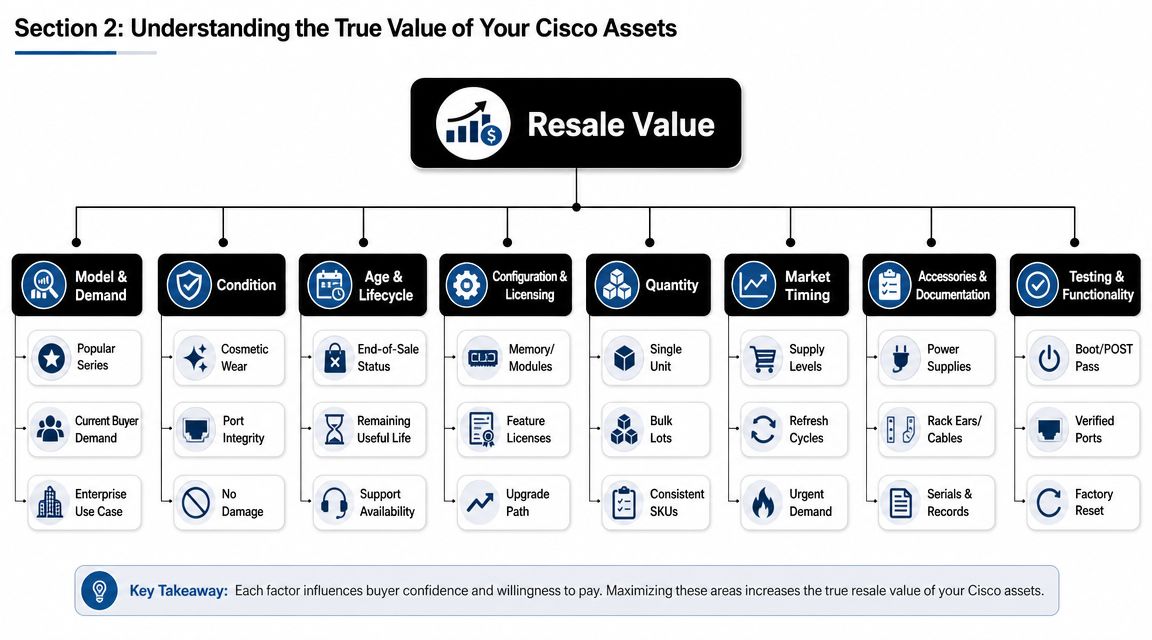
What usually holds value
A buyer isn't paying for your original purchase price or your depreciation schedule. They're paying for what they can place back into use.
That usually favors:
- In-demand network gear: Routers, switches, firewalls, and certain UCS platforms.
- Legacy-fit hardware: Equipment that still matches installed customer environments.
- Clean pulls: Units removed from service in working order with normal wear.
- Complete assemblies: Chassis with the expected power and accessory set.
The legacy point matters more than many sellers expect. Some older Cisco models still move because customers need exact compatibility inside existing environments. That can support value longer than a normal refresh cycle would suggest.
What causes value to fall fast
Buyers also apply hard filters. ComSources says it purchases most Cisco models that are less than 7 years old, using serial-number manufacturing date data as part of valuation, as described on ComSources' used Cisco equipment page. If your lot is outside that window, the conversation may shift from resale toward parts harvesting, redeployment, or compliant recycling.
A quick comparison helps set expectations:
| Factor | Higher recovery potential | Lower recovery potential |
|---|---|---|
| Age | Within common buyer window | Past common buyer window |
| Condition | Tested, intact, clean | Damaged, incomplete, heavy wear |
| Configuration | Standard, easy to reset | Locked, altered, unknown state |
| Demand | Fits installed base needs | Obsolete or oversupplied |
| Packaging of lot | Organized by model | Mixed pallets with poor records |
A seller's biggest valuation mistake is assuming every retired Cisco device still belongs in the resale lane.
How to estimate realistically
Start by sorting your inventory into three buckets:
- Likely resale candidates: Newer and complete, or older but still useful in installed environments.
- Conditional resale candidates: Untested, cosmetically rough, incomplete, or model-dependent.
- Disposition candidates: Clearly obsolete, damaged beyond practical reuse, or nonfunctional.
That triage gives you an advantage. It lets you talk to buyers with a view of the lot instead of hoping they explain your own inventory back to you.
For organizations selling networking assets regularly, reference points like Beyond Surplus's page on where to sell used network switches and routers can help align expectations around resale pathways and recovery options.
What works is realism. What doesn't work is treating every old Cisco phone, router, or switch as if it still carries broad market demand. Secondary-market value exists, but it's selective.
Vetting Buyers Beyond the Price Tag
The highest number in the inbox is not automatically the best deal. In used Cisco telecom equipment sales, the primary question is whether the buyer can complete the transaction in a way that protects your organization after the equipment leaves your control.
Many buyer pages talk about speed and categories they purchase. Far fewer explain how they handle chain of custody, secure offboarding, or audit support. That gap matters because telecom equipment can store sensitive material, and weak documentation leaves the seller carrying the risk. Telecom Recycle's discussion of Cisco equipment handling highlights this liability gap, especially where FTC Disposal Rule style obligations and internal audit requirements come into play.
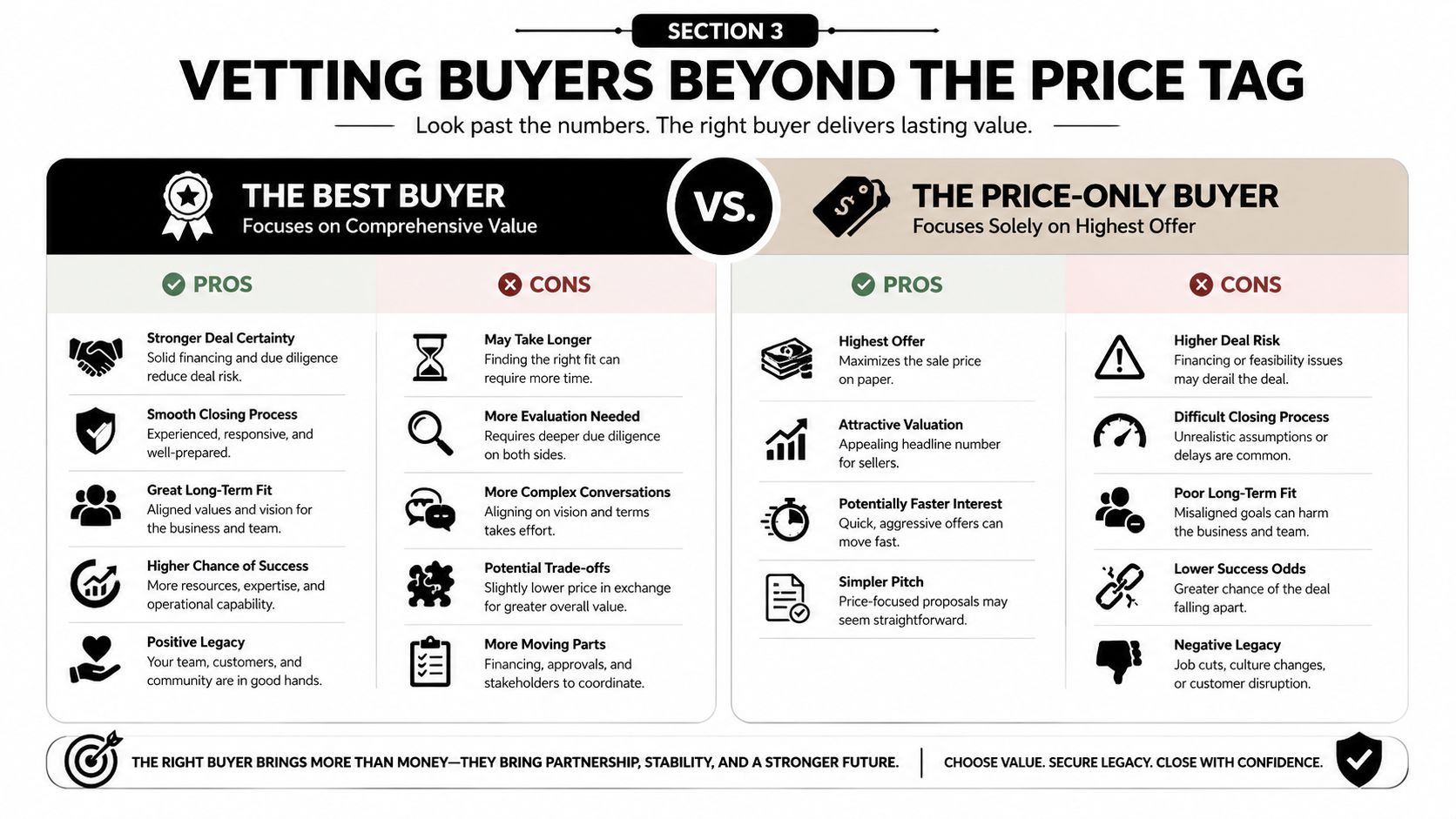
What a serious buyer should answer clearly
If a buyer gets vague when the discussion moves past price, that's a warning sign.
Ask direct questions:
- Who handles pickup and packing? You want a defined logistics process, not a handoff to an unknown party with no documentation.
- How is custody documented? Serialized records matter when equipment contains data-bearing components or regulated information.
- What happens to unsellable items? Reuse, parts, destruction, and recycling should all be addressed.
- Can they document reset or destruction? If the answer is soft, assume the process is soft.
- How are deductions handled after audit? After audit, “great” offers often shrink.
Compare the buyer types, not just the bid
A simple reseller and a structured ITAD partner can both buy Cisco gear. They are not providing the same thing.
| Buyer type | Usually does well | Usually leaves gaps |
|---|---|---|
| Price-only buyer | Fast quote, narrow transaction | Limited compliance detail, weak audit package |
| Operational buyer | Pickup coordination, inventory review | May still be light on data documentation |
| Certified ITAD-style partner | Secure handling, reporting, liability transfer focus | Offer may not always be the highest line item |
That doesn't mean every lower offer is better. It means you should price risk into the comparison. If your organization is in healthcare, finance, education, government, or any environment with internal audit pressure, documentation has monetary value even if it doesn't show up as a higher bid.
A buyer who can't explain custody, sanitization, and reporting is asking you to trust a process they haven't defined.
What works in practice
The strongest transactions usually involve a short buyer diligence pass before any pickup is approved. A checklist helps. So does forcing the conversation into specifics before hardware leaves your site.
For teams formalizing vendor screening, a tool like Beyond Surplus's vendor due diligence checklist is useful because it frames the decision around controls, downstream handling, and documentation instead of just payout.
One factual example fits here. Beyond Surplus is one option in this space because it provides business pickup, secure disposition, and documentation for telecom equipment sales. That matters when your objective includes both value recovery and defensible records.
What does not work is selecting a buyer based only on responsiveness. Fast replies are nice. Process quality is what protects you later.
Navigating Contracts Logistics and Payment
A lot can go wrong after the quote is accepted.
I have seen teams negotiate a decent resale number, then give it back through loose contract language, poor packing, disputed counts, or payment terms that shift after pickup. The buyer selection work is already done at this point. Now the job is to lock down scope, custody, and cash timing so the transaction closes the way it was presented.
Start with the paper. The purchase order, bill of sale, service agreement, and pickup confirmation should say the same thing about what is being sold, how it will be collected, how condition will be evaluated, and when payment is due. If those documents conflict, the buyer usually has room to adjust value after your equipment is gone.
Clauses that affect margin and risk
Read the commercial terms line by line, especially if the buyer reserves a right to inspect and regrade.
Focus on these points:
- Asset scope: Model numbers, quantities, installed components, and stated condition should match the approved inventory.
- Audit adjustments: The contract should define what triggers a downgrade, who documents it, and how disputes are handled.
- Title and custody transfer: State exactly when ownership and liability pass. At dock pickup, at receipt, or after audit are very different positions.
- Payment timing: Payment on pickup helps cash flow. Payment after testing can be reasonable for higher-value lots, but the timeline needs to be written down.
- Freight responsibility: Clarify who arranges transport, who insures the load, and who carries the loss if pallets are damaged in transit.
- Exceptions: Misidentified units, dead-on-arrival hardware, missing power supplies, and cracked screens should have a defined resolution path.
A short legal or procurement review is usually money well spent. Ambiguity rarely benefits the seller.
Logistics changes value
Physical handling is part of value recovery, not a side task. Cisco handsets, supervisor modules, line cards, and rack equipment can test fine when powered down on site and still arrive damaged if they are pulled, stacked, or wrapped carelessly.
If your team is coordinating internal moves before pickup, guidance on choosing the right fragile removal service is useful because the same handling principles apply to telecom gear. Labeling, shock protection, staged loading, and documented handoff all reduce disputes later.
The practical standard is simple. Freeze the inventory after final approval. Pack to the asset list. Record serials where the value justifies the effort. Photograph high-value lots before they leave. Get a signed pickup record that ties back to the quoted inventory.
For organizations selling across multiple sites, a buyer with a defined service model matters more than a generic promise to arrange freight. Beyond Surplus outlines that scope on its page for nationwide telecom equipment buyers, which is the kind of operational coverage to look for when pickups involve branch offices, warehouses, and data closets in different regions.
Payment terms deserve the same discipline. "Prompt payment" is not a term. A real term is net 3 after pickup, net 7 after audit receipt, or same-day ACH once the signed load sheet is confirmed. If the buyer pays after inspection, tie that inspection window to a fixed number of business days and require written support for any deduction.
The cleanest transactions follow one rule. No truck is scheduled until the contract, logistics plan, asset list, and payment trigger all match.
Ensuring Compliant Data Destruction and Liability Transfer
A lot of resale projects go off track here. The equipment is gone, the payment cleared, and six months later someone asks whether the phones, routers, or voice gateways were sanitized and when liability passed to the buyer. If the answer lives in an email thread or a verbal assurance, the seller still owns too much risk.
Cisco telecom gear can retain more than basic configuration data. Depending on the platform, it may hold credentials, certificates, call records, voicemail-related information, tenant settings, and other remnants that should not leave your control without a documented sanitization process.
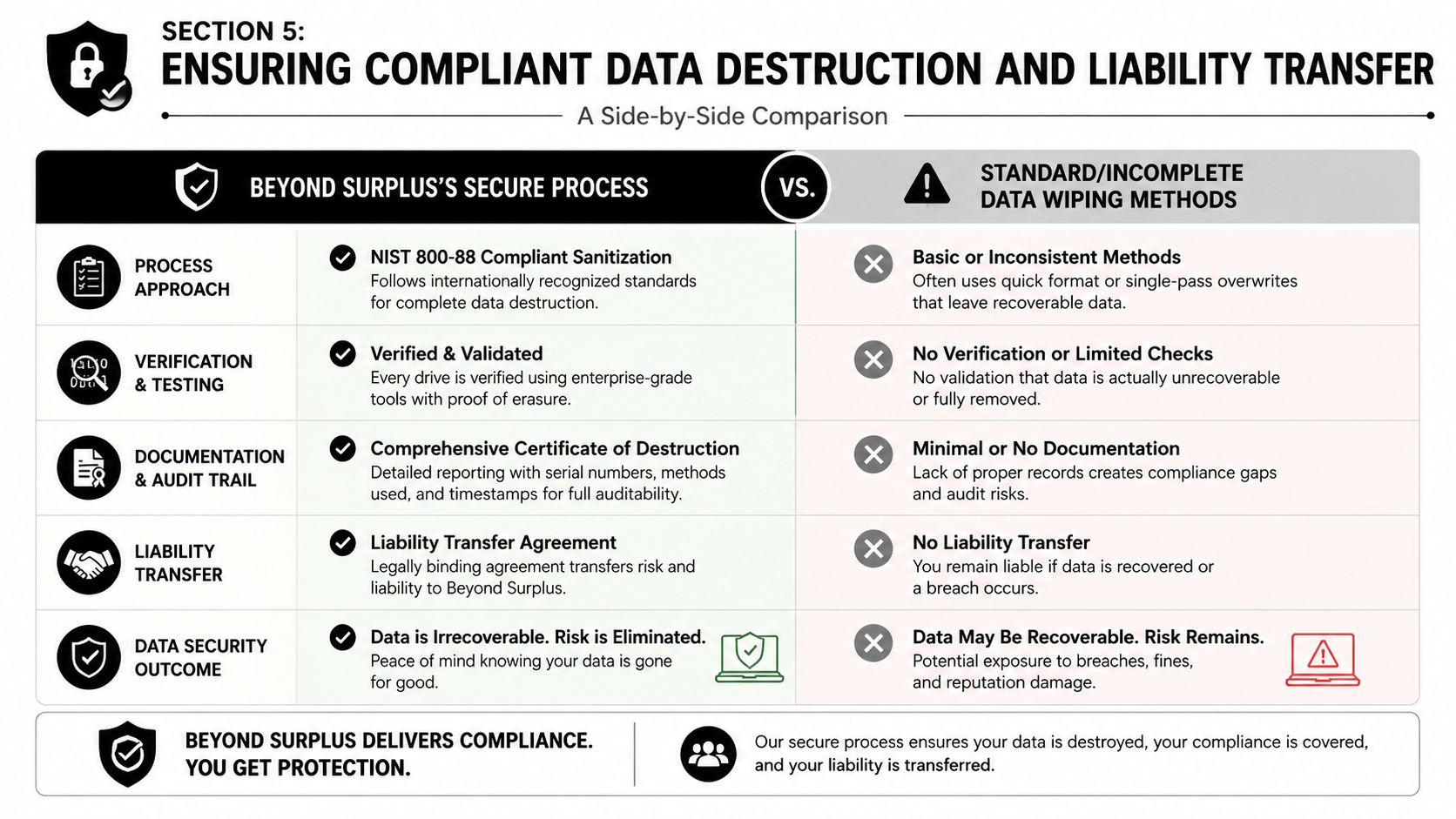
Resetting a device isn't the same as closing risk
A factory reset may satisfy policy for some assets. For others, it falls short. The right approach depends on what the device stored, whether the hardware still functions, and what your security and compliance teams will accept during review.
Common options include:
- Logical reset or wipe: Appropriate when the device can be sanitized reliably and the process is recorded.
- Reflash and validation: Useful when a standard reset does not satisfy policy or when the device state needs verification before resale.
- Physical destruction: Appropriate for damaged units, unsupported hardware, or any asset your team does not trust for logical sanitization.
The key business issue is not the method's perceived strength, but whether it aligns with policy and can be proven.
If a buyer says “we wipe everything” but cannot produce serialized evidence, your audit exposure has not changed much.
Certificates support the audit trail
A Certificate of Data Destruction is evidence. It helps the seller answer internal audit questions, customer security reviews, and legal or compliance follow-up after the gear has left the building. “We were told it was wiped” is weak documentation and a poor defense if a problem surfaces later.
The record set should include:
- Serialized asset identification where applicable
- Sanitization or destruction method
- Processing date
- Chain of custody details from pickup through final disposition
- Final disposition status such as reset, destruction, or recycling
Teams that want a benchmark for documentation can review what a certificate of destruction should document in an ITAD process.
Liability transfer needs a defined endpoint
Liability does not end at dock pickup. It ends when the inventory is reconciled, exceptions are cleared, sanitization is documented, and final disposition records are issued. That distinction protects the seller if a unit is missing, if a serial number does not match, or if a later audit asks who had custody at each stage.
This point gets more attention in healthcare, finance, government, and education. It applies just as much to ordinary enterprise environments. Retired Cisco gear sitting in a closet is an operational nuisance. Retired Cisco gear that left without documented sanitization and custody transfer is a governance problem.
Experienced ITAD teams treat data destruction and liability transfer as closing controls, not cleanup tasks. That is where resale value, compliance, and risk management finally meet.
Conclusion Choose a Partner Not Just a Purchaser
Selling retired Cisco telecom gear should be handled as a controlled business process, not a quick cleanout. The organizations that recover the most value usually do the boring parts well. They inventory carefully, separate realistic resale candidates from scrap, challenge buyer assumptions before pickup, and insist on documentation all the way through final disposition.
The bigger point is that price is only one part of the decision. A buyer who moves fast but can't document custody, sanitization, and final processing may create more cost than value once audit, compliance, and internal risk are factored in.
That's why the strongest used Cisco telecom equipment buyers conversations start with operational detail. What exactly is in scope. How will it be packed and moved. When does liability transfer. How are adjustments handled. What proof do you receive at the end.
Good ITAD outcomes come from controlled process, not optimistic assumptions.
If your team is sitting on decommissioned Cisco phones, switches, routers, firewalls, or other telecom gear, take the extra time to structure the sale properly. It protects the balance sheet, the audit trail, and the people signing off on the project.
Beyond Surplus helps organizations manage secure telecom equipment disposition, value recovery, logistics coordination, and documented end-of-life processing. If you need a commercial partner for used Cisco telecom equipment buyers services, contact Beyond Surplus for a structured, compliant IT asset disposition workflow.