

Your server refresh is approved. The old laptops are boxed. The switches from the branch consolidation are still in the closet. Finance wants to know whether any of it has resale value, security wants proof that every drive is handled correctly, and operations wants it gone without disrupting the site.
That's where most Georgia companies realize IT asset disposition isn't a disposal task. It's a control point for cash recovery, data risk, and audit readiness. If you want to know how Georgia businesses can maximize value with ITAD services, the answer starts before pickup and ends with documentation that stands up to scrutiny.
Why ITAD Strategy Is Crucial for Georgia Businesses Today
Georgia businesses are retiring more infrastructure, more often. That matters because the state's technology footprint is getting larger and more complex. Georgia has become one of the fastest-growing U.S. data-center markets, Metro Atlanta led the nation in net absorption in 2024, and a revised 2026 review found 8,505 construction jobs tied to data centers added about $1 billion to the economy while 1,641 operations jobs added $247 million more, according to Georgia's data-center economic impact review.
More refresh cycles mean more value at risk
For an IT manager, that growth translates into more server, storage, and network refresh cycles. Every refresh creates two possible outcomes. One is controlled: remarketing, certified data destruction, and documented chain of custody. The other is expensive: missing assets, generic destruction paperwork, and reusable equipment treated like scrap.
A workable ITAD plan also has to fit real-world moves and consolidations. If your organization is relocating offices, staging equipment, or coordinating disconnects across sites, resources like TLC Moving & Storage office IT solutions can help frame the operational side that often overlaps with disposition planning.
Practical rule: The value of retired hardware is usually decided before the truck arrives.
Georgia organizations need lifecycle control, not just pickup
The companies that recover the most value don't treat end-of-life IT as a one-time cleanout. They treat it as part of the asset lifecycle. That means identifying what can be resold, what must be sanitized, what needs physical destruction, and what belongs in responsible recycling.
A Georgia-specific playbook should also account for local decommissions, office relocations, and data-center turnover. A useful starting point is this Georgia IT asset disposal guide, which focuses on secure handling and documented processing.
Preparing Your Assets for Maximum Return
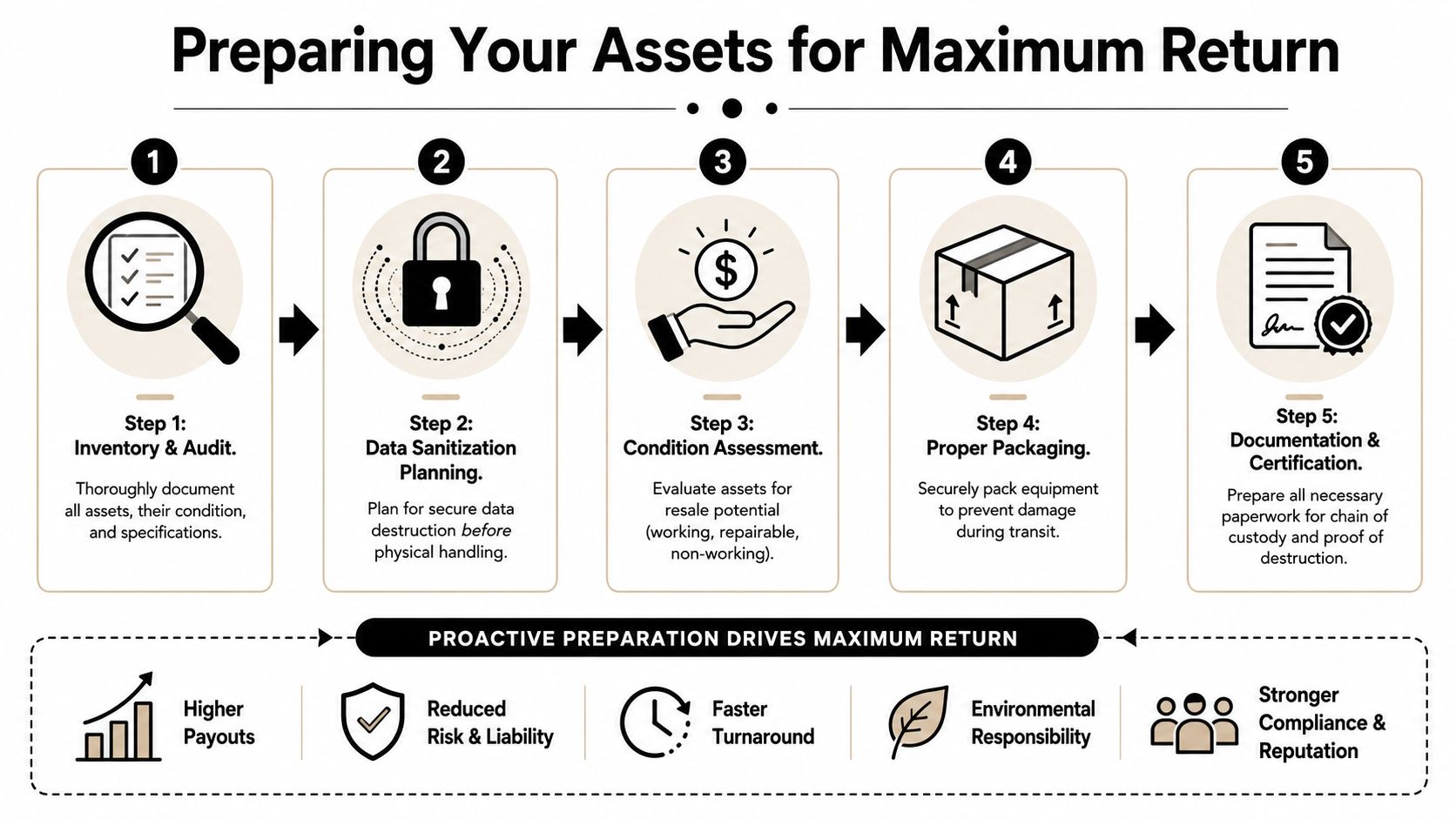
Most value loss happens in the handoff phase. Assets get mixed together. Serials are missing. High-value devices sit in the same pallet as scrap. Then the vendor has to estimate, downgrade, or destroy value you could have preserved.
A high-value workflow starts with a serialized asset inventory that separates equipment into reuse, resale, wiping, shredding, or recycling streams. A practical benchmark is to record the asset tag or serial number, device condition, and data classification before pickup, then require a serialized Certificate of Data Destruction for every drive, as outlined in this ITAD best-practices guide.
Build the inventory before you schedule pickup
Start with what you can verify, not what you think is in storage.
- Record identifiers first. Asset tag, serial number, manufacturer, and model.
- Grade condition. Working, repairable, cosmetically damaged, or non-working.
- Assign data sensitivity. A monitor doesn't need the same controls as a laptop or SAN shelf with drives.
- Note location. Floor, closet, branch, cage, or data hall.
- Separate accessories. Power adapters, rails, caddies, and transceivers can affect resale outcomes.
Pre-sort assets into the right streams
Don't hand over one mixed lot and expect precise valuation. Break the inventory into categories that reflect likely disposition outcomes.
- Reuse candidates: Newer laptops, desktops, servers, and networking gear with market demand.
- Sanitize and remarket: Data-bearing assets that can stay intact after compliant wiping.
- Destroy media only: Systems with recoverable chassis value but non-recoverable drives.
- Recycle only: Damaged, obsolete, or incomplete equipment with little remarketing potential.
A generic certificate tells you that something was destroyed. A serialized certificate tells you exactly what happened to each drive.
If you want a disposition program that prioritizes equipment with buyback potential, this Georgia IT equipment resale page is the right operational benchmark.
Choosing the Right Certified ITAD Partner in Georgia
A scrap hauler and a certified ITAD provider don't solve the same problem. One removes material. The other protects your company from data exposure, compliance failures, and undocumented downstream handling.
Certifications are a filter, not a marketing detail
For Georgia businesses, industry guidance emphasizes using certified providers such as NAID AAA, R2, or e-Stewards to reduce downstream risk. The same guidance also points to background-checked staff, GPS-tracked transport, and access-controlled facilities as core controls for chain of custody, not optional extras.
That's why certification should be your first screen. If a provider can't clearly explain its audited process, who handles transportation, and how item-level tracking works from pickup to final disposition, you're taking unnecessary risk.
Questions that expose weak providers
Use due diligence to separate polished sales language from defensible operations.
- Ask for sample records. You want to see serialized reporting, not a generic destruction form.
- Ask where processing occurs. If they broker work out, your risk doesn't disappear. It moves downstream.
- Ask who touches the assets. Trained, screened staff matter when devices contain regulated data.
- Ask how exceptions are handled. Missing drives, failed wipes, damaged pallets, and unlisted assets should trigger documented procedures.
For teams formalizing that process, this vendor due diligence checklist is useful because it pushes the conversation beyond price.
Navigating Secure Data Destruction Options
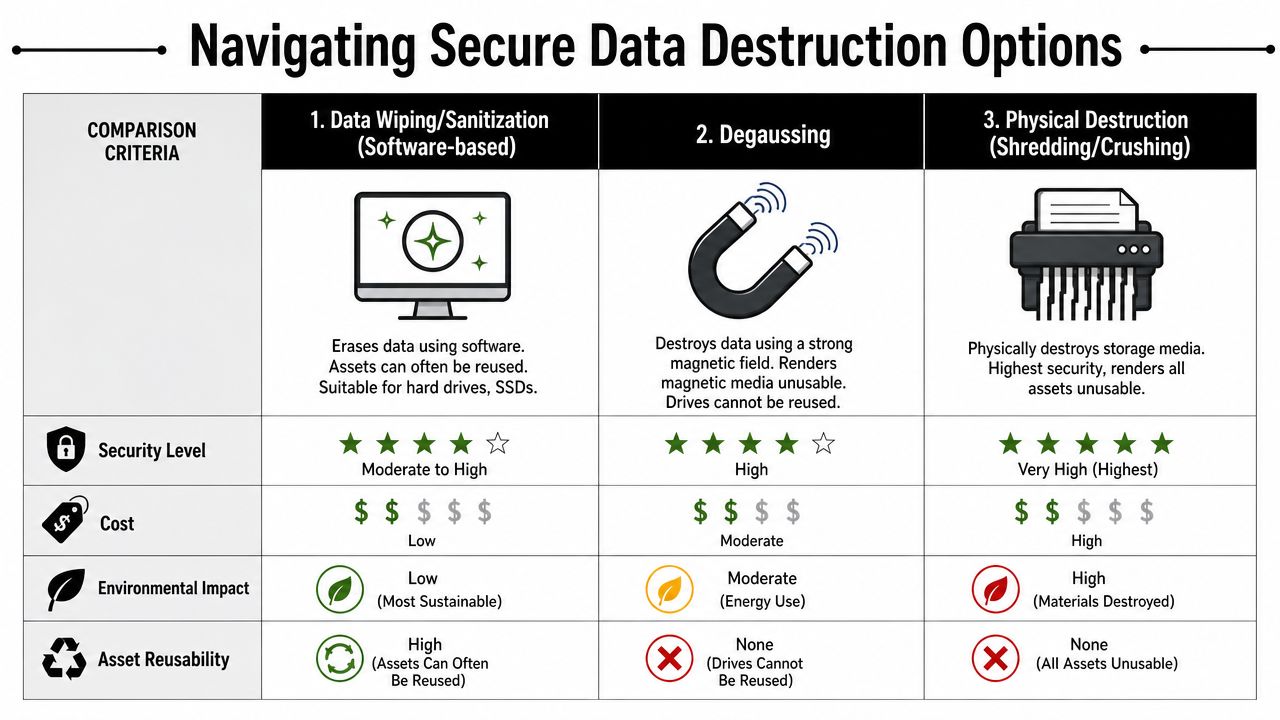
Not every asset needs the same destruction method. If you shred everything, you destroy resale value. If you wipe everything, you may under-protect highly sensitive media. The right choice depends on data sensitivity, asset type, and whether reuse is realistic.
Industry guidance for Georgia businesses recommends choosing between on-site destruction, secure off-site processing, and certified wiping based on risk. It also recommends NIST 800-88-compliant sanitization for drives that can be reused, with physical shredding for non-recoverable media, as described in this Georgia business IT asset disposal guide.
When on-site destruction makes sense
On-site shredding gives you the highest level of visibility. It's a strong fit when the media is highly sensitive, internal policy requires witnessable destruction, or the organization doesn't want intact drives leaving the facility.
That transparency comes with a trade-off. On-site workflows can be less efficient for mixed loads where some assets should be tested and remarketed instead of destroyed.
When off-site processing and wiping create better outcomes
Off-site processing usually works better for bulk retirements. It gives the provider room to test systems, isolate reuse candidates, and sanitize drives that can remain with the asset.
Use this simple decision logic:
| Asset situation | Better fit |
|---|---|
| Highly sensitive media, strict witness requirement | On-site shredding |
| Bulk retirement with mixed resale potential | Secure off-site processing |
| Reusable drives in marketable equipment | Certified wiping |
A good technical baseline for sanitization decisions is this NIST SP 800-88 resource.
If the drive can be reused safely, wiping preserves value. If it can't be defended in an audit, destroy it.
The Financials of ITAD Valuation and Buyback Strategies
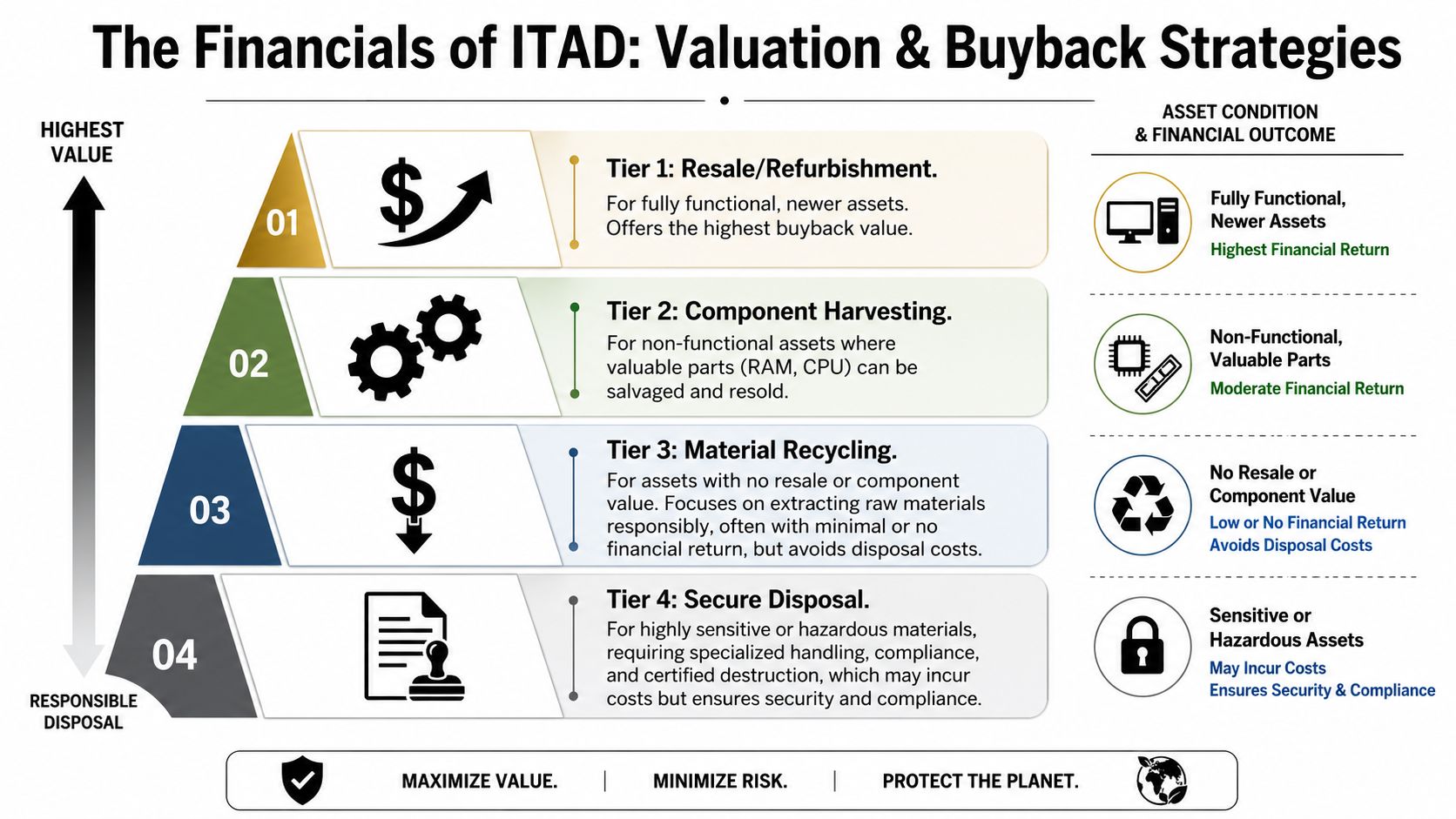
“Value recovery” is too vague to guide a real disposition decision. The better question is simpler. Will this lot produce net proceeds after testing, handling, wiping, logistics, and remarketing, or is recycling the cleaner answer?
The key to maximizing value is understanding when buyback beats recycling. That calculation must weigh expected resale value against handling costs, age, model, condition, and market demand. It also requires speed, accurate grading, and low logistics costs that preserve margin, as explained in this ITAD value recovery analysis.
What actually determines net proceeds
Buyback value is rarely about age alone. In practice, these factors usually matter more:
- Model and configuration: Enterprise gear with desirable CPUs, memory, storage, or optics can outperform older but still useful systems.
- Condition quality: Cracked housings, missing rails, dead batteries, and absent power supplies all change the economics.
- Testing burden: A provider prices the labor required to verify, wipe, grade, and package equipment.
- Time to market: Delays reduce resale opportunity. Stored equipment generally doesn't become easier to sell later.
- Freight and handling: Poor packaging, dispersed sites, and rushed removals eat into margin quickly.
A practical decision framework
Use a pre-pickup review that asks three questions.
First, is there proven secondary-market demand for the model class?
Second, can the asset be processed without excessive labor or security cost?
Third, will data sanitization preserve the asset, or will media destruction reduce it to parts or scrap?
If the answer to the first two is yes, buyback is usually worth exploring. If the answer to the third is no, then recycling or component harvesting may be the better financial outcome.
A finance team will also want to align resale timing with accounting treatment. For internal planning, a plain-language small business depreciation guide can help frame how retired assets may already be viewed on the books before disposition proceeds are recognized.
One market where this comes up often is telecom cleanup after migrations. For those assets, a specialized telecom equipment buyback program can be more useful than a generic mixed-load quote.
Managing Logistics Compliance and Sustainability Reporting
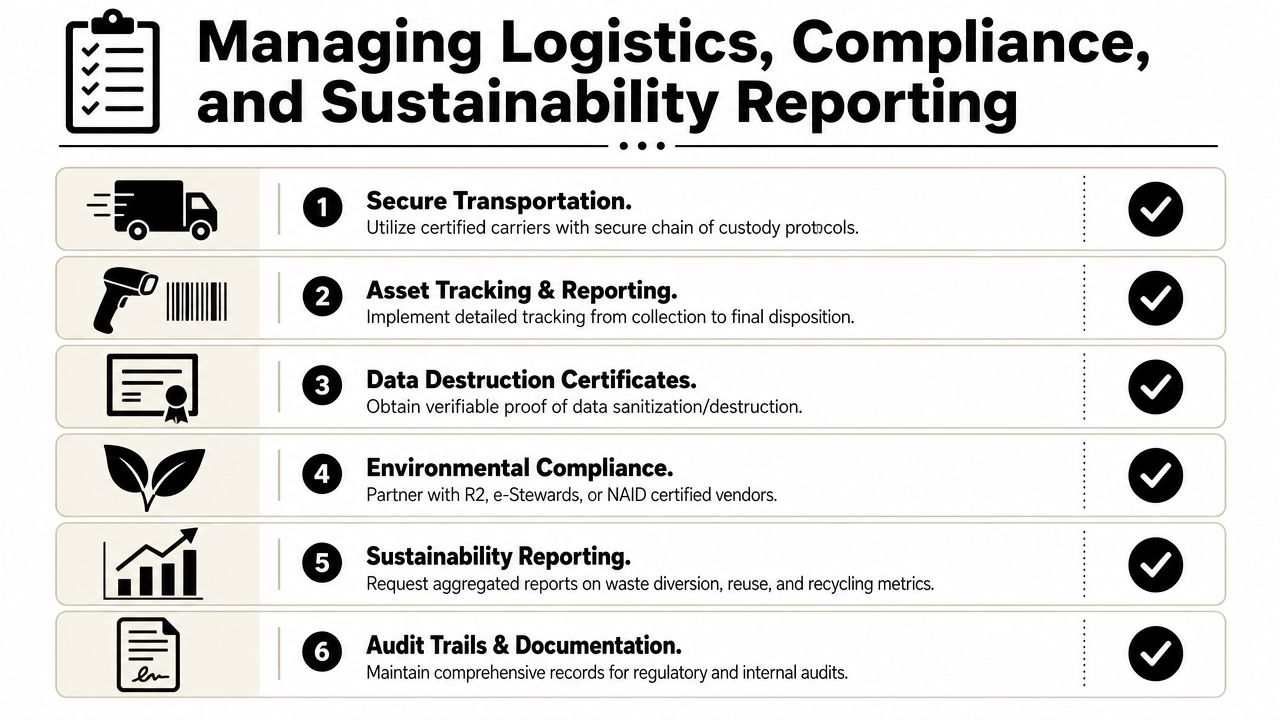
A strong ITAD program can fail on paperwork. You can choose the right vendor, classify the assets properly, and still create audit exposure if transportation, custody records, and final reporting are incomplete.
The broader market is moving toward more formal ITAD controls. The global IT Asset Disposition market is projected to grow from US$12.1 billion in 2026 to US$27.8 billion by 2035, at a 9.6% CAGR, driven by stricter cybersecurity and disposal requirements. For Georgia businesses, that trend matters because ITAD supports value recovery and compliance with rules such as HIPAA and the FTC Disposal Rule, according to this ITAD market outlook.
Chain of custody has to survive an audit
A defensible process documents every transfer point.
- Pickup control: Who released the assets, when, and from which location.
- Transit visibility: Which carrier handled them and how the load was secured.
- Receiving audit: What was received versus what was scheduled.
- Final disposition: Resold, wiped, shredded, or recycled, tied back to serialized records where required.
Sustainability reporting should be usable, not decorative
Many companies ask for sustainability reporting but get a generic recycling statement. That isn't enough for internal reporting or procurement review.
Ask for reporting that distinguishes:
- Assets reused or remarketed
- Assets recycled
- Certificates tied to data-bearing media
- Supporting documentation for audit files
Compliance records should answer two questions without interpretation: where each asset went, and what happened to its data.
Your ITAD Value Maximization Checklist
A strong outcome usually comes from discipline, not from a last-minute vendor scramble. If your team wants better security and better financial recovery, use this checklist before the next refresh, relocation, or decommissioning project.
What to verify internally
- Build the asset list: Capture serials, models, condition, and location before scheduling pickup.
- Separate by disposition path: Don't mix resale candidates with scrap or media slated for destruction.
- Flag sensitive assets early: Regulated data should drive the destruction method, not the other way around.
- Stage equipment securely: Keep assets in a controlled area until transfer.
What to require from the vendor
- Certification evidence: Confirm the provider's current credentials and operating controls.
- Serialized reporting: Item-level tracking matters more than broad summary paperwork.
- Defined destruction methods: Wiping, off-site processing, and on-site shredding should be matched to asset risk.
- Clear settlement logic: Ask how testing, grading, transport, and remarketing affect net proceeds.
What to collect at the end
- Certificate of Data Destruction: Preferably serialized for each processed drive.
- Disposition report: Show what was reused, recycled, or destroyed.
- Chain-of-custody records: Keep them with your internal retirement records.
- Sustainability support: Use reporting that procurement, compliance, and leadership can reference.
One Georgia-based option in this category is Beyond Surplus, which provides ITAD, data destruction, buyback, and documented logistics for business assets. The main point, though, is broader than any single provider. Maximize value before pickup, protect the chain of custody during transit, and insist on documentation that proves what happened at the end.
If your organization needs a tighter process for IT buyback, secure data destruction, or documented electronics recycling in Georgia, contact Beyond Surplus to plan a compliant ITAD workflow that protects data and improves value recovery.


