

Old laptops in a locked closet feel harmless until someone asks what happened to the data. That's the moment many East Point IT managers realize retired equipment isn't just clutter. It's a live security, compliance, and asset-recovery issue.
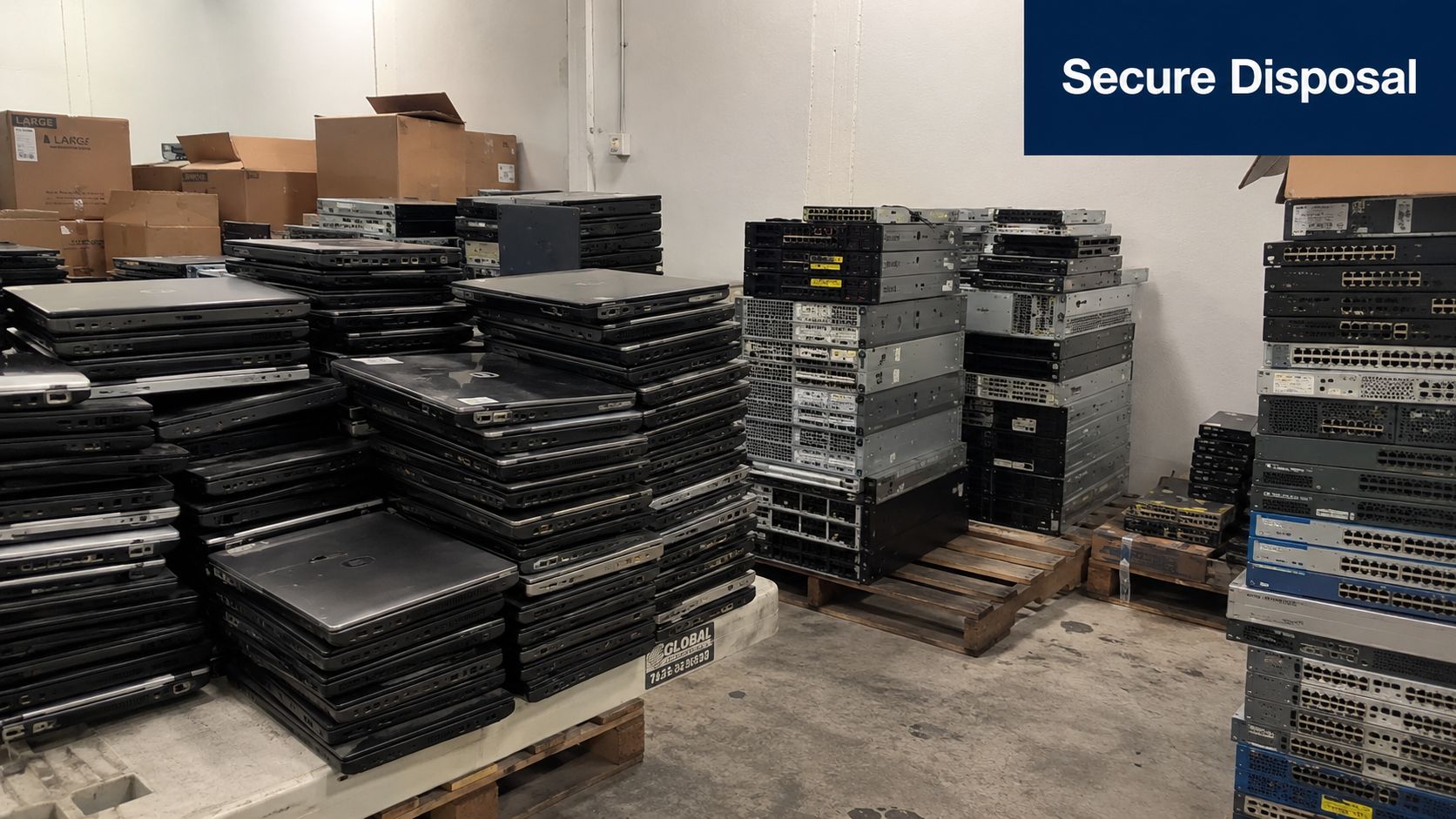
A stack of decommissioned desktops, failed SSDs, network switches, and servers usually contains three things at once: residual data, audit exposure, and recoverable value. Treating that pile like generic e-waste is where companies create avoidable risk. The better approach is to run end-of-life hardware through a controlled IT asset disposition process that documents custody, decides whether equipment should be wiped or destroyed, and closes the file with reporting your team can use.
Your Guide to Secure IT Disposal in East Point
East Point businesses often hit the same bottleneck. A refresh is done, the new equipment is in production, and the old gear sits in storage because nobody wants to make the wrong call on drives, resale, or compliance records.
That hesitation makes sense. Once a device leaves active service, it still carries liability until data is verifiably removed or the media is physically destroyed. For regulated organizations, that's not a side issue. It's part of the control environment.
What usually goes wrong
Most disposal problems start with shortcuts:
- Untracked pickup: assets leave the building without serialized inventory
- Generic recycling: the recycler handles material recovery but not device-level proof
- Late decisions: teams decide on resale versus destruction after hardware has already moved
- Incomplete media handling: a failed drive, embedded storage, or mixed-media device gets missed
Practical rule: If your team can't answer where each retired device is, who handled it, and how its data was eliminated, the process isn't defensible.
For East Point companies looking for a local starting point, East Point computer and electronics recycling services can support pickup and disposition planning for business hardware. The important distinction is that secure IT recycling isn't just about clearing space. It's about controlling what happens next.
What a sound program delivers
A proper process should give your IT, compliance, and procurement teams clear outputs:
- Data security through sanitization or destruction matched to the device
- Chain of custody from pickup through final disposition
- Value recovery when hardware still has resale potential
- Audit-ready records including certificates and reporting
That's the standard East Point ITAD services should be measured against.
Understanding Secure ITAD and IT Recycling
Basic electronics recycling and formal IT asset disposition solve different problems. Recycling focuses on downstream material handling. ITAD governs the full retirement process for data-bearing equipment.
That distinction matters because businesses aren't disposing of empty metal. They're disposing of devices that may still hold customer records, employee information, credentials, configurations, and regulated data.

Recycling removes waste. ITAD manages risk
Think of it this way. Recycling is like hauling away old file cabinets. ITAD is like inventorying every file inside, shredding what must be destroyed, documenting the work, and only then deciding what can be reused.
One industry estimate valued the ITAD market at USD 17.5 billion in 2025 and projected 8.9% CAGR from 2026 to 2035, which reflects growing demand for certified wiping, chain-of-custody tracking, and compliance documentation as part of asset retirement, according to ITAD market analysis from Global Market Insights.
What belongs in an ITAD process
A business-grade program usually includes:
- Serialized tracking: each asset is logged individually, not as a vague pallet count
- Secure handling: collection, staging, and transport are controlled
- Data treatment: assets are either sanitized to standard or physically destroyed
- Disposition decisioning: usable devices go to remarketing, obsolete units go to recycling
- Reporting: destruction and recycling records close the loop
For teams comparing providers, Georgia IT equipment recycling best practices is a useful reference point because it frames recycling as one component of a larger end-of-life control process.
A recycler answers, “Can you take this equipment?”
An ITAD program answers, “What happened to each asset, and can you prove it?”
Why this matters in East Point
East Point companies often operate with distributed users, branch equipment, and mixed device types. That makes informal disposal harder to control. Once laptops, drives, and network gear move through office cleanouts or refresh cycles, small tracking gaps turn into larger compliance problems.
Secure IT recycling works when security decisions come first and environmental handling follows, not the other way around.
Core ITAD Services for East Point Companies
Most businesses don't need every ITAD service on every job. They need the right mix based on data sensitivity, asset condition, and whether there's value left in the equipment.
At enterprise scale, that mix has to hold up operationally. One global ITAD provider reports processing 650,000 assets per year, handling 3.6 million kilograms per year, and supporting clients in 32 countries across 59 ITAD processing sites, which shows how much infrastructure secure inventory control and documented sanitization can require for larger programs, as described by Iron Mountain's secure IT asset disposition service.
Data destruction options
Some assets should never leave your site with readable data intact. Others can move securely to a processing facility if custody controls are tight.
- On-site shredding: best when internal policy, contract terms, or risk tolerance requires visible destruction before media leaves the property.
- Off-site destruction: practical for larger batches when the vendor's intake, tracking, and certificate process is stronger than what most internal teams can manage on their own.
- Software sanitization: appropriate for devices that may be reused or remarketed after verified wiping.
Value recovery and buyback
Many East Point businesses leave money on the table: a recent laptop fleet, late-model desktops, enterprise networking hardware, and some mobile devices may still have resale value if the data can be sanitized to standard.
A provider such as Beyond Surplus ITAD services in Georgia typically handles the chain from pickup through data destruction, grading, and resale-or-recycle routing. That's useful when finance wants recovery value but security wants strict controls.
Logistics and asset handling
The weakest part of many projects isn't wiping or shredding. It's the handoff.
Look for service components such as:
- Pre-pickup inventory planning: know what's being removed before a truck arrives
- Secure packing and palletization: especially for drives, servers, and mixed lots
- Serialized intake reconciliation: what was scheduled should match what was received
- Exception handling: failed drives, damaged laptops, and missing tags need documented decisions
The most expensive mistake is often not choosing destruction over resale. It's moving hardware before anyone decided which path it belongs on.
The practical service menu
If you're evaluating East Point ITAD services, the core menu should include:
| Service | Best fit |
|---|---|
| Certified data wiping | Reusable assets with residual market value |
| Hard drive shredding | Failed media, high-sensitivity data, or strict policy environments |
| IT buyback and remarketing | Working equipment that can recover value after sanitization |
| Secure electronics recycling | End-of-life gear with no reuse value |
| Pickup and logistics coordination | Multi-room, multi-site, or data center removals |
Navigating Compliance and Chain of Custody
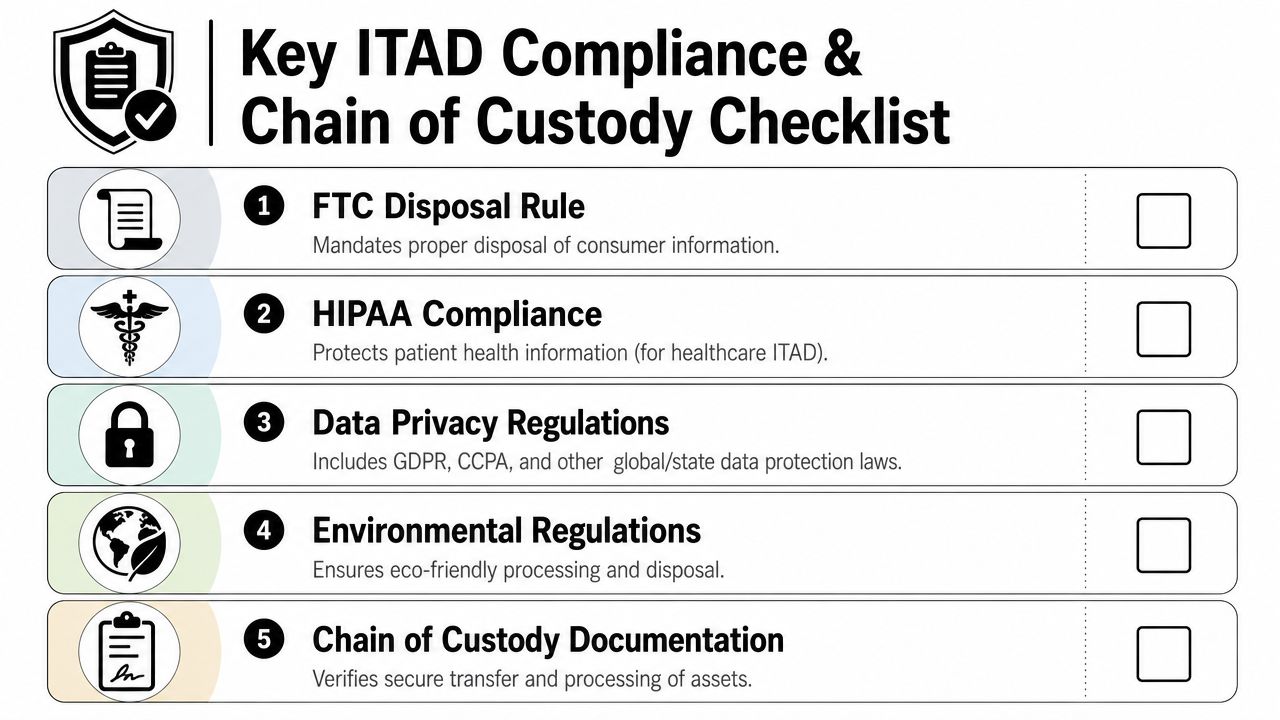
Compliance failures rarely start with a shredder problem. They start with missing proof. A company may believe devices were handled correctly, but if it can't produce records showing what happened to each asset, that belief won't carry much weight during an audit, investigation, or customer review.
For East Point organizations in healthcare, finance, legal, education, and any business holding consumer or employee information, chain of custody is the control that ties disposal activity to actual accountability.
What chain of custody really means
Chain of custody is the documented trail from your office, data center, clinic, or warehouse to final outcome. It should show:
- Asset identity
- Date and point of transfer
- Who accepted custody
- What happened to the device or media
- What certificate or report closed the record
Without that trail, disposal becomes trust-based. That's not enough for regulated data.
Standards that make the process defensible
The strongest technical benchmark for data sanitization is NIST 800-88, often paired with DIN 66399-style shredding where physical destruction is required. Those standards matter because recycling by itself doesn't prove data elimination. Audit requirements generally require evidence that data was removed or destroyed, as outlined in this Georgia guide to secure data destruction and ITAD compliance.
What auditors and legal teams care about
They usually want answers to simple questions:
- Was this device identified as data-bearing?
- Was the sanitization or destruction method appropriate for the media type?
- Was custody controlled the entire way through?
- Can the business retrieve a certificate tied to the device or batch?
If the only record says “recycled,” you have an environmental note, not a data-destruction record.
Where companies create avoidable exposure
Dropping equipment at a general recycler can be perfectly fine for non-data-bearing scrap. It's a weak approach for retired laptops, servers, storage arrays, or networking gear with embedded storage.
That's why the certificate matters. A Certificate of Data Destruction or Certificate of Recycling isn't marketing paperwork. It's the formal record that helps your organization show it followed a controlled process and transferred custody through documented steps.
For East Point businesses, this isn't just about staying neat and organized. It's about being able to defend your process later, when someone asks for proof.
Choosing the Right ITAD Strategy for Your Assets
The strategic question isn't whether to recycle. It's whether an asset should be sanitized and remarketed or destroyed and recycled.
That decision should happen before pickup, not after hardware has already entered the stream. Neutral industry guidance is straightforward here. ITAD is the better fit when assets still contain sensitive data, have residual value, or require audit-ready documentation. Basic recycling fits hardware with no value and no reporting need, as discussed in this comparison of ITAD versus recycling.

When remarketing makes sense
Remarketing is the right path when four conditions line up:
| Question | If yes |
|---|---|
| Is the device still functional or economically repairable? | Consider resale |
| Does it have market demand? | Preserve value |
| Can the data be sanitized to standard? | Move toward remarketing |
| Do you have device-level reporting? | Proceed with confidence |
Typical candidates include business-class laptops, late-model desktops, mobile devices, and some network equipment.
When destruction is the smarter call
Shredding and recycling are usually the stronger choice when:
- Media has failed: failed drives can't be trusted for reuse
- Data sensitivity is high: legal hold concerns, regulated data, sensitive IP, or highly restricted records
- Storage is mixed or hard to verify: especially in SSD-heavy or embedded-storage environments
- Residual value is negligible: no reason to preserve hardware that won't recover meaningful value
Secure recycling isn't always the safest option by itself. The higher-risk mistake is often failed sanitization before resale.
A practical decision framework
Use this sequence before authorizing disposition:
Identify the asset class
Laptop, server, mobile device, array, switch, printer, medical equipment, lab gear.Check for data-bearing components
Include SSDs, removable media, embedded flash, and failed drives.Assess resale potential
If the unit is obsolete, damaged, or missing key components, don't force a remarketing path.Match the method to the media
Some devices are good wiping candidates. Others belong in physical destruction.Require proof
No resale without verified sanitization logs. No destruction without certificate records.
For East Point procurement and IT teams evaluating vendors, how to choose an ITAD vendor in Georgia is a practical checklist because it forces the conversation toward controls, documentation, and downstream handling instead of pickup alone.
The Secure Disposal Process From Start to Finish
A professional ITAD engagement should feel controlled from the first inventory discussion to the final certificate package. If the process feels vague, it probably is.
Industry guidance describes a robust workflow as pre-disposition scoping, secure collection, approved data handling, reuse-or-destroy decisions, recycling, and centralized reporting, with each custody transfer treated as a risk point, according to Reconext's explanation of the ITAD workflow.
Step one through three
Scope the project
The provider identifies asset types, pickup conditions, data-bearing devices, and any special handling requirements such as server racks, failed drives, or restricted access areas.Collect and reconcile
Equipment is packed, palletized, or removed from service under controlled procedures. Good teams reconcile what they pick up against what was scheduled.Apply the right data method
Devices slated for reuse are sanitized. Media that can't be reliably wiped, or shouldn't be, moves to physical destruction.
Step four through six
Grade for reuse or retirement
Sanitized devices are assessed for redeployment, resale, parts harvesting, or final recycling.Process non-reusable material responsibly
Equipment with no practical reuse path enters downstream recycling.Issue reports and certificates
This closes the job. Your team should receive enough documentation to support internal records, compliance reviews, and asset retirement reconciliation.
What a good client experience looks like
You shouldn't need to chase a vendor for basic answers. By the end of the project, you should know:
- what assets were received
- which were wiped
- which were destroyed
- which were remarketed
- which were recycled
- what documentation supports each outcome
That transparency is what turns disposal from a facilities task into a controlled business process.
Frequently Asked Questions about East Point ITAD
What happens if a hard drive fails and can't be wiped
It should move to physical destruction, not a best-effort erase attempt. Failed media is exactly where shred workflows and destruction certificates matter most.
How is buyback or remarketing value determined
Value usually depends on device type, condition, age, configuration, cosmetic quality, and current secondary-market demand. The right way to think about buyback is not guaranteed revenue. It's controlled value recovery after verified data handling.
Can a provider handle a full data center decommissioning near East Point
Yes, if the provider can manage serialized inventory, secure logistics, data-bearing infrastructure, rack removals, and reporting across the entire project. The key question isn't whether they “do decommissions.” It's whether they can maintain custody and documentation through every handoff.
Is basic electronics recycling ever enough
Yes, for equipment with no reuse value and no reporting requirement. It's not enough for most business laptops, servers, storage devices, or any asset where you may later need proof of sanitization or destruction.
If your East Point team is deciding whether to wipe and remarket equipment or shred and recycle it, Beyond Surplus can help evaluate the risk, recovery, and documentation requirements for each asset class, then support certified electronics recycling and secure IT asset disposal.


