A lot of Dunwoody IT directors are dealing with the same scene right now. A locked storage room holds retired laptops from the last refresh, a few racks of decommissioned servers, loose networking gear, and maybe a pallet that nobody wants to touch until legal, finance, and security all agree on what happens next.
That backlog creates three competing pressures at once. You need to recover value, protect data, and close the loop with documentation that stands up to audit. If you treat retired hardware like junk removal, you usually lose on all three.
Your Guide to IT Asset Recovery in Dunwoody
A common Dunwoody scenario looks like this. The hardware is already out of production, but it is still sitting in a branch office, server room, or locked storage area while IT, finance, and security wait for someone to own the process. Every extra week usually lowers resale value, increases handling mistakes, and makes chain-of-custody records harder to defend later.
The teams that recover the most value treat IT asset recovery as an operating process, not a cleanup project. In practice, that means one accountable workflow from internal collection through pickup, data destruction, remarketing, recycling, and final reporting. It also means using one certified vendor that can handle the full chain locally instead of splitting pickups, wiping, and resale across multiple parties.
That local piece matters in Dunwoody. Shorter transport routes, faster scheduling across metro Atlanta, and fewer handoffs reduce the two problems I see most often: devices waiting too long for disposition and devices moving without clean documentation. Those are not minor admin issues. They directly affect resale proceeds, audit readiness, and legal exposure.
The financial upside is real, but only if operations are controlled.
For organizations that want a Georgia-based option, IT asset recovery services in Georgia can support local retrieval, remarketing, and compliant disposition. The better standard for vendor selection is straightforward: confirm certifications, require serialized reporting, verify downstream recycling controls, and make sure the vendor can separate resale candidates from scrap before value is lost.
In Dunwoody, the gap between strategy and execution is usually logistics. A sound ITAD policy on paper does not help much if pickups are delayed, pallets are mixed, or custody records break between your office and the processor. The strongest recovery programs close that gap with a single documented path from inventory to final ROI calculation.
Building Your Foundation with Asset Inventory and Valuation
A Dunwoody IT director usually sees the problem at the worst moment. Pickup is booked, a department drops off a stack of laptops, and half the devices have no verified owner, no recorded specs, and no clear disposition path. At that point, valuation turns into guesswork and chain-of-custody records start with gaps.
Start with inventory before anything leaves the office. That gives your team a usable asset count, a defensible handoff record, and a realistic view of what can return cash versus what will only add processing cost. It also helps a single certified vendor quote the job correctly instead of revising pricing after pickup.
What to capture in the inventory
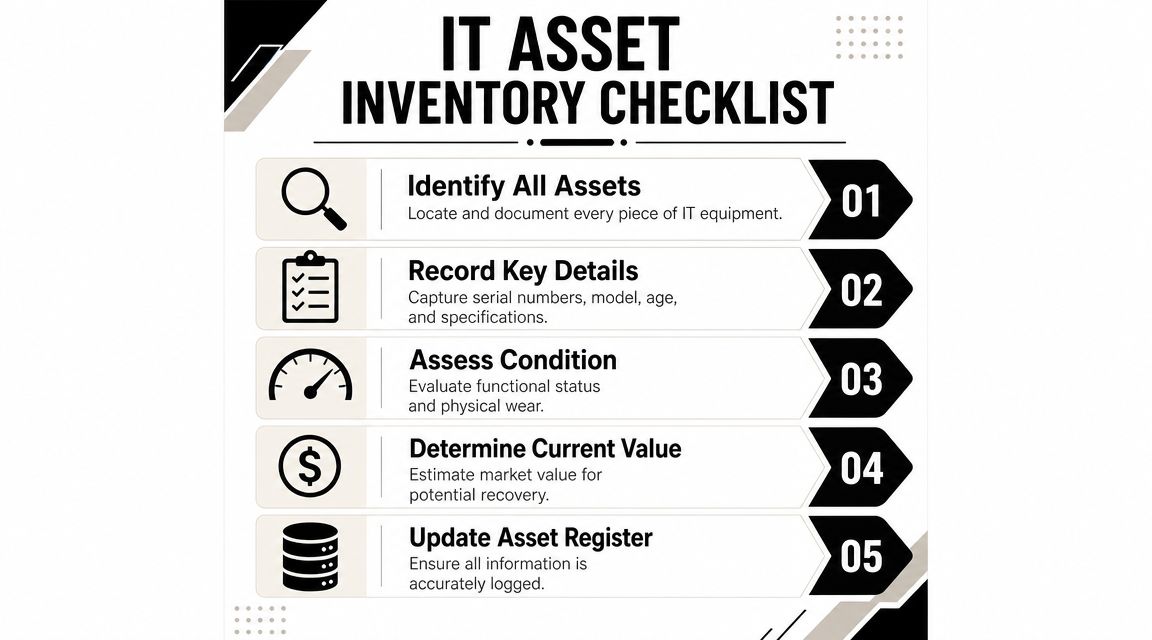
For each device, record the details that affect resale value, internal approval, and downstream compliance:
- Identity data such as asset tag, serial number, manufacturer, and model
- Hardware configuration including CPU, RAM, storage type, and installed accessories
- Physical condition with notes on dents, cracked bezels, missing rails, power supplies, or adapters
- Functional status such as working, powers on, no boot, damaged, or parts only
- Location and owner so retrieval teams know where the asset sits and who approved retirement
Good inventory work is specific. “HP desktop” is not useful for pricing. “HP EliteDesk with serial number, processor class, memory, storage, and cosmetic grade” is useful. That level of detail lets your vendor sort resale candidates from low-value scrap before labor and transport costs eat into returns.
If records are incomplete, do not wait for perfection. Capture assets by room, rack, closet, or department, then reconcile exceptions against your CMDB, procurement files, or endpoint management records. In practice, a controlled serialized count beats a polished spreadsheet with missing devices every time.
Why inventory drives valuation
Valuation depends on model, age, configuration, completeness, and condition. A current business laptop with charger, intact case, and standard corporate specs will price differently from the same model with battery failure, missing SSD, or heavy cosmetic damage.
That is why inventory and valuation should happen together, not as separate admin tasks. Your team needs an early triage view: likely resale, possible repair, parts harvest, or recycle. Make that call while the assets are still traceable to a department and still easy to inspect. Delays create confusion, and mixed pallets usually produce lower recovery.
For companies formalizing this process across refresh cycles, IT asset lifecycle management programs connect procurement history, deployment records, retirement approvals, and final disposition reporting. That link matters because recovery value is usually won or lost long before the pickup truck arrives.
One more practical point. Inventory is also your first compliance document. If the serial list is wrong at intake, the valuation file, destruction record, and final settlement report will all be harder to trust.
Making the Right Call Buyback Refurbish or Recycle
Once the inventory is clean enough to trust, each asset needs a disposition decision. This choice determines whether significant value is gained or squandered. Teams either over-destroy equipment that should have been resold, or they waste time testing devices that are already at end of life.
Speed matters here. Delays can reduce asset value by 40% to 60%, and one industry guide recommends selling within 36 to 48 months to capture peak market value before depreciation accelerates, according to RCA Recycling's IT asset recovery ROI guidance. In practical terms, old inventory sitting in a Dunwoody office for another quarter usually isn't a neutral choice. It's a value loss.
When buyback makes sense
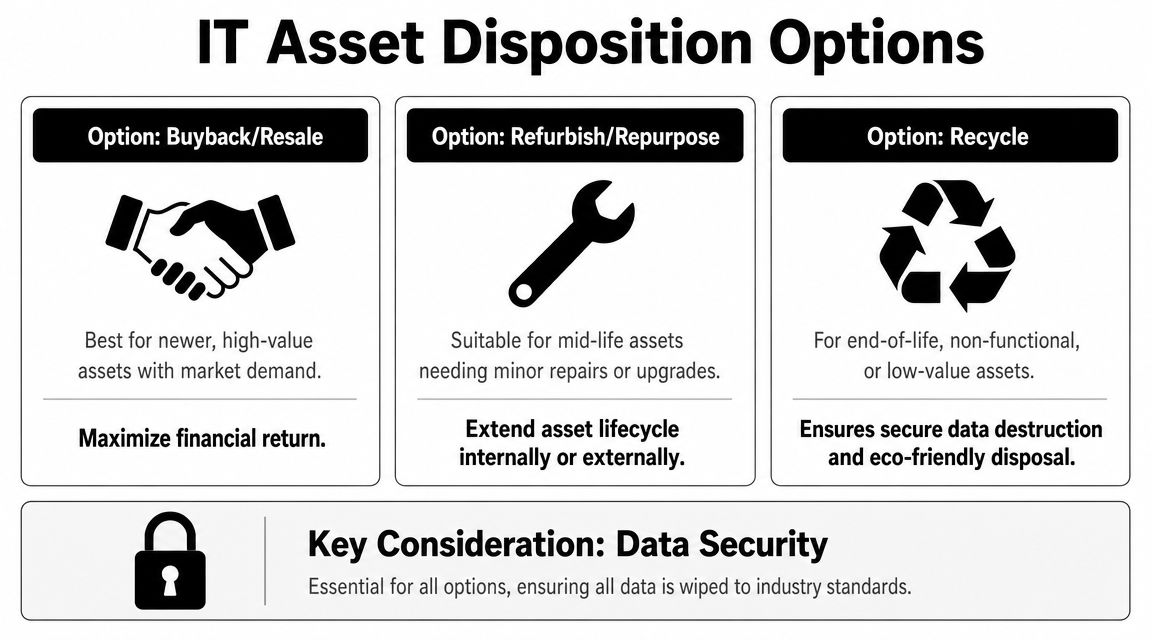
Choose resale when the asset is current enough to attract business demand and still looks deployable.
Typical signs:
- Clean cosmetics with no major cracks, bent housings, or missing covers
- Complete units including drives, memory, power supplies, rails, or adapters where expected
- Commercially relevant specs that secondary buyers still want
That path usually delivers the highest return, but only if the device reaches market intact and documented.
When refurbishment is the smarter move
Some equipment isn't resale-ready on arrival but still deserves another look. Minor repairs, battery replacement, memory upgrades, or cleaning can restore value. This works best for business-class laptops, desktops, and some networking hardware where the core platform still has demand.
A quick triage question helps: is the issue cosmetic or light service, or is it deep board-level uncertainty? If the latter, don't let technicians sink hours into a low-probability recovery.
When recycling is the right answer
Recycle when the gear is obsolete, physically compromised, incomplete, or too costly to restore. This isn't the failure path. It's the compliant end-of-life path.
A practical local rule is to route gear into IT equipment resale services in Georgia only after inventory, testing, and data handling requirements are clear. Everything else should move to certified recycling with documentation.
| Disposition path | Best fit | Main risk if mishandled |
|---|---|---|
| Buyback | Newer, intact, marketable equipment | Delayed sale and avoidable depreciation |
| Refurbish | Mid-life assets with fixable issues | Repair cost exceeds likely recovery |
| Recycle | Broken, obsolete, or low-value gear | Data risk and poor documentation |
Ensuring Secure Data Destruction and Full Compliance
The most expensive mistake in IT asset recovery usually isn't a weak resale number. It's weak data control. If a retired device leaves your office without a documented destruction or sanitization path, you've created a security problem that finance can't offset.
Certified data destruction protects value in two ways. First, it reduces breach and compliance exposure. Second, it prevents premature shredding of devices that still have resale potential. Summit 360 makes that point clearly in its IT asset recovery recommendations: keep equipment 100% intact, because disassembly, missing parts, or cosmetic damage can sharply reduce remarketing value. The best practice is to decide the disposition path only after a formal assessment, then issue certificates of destruction or recycling where appropriate.
Wiping and shredding are different decisions
Software-based sanitization works when the device will be reused or resold and the media can be securely erased to your policy standard. Physical destruction works when the media is failed, the risk profile is too high, or policy requires irrecoverable destruction.
What doesn't work is mixing those decisions too early.
- Don't shred first and ask valuation later. You kill resale before anyone can assess it.
- Don't let unverified wiping stand in for evidence. You need documented results and device-level traceability.
- Don't separate drives from systems casually. That often damages resale value and complicates inventory reconciliation.
Security and recovery aren't opposites. Good operators sequence them correctly.
Chain of custody is the real control
A certificate matters, but the document is only as strong as the process behind it. Your Dunwoody team should be able to show where the asset started, who handled it, when it moved, how it was transported, and what final disposition was applied.
That matters for regulated environments, but it's just as important for any company handling employee, customer, financial, or proprietary business data. If you want a plain-language example of how device handling mistakes can expose personal information, these phone repair data privacy insights are useful because they show how ordinary service events can turn into data exposure when controls are loose.
For Georgia organizations that need documented sanitization and destruction support, secure data destruction and ITAD compliance services can align pickup, data handling, and final reporting into one custody trail. The important thing is to require certificates, serialized records, and a disposition report that matches your original manifest.
Coordinating Logistics and Pickups in Dunwoody
Logistics decides whether your plan survives practical conditions. A clean spreadsheet doesn't help if half the assets are spread across offices, two closets, and a staging area near the server room.
Local pickup planning should start with containment. Move retired assets into a controlled area, separate resale candidates from destruction-only material, and attach serialized labels that match your working inventory. When the truck arrives, your team shouldn't be debating what belongs in the load.
What to do before pickup day
- Stage by disposition class so laptops, servers, drives, and loose accessories aren't mixed together
- Keep systems complete with caddies, rails, power cords, docking stations, and chargers where applicable
- Prepare a manifest that lists serialized assets and highlights exceptions
- Assign one internal owner from IT or facilities to approve handoff at the dock or suite
That last point matters more than people think. When too many stakeholders touch the handoff, accountability gets blurry.
What a strong local pickup process looks like
A well-run pickup in Dunwoody should feel controlled, not complicated. The vendor confirms scope, arrives with the right transport method, checks counts against the manifest, and documents custody at the point of removal. If you're dealing with office towers, medical offices, schools, or mixed-use commercial properties, local familiarity helps because loading access, freight elevators, and scheduling windows can create delays.
For businesses scheduling regional retrievals, IT equipment pickup services in Georgia should include documented transport and a clear process for updating exceptions discovered at pickup. That keeps your internal team from spending another week fixing paperwork after the equipment is already gone.
Calculating and Maximizing Your Asset Recovery ROI
A Dunwoody IT director closes a refresh cycle, sees a resale credit on part of the lot, and assumes the project performed well. Finance asks for the actual return. That answer takes more than a resale total.
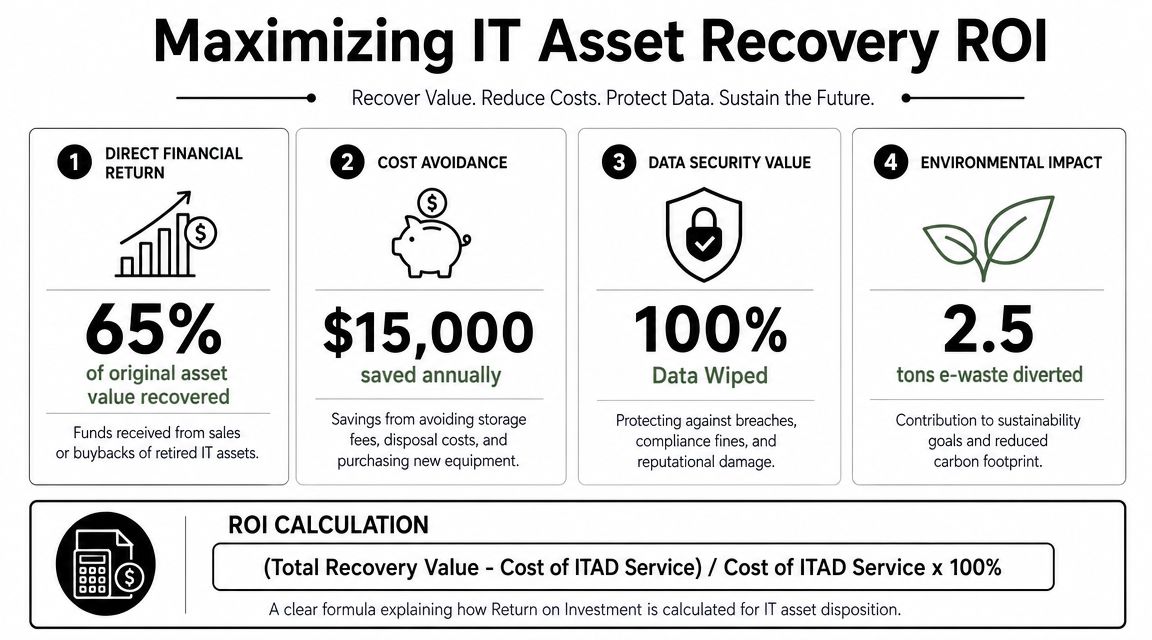
Use an ROI model that matches what happens on the ground with local pickup, processing, and disposition through one certified vendor. The core calculation is simple. Add recovery value and avoided internal cost, then subtract the full service cost.
Start with three buckets:
- Recovery value from assets sold into secondary markets or prepared for reuse
- Cost avoidance from clearing storage space, reducing staff handling time, and avoiding unnecessary disposal charges
- Program cost for pickup, transport, data destruction, processing, reporting, and recycling for non-resalable equipment
A practical ROI view
The resale line gets attention, but it is rarely the whole story. In practice, ROI improves when fewer assets fall out of the chain of custody, fewer devices arrive damaged, and fewer hours are spent by your team reconciling exceptions after pickup. That is why the local execution model matters as much as the valuation model.
For Dunwoody organizations, the best returns usually come from process control. A single certified vendor that handles pickup, data destruction, remarketing, recycling, and final reporting can reduce handoff errors and duplicate labor. It also gives finance one file to review instead of chasing documentation across multiple providers.
Capture rate matters more than optimistic pricing.
If ten usable laptops never make the manifest, no resale estimate will fix the gap. If accessories are separated, if systems sit too long before processing, or if mixed loads force extra sorting, the return drops fast. The practical goal is not to chase the highest theoretical resale number. It is to get the highest verified net return after all service costs and losses are accounted for.
What raises ROI in the field
- Bundle equipment by project or site so pickup and processing costs are spread across a larger lot
- Separate value-bearing assets from scrap before handoff so reusable equipment is not treated like low-grade recycling
- Protect condition during staging because cracked housings, missing drive caddies, and broken ports cut resale value
- Keep complete systems together including chargers, docks, rails, and power supplies when they affect resale readiness
- Move assets promptly so aging inventory does not lose more market value while sitting in storage
- Review results by device class because laptops, servers, network gear, and mobile devices recover value differently
A workable internal formula looks like this: (recovery value + avoided cost) – total program cost = net recovery.
Then test that number against what your team spent internally. If your staff put in two weeks of labor cleaning, sorting, labeling, reconciling serials, and resolving exceptions, count it. If old equipment occupied usable office or storage space in Dunwoody for another quarter, count that too. Those costs are real, even when they never hit the vendor invoice.
The strongest programs treat ROI as an operating metric, not a one-time rebate. Track recovery by asset class, compare expected value to actual settlement, and look for process failures at the site level. That is how an ITAD strategy turns into repeatable financial return.
Your Dunwoody ITAR Checklist and Next Steps
If you're cleaning out a server room, preparing for a move, or closing a refresh cycle, keep the process simple and disciplined.
The checklist that actually works
- Inventory everything before a single asset leaves the building
- Evaluate residual value using model, specs, condition, and completeness
- Triage correctly into resale, refurbishment, destruction, or recycling
- Secure the data path with documented sanitization or physical destruction
- Schedule controlled pickup with serialized manifests and handoff records
- Document final disposition so finance, security, and compliance all have the same file
Common local mistakes to avoid
A few problems show up over and over in Dunwoody-area projects:
- Mixed pallets where valuable equipment is buried with scrap
- Early drive removal that damages resale potential and complicates reconciliation
- Loose accessories that disappear before valuation
- Incomplete sign-off between IT, facilities, and procurement
If you fix those four issues alone, your recovery program usually gets cleaner fast. What's more, it becomes easier to defend to leadership because the process is visible, repeatable, and tied to both risk reduction and financial return.
For Dunwoody businesses that need certified electronics recycling, secure data destruction, IT asset disposition, and local pickup coordination, contact Beyond Surplus to start an IT asset recovery plan that protects data, documents chain of custody, and helps recover value from retired equipment.