

Your Georgia office has a cage full of retired laptops, a pallet of drives from a storage refresh, and a data center team asking when the old servers can leave. Legal wants documentation. Security wants zero surprises. Finance wants the cheapest path. That's where the main decision starts.
For most Georgia companies, onsite vs offsite ITAD services in Georgia isn't a simple preference call. It's a risk allocation decision. You're deciding whether to prioritize direct physical control or operational efficiency, and that choice affects compliance, project speed, and total disposal cost.
Georgia adds pressure. According to the verified Georgia data provided, the state generated over 1.4 million tons of electronic waste in 2022, but only 128,000 tons were formally processed through certified ITAD channels. That gap explains why chain-of-custody, documentation, and certified downstream handling matter so much for business disposals in this market.
The ITAD Dilemma for Georgia Businesses
A common Georgia scenario looks like this. An IT director inherits years of retired equipment sitting in a locked room. Some assets hold customer records. Some came from finance or HR. Some still have resale value. None of them can sit there forever.
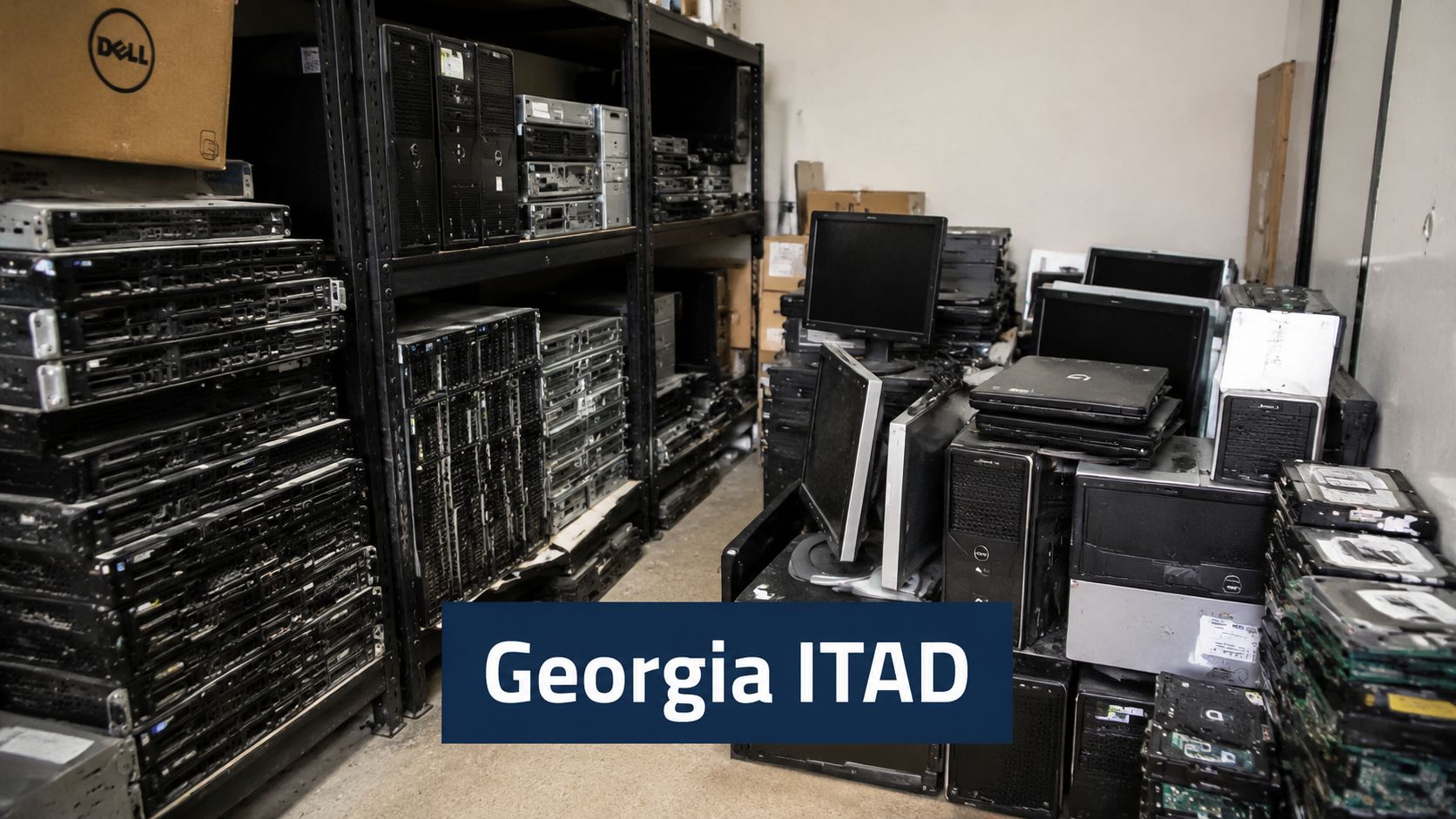
The problem isn't disposal alone. It's proving that disposal happened correctly. Georgia's compliance environment has pushed companies away from casual, undocumented disposition. If your process doesn't produce a clean audit trail, it creates risk long after the hardware is gone.
What usually drives the decision
Three forces tend to collide at once:
- Security pressure: Drives, SSDs, and servers can't leave a blind spot in your disposal process.
- Compliance pressure: The FTC Disposal Rule and industry obligations demand documented controls.
- Budget pressure: Leadership wants certainty without paying mobile-shredder pricing on every asset.
Georgia companies dealing with that mix should start with governance, not convenience. If your internal stakeholders are split, use a documented framework and align the decision to asset sensitivity, volume, and audit requirements. That's why ITAD services matter for Georgia companies. The disposal method you choose becomes part of your compliance posture.
Practical rule: If you can't explain your chain of custody in one clear sentence to an auditor, your process is too loose.
The Core Tradeoff Onsite vs Offsite ITAD
The decision comes down to one tradeoff. Onsite gives you maximum immediate control. Offsite gives you maximum scale and efficiency.
Here's the quick view:
| Factor | Onsite ITAD | Offsite ITAD |
|---|---|---|
| Primary strength | Witnessed destruction on your premises | Batch processing at centralized facility |
| Best fit | High-sensitivity, low-volume assets | Enterprise refreshes, decommissions, multi-site projects |
| Cost profile | Higher per unit | Lower per unit at scale |
| Throughput | Limited by mobile equipment and site logistics | Higher throughput through industrial systems |
| Audit comfort | Strongest visual verification | Strong when documentation is complete |
Why offsite usually wins at scale
Industry guidance notes that offsite ITAD is typically the higher-throughput, lower-unit-cost model because centralized facilities reduce per-device handling cost and process assets faster through batch-optimized industrial systems, while onsite work depends on mobile shredders, travel, and security staffing, as summarized by Inteleca's overview of on-site vs off-site ITAD.
That matters in Georgia because many business projects aren't ten drives. They're hundreds of laptops across offices, racks of decommissioned servers, or a multi-site cleanout tied to relocation, merger, or cloud migration.
When onsite is the right call
Onsite is the right answer when assets cannot leave the premises intact. That usually means highly sensitive data, internal policy requirements, or a leadership team that demands witnessed destruction for every data-bearing device.
Use onsite if your top priority is direct observation. Use offsite if your top priority is efficient processing of large volumes with strong documentation.
Security and Data Destruction Methods Compared
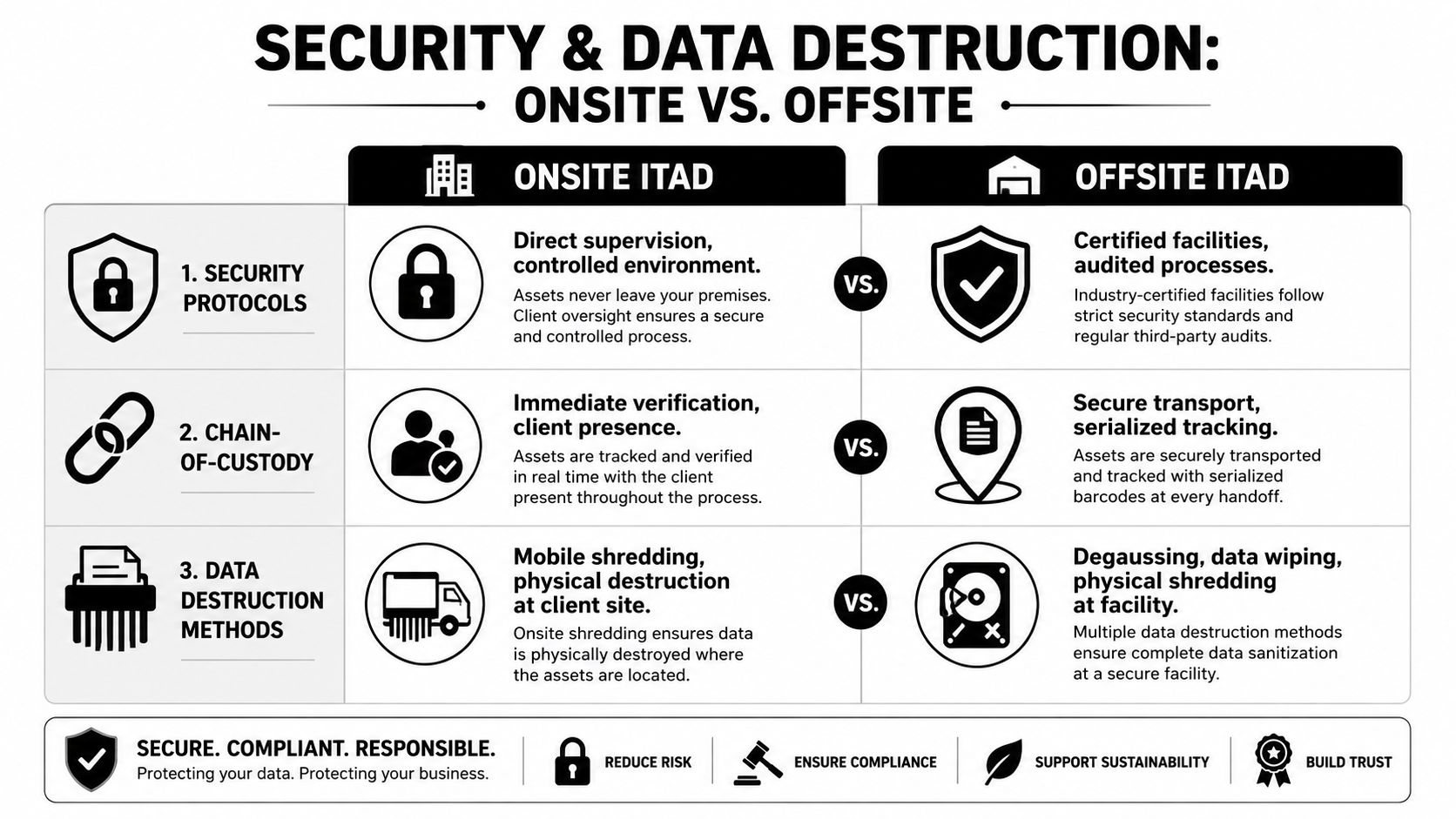
Security decisions in ITAD shouldn't rely on comfort words like “secure pickup” or “certified process.” You need to know exactly where custody changes, who records it, and what evidence exists at the end.
Onsite control
With onsite service, the strongest advantage is obvious. Media stays under your supervision until destruction occurs. Staff can witness the process, verify asset counts, and close the loop immediately. That's why organizations with strict internal controls often prefer onsite shredding for a narrow set of drives.
The tradeoff is operational. Mobile destruction is less flexible for mixed loads, value recovery, and high-volume processing. It's a control-first model, not an optimization model.
Offsite documentation
Offsite introduces a transit stage, so the process has to compensate through discipline. According to the verified guidance summarized by BitRaser, onsite ITAD offers the strongest chain-of-custody control, but offsite can still meet compliance targets when documented correctly through sealed containers, secure transport, serial-number tracking, and a Certificate of Destruction for each device, as discussed in BitRaser's analysis of onsite and offsite data destruction.
That means the key question isn't “Did the asset leave the building?” It's “Can the provider prove uninterrupted custody at item level?”
- Onsite evidence: witness visibility, immediate destruction, local signoff
- Offsite evidence: serialized intake, sealed transport, facility controls, item-level destruction records
If you need a Georgia-specific model for witnessed service, review onsite data destruction options in Georgia.
Strong chain of custody isn't a feeling. It's a documented sequence with no unexplained handoff.
Navigating Georgias Compliance Landscape
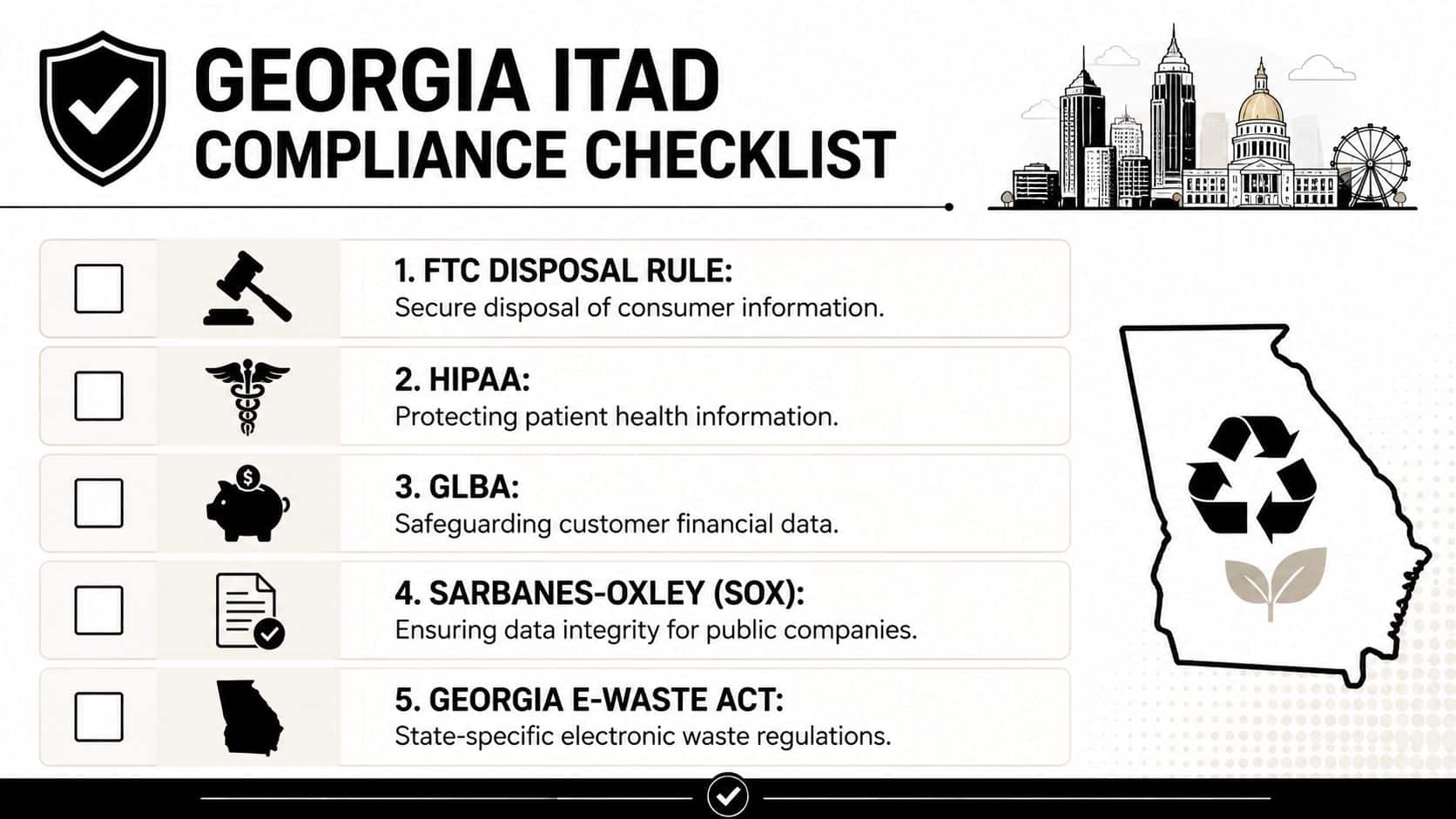
Compliance drives this decision harder than most IT teams admit. The FTC Disposal Rule already requires secure disposal of consumer information. In healthcare, HIPAA raises the standard for handling media tied to protected health information. Finance and public-company environments also expect documented controls that hold up under audit.
Georgia raised the documentation standard
According to the verified Georgia data, the state's 2021 Electronic Waste Management Act mandated stricter chain-of-custody documentation, and 68% of regional enterprises shifted from informal onsite disposal to certified offsite ITAD services to comply with FTC Disposal Rule standards. The same verified data states that offsite services now account for nearly 74% of all certified ITAD transactions in Georgia because providers can issue granular Certificates of Destruction that transfer liability completely.
That's the practical issue for IT directors. Informal disposal is no longer defensible. You need records tied to assets, dates, custody, and disposition outcome.
Compliance choice by risk profile
If your auditors or legal team want physical witnessability, onsite gives you a simple proof path. If your organization can accept secure transport and relies on formal documentation, offsite can satisfy compliance just fine when the paperwork is rigorous.
For Georgia teams tightening process controls, this guide to secure data destruction and ITAD compliance in Georgia is a useful operational reference.
Compliance test: Could you hand an auditor your asset list, destruction records, and chain-of-custody documentation without rebuilding the story afterward?
Cost Throughput and Logistics in Georgia
Here, opinions should get sharper. If you're retiring large volumes of assets in Georgia, offsite is usually the better business decision. Not because it sounds modern, but because the economics are better and the workflow is faster.
According to the verified Georgia data, organizations relying on onsite data destruction often face $45 to $60 per hard drive for mobile shredding, while offsite facilities can reduce processing costs to $18 to $25 per unit by consolidating volumes. That cost gap is big enough to change project approval decisions.
The logistics reality
Onsite jobs require truck scheduling, crew time, parking and loading access, security coordination, and enough on-premises volume to justify the mobilization. Offsite programs centralize those variables. Assets move into one controlled workflow, which is why they're usually better for office consolidations, refresh cycles, and warehouse cleanouts.
The verified Georgia data also states that a late-2023 FTC Disposal Rule enforcement update led to a 19% increase in certified offsite ITAD contracts in Georgia. Companies didn't move that direction by accident. They moved because certified offsite processing is easier to document and easier to scale.
What Georgia IT teams should do
Use onsite only when transit itself is unacceptable. For everything else, evaluate pickup design, packaging controls, and receiving workflow. If you operate across state lines, it also helps to understand how privacy expectations evolve in neighboring markets. For legal context outside Georgia, Understanding Florida data privacy offers a useful comparison in how businesses should think about regulated data handling.
For statewide and multi-location projects, a scheduled Georgia IT equipment pickup service is usually the cleaner operating model.
Recommended ITAD Scenarios by Industry
The right answer depends on what your organization does, not what your vendor prefers.
Healthcare and other high-sensitivity environments
Healthcare organizations in Georgia still lean heavily toward onsite for one reason: witnessability. The verified Georgia data states that 45% of healthcare facilities in Georgia prefer onsite hard drive shredding because strict HIPAA compliance requirements demand in-person verification before sanitization.
If your assets contain patient data, legal files, or highly restricted internal records, onsite makes sense for the most sensitive media. Pay the premium and remove the transit argument entirely.
Data centers and enterprise decommissions
This is the opposite case. The verified data states that enterprise-level data center de-installations in Georgia chose offsite ITAD 81% of the time, and that offsite service reduces total cost of ownership by an average of 22% compared with onsite mobile units for those projects. The same verified dataset notes that data center decommissioning volume in the Southeast rose 32% between 2022 and 2024, with Atlanta becoming the third-largest hub for cloud infrastructure in the U.S. by 2023.
Those are scale projects. They need de-install labor, transportation, industrial throughput, and a path for remarketing and recycling. Offsite also supports value recovery better in those environments. Verified Georgia data states that large-scale offsite services can recover 15% to 25% more revenue through remanufacturing.
My recommendation
- Healthcare, legal, government, classified workflows: favor onsite for the most sensitive drives.
- Corporate refreshes, warehouse cleanouts, multi-site retirements: favor offsite.
- Data center decommissions in Atlanta and across Georgia: choose offsite unless policy prohibits asset transit.
- Mixed environments: split the project. Shred the highest-risk media onsite and send the rest through documented offsite ITAD.
That hybrid model is often the most rational choice.
Your Final Decision A Risk and Value Checklist
A Georgia IT director usually makes this call under pressure. A lease return is due, auditors want proof of destruction, and legal wants to know who touched every drive between your office and final disposition. The right answer is the option that lowers exposure and stands up in an audit.
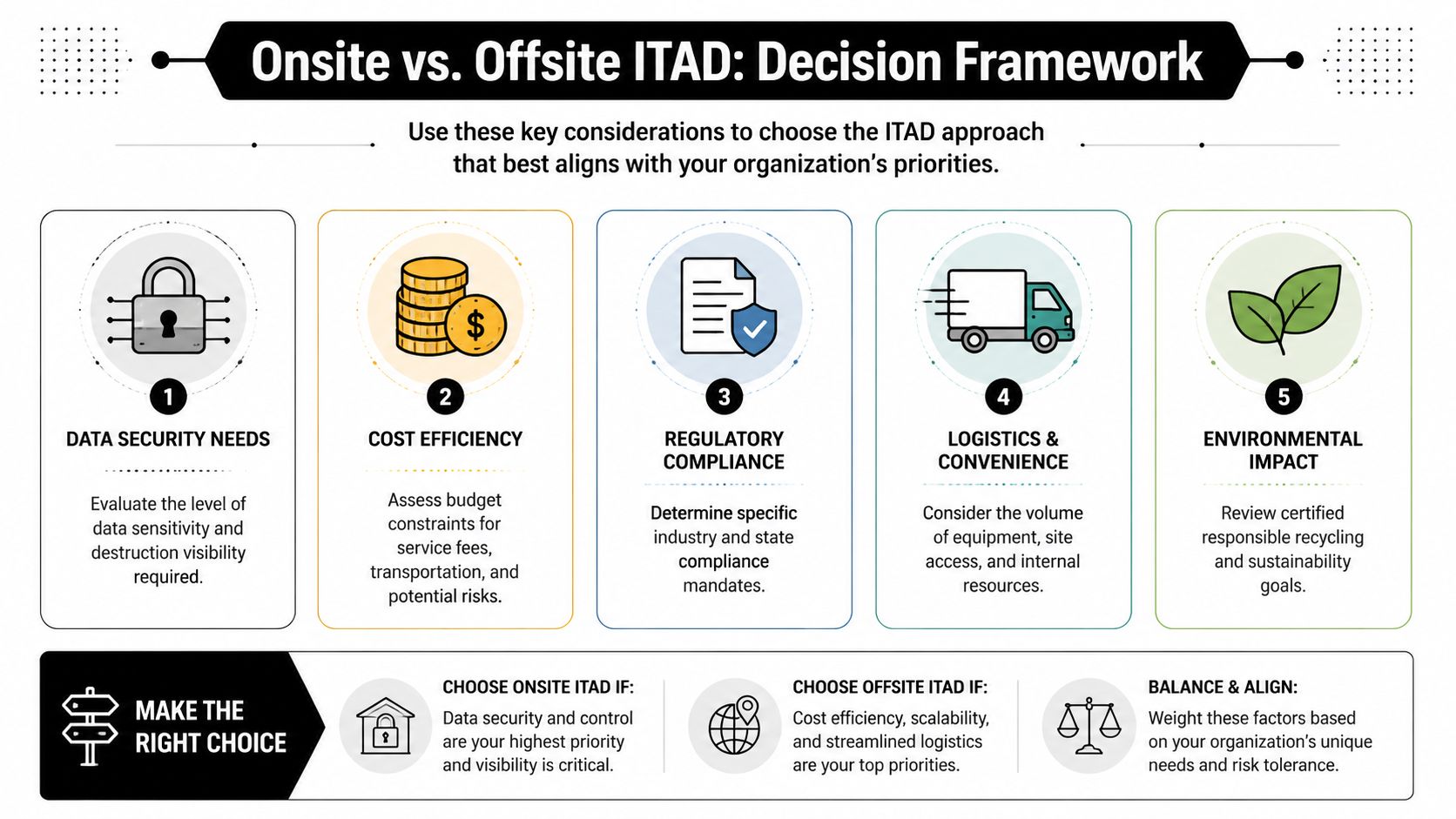
Use a weighted decision matrix, not a generic pros and cons list. Score each factor from 1 to 5, then apply the higher weight to the factors that matter in Georgia: documented chain of custody, destruction evidence, transport exposure, and downstream compliance support under the FTC Disposal Rule and your sector-specific retention policies.
Score these five factors
Data sensitivity and transit tolerance
If your policy or risk profile does not allow media to leave the site intact, choose onsite. This matters most for regulated records, legal hold environments, and executive devices.Audit evidence requirements
If your auditor, privacy officer, or client contract requires witnessed destruction, serialized reporting, or clear custody documentation, choose the provider that can prove each control step. Ask for sample certificates, asset logs, and exception handling records.Volume and processing speed
Large refreshes, warehouse clear-outs, and multi-site projects usually fit offsite processing better. Dedicated facilities handle sorting, testing, wiping, shredding, and resale triage with more efficiency than a mobile setup.Asset value recovery
If resale return matters, offsite usually wins. Centralized processing supports better testing and remarketing, which can offset project cost.Vendor control maturity
Your real risk sits with the vendor. Review insurance, NAID or downstream certifications if applicable, employee screening, chain-of-custody procedures, and exception reporting. Use this vendor due diligence checklist for ITAD providers before you sign anything.
Security review principles apply here too. Weak handoffs create avoidable risk, whether the asset is a hard drive or a building access point. GM GROUP Services' guide to security assessments is a useful reference for evaluating control gaps before they become incident reports.
My recommendation
Choose offsite for standard corporate ITAD in Georgia when you need scale, better resale recovery, and cleaner processing economics.
Choose onsite when the media is highly sensitive, the chain of custody cannot include road transport, or internal stakeholders require direct observation of destruction.
Choose a hybrid model for mixed environments. Shred the highest-risk media onsite. Send lower-risk laptops, networking gear, and bulk hardware to an offsite facility for processing and value recovery.
One Georgia-based option is Beyond Surplus, which provides both onsite and offsite ITAD services.


