When your Georgia business retires old electronics, it's not just a disposal task—it's a critical moment for risk management. A proper business electronics recycling Georgia program isn't about just getting rid of old gear; it's a secure, compliant, and fully documented process. It's about protecting your company's sensitive data and upholding your commitment to environmental responsibility. This is a commercial-grade service, distinct from standard recycling.
The High Stakes of E-Waste for Georgia Businesses
For any IT director or compliance officer in Georgia, managing retired technology assets presents a significant challenge. Simply disposing of old servers, laptops, or networking equipment is not an option. Such actions create a direct path to serious risks, including devastating data breaches, steep legal penalties, and a stained brand reputation. Standard recycling services are not equipped to handle the complexities of corporate IT equipment.
The challenges are real and impact multiple fronts:
- Data Security: Every single retired hard drive, server, and smartphone is a potential liability. It could be holding sensitive customer information, private financial records, or your company's most valuable intellectual property.
- Regulatory Adherence: Federal and state regulations, such as the FTC Disposal Rule, mandate the secure destruction of consumer information. Non-compliance can result in severe fines.
- Operational Efficiency: Obsolete equipment consumes valuable office or data center space and ties up internal resources that could be focused on core business functions.
Shifting from E-Waste to Strategic ITAD
This is precisely why the conversation has shifted from simple e-waste collection to comprehensive IT Asset Disposition (ITAD). ITAD is not just a service; it's a formal, strategic process that covers the entire lifecycle of your retired IT assets. It provides a structured solution for secure data destruction, maximizes value recovery through resale, and delivers the auditable documentation required for compliance.
A professional ITAD partner transforms a disposal problem into a secure, efficient, and often profitable component of your operations. The consequences of mismanagement are significant, as detailed in the environmental impact of electronic waste.
Georgia's Role in a Growing Industry
Georgia, particularly Atlanta, has emerged as a key hub in the rapidly expanding U.S. electronics recycling industry, with companies like Beyond Surplus at the forefront. The U.S. Electronic Goods Recycling market has demonstrated steady growth, with a compound annual growth rate (CAGR) of 4.8% from 2020 to 2025. Projections indicate market revenue will reach $27.7 billion by 2025.
To put the scale of the problem in perspective, the U.S. generated 6.9 million tons of e-waste in 2023 alone. This highlights the urgent need for professional services that guarantee secure and compliant disposal. You can explore this industry growth further on IBISWorld.com. This growth underscores one critical point: selecting a certified, experienced partner for your business's ITAD needs has never been more important.
Preparing Your IT Assets For Secure Handover
Before any retired electronics leave your facility, a clear plan is essential. This process involves more than just stacking old equipment; it's a critical step for a secure, efficient, and fully auditable handover to your ITAD partner. Proper preparation minimizes business disruption and establishes a transparent chain of custody from the start.
The first action is to conduct a thorough inventory. This is not a quick headcount but a detailed log of every asset designated for disposal. This log serves as the single source of truth, ensuring no equipment is misplaced during the process.
Creating A Detailed Asset Inventory
Consider your inventory the first line of defense against mismanagement. It creates an undisputed record of what is leaving your facility and what you expect your ITAD partner to process and report on.
For each piece of equipment, ensure your list includes:
- Asset Type: Be specific (e.g., Dell PowerEdge R740 Server, Cisco Catalyst 9300 Switch, HP EliteBook 840 G5 Laptop).
- Serial Number: This is a non-negotiable unique identifier for tracking and auditing each device.
- Asset Tag Number: Your internal company tag is crucial for cross-referencing with your own asset management system.
- Physical Location: Note its origin (e.g., Data Center Rack 42U, Office 301, Storage Closet B).
While creating this inventory can be time-consuming, especially when decommissioning a data center, this detailed record is invaluable for validating the final Certificate of Recycling and Data Destruction. For a deeper dive into this process, consult our guide on how businesses should prep for IT disposal.
The journey from identifying e-waste to managing the associated risks is a critical one, as this flow illustrates.
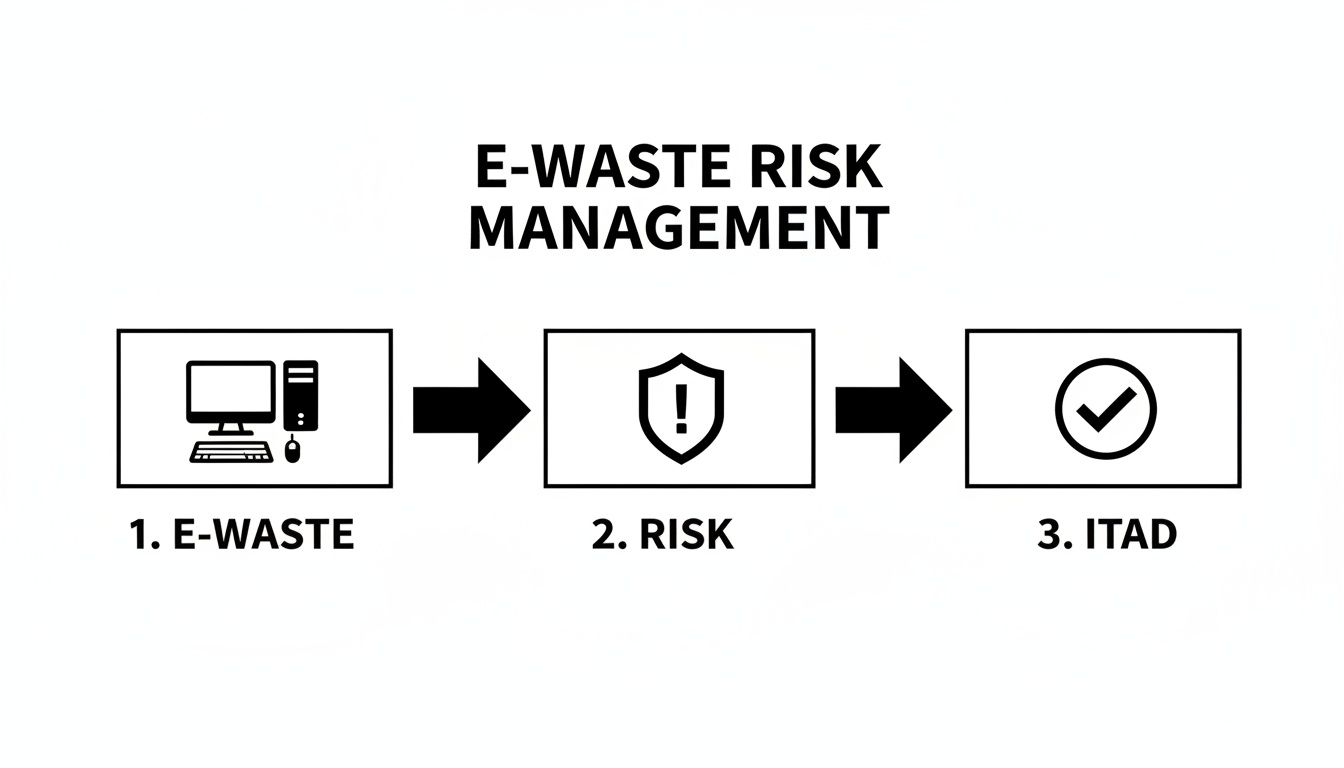
This process highlights how engaging a professional ITAD partner is the final, definitive step in converting a potential liability into a securely managed asset.
Segregating Assets And Organizing For Pickup
With your inventory complete, it's time to physically sort the equipment. Not all retired IT assets are equal—some devices carry far more data-related risk. Your team should separate devices based on data sensitivity to streamline the handling and destruction process.
For instance, a pallet of servers that stored sensitive financial records should be kept and labeled separately from a pallet of old VoIP phones or monitors. This organization helps your ITAD provider immediately prioritize the most critical assets for secure processing upon arrival.
A common mistake is mixing high-risk data-bearing devices with non-sensitive peripherals. By segregating your assets beforehand, you directly contribute to a more secure and efficient data destruction workflow, reducing the margin for error.
Consider a real-world scenario: decommissioning a server rack. This involves more than unplugging machines. It means carefully de-racking each server, organizing corresponding rails and cables, and palletizing everything securely for transport. Servers should be wrapped to prevent damage, especially if value recovery is a goal.
A well-organized pickup not only simplifies logistics but also demonstrates a commitment to a secure and professional disposition process. This level of organization is the hallmark of a mature business electronics recycling Georgia strategy.
Executing Certified Data Destruction
With your assets inventoried, the next step is the most critical: securely destroying all sensitive data. This is not merely a best practice; it is a non-negotiable requirement that shields your business from the consequences of a data breach. A single improperly handled hard drive can create a massive liability.
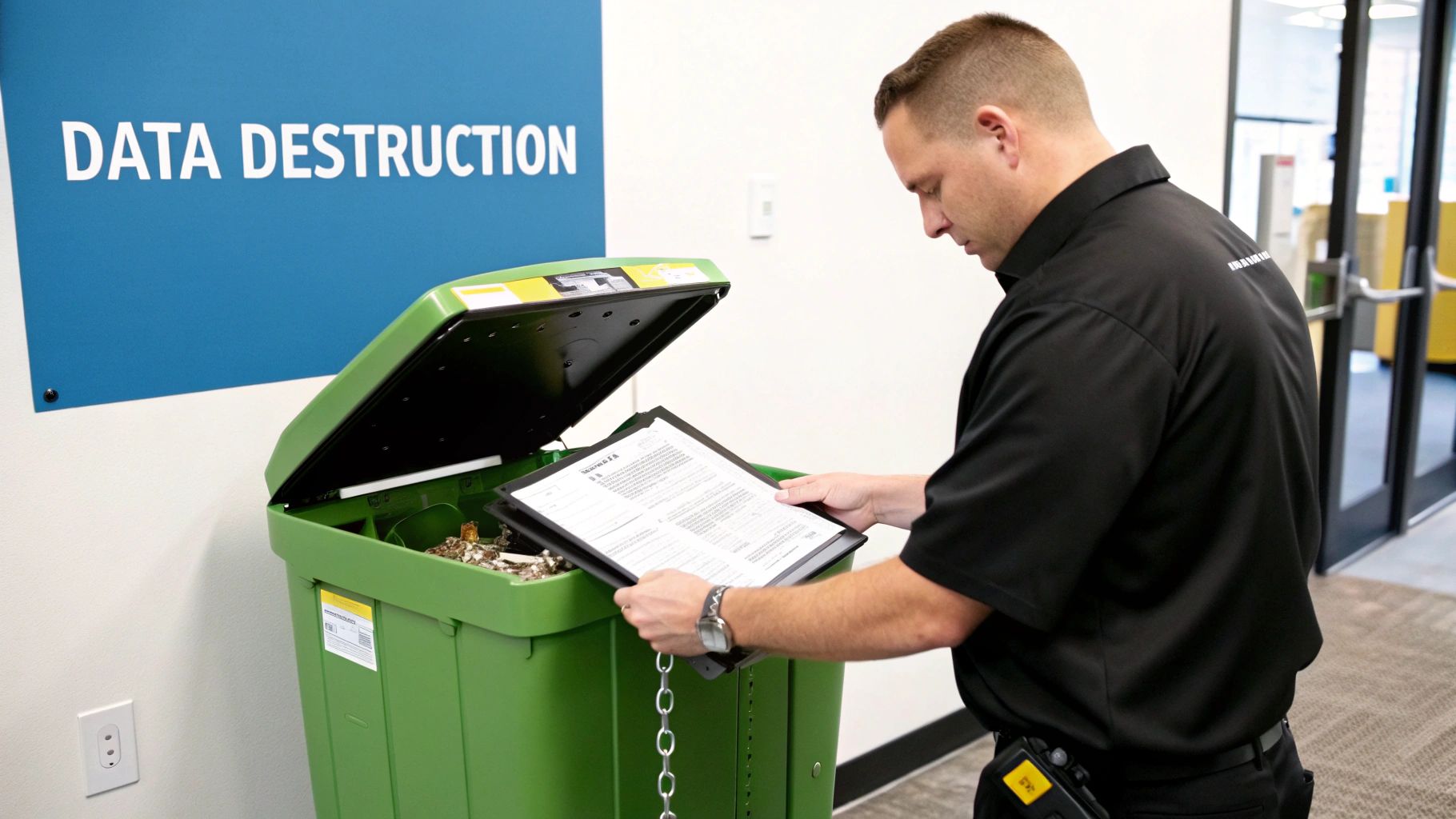
For certified data destruction, two industry-approved methods are available: software-based data wiping and physical destruction. The optimal choice for your Georgia business depends on your security requirements, compliance mandates, and whether you aim to recover value from the old equipment.
Data Wiping to NIST 800-88 Standards
Data wiping, or sanitization, uses specialized software to overwrite data on a hard drive or SSD. The process layers random characters over the original information, making it irrecoverable. The industry benchmark for this is the NIST 800-88 standard, a set of rigorous guidelines from the National Institute of Standards and Technology.
This approach is ideal for newer or high-value devices intended for resale. Wiping preserves the hardware's functionality, maintaining its potential for value recovery.
Imagine a growing tech startup in Atlanta upgrading its two-year-old developer laptops. These machines retain significant resale value.
- Action: The company engages an ITAD partner to perform a certified NIST 800-88 wipe on every SSD.
- Outcome: The data is permanently erased. The company receives a Certificate of Data Destruction for each serial number, and the laptops are resold, offsetting a substantial portion of the new hardware cost.
Physical Destruction On-Site or Off-Site
For organizations in highly regulated sectors like healthcare or finance, physical shredding provides the ultimate peace of mind. Physical destruction involves pulverizing hard drives, SSDs, backup tapes, and other storage media into small, unusable fragments.
This method offers the highest security guarantee and can be performed in two ways:
- On-Site Shredding: A mobile shredding truck comes directly to your Georgia facility. You can witness the entire process, from serial number scanning to the final destruction of the drives.
- Off-Site Shredding: Your devices are transported in locked, secure containers to a certified facility. The entire process is recorded, with serial numbers logged before destruction.
Consider a financial firm in Savannah decommissioning old servers under strict GLBA rules. The risk of a data leak is too high to accept any alternative. For them, witnessed on-site shredding is the only option that provides a completely secure and verifiable chain of custody.
The choice between wiping and shredding often depends on balancing value recovery against absolute security. If a device has no resale value or compliance rules mandate it, physical destruction is the superior choice.
To help you decide, here's a comparison of common data destruction methods for Georgia businesses.
Comparing Data Destruction Methods For Georgia Businesses
| Method | Security Level | Ideal Use Case | Compliance Alignment | Key Benefit |
|---|---|---|---|---|
| NIST 800-88 Wiping | Very High | Newer, functional assets with resale potential | HIPAA, GLBA, FACTA, SOX | Preserves hardware value for IT buyback |
| On-Site Shredding | Maximum | End-of-life assets, high-risk data | All major regulations, provides witnessed proof | Unbroken chain of custody, ultimate peace of mind |
| Off-Site Shredding | Very High | Bulk disposal of end-of-life assets | All major regulations, with secure transport & video proof | Cost-effective for large volumes |
Each method provides a certified, defensible process. Matching the right one to your specific assets and risk profile is key to a successful ITAD strategy.
The Certificate of Data Destruction: Your Proof of Compliance
Regardless of the method chosen, the process must conclude with a Certificate of Data Destruction. This legally binding document serves as your official record, proving that data on specific devices (listed by serial number) was destroyed according to professional standards.
This certificate represents a transfer of liability from your company to your ITAD vendor. In the event of a future issue, this document is your proof of due diligence and compliance with regulations like the FTC Disposal Rule.
Without it, you have no verifiable evidence that you protected sensitive information, leaving your organization vulnerable to legal and financial repercussions. This is why selecting a partner with credentials like R2 is critical; it ensures the documentation you receive is valid and trustworthy. You can learn more about what R2 certification means and why it's a non-negotiable for any serious business.
Navigating Compliance And Managing Risk
Disposing of corporate electronics in Georgia is more than a logistical task—it’s a serious exercise in risk management. Businesses must navigate a complex web of data privacy regulations. Failure to comply can result in severe financial penalties, legal action, and lasting damage to your company’s reputation.
The first step toward a defensible disposition strategy is understanding the rules governing your industry. As Georgia businesses navigate e-waste regulations, understanding effective IT compliance solutions is essential for managing risk.
Key regulations affecting Georgia businesses include:
- The FTC Disposal Rule: This requires businesses to take reasonable measures to protect against unauthorized access to consumer information during its disposal.
- HIPAA (Health Insurance Portability and Accountability Act): Healthcare entities must adhere to strict protocols for protecting patient health information on all electronic devices.
- GLBA (Gramm-Leach-Bliley Act): Financial institutions must ensure the security and confidentiality of customer records throughout an asset's lifecycle.
The Power of a Documented Chain of Custody
Proving compliance requires a clear and unbroken paper trail. Chain-of-custody documentation is your most valuable tool. It’s a chronological record that tracks every IT asset from the moment it leaves your facility to its final disposition—be it resale, recycling, or destruction.
This documentation should meticulously detail every handoff, including who handled the asset, where it was transported, and what actions were performed. It serves as definitive proof of a secure and compliant process, protecting you during an audit or data breach investigation.
Your Certificate of Recycling and Certificate of Data Destruction are more than just receipts. They are legal documents that formally transfer liability from your organization to your certified ITAD partner, shielding you from future claims of improper disposal or data mismanagement.
A proper Certificate of Recycling should list every asset by its serial number, confirming it was processed in an environmentally responsible manner. This documentation is also crucial for demonstrating your commitment to Corporate Social Responsibility (CSR) and Environmental, Social, and Governance (ESG) goals.
Turning Compliance into a Brand Asset
Choosing a certified R2 or e-Stewards recycler is more than a compliance checkbox. These certifications are the gold standard in the ITAD industry, guaranteeing a vendor adheres to the highest standards for data security, environmental protection, and worker safety.
When you partner with a certified provider, you transform a necessary compliance task into a powerful statement about your company’s values. Learn more about how standards like NIST SP 800-88 protect your data and ensure a compliant process.
This proactive approach to compliance doesn't just manage risk—it enhances your brand's reputation as a responsible corporate citizen.
Unlocking Value from Your Retired IT Assets
Strategic ITAD is not just an expense; it's a financial opportunity for your Georgia business. After data destruction, the process shifts to logistics and value recovery—turning a cost center into a potential revenue source. This involves managing the physical logistics of retired IT assets and unlocking their remaining market value.
Organizing logistics for a major IT refresh or data center decommissioning requires precision. A professional ITAD partner handles everything, from scheduling a pickup that minimizes operational disruption to ensuring the secure transport of your assets. This specialized handling protects sensitive and valuable equipment from damage in transit.
The IT Asset Value Recovery Playbook
The core of maximizing your return on investment lies in the IT asset value recovery process. This is where retired servers, laptops, and networking gear are evaluated to capture any lingering financial value. It's a detailed, multi-step system requiring deep knowledge of the secondary market.
Once your equipment arrives at a certified facility, it undergoes a rigorous evaluation:
- Testing and Auditing: Each device is powered on and tested. Technicians assess CPUs, RAM, storage, and other key components to determine functionality.
- Grading: Based on functional and cosmetic condition, each asset receives a grade (e.g., A-Grade or B-Grade), which heavily influences its resale value.
- Remarketing: Using established sales channels, the ITAD partner finds buyers for the refurbished equipment, ensuring you get the best possible price.
This financial return is passed back to you, helping to offset the costs of data destruction and recycling. In many cases, especially with recent-model equipment, the value recovered can result in a net positive return.
Nailing the Logistics for Georgia Businesses
Whether your business is in Atlanta, Savannah, or Augusta, the logistics of moving sensitive IT equipment must be flawless. A reliable partner offers flexible solutions, from a single-pallet pickup to a full truckload for a complete data center cleanout.
For example, a hospital system upgrading diagnostic equipment needs a partner experienced in handling delicate medical devices. A manufacturing firm retiring industrial control systems requires a logistics plan that avoids production downtime.
Successful logistics requires a plan that is both secure and efficient. This means using dedicated vehicles, experienced personnel, and maintaining a clear chain of custody from your loading dock to the processing facility.
The right partner makes it all seamless, managing transportation details so your team can focus on their core responsibilities. This should include local pickups with their own fleet for Georgia-based businesses and nationwide logistics coordination for companies with multiple locations.
Turning a Cost Center into a Revenue Stream
The greatest benefit of a well-executed ITAD program is its financial impact. Instead of paying to dispose of old electronics, you participate in the circular economy by giving viable equipment a second life. This not only generates revenue but also strengthens your company's commitment to sustainability.
Consider these real-world scenarios:
- A financial institution in Macon retires hundreds of three-year-old laptops. After certified wiping and remarketing, they recover 40-50% of their original purchase price.
- A tech company in Alpharetta decommissions a rack of four-year-old servers. The individual components—CPUs, RAM, and SSDs—are sold, generating thousands in returns.
By partnering with a specialist in business electronics recycling in Georgia, you gain access to the expertise and market connections needed to achieve this. The process transforms retired hardware from a liability into a valuable asset.
Choosing The Right ITAD Partner In Georgia
Selecting a partner for your business electronics recycling in Georgia is a critical decision that impacts your company’s security, compliance, and bottom line. This isn't about finding the cheapest disposal option; it's about engaging a risk management ally who can protect your brand and deliver a secure, transparent process.
The right ITAD partner becomes an extension of your team, shouldering the burden of data security and environmental responsibility.
Non-Negotiable Certifications
When vetting potential vendors, certifications should be your first filter. They provide independent proof that a company adheres to the highest industry standards for security and environmental handling.
Key certifications to look for include:
- R2 (Responsible Recycling): This leading global standard for electronics recycling means the vendor follows strict protocols for data security, environmental protection, and worker health and safety.
- e-Stewards: This highly respected certification focuses on preventing the illegal export of hazardous e-waste to developing nations.
Choosing a certified recycler is the most effective way to ensure your assets are managed responsibly. It is critical to understand the landscape of IT asset disposition companies and what sets them apart.
Key Questions to Ask Potential Partners
Once you have a shortlist of certified vendors, it’s time to dig deeper. A professional partner will welcome detailed questions and provide clear, confident answers. Your goal is to understand their processes and ensure they align with your company's needs and risk tolerance.
Do not hesitate to ask for specifics. A vague answer about "secure processing" is a major red flag. A reliable partner will gladly walk you through their entire chain of custody, from arrival at your loading dock to the final certificate of destruction.
Prepare a list of questions that cover all aspects of the partnership.
Essential Vetting Questions:
- Data Destruction: Can you detail your data sanitization process? Do you offer on-site shredding that my team can witness?
- Reporting: What documentation will I receive? Can you provide a sample Certificate of Recycling and Data Destruction?
- Insurance: What are your liability insurance limits, and do you carry data breach and pollution insurance?
- Logistics: Do you use your own fleet and vetted personnel for pickups? How do you secure our assets during transit?
- Value Recovery: What is your process for testing and remarketing our assets to maximize our financial return?
Answering Your Georgia Business E-Waste Questions
When managing IT asset disposition, practical questions often arise. IT directors and facility managers across Georgia frequently share the same concerns. Here are direct answers to help you make informed decisions.
What Kinds of Business Electronics Do You Take?
We are equipped to handle a wide range of business and enterprise-level IT hardware. Our services are designed for corporations, healthcare systems, data centers, schools, and government agencies, not residential electronics.
This includes assets such as:
- Servers and associated data center hardware (racks, switches, routers)
- Laptops, desktops, and workstations
- Specialized medical and laboratory equipment
- Networking gear and telecommunications systems
By focusing exclusively on commercial assets, we ensure the necessary expertise and security protocols are in place to manage their unique challenges.
Do You Offer On-Site Hard Drive Shredding Everywhere in Georgia?
Yes. We provide secure on-site hard drive shredding for businesses throughout Georgia, from Atlanta to Augusta and Savannah. We also service the entire contiguous United States.
Our mobile shredding trucks come directly to your facility.
The primary benefit is that your team can physically witness the destruction of data-bearing devices. For compliance and internal security, witnessed destruction offers an unparalleled level of verification and peace of mind.
We document the entire process by serial number, providing a clear, auditable chain of custody from start to finish.
How Does the IT Buyback Program Actually Work?
Our IT buyback program, also known as value recovery, is designed to provide a financial return for retired equipment that still has market value.
The process begins with an assessment of your equipment, considering its age, condition, configuration, and current secondary market value. Based on this evaluation, we make a formal offer.
Once you accept and we have securely processed the assets at our facility, we remit the agreed-upon payment to your organization. This often helps offset or completely cover the costs of data destruction and recycling, turning a potential expense into a positive budget item.
For a complete, secure, and compliant solution to your IT asset disposition needs, contact Beyond Surplus. We provide certified electronics recycling and secure data destruction services tailored for Georgia businesses. Learn more about how we can help.