

A Certificate of Destruction (CoD) is more than a simple receipt. For businesses, it is the official, legally recognized proof that sensitive assets—from hard drives and servers to proprietary equipment—have been securely and permanently destroyed. This document is a critical component of risk management, providing auditable verification that your company has fulfilled its data protection responsibilities.
What Is a Certificate of Destruction

When your business retires IT equipment, you are disposing of more than just hardware; you are managing the sensitive data it contains. Standard file deletion is insufficient, as data can often be recovered. A Certificate of Destruction offers undeniable proof that the physical media storing that data has been rendered permanently unrecoverable.
Think of it as the final, official link in a secure chain of custody. This formal document closes the loop on an asset’s lifecycle, which began the moment it was designated for disposal. Without it, your company lacks verifiable proof of proper data handling in the event of a breach or audit. The CoD formally transfers liability from your organization to your certified ITAD (IT Asset Disposition) partner.
The Role of a CoD in Business Operations
A Certificate of Destruction is a cornerstone of any robust IT Asset Disposition (ITAD) strategy. It is not merely an archival document but an active tool for ensuring compliance and maintaining information security. It demonstrates that your company is proactive about data protection rather than reactive.
For IT, facility, and procurement managers, the CoD provides documented assurance that all security protocols were followed precisely. It replaces ambiguity with a clear, auditable trail.
Here are the essential components a valid Certificate of Destruction must contain to meet legal and audit requirements.
Quick Look at Certificate of Destruction Components
| Component | Its Purpose |
|---|---|
| Unique Serial/Reference Number | Provides a specific ID for tracking and verifying the certificate. |
| Issuing Vendor Information | Details of the certified ITAD partner that performed the destruction. |
| Client Information | Identifies your business as the owner of the destroyed assets. |
| Chain of Custody Details | Documents the secure transfer from your facility to the destruction site. |
| Description of Assets | Lists the items destroyed (e.g., 25 hard drives, 5 servers). |
| Destruction Method | Specifies how the items were destroyed (e.g., shredding, degaussing). |
| Date and Location of Destruction | Confirms when and where the destruction took place. |
| Authorized Signature | A legally binding signature from an authorized representative of the vendor. |
Each component works in concert to create an ironclad record that stands up to professional scrutiny.
Key Functions of the Certificate
This single document serves several vital functions for a modern business:
- Proof of Compliance: It is tangible evidence that your organization adheres to data privacy laws like HIPAA, FACTA, and the FTC Disposal Rule.
- Liability Transfer: It legally shifts the responsibility for the destroyed assets from your company to your ITAD vendor, mitigating future legal risks.
- Audit Trail: It establishes a clear, auditable record of an asset’s end-of-life journey, which is invaluable during security audits.
- Brand Protection: For proprietary products or counterfeit goods, it confirms they have been removed from circulation, safeguarding your brand’s reputation and intellectual property.
A robust data destruction process, finalized with a Certificate of Destruction, is not just a best practice—it’s an essential part of a comprehensive cybersecurity strategy. It secures the final, and often most overlooked, stage of the data lifecycle.
Understanding secure disposal is critical for any organization. To learn more, review this comprehensive guide to keeping your information secure and strengthen your data protection framework. Ultimately, the certificate provides the definitive statement that your data has met a secure end.
Why This Document Is Your Business’s Legal Shield
A Certificate of Destruction is more than a receipt; it is your company’s legally defensible proof of due diligence. In a business environment where a single data breach can cause severe reputational and financial damage, this document serves as the official record confirming the professional and permanent destruction of sensitive information. It is not mere paperwork; it is a corporate shield.
This certificate is a critical tool for limiting liability. When you engage a certified IT Asset Disposition (ITAD) partner, the CoD formally transfers responsibility for the retired assets from your company to theirs. Should any legal questions arise concerning data from a decommissioned device, this document proves it was securely destroyed, protecting you from claims of negligence.
Navigating the Regulatory Minefield
In many sectors, proper data disposal is not just a good practice—it is a legal requirement. A Certificate of Destruction is your primary evidence of compliance with a complex web of regulations designed to protect consumer and patient data. Foregoing this documentation is not a viable option for any serious enterprise.
Several major federal laws mandate secure data destruction, making a CoD essential:
- HIPAA (Health Insurance Portability and Accountability Act): For any healthcare-related entity, a CoD is non-negotiable proof that Protected Health Information (PHI) on retired servers, computers, or medical equipment was destroyed in accordance with strict federal standards.
- FTC Disposal Rule: This rule requires businesses to take appropriate measures to dispose of sensitive information derived from consumer reports. A certificate demonstrates this obligation has been met.
- FACTA (Fair and Accurate Credit Transactions Act): Similar to the FTC rule, FACTA mandates the proper disposal of consumer information to prevent identity theft.
Failure to comply with these—and various state-level privacy laws—can result in significant penalties. What begins as a routine equipment disposal project can escalate into a legal and financial crisis. Incorporating a Certificate of Destruction into your ITAD process is a cornerstone of sound legal data security practices.
The High Cost of Non-Compliance
The financial risks associated with improper data disposal are substantial. Data breaches cost companies an average of nearly $5 million per incident, which highlights the danger of inadequate disposal methods. In regulated industries like healthcare, HIPAA violations related to data destruction can lead to fines as high as $1.5 million per year for each violation category.
A Certificate of Destruction functions like an insurance policy against regulatory fines and litigation. It provides the definitive answer when an auditor asks, “How can you prove this data was securely destroyed?”
Without that proof, your organization is exposed. Real-world cases have seen companies face massive fines simply because they lacked the documentation to prove they followed correct disposal protocols. A CoD closes that compliance loop, providing the concrete evidence needed to satisfy auditors and withstand legal challenges. For any business aiming to enhance its security posture, it is a strategic imperative to keep your business secure with professional data destruction services. This document transforms data destruction from a potential liability into a documented, secure, and compliant business function.
The Anatomy of an Audit-Proof Certificate
What distinguishes a simple receipt from a legally sound, audit-proof Certificate of Destruction? The difference lies in specific, verifiable details. A vague or incomplete document will not satisfy auditors or legal teams, leaving your organization exposed to significant risk.
An audit-proof certificate is a meticulously detailed record that eliminates ambiguity. It presents the complete end-of-life narrative for your assets on a single page. Understanding what to look for empowers your team to instantly recognize a compliant document and reject any that are inadequate.
Core Components of a Valid Certificate
Every legitimate Certificate of Destruction is built on a foundation of essential data points. Together, these elements create a transparent and unbroken chain of evidence. If even one component is missing, the document’s legal standing is compromised.
To be considered complete and reliable, a compliant certificate must include:
- A Unique Serial or Reference Number: This is vital for tracking and internal record-keeping, giving each destruction event a distinct identifier for simplified auditing.
- Official Company & Vendor Information: The certificate must clearly state the full legal names and addresses of both your organization and the ITAD vendor, formally establishing the parties involved.
- The Date and Location of Destruction: Pinpointing the exact date and physical address where the destruction occurred is non-negotiable, providing a clear timeline and geographic context.
- Authorized Signature: The document must be signed by an authorized representative from the destruction company, serving as a legal attestation to the accuracy of the certificate’s contents.
These are the fundamental requirements that establish the who, what, where, and when, forming the backbone of a document designed to withstand rigorous scrutiny.
Asset and Method Specifics
Beyond administrative details, an audit-proof certificate provides granular information about what was destroyed and how. This level of detail ensures true accountability and proves that specific assets were handled correctly. This section is the core evidence of the entire process.
The most critical details include:
- A Detailed Inventory of Destroyed Assets: A generic line item like “computer equipment” is a major red flag. A proper certificate lists each asset, including its make, model, and—most importantly—the unique serial number of every hard drive or device. This creates a direct, one-to-one link between your internal asset registry and the destruction event.
- The Specific Method of Destruction Used: The certificate must explicitly name the technique. Was it physical shredding, degaussing, or another NIST-compliant method? This detail is crucial for proving the method was appropriate for the media type and met all regulatory standards.
An audit-proof certificate tells a complete story. It should allow a third-party auditor to trace a single asset from your inventory list directly to its confirmed destruction on a specific date, by a specific method, at a specific location.
By understanding this anatomy, you gain the confidence to verify any certificate from your ITAD partner. You can ensure every document meets the highest compliance standards, giving your business the ironclad proof it needs to navigate any audit successfully. This level of detail transforms a simple piece of paper into a powerful tool for risk management.
Decoding the Different Types of Certificates
Not all destruction events are the same, and neither are the certificates that document them. To maintain precise, compliant records, it is essential to request the correct type of documentation. A mismatch can create dangerous gaps in your compliance trail.
Each certificate serves a specific purpose, verifying a different aspect of an asset’s end-of-life process. Let’s break down the main types your business will encounter.
Certificate of Data Destruction
This is the most critical document in the IT asset disposition landscape. Its focus is singular and absolute: proving that digital data has been rendered completely unrecoverable.
A Certificate of Data Destruction is exclusively for media that stores information, such as:
- Hard Disk Drives (HDDs) from computers, laptops, and servers.
- Solid-State Drives (SSDs), which require specific shredding methods for complete destruction.
- Backup Tapes, USB drives, and other removable storage media.
This document confirms that a specific, NIST-compliant method—like physical shredding or degaussing—was used to destroy the data. For any business subject to HIPAA, FACTA, or general data privacy regulations, this certificate is non-negotiable.
Certificate of Product Destruction
Sometimes, the asset itself is the liability, not just the data it contains. A Certificate of Product Destruction is used when a physical product must be permanently removed from the market to protect a brand’s reputation or intellectual property.
This certificate is vital for assets like:
- Obsolete or Branded Materials: Old company uniforms, marketing materials, or ID badges that could be misused.
- Counterfeit Goods: Proof that fraudulent products were permanently removed from circulation.
- Proprietary Equipment: Destruction of prototypes or recalled products to ensure they do not enter the public domain.
While a branded laptop may contain data, this certificate’s primary purpose is to verify the physical obliteration of the item itself.
Certificate of Recycling
Finally, the Certificate of Recycling shifts the focus from security to environmental responsibility. It certifies that your non-sensitive electronic waste was processed in an environmentally sound manner, adhering to all federal, state, and local regulations from agencies like the EPA.
This certificate is typically issued for assets that do not store sensitive data, such as:
- Keyboards and mice
- Monitors (after any data-bearing components are removed)
- Power supplies and cables
- General office electronics
It serves as your proof of responsible environmental stewardship. A comprehensive ITAD partner often handles both data destruction and recycling, but you may receive separate certificates to document each distinct process.
Comparing Destruction Certificate Types
| Certificate Type | Primary Purpose | Covered Assets Example |
|---|---|---|
| Certificate of Data Destruction | To prove that digital data on storage media has been rendered completely unrecoverable. | Hard drives (HDD/SSD), backup tapes, servers, USB drives |
| Certificate of Product Destruction | To verify the physical obliteration of a branded or proprietary product. | Company uniforms, prototypes, counterfeit goods, ID badges |
| Certificate of Recycling | To document the environmentally responsible processing of non-sensitive e-waste. | Keyboards, mice, monitors, cables, power supplies |
Each certificate documents a different part of your asset’s end-of-life story. Knowing which one to request ensures you have the right proof for the right process, keeping your compliance records airtight.
The intense focus on data privacy has caused the secure data destruction market to soar. Valued at around $15 billion, the industry is projected to grow by about 12% annually, potentially hitting nearly $35 billion by 2033. This growth is fueled by strict laws like GDPR and CCPA that demand accountability. You can discover more insights on this market growth here. This trend makes it clear: proper documentation is not just good practice—it’s essential for corporate survival.
Verifying the Process Behind the Paperwork
A Certificate of Destruction is a powerful document, but its value is directly tied to the integrity of the process behind it. The paper itself is the final receipt; it is the secure, unbroken chain of custody leading to its creation that gives it legal weight.
Without a transparent and verifiable process, a certificate is little more than an empty promise. This is why experienced IT and compliance managers always look beyond the document itself and scrutinize the vendor’s entire workflow. You must be certain that from the moment an asset leaves your facility to its final destruction, there are no gaps where a data breach could occur.
What a Secure Chain of Custody Looks Like
A genuinely secure chain of custody is a series of specific, documented actions that create a clear, auditable trail. Each step should be transparent and verifiable. Your ITAD partner should not just claim to follow these steps; they should be able to prove it.
Key elements of a defensible chain of custody include:
- Serialized Asset Tracking: Every device, from a large server to an individual hard drive, is tagged and scanned, creating a detailed inventory that is tracked from pickup to destruction.
- Secure, Locked Transport: Assets should be moved in locked, GPS-tracked vehicles to prevent unauthorized access or loss during transit.
- Monitored Facility Access: The destruction facility must be a secure environment with controlled access points, thorough employee background checks, and strict visitor protocols.
- 24/7 Video Surveillance: Every critical point in the process—from the loading dock to the shredder—must be under constant video surveillance.
A secure chain of custody means that at any point, a vendor can answer two simple questions with documented proof: “Where is my asset right now?” and “Who has access to it?”
This meticulous approach is non-negotiable. The global market for certified data destruction is projected to expand from $1.65 billion to roughly $5.05 billion by 2035. This growth is fueled by the rising corporate demand for verifiable security and regulatory proof. You can learn more about this industry growth and its drivers.
Your Right to Witness and Verify
Transparency is the hallmark of a confident and secure destruction partner. As a client, you have every right to verify the process you are paying for. A reputable vendor will welcome this scrutiny and facilitate your confirmation of their security measures.
The infographic below shows the different focuses of the main certificate types—Data, Product, and Recycling—which helps clarify what documentation you need for different asset disposition goals.
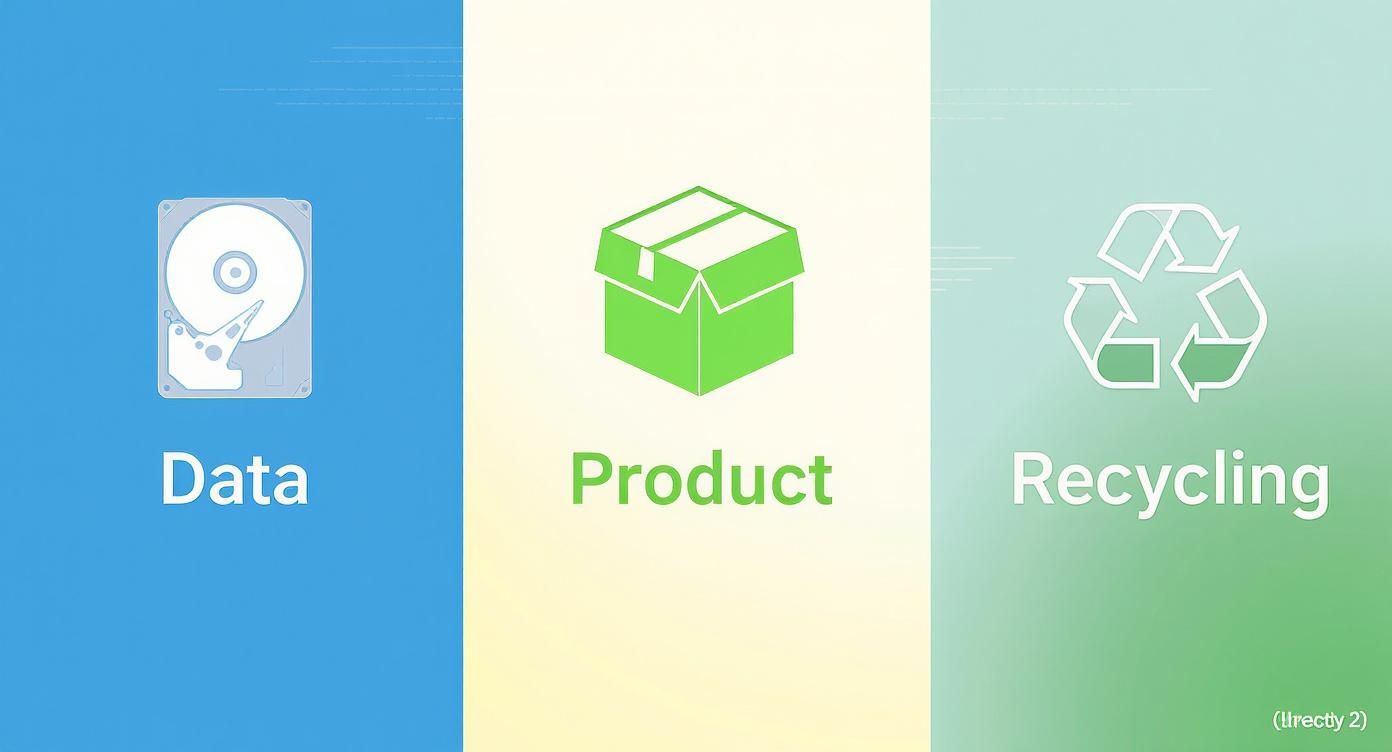
This visual breakdown highlights the importance of matching the certificate to the asset, a crucial detail in any verifiable process.
How can you verify a vendor’s process? You have several options:
- On-Site Destruction: For maximum assurance, the vendor can bring a mobile shredding truck to your facility, allowing you to witness the destruction of your hard drives before they leave your property.
- Off-Site Witnessing: If using an off-site facility, you have the right to schedule a visit and witness the destruction in person. Secure vendors provide designated, safe viewing areas.
- Video Verification: Many top-tier vendors offer recorded video evidence of the destruction, often including close-ups of your assets’ serial numbers as they are fed into the shredder.
Ultimately, the paperwork you receive should be the conclusion of a process you have complete confidence in. By asking the right questions and demanding total transparency, you ensure every Certificate of Destruction you file is backed by an irrefutable, secure, and defensible process.
Got Questions About Destruction Certificates? We’ve Got Answers
Even for seasoned professionals, practical questions about a Certificate of Destruction can arise during the management of IT assets and compliance protocols.
We regularly address these questions from IT managers, business owners, and procurement professionals. Here are the most common inquiries, with direct answers to help you manage your destruction certificates effectively and maintain a robust compliance program.
How Long Should We Keep a Certificate of Destruction?
While no single rule applies universally, the industry best practice is to retain a Certificate of Destruction for a minimum of three to seven years.
The appropriate retention period depends on your industry. For healthcare, HIPAA dictates specific record-keeping timelines. A CoD should be treated as a permanent part of your company’s legal and operational history, similar to a tax filing or a major contract.
Our professional recommendation is to store them digitally. A secure, backed-up digital folder ensures they are easily accessible for internal reviews or, more importantly, during an audit.
Is a Digital Certificate as Valid as a Paper One?
Yes, absolutely. A secure PDF from a reputable ITAD partner is just as legally valid as a printed copy and is the preferred format in modern business operations.
A certificate’s validity is determined not by its physical format but by the information it contains and the integrity of the issuing company.
Digital certificates offer practical advantages:
- Efficient Storage: They eliminate the need for physical filing cabinets.
- Rapid Retrieval: A specific certificate can be located in seconds during an audit.
- Seamless Integration: Digital copies can be easily integrated into your company’s asset management and compliance systems.
As long as the document contains all critical details—serial numbers, asset lists, destruction method, and an official signature—it is a legitimate legal record.
What if Our Vendor Doesn’t Offer a Certificate?
This is a significant red flag. If a vendor cannot or will not provide a detailed Certificate of Destruction, it indicates that their process is unprofessional, non-compliant, and unauditable. Any credible ITAD partner considers the CoD a standard, non-negotiable deliverable.
A Certificate of Destruction is not an optional add-on. It is the only verifiable proof that your vendor fulfilled their contractual and legal obligations. Without it, you have no legal standing if a data breach occurs.
If a potential vendor is evasive on this point, it is best to seek another partner. The risk falls entirely on your business, leaving you exposed during an audit or a data breach investigation.
Does a CoD Cover Environmentally Safe Recycling?
This is a common point of confusion. A Certificate of Destruction is focused exclusively on one thing: verifying that data or a physical product has been permanently destroyed. It is a security document.
Environmental compliance is documented separately.
While a professional ITAD company like Beyond Surplus manages both data destruction and environmentally sound recycling, these are two distinct processes requiring separate documentation. First, data-bearing devices are sanitized or shredded. Then, the resulting e-waste—plastic, metal, and circuit boards—is recycled according to EPA and state regulations.
For the second step, you should receive a Certificate of Recycling. This document confirms that non-sensitive materials were processed in an eco-friendly manner. Receiving both certificates provides a complete record, covering both your data security and environmental compliance obligations.
For a partner that provides ironclad documentation and a transparent, secure process, trust Beyond Surplus. We deliver certified electronics recycling and secure IT asset disposal for businesses across the United States, protecting your data and your reputation. Contact us today to schedule a secure pickup and ensure your compliance needs are met with professionalism and precision. Learn more at https://www.beyondsurplus.com.


