

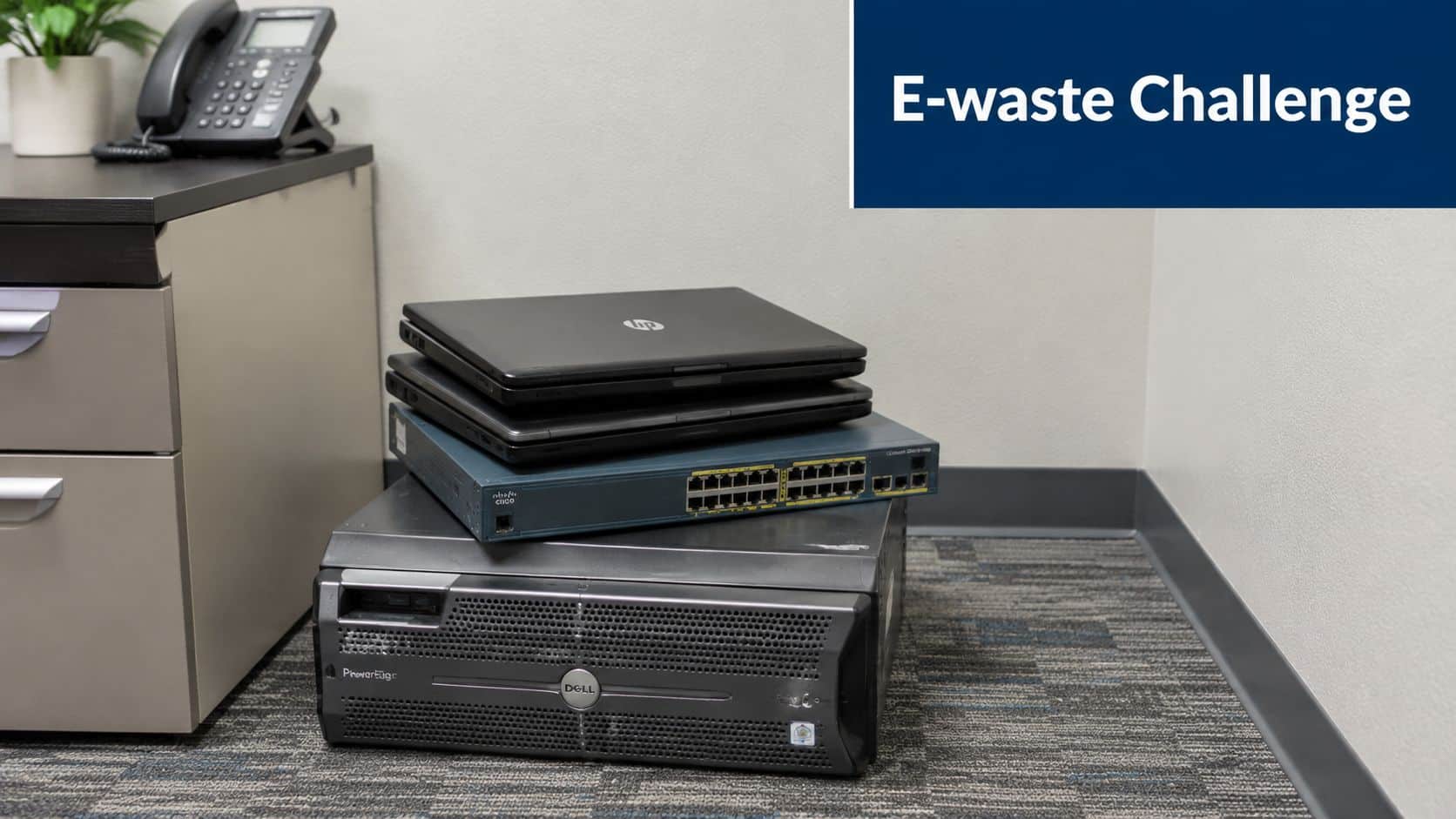
Retired laptops piling up in a storage room. A rack server pulled from production but still holding regulated data. Network switches with no resale plan, no destruction record, and no clear owner. That's the point where many Lithonia companies realize “recycling” isn't the true task.
IT Equipment Recycling in Lithonia: ITAD Best Practices starts with a different mindset. End-of-life IT gear is not ordinary scrap. It's a mix of data risk, compliance exposure, reusable value, and regulated material that needs documented handling from pickup through final processing.
Why Your Lithonia Business Needs a Formal ITAD Strategy
Most businesses in Lithonia don't struggle because they lack a recycler. They struggle because they lack a formal IT asset disposition process. When equipment leaves service, the business still owns the risk until every device is inventoried, every data-bearing component is sanitized or destroyed, and every downstream step is documented.
Disposal thinking creates avoidable risk
If your team treats retired hardware like junk removal, three problems show up fast:
- Data exposure: Drives, SSDs, backup media, and embedded storage often stay in equipment longer than anyone expects.
- Audit gaps: Untracked assets can't be matched to wiping or destruction records.
- Lost recovery value: Functional laptops, servers, and network gear may have remarketing potential if they're separated early.
Georgia guidance also reinforces that computer equipment shouldn't go to landfill. For a Lithonia business, that means the process has to split assets into reuse, resale, shredding, wiping, and material recycling instead of throwing everything into one stream.
Practical rule: If your company can't show where a retired asset went, assume you still own the liability.
The scale of e-waste makes ad hoc handling a bad bet
The need for structure isn't theoretical. The Global E-waste Statistics Partnership reports that the world generated 53.6 million metric tons of e-waste in 2019, and only 17.4% was formally collected and recycled. The same dataset projects 74.7 million metric tons by 2030 if current patterns continue.
That's why serious organizations no longer treat retirement events as occasional cleanouts. They build a repeatable ITAD workflow around custody, data destruction, and downstream accountability. For Georgia companies, why ITAD services matter for Georgia companies in 2026 is less about optics and more about legal defensibility.
What works in practice
A formal program works when operations and security agree on one standard process. Procurement, IT, facilities, and compliance should all follow the same handoff rules.
A weak process usually looks like this: someone approves a purge, facilities moves pallets, and the organization tries to reconstruct the record later. That approach breaks as soon as one missing laptop or undocumented drive shows up in an audit.
Inventory and Assessment The First Critical Step
The most common ITAD failure happens before pickup day. Companies skip the inventory because they're in a hurry to clear space. That one shortcut undermines everything that follows.
Build the serialized record before anything moves
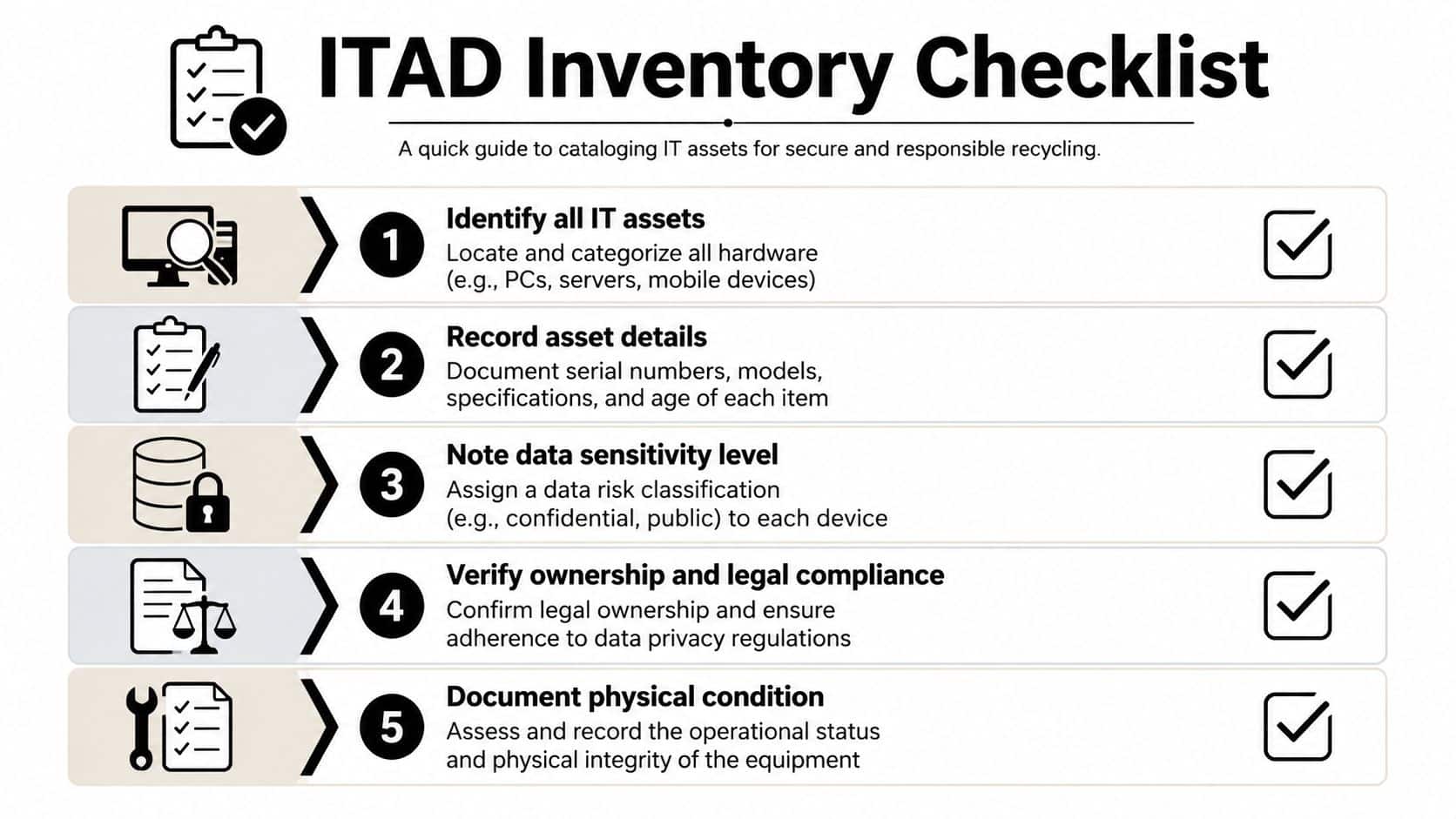
A defensible workflow starts with a serialized inventory. According to this ITAD best-practices guide, a high-control process should run in this order: perform a serialized asset inventory, classify each device by reuse, resale, or recycling potential, apply NIST 800-88 aligned sanitization or physical destruction to every data-bearing component, then issue chain-of-custody records and certificates of destruction or recycling for auditability.
That order matters. If you sanitize first and reconcile later, you create uncertainty about what was processed.
What to capture in the inventory
Your list should be useful to security, finance, and operations. At minimum, record:
- Asset identity: Serial number, make, model, and asset tag.
- Device role: Laptop, desktop, server, switch, firewall, storage array, mobile device, or peripheral.
- Data-bearing status: Hard drive, SSD, flash storage, removable media, or embedded memory.
- Condition notes: Working, powers on, damaged, missing components, locked, or cosmetically rough.
- Disposition path: Reuse, resale, parts harvest, or recycling.
A mature IT asset lifecycle management approach also captures software state, lock status, and whether accessories like power supplies or rails are included. Those details affect both risk and residual value.
Inventory is not admin overhead. It's the control point that ties the physical asset to the destruction evidence.
Classification should happen early
Don't wait until gear reaches a processor to decide what it's worth. Make the first pass at your site. A newer laptop in good condition belongs in a remarketing review, not a shred bin. A failed drive from a regulated environment belongs in the destruction queue, not a generic recycling pallet.
Teams get better results when they label assets by path before transport. That reduces unnecessary shredding and makes pickup, reconciliation, and reporting cleaner.
Ensuring Secure Data Destruction On-Site and Off-Site
Data destruction is where many recycling programs fall short. Recycling handles material. ITAD handles liability. Those aren't the same thing.
Wiping versus shredding
Software sanitization and physical destruction each have a place.
| Method | Best fit | Main advantage | Main limitation |
|---|---|---|---|
| NIST 800-88 wiping | Functional drives and devices with reuse value | Preserves remarketing potential | Requires successful access and verification |
| Physical shredding | Failed media, damaged devices, highly sensitive storage | Irreversible destruction | Ends any reuse or resale path |
Benchmark controls for secure recycling and destruction include NIST 800-88 compliant sanitization, DIN 66399 media shredding, sealed or GPS-tracked transport, and post-process certificates of destruction. If a vendor only says “we recycle electronics,” that doesn't answer the data question.
For security teams that want a stronger grounding in why handling standards and evidence matter, these Expert-curated CISSP study materials are a useful reference on broader information security principles.
On-site versus off-site destruction
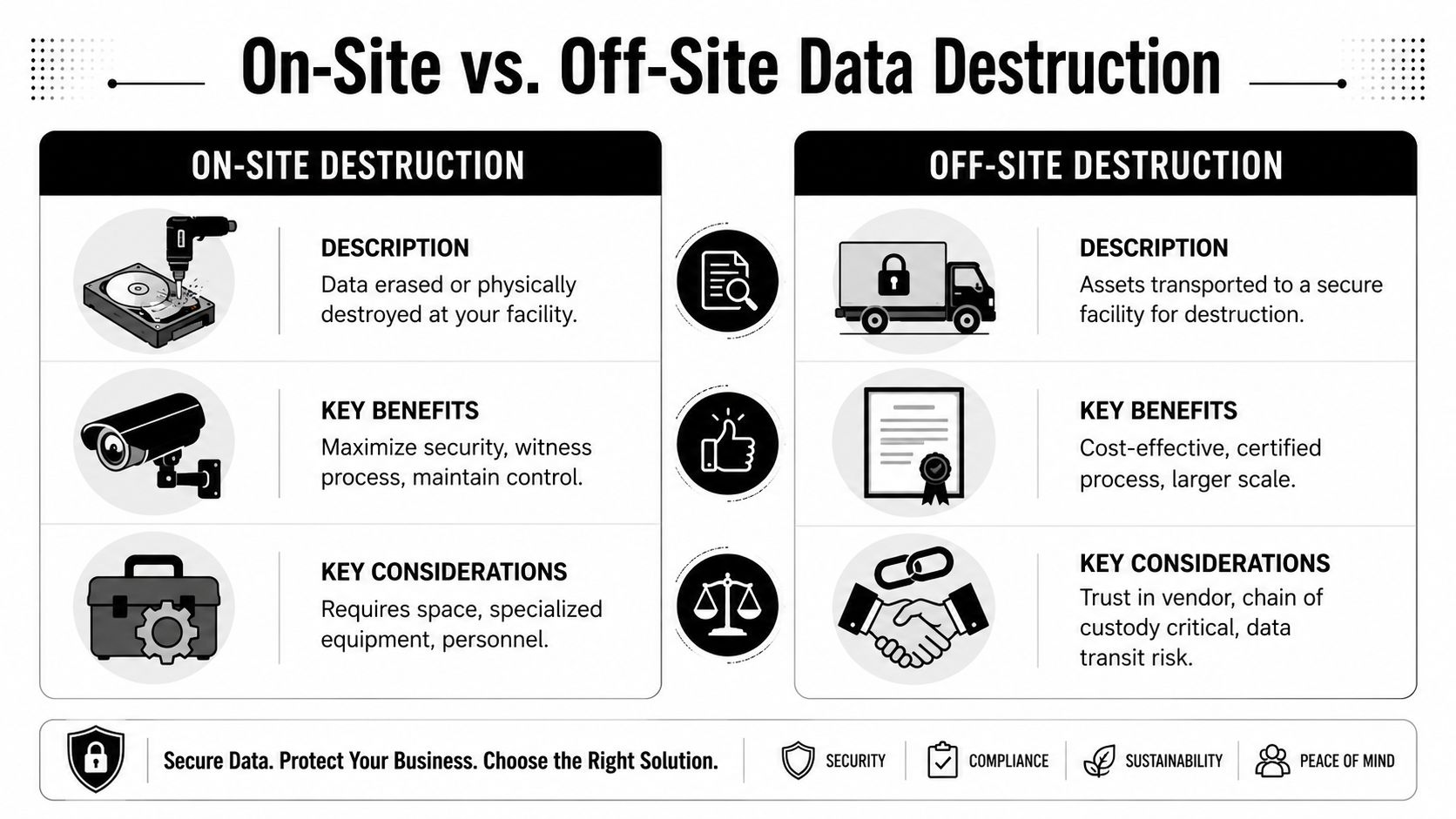
On-site destruction gives your staff direct visibility. It makes sense when chain-of-custody sensitivity is high, internal policy requires witness capability, or the organization wants drives destroyed before they leave the property.
Off-site destruction can be more efficient for larger mixed loads, especially when the vendor operates a secure facility with controlled intake, serialized processing, and audited reporting. The trade-off is simple. Once assets leave your site, transport controls and reconciliation quality become critical.
If the media is highly sensitive and the organization won't accept transit risk, destroy it on-site and transport only the remnants.
What good evidence looks like
A credible vendor should document exactly what happened to each data-bearing asset. That includes serial-based logs where possible, confirmation of the sanitization or destruction method used, custody records, and final certificates.
For companies that need a baseline on the standard itself, NIST SP 800-88 guidance is the benchmark most IT and compliance teams recognize. What doesn't work is vague paperwork that confirms a pickup happened but doesn't identify the media processed.
Maximizing Value Recovery and IT Buyback Potential
A lot of companies overspend on IT disposal because they treat every retired asset as waste. That's expensive and unnecessary.
The better approach is to separate value recovery from end-of-life recycling. Those are different economic decisions. Industry guidance often frames ITAD as a mix of refurbishment, resale, and recycling, but it rarely gives hard decision rules. What matters in practice is that laptops, servers, networking gear, and low-value peripherals behave very differently in the secondary market, as noted in this ITAD workflow discussion.
Which assets usually deserve a resale review
Some categories are worth evaluating before you authorize destruction:
- Business laptops and desktops: Especially units that still boot, have intact screens, and aren't locked or heavily damaged.
- Enterprise servers: Often worth review when memory, CPUs, rails, caddies, or current-generation components remain in demand.
- Networking equipment: Firewalls, switches, and access gear can hold value if they're current enough and complete.
- Mobile fleets: Good candidates when they're free from activation locks, resettable, and physically intact.
Low-value peripherals are different. Worn keyboards, broken monitors, obsolete cables, and damaged accessories usually cost more to sort, test, and market than they return.
What changes the economics
Residual value rises or falls based on details, not wishful thinking. Buyers care about model relevance, cosmetic condition, included components, lock status, and whether the unit can be tested efficiently.
A practical screen looks like this:
- Can it be sanitized without destroying value?
- Can someone verify it works without excessive labor?
- Will packaging, pickup, and processing costs erase the return?
If the answer to the third question is yes, recycle it. If the first two are yes and the third is manageable, send it to remarketing review.
A mixed pallet almost never has one right answer. Good ITAD separates profitable assets from liabilities instead of forcing one outcome across the whole load.
For organizations evaluating local options, IT equipment resale in Georgia is the relevant service category to compare against pure recycling. The point isn't to chase resale on everything. It's to avoid destroying recoverable value while still processing obsolete material responsibly.
Logistics Chain of Custody and Final Reporting
The highest-risk moment in the process is often the handoff. Once assets leave your building, your internal controls stop and the vendor's controls take over.
Secure logistics should be visible, not implied
A vendor's transportation process should be specific. Sealed loads, tracked vehicles, scheduled pickups, serialized manifests, and reconciliation at intake are the basics. If pickup staff can't match what they remove to your inventory, the chain starts weak and usually ends weaker.
Final documents should close the loop
You should expect at least two categories of records:
- Chain-of-custody documentation: Confirms what was collected, when, from where, and under whose control.
- Certificates of destruction or recycling: Confirms the final processing outcome for the assets or media.
Good documentation transfers liability because it shows a complete record from retirement through final disposition. Weak documentation creates the illusion of compliance without the proof.
Why reporting matters beyond compliance
There's also a material recovery reason to insist on proper reporting. The United States generates 23.7 million tons of e-waste annually, and industry sources citing EPA-based figures note that recycling one million smartphones can recover about 772 pounds of silver, 75 pounds of gold, 33 pounds of palladium, and 35,000 pounds of copper, according to this e-waste recovery summary.
That doesn't mean every asset should be shredded for commodity recovery. It means the downstream path matters. Final reporting is how you prove equipment was processed through a controlled system instead of disappearing into an opaque one.
When a vendor's paperwork is vague, assume the downstream process is vague too.
Choosing Your Certified ITAD Partner in Lithonia
By the time you evaluate vendors, the checklist should be clear. You need a partner that can control inventory, protect data, manage transport, separate resale candidates from scrap, and issue audit-ready records at the end.
What to verify before you sign
Look for these capabilities:
- Serialized intake and reconciliation
- NIST 800-88 aligned sanitization and physical destruction options
- Documented chain of custody
- Certificates of destruction and recycling
- A defined process for remarketing and IT buyback
- Environmental certifications and downstream accountability
Certifications such as R2 or e-Stewards are useful because they indicate that the vendor's process has been structured around environmental and operational controls. They're not a substitute for reviewing the actual workflow, but they are a strong signal that the company treats ITAD as a controlled discipline.
For Lithonia companies that want a local service path, Lithonia computer and electronics recycling is the right starting point to compare service scope, pickup options, data destruction methods, and documentation standards. Beyond Surplus is one example of a provider that offers business pickups, secure data destruction, recycling, and IT buyback as part of a commercial ITAD workflow.
The right partner won't just remove equipment. They'll help your business retire assets with evidence, recover value where possible, and close out the risk you still carry long after a device is unplugged.
If your team needs a documented path for retired laptops, servers, storage, and network gear, contact Beyond Surplus for certified electronics recycling and secure IT asset disposal.


