

For any business in Colorado, from downtown Denver to Grand Junction, secure hard drive shredding isn't just a technical task—it's a critical component of corporate risk management and regulatory compliance. This process goes far beyond simply hitting "delete." True data security for enterprises demands the complete physical destruction of retired hard drives, ensuring that sensitive corporate, customer, and employee information can never be recovered.
This guide outlines the essential procedures for Colorado businesses to protect themselves against data breaches and comply with state and federal laws through certified hard drive destruction.
The Dual Challenge: Data Security and Environmental Compliance
In Colorado, retiring IT assets like servers, laptops, or storage arrays presents a dual set of challenges for businesses. The first is the significant financial and reputational damage that can result from a data breach. The second involves substantial penalties for the improper disposal of electronic waste. A failure in either area can lead to severe operational and legal consequences.
Simply reformatting a drive and discarding it is a direct path to liability. Modern data recovery technologies can easily retrieve sensitive information from drives that were merely "wiped," leaving proprietary data exposed. Furthermore, Colorado enforces strict e-waste landfill bans for businesses, making it illegal to dispose of IT equipment in standard waste streams.
Key Risks for Colorado Businesses
IT and facility managers must be clear on the primary threats associated with improper IT asset disposal:
- Data Breach Liability: A single retired hard drive can contain thousands of sensitive files. If compromised, the business faces costly litigation, regulatory fines, and an erosion of customer trust that is difficult to repair.
- Regulatory Penalties: State laws like the Colorado Privacy Act (CPA) and federal mandates such as HIPAA impose strict requirements for data handling and destruction. Non-compliance is not an option for any commercial entity.
- Environmental Fines: Disposing of e-waste in landfills violates state regulations and can result in significant financial penalties, reinforcing the need for a documented IT Asset Disposition (ITAD) strategy.
The only guaranteed method to ensure permanent data eradication is physical destruction. For businesses in Colorado, this necessitates partnering with a certified vendor who provides auditable proof that every data-bearing asset has been destroyed in a compliant manner.
Colorado is committed to responsible e-waste management. In 2023, the state successfully diverted nearly 12,000 tons of electronics from landfills, part of a broader initiative to increase the statewide recycling rate from 16% to 60% by 2035. This regulatory environment underscores why businesses must adhere to the state's e-waste landfill bans.
Professional hard drive shredding addresses both data security and environmental compliance simultaneously. A certified process guarantees data is irreversibly destroyed, while the resulting materials—metals and plastics—are recycled responsibly. This integrated approach is essential for modern business operations in Colorado.
To understand how this fits within a comprehensive ITAD framework, explore our guide on Colorado electronics recycling services for businesses. This strategy protects your organization from liability while promoting sustainable lifecycle management of your IT assets.
Maintaining Compliance with Data Destruction Mandates in Colorado
For businesses operating in Colorado, navigating data privacy laws is a serious, non-negotiable responsibility. The Colorado Privacy Act (CPA) establishes a high standard for how companies must manage consumer data, a responsibility that extends through the final disposal of that data.
This legal requirement mandates that your IT Asset Disposition (ITAD) process be founded on "reasonable security procedures." For hard drives containing sensitive information, that standard points unequivocally to certified physical destruction.

Simply deleting files or even degaussing older magnetic media is insufficient and can leave a company dangerously exposed. The CPA, along with federal regulations like HIPAA for healthcare and the FTC Disposal Rule for consumer credit information, demands absolute, verifiable proof that data has been rendered unrecoverable. Physical shredding provides this undeniable finality.
The Gold Standard: NIST SP 800-88
When facing an audit or regulatory review, your data destruction practices will be evaluated against the standards set by the National Institute of Standards and Technology (NIST). Specifically, auditors will reference NIST Special Publication 800-88, the definitive federal guide for media sanitization.
This publication categorizes data destruction into three actions:
- Clear: Involves overwriting data. This method may be suitable for drives being repurposed internally but offers minimal protection for assets leaving your organization's control.
- Purge: Includes methods like degaussing. While it makes data recovery significantly more difficult, it is not always foolproof against advanced forensic techniques.
- Destroy: This is the final and most secure method, encompassing disintegration, pulverization, melting, or shredding. For hard drives, shredding is the most practical and universally accepted form of destruction that meets NIST's highest security level.
Adherence to NIST SP 800-88 is not merely a "best practice"; it is the clearest method to demonstrate due diligence and satisfy the "reasonable security" mandates of the CPA and other privacy laws. Our services are engineered to meet these precise standards. You can find more on these critical guidelines in our detailed analysis of NIST SP 800-88 compliance.
Your Legal Shield: The Certificate of Data Destruction
In the domain of compliance, documentation is paramount. A verbal assurance of destruction is worthless in an audit or legal context. This is where the Certificate of Data Destruction (CoDD) becomes an indispensable corporate document.
A properly executed CoDD is more than a simple receipt; it is a legally binding instrument that formally transfers liability from your organization to your destruction vendor. To be valid, it must contain specific, auditable details.
A robust Certificate of Data Destruction serves as your official record, proving the fulfillment of your legal duty to protect sensitive information. It should be archived indefinitely as part of your company's official compliance records.
For a certificate to be considered legally valid, it must include:
- Serialized Inventory: A complete list of the unique serial numbers for every hard drive destroyed.
- Date and Location of Destruction: The exact date and physical address where the destruction occurred, whether on-site at your Colorado facility or at the vendor’s secure plant.
- Method of Destruction: A clear statement confirming the drives were physically shredded in accordance with NIST SP 800-88 standards.
- Chain of Custody: An acknowledgment of the secure transfer of assets from your business to the vendor.
- Authorized Signatures: Signatures from authorized representatives of both your company and the destruction service provider.
Without a detailed, serialized certificate, you lack verifiable proof of compliance, leaving your business exposed to significant legal and financial risks should a data breach be traced back to an improperly disposed-of asset.
On-Site vs. Off-Site Hard Drive Shredding for Colorado Businesses
When arranging for hard drive shredding in Colorado, a primary decision for any IT manager is whether to perform the destruction on-site at their facility or have the assets transported to a secure off-site plant. There is no single correct answer; the optimal choice depends on your company's specific security requirements, operational needs, and budget.
Consider a Denver-based financial services firm retiring a server rack containing years of sensitive client data. For this organization, the ability to witness the physical destruction of each hard drive is a non-negotiable element of their risk management strategy. This scenario is a perfect use case for on-site shredding.
Conversely, imagine a large logistics company in Aurora decommissioning hundreds of computers from its vehicle fleet. While security remains a priority, the primary focus is on efficiency and cost-effectiveness. For this business, the streamlined logistics and favorable pricing of off-site shredding present a more practical solution.
What is On-Site Hard Drive Shredding?
On-site shredding, also known as mobile shredding, brings the entire destruction process directly to your business location. A specialized truck equipped with a powerful industrial shredder arrives at your Colorado facility, allowing your staff to witness the physical destruction of your hard drives firsthand as they are fed into the machine and reduced to small, irrecoverable fragments.
This service offers the highest level of transparency and verification.
- Maximum Security and Verification: Witnessing the process eliminates any chain-of-custody concerns, as the drives never leave your sight intact.
- Immediate Certification: A Certificate of Data Destruction is typically issued on the spot upon completion of the job, providing instant proof for your compliance records.
- Ideal for High-Stakes Data: This is the preferred method for healthcare, financial, legal, and government entities where regulations demand undeniable proof of destruction.
For businesses that prioritize transparency and direct oversight, the value of on-site services is clear. You can learn more about the specific equipment and security protocols involved by reviewing our page on on-site shredding services.
Understanding Off-Site Shredding
Off-site shredding, or plant-based shredding, involves the secure collection of your hard drives, which are then transported in locked containers by vetted personnel to a high-security destruction facility. The entire process is managed under a strict chain-of-custody protocol, from pickup to final destruction.
Although the shredding is not witnessed in person, it is an equally secure method when executed by a certified vendor.
Off-site shredding is a highly secure and efficient process. All assets are inventoried, transported in GPS-tracked vehicles, and destroyed under 24/7 video surveillance at a certified facility, ensuring a fully auditable and compliant destruction process.
This approach is often favored for large-scale projects where efficiency and cost are primary considerations.
- Cost-Effective for High Volumes: By centralizing the destruction process, off-site services typically offer a lower per-unit cost, especially for large quantities of drives.
- Logistical Simplicity: Your team's involvement ends with the secure pickup. The vendor manages all transportation and destruction logistics, freeing up your internal resources.
- Comprehensive Security: Reputable vendors operate facilities with robust security measures, including controlled access, advanced alarm systems, and continuous video monitoring to ensure process integrity.
On-Site vs. Off-Site Shredding: A Practical Comparison
This side-by-side comparison will help you determine the best hard drive destruction method for your Colorado business.
| Consideration | On-Site Shredding (Mobile) | Off-Site Shredding (Plant-Based) |
|---|---|---|
| Security | Highest level; witness destruction firsthand. | Very high; relies on a documented, audited chain-of-custody. |
| Cost | Generally higher due to specialized equipment and labor. | More economical, especially for large quantities. |
| Convenience | You manage asset handling on-site before destruction. | Minimal disruption; vendor handles transport and logistics. |
| Transparency | 100% transparent; you see everything happen in real-time. | Relies on reporting, video evidence, and certifications. |
| Chain of Custody | The chain of custody ends at your doorstep. | A strict, documented chain of custody is maintained throughout. |
| Best For | Highly sensitive data, strict compliance, peace of mind. | High-volume projects, cost-conscious businesses, efficiency. |
Ultimately, both on-site and off-site services provide secure, certified data destruction. The decision hinges on your organization’s priorities: hands-on verification versus logistical and financial efficiency.
With the global hard drive destruction market projected to grow from $1.65 billion in 2024 to $5.05 billion by 2035, it is evident that data security is a top corporate priority. Both on-site and off-site services are critical to meeting this demand, providing Colorado businesses with certified methods to protect their data. The most important factor is selecting a partner that delivers a transparent, fully documented process, regardless of the service chosen.
The Hard Drive Disposition Process: A Step-by-Step Guide
Understanding the end-to-end disposition process is crucial for Colorado businesses engaging a professional shredding service. This knowledge ensures transparency, security, and compliance throughout the IT asset management lifecycle.
The entire workflow is built on maintaining a secure and unbroken chain of custody. Whether shredding occurs at your office or at a secure facility, the process begins with proper preparation on your part and concludes with certified documentation confirming the job was completed correctly. Here is a walkthrough of a professional engagement.
Stage One: Initial Inventory and Preparation
This foundational step begins with your internal team before a shredding partner is even on-site. Preparing your assets in advance streamlines the entire project, controls costs, and ensures every data-bearing device is accounted for.
A common oversight is the failure to create a detailed inventory. Your team must compile a serialized list of every hard drive designated for destruction. This list serves as the basis for the Certificate of Data Destruction and provides the essential auditable record required for compliance.
Use this checklist to prepare your assets:
- Compile a Serial Number List: Create a spreadsheet listing the unique serial number of each drive. This is mandatory for a verifiable audit trail.
- Remove Drives from Equipment: If feasible, have your IT staff remove hard drives from desktops, laptops, and servers. This can significantly reduce labor costs and on-site time.
- Consolidate and Secure Assets: Gather all drives in a single, secure location to prevent any assets from being misplaced or overlooked during the handoff.
Expert Tip: For large-scale projects such as a data center decommissioning, it is beneficial to segregate drives by type (e.g., HDD vs. SSD). Solid-state drives require a smaller shred size to guarantee complete data destruction.
For major facility shutdowns, our guide on decommissioning a data center offers a broader strategic framework that complements this process.
Stage Two: Secure Logistics and Transportation
Once your assets are prepared, the logistics phase commences, marking the formal start of the chain of custody. A certified ITAD partner will use only vetted, background-checked personnel and secure, GPS-tracked vehicles for transport.
If you have chosen off-site shredding, your drives will be sealed in locked, tamper-evident containers before leaving your Colorado facility. The inventory list you prepared is reconciled against the physical count at the time of collection to confirm a one-to-one match. This meticulous tracking ensures accountability from your location to the destruction plant.
This diagram illustrates how both on-site and off-site shredding maintain security throughout the process.
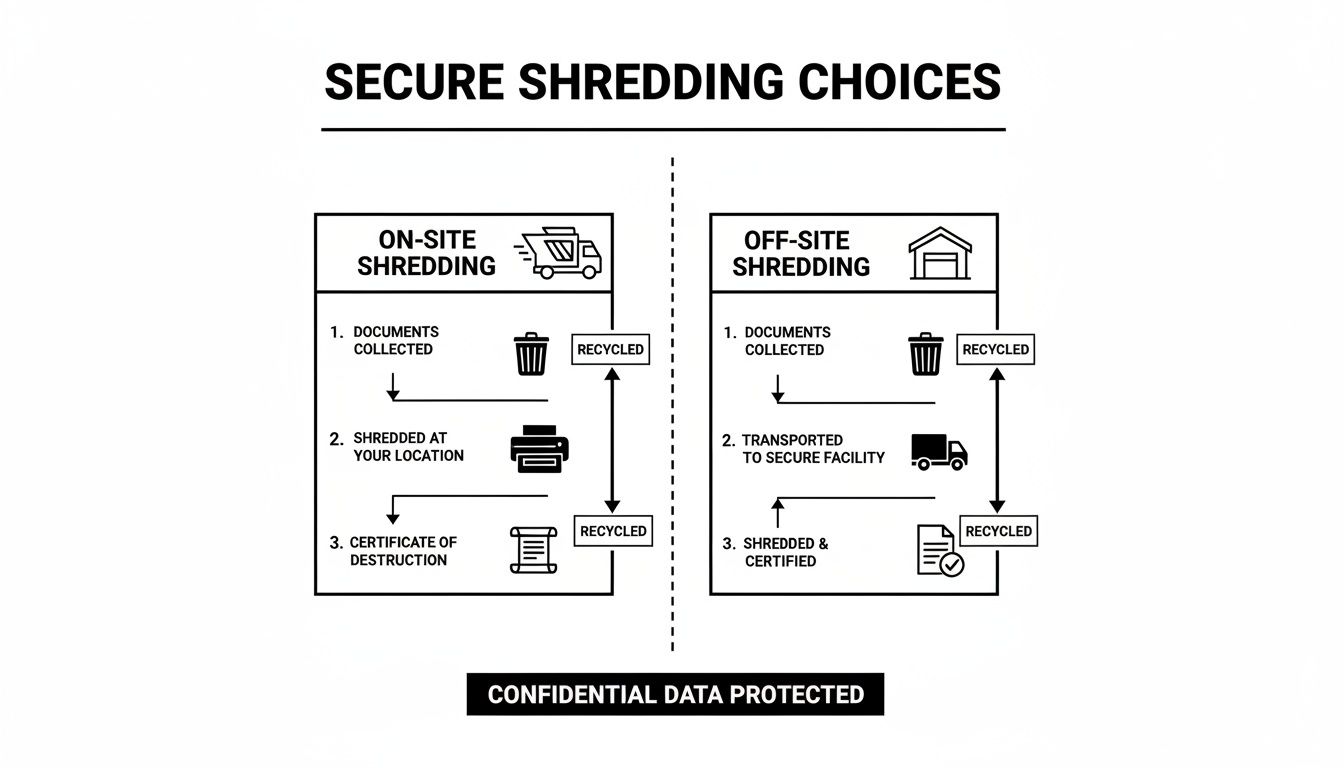
As shown, while the location of destruction may differ, the core principles of secure collection, certified destruction, and responsible recycling remain consistent for both service models.
Stage Three: Physical Destruction and Final Documentation
The final stage is the physical destruction of the assets. Whether a mobile shredding truck is parked outside your Denver office or the drives are processed at a secure facility, the outcome is the same: complete data obliteration. Powerful industrial shredders convert the hard drives into small, irrecoverable fragments of metal and plastic.
Following destruction, you will receive the official documentation that closes the liability loop for your company.
Your documentation package will include:
- A Certificate of Data Destruction: This legal document lists every serial number, confirms the date and method of destruction, and officially transfers liability.
- A Certificate of Recycling: This document verifies that the shredded materials were recycled responsibly, in compliance with Colorado's environmental regulations.
This paperwork constitutes your permanent record of compliance and should be archived indefinitely. It is your definitive proof that your organization adhered to all data security and environmental laws, completing a secure and fully auditable hard drive disposition.
How to Select a Certified Shredding Partner in Colorado
Choosing a partner for hard drive shredding in Colorado is a decision that extends far beyond logistics and pricing. You are entrusting this vendor with your organization's sensitive data. Not all service providers operate with the same level of security, compliance, or environmental ethics. It is imperative to look beyond the cost and scrutinize the credentials that genuinely protect your business.
A vendor's certifications serve as the primary checkpoint, providing independent, third-party validation of their security and operational standards. Without these, you are relying solely on a vendor's claims—a significant risk when proprietary data is at stake.
Decoding Key Industry Certifications
When vetting a potential IT Asset Disposition (ITAD) partner, two certifications are recognized as the gold standard, addressing the primary risks of data security and environmental responsibility.
-
NAID AAA Certification: This certification is non-negotiable for data security. Issued by the International Secure Information Governance & Management Association (i-SIGMA), it signifies adherence to the strictest operational security protocols. NAID AAA certified companies undergo regular, unannounced audits covering employee screening, access control, and the destruction process itself, guaranteeing a secure chain of custody.
-
R2v3 Certification: This certification focuses on environmental accountability. The Sustainable Electronics Recycling International (SERI) R2v3 standard ensures that after your drives are shredded, the resulting e-waste is managed safely and sustainably. It strictly prohibits the illegal export of e-waste and mandates a "reuse, recover, dispose" hierarchy, aligning perfectly with Colorado's landfill bans.
Selecting a vendor with both NAID AAA and R2v3 certifications ensures comprehensive risk mitigation. You receive documented proof of both secure data destruction and responsible electronics recycling, satisfying legal requirements and corporate social responsibility objectives.
Critical Questions for Potential Vendors
After verifying a vendor’s certifications, it is time to probe their operational procedures. The answers to the following questions will reveal their security posture and commitment to client protection.
Before signing any agreement, obtain clear, confident answers to these questions:
- What are your insurance liability limits? Request specifics on their professional liability (errors and omissions) and, most importantly, their downstream data liability coverage. This insurance protects you in the event of a data breach originating from their operations.
- How do you screen your employees? All personnel with access to your assets—including drivers, technicians, and facility staff—must undergo rigorous, ongoing background checks and drug testing.
- What security measures are in place at your facility? A secure facility must have restricted keycard access, 24/7 video surveillance, and robust alarm systems. If you opt for off-site shredding, your assets require the same level of protection as they would in your own building.
- Can we witness the destruction process? A reputable vendor will always accommodate this request, offering the option to witness shredding in person or via a secure video feed. This transparency is the hallmark of a trustworthy partner.
The global demand for secure data disposal is rapidly increasing, with the hard drive destruction service market projected to grow from USD 1.65 billion in 2024 to USD 5.05 billion by 2035. This growth underscores the importance of thorough vendor vetting. North America, including Colorado, is a key driver of this demand due to the high concentration of technology firms and stringent data privacy laws. You can find further analysis in these insights into the global hard drive destruction market.
Selecting the right shredding partner is a cornerstone of a secure IT asset management strategy. The right partner acts as an extension of your security team, providing a defensible, compliant, and transparent process. To see how these services integrate into a complete disposition plan, explore our comprehensive Colorado ITAD services designed for businesses across the state.
Frequently Asked Questions About Hard Drive Shredding for Colorado Businesses
Even with a well-defined plan, specific questions often arise. When dealing with sensitive corporate data, absolute clarity is essential. Here are answers to some of the most common inquiries we receive from Colorado businesses.
Is It Necessary to Wipe Hard Drives Before Shredding?
For the vast majority of business applications, the answer is no. While data wiping (sanitization) is a valid procedure, physical destruction renders it redundant. Think of wiping as scrambling the information in a book, whereas shredding turns the entire book into irrecoverable confetti.
Physical destruction obliterates the data platters, making it impossible to reassemble the data. This single act is sufficient to meet the stringent standards of regulations like the Colorado Privacy Act (CPA) and federal laws such as HIPAA. The physical media is permanently destroyed, a fact documented by your Certificate of Data Destruction. This makes professional shredding the most efficient and secure method for most IT retirement projects.
What Documentation Should We Expect from a Shredding Service?
The documentation you receive is your legal proof of due diligence and data protection. It is your primary defense in a compliance audit.
Following any shredding project, you must receive two critical documents:
- A Serialized Certificate of Data Destruction: This is the most vital document. It must list the unique serial number of every drive, the date of destruction, and the method used (e.g., physical shredding compliant with NIST SP 800-88). This serves as your official, auditable record.
- A Certificate of Recycling: This document confirms that all residual materials—aluminum, steel, and circuit boards—were managed responsibly and in accordance with Colorado's e-waste landfill bans.
These documents should be archived indefinitely as part of your permanent corporate records.
What is the Typical Cost for Hard Drive Shredding in Colorado?
There is no standard price for hard drive shredding, as the cost depends on several project-specific factors.
Key variables include:
- Volume: The quantity of drives is the largest cost driver. Higher volumes typically result in a lower per-unit cost due to economies of scale.
- Service Type: On-site shredding, which requires mobilizing a specialized truck to your location, is generally more expensive than off-site shredding at a secure facility.
- Logistics: Factors such as travel distance and the labor required to remove drives from equipment can also influence the final price.
While budget is a consideration, it should not be the sole determinant.
Viewing secure shredding as an expense is a miscalculation; it is an investment in risk management. Opting for the cheapest vendor without verifying certifications like NAID AAA and R2v3 could expose your business to a data breach with costs that far exceed any initial savings.
Can Solid-State Drives (SSDs) Be Shredded Like Traditional Hard Drives?
Yes, SSDs can and must be shredded to ensure data destruction, but the process requires specialized equipment.
Traditional hard disk drives (HDDs) store data on large, spinning magnetic platters. In contrast, SSDs use multiple small flash memory chips soldered to a circuit board. A standard HDD shredder may not reduce these chips to a small enough size, potentially leaving data fragments intact—a significant security risk.
Proper SSD destruction requires a shredder calibrated to a much smaller particle size, often 2mm or less, to guarantee every memory chip is obliterated. Before engaging a vendor for an SSD project, you must confirm their equipment is specifically designed for solid-state media and meets NIST SP 800-88 standards for that media type. A certified ITAD professional will have this capability and can provide specifics on their process.
Contact Beyond Surplus for certified electronics recycling and secure IT asset disposal. We provide transparent, compliant solutions for all your ITAD needs, from hard drive shredding to complete data center decommissioning. Our nationwide pickup services ensure your end-of-life IT equipment is managed securely and responsibly. Learn more about our secure ITAD services.


