

When it comes to Connecticut electronics recycling, navigating the requirements can seem complex. For businesses, the bottom line is simple: you cannot simply discard old IT equipment. While state laws dictate proper disposal, the more critical federal data security regulations place the full responsibility for protecting sensitive information on your organization. This guide clarifies the essential differences between residential recycling programs and the secure, compliant process your business must follow for all IT asset disposal.
The Business Side of Connecticut Electronics Recycling
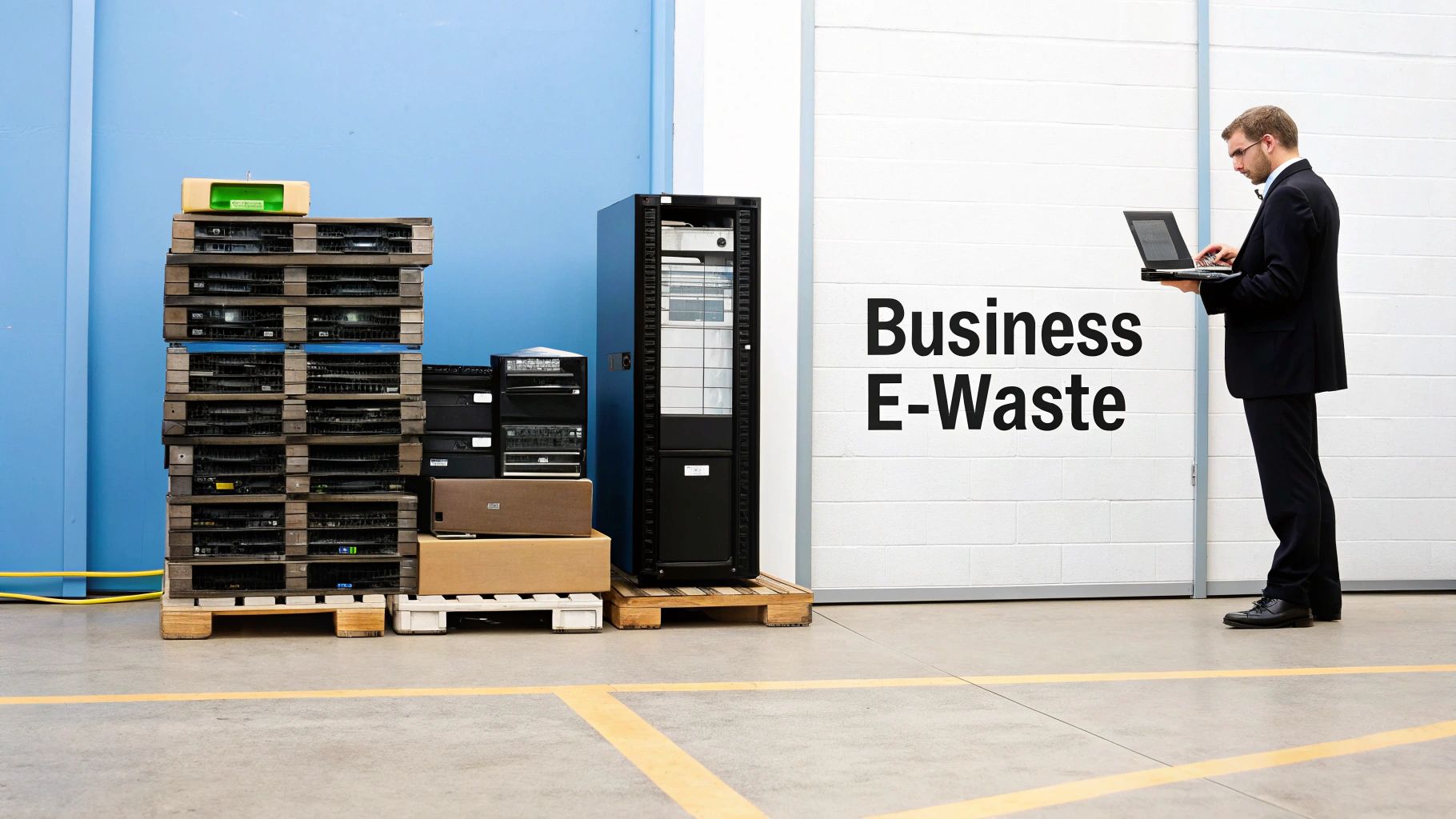
When an IT manager in Hartford or a facilities director in Stamford assesses a storage room full of outdated computers, servers, and monitors, they face a challenge entirely different from a consumer disposing of a single device. Connecticut's residential e-waste program is designed for households and does not address the stringent needs of the corporate world. For any business, the stakes are significantly higher, involving vast amounts of proprietary data, significant legal liability, and strict regulatory compliance.
In 2007, Connecticut enacted a pioneering electronics recycling law, Public Act 07-189. This was one of the nation's first extended producer responsibility (EPR) models, shifting the financial burden of recycling TVs, computers, and printers from municipalities to manufacturers. While this was a major advancement for consumer recycling, this consumer-focused law does not absolve businesses of their distinct and more demanding obligations.
Why Your Business Needs a Professional ITAD Partner
For any company, disposing of IT equipment is fundamentally about risk management, not just recycling materials. The data stored on a single corporate hard drive can be far more valuable—and far more damaging if exposed—than the physical hardware itself. This is where a formal IT Asset Disposition (ITAD) strategy becomes essential. An ITAD program is a secure, documented, and systematic process for managing technology at the end of its operational life.
This is critical for several key reasons:
- Ensuring Data Security: Professional data destruction, such as physical shredding of hard drives, is the only method to be 100% certain that sensitive corporate, employee, or customer information is irretrievably destroyed. Simple drive wiping is insufficient for business assets.
- Maintaining Legal Compliance: Your business must adhere to federal laws like HIPAA, FACTA, and the FTC Disposal Rule. Penalties for data breaches resulting from improper equipment disposal are severe, and regulators do not accept ignorance as an excuse.
- Protecting Your Reputation: A single data breach can irreparably damage your brand's reputation and erode customer trust. The financial and reputational fallout from such an incident will always exceed the cost of professional, secure recycling.
The table below provides a clear comparison of why the state's residential program is not suitable for business needs.
Connecticut E-Waste Rules At a Glance
| Aspect | Residential Program (State Mandated) | Business Responsibility (ITAD Partner) |
|---|---|---|
| Primary Goal | Divert household e-waste from landfills. | Manage risk, ensure data security, and maintain compliance. |
| Data Security | Not a primary focus; wiping data is the owner's responsibility. | The core component; includes certified data destruction (shredding). |
| Cost Structure | Funded by manufacturers (EPR model). | Service-based fee, often offset by asset value recovery. |
| Documentation | Simple drop-off, no formal documentation provided. | Provides Certificates of Recycling & Data Destruction for legal proof. |
| Applicable Laws | CT Public Act 07-189. | Federal laws like HIPAA, FACTA, and state data privacy regulations. |
| Liability | Ends at the collection point. | Remains with the business until final disposition is documented. |
The requirements for businesses are clearly distinct. Relying on a municipal drop-off site for corporate assets is a significant compliance risk for any organization. Understanding how to dispose of old computers securely is the foundational step in a robust ITAD program. A certified partner provides essential documentation, like Certificates of Data Destruction, that serves as your legal proof of due diligence.
Staying Compliant With Connecticut E-Waste and Data Laws
Navigating the legal landscape of electronics disposal can seem daunting, but for Connecticut businesses, the distinction between state and federal rules simplifies the path to compliance. While Connecticut has robust e-waste laws, they primarily target consumer electronics. The most significant compliance burden for your organization stems from federal data security mandates.
Connecticut's Public Act 07-189 was a landmark law that placed the financial responsibility for recycling residential computers, monitors, printers, and TVs on manufacturers. This was later strengthened by a 2011 disposal ban, making it illegal for residents to discard these items in standard waste streams. It is an effective program, but it was designed for households, not for commercial enterprises.
For your company, the critical compliance framework is a set of federal data protection laws.
Federal Regulations Over State Disposal Rules
Here is the crucial distinction: while the state manages the physical recycling of consumer electronics, your business is 100% responsible for the sensitive data contained within your corporate IT assets. A single discarded hard drive can hold trade secrets, employee records, or customer financial details, making it a prime target for data thieves.
Failure to properly sanitize this data can lead to severe federal penalties under several key laws:
- The FTC Disposal Rule: This requires businesses to take "reasonable measures" to protect against unauthorized access to information derived from consumer reports.
- HIPAA: The Health Insurance Portability and Accountability Act imposes strict security rules for protecting patient health information, with fines for breaches potentially reaching millions.
- GLBA: The Gramm-Leach-Bliley Act establishes stringent requirements for financial institutions to safeguard sensitive customer data.
These regulations shift the focus from simple recycling to secure, documented data destruction. The consequences of a data breach are infinitely more severe than a penalty for improper physical disposal.
The greatest risk for any Connecticut business is not an environmental fine, but the multi-million dollar penalty and catastrophic brand damage resulting from a data breach traced back to a discarded hard drive.
Proving Compliance and Transferring Liability
To effectively protect your organization, you need a defensible, auditable chain of custody for every IT asset you retire. This makes a certified IT Asset Disposition (ITAD) partner a mandatory component of your risk management strategy. Using a local recycling event offers zero legal protection for your business.
A professional ITAD vendor provides the critical documentation that proves you have met your legal duty of care. The most important document is a Certificate of Data Destruction, which serves as official proof that all data-bearing devices were sanitized according to strict, verifiable standards. For companies requiring the highest level of assurance, it is beneficial to understand the NIST SP 800-88 guidelines, the definitive gold standard for media sanitization.
This documentation effectively transfers liability from your company to your certified vendor, shielding you from the devastating fallout of a potential data breach. Without this certified proof, your business remains fully exposed to legal and financial risk long after the equipment has left your premises.
Why Secure Data Destruction Is Not Optional
Simply deleting files from a retired office computer is not just insufficient—it is a significant gamble with your company's future. For any Connecticut business, this action is equivalent to leaving your front door unlocked with all sensitive financial, client, and employee data readily accessible. Real data security demands a process that ensures information is permanently and irretrievably eliminated.
This process is called data sanitization, and it is a non-negotiable step in modern IT asset management. Standard deletion methods leave behind recoverable data fragments that can be easily reassembled using widely available software. To a data thief, a "formatted" hard drive is not an empty device but a puzzle waiting to be solved—one that could lead directly to a devastating data breach at your organization's expense.
To truly protect your business, the entire process must adhere to strict government standards like those outlined in NIST 800-88. This framework sets the gold standard for media sanitization, ensuring data is eliminated in a verifiable and absolute manner.
Methods of Certified Data Destruction
Choosing the appropriate method for data destruction depends on the sensitivity of the information and the intended disposition of the hardware. For Connecticut companies handling everything from proprietary research to patient health records, understanding these options is essential for maintaining compliance and managing risk.
There are two primary, certified methods:
- Data Wiping (Sanitization): This software-based approach overwrites every sector of a hard drive with random data, often in multiple passes. When performed correctly, it effectively erases the information, making it a suitable option for devices intended for resale or reuse.
- Physical Shredding (Destruction): For the highest level of security, physical destruction is unmatched. Industrial-grade shredders pulverize hard drives, SSDs, and other storage media into small, irrecoverable fragments. This makes data recovery physically impossible and is the preferred method for devices that contained highly sensitive information.
The decision often depends on whether the asset is a business device governed by data protection laws or a household item being disposed of under the state's residential program.
This decision tree illustrates the different paths for business and residential e-waste, highlighting the legal obligations associated with corporate assets.
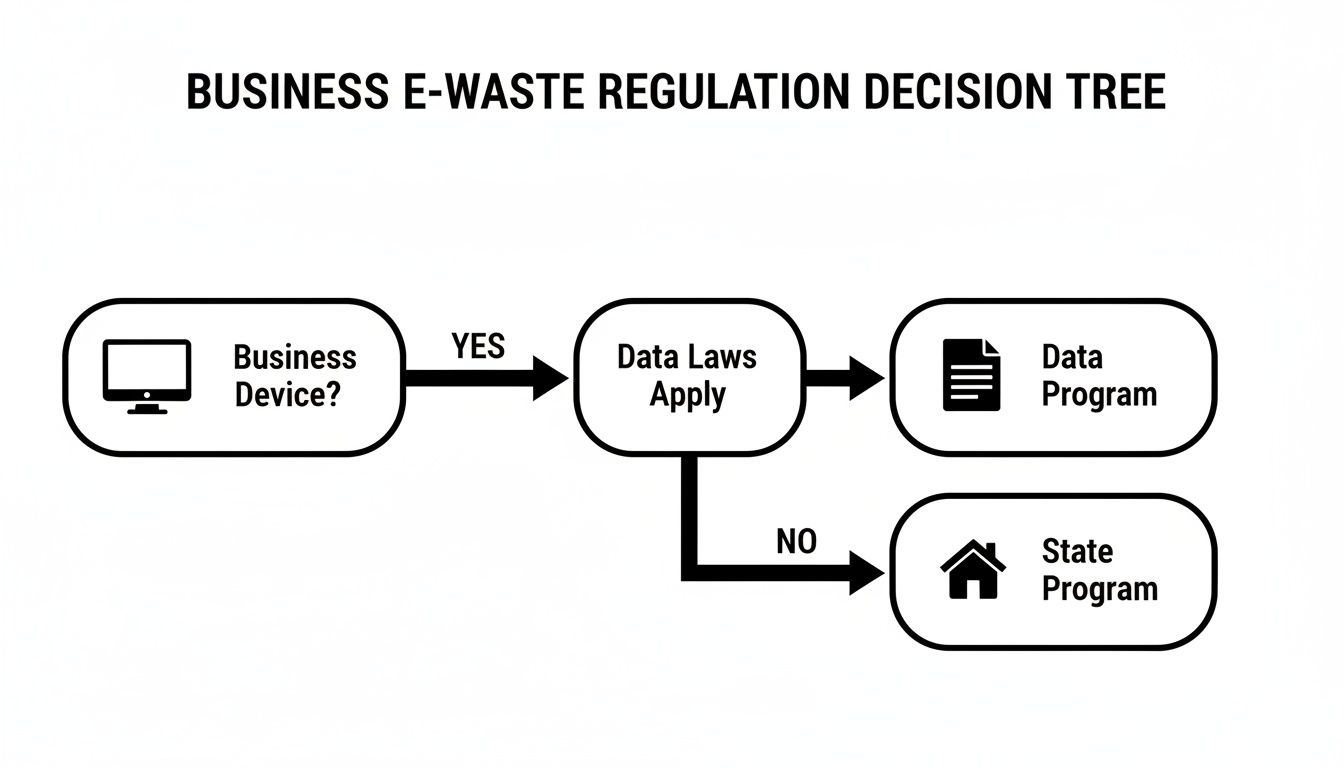
The key takeaway is clear: once a device is classified as a business asset, data security laws are triggered, making certified destruction a mandatory requirement.
The Power of a Certificate of Data Destruction
The final and most critical element of the security process is the documentation. A professional ITAD partner will provide a serialized Certificate of Data Destruction upon completion of the service. This is not merely a receipt; it is your legal proof of compliance.
This certificate serves as an auditable, third-party verification that your company fulfilled its duty of care, effectively transferring liability and protecting you from the severe fines and reputational ruin that follow a data breach.
It provides a detailed inventory, tracking every data-bearing asset by its serial number and confirming its permanent destruction. For businesses managing Connecticut electronics recycling, this document is the ultimate safeguard, proving that you took every necessary step to protect your data.
You can explore the specifics of a fully compliant and certified security and data destruction service to see how this process protects your organization from start to finish.
Moving Beyond Recycling With Full ITAD Services
For forward-thinking Connecticut businesses, retired technology represents more than a disposal challenge—it is a hidden opportunity. Moving beyond basic Connecticut electronics recycling involves adopting a comprehensive IT Asset Disposition (ITAD) strategy. This approach transforms end-of-life asset management from a compliance burden into a process that can actively enhance your bottom line.
A complete ITAD program addresses the entire lifecycle of your equipment, focusing on opportunities to recover value, secure data, and streamline operations. It is the strategic difference between simply disposing of old hardware and managing it as a business asset, even at the end of its useful life.
Unlocking Value With IT Asset Buyback Programs
One of the most significant benefits of a true ITAD partnership is the potential to recover capital from your used equipment. Many businesses are unaware that their depreciated servers, laptops, and networking hardware may still hold considerable market value. An IT asset buyback program is designed to unlock that value.
Instead of paying for all equipment to be recycled, an ITAD specialist will assess your assets for their resale potential.
- Financial Return: Functional, in-demand assets are purchased, converting a disposal expense into a revenue stream.
- Secure Process: Data destruction is always the first step. Your information is completely sanitized before any equipment is considered for refurbishment or resale.
- Sustainability: Extending the life of functional equipment is the most environmentally responsible option. It maximizes the utility of the hardware and reduces the environmental impact of manufacturing new products.
This strategic approach ensures you extract maximum financial return from your original technology investment, directly benefiting your IT budget.
A mature ITAD strategy redefines "end-of-life" equipment. It is no longer waste to be managed but a portfolio of assets with potential value to be recovered, all while maintaining the highest security standards.
Handling Complex and Specialized Projects
A qualified ITAD partner provides the expertise and logistics to manage much more than a standard office equipment refresh. Businesses in specialized sectors or those undergoing major infrastructure changes require a higher level of service. For those seeking a deeper understanding of these offerings, you can learn more about our dedicated Connecticut ITAD services and how they are tailored for complex needs.
This includes managing projects like:
- Data Center Decommissioning: This involves the systematic disassembly of server racks, networking infrastructure, and support systems. It requires meticulous project management, secure logistics, and certified data destruction for hundreds or thousands of assets simultaneously.
- Medical and Laboratory Equipment Disposal: Healthcare and research facilities in cities like New Haven or Hartford must adhere to strict HIPAA regulations. A specialized ITAD provider ensures sensitive patient or research data is securely destroyed and that all equipment is handled in a compliant manner.
The table below outlines the core services that constitute a robust ITAD program for businesses in Connecticut.
Core ITAD Services for Connecticut Businesses
This table highlights the key services within a comprehensive ITAD program, helping you identify solutions that align with your specific operational and financial requirements.
| Service Category | Description | Primary Benefit for Businesses |
|---|---|---|
| Logistics & On-Site Services | Secure, documented pickup and transportation of assets, including on-site data destruction and equipment de-installation. | Minimizes disruption to your operations and ensures a secure chain of custody from the start. |
| Data Destruction | Certified physical shredding or digital wiping of hard drives and other storage media to NIST 800-88 standards. | Guarantees complete data security, protecting against breaches and ensuring compliance with privacy laws. |
| Asset Value Recovery | Assessment, testing, and resale of functional IT equipment through established secondary market channels. | Generates revenue from retired assets, turning a cost center into a source of income for your IT budget. |
| Certified Electronics Recycling | Environmentally responsible dismantling and processing of non-functional or obsolete electronics to R2 or e-Stewards standards. | Ensures environmental compliance, avoids landfill penalties, and supports corporate sustainability goals. |
| Reporting & Documentation | Detailed inventory reports, Certificates of Data Destruction, and Certificates of Recycling for every asset processed. | Provides a clear audit trail for compliance, internal tracking, and stakeholder reporting. |
By partnering with a vendor capable of managing these complex scenarios, Connecticut organizations can ensure every asset, regardless of its specialization, is processed securely, compliantly, and with a focus on maximum value recovery. This strategic approach transforms a logistical challenge into a secure and efficient operational success.
How to Choose the Right E-Waste Partner in Connecticut

Selecting the right partner for your Connecticut electronics recycling is a critical decision for any IT or facilities manager. This choice extends beyond simple equipment removal; it directly impacts your company's data security, legal compliance, and public reputation.
Entrusting your retired assets to an unqualified vendor is a significant risk. A single error on their part could result in a devastating data breach or substantial regulatory fines for your company. It is imperative to look beyond cost and thoroughly evaluate a potential partner's certifications, security protocols, and operational transparency. A true partner provides a secure, documented process that shields you from liability.
Look for Gold-Standard Certifications
In an industry with numerous providers, certifications are the most effective way to distinguish professional, reputable vendors. These credentials serve as a third-party verification that a provider adheres to the highest industry standards for security and environmental responsibility.
Two certifications are paramount:
- R2v3 (Responsible Recycling): This is a comprehensive standard covering data security, environmental practices, and worker safety. An R2v3-certified facility has demonstrated a secure and accountable process from collection to final disposition.
- e-Stewards: Renowned for its stringent environmental requirements, the e-Stewards certification is the strongest assurance that your e-waste will not be illegally exported or processed in an unsafe manner.
When a vendor holds one or both of these certifications, it signifies a serious investment in proper procedures and provides a high level of confidence.
Essential Questions to Ask Any Potential Vendor
Before engaging a vendor, it is crucial to ask direct questions to verify their commitment to security. Their responses will reveal the integrity of their operations. The selection process can be complex; our guide on choosing the right recycling center offers a more in-depth look at making this critical decision.
A professional ITAD partner will welcome detailed questions about their security protocols. Hesitation or vague answers about their chain-of-custody or data destruction methods are major red flags.
Ensure these questions are part of your vetting process:
- Can you describe your chain-of-custody process from pickup to final disposition? They should provide a detailed explanation of how they track and secure your assets at every stage.
- What data destruction methods do you offer, and do they meet NIST 800-88 standards? Look for partners who offer both on-site and off-site physical shredding as standard practice.
- Will I receive a serialized Certificate of Data Destruction? This is non-negotiable. The certificate is your legal proof of compliance and must list every data-bearing asset by its serial number.
- What types of insurance do you carry? A qualified vendor must have both pollution liability and data breach insurance to protect your organization in the event of an incident.
By prioritizing certified partners and asking these essential questions, you can confidently select a vendor who will genuinely protect your company's interests.
Frequently Asked Questions for Connecticut Businesses
Several questions arise repeatedly from Connecticut businesses regarding the retirement of their IT assets. Here are clear, concise answers to the most common inquiries from IT managers and business owners.
Does Connecticut's State Program Cover Office Computers?
No, this is a common misconception. The state-managed recycling program available at municipal transfer stations is funded by electronics manufacturers specifically for residential use. It is designed for household e-waste and does not meet the unique security and liability requirements of a business. Corporate assets must be handled by a professional ITAD (IT Asset Disposition) vendor to ensure data is completely destroyed and to obtain the necessary documentation for compliance with federal laws like the FTC Disposal Rule.
What Paperwork Is Essential When We Recycle Electronics?
This is the most critical aspect of the process. Without the correct documentation from your recycling partner, your company remains legally and financially liable.
You must receive two non-negotiable documents:
- A Certificate of Recycling: This document proves that all non-data-bearing equipment, such as keyboards, mice, and monitors, was managed in an environmentally responsible manner in accordance with all state and federal regulations.
- A Certificate of Data Destruction: This is your primary liability shield. It provides a serialized, auditable record proving that every hard drive, server, and other data-bearing device was professionally wiped or physically shredded, protecting you from the consequences of a data breach.
Is Our Old But Working IT Equipment Worth Anything?
Yes, it often is. Assuming old equipment is worthless is a common and costly mistake. A reputable ITAD partner will offer a robust IT asset buyback program. They will assess your retired servers, laptops, networking gear, and other hardware for any remaining value in the secondary market. This process can convert a disposal cost into revenue for your IT budget, all while ensuring your data is certifiably destroyed before any item is considered for resale.
Can We Safely Recycle Medical Equipment With Patient Data?
Yes, but this requires a specialized provider, not a general recycler. Disposing of medical or laboratory equipment containing protected health information (PHI) is a high-risk activity governed by HIPAA. The process demands a fully documented and unbroken chain of custody from the moment the equipment leaves your facility until its final destruction. There is no margin for error. You need an ITAD provider with proven expertise in healthcare compliance to ensure every trace of patient data is permanently eliminated and that you receive the documentation to prove it.
For organizations seeking a partner that can manage every aspect of Connecticut electronics recycling with certified security and professionalism, Beyond Surplus offers nationwide services tailored to corporate needs. Contact us today for a secure and compliant ITAD solution.


