

A lot of ITAD companies think they know how customers feel because renewals still come in and nobody has escalated. That's a dangerous assumption. In this business, dissatisfaction often stays quiet until a client moves a refresh project to another vendor, questions your chain of custody during an audit, or stops trusting your reporting around data destruction and asset value recovery.
That's why customer satisfaction measurement in ITAD has to be built like an operations system, not a marketing exercise. The right program captures what happened at pickup, during processing, at certificate delivery, and after final settlement. It gives account managers, logistics leads, compliance staff, and plant managers the same signal. It also forces discipline in the places where ITAD firms can't afford sloppiness: scheduling, documentation, secure handling, and final proof.
Why Satisfaction Measurement is Mission-Critical for ITAD
A pickup crew signs out 420 devices from a hospital refresh. The truck leaves on time, but the site contact still feels uneasy because two serial numbers were corrected by hand, the chain-of-custody form arrived late, and the certificate package took days longer than promised. On paper, the job may still look complete. In ITAD, that gap between completion and confidence is where accounts are lost.
Satisfaction measurement matters because clients judge ITAD on risk control as much as service quality. They need proof that assets were tracked correctly, data-bearing devices were handled according to policy, and final documentation will hold up during procurement review, internal audit, or a regulator's inquiry. If you do not measure confidence at those points, you are leaving one of the biggest drivers of renewal and referral to guesswork.
Silence is not approval
Enterprise customers often do not report every problem. The IT manager logs the issue mentally. Procurement remembers the missed SLA. Compliance notices that paperwork needed follow-up. Then the next migration, office closure, or refresh project goes to a different vendor.
I have seen this pattern in ITAD operations. A customer rarely says, "your CSAT is slipping." They ask more questions about tracking, request extra documentation, or copy more people on routine emails. Those are early warnings that trust is thinning.
Satisfaction measurement belongs beside quality control, audit preparation, and exception management because poor service in ITAD creates operational risk. A delayed pickup can disrupt a facility schedule. A confusing asset report can trigger reconciliation work for the client. A slow destruction confirmation can create internal exposure for teams trying to close a security ticket.
Practical rule: If a customer has to ask where assets are, whether drives were destroyed, or when paperwork will arrive, treat that as an operational failure that should be measured, trended, and assigned to an owner.
The risk is concentrated at known moments
ITAD leaders do not need vague sentiment tracking. They need feedback tied to the moments where trust can weaken or strengthen:
- Pickup execution: Did the crew show up prepared, match the approved scope, and handle onsite interactions professionally?
- Chain of custody: Did the customer receive accurate handoff records, serial visibility, and exception notes that made sense?
- Data destruction confirmation: Did certificates arrive on time, with enough detail to satisfy security and compliance teams?
- Value recovery reporting: Did settlement reporting match expectations on grading, pricing, and itemization?
- Project closeout: Did the final package support internal audit, ESG reporting, and regulatory recordkeeping?
Measure those touchpoints consistently and you get more than a service score. You get a record of where execution breaks down, which teams are involved, and which issues threaten retention. That record is useful during QBRs, CAPA reviews, and customer-specific process updates.
Research from Forrester's US Customer Experience Index rankings and reports has long tied stronger customer experience performance to better retention outcomes. In ITAD, that connection is even tighter because the work is repeatable, high trust, and hard to separate from compliance performance. A client that doubts your documentation or chain of custody will not wait for a second major failure.
Trust is part of the deliverable
Clients do not hire an ITAD provider just to remove equipment. They hire one to reduce data security exposure, maintain documented custody, recover value where appropriate, and produce records that stand up later. Satisfaction measurement proves whether your operation is delivering that outcome from the customer's point of view.
It also improves how you run the business. If pickup scores drop for one region, you can inspect dispatch notes, crew preparation, and onsite paperwork. If certificate satisfaction falls, you can review processing queues, template quality, and approval steps. If settlement feedback declines, you can compare quoted assumptions against actual grading and reporting. The point is not to collect opinions. The point is to connect feedback to corrective action.
For companies building that broader business case, why ITAD services matter for Georgia companies in 2026 provides useful context on why disciplined disposal, recovery, and documentation processes matter at the executive level.
Choosing Your Core ITAD Satisfaction Metrics
A client can praise your team after pickup and still hesitate to send the next truckload if certificate turnaround slips or settlement reports create extra work. That is why ITAD companies need a metric set, not a single headline score. One measure should track execution at the event level, one should test account confidence over time, and one should expose friction in the parts of the process clients have to touch.
Use CSAT for transaction quality
Customer Satisfaction Score, or CSAT, measures the share of respondents who rate an experience positively, usually 4 or 5 on a 5-point scale. A standard formula is CSAT % = (Number of responses scoring 4 or 5) / (Total responses) × 100, as outlined by Formbricks on measuring customer satisfaction. Broad benchmarks from software and service industries can give rough context, but ITAD operators should be careful with them. A secure pickup with accurate serial capture, proper site signoff, and zero chain-of-custody gaps carries a different risk profile than a typical support interaction.
In practice, CSAT works best right after a defined service event. That keeps the score tied to one team, one workflow, and one set of records you can audit.
Use CSAT after:
- completed pickup
- on-site deinstallation
- certificate delivery
- value recovery report submission
Each of those moments reflects a different part of the ITAD promise. Pickup CSAT tests field execution. Certificate CSAT tests documentation quality and turnaround. Settlement CSAT tests whether your reporting and downstream disposition matched the client's expectations.

Use NPS for account durability
Net Promoter Score, or NPS, is calculated by subtracting the percentage of detractors from the percentage of promoters. It is better suited to the broader B2B relationship than to a single truck arrival or one reporting packet. Ask it only after the client has seen enough of your operation to judge consistency across locations, projects, and issue handling.
For ITAD, NPS is useful because the buying group is rarely one person. Operations may care about pickup discipline. Security may care about destruction controls and exception handling. Procurement may care about pricing clarity and claim resolution. Compliance may care about whether records hold up months later during an audit or legal review. A healthy NPS suggests those groups see your company as dependable across the full program, not just pleasant to work with on one day.
Use CES to expose friction
Customer Effort Score, or CES, measures how easy or difficult a task felt for the customer. This is the metric many ITAD teams skip, and it often points to the fastest operational fixes.
Use CES around tasks like:
- scheduling a pickup
- accessing the client portal
- requesting certificates
- approving a settlement report
- coordinating a multi-site project
A client may be satisfied with the final outcome and still see your process as hard to work through. That matters. In ITAD, friction often shows up in places that create hidden account risk: too many emails to confirm site readiness, confusing packing instructions, delays in exception approval, or reports that force the client to reconcile serial numbers manually. CES surfaces those problems before they turn into escalations.
Build one scorecard that maps to the operation
The strongest setup is one scorecard tied to your workflow and compliance records, not three disconnected survey streams. If a pickup CSAT score drops, operations should be able to trace it to route planning, crew readiness, or site paperwork. If CES falls on certificate access, the team should inspect the portal, file naming, release controls, and notification steps. If NPS weakens on a strategic account, account management should review whether repeated small failures are eroding trust.
A practical starter model looks like this:
| Metric | Best ITAD use | Trigger |
|---|---|---|
| CSAT | Pickup, processing, reporting quality | Immediately after event |
| NPS | Overall account loyalty | Periodic account review |
| CES | Ease of scheduling and documentation access | Right after a task is completed |
Companies that already manage devices across redeployment, retirement, resale, and final disposition usually have the right operational structure to support this approach. A disciplined IT asset lifecycle management process gives you the handoffs, timestamps, and ownership needed to connect satisfaction scores to what happened in the field, in the warehouse, and in the audit file.
Designing Surveys for Key ITAD Touchpoints
A survey only works if it arrives when the experience is still fresh and asks for one decision, not a dissertation. In ITAD, that means event-triggered surveys tied to milestones in the service workflow.
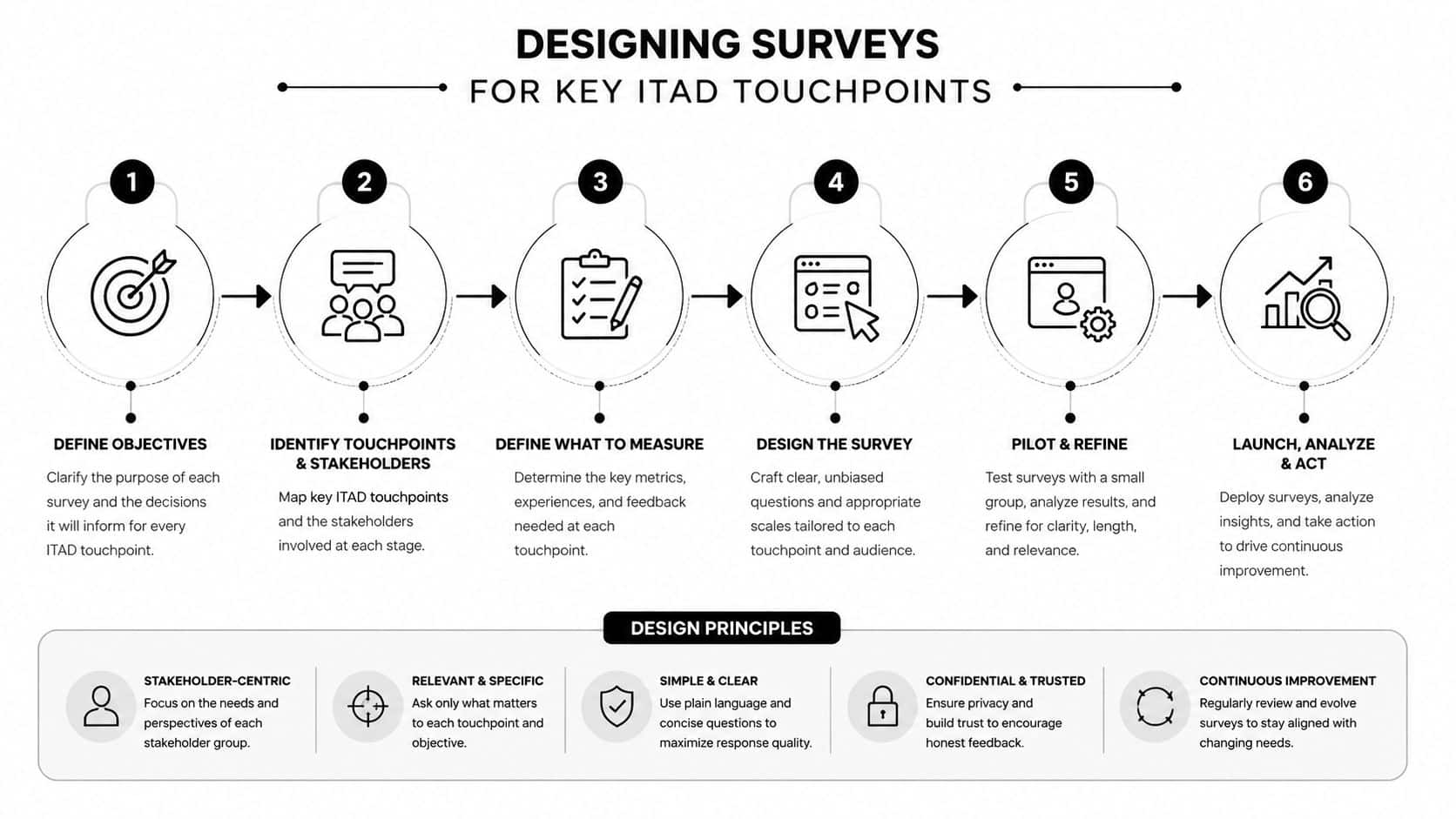
Match the survey to the touchpoint
Use a simple what, when, who model.
Initial inquiry and quote
Ask whether the proposal was clear and whether the scope matched the client's need. Send it to the contact who requested pricing.
Scheduling and logistics
Ask how easy it was to arrange the service window, building access, packing requirements, and site coordination. This is a natural CES moment.
On-site collection or deinstallation
Ask whether the team arrived prepared, followed site rules, and handled assets professionally. This is strong CSAT territory.
Data destruction and processing
Ask the compliance contact whether security steps were communicated clearly and whether exceptions were explained in plain language.
Reporting and settlement
Ask whether serialized reporting, destruction documentation, and financial reconciliation were easy to review.
Keep transactional surveys short
The best verified guidance is strict here. A common failure is skipping recontact windows and over-surveying users. The recommended practice is a 30-60 day recontact window per user, surveys triggered by specific actions rather than fixed schedules, and transactional CSAT surveys that are only one to three questions long, as summarized by Goodays on common customer satisfaction survey mistakes.
That model fits ITAD well. Most service events only need:
- the core rating
- an optional open-text follow-up for a low score
- a short follow-up for a high score, such as what stood out
Use skip logic to get detail without burden
Don't ask every client the same long list. Ask one core question first. Then branch.
For example:
- Low score path: What went wrong with pickup coordination, documentation, communication, or on-site handling?
- High score path: What should we keep doing on future pickups?
That produces useful comments without creating survey fatigue.
Short surveys respect the customer's time. In ITAD, they also isolate the exact stage that failed.
Send surveys to the right person
The facilities coordinator can rate the crew. The IT manager can rate inventory accuracy. The compliance lead can rate certificate clarity. If you send every survey to the original buyer, you'll get partial truth.
For distributed workforces and device collection programs, the same logic applies. A service model built for reverse logistics should measure the employee return experience separately from the enterprise sponsor. That's especially relevant in laptop recovery workflows, which is why the complete guide to remote employee laptop return in 2026 is closely related operationally.
Effective Data Collection and Analysis Methods
Collecting responses is the easy part. Making them usable is where customer satisfaction measurement usually breaks down.
Blend survey data with operating signals
Survey scores need context. Verified guidance from SmartSurvey on customer satisfaction metrics stresses that success depends on integrating behavioral analytics with survey data, that trust influences response rates, and that teams should analyze trends over time while connecting satisfaction metrics with KPIs such as retention and product usage.
In ITAD, “behavioral analytics” translates into operational evidence:
- repeat pickup frequency
- quote acceptance patterns
- certificate download activity
- portal logins
- time to approve settlement reports
- service tickets tied to documentation questions
If a client gives decent scores but repeatedly chases your team for paperwork, the comments may lag behind the behavior.
Segment by service line
A blended average hides too much. Split results by operating context.
Good segmentation for ITAD includes:
- Service type: data center decommissioning, office equipment pickup, medical equipment disposal, product destruction
- Client profile: healthcare, finance, education, enterprise IT, government
- Location model: single site, multi-site, remote workforce return
- Process owner: logistics, on-site technicians, reporting team, account management
Root causes become evident. A low score on one service line may have nothing to do with another.
Track trendlines, not snapshots
One bad week can come from weather, a facility access issue, or a rushed project scope. That doesn't excuse the issue, but it changes the fix. Trend analysis tells you whether the problem belongs to a route, a team, a customer segment, or a broken handoff inside your own operation.
A practical review rhythm is:
- weekly for transactional comments
- monthly for trend analysis
- quarterly for account-level patterns
Inventory accuracy and asset visibility often shape those patterns more than managers expect. Teams that already monitor asset movement and disposition detail can connect satisfaction signals back to workflow design. Inventory optimization is one operational lens for doing that.
Integrating Feedback Directly into ITAD Operations
Most companies collect feedback into a dashboard and stop there. ITAD needs a closed-loop model where feedback changes the work.

Route each signal to an owner
A low score should never sit in a generic inbox. Map issue types to operational owners.
- Pickup complaint goes to the logistics manager.
- Chain-of-custody concern goes to compliance or operations control.
- Certificate delay goes to the reporting team.
- Settlement dispute goes to finance and account management.
- Technician professionalism issue goes to field operations leadership.
That sounds basic, but many ITAD firms still let account managers carry every problem. That creates delays and weak root-cause analysis.
Tie comments to the record of work
Every piece of feedback should attach to the shipment, project, or serialized job file. In practice, that means linking survey data to:
- work order number
- client site
- service date
- asset class
- crew or technician assignment
- final documentation package
When you do that, customer satisfaction measurement becomes auditable. You can see whether complaints cluster around one route, one documentation template, or one category of equipment.
The useful unit of analysis in ITAD isn't just the customer. It's the customer plus the job record.
Build automatic response rules
Not every comment deserves the same reaction. High scores can feed recognition and reference tracking. Low scores need action rules.
A simple operating model:
- negative score creates a service recovery case
- issue category is assigned automatically
- owner has a response deadline
- account manager confirms customer follow-up
- corrective action is logged against the process
Feedback ceases to be abstract. It becomes part of daily management.
Feed training, SOPs, and quality checks
The best fixes usually live inside standard work:
- revised loading checklists for pickup crews
- better pre-arrival communication templates
- clearer exception language in destruction reports
- stronger handoff rules between operations and reporting
- site-readiness confirmations before dispatch
In ITAD, operational quality is visible to customers through details. Did the crew label gaylords correctly? Did the driver know which cages were in scope? Did the serial report align with what left the dock? Those details decide whether a client feels secure.
Building Dashboards and Reporting for Impact
A dashboard should help someone act, not just admire charts. In customer satisfaction measurement, the audience decides the design.

What executives need to see
An executive dashboard should stay narrow. It answers whether service quality supports retention, trust, and account growth.
Include views such as:
- overall CSAT trend
- NPS trend by strategic account tier
- issue volume by category
- unresolved service recovery cases
- themes from open-text responses
The most useful executive report also includes a short narrative. Not a data dump. A monthly summary that says which problem is growing, which fix was implemented, and which accounts need direct attention.
What service managers need to see
Operational dashboards should look different. Service managers need to identify where the process broke.
A stronger operational layout includes:
- CSAT by pickup crew or project team
- CES by scheduling workflow or portal task
- comments tagged to issue type
- documentation turnaround flags
- open and closed recovery actions
This lets a manager compare what customers said with what the operation did. If scores drop after multi-site pickups, the manager can inspect dispatch notes, access issues, or reporting backlog.
A good dashboard tells two stories at once. What customers experienced, and what the operation needs to fix next.
Reporting should travel across departments
Compliance teams care about documentation quality. Finance cares about settlement disputes. Operations cares about handoffs and timing. Sales cares about renewal risk.
That means one master dataset, but different views:
- board or leadership summary
- account review pack
- operations exception report
- compliance issue log
When reporting is built this way, customer satisfaction measurement stops being “owned” by one department. It becomes part of how the company runs work.
Closing the Loop for Compliance and Continuous Improvement
A client calls two days after a pickup and asks a hard question: where is the destruction confirmation, and who had custody of the drives between removal and processing? In ITAD, that moment defines whether your satisfaction program has any operational value. If feedback stops at a score, the risk stays in the process. If feedback triggers a documented response, you protect the account and strengthen your controls.
Close the individual issue
Every complaint needs an owner, a response deadline, and a record tied to the job file. The response should confirm what happened, state the corrective action, provide any corrected paperwork or updated status, and note when the customer accepted the resolution. That level of follow-through matters in ITAD because the issue often touches data handling, transportation custody, site access controls, or final reporting.
I treat service recovery as part of the operating record, not a courtesy task. If a pickup arrived without the right labels, if serialized reporting was late, or if a certificate created confusion, the account team should not handle that informally over email and move on. The case belongs in the same system as the shipment, the asset list, and the compliance documents.
Keep a defensible record
A strong satisfaction program produces evidence your team can use in audits, client reviews, and renewal discussions. That record should include complaint history by job, corrective actions, revised SOPs, customer communications, and final supporting documents tied to the original service event.
Many ITAD companies fall short by collecting feedback in one tool, managing exceptions in another, and storing compliance paperwork somewhere else. That separation creates gaps. During a vendor assessment, you need to show more than a resolved ticket. You need to show how the complaint was investigated, what changed in the process, and which document now reflects the corrected control.
Connect the program to compliance obligations
Satisfaction issues in ITAD often point to control issues. Repeated complaints about delayed destruction certificates, unclear disposition records, or inconsistent chain-of-custody updates usually indicate a process problem that can affect compliance confidence.
The standard for media sanitization should be anchored to primary guidance, not vendor language. Use NIST SP 800-88 Rev. 1 media sanitization guidance as the reference point for destruction and sanitization standards, and use the FTC Disposal Rule when your program touches regulated consumer information disposal requirements. If customer feedback keeps surfacing the same documentation issue, review whether your certificates, manifests, and exception logs prove the control you say you performed.
Documentation quality is part of the customer experience in this industry. A certificate of destruction template helps only if the underlying workflow is consistent, the job data is accurate, and the document is issued on time. Otherwise, the template masks a broken handoff.
Turn feedback into process change
The best close-the-loop programs do not stop at resolving one account problem. They feed changes back into dispatch instructions, site checklists, asset reconciliation steps, certificate issuance rules, and QA review. If one customer reports a missing serial range, check whether the issue came from intake, reporting logic, or an exception during packing. If three customers report the same problem over a quarter, update the SOP and train to it.
That is how continuous improvement should work in ITAD. Feedback identifies weak controls. Operations corrects the workflow. Compliance verifies the record. Leadership can then show customers that service quality, security, and documentation are being managed together.


