For businesses across the First State, Delaware ITAD services are a critical component of a robust operational strategy. A professional IT Asset Disposition (ITAD) program is the definitive playbook for managing retired technology, protecting sensitive corporate and customer data, ensuring regulatory compliance, and recovering value from end-of-life equipment. This guide is designed for IT managers, facility managers, and business owners in Delaware seeking secure and efficient IT equipment disposal solutions.
Why Delaware ITAD Services Are a Business Necessity
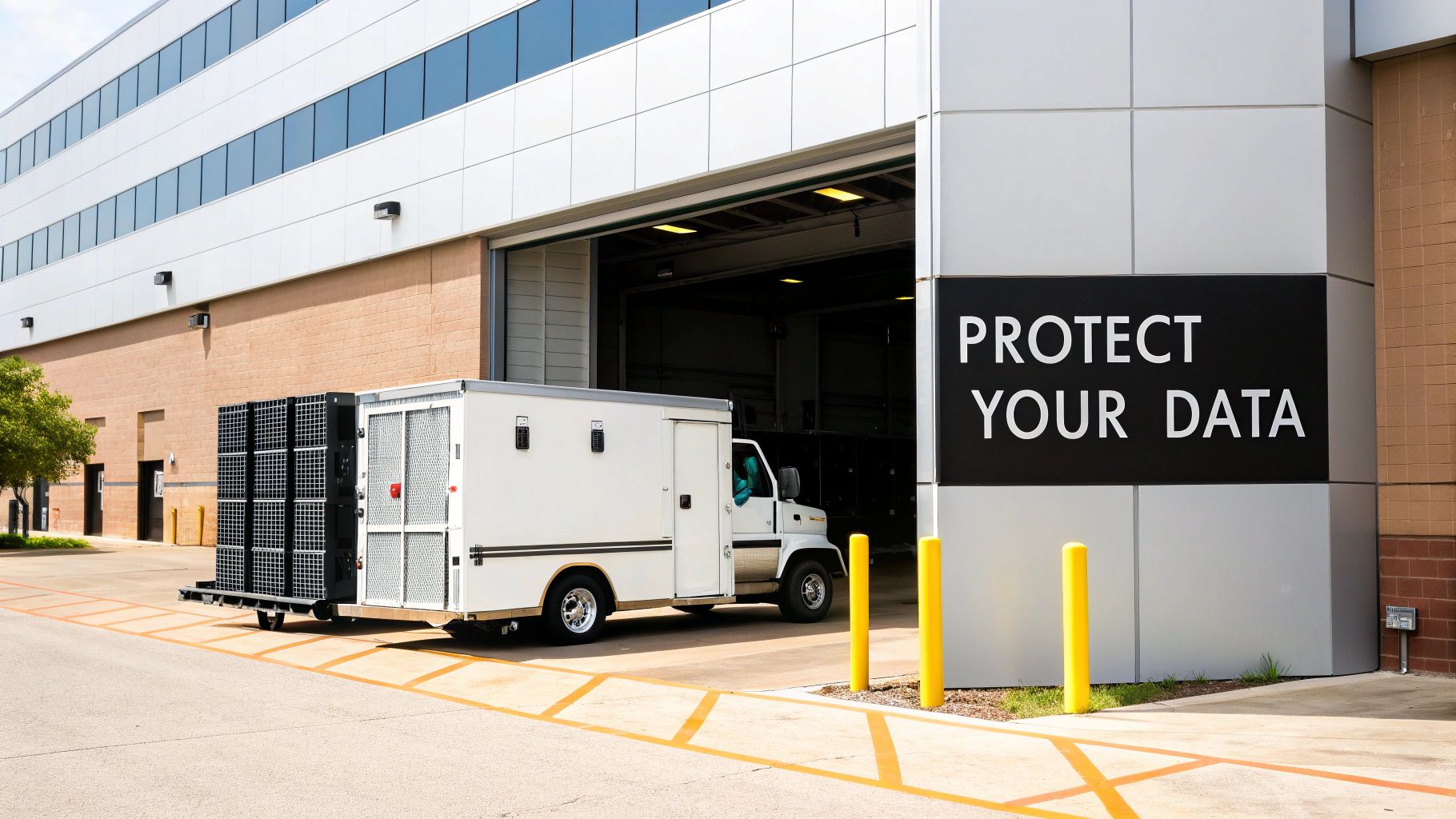
It is common for Delaware businesses to view obsolete IT gear as a simple disposal task. However, this perspective overlooks the significant risks and opportunities associated with retired enterprise assets. Your decommissioned servers, laptops, and hard drives contain your company's most valuable asset: its data. Mishandling these devices creates an immediate and substantial liability. An improperly disposed-of hard drive is an open invitation for a data breach, which can lead to severe regulatory fines, litigation, and irreparable damage to your brand's reputation. A single leaked customer file can destroy years of hard-won trust.
Moving from Liability to Strategic Asset
A professional ITAD program transforms this process from a potential liability into a secure, compliant, and often profitable operational function. A qualified ITAD partner provides a comprehensive security service that manages the entire end-of-life journey for your technology assets.
The core of a strategic ITAD framework includes:
- Secure Logistics: Every asset is tracked from the moment it leaves your facility with a documented chain of custody, ensuring complete accountability.
- Certified Data Destruction: We utilize methods such as physical shredding or certified data wiping that render information entirely unrecoverable, adhering to stringent industry standards.
- Compliance and Reporting: You receive detailed documentation, including Certificates of Data Destruction, to prove fulfillment of all legal and regulatory obligations.
- Value Recovery: We identify valuable assets, refurbish them, and manage their sale on the secondary market to generate a financial return for your business.
The Real Cost of Neglect
Ignoring proper ITAD protocols is a high-stakes gamble. Beyond data security risks, Delaware businesses must adhere to strict environmental laws governing e-waste. Improper disposal of electronics can result in significant fines and public relations challenges.
A robust ITAD strategy is an investment in risk mitigation. It systematically neutralizes the threats tied to retired technology while unlocking any financial value left inside, protecting your organization from every angle.
Ultimately, partnering with a certified provider of Delaware ITAD services is fundamental to modern business operations. It safeguards your data, ensures legal compliance, and supports your company's financial and environmental sustainability goals. When you understand what IT asset disposition is and its importance, you can convert a necessary task into a powerful strategic advantage.
Securing Your Data and Ensuring Compliance
When your company's IT equipment reaches its end-of-life, the physical hardware is secondary to the data stored on it. Every hard drive, server, and smartphone contains sensitive company, customer, and employee information. Properly managing this data is a legal requirement for every business in Delaware. An improperly discarded hard drive can lead to a data breach, triggering massive financial penalties under laws like the Health Insurance Portability and Accountability Act (HIPAA) or the Gramm-Leach-Bliley Act (GLBA). Beyond fines, a breach inflicts lasting damage to your brand and erodes customer trust.
Navigating Data Security Regulations
For any Delaware business, compliance is not optional. Specific industries are bound by strict data protection laws that mandate how sensitive information must be handled and destroyed.
Key regulations include:
- HIPAA: Healthcare organizations and their business associates must ensure all Protected Health Information (ePHI) on retired medical equipment and office computers is rendered 100% irrecoverable.
- GLBA: Financial institutions are legally obligated to protect consumers' private financial information, with strict rules for the disposal of any data-bearing assets.
- FTC Disposal Rule: This federal rule requires businesses to take appropriate measures to dispose of sensitive information from consumer reports to prevent identity theft.
Failure to comply can lead to audits, legal action, and fines that can reach seven figures.
The Gold Standard for Data Destruction
To meet these stringent requirements, your business needs a verifiable method to destroy data permanently. The industry benchmark is defined in the National Institute of Standards and Technology (NIST) Special Publication 800-88. This standard outlines a framework for making data permanently unrecoverable through three main methods: Clear, Purge, and Destroy. While software-based wiping (Purge) is effective, the most secure and final method is physical destruction. This process guarantees the storage media is physically obliterated, making data retrieval impossible. Learn more about how Beyond Surplus follows the rigorous NIST SP 800-88 guidelines for complete data sanitization.
Proof of Compliance: The Certificate of Data Destruction
A Certificate of Data Destruction is the official, auditable proof that your data was securely and permanently destroyed according to industry standards. This document is your legal receipt that formally transfers liability and confirms that your sensitive information was eliminated correctly.
A proper certificate will always include:
- A unique serial number for tracking
- The date and method of destruction
- A serialized list of the destroyed hard drives or media
- A statement of compliance with standards like NIST 800-88
This document is essential during an audit and provides peace of mind that your company's sensitive data is gone forever. To establish a robust framework for managing information security risks, refer to a comprehensive guide to Information Security Management Systems. Partnering with a certified provider of Delaware ITAD services ensures this entire process is handled securely and professionally.
The Journey of Your Assets From Pickup to Processing
Once you schedule a pickup for your retired IT assets, a critical process begins that demands meticulous management to ensure security and total accountability. What occurs after the truck departs from your Delaware facility is the true measure of an ITAD partner’s competence. This journey is defined by a rigorous, unbroken chain of custody. The chain of custody is an auditable trail that tracks every piece of equipment from the moment it leaves your control until its final disposition, whether that is secure data destruction, remarketing, or responsible recycling. This process is non-negotiable for compliance and risk management. A weak link in this chain can expose your business to significant risks, including data breaches, lost assets, and legal complications. That is why professional Delaware ITAD services are built on a foundation of logistical security and transparent tracking.

This process ensures that data is not just wiped but physically destroyed, with certified proof to back it all up.
Securing Assets From Point A to Point B
The journey starts with a secure pickup. Professional ITAD providers use a combination of tools and strict protocols to safeguard your assets during transit. This is a specialized security operation.
Key components of secure logistics include:
- Serialized Asset Tagging: Before being moved, each device—server, laptop, or hard drive—is individually tagged with a unique serial number. This barcode is scanned and logged, creating the first entry in the chain of custody record.
- GPS-Tracked Vehicles: Transport trucks are equipped with GPS tracking, providing real-time visibility into the location of your assets and ensuring they follow a designated route directly to the secure processing facility.
- Secure, Monitored Facilities: Upon arrival, assets are moved into a facility under 24/7 surveillance with controlled access, preventing theft or unauthorized handling while equipment awaits processing.
This level of detail is critical for large-scale projects. For businesses undergoing major infrastructure changes, a partner with proven experience is essential. Learn more about how Beyond Surplus manages large-scale projects by exploring our data center decommissioning services.
Pickup Options for Every Delaware Business
Flexibility in logistics is crucial. A capable ITAD partner should offer pickup options tailored to your needs, whether your organization operates from a single office in Wilmington or has multiple branches. This can range from a one-time cleanout to regularly scheduled pickups for ongoing IT refresh cycles.
The Auditing and Reporting Phase
Once your assets are securely inside the ITAD facility, the auditing process begins. The initial asset list is meticulously verified, with technicians inspecting each item to confirm serial numbers, specifications, and conditions.
This detailed audit serves two primary purposes:
- Reconciliation: It confirms that every asset that left your facility has been accounted for, providing a closed-loop chain of custody.
- Value Assessment: It identifies which assets may have residual value for resale and which are destined for destruction and recycling.
The final audit report is a comprehensive, transparent record of your assets' end-of-life journey, providing the detailed documentation needed for internal audits, compliance checks, and financial reporting.
This transparent reporting provides a clear and defensible record, demonstrating due diligence and setting the stage for the final steps of data destruction and value recovery.
Unlocking Hidden Revenue from Your Retired IT Equipment
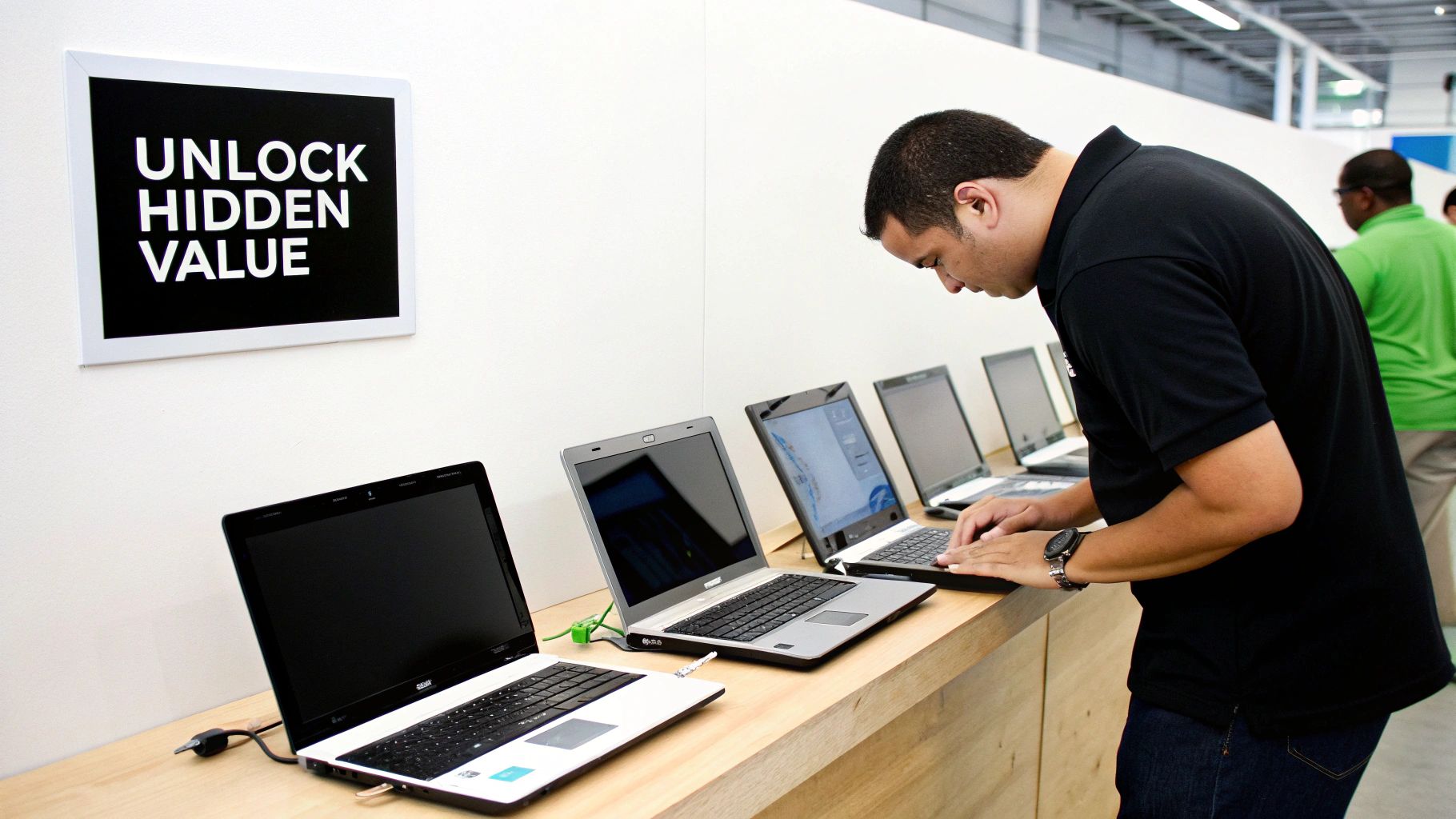
For most Delaware businesses, old IT equipment is often seen as a liability—a storage problem that requires a disposal budget. However, retired servers, laptops, and networking gear represent a hidden financial opportunity. This is where value recovery becomes a key component of a strategic ITAD program. It is the process of identifying assets that, while retired from your daily operations, retain value in the secondary market. Instead of being scrapped, this equipment is securely refurbished, tested, and resold, turning a potential cost into a revenue stream.
From Depreciated Asset to Cash Flow
Not all unplugged equipment is destined for recycling. Enterprise-grade hardware often has a robust second life. An experienced ITAD partner can identify this potential and manage the entire process to secure the best possible financial return for your business.
The equipment that most often generates a return includes:
- Enterprise Servers and Storage Arrays: High-end servers and SANs from major brands retain their value well.
- Networking Gear: Switches, routers, and firewalls are consistently in demand.
- Laptops and Desktops: Recent-model business laptops and desktops, particularly in bulk quantities, are highly marketable.
- Specialized Equipment: Technology from medical, laboratory, or manufacturing environments can also command a high resale price.
By leveraging these remarketing channels, you can offset the costs of data destruction and recycling, often achieving a positive net return.
What Determines an Asset's Resale Value?
The return on your equipment is calculated based on clear, market-driven factors. Understanding these helps set realistic expectations for your assets' worth.
A professional assessment will consider:
- Age and Generation: Equipment that is three to five years old typically commands the highest prices.
- Condition: Functionality is essential, but cosmetic condition also matters. Gear with minimal wear will be worth more.
- Brand and Model: Names like Cisco, Dell, HP, and Apple have a reputation for reliability that translates to better resale value.
- Configuration: Specifications such as CPU speed, RAM, and storage capacity directly impact the final sale price.
- Current Market Demand: The value of used IT equipment fluctuates based on global supply and demand.
How an IT Buyback Program Works
The value recovery process is formalized through an IT buyback program. A certified ITAD partner will provide a detailed quote for your equipment based on the factors above. Once approved, they manage everything—from secure pickup at your Delaware facility to certified data destruction and final resale.
A transparent IT buyback program provides a clear, itemized report showing the value generated from each asset. This ensures you receive a fair market return while maintaining a secure and compliant disposition process from start to finish.
This approach offers a direct cash return on assets that would otherwise be a cost. To see how your outdated equipment can become a revenue source, explore Beyond Surplus's professional IT equipment buy back services. By partnering with a provider of Delaware ITAD services, you can effectively turn end-of-life technology into a financial asset.
ITAD Solutions for Delaware's Core Industries
Different industries across Delaware operate under distinct rules, particularly regarding data security and compliance. A one-size-fits-all approach to IT Asset Disposition is insufficient. Effective Delaware ITAD services must be tailored to the specific regulatory and operational challenges of sectors like healthcare, finance, and education.
Healthcare and HIPAA Compliance
For healthcare organizations in Delaware, from large hospitals to small private clinics, the top priority is protecting patient data. The Health Insurance Portability and Accountability Act (HIPAA) mandates that all electronic Protected Health Information (ePHI) must be made completely unrecoverable when equipment is decommissioned.
This applies to a wide range of devices:
- Diagnostic imaging machines
- Patient monitoring systems
- Servers storing electronic health records (EHR)
- Laptops and tablets used for administrative tasks
Failure to comply can lead to severe data breaches and significant financial penalties. A specialized ITAD partner ensures every device containing ePHI undergoes certified data destruction and provides the necessary documentation for HIPAA compliance. For more details, review our guide on the secure disposal of medical equipment.
Financial Sector and GLBA Security
Delaware's financial sector, including banks, investment firms, and insurance companies, operates under the Gramm-Leach-Bliley Act (GLBA). This law requires institutions to implement strong safeguards to protect sensitive customer financial information. When disposing of IT assets, this means data must be completely obliterated.
For financial institutions, the risk of data exposure is too significant to leave to chance. On-site hard drive shredding is often the preferred method, as it allows IT and compliance managers to physically witness the destruction of data-bearing media before it leaves the premises.
This approach provides an airtight chain of custody and immediate peace of mind, satisfying auditors and maintaining customer trust.
Educational Institutions and Large-Scale Refreshes
Schools, colleges, and universities in Delaware face unique challenges, managing large fleets of devices—student laptops, computer lab desktops, and tablets—often with tight budgets. Their primary goals are to manage large-scale technology refreshes in a cost-effective and environmentally responsible manner.
An ITAD program for education excels in two key areas:
- Cost-Effective Logistics: Efficiently collecting and processing thousands of devices from multiple campuses requires significant coordination.
- Value Recovery: Maximizing the resale value of equipment is crucial for funding the next generation of technology for students.
When an educational institution partners with an ITAD provider skilled in remarketing, old assets can become a new funding source, helping to stretch budgets while ensuring all student and administrative data is securely erased.
How to Choose the Right Delaware ITAD Partner
Selecting a provider for Delaware ITAD services is a critical decision that extends beyond simple equipment removal. The right partner acts as an extension of your security and compliance team, while the wrong one can expose your business to significant data, financial, and reputational risks. It is essential to differentiate between a certified professional and a low-cost vendor that may cut corners. A smart choice involves looking beyond the initial price to evaluate a provider's certifications, processes, and transparency. The objective is to find a partner who delivers a secure, environmentally sound, and fully auditable service.
Non-Negotiable Industry Certifications
In the ITAD industry, certifications are proof that a provider adheres to strict, audited standards for data security, environmental safety, and employee health. For any business in Delaware, these two certifications are essential:
- R2v3 (Responsible Recycling): This is a leading standard for electronics recycling, covering environmental protection, data security, and worker safety. An R2v3-certified vendor has demonstrated adherence to best practices for testing, repairing, and recycling equipment while maintaining a secure chain of custody.
- e-Stewards: As one of the most stringent certifications, e-Stewards guarantees that no hazardous e-waste is exported to developing countries or disposed of in landfills. It places a strong emphasis on data security and ensuring all downstream partners are equally responsible.
The absence of these certifications is a significant red flag, indicating potential gaps in security or environmental protocols.
Key Questions for Vetting Potential Partners
Once you confirm certifications, investigate the provider's operational procedures. The answers will reveal the quality and security of their services.
1. Can You Walk Me Through Your Chain of Custody Protocol?
Request a step-by-step breakdown of how they track each asset, from pickup to final disposition. A thorough response will include details on serialized asset tagging, secure transport, and facilities with controlled access and 24/7 surveillance.
2. What Are Your Insurance Coverage Limits?
A reputable ITAD partner will carry significant insurance policies, including general liability, errors and omissions, and pollution liability. This coverage protects your business in the rare event of a data breach or environmental issue.
3. How Do You Handle Downstream Vendor Transparency?
Your responsibility for your electronics continues downstream. Ask how they audit their partners who handle final smelting, refining, and recycling. A certified vendor will have a documented process for vetting and continuously monitoring their entire network.
4. What Kind of Reporting Will I Receive?
The final documentation is your proof of compliance. A professional partner should provide detailed, serialized reports, including a Certificate of Data Destruction and a Certificate of Recycling. These documents should list every asset processed, confirming it was handled securely.
North America's leadership in the global ITAD market, valued at USD 9.29 billion, is driven by sophisticated IT infrastructure and strict compliance requirements. To learn more, discover more insights about the IT asset disposition market. By using this checklist, you can confidently evaluate Delaware ITAD services and choose a partner who will protect your organization's interests.
Common Questions About Delaware ITAD Services
When retiring IT assets, Delaware businesses often have numerous questions. Obtaining clear, straightforward answers is crucial for making informed decisions that protect your company. This section addresses common inquiries about professional Delaware ITAD services, covering topics from cost and logistics to the critical documentation you should expect.
How Much Do ITAD Services Cost?
The cost of ITAD services depends on several factors, including the volume and type of equipment, the required level of data destruction (e.g., on-site vs. off-site shredding), and logistical details. However, a well-managed ITAD program is not merely an expense. Through value recovery and an IT buyback program, newer assets can generate a significant return. This revenue often covers the service costs and, in many cases, can result in a net positive return for your budget.
What Types of Equipment Do You Accept?
A full-service ITAD provider should handle a wide range of business technology, allowing you to manage all retired electronics through a single, secure channel.
We routinely accept commercial and enterprise equipment, including:
- Data Center Hardware: Servers, storage arrays (SANs/NAS), networking switches, and routers.
- Office Equipment: Laptops, desktops, monitors, printers, and VoIP phones.
- Specialized Technology: Medical devices, laboratory equipment, and point-of-sale (POS) systems.
A partner capable of managing diverse equipment streams simplifies the process, ensuring everything is handled under the same secure and compliant framework.
How Do I Schedule a Pickup?
Initiating a pickup should be a seamless process. A reputable vendor will offer flexible logistics that work around your business operations. You can typically start a service request via a contact form, email, or phone call to discuss your inventory and requirements.
Coordinating logistics to ensure zero disruption to your business is a key part of the scheduling process. This includes confirming the pickup date, time, and any specific on-site requirements.
Once details are finalized, the ITAD provider’s team will arrive to securely pack and transport your assets, initiating the documented chain of custody at your location.
What Documentation Will I Receive?
Comprehensive documentation is non-negotiable. It serves as your official proof of compliance and due diligence. Upon completion of the service, you should receive a full reporting package.
This package must include:
- A Certificate of Data Destruction, detailing the serial numbers of all destroyed drives and media and the method used.
- A Certificate of Recycling, confirming that non-working assets were processed in an environmentally responsible manner.
- A serialized audit report, providing a complete, itemized inventory of every asset handled.
These documents are essential for any internal or external audits and demonstrate that you have met your legal and ethical obligations.
Contact Beyond Surplus for certified electronics recycling and secure IT asset disposal. Schedule your secure Delaware ITAD services consultation today through our website at https://www.beyondsurplus.com.