A New York City office refresh can leave you with a messy back room fast. Old laptops are stacked on carts, retired switches are still mounted in a closet, and someone is asking whether the team can just haul it all to a public drop-off site and move on.
That is where most e-waste nyc advice stops being useful for business readers. Corporate e-waste in NYC is not just a disposal issue. It is a data security problem, a compliance problem, and a logistics problem. If your equipment holds customer records, employee data, financial files, or protected health information, the wrong disposal path can create liability long after the hardware leaves your office.
Residential recycling guidance does not solve that. Enterprise disposition requires documented custody, secure transport, defensible data destruction, and reporting your legal team can keep on file. That is the standard business managers should use when evaluating any recycler, pickup service, or ITAD vendor operating in the five boroughs.
Navigating Corporate E-Waste Disposal in NYC
The practical challenge usually starts before disposal. Equipment sits because no one wants to be the person who approves the wrong process. Facilities wants the space back. IT wants drives handled securely. Procurement wants to know whether any assets still have resale value.
What business teams need first
Start with three questions:
- What assets are leaving service
- Which of those assets contain data
- What documentation must you retain after disposition
That sounds basic, but it changes everything. A pallet of monitors is one workflow. A batch of encrypted laptops is another. A server decommission with mixed drives, rails, and network gear needs tighter handling than a few peripherals from a branch office.
A good internal starting point is to separate assets into categories before you ask for quotes:
- Data-bearing devices: Laptops, desktops, servers, storage arrays, mobile devices.
- Non-data hardware: Monitors, docks, keyboards, cables, phones without retained data.
- High-effort removals: Rack equipment, UPS units, lab gear, and anything still installed.
If your team has not formalized this process, review the basics of IT asset disposition before scheduling pickup. The important point is simple. Disposal is not the event. Disposition is the controlled business process that covers inventory, handling, transport, destruction, recycling, and reporting.
Tip: If an internal stakeholder says “it’s just old electronics,” assume the risk has been underestimated.
What works in NYC
What works is a documented chain from office to downstream processor. What does not work is informal hauling, mixed storage with live assets, or relying on a consumer-facing program for enterprise equipment. In dense city environments, secure removal matters as much as end processing. Elevators, loading docks, building rules, and limited staging space all affect the job.
The teams that handle e-waste nyc well usually do one thing right. They treat retired equipment as regulated business material, not trash.
NYC E-Waste Laws Your Business Must Follow
New York does not treat electronics disposal casually. Under the state framework, electronics recycling is mandatory enough that businesses need to know where their responsibilities begin and where free public options end.

The state rule businesses need to understand
New York State’s E-Waste Recycling & Reuse Act created a serious statewide collection framework. In 2015, manufacturers reported collecting more than 101 million pounds of e-waste, which exceeded the statewide goal and equaled 5.1 pounds per capita according to the New York State DEC report on the E-Waste Recycling & Reuse Act.
That number matters for one reason. It shows the state expects electronics to move through a formal recycling system, not into regular trash or ad hoc disposal channels.
For businesses, the law is not just a recycling reminder. It is a signal that New York expects accountable handling of covered devices. If you manage office relocations, refresh cycles, lease returns, or data center cleanouts, you need a vendor process that aligns with that framework. For added context on handling regulated equipment streams, this guide to universal waste regulations is a useful reference.
Where companies get confused
Many NYC teams read general e-waste guidance and assume business and household rules are basically the same. They are not. Consumer-facing messaging often focuses on convenience. Commercial compliance focuses on accountability.
A business should verify:
- Who is legally responsible: Your company remains responsible for how assets are handled until liability is properly transferred.
- What records exist: Pickup logs, serialized audits, certificates, and downstream recycling records matter.
- Which devices need special handling: Any media-bearing asset needs a data destruction decision before it leaves your control.
The federal data rule many teams overlook
State recycling law is only part of the picture. If your company handles consumer information, the FTC Disposal Rule belongs in the conversation. Public drop-off is not a compliance strategy if no one can prove what happened to the data-bearing device after handoff.
That is why legal, compliance, and IT usually care less about “where can we drop this off” and more about “who documented possession, transport, destruction, and final processing.”
Key takeaway: In NYC, environmental compliance and information security overlap. A recycler that cannot document custody is not solving the full problem.
The standard procurement should require
Before approving any e-waste nyc vendor, ask for:
- Scope clarity: What equipment they accept and what they will not handle.
- Custody controls: How assets are labeled, packed, transported, and tracked.
- Destruction documentation: What proof you receive for wiping, shredding, or recycling.
- Downstream transparency: Whether they can identify how material moves after initial pickup.
Businesses do not need the cheapest outlet. They need a process they can defend in an audit, incident review, or legal hold discussion.
Why NYC Residential Programs Create Business Risks
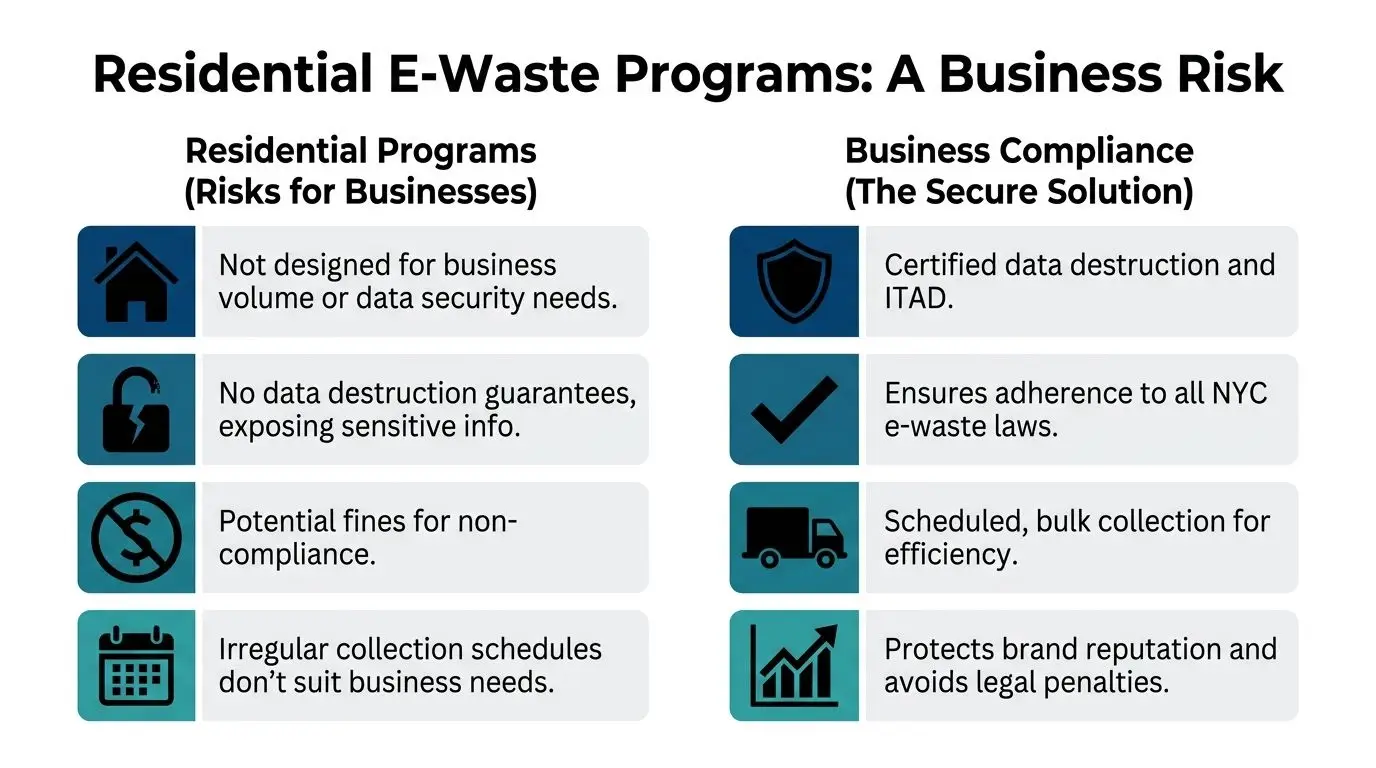
The biggest mistake NYC companies make is treating public electronics programs as if they scale to enterprise work. They do not. They were built to divert household material, not to protect corporate data, manage office volume, or support regulated industries.
Free does not mean compliant
This is the part many managers only learn after a rushed cleanout. A public program may accept the item, but that does not mean it gives your company the records needed to close the project safely.
According to Human-I-T’s summary of New York e-waste rules, businesses over 50 employees are not covered by manufacturer take-back programs under New York law, and using public drop-offs offers no chain-of-custody documentation, which creates liability risk under the FTC Disposal Rule.
That is the core trade-off. Residential systems are designed for diversion. Business systems are designed for diversion plus defensibility.
Where public options fail for business use
A corporate IT manager needs more than a place that accepts devices. They need proof.
Common failure points include:
- No documented custody: Someone in your office carries drives or laptops out the door, and the paper trail ends there.
- No destruction certificate: You cannot show whether data was wiped, shredded, or passed downstream.
- Volume limits: Public programs may fit a few items. They are not built for office closures, branch consolidations, or rack removals.
- Self-hauling exposure: Staff transport sensitive assets through city streets, lobbies, and loading areas with no controlled handoff.
- Mixed equipment issues: Enterprise loads often include proprietary devices, damaged hardware, batteries, and infrastructure components that need preplanning.
The hidden cost of convenience
Teams often frame public drop-off as the budget option. That overlooks labor time, transport coordination, internal handling risk, and the lack of audit-ready paperwork. If your company later needs to prove secure disposal, “we dropped it off” is not useful.
A better way to evaluate disposal options is to compare business risk, not only upfront cost.
| Feature | NYC Public/Retail Drop-Off | Certified ITAD Partner (Beyond Surplus) |
|---|---|---|
| Data destruction documentation | Typically limited or unavailable | Provided as part of controlled service |
| Chain of custody | Informal or absent | Documented from pickup through processing |
| Enterprise volume handling | Often impractical | Built for bulk corporate loads |
| Pickup from office | Usually self-haul | Scheduled business logistics |
| Reporting for audits | Limited | Formal certificates and asset reporting |
| Value recovery | Usually none | Available for resale-eligible assets |
One caution. Retail guidance can sound business-friendly while still functioning as a consumer channel. That is why relying on a retail roundup like Best Buy recycling information as your primary enterprise plan can leave major gaps.
Practical rule: If the process does not end with a certificate, a custody record, and a named receiving party, it is not enough for most businesses.
What a safer alternative looks like
A business-grade program starts before pickup. The vendor reviews the asset mix, confirms data-bearing devices, coordinates building access, and defines the destruction method. That is what reduces risk. Not the fact that the equipment left the premises.
For e-waste nyc projects, the wrong option usually looks attractive because it appears quick. The right option usually looks more structured because it is.
Ensuring Compliant Data Destruction in New York City
Most business e-waste problems are really data destruction problems. Once that is clear, vendor selection gets easier. The recycler is not just moving boxes. The recycler is handling media that may contain regulated, confidential, or operationally sensitive information.
Why business devices need a different standard
NYC’s residential success does not change the needs of commercial IT. As noted by RTS in its NYC waste statistics overview, the success of ecycleNYC in residential diversion highlights the difference between household collection and commercial requirements, where secure data destruction and certified chain-of-custody are key differentiators for enterprise hardware.
That distinction matters most for:
- Healthcare providers handling protected health information
- Financial organizations handling customer records
- Law firms holding privileged files
- Schools and universities with student data
- Any company with HR records, contracts, or internal communications on retired devices
The three common destruction methods
Not every asset needs the same treatment. Good ITAD providers match the method to the media type and the compliance requirement.
Certified wiping
Use this when devices are still functional and may have resale value. Software-based sanitization can support reuse, but only when the process is controlled, logged, and validated.
This option makes the most sense for late-model laptops, desktops, and some servers that your company wants to remarket rather than physically destroy.
Degaussing
This method targets magnetic media. It is useful in specific cases, but it is not universal. Many modern environments contain mixed media types, so degaussing alone is rarely the whole answer.
It also destroys reuse potential for affected media, which changes the financial equation.
Physical shredding
This is the preferred method when reuse is not appropriate, the media is damaged, or the data sensitivity is high. Drives, tapes, and other storage devices are physically destroyed so the information cannot be reconstructed through ordinary means.
For many compliance-driven organizations, shredding gives legal, security, and executive stakeholders the cleanest answer.
The document that closes the loop
The most important output is usually the Certificate of Data Destruction. That is what proves the media was handled under a defined process.
If you are comparing vendors, ask these questions:
- Will each serialized device appear in reporting?
- Will the certificate identify the destruction method?
- Can they separate wiped assets from shredded assets?
- Can they support projects that include both office IT and data center equipment?
For standards guidance, many teams align internal expectations with NIST SP 800-88, especially when choosing between sanitization and destruction.
Tip: If a vendor promises “secure recycling” but cannot explain exactly how drives are wiped, destroyed, documented, and reported, keep looking.
What compliance teams usually want
Compliance officers generally want the same three things every time. A defined process. Verifiable documentation. Clear transfer of responsibility.
That is why e-waste nyc planning should start with data-bearing assets first, not last. Once drives, servers, and storage media are handled correctly, the rest of the recycling stream becomes much easier to manage.
Your Enterprise E-Waste Disposal Process
A professional ITAD project should feel predictable. If the process sounds vague during the first call, it usually stays vague during pickup, auditing, and reporting. Business teams need a workflow they can schedule around office operations, landlord rules, and internal approvals.
Step one with asset review
Start with a scoped conversation, not a generic pickup request. The vendor should ask what equipment you have, where it is located, whether it is packed, whether any of it is still installed, and which items contain data.
A useful asset review usually includes:
- Office hardware: Laptops, desktops, monitors, phones, docking stations.
- Infrastructure gear: Servers, switches, storage, UPS units, firewall appliances.
- Special categories: Medical devices, lab equipment, point-of-sale systems, or branded product slated for destruction.
If your team cannot provide an exact inventory yet, that is normal. A qualified vendor should still be able to define the project based on estimated scope and known risk points.
Step two with quote and service terms
The quote should do more than list pickup. It should define what happens after pickup.
Look for service language covering:
- Pickup and loading responsibility
- On-site packing or palletizing
- Serialized audit options
- Data destruction method
- Recycling documentation
- Asset recovery where applicable
This is also where building logistics should get addressed. NYC sites often have strict freight elevator windows, COI requirements, and loading dock limits. If the vendor ignores those details early, expect friction later.
Step three with secure removal
The physical handoff is where many internal projects break down. Equipment may be spread across floors, stored in unsecured rooms, or mixed with active devices. A controlled pickup solves that by assigning responsibility at the moment of transfer.
At this stage, the strongest workflows include labeled containers, clear segregation of media-bearing assets, and signoff by your authorized employee.
Key takeaway: A pickup is not secure just because a truck arrives. It becomes secure when assets are controlled, counted, and documented before they leave the building.
Step four with transport and intake
Once the equipment leaves your site, the custody trail should continue without gaps. Transport needs to be vetted, and intake procedures should confirm what was received.
This is the stage where one option among others, Beyond Surplus, can fit a national business workflow. The company provides nationwide pickup for organizations, coordinates logistics for commercial loads, and issues certificates of recycling and data destruction as part of documented ITAD processing.
The point is not the brand name. The point is the operating model. For NYC businesses, national pickup matters when assets are spread across boroughs, remote offices, or multiple states.
Step five with audit, destruction, and recycling
At this stage, the project stops being theoretical. Devices are processed according to the agreed method. Some may be wiped for resale. Others may be shredded. Non-data hardware moves into the proper recycling stream.
A well-run process separates these paths rather than blending everything into one “recycle” label.
Step six with final reporting
The project is not complete until your records are complete. Final reporting may include:
- Asset lists
- Destruction records
- Certificates of recycling
- Certificates of data destruction
- Notes on resale-eligible units
For internal teams, this reporting does two jobs. It closes the current project, and it creates a template for the next one. That is how e-waste nyc stops being a recurring fire drill and becomes a repeatable operational process.
Unlocking Value from Your Retired IT Assets
Not every retired device is scrap. Many companies lose value because they treat all outbound equipment as waste when part of the lot still has reuse potential.
That is a planning error, not just a disposal choice.
Where value usually exists
Value recovery is most realistic when equipment is functional, recent enough for secondary demand, and complete enough to resell without excessive processing. Business-grade laptops, desktops, servers, and networking hardware often fit that profile better than damaged accessories or obsolete peripherals.
According to Big Reuse’s NYC e-waste event overview, businesses that rely on free drop-off options can miss an estimated $10 to $50 per device in resale value for functional gear, while ITAD models can recover 30 to 50 percent of disposal costs through certified resale.
Why free disposal can cost more
Free public disposal has a clean story. Equipment leaves. No invoice appears. But the business still absorbs the lost recovery opportunity.
That matters most when you are retiring:
- Laptop fleets from a refresh cycle
- Server hardware replaced on a planned cadence
- Network gear that still has secondary market demand
- Spare inventory sitting in storage after standardization changes
A disciplined asset recovery process usually starts with sorting, not recycling. Devices are screened for condition, age, configuration, and resale viability before destruction decisions are finalized.
A better decision framework
Use this simple lens:
| Asset condition | Best path |
|---|---|
| Functional and marketable | Wipe, audit, resell |
| Functional but low demand | Recycle after secure data handling |
| Damaged or high-risk data media | Physical destruction |
| Mixed loads with uncertain status | Triage before final disposition |
Tip: Do not approve blanket shredding for an entire lot until someone checks whether a portion of the hardware still has recovery value.
The strongest e-waste nyc programs treat security and value recovery as compatible goals. You do not have to choose between responsible recycling and financial return. You need a process that identifies which assets belong in each stream.
Schedule Nationwide ITAD Pickup From Your NYC Office
If your office has equipment piling up, delay creates its own risk. Assets get moved, labels fall off, drives sit in unsecured rooms, and internal ownership gets fuzzy. The cleanest solution is a scheduled commercial pickup with documented handling from the first touch.
For NYC businesses, local disposal options are often fragmented. Some are designed for residents. Some require self-hauling. Some offer recycling without the reporting a business needs. That is why a nationwide ITAD model can be simpler than trying to stitch together local workarounds.
A business can use one provider standard across headquarters, branch offices, and remote locations. That keeps data destruction requirements, certificates, and audit records consistent. If your company needs that type of workflow, review nationwide IT equipment disposal services and compare the process against your internal compliance requirements.
What to have ready before you request pickup
Gather these basics first:
- Asset types: Laptops, servers, monitors, networking gear, storage.
- Site details: Floor, elevator access, loading dock, parking constraints.
- Data requirements: Wiping, shredding, or mixed methods.
- Timing: Office refresh, relocation, lease return, or decommission schedule.
That short prep step usually speeds up quoting and reduces pickup-day confusion.
For e-waste nyc, the right service should remove four problems at once. Storage burden, compliance uncertainty, data exposure, and administrative cleanup. If the provider only solves one of those, you are still carrying the rest.
Frequently Asked Questions About Commercial E-Waste
Do NYC businesses need more than a recycling receipt
Yes. A receipt may show that material changed hands. It usually does not prove how data-bearing devices were sanitized, destroyed, or tracked. Businesses should expect custody records and formal certificates.
Is wiping enough, or should drives be shredded
It depends on the media, the condition of the device, and your risk tolerance. Wiping supports reuse when the process is validated. Shredding is the cleaner answer when the media is damaged, highly sensitive, or not worth remarketing.
Can my staff use a public drop-off if the load is small
For business assets, that is still a weak control. Small volume does not remove data risk, and it does not create chain-of-custody documentation.
What should I ask an ITAD vendor before approval
Ask how they handle pickup, inventory, transport, data destruction, downstream recycling, and final reporting. If answers stay general, keep asking.
How do I compare disposal options quickly
Use this risk table:
| Feature | NYC Public/Retail Drop-Off | Certified ITAD Partner (Beyond Surplus) |
|---|---|---|
| Chain of custody | Limited or none | Documented |
| Data destruction proof | Rarely sufficient for business records | Formal certificate available |
| Bulk office pickups | Usually not practical | Standard service model |
| Asset recovery | Typically none | Available when equipment qualifies |
| Audit readiness | Weak | Stronger documentation trail |
What equipment should be separated before pickup
Pull out laptops, desktops, servers, phones, storage media, and anything containing data. Keep those distinct from monitors, cables, and low-risk peripherals. That makes the destruction plan cleaner and the final reporting more useful.
Contact Beyond Surplus to schedule certified electronics recycling, secure data destruction, and commercial IT asset disposal for your NYC office. If your team needs pickup, chain-of-custody documentation, and reporting that supports compliance, start with a business-grade ITAD process instead of a residential workaround.