

For businesses across Georgia, managing retired IT equipment is far more than a simple cleanup task. It is a critical operational function that directly impacts data security, environmental compliance, and the corporate bottom line. Failure to properly manage IT asset disposal can lead to severe data breaches, significant regulatory fines, and lasting damage to your company’s reputation. This guide outlines a secure, compliant framework for electronics recycling and IT asset disposition (ITAD) tailored for commercial enterprises in Georgia.
Your Strategic Partner for Secure Electronics Recycling in Georgia
Every commercial entity in Georgia, from Atlanta’s dynamic tech startups to Savannah’s established manufacturing firms, must address the lifecycle of its electronic assets. Obsolete servers, laptops, and networking hardware cannot be discarded in standard waste streams. These devices contain sensitive corporate data and regulated materials that require specialized, compliant handling. Mishandling this process is not a minor oversight; it is a significant corporate liability.
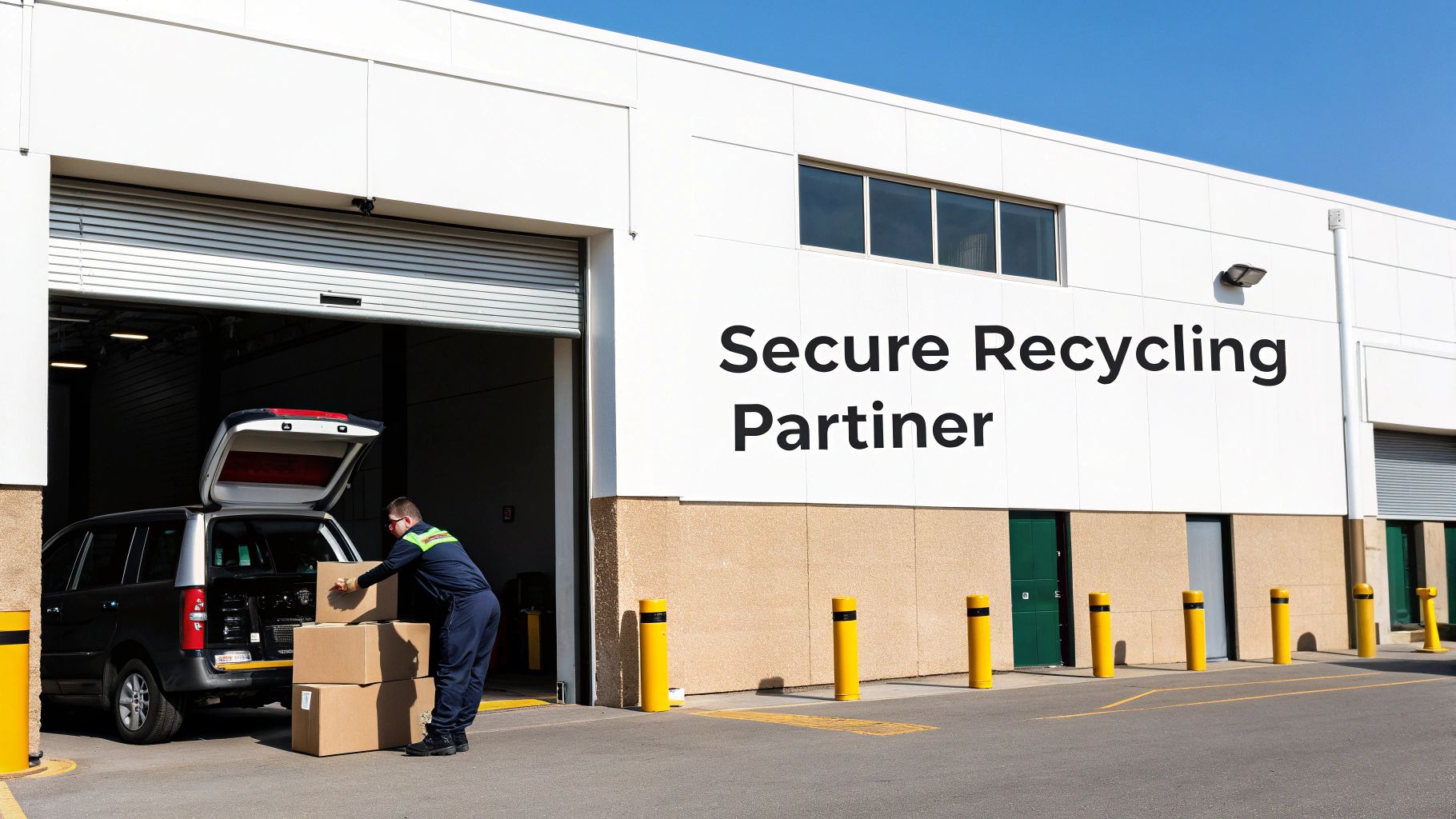
Engaging a certified electronics recycling specialist transforms this liability into a secure, managed process. A professional IT Asset Disposition (ITAD) program is engineered to protect your organization at every stage, ensuring complete legal and environmental compliance.
The Foundation of a Responsible ITAD Strategy
A robust ITAD strategy is not a single service but a combination of key pillars designed to protect your organization’s interests. This integrated approach provides a clear, defensible path for every piece of retired equipment.
Key components include:
- Secure Logistics: Professional, documented transport of your assets from your Georgia facility to a secure processing center.
- Certified Data Destruction: Verifiable erasure or physical destruction of all data on hard drives and storage media, compliant with NIST 800-88 and other industry standards.
- Compliant Recycling: Environmentally sound processing of all materials in accordance with a strict zero-landfill policy.
- Asset Value Recovery: Identifying and remarketing functional equipment to generate a financial return, turning a disposal cost into a revenue opportunity.
This guide serves as a strategic roadmap for IT managers, compliance officers, and business leaders. We will detail the essential elements of a successful ITAD program, from compliant logistics and certified data destruction to maximizing the financial return on retired technology. Explore how Beyond Surplus delivers certified e-waste recycling in Georgia to protect businesses like yours.
A certified ITAD partner functions as an extension of your risk management and compliance team. Their primary role is to transfer liability away from your organization by providing an auditable, secure, and transparent process for every retired asset.
By implementing a structured ITAD program, you ensure the protection of sensitive corporate information and minimize your environmental impact. Furthermore, you can unlock residual value from outdated technology. This guide will cover the critical information your business needs.
E-Waste Compliance for Businesses in Georgia
Ensuring regulatory compliance during the disposal of electronic assets is a non-negotiable aspect of modern business operations. Navigating the complex web of regulations governing IT asset disposal in Georgia can be challenging, but a misstep can expose your company to significant fines and reputational harm.
Compliance is not about a single rule but a matrix of federal laws and industry-specific mandates that Georgia businesses must adhere to. Non-compliance is not merely an environmental issue; it represents a substantial data security and legal liability.
Federal Mandates Impacting Georgia Businesses
While Georgia does not have a comprehensive state-level e-waste law for businesses, several stringent federal regulations apply, primarily focusing on data protection. These laws mandate the secure, verifiable destruction of sensitive information stored on retired IT assets.
Key federal regulations include:
- The FTC Disposal Rule: This rule requires businesses to take appropriate measures to dispose of sensitive information derived from consumer reports, making certified data destruction essential for any device that has handled such data.
- HIPAA (Health Insurance Portability and Accountability Act): For healthcare organizations, HIPAA establishes strict guidelines for the disposal of electronic protected health information (ePHI), with severe penalties for non-compliance.
- GLBA (Gramm-Leach-Bliley Act): Financial institutions must comply with GLBA, which mandates the protection of sensitive customer financial information, including during the disposal of IT equipment.
- RCRA (Resource Conservation and Recovery Act): The EPA’s RCRA governs the handling of hazardous materials commonly found in electronics, such as lead and mercury, which applies even in the absence of a specific state e-waste law.
These regulations place the burden of proof on your organization to demonstrate that data was properly destroyed and equipment was handled in a compliant manner.
The Unbreakable Chain of Custody
The chain of custody is a critical compliance concept. It refers to the documented trail that tracks your IT assets from the moment they leave your facility to their final disposition. An unbroken chain of custody is your primary defense against liability claims.
The process begins when your equipment is collected from your Georgia facility and concludes only upon its final processing. A certified ITAD partner provides meticulous tracking and documentation at every stage, creating a complete, auditable record. A structured process for IT asset disposition in Georgia is designed specifically to mitigate these risks.
A Certificate of Data Destruction is a legal document that formally transfers liability for the data from your company to the certified vendor. Without this documentation, your organization retains all the risk.
This documentation serves as proof of due diligence, confirming that you took all necessary steps to protect sensitive information and dispose of assets responsibly. As of 2025, electronics recycling is a critical component of waste management in the U.S., with 25 states and Washington D.C. having passed specific legislation over the past two decades. This regulatory landscape, without a single federal law, has fundamentally changed how businesses manage end-of-life technology. Georgia is a key participant, attracting investment to become a regional leader in electronics recycling. Partnering with a certified vendor is the only way to ensure correct navigation of this complex environment.
Core Components of a Secure ITAD Program
What constitutes a genuinely secure and comprehensive electronics recycling program for a Georgia business? It is far more than a simple pickup service. It is a structured process engineered to protect your organization at every stage—from asset departure to final disposition.
An effective ITAD program is founded on secure logistics, absolute data destruction, and transparent, auditable tracking. This methodical approach is essential to fully mitigate the significant risks associated with retiring IT assets.
Secure Logistics And On-Site Services
The initial step—transporting assets from your Georgia location to a secure facility—is a critical control point. Professional electronics recycling services in Georgia utilize a dedicated fleet and trained personnel to establish a secure chain of custody from the outset.
This professional process includes:
- Scheduled Pickups: Logistics are coordinated around your business operations to minimize disruption.
- Secure Transport: Assets are transported in locked, tracked vehicles to prevent loss or theft in transit.
- On-Site Capabilities: For maximum security, services such as asset scanning, packing, and on-site hard drive shredding can be performed at your facility.
Whether decommissioning a few servers or an entire data center, logistics must be precise and executed with a security-first protocol.
The compliance process can be distilled into several key stages, from secure collection to final certification.
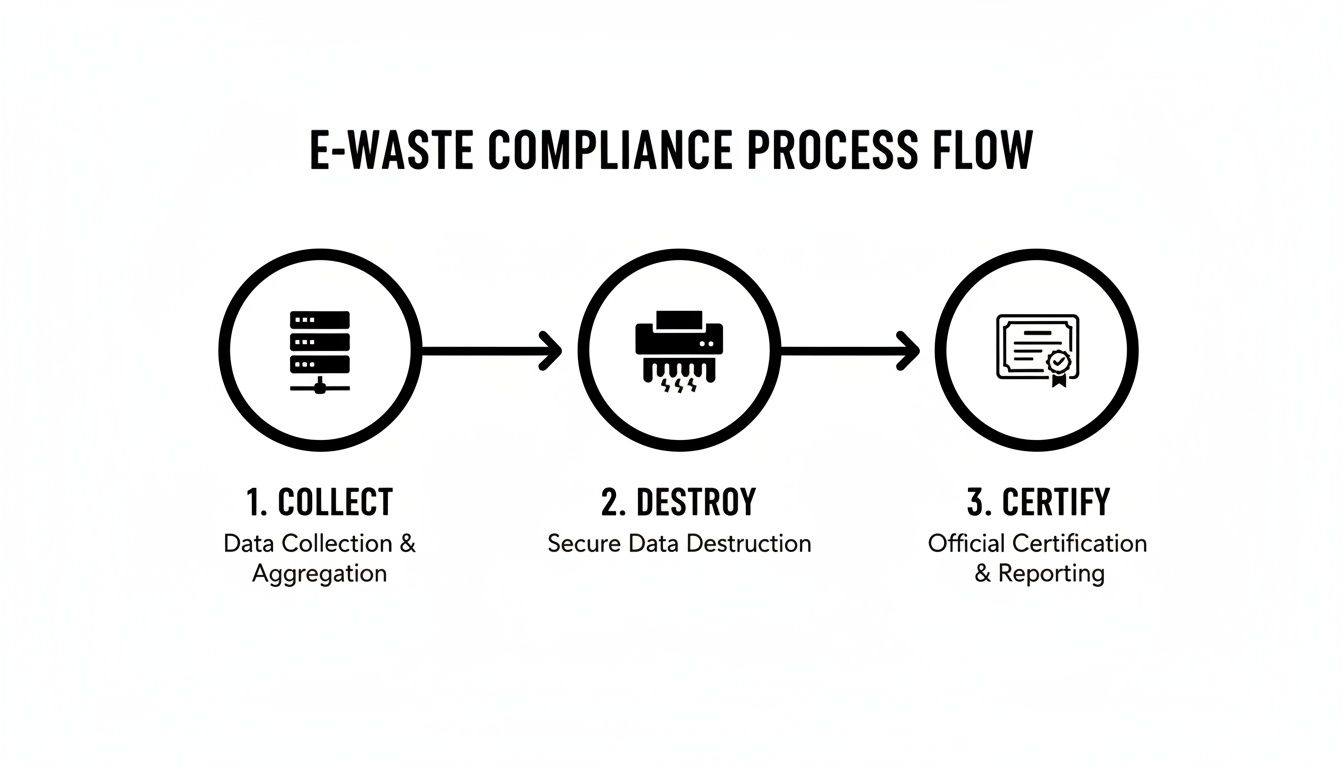
As illustrated, a compliant process is a series of verified steps—collection, destruction, and certification—that collectively create a defensible audit trail.
Certified Data Destruction Methods
The irreversible destruction of sensitive data is the core of any reputable ITAD program. Deleting files is insufficient, as data can often be recovered from discarded hard drives, posing a significant security threat. Certified partners employ industry-standard methods to ensure data is permanently eliminated, adhering to frameworks like NIST 800-88.
Before recycling, a proper ITAD program evaluates if electronics can be repaired or refurbished. Businesses specializing in this often require efficient communication tools, like an electronics repair answering service, to manage operations effectively.
The choice of a data destruction method is a risk management decision. Physical shredding provides the highest security for end-of-life media, while certified wiping preserves asset value for potential resale.
Understanding your options is crucial for making the right choice. Learn more about how Beyond Surplus delivers secure ITAD services in Georgia to protect your corporate data.
Comparing Data Destruction Methods For Georgia Businesses
Selecting the appropriate data destruction method is a critical decision that balances security requirements, compliance mandates, and the potential for asset value recovery. The table below outlines the most common methods to help your organization determine the best approach for its risk profile.
| Destruction Method | Process Description | Best For | Compliance Alignment | Asset Reuse Potential |
|---|---|---|---|---|
| Data Wiping/Sanitization | Specialized software overwrites existing data with random characters across the entire drive, making original data unrecoverable. | Devices planned for resale, donation, or internal redeployment where the hardware needs to remain intact. | Meets NIST 800-88 Clear & Purge standards, suitable for HIPAA, FTC Disposal Rule, etc. | High. The drive and device are fully functional and ready for a second life. |
| Degaussing | A powerful magnetic field is used to instantly and permanently erase the magnetic data stored on hard drives and tapes. | Quickly sanitizing large quantities of magnetic media (not for SSDs) that will be recycled. | Aligns with NIST 800-88 Purge standards for magnetic media. | Low. The drive’s firmware is often destroyed, rendering it unusable. |
| Physical Shredding | The hard drive or other media is fed into an industrial shredder that grinds it into tiny, unrecognizable pieces of metal and plastic. | End-of-life drives, damaged media, or when the absolute highest level of security is required. | Exceeds NIST 800-88 Destroy standards, providing definitive proof of destruction. | None. The asset is completely destroyed and cannot be reused. |
The optimal method depends on your specific objectives. For recovering value from newer equipment, certified data wiping is the preferred choice. For older or highly sensitive devices, physical shredding provides absolute security.
Detailed Asset Tracking And Reporting
Proof of compliance is established through meticulous documentation. A robust audit trail is created through detailed asset tracking and transparent reporting. From pickup to final processing, every asset is inventoried by serial number.
This rigorous documentation provides:
- Serialized Inventory Reports: A complete, itemized list of every processed asset for internal audits and compliance verification.
- Certificates of Data Destruction: Legal proof that all data-bearing devices were sanitized or destroyed according to industry standards.
- Certificates of Recycling: Confirmation that all non-reusable materials were processed in an environmentally responsible manner, adhering to a zero-landfill policy.
This transparency offers complete visibility into the disposition process and ensures every asset is accounted for. This documentation is your definitive proof of due diligence, protecting your business from potential legal and financial consequences.
Turning Retired IT Assets into Revenue
Disposing of end-of-life technology does not have to be solely an expense. For strategic Georgia businesses, it represents an opportunity to recover capital and enhance the bottom line. This process, known as IT Asset Value Recovery (AVR) or an IT buyback program, transforms a cost center into a financial benefit.
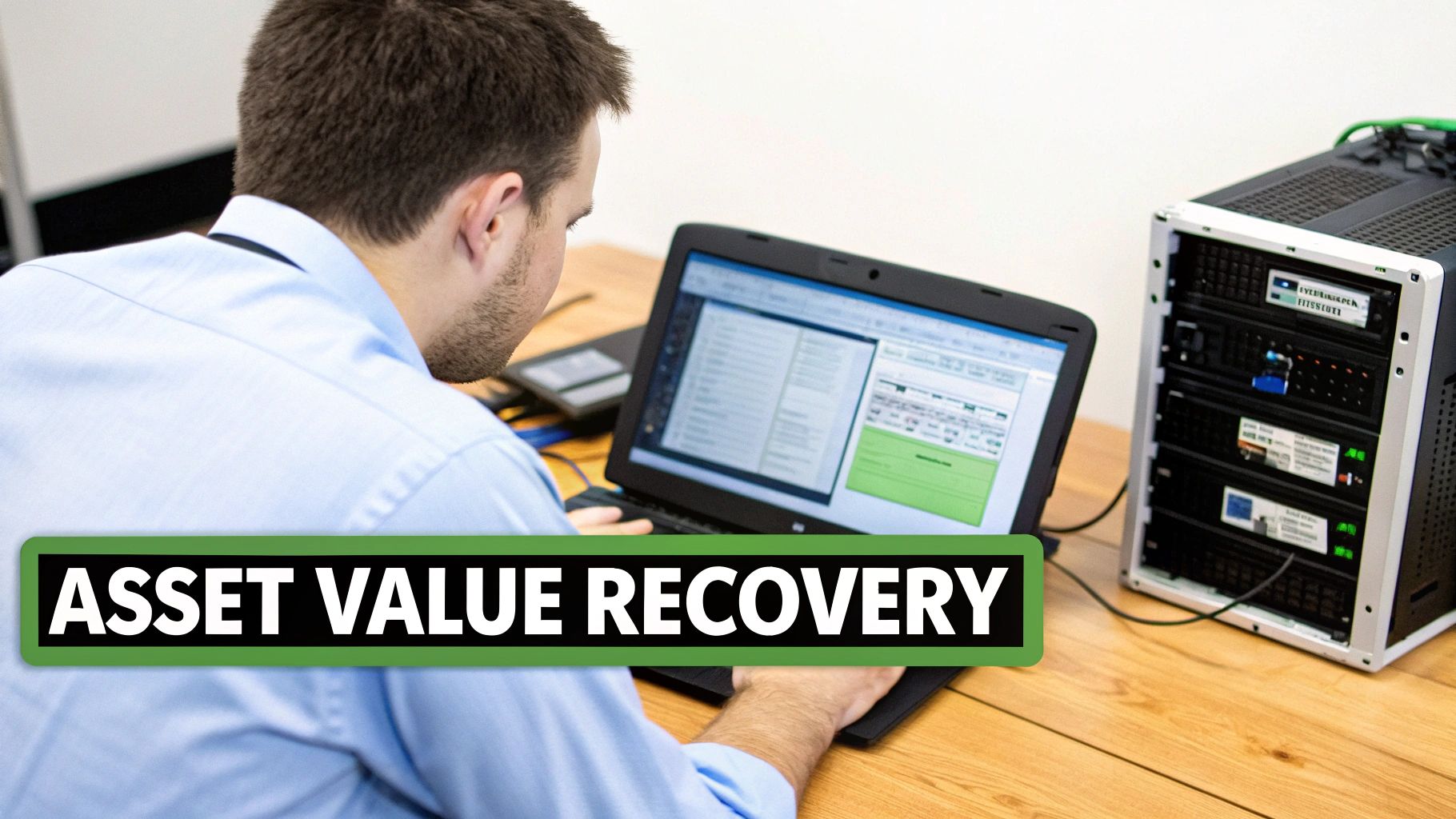
The concept is simple: retired but functional IT equipment retains residual value. A professional ITAD partner can help you realize this value by testing, refurbishing, and reselling these assets through established secondary market channels. This not only offsets recycling costs but can also generate a positive return, helping to fund your next technology refresh.
The Asset Value Recovery Process
The conversion of retired hardware into cash is a structured, secure process designed to maximize value while ensuring uncompromising data security.
The typical workflow is as follows:
- Initial Assessment: An expert evaluates your inventory of used laptops, servers, and networking equipment to identify assets with potential resale value.
- Secure Logistics: Your assets are securely transported from your Georgia facility to a certified processing center, maintaining a strict chain of custody.
- Data Sanitization: Every device undergoes certified data destruction, typically following the NIST 800-88 standard, to permanently erase all sensitive information without damaging the hardware.
- Testing and Refurbishment: Technicians test each component for functionality, performing necessary repairs or upgrades to prepare it for resale.
- Remarketing and Sales: The refurbished equipment is sold through established global networks to achieve the highest possible return.
- Revenue Sharing: You receive a detailed report and payment for your share of the proceeds, converting your e-waste into a revenue stream.
This methodical approach ensures every step is secure, transparent, and fully documented. To understand the journey of your retired devices, learn more about what happens to recycled electronics in our detailed overview.
What Determines an Asset’s Value
Not all retired IT equipment is of equal value. Several key factors directly influence the financial return you can expect from an AVR program.
Asset value recovery is fundamentally about timing and technology cycles. Newer, in-demand equipment like enterprise-grade servers, modern laptops, and high-end networking switches will always command a higher price than older, more common devices.
Key value drivers include:
- Age: Equipment that is less than three to four years old typically retains the most value.
- Brand and Model: Enterprise-level brands such as Dell, HP, Cisco, and Apple are consistently in high demand.
- Condition: Assets in good physical and operational condition will always command a better price.
- Completeness: The inclusion of original components, such as power adapters and accessories, enhances the final value.
- Market Demand: Current trends in the secondary IT market play a significant role in determining final pricing.
By partnering with an expert in electronics recycling services Georgia, you can obtain an accurate assessment of your assets’ worth and begin converting retired IT hardware into a valuable financial resource.
Custom E-Waste Solutions for Georgia’s Core Industries
From Atlanta’s thriving technology sector to Savannah’s expansive logistics hubs, Georgia’s economy comprises diverse industries, each with unique IT asset disposal (ITAD) and electronics recycling requirements. A one-size-fits-all approach is inadequate.
A financial firm’s compliance challenges differ significantly from those of a university. The operational demands of a data center are distinct from a local healthcare clinic. Therefore, you need a partner with industry-specific expertise. A specialist in electronics recycling services Georgia understands how to develop custom solutions that address the specific regulations, operational constraints, and security concerns of the state’s key sectors. This tailored focus ensures that your organization’s unique risks are managed effectively.
Healthcare and HIPAA Compliance
For hospitals, clinics, and medical research facilities throughout Georgia, the primary concern is protecting electronic protected health information (ePHI). The Health Insurance Portability and Accountability Act (HIPAA) imposes strict regulations for the disposal of any device that has stored or transmitted patient data.
Non-compliance can result in severe financial penalties and irreparable reputational damage. A robust ITAD program for a healthcare organization must include:
- Verified Data Destruction: On-site or off-site shredding of hard drives from medical equipment, servers, and computers, providing physical proof of data elimination.
- Asset Tracking: Meticulous serial number tracking of every medical device to maintain a perfect, unbroken chain of custody.
- Business Associate Agreements (BAAs): A formal, signed contract that legally binds your ITAD vendor to protect your ePHI according to strict HIPAA standards.
Financial and Legal Sector Solutions
Financial institutions and law firms in Georgia manage vast amounts of sensitive information, including personally identifiable information (PII) and confidential client data. They are subject to stringent regulations like the Gramm-Leach-Bliley Act (GLBA) and the FTC Disposal Rule, which mandate the secure destruction of this information.
For these industries, the chain of custody is not just a best practice—it is a critical component of their legal and fiduciary duty. Every step, from asset departure to final certification, must be documented and auditable.
An effective program for these sectors prioritizes verifiable security. This includes offering services like on-site hard drive shredding, allowing clients to witness the destruction of their data. It also means providing detailed Certificates of Data Destruction for their compliance records.
Data Center Decommissioning
Georgia is a major hub for data centers, and decommissioning one presents a massive logistical and security challenge. This is far more complex than a standard office cleanout, involving the management of thousands of servers, networking switches, and storage arrays containing proprietary or customer data.
A specialized ITAD solution for data centers should include:
- Project Management: A dedicated team to plan and execute the entire project, from on-site server de-racking and asset inventory creation to secure transport coordination.
- High-Volume Data Destruction: The capacity to shred or wipe thousands of drives efficiently and securely.
- Value Recovery: Expertise in remarketing enterprise-grade hardware to maximize the financial return on decommissioned assets.
Education and Government Institutions
School districts, universities, and government agencies across Georgia frequently manage large-scale technology refreshes, resulting in thousands of laptops, desktops, and tablets requiring disposal. Their primary challenges are logistics and fiscal responsibility. A custom solution should streamline the process, offering scheduled pickups that align with academic calendars or fiscal year-end deadlines.
These institutions can also benefit significantly from Asset Value Recovery programs. These programs convert old equipment into revenue that can be reinvested into new technology, making the ITAD process a financially sustainable cycle. This is not only fiscally responsible but also supports the state’s circular economy.
The positive impact of recycling in Georgia is substantial, as the state possesses one of the nation’s strongest infrastructures for using recovered materials. It ranks second largest, with over 120 manufacturers actively using recycled content in their products. This robust ecosystem, including giants like Atlanta-based Novelis, the world’s largest aluminum manufacturer, makes responsible electronics recycling a key economic driver for Georgia.
How to Choose the Right E-Waste Partner in Georgia
Selecting the right IT Asset Disposition (ITAD) partner is one of the most critical decisions for an IT or facility manager in Georgia. This choice extends beyond logistics; it directly impacts your company’s data security, environmental compliance, and legal standing.
Opting for the lowest-cost vendor can expose your business to significant risks, including substantial data breach fines and environmental penalties. A thorough vetting process is therefore essential. You need a partner who not only meets industry standards but sets them.
The ideal partner acts as an extension of your compliance team, transferring risk away from your organization through a secure, transparent, and fully auditable process.
Your Vendor Vetting Checklist
When evaluating potential partners for electronics recycling services in Georgia, demand proof and ask probing questions to assess their capabilities and integrity. A professional vendor will welcome this scrutiny.
Use this checklist to guide your evaluation:
- Verify Certifications: Request current, industry-recognized certifications. The gold standard is R2v3 (Responsible Recycling). This certification is not merely a document; it represents a rigorous framework governing environmental impact, employee safety, and data security protocols.
- Confirm Insurance Coverage: Ensure the vendor carries sufficient liability and data breach insurance to protect your business in case of an incident. Request a copy of their insurance certificate.
- Demand Downstream Transparency: Inquire about the final destination of your equipment. A reputable partner should be able to map the entire downstream journey of your assets and provide evidence of a strict zero-landfill policy. Vague responses about downstream partners are a major red flag.
The Importance of Documentation
In the realm of compliance, documentation is your defense. It is your ultimate protection in an audit or legal challenge. Before engaging a vendor, request sample documents. This simple step reveals much about their professionalism and attention to detail.
A vendor’s documentation is a direct reflection of their operational discipline. If their sample reports are unprofessional, incomplete, or confusing, it is likely their entire process is as well.
Request the following samples:
- Sample Certificate of Data Destruction: This critical legal document should clearly state the destruction method used (e.g., NIST 800-88 Purge or physical shredding) and list the individual serial numbers of every destroyed storage device.
- Sample Serialized Inventory Report: This report establishes an unbroken chain of custody from your facility to final disposition. It should provide a detailed, itemized list of every asset processed.
By following this framework, you can move beyond sales pitches and confidently select a partner who will genuinely protect your organization. To see these principles in practice, learn more about computer recycling in Georgia and how a structured approach eliminates risk. This decision provides peace of mind, knowing your compliance and data security are managed by experts.
Common Questions About Business E-Waste Recycling in Georgia
Even with a clear strategy, Georgia businesses often have specific questions regarding the practical aspects of IT asset disposal. Clarifying these details is essential for moving forward with confidence and ensuring your company remains compliant and secure.
Based on daily inquiries from IT managers, facility coordinators, and business owners across the state, here are answers to the most frequently asked questions.
What Types of Business Equipment Do You Recycle in Georgia?
We manage the full spectrum of commercial IT and electronic hardware for businesses throughout Georgia. Our services are specifically designed to handle corporate and enterprise-grade equipment, which presents unique disposal challenges.
Our capabilities include:
- Servers and enterprise storage arrays (SANs, NAS)
- Networking equipment such as switches, routers, and firewalls
- Laptops, desktops, and high-performance workstations
- Telecommunications systems and VoIP equipment
- Specialized medical and laboratory equipment
Please note that our services are exclusively for commercial assets; we do not process electronics from residential households.
Is On-Site Hard Drive Shredding Available in Georgia?
Yes. We provide mobile, on-site hard drive shredding services across the entire state of Georgia. Our industrial-grade shredding truck comes directly to your office, warehouse, or data center, offering the highest level of security and transparency.
With on-site shredding, your team can witness the physical destruction of every hard drive. You receive a Certificate of Data Destruction on-site, providing immediate, verifiable proof for your compliance records.
This service is ideal for organizations in highly regulated sectors such as healthcare, finance, and government, where witnessing the destruction process is often a mandatory security protocol.
What Is the Cost of Electronics Recycling for a Georgia Business?
There is no standard price for professional electronics recycling services in Georgia. The final cost is determined by several factors, including the volume and type of equipment, your location within the state, and the specific data destruction services required.
However, these costs can often be significantly reduced or even eliminated through our IT Asset Value Recovery (AVR) program. If your retired equipment has residual resale value, we can remarket it and apply the proceeds to offset or exceed your service fees. Every client receives a transparent, itemized quote based on their specific inventory and service needs, ensuring no surprises.
Contact Beyond Surplus for a detailed quote or to schedule a secure pickup for your Georgia business. Let us demonstrate how our certified electronics recycling and secure ITAD services can protect your data while enhancing your bottom line. Find out more at https://www.beyondsurplus.com.


