
Retired telecom gear looks low-risk because it's familiar. Old desk phones, routers, switches, access points, PBX components, and branch-office appliances don't look as sensitive as servers. That's a mistake. They still hold data, still create environmental liability, and still sit inside a disposal chain that can either protect your organization or expose it.
The disposal question isn't just whether equipment gets recycled. It's whether your team can prove three things under scrutiny: who had custody of the assets, how data was destroyed, and where the material went next. That's the standard for environmentally responsible telecom disposal in a business setting.
The High Stakes of Improper Telecom Equipment Disposal
In 2022, the world generated 62 million tonnes of e-waste, but only 22.3% was documented as properly collected and recycled. E-waste generation is now outpacing documented recycling by nearly five to one, and the world is projected to reach 82 million tonnes by 2030 according to the Global E-waste Monitor 2024. For corporate IT leaders, that isn't an abstract sustainability statistic. It means most retired electronics still fall outside verified recovery channels.
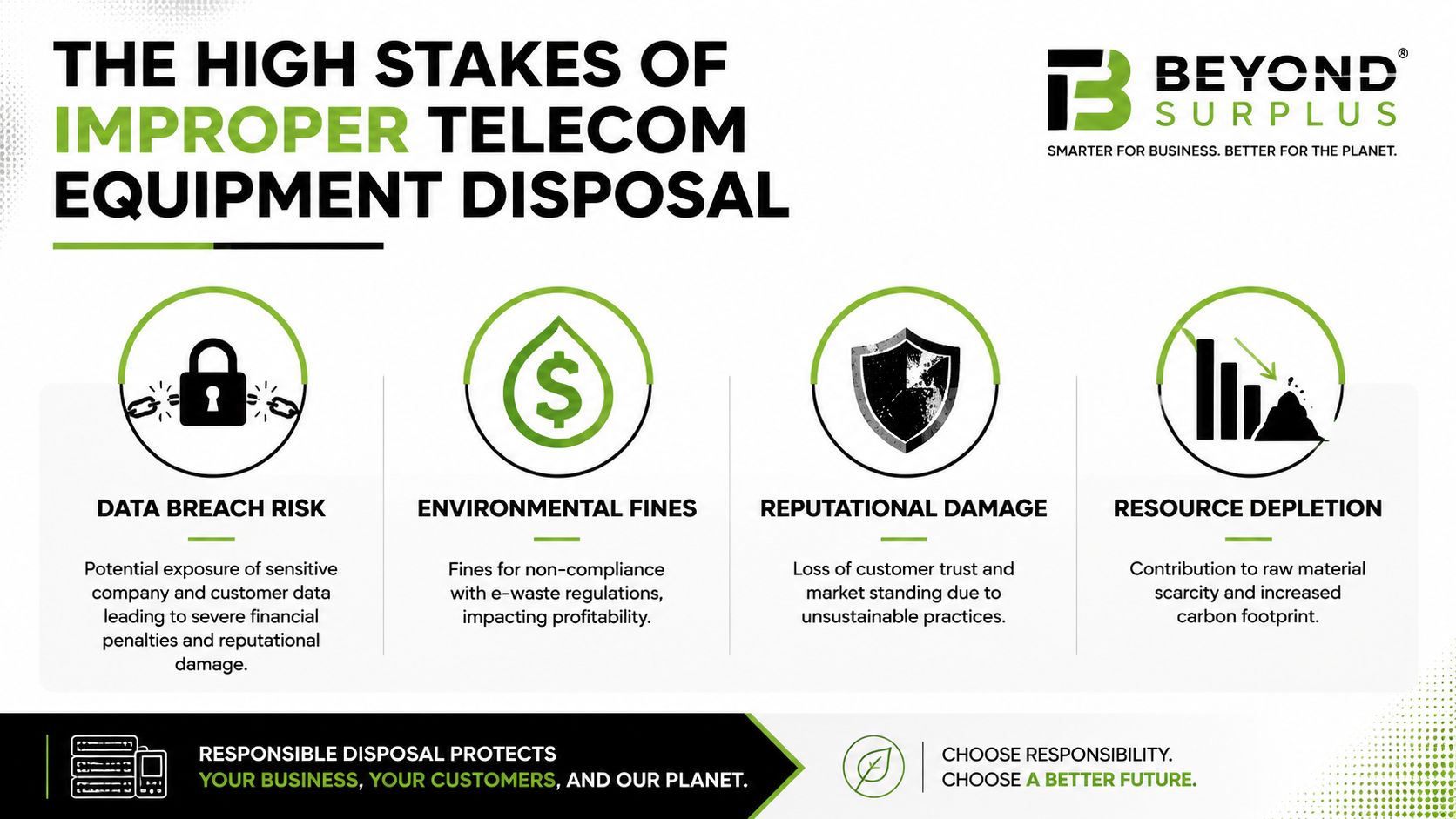
Telecom hardware creates a specific kind of blind spot. Teams often treat it as low-value infrastructure and move it out during office closures, network refreshes, carrier transitions, or data center work. That's exactly when controls weaken. A closet full of retired handsets or edge devices can contain call logs, credentials, configuration files, customer information, and location data. If those assets disappear into an undocumented downstream channel, your company owns the risk.
Why the business risk is immediate
Improper disposal usually creates problems in two places. First, data exposure. Second, environmental non-compliance. Both are hard to defend after the fact because disposal failures are often discovered only when an auditor, customer, or regulator asks for records your team can't produce.
A weak process tends to fail in predictable ways:
- Untracked removals: Equipment leaves a site without serialized inventory or signed transfer records.
- Assumed sanitization: Someone says devices were “wiped” but there's no method, no verification, and no certificate.
- Shallow recycling claims: A vendor says material was handled responsibly but can't show downstream destinations.
- Mixed-value loads: Reusable and scrap equipment get lumped together, destroying residual value and making reporting harder.
Practical rule: If your vendor can't document custody, destruction, and downstream disposition, you haven't transferred liability. You've only outsourced handling.
Reputation matters here too. Customers, boards, procurement teams, and ESG stakeholders don't distinguish between a careless hauler and your internal IT group. They see your company's name attached to the incident. That's why environmentally responsible telecom disposal has to be managed like any other risk-controlled business process, not as a facilities cleanout task.
For a broader view of the issue, Beyond Surplus's page on the environmental impact of electronic waste is a useful reference point for internal stakeholder discussions.
Navigating the Regulatory Maze of E-Waste Compliance
Most IT directors don't need a legal seminar. They need a disposal process that stands up in an audit. The practical starting point is simple: retired telecom equipment can trigger both data-handling obligations and waste-handling obligations at the same time.
What compliance looks like in practice
The Federal Trade Commission Disposal Rule matters when equipment contains consumer information. In practical terms, that means your company needs reasonable measures to protect data during disposal. For telecom assets, that can include voicemail storage, contact records, user credentials, account details, or exported call data.
State e-waste rules add another layer. If you operate across multiple locations, don't assume one disposal playbook fits every site. Transport rules, waste classifications, and downstream processor requirements can vary. That's why multi-state organizations need a standardized internal policy paired with local execution controls.
Healthcare organizations face an even tighter standard. A retired office phone or network appliance in a clinic may still intersect with protected health information. If a device with regulated data leaves your control without verified sanitization, the problem isn't “old hardware.” It's a privacy failure.
Questions your team should ask before any pickup
A compliant disposal program starts with vendor interrogation. Ask direct questions and reject vague answers.
- What data destruction method is used: Software sanitization, physical destruction, or a documented decision tree based on asset type.
- How is custody recorded: Site sign-off, transport manifest, serialized intake, and reconciliation reports.
- What happens downstream: Refurbishment, parts harvesting, certified recycling, or destruction, with reporting for each category.
- Which facilities touch the load: Your risk doesn't end with the first truck.
Compliance failures often start with operational shortcuts, not criminal intent. A rushed office move, an undocumented pickup, or a mislabeled pallet is enough.
For teams that need a baseline on waste-handling requirements, Beyond Surplus's overview of universal waste regulations helps frame why electronics disposal can't be treated like ordinary surplus removal.
A Zero-Trust Approach to Data Security in Disposal
The safest assumption is that every retired telecom asset contains recoverable data until proven otherwise. That includes devices people forget about. Conference phones, branch routers, firewall appliances, cellular failover units, and multifunction telecom gear often retain more information than staff expects.
Wiping versus physical destruction
Certified software wiping preserves value. It's the right choice when equipment is modern enough for remarketing, redeployment, or refurbishment and the device supports reliable sanitization. The advantage is obvious. You protect data without destroying resale potential.
Physical destruction removes the reuse question entirely. It makes sense for failed drives, damaged storage media, high-risk regulated environments, or any situation where your policy requires destruction rather than recovery. The trade-off is also obvious. Once shredded, the asset's remarketing value is gone.
A defensible process usually applies both methods selectively rather than treating every device the same.
| Method | Best fit | Main advantage | Main trade-off |
|---|---|---|---|
| Certified wiping | Reusable devices | Preserves asset value | Requires device compatibility and verification |
| Physical destruction | High-risk or failed media | Maximum finality | Eliminates reuse and buyback potential |
On-site versus off-site destruction
On-site destruction gives your team direct visibility. It's useful when internal policy, customer contracts, or regulated data handling require witness control. It also reduces the window between pickup and destruction.
Off-site destruction can still be appropriate if custody controls are strong and documentation is complete. The issue isn't geography. It's whether the chain remains intact from your loading dock to the final processing event.
Use a zero-trust standard when reviewing options:
- Verify the trigger point: Decide which assets qualify for wiping and which require shredding before pickup day.
- Control the handoff: Seal containers, count assets, and reconcile serials.
- Demand proof: Sanitization logs and destruction certificates should match the inventory you released.
If your internal team can't explain why one device was wiped and another was shredded, your policy is too loose.
For organizations aligning disposal with recognized sanitization guidance, the NIST SP 800-88 resource is the right operational reference.
The Crucial Role of Chain of Custody and Documentation
Documentation isn't administrative cleanup. It's the evidence package that protects your company when someone asks what happened to retired telecom assets months later.
What a defensible record actually includes
At minimum, your file should show what left the site, who released it, who received it, how it was processed, and what certification was issued at the end. A simple pickup receipt doesn't do that. It only proves that something was removed.
The most important records usually include:
- Asset inventory: Model, serial number, quantity, and site origin.
- Transport records: Signed handoff paperwork and shipment details.
- Processing reports: The disposition path for each asset or batch.
- Final certificates: Data destruction and recycling documentation tied back to the original load.
If your logistics team needs a refresher on transport paperwork, this bill of lading guide gives useful context for understanding how shipping records support custody and accountability.
Why certificates matter
A Certificate of Data Destruction is your record that data-bearing media was processed using the agreed method. A Certificate of Recycling documents that material entered the stated downstream recovery path. Together, they create the audit trail that proves your organization followed a controlled process.
They also help transfer liability. Not magically, and not by themselves. But when certificates are supported by inventory records, intake reconciliation, and processor reporting, your company is in a far stronger position than a business relying on verbal assurances.
The vendor's promise matters far less than the paper trail behind it.
If you want to benchmark what these records should look like, start with the basics of a certificate of destruction.
From De-Installation to Disposition The Logistics of Telecom ITAD
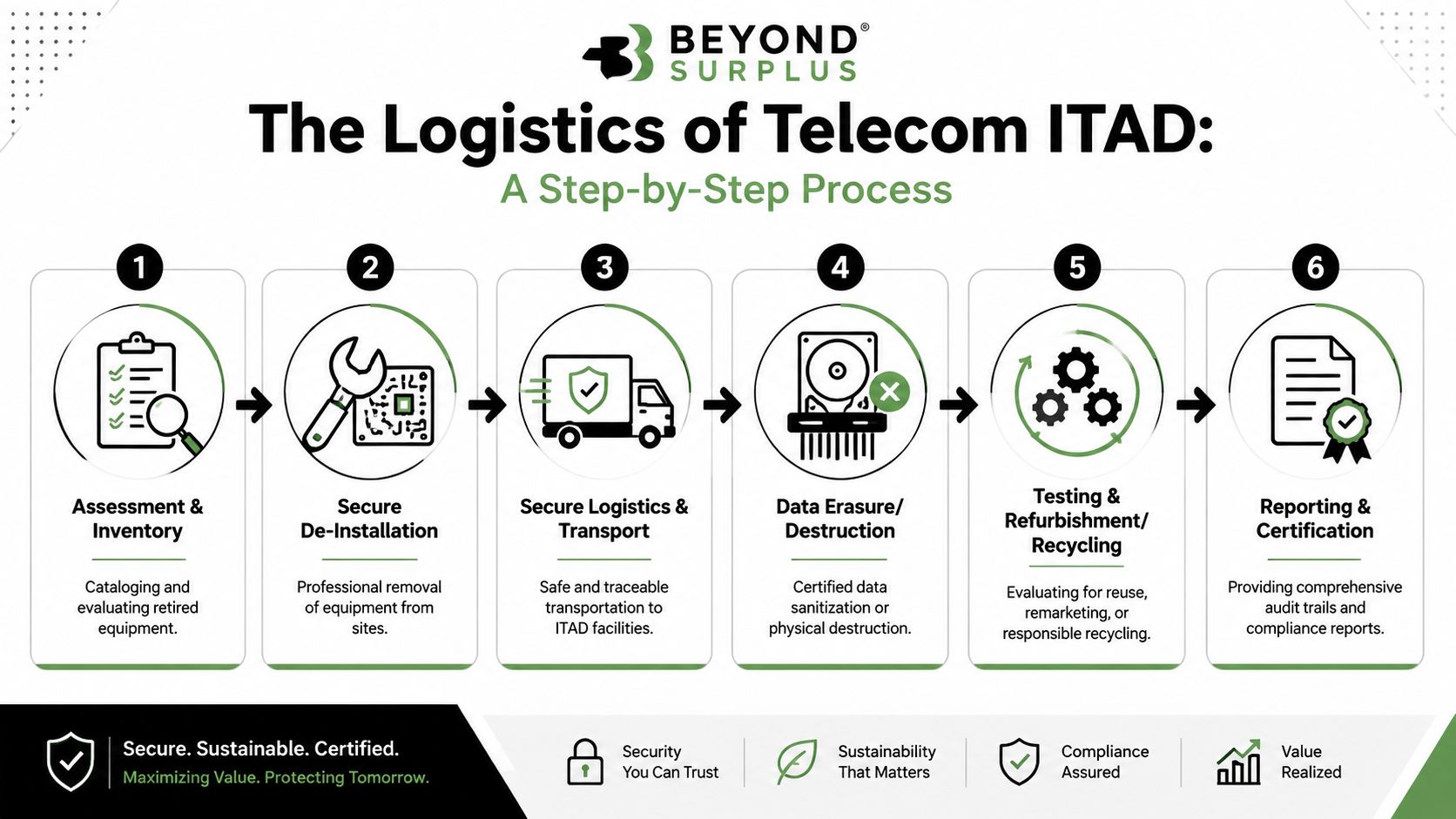
Telecom disposal goes wrong most often in the middle. Not at executive approval. Not at final recycling. The problems usually happen during de-installation, packing, movement, and intake, when assets are physically in motion and accountability gets blurry.
What a professional workflow looks like
A sound telecom ITAD process starts before the first rack is touched. Scope has to be defined. Which assets are coming out, which are staying live, which carry storage, and which have resale potential.
Then the sequence becomes operational:
Assessment and inventory
Teams catalog equipment, capture serials where practical, and separate data-bearing assets from non-storage telecom gear.De-installation
Technicians remove equipment without damaging adjacent systems, cabling, or site infrastructure.Secure transport
Assets move in controlled loads with transfer documentation and intake reconciliation.Data handling
Media is wiped or destroyed under the predefined policy.Disposition sorting
Reuse candidates are tested. Commodity scrap goes to recycling. Non-compliant or failed items are destroyed.Reporting
The vendor issues final records tied to the original asset list.
Why refurbish-first is the right default
Material recycling has a place, but it shouldn't be the first answer for every asset. Deutsche Telekom reported that in 2024 it took back more than 4.6 million customer-premises devices, with 44% refurbished for reuse, according to its circular economy reporting. That's the right operating logic for business telecom disposal too. Reuse first when security and condition allow. Recycle when reuse no longer makes sense.
That downstream secondary market is also real and visible. If you want a simple consumer-facing example of how refurbished devices are resold after testing and grading, browse marketplaces for cheap iPhones UK. Enterprise telecom and IT remarketing is more controlled, but the core model is similar. Extend useful life before breaking equipment down for raw materials.
One provider operating in this space is telecom decommissioning services, which covers removal, logistics coordination, data destruction, and final reporting for business equipment.
Choosing the Right ITAD Partner A Vendor Selection Checklist
Vendor selection decides whether disposal becomes a documented control or a recurring liability. The wrong partner creates black boxes. The right one gives your team evidence, options, and a clean audit trail.
The shortlist criteria that actually matter
Start with controls, not marketing claims.
Certifications and compliance posture
Look for recognized certifications relevant to recycling and data destruction. Then verify them. Don't stop at logos on a website.Security procedures
Ask for the exact sanitization and destruction workflow, not a general statement about “secure handling.”Downstream transparency
A serious ITAD vendor should be able to explain where equipment goes after intake and what determines reuse versus recycling.Insurance and risk allocation
Review contractual responsibility, not just service scope.Reporting depth
You need serialized or batch-level reconciliation, destruction records, and recycling documentation that supports audits.
Don't ignore value recovery
The global e-waste stream in 2022 contained an estimated US$91 billion in raw materials, yet only a fraction of that value was captured through environmentally sound recycling, as noted by the Global E-waste Monitor 2024 summary. For businesses, that's a reminder that disposal shouldn't automatically be treated as pure cost.
A capable partner should separate assets into at least three buckets:
- Remarketable equipment: Devices suitable for reuse or buyback.
- Harvestable equipment: Items with component value but limited full-unit resale potential.
- End-of-life material: Equipment that should go directly to certified recycling or destruction.
Good ITAD vendors don't promise maximum recovery on every load. They show you which assets still have recoverable value and document why the rest doesn't.
If a vendor avoids that conversation, they're probably defaulting to bulk processing. That's easier for them and worse for you.
Putting It All Together Real-World Disposal Scenarios
A healthcare group retiring office phones, wireless gear, and edge networking equipment has a narrow margin for error. The practical solution is controlled pickup, device segregation, documented data destruction for anything with storage, and certificates that support privacy compliance. What matters isn't a generic recycling statement. It's the ability to show auditors exactly how each asset class was handled.
A small technology company decommissioning a server room faces a different mix of priorities. It needs de-installation support, inventory control, a decision on which systems can be wiped and remarketed, and clear reporting on what gets recycled versus destroyed. The strongest outcome usually comes from separating newer equipment with resale potential from obsolete telecom gear that belongs in material recovery channels.
Both scenarios turn on the same final issue: downstream verification. The World Broadband Association notes that a large share of e-waste is still illegally traded or dumped, which is why responsible telecom disposal can't stop at “picked up” or “recycled” claims in a vendor email. Your ITAD partner should provide transparent reporting on downstream pathways so you can verify assets didn't drift into non-compliant export or dump channels.
If your organization needs a documented process for environmentally responsible telecom disposal, contact Beyond Surplus for certified electronics recycling and secure IT asset disposition support.