

A telecom hardware refresh usually starts as a routine infrastructure project. Then the retired gear starts piling up. Routers in one closet, phones in another, switches still mounted in racks, batteries mixed into pallets, and nobody wants to sign off on where the data risk ends and the disposal risk begins.
That's where zero landfill telecom equipment disposal becomes more than a sustainability line item. For an IT manager, it's a control system for decommissioning. Done right, it protects data, documents chain of custody, recovers value from reusable assets, and gives procurement, compliance, and operations a defensible record of what happened to every class of equipment.
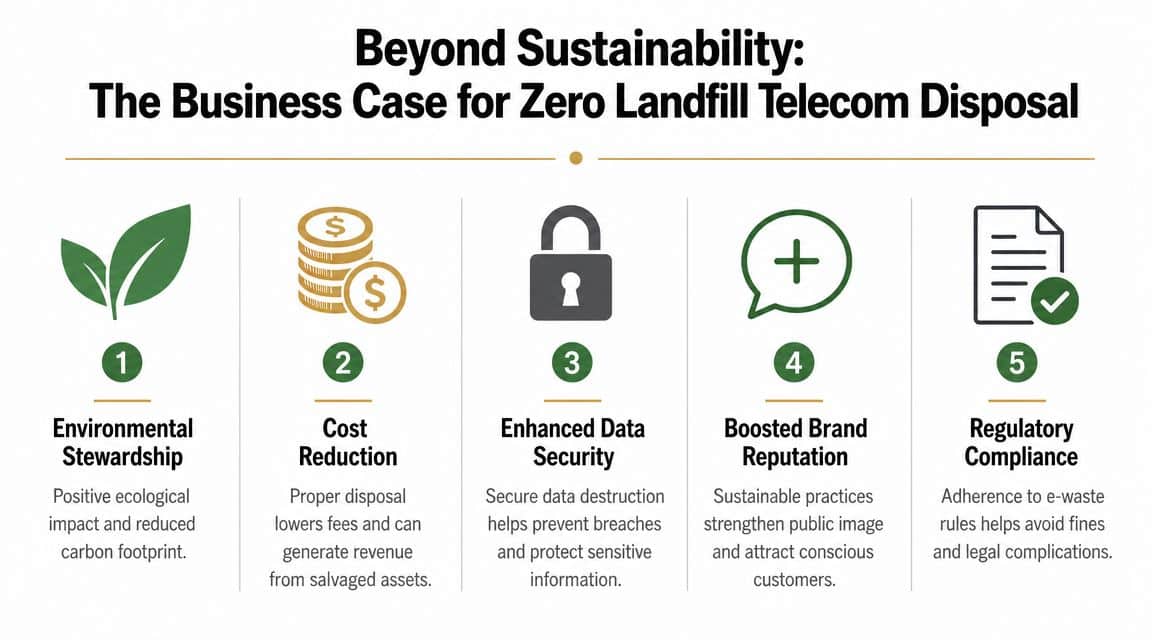
Beyond Sustainability The Business Case for Zero Landfill
Most internal discussions about telecom disposal start too late. The project is already underway, equipment has already been disconnected, and the team is trying to solve security, logistics, reporting, and sustainability at once. That's when expensive mistakes happen.
The bigger issue is scale. The world generated 62 million tonnes of e-waste in 2022, equal to 7.8 kg per person, and the stream is rising five times faster than documented recycling. Only 22.3% was formally collected and recycled, and the UN projects 82 million tonnes by 2030 if current trends continue, according to the Global E-waste Monitor 2024. That matters to telecom teams because phones, routers, modems, switches, and network gear all sit inside that same waste stream.
What executives actually care about
A strong zero-landfill program solves business problems that show up in budgets, audits, and contracts:
- Risk control by removing undocumented disposal practices
- Data protection through tracked handling of storage-bearing equipment
- Compliance support with auditable records instead of verbal assurances
- Value recovery by separating reusable gear before it becomes bulk scrap
- Operational discipline across deinstall, staging, transport, and downstream processing
A telecom disposal program that only says “nothing went to landfill” is incomplete. The better standard is documented handling from pickup through final disposition. That's why many organizations pair sustainability goals with a more operational framework such as sustainable telecom equipment recycling.
Practical rule: If your vendor can't show where the asset went before recycling, the zero-landfill claim doesn't reduce your liability.
What works and what fails
What works is planning disposal as part of asset retirement, not as an afterthought. Teams that identify reusable equipment early usually preserve more value and avoid mixing marketable gear with damaged scrap.
What fails is bulk loading everything into one stream. Once telecom gear is mixed with general e-waste, you lose condition data, resale options, and often the clean material separation needed for strong diversion results. Zero landfill isn't a slogan. It's an operating model.
The Foundation Building Your Asset Inventory and Audit Playbook
A zero-landfill claim becomes credible only when the asset record is credible. If you don't know exactly what left your environment, you can't prove reuse, recycling, destruction, or chain of custody.
Start with a line-item inventory before anything is packed. That means more than an equipment count. Capture make, model, serial number, asset tag, physical location, condition, power status, and whether the unit contains data-bearing media or attached batteries. For telecom environments, also note rack position, carrier-specific hardware, removable modules, optics, handsets, cabling bundles, and accessories that affect resale or recycling path.

What the audit has to capture
An effective audit playbook usually includes these fields:
- Identity data such as manufacturer, model family, serial number, and internal asset ID
- Condition notes including cracked housings, missing faceplates, failed ports, or visible corrosion
- Configuration details like installed cards, transceivers, memory, drives, or power supplies
- Location history that shows where the device was removed, staged, and transferred
- Security flags that identify storage media, SIM-enabled units, or embedded management modules
This level of detail is what supports IT asset lifecycle management instead of simple disposal.
Why inventory drives value recovery
Telefónica gives the clearest public example of why this matters. It reports reusing more than 4 million devices annually, representing 75% of collected electronic equipment, with the remaining 25% recycled. It also says it had reused more than 780,000 units of network equipment by 2025 and reused or recycled 100% of collected equipment, as outlined in its circular economy reporting.
That result doesn't come from bulk recycling. It comes from graded inventory. Once a technician can distinguish a reusable managed switch from a parts-only unit, the financial path changes.
A pallet is not an inventory. It's just a liability waiting for someone else to classify it on your terms, not yours.
A practical audit sequence
Use a repeatable sequence so different sites produce the same output:
- Tag the asset at source before it leaves the closet, rack, MDF, IDF, or office.
- Photograph exceptions when physical condition affects value or recycling path.
- Separate data-bearing units immediately from simple peripherals and passive gear.
- Record weights by outbound category once equipment is staged for final disposition.
- Match every transfer to a signed custody event.
The audit doesn't need to be complicated. It needs to be consistent. Most zero-landfill telecom programs break down because the company tries to prove outcomes after the hardware is already mixed, moved, and depersonalized.
Sorting for Value Segregating Assets for Reuse Harvesting and Recycling
Once the audit is done, the next decision is physical segregation. At this stage, a lot of companies lose both money and landfill diversion performance. They recycle too early.
The practical target for zero waste to landfill is 99% diversion, with the remaining less than 1% treated as true residuals, and mixed or contaminated streams are a major reason recovery rates fall, according to the Global E-waste Monitor 2020. In telecom disposal, contamination usually means mixing batteries with network gear, throwing reusable handsets into gaylords of broken plastics, or bundling copper-bearing cabling with low-value debris.

Build four outbound streams
A workable telecom segregation model uses four lanes.
Reuse-ready equipment goes first. This includes current-generation phones, clean switches, usable routers, and network components with market demand. If it can be redeployed internally or remarketed without heroic labor, don't shred it.
Parts harvest units come next. These are systems that won't sell well as complete units but still contain usable modules, power supplies, fans, rails, optics, or interface cards. Harvesting preserves value and reduces unnecessary recycling.
Commodity recycling material includes printed circuit boards, metals, sorted plastics, and cabling. This stream works best when it stays clean and separated by material type.
Residuals should be the smallest category in the building. If residuals are growing, the problem is usually upstream. Poor triage, mixed loading, or rushed deinstalls.
Use condition, not optimism
Teams often overestimate what can be reused. A better method is to grade by labor burden and demand:
- Choose reuse when the unit is functional, complete, and economically testable.
- Choose harvesting when the shell is poor but internal components still carry value.
- Choose recycling when damage, age, or missing parts make refurbishment unrealistic.
- Choose destruction when the item is sensitive, unsafe, or nonrecoverable.
A useful mental model comes from small-device buyback markets. If you've ever reviewed trade-in logic or consumer examples like get cash for your laptop, the same core principle applies in enterprise telecom. Condition data determines disposition. Not good intentions.
Mixed loads kill recovery. The more categories you collapse together, the more value disappears into low-grade scrap.
Where organizations usually get it wrong
The most common mistake is treating all retired telecom hardware as one recycling project. It isn't. A branch phone refresh, a core network upgrade, and a carrier equipment decommission all create different recovery paths.
Another common issue is logistics timing. If gear sits unprotected in hallways or loading areas, cosmetic damage and missing accessories push assets out of reuse and into lower-value channels. For large projects, it often makes sense to align deinstall teams with large-scale telecom equipment liquidation planning so equipment is sorted correctly before transport.
The Non-Negotiable Step Ensuring Secure and Compliant Data Destruction
Security is where weak zero-landfill programs fall apart. A sustainability claim won't help if storage media leaves your control without proof of sanitization or destruction.
EPA guidance emphasizes that used computer and telecommunication equipment is a regulated waste stream that must be managed responsibly, and that's why “zero landfill” alone is not enough. The stronger standard is verified reuse + certified recycling + documented destruction, especially for regulated organizations handling sensitive information, as noted by the EPA's e-waste guidance.
Match the method to the asset
Not every device needs the same destruction method. The mistake is forcing one process onto every asset.
Software wiping fits devices that will be reused and that support verifiable sanitization workflows. In enterprise programs, many teams align this with NIST SP 800-88 practices so the sanitization decision matches the media type and reuse objective.
Degaussing has a narrower role. It can make sense for certain magnetic media, but it also affects reuse potential. If the goal is remarketing the complete asset, degaussing may destroy more value than necessary.
Physical shredding is the cleanest answer for failed drives, highly sensitive media, and any situation where policy requires irreversible destruction. It's also the easiest method to defend in an audit when chain of custody has to be simple and explicit.
The certificate matters more than the promise
A vendor saying “we wipe everything” isn't evidence. The document trail is what transfers liability.
Ask for records that connect the specific asset or media batch to the sanitization outcome. For storage removed before recycling, you want documentation that shows removal, handling, destruction method, and final certificate issuance. If the hardware itself is reused but the media is destroyed, the paperwork should make that distinction obvious.
If the data record can't be tied back to the asset record, you don't have closure. You have a gap.
What compliance-minded teams insist on
Security-sensitive organizations usually build disposal around three controls:
- Controlled custody from pickup through processing, with named handoff points
- Method discipline so wiping, shredding, and recycling are not improvised on the floor
- Final evidence in the form of certificates, serialized logs, and exception reporting
Often, “green disposal” language gets too soft. Telecom equipment can carry customer data, credentials, call records, configuration files, and management access details. The disposal program has to be written like a risk policy, not a marketing statement.
Choosing Your Partner Vetting and Contracting an ITAD Vendor
Plenty of vendors can haul electronics. Far fewer can support an auditable zero-landfill telecom program with clean documentation, secure handling, and defensible downstream controls.
Under UL's Zero Waste to Landfill framework, a facility must prove at least 90% diversion by methods other than waste-to-energy, with Silver at 90% to 94%, Gold at 95% to 99%, and Platinum at 100%, backed by weight records and downstream validation, according to UL's guidance on achieving and validating zero waste to landfill. That requirement changes how you should vet an ITAD vendor. You're not buying pickup alone. You're buying proof.

Questions that expose weak vendors
Ask direct operational questions. Marketing language won't tell you much.
- How do you document chain of custody? Ask to see sample intake records, transfer logs, and final reporting.
- How do you separate reuse from scrap? If the answer is vague, value recovery will be weak.
- Which downstream partners touch each material stream? You need more than “we handle that responsibly.”
- How are weights captured? Zero-landfill claims depend on diversion by mass, not by truckload count.
- What happens to exceptions? Missing serials, damaged media, mixed batteries, and unlisted equipment should trigger a defined process.
A formal vendor due diligence checklist helps procurement teams keep these reviews consistent across bids.
What should be in the contract
Your agreement should specify service scope, custody transfer points, reporting requirements, data destruction documentation, insurance expectations, and treatment of residuals. If landfill avoidance is part of your ESG reporting, require written definitions. Different vendors use “zero landfill” differently.
This is also the right place to define whether assets are purchased outright, processed under revenue share, or handled as a recycling service with no resale return. None of those models is automatically better. The right one depends on asset mix, timing, and the level of testing needed.
The best vendor conversations are boring. Clear process, clear documents, clear exceptions. That's what survives legal review.
One operational note
Some providers, including Beyond Surplus, state that they support telecom equipment pickup, de-installation, data destruction, and certificate-based reporting for business clients. What matters in vendor selection isn't the claim itself. It's whether the provider can show the exact custody, destruction, and downstream records your organization requires.
Measuring Success Reporting Value Recovery and Continuous Improvement
A disposal project isn't finished when the truck leaves. It's finished when the reporting tells a coherent story. That means security closure, environmental documentation, and a financial summary that procurement can reconcile.
Read the report like an operator
A useful final report answers practical questions:
| Reporting area | What to verify |
|---|---|
| Asset reconciliation | Did the received inventory match the released inventory, and were exceptions documented? |
| Data destruction | Did every storage-bearing asset or media batch receive a corresponding destruction or sanitization record? |
| Diversion outcome | Were reuse, recycling, harvesting, and residuals separated clearly enough to support your internal claims? |
| Financial result | Was resale value, service cost, or revenue share explained in a way finance can audit? |
If the report only gives a general recycling statement, ask for more detail next cycle. Mature programs improve because they measure by asset class, site, and handling path.
Use results to fix the next project
The best lessons usually come from exceptions. Maybe branch offices packed phones well but mixed batteries incorrectly. Maybe data center gear produced strong resale returns while older access-layer equipment moved straight to scrap. Maybe one location had incomplete serial capture.
That's the point of measurement. It helps your team rewrite internal retirement procedures, tighten packaging standards, and improve forecasting for future refreshes.
Strong zero-landfill telecom equipment disposal programs improve one batch at a time. The report should change behavior, not just satisfy compliance.
Frequently Asked Questions About Zero Landfill Telecom Disposal
| Question | Answer |
|---|---|
| Is zero landfill the same as compliant telecom disposal? | No. A landfill-diversion claim addresses where material went. Compliance also depends on data destruction, chain of custody, downstream handling, and proper records. |
| Should older telecom gear be reused or recycled? | Reuse comes first when the equipment is functional, complete, and economical to test or redeploy. Recycling is the better choice when age, damage, missing parts, or security constraints eliminate realistic reuse value. |
| What final documents should an IT manager expect? | Expect an asset reconciliation report, data destruction certificate or sanitization record, recycling or disposition summary, and exception notes for anything missing, damaged, or handled outside the standard path. |
Contact Beyond Surplus for certified electronics recycling and secure IT asset disposal with documented chain of custody, data destruction, and telecom equipment disposition support for business environments.


