

A server room is being cleared after a storage refresh. The racks are empty, the failed drives are sitting in a box, and someone asks the question that creates risk: “Can we just format them?” Hard drive shredding may be the right answer, but it isn't automatically the right answer for every drive.
Shredding is a physical-destruction control for media that has reached the end of its useful life. It permanently removes the drive's intended function, prevents reuse, and can support a defensible disposal record when the method, particle size, custody trail, and media inventory are properly documented. For a healthy, encrypted drive that could be redeployed, however, destruction may eliminate recoverable value unnecessarily.
The sound approach is simple: classify the media, assess the data, confirm whether reuse matters, then select Clear, Purge, or Destroy. That decision protects information without turning every equipment refresh into avoidable asset loss.
Table of Contents
- What Hard Drive Shredding Means in Practice
- How Shredding Fits the Clear, Purge, and Destroy Framework
- On-Site Shredding Compared to Off-Site Shredding
- Technical Standards That Govern Shred Size and Method
- Chain of Custody, Certificates, and Regulatory Compliance
- When Shredding Is the Wrong Choice
- Choosing a Hard Drive Shredding Provider
- Practical Next Steps for IT and Procurement Teams
What Hard Drive Shredding Means in Practice
Hard drive shredding breaks a drive into physical fragments. It isn't a software command, a formatting routine, or an enhanced version of deleting files. The process destroys the enclosure, electronics, platters, and other data-bearing components so the drive can't return to service in its original form.
The U.S. Environmental Protection Agency describes “destroying” media as making it unable to be reused as originally intended, with shredding listed as an example. The EPA also distinguishes destruction from clearing and purging, and notes that shredded media may still be recyclable. EPA media sanitization guidance explains why a drive can be physically destroyed while its metal and magnets continue into a recycling stream.
Why deletion isn't destruction
Deleting a file usually removes a reference to its location. Reformatting prepares a file system for use, but neither action necessarily removes every recoverable representation of the information. A retired drive can therefore remain a data-bearing asset even after an employee or technician sees an empty directory.
Use this decision sequence before sending anything to a shredder:
- Confirm retention needs. Make sure the business has preserved data required for operations, litigation, records management, or backup obligations.
- Identify the media. Separate magnetic hard disk drives from SSDs, NVMe modules, hybrid drives, removable flash, and embedded storage.
- Assess reuse. A functioning drive may be suitable for internal redeployment, resale, or another approved purpose after validated sanitization.
- Escalate failed media. A drive that can't be reliably accessed, verified, or sanitized deserves a more conservative path.
- Specify the destruction result. “Shredded” isn't enough. Require the governing standard, particle size, serial tracking, and certificate fields.
Practical rule: Shred when you need irreversible physical destruction. Don't shred simply because the drive is old.
The distinction matters during a storage-array refresh, a lease return, or a failed-drive replacement. Every drive should have a documented disposition, whether that result is reuse, purge, recycling, or destruction.
How Shredding Fits the Clear, Purge, and Destroy Framework
A working encrypted HDD headed for approved reuse and a failed, unencrypted server drive do not deserve the same disposition. NIST's Clear, Purge, and Destroy framework gives IT and procurement teams a way to match the sanitization outcome to the recovery threat, media condition, and reuse plan. For a full walkthrough, see this explanation of NIST 800-88 data destruction standards.
Clear removes data through an approved method while leaving the media usable. It can suit a healthy laptop or HDD being reassigned internally, provided the organization addresses routine recovery and verifies the result. Reuse preserves the asset's operational value.
Purge applies a stronger sanitization method while the organization still considers reuse. The process must reach the relevant storage areas and account for the media type, encryption status, and approved policy. A method that works for a magnetic HDD may not produce the same result on an SSD or another storage technology.
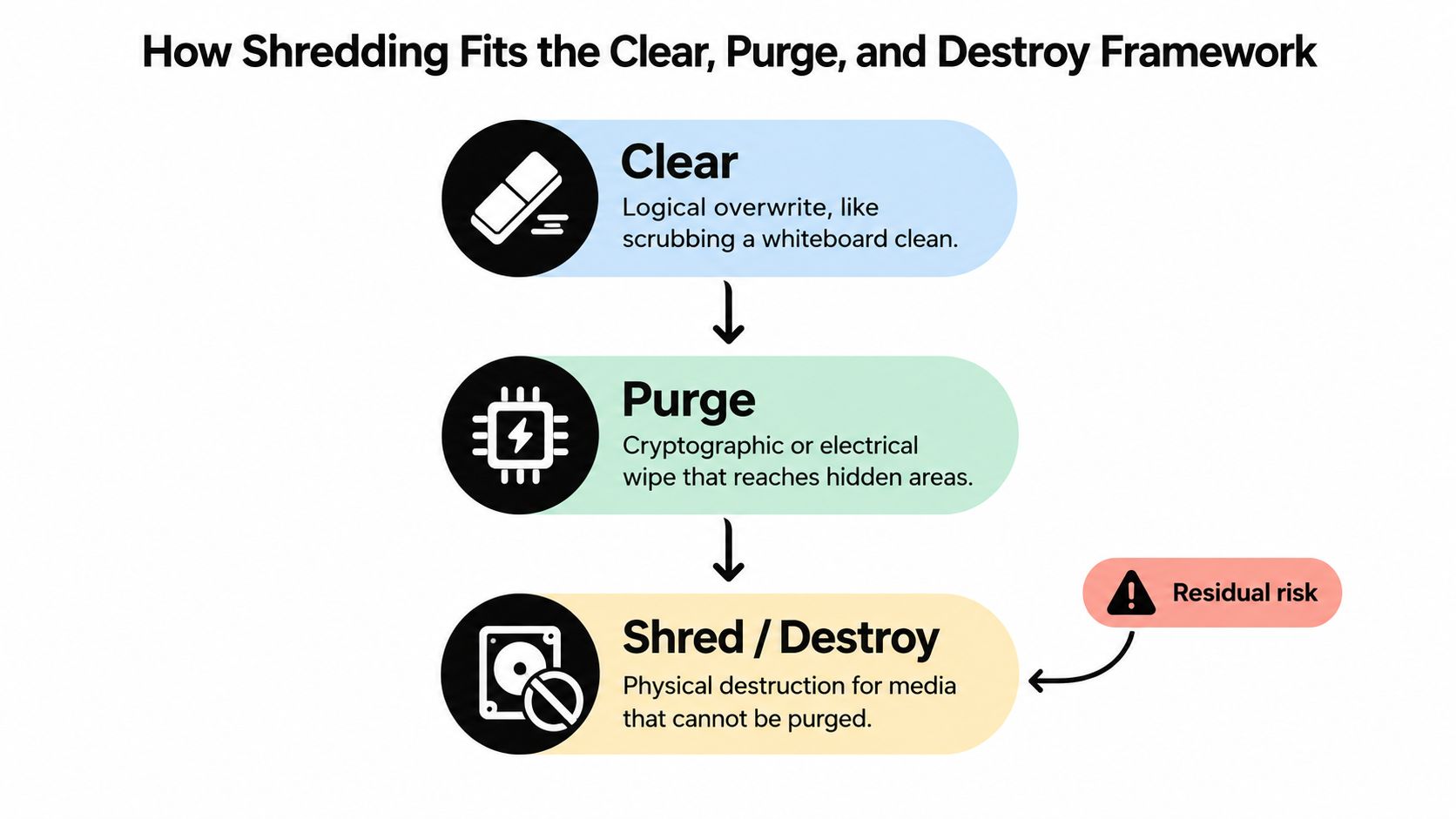
Destroy ends the media's role as a storage device. Shredding is appropriate when the drive must not return to service, especially after failure prevents reliable access, verification, or sanitization. NIST describes destruction as making recovery infeasible with state-of-the-art laboratory techniques while preventing reuse for data storage. NIST's explanation of media sanitization outcomes places that decision within organizational policy rather than a vendor's generic service label.
Destroy is not automatically the strongest choice for every drive. Choose based on data sensitivity, media type, verification, and reuse intent. An encrypted HDD that remains functional may need a validated purge, while a failed drive with unknown encryption status warrants physical destruction. Document the selected outcome and the evidence supporting it.
On-Site Shredding Compared to Off-Site Shredding
On-site and off-site shredding can both work. The difference is where custody changes, how much activity takes place at your facility, and whether your team needs to witness destruction before the media leaves the premises.
On-site service brings mobile equipment to the customer location. Drives can be inventoried, loaded, and processed under the observation of authorized staff. That model is attractive for a sensitive data-center exit, a healthcare deployment, or a project where internal policy requires destruction before transport.
Off-site service moves the drives to a controlled processing facility. This usually reduces the equipment burden at the customer site and can make sense when the provider already operates a suitable shredder, has a stable receiving process, and supplies a detailed custody record. The security question shifts from “Did we watch the shredder?” to “Did we select and monitor a trustworthy processor?”
| Criterion | On-Site Shredding | Off-Site Shredding |
|---|---|---|
| Custody | Drives can be destroyed before leaving the facility | Requires documented transfer, transport, and receipt |
| Witnessing | Staff may observe the process directly | Evidence comes from facility records, video, or attestations |
| Site disruption | Requires space, access, staging, and equipment coordination | Keeps shredding activity away from the work site |
| Scheduling | Must align mobile equipment and site availability | Often fits the provider's receiving and production schedule |
| Large projects | Useful when immediate, visible destruction is required | Efficient when the facility can process mixed inventory centrally |
| Small projects | May be affected by route planning or minimum-load rules | Often practical for a boxed or consolidated shipment |
| Primary question | Must destruction happen before transport? | Can we accept transfer to a vetted facility? |
A regional healthcare system retiring 300 laptops may prioritize a controlled on-site event if multiple departments need visible confirmation. An Atlanta-area accounting firm with a closet of retired desktops may prefer off-site processing if it can receive serial-level documentation and doesn't require witnessed destruction.
The comparison of on-site and off-site ITAD services provides a useful starting point, but your contract should settle the operational details. Ask how drives are sealed, who signs each handoff, how exceptions are handled, and whether the certificate covers every serial number rather than only the job total.
Technical Standards That Govern Shred Size and Method
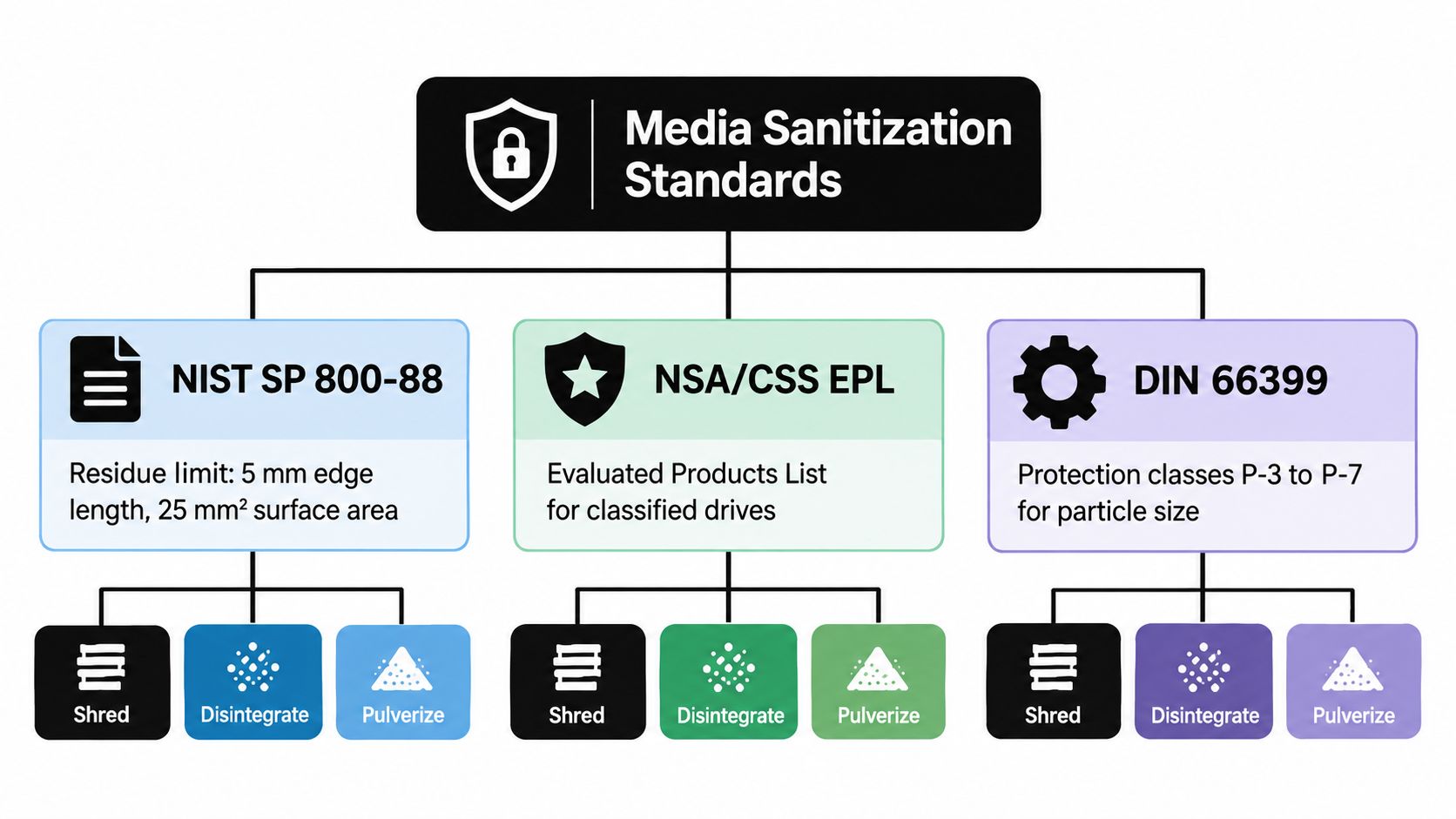
Procurement language should describe the physical result, not merely promise that a vendor will “destroy” the drive. A machine can deform a platter without producing the residue size your security policy requires. NSA/CSS guidance states that some destruction devices deform magnetic platters but don't sanitize magnetic storage when used alone. Pairing destruction with degaussing may be required unless the shredder reduces the media to particles of 2 mm or smaller under the applicable NSA/CSS procedure.
NIST SP 800-88 provides another measurable benchmark. For residues from disintegration or shredding, the cited specification calls for nominal edge dimensions of 5 mm and a surface area of 25 mm². NIST's media-destruction specification also makes the important point that the appropriate result depends on the confidentiality of the information.
Write requirements vendors can verify
A practical specification should identify:
- Media scope: Conventional HDD platters, external drives, RAID members, SSDs, NVMe modules, and any embedded storage must be classified separately.
- Particle target: State whether the contract requires the NIST residue benchmark or a smaller result under an applicable NSA/CSS procedure.
- Component coverage: Require processing of the platters or memory chips, not just the enclosure, controller board, or drive casing.
- Output inspection: Require representative checks for oversized fragments, intact platters, and unprocessed media.
- Evidence: Record the equipment or process, date, serial numbers, destruction standard, and exceptions.
Degaussing applies to magnetic media. It doesn't sanitize SSDs, NVMe devices, or other flash storage because those devices don't store information as magnetic domains. Physical destruction must reach the individual memory components, while cryptographic erasure may be suitable in specific cases where the device and policy support it.
The hard-drive destruction compliance requirements should be treated as a procurement topic, not a marketing checkbox. A certificate that says “shredded” without the method, standard, and media scope leaves the auditor to guess what happened.
Chain of Custody, Certificates, and Regulatory Compliance
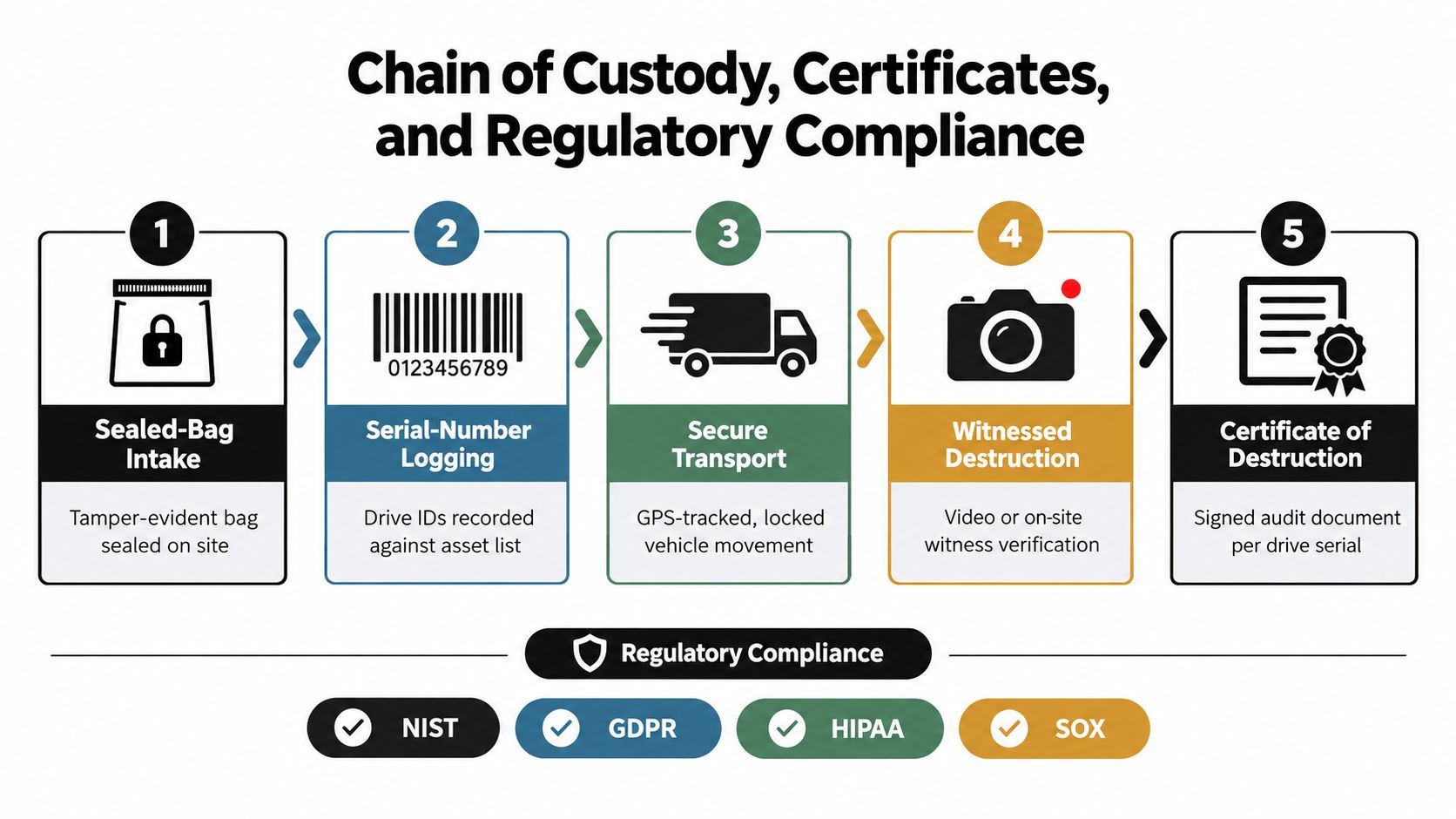
Physical destruction becomes defensible when the organization can connect the original asset list to the final processing record. The chain starts before transport, with an inventory that identifies each drive by serial number or another unique identifier.
A strong workflow looks like this:
- Sealed intake: Place drives in a controlled container or tamper-evident bag and record the person responsible for the handoff.
- Serial logging: Reconcile manufacturer, model, serial number, asset tag, and media type against the disposition list.
- Secure movement: Document the carrier, vehicle or transfer details, receiving party, and time of custody change.
- Destruction evidence: Record the destruction event, applicable standard, equipment or process, and any witness or video evidence.
- Final records: Issue the Certificate of Destruction and, where applicable, a separate Certificate of Recycling for downstream material processing.
What the certificate should prove
A defensible certificate should contain enough information for an auditor to connect the document to the physical media:
- Destruction date: Identify when processing occurred.
- Media scope: State whether the record covers HDDs, SSDs, NVMe, or another device class.
- Serial numbers: List each drive or attach a serialized manifest.
- Method and standard: Describe shredding, particle size, and the governing policy or standard.
- Authorized sign-off: Name the responsible technician and include a witness signature where required.
- Exceptions: Document missing labels, unreadable serials, rejected devices, and any alternate treatment.
The FTC Disposal Rule applies to businesses and individuals who use consumer reports for business purposes. It requires reasonable and appropriate disposal practices that prevent unauthorized access or use, and it identifies vendor due diligence measures such as reviewing an independent audit, checking references, evaluating information-security procedures, or requiring certification by a recognized trade association. FTC guidance on disposal of consumer-report information supports treating vendor selection and documentation as part of the control.
A bulk certificate may confirm that a job occurred, but it doesn't necessarily prove that a particular drive was included. The chain-of-custody documentation process should therefore be evaluated at the serial-number level, especially for server rooms, regulated workloads, and leased equipment returns.
When Shredding Is the Wrong Choice
A healthy, encrypted HDD headed for reuse does not automatically belong in a shredder. Shredding destroys the data and the asset's resale, redeployment, and refurbishment value, sending it into material recovery instead. That can undermine sustainability goals and IT asset recovery plans when sanitization can be validated.
Choose a non-destructive method when the evidence supports continued use:
- Verified encryption: A self-encrypting drive may qualify for cryptographic erasure when key destruction is performed and documented correctly.
- Internal redeployment: A functioning HDD can be cleared or purged under an approved method before reassignment.
- Value recovery: Remarketable equipment may generate recovery value that physical destruction removes.
- Reuse targets: Refurbishment preserves more utility than converting working hardware into scrap.
Revision 2 of NIST SP 800-88, discussed earlier, places greater emphasis on organizational policy, assigned roles, verification, and documentation. Apply that decision process to the media type, data sensitivity, reuse plan, and verification requirements rather than defaulting to destruction.
When destruction earns its place
Shredding earns priority when a drive has failed, cannot be reliably sanitized, has an unknown encryption state, or contains information whose disclosure consequences outweigh recovery value. It also suits contracts or policies that require physical destruction, provided the organization can validate the selected particle-size result.
A reusable, encrypted drive may need less destruction than a failed, unencrypted drive. What matters is proof: the organization must show that its selected method addressed the actual media and the actual threat. The comparison of hard-drive shredding and data wiping helps frame that choice after the media, data, and reuse intent have been classified.
Choosing a Hard Drive Shredding Provider
A provider should make your audit easier, not ask you to trust a vague service description. Start with the process records, then inspect the equipment and service model behind them.
Use a procurement scorecard
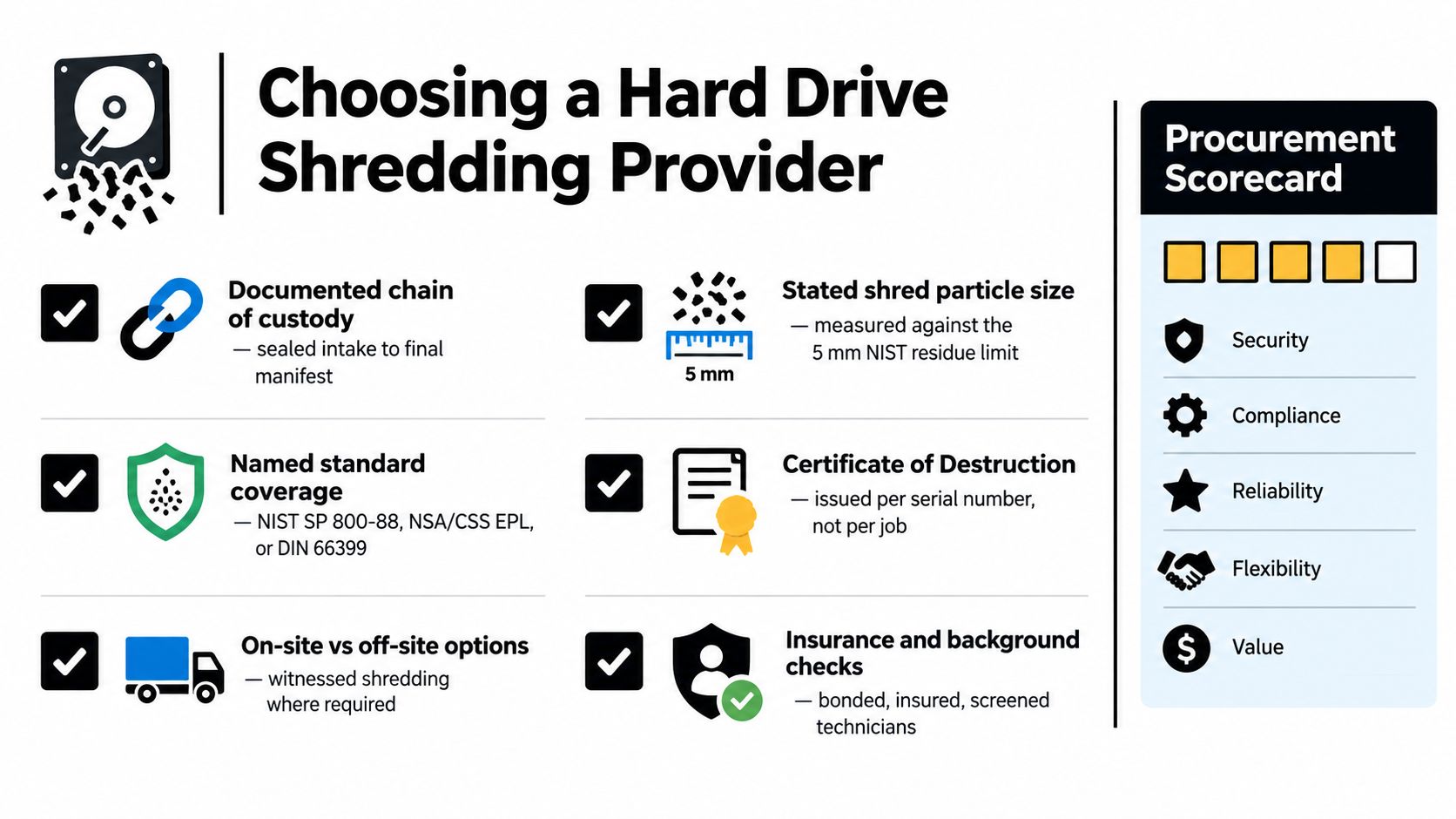
Require the vendor to answer these points in writing:
- Custody control: Explain sealed intake, serial-number reconciliation, transport, facility receipt, and exception handling.
- Technical result: State the shredder type, validated particle-size output, inspection method, and treatment of platters or memory chips.
- Standard alignment: Identify whether the process follows NIST SP 800-88, NSA/CSS guidance, or another approved policy.
- Media coverage: Confirm the provider can classify and process HDDs, SSDs, NVMe, hybrid drives, and embedded storage rather than treating everything as a conventional hard drive.
- Documentation: Require a Certificate of Destruction by serial number and a separate recycling record when materials move downstream.
- Risk controls: Review insurance, technician screening, references, facility security, and named downstream recyclers.
- Service model: Compare mobile on-site work with off-site processing, including staging needs, scheduling, minimum loads, and transport responsibilities.
NAID or R2 certification can be relevant evidence, but a badge doesn't replace questions about your actual inventory. Ask for a sample certificate, a sample serialized manifest, the applicable particle-size specification, and the escalation path for a drive that arrives without a readable serial number.
Beyond Surplus offers on-site and off-site hard drive shredding, certified data wiping, serialized Certificates of Destruction, electronics recycling, and IT asset disposition for business inventories. Its service scope is relevant when one project includes working assets for recovery alongside failed media requiring physical destruction.
Procurement test: If the vendor can't explain what happens to an overlooked SSD or an unlisted serial number, the proposal isn't ready for approval.
Practical Next Steps for IT and Procurement Teams
For a quarterly refresh involving a few dozen drives, lock down the media inventory, encryption status, reuse decision, destruction standard, and certificate fields before pickup. Don't let a small volume justify informal handling.
For a data-center decommission, build the disposition plan around serialized manifests, staged custody transfers, failed-drive escalation, and separate treatment for HDDs, SSDs, NVMe, and embedded storage. Require downstream recycling records after destruction so the project closes both the security and material-management loops.
For a recurring, multi-site enterprise program, standardize the approved methods and evidence across locations. The contract should support on-site or off-site processing, define who may authorize exceptions, and make serial-level reporting available for every shipment.
A single accountable ITAD provider can coordinate pickup, data destruction, recycling, value recovery, and reporting across projects ranging from a small equipment room to a multi-state data-center shutdown. The right program doesn't shred everything. It sends each device to the method that matches its condition, sensitivity, and reuse value.
Contact Beyond Surplus for serialized hard drive shredding, certified data wiping, electronics recycling, and secure IT asset disposal for business equipment. Review your media inventory and request a destruction or pickup plan through Beyond Surplus.


